
Coax Cable Tester with Voltage Toner
4.3Editor score
Compact coax continuity testing
Audible and LED connection cues
Ready-to-use AAA battery
Our coaxial cable tester guide compares 10 options for coax fault detection, cable mapping, tone tracing, connector support, displays, remotes, and field
A coaxial cable tester helps technicians and homeowners determine whether a coax run is intact, where it connects, and whether a fault lies in the cable or its terminations. The right unit should offer clear status indicators, useful connector support, and a workflow suited to everything from quick outlet checks to mapping several cables at once.
We compared the ten products using their supplied specifications, including supported cable types, fault detection, remote accessories, display design, tracing functions, and included components. The list covers dedicated coax testers, compact toners, multi-cable mapping kits, and broader cable diagnostic tools that also support data or voice wiring.
Each review explains what a product does best, where its limitations matter, and whom it is likely to suit. Ratings and product details reflect the supplied listing information, while practical suitability depends on the connectors and wiring in your installation. Retail listings and availability can change, so confirm current details before purchasing.
4.3Editor score

4.7Editor score

4.7Editor score
The table below compares all ten options by their primary testing purpose, supported connections, diagnostic features, and practical extras. It highlights the difference between dedicated coax mapping kits, pocket toners, multi-connector continuity tools, and general-purpose cable testers.


The Klein Tools VDV512-101 Explorer 2 Coax Tester Kit is a dedicated coax mapping solution with a 4.7 rating. It stands out because it combines continuity testing, cable identification, and mapping for as many as four locations in one coordinated kit. That makes it a strong choice for installers, repair technicians, and homeowners working with several coax runs rather than a single loose cable.
We may earn a commission when you buy through this link, at no additional cost to you.
Its clearest advantage is the four-remote system. Color-coded push-on remotes let the user distinguish separate cables while the LED panel reports PASS, OPEN, or SHORT. Push-button operation reduces menu complexity, while the removable snap-on holder keeps the remotes and F-adapter together. The kit also includes four remotes, an F-adapter, and batteries, so the core workflow is ready to use without separately assembling a multi-remote setup.
The trade-off is specialization. This unit is centered on coaxial testing and mapping rather than Ethernet wiremap analysis or broad voice-cable diagnostics. It also does not work through cable splitters, an important limitation when the path in question passes through distribution hardware. The simple LED interface is excellent for pass-or-fail work but offers less numeric detail than a screen-based cable analyzer.
Despite those limits, the VDV512-101 is the most balanced product in this guide for its stated purpose. Anyone who needs to identify several coax runs, verify newly installed wiring, or isolate opens and shorts will benefit from the included accessories and straightforward controls. It is the recommendation to consider first when efficient coax mapping is the central requirement.
The color-coded remotes reduce ambiguity when several coax cables terminate in the same work area. A technician can move among remote ends while using the main unit's LED panel to identify which line is connected and whether the path passes.
The included F-adapter, four remotes, battery power, and removable holder make this more than a basic tester. The accessories support a repeatable mapping process and help prevent small components from being misplaced during service work.
We may earn a commission when you buy through this link, at no additional cost to you.
The Klein Tools VDV512-100 Cable Tester is a streamlined version of the Explorer 2 platform, carrying a 4.6 rating. It tests and maps common coaxial cable types, including RG59, RG6 and RG6Q, RG7, and RG11, while its LED panel identifies PASS, OPEN, and SHORT conditions. It is a practical option when one-cable-at-a-time testing is sufficient but broad coax compatibility still matters.
We may earn a commission when you buy through this link, at no additional cost to you.
The included red remote provides the second endpoint needed for continuity and mapping work. Additional color-coded remotes can be used for up to four cables, although they are sold separately. A carrying clip keeps the unit accessible during installations, and the simple push-button control means there is no complicated setup to learn before checking an installation.
Compared with the higher-ranked VDV512-101 kit, this package is less complete out of the box. It does not include the four-remote set, F-adapter, or remote holder supplied with the larger kit. The fact that it cannot test through cable splitters also narrows its use in branched coaxial networks, where a signal path may pass through distribution equipment before reaching the remote.
Choose the VDV512-100 if you want Klein's recognizable coax mapping interface, support for several common RG cable types, and a single-remote workflow without carrying a larger multi-remote kit. It is most useful for technicians who already own compatible remotes or need only a single connection identifier.
Support from RG59 through RG11 allows the tester to cover several familiar coax categories, including widely used RG6 and RG6Q installations. Confirm that the cable type in your system appears in the stated specifications before relying on it for a particular installation.
The LED panel communicates the essential result without requiring interpretation of a complicated display. PASS confirms the tested path, while OPEN and SHORT distinguish two common conditions that require different troubleshooting approaches.
We may earn a commission when you buy through this link, at no additional cost to you.
The Klein Tools VDV501-851 Scout Pro 3 Tester Starter Set is the most feature-rich option in this comparison, with a 4.7 rating. It supports voice cables using RJ11 or RJ12 terminations, data cables using RJ45, and video cables using coax F-connectors. For a technician who works across multiple wiring systems, that broad coverage can justify the more specialized and capable tool.
We may earn a commission when you buy through this link, at no additional cost to you.
Its backlit LCD presents cable length, wiremap, cable ID, and test results, giving it much greater diagnostic depth than a simple LED tester. The unit can measure cable length up to 2,000 feet, identify Open, Short, Miswire, and Split-Pair faults, and trace cables, wire pairs, or individual conductors. The display should also be easier to read in dim workspaces than a set of basic indicator lights.
There are important boundaries. The Ethernet testing function is intended for unenergized cables and is not designed for PoE, so it should not be treated as a live-network certification tool. Cable tracing also requires the analog probe listed as Cat. No. VDV500-123, which is sold separately. These details matter if your work depends specifically on tone-based tracing or testing powered cables.
For a broad installer seeking one diagnostic platform for coax, data, and voice wiring, the Scout Pro 3 is the strongest premium pick in the list. It is best suited to users who will use its measurement, fault-location, and wiremap functions rather than those interested only in a basic coax continuity check.
RJ11 or RJ12 voice, RJ45 data, and F-connector coax coverage lets the same unit handle common low-voltage wiring tasks. This reduces the need to carry separate basic testers for each service.
Cable-length readings, wiremap output, and explicit fault labels provide more actionable information than a simple pass-or-fail light. The backlit screen improves access to those results in closets, crawl spaces, and other poorly illuminated areas.
We may earn a commission when you buy through this link, at no additional cost to you.
The Coaxial Pocket Toner Continuity Tester is a compact tracing and identification tool rated 4.5. It is designed for situations in which several coax cables emerge in different rooms or work areas and the technician needs to determine which outlet corresponds to which run. Its small form, audible signal, and LED indication make it especially approachable for basic installation and troubleshooting work.
We may earn a commission when you buy through this link, at no additional cost to you.
The supplied right-angle barrel connector, detachable tone detector, and female push-on connector support practical coax identification. The audio alert can help locate a cable through ceilings, under floors, or within interior walls, reducing the need to pinpoint the cable visually before testing. Connecting the transmitter to the desired outlet and applying the adapter is a straightforward process for a user familiar with coax terminations.
Its compactness is also its main constraint. The tester provides a simple signal-based indication rather than the detailed fault categories, wiremaps, or length measurements available from a professional analyzer. The product does not include a battery, so a single AAA battery must be obtained before use. Users should also account for the limitations of tracing through common building materials when judging how quickly a signal can be detected.
This is a sensible pick for technicians or homeowners who mainly need to identify and trace RG6, RG59, or CATV-style coax runs. It is less appropriate for diagnosing complex wiring problems. Its value lies in portability, simple feedback, and the ability to follow a signal through partially concealed construction.
The tone and light provide confirmation at the remote endpoint, which can be useful when the cable path is hidden behind a wall, floor, or ceiling. This is different from visually following a conductor through accessible space.
Right-angle fittings reduce the amount of space needed around a wall plate or equipment panel. The detachable detector also allows the user to keep the main tester accessible while moving the probe to the point being checked.
We may earn a commission when you buy through this link, at no additional cost to you.
The Coax Cable Tester with Voltage Toner is a lightweight continuity option with a 4.3 rating. It focuses on a common field task: identifying the correct coax line when multiple cables originate in different rooms. Sound and LEDs provide confirmation when a selected cable is connected correctly, making it a straightforward option for users who do not need a detailed analyzer.
We may earn a commission when you buy through this link, at no additional cost to you.
Its compact 68-gram construction is useful in tight spaces, while the built-in AAA battery means the unit can be put into service without searching for a separate cell. The test process is based on attaching the transmitting end to the desired outlet and applying the provided adapter to the cable. This simplicity suits occasional troubleshooting around coax connections in a home, vehicle, or small installation.
The product does not offer the richer fault display, numeric length measurement, or multi-remote mapping found in professional Klein Tools models. Its rating and feature set also suggest that it is a basic instrument rather than a comprehensive certification device. Users who need to distinguish among several fault types with detailed reports should consider a more capable tester.
For basic cable identification and continuity confirmation, this is a practical budget-oriented choice. The included battery, audible alert, and compact body cover the essentials, while its limitations are acceptable for technicians who mainly need a quick answer about which coax line is connected.
Including the AAA battery removes one common source of delay for a compact field tool. Once powered, the combination of sound and light provides immediate confirmation without navigating a display or configuring detailed test modes.
The tester is particularly helpful when coax leads from several rooms are otherwise difficult to distinguish. It can provide a quick connection check before a connector is replaced or a cable is rerouted.
We may earn a commission when you buy through this link, at no additional cost to you.
The Klein Tools VDV002-818 Coax Install and Test Kit has a 4.7 rating and combines testing with the tools needed to prepare and terminate coax. It includes a Coax Explorer 2 tester, a two-level radial stripper, a compact crimper, and six universal F-connectors. That combination makes it particularly well matched to installers who want to move from cable preparation to connection verification without assembling several separate tools.
We may earn a commission when you buy through this link, at no additional cost to you.
The radial stripper supports a single-operation preparation workflow, while the crimper is designed for compression F-connectors. The included universal sleeve connectors are intended for RG6 and RG6Q, and the tester can verify whether a finished connection is good, open, or short. The result is a compact installation workflow centered on repeatable connector preparation and verification.
It is less focused than a multi-remote mapper and may include more equipment than a homeowner needs for a single connection check. Its main value appears when new coax lines are being prepared, connectors are being installed, and the same job also requires an immediate continuity test. Users with an established, stable installation may prefer a smaller dedicated tester.
For professional coax installers or careful DIY users building a complete tool collection, the VDV002-818 is a well-balanced package. Its high rating reflects the utility of combining installation and verification equipment, while the limited tool count keeps it more focused than a general electrician's kit.
The kit covers the sequence a technician needs to follow: strip the cable, crimp the connector, install the termination, and verify the result. Including the tester in the same set reduces the chance of overlooking a basic continuity check after installation.
The crimper, radial stripper, and universal compression F-connectors are coordinated for common RG6 and RG6Q work. The stated compatibility is important because using the wrong connector or preparation method can undermine a sound cable connection.
We may earn a commission when you buy through this link, at no additional cost to you.
The Coaxial Tester with Audible Beep is a pocket-oriented continuity tracer with a 4.5 rating. Its defining feature is the stated voltage-protected design, which adds a layer of suitability when working around connected or potentially powered coax equipment. The audible beep and LED give users two ways to recognize a successful connection or locate a tone through a wall, floor, or ceiling.
We may earn a commission when you buy through this link, at no additional cost to you.
The package includes a pocket tester and toner with a right-angle barrel connector, a detachable tone detector, and a female push-on connector. Those right-angle and push-on components are well suited to outlets, panels, and other confined work areas where a straight bulky plug would be awkward. The operating sequence is easy to understand: attach the transmitting end to the desired outlet, apply the adapter, and listen for the signal.
The supplied information states that no battery is included, so a AAA battery must be purchased for normal operation. As with the other compact toners, it provides less diagnostic detail than a dedicated coax mapper or screen-based wiremap tester. Its protection rating should also be understood as part of the product's design rather than a substitute for following safe procedures around energized systems.
This model is best for quick coax identification where portability, audible tracing, and voltage protection matter more than numeric measurements. It suits field work in homes, attics, recreational vehicles, and partially concealed cable routes. A professional seeking broad fault analysis should choose a more comprehensive unit.
Voltage protection is a meaningful distinction when a tester may be connected near operational equipment. Users should still follow appropriate electrical safety practices and confirm that the tool and procedure are appropriate for the specific installation.
The audible tone makes it easier to identify a line while attention remains on the remote endpoint. The LED provides a visual cross-check, which is useful in bright areas or for users who prefer not to rely on sound alone.
We may earn a commission when you buy through this link, at no additional cost to you.
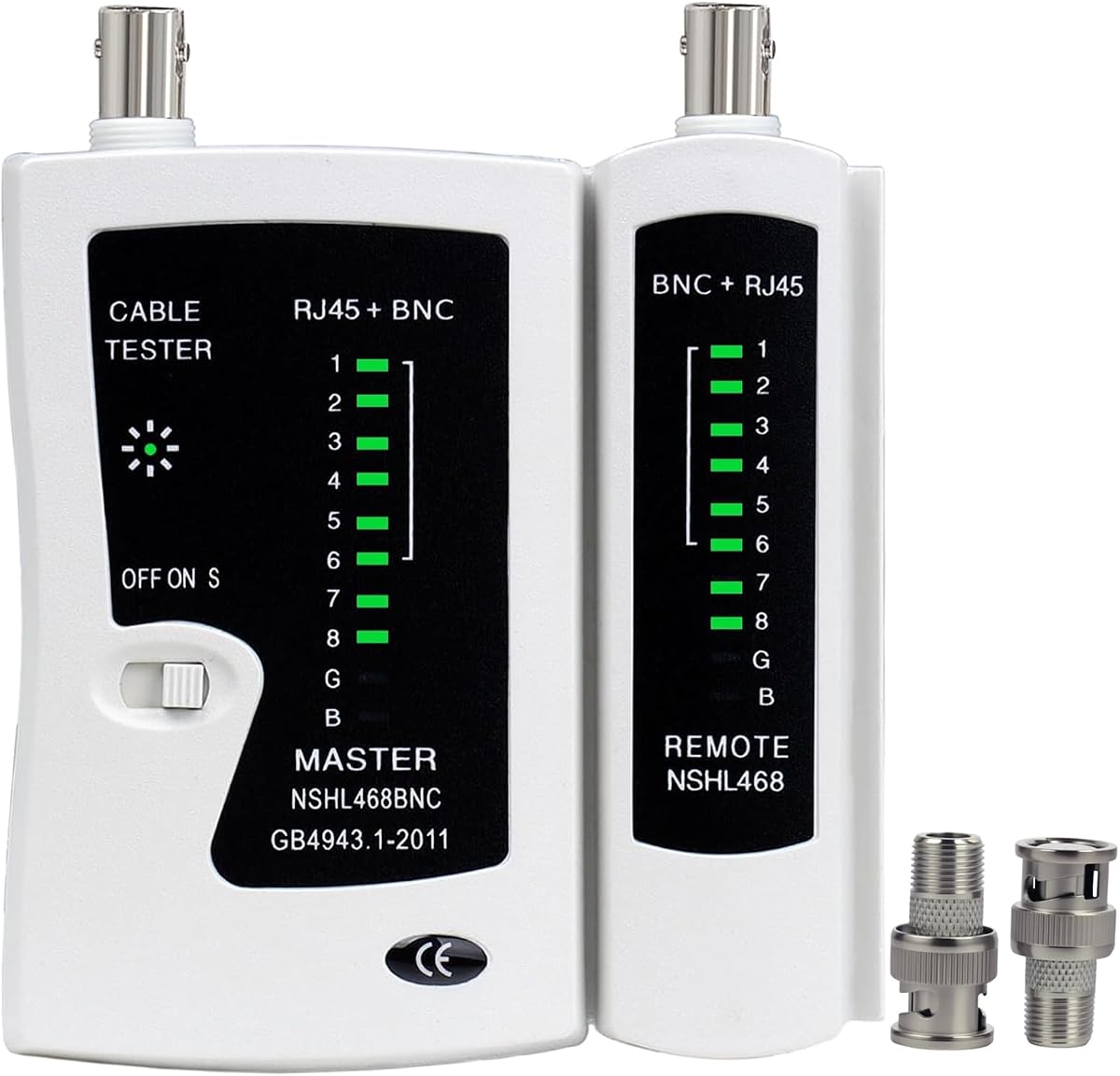
The Portable BNC RJ59 F-Style Tester is a broad, entry-oriented continuity tool with a 3.7 rating. It supports F-style and BNC coax connections as well as RJ45 Ethernet cables, including CAT5 and CAT6. This variety makes it relevant to users who encounter different termination styles in network, video, audio, or security installations and want to carry one compact checker.
We may earn a commission when you buy through this link, at no additional cost to you.
Its detachable remote design allows patch cables to be checked directly and supports testing installed cables by separating the remote component. Included F-female adapters broaden the range of coax arrangements that can be connected. The portable format is also useful for field troubleshooting, where the goal is to locate a connectivity problem without carrying a larger display-based analyzer.
The 3.7 rating is lower than that of the other products in the guide, and the supplied specifications describe continuity checking rather than advanced diagnostics. It does not provide the detailed wiremap, measured cable length, split-pair identification, or explicit fault categories found in higher-end options. The range of supported connectors should therefore not be confused with certification-level testing.
Choose this model when the main requirement is a lightweight, general-purpose continuity checker across common coax and Ethernet connector types. It may suit a technician with varied patch cords or a homeowner checking several standards of cable. Users requiring fault localization and measurement should consider the Klein Tools Scout Pro 3 instead.
BNC, F-style, and RJ45 support covers a useful mix of coax and network terminations. The included F-female adapters make it easier to connect leads whose installed fittings are not directly supported by the main body.
Separating the remote makes the tool practical for both loose patch leads and cables already routed through a building. It also improves access around outlets and equipment where a fixed remote or straight connector would be inconvenient.
We may earn a commission when you buy through this link, at no additional cost to you.
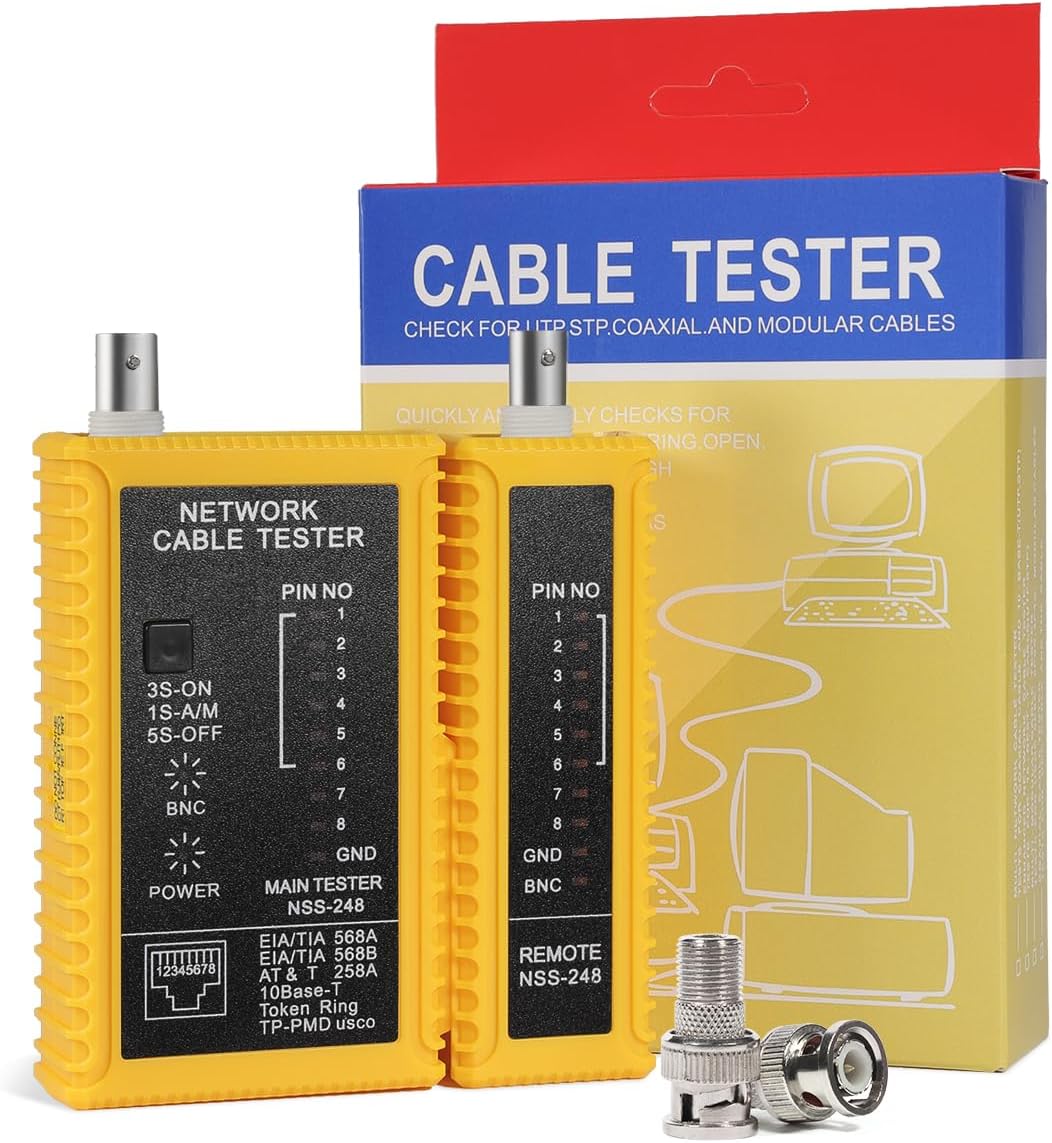
The Portable BNC F-Style RJ45 Tester is a compact continuity checker with a 4.2 rating. It supports coax terminated with BNC or F-style connectors and RJ45 Ethernet cables, giving it useful flexibility for network, audio, video, and security work. The emphasis is on locating connection faults quickly rather than performing a detailed analysis of the installed wiring.
We may earn a commission when you buy through this link, at no additional cost to you.
Its portable construction makes it convenient for field service and installation tasks. A user can check the continuity of a cable, isolate a faulty lead, and determine whether a connector or cable is likely responsible for a problem. The tool's simplicity also makes it accessible to users who need a quick confirmation rather than a lengthy diagnostic report.
The information supplied does not indicate a backlit display, numeric length measurement, detailed fault classification, or wiremap output. Those limitations matter when the cable is part of a complex network with several pairs, when exact fault location is required, or when a formal record of test results is needed. Connector support alone does not make it a comprehensive network certification device.
This is a sensible option for technicians who need a small checker that handles both coax and Ethernet terminations. It fills the gap between a coax-only pocket tone tool and a larger display-based analyzer. For detailed diagnostics, move up to a product with explicit fault reporting and measured cable length.
Supporting both BNC or F-style coax and RJ45 allows the same unit to check several wiring types found in low-voltage installations. This is especially useful for technicians moving between coax video, network, audio, or security connections.
A simple continuity checker can quickly separate a likely cable or connector problem from a broader installation issue. The compact format also makes it easy to keep in a tool bag for service calls and routine maintenance.
We may earn a commission when you buy through this link, at no additional cost to you.
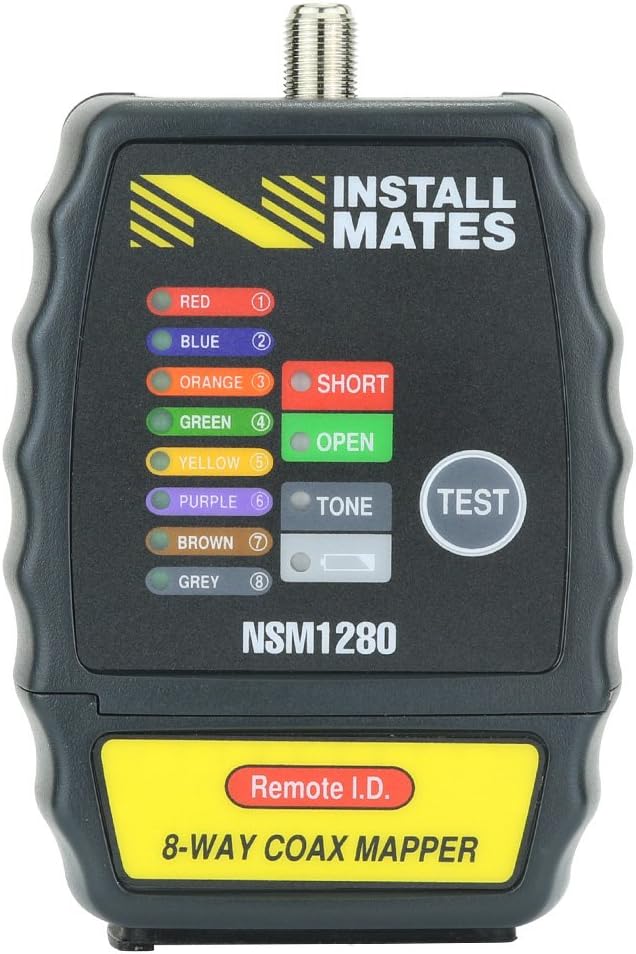
The 8-Way Coax Cable Tester with Case is a high-capacity mapping tool with a 4.5 rating. Its defining feature is the ability to check up to eight cable leads at once using eight color-coded terminators. This makes it especially useful for buildings, complexes, or installation jobs where numerous coax runs converge and identifying them one at a time would be inefficient.
We may earn a commission when you buy through this link, at no additional cost to you.
The tester accepts F-connectors directly and includes an adapter for BNC connections. Each remote has a distinct color and number, while the main unit displays PASS when no failure is found. OPEN and SHORT conditions are also detected, displayed, and accompanied by a beep, giving users both visual and audible fault feedback. A built-in storage compartment helps keep the color-coded terminators organized.
The included nine-volt battery supports immediate operation, and the mesh case protects the unit and accessories during transport. As a specialized and physically larger tool, however, it may be more than necessary for a household with only one or two coax outlets. It also does not offer the screen-based wiremap and measurement features of a general cable analyzer.
For contractors who routinely map many coax lines, this unit provides an efficient alternative to repeated one-cable testing. It is best suited to professional or advanced residential work where numerous terminators must be distinguished quickly. Occasional users should compare its capabilities with the simpler two- or four-location Explorer kits.
Eight numbered and color-coded terminators provide the largest simultaneous mapping capacity in this guide. That helps technicians compare multiple remote endpoints and identify the correct run without moving a single remote through every location.
The main unit includes a storage compartment for its terminators, reducing the chance of mixing colors or leaving a remote behind. The mesh case adds protection for transport between job sites.
We may earn a commission when you buy through this link, at no additional cost to you.
The right coaxial cable tester depends on whether you need simple continuity confirmation, cable identification, multi-run mapping, detailed fault diagnosis, or a broader installation toolkit. Consider the cable types, connectors, fault information, accessories, and working conditions involved in your specific task.
Match diagnostic depth to the task, not simply to the number of buttons or accessories.
Verify the exact RG type and physical connector before purchasing.
Choose more remotes when several coax lines share a termination area.
Use simple LEDs for pass-or-fail checks and an LCD for detailed diagnosis.
Check splitter compatibility before testing an active coax route.
Balance pocket portability with organized, protected field accessories.
Choose a coordinated installation kit when new terminations are part of the job.
Use tone tracing for location, not detailed electrical analysis.
Begin by identifying the cable type, connector style, and intended test. Inspect the cable, fittings, and tester for physical damage, then install the correct batteries as directed. For a direct continuity test, disconnect relevant equipment and avoid testing through splitters unless the unit explicitly supports that configuration. Connect the main tester to one end and the appropriate remote or probe to the other, making sure every fitting is fully seated.
For mapping, attach a distinct colored remote to each cable endpoint and record where each remote was placed. Activate the tester one remote at a time, observe the PASS, OPEN, or SHORT result, and write down the corresponding location. If a fault is indicated, repeat the test from the other end and inspect the connector, cable bend, and any intermediate hardware. A visual result from a multi-remote unit is more reliable when the cable identifiers are recorded rather than memorized.
Store the tester in its case or away from moisture, excessive heat, and conductive debris. Keep remote adapters together, clean connector contacts gently, and replace a depleted battery promptly. Do not immerse the unit, open its housing, or apply it to energized systems unless the instructions expressly permit it. For detailed questions, use the manufacturer's current documentation and have questionable wiring inspected by a qualified professional.
A continuity tester can indicate an OPEN condition when a conductor is broken or a connection fails, provided the test covers the relevant cable path. Exact fault location may require sectional testing, tracing, or a more advanced analyzer. A simple tester establishes that a problem exists but may not pinpoint its position.
A continuity tester checks whether a direct cable path is connected and may identify conditions such as open or short. A cable mapper uses multiple remotes to distinguish several cables and associate each remote with a physical location. Mapping is more useful when several coax lines are present in the same area.
It depends on the model. The Klein Tools VDV512-100 and VDV512-101 support the common coax types listed in their specifications, including RG59, RG6/6Q, and RG11. Smaller continuity tools may focus on F-type coax and omit explicit support for every category, so check the listed cable range before use.
An OPEN result can come from a failed connector, an interrupted conductor, an improperly seated remote, or a network component between the test points. Some testers do not operate through splitters, so an in-line splitter can also alter the expected result. Test a direct segment and inspect both terminations before assuming the cable jacket is the problem.
Only some models support non-coax wiring. The Klein Tools VDV501-851 handles RJ11 or RJ12 voice, RJ45 data, and F-connector coax cables, while two portable continuity models support RJ45 Ethernet. Dedicated pocket toners and coax mappers are limited to coax and should not be treated as general-purpose cable analyzers.
A remote or tone probe is generally required to establish a complete circuit between the two ends. Some combined units include the necessary accessories, while others provide only one remote or list additional remotes separately. Confirm the contents of the package before beginning a mapping procedure.
A higher customer rating can indicate stronger overall satisfaction, but it does not replace checking the tool's specifications. Accuracy for your task depends on supported cable types, fault methods, connectors, calibration, and correct use. A simpler model may be more appropriate than a complex analyzer if it covers the exact test you need.
Some compact tracers include voltage protection, but many continuity and mapping testers are intended for disconnected coax. The Klein Tools Scout Pro 3 is expressly described for unenergized Ethernet and is not designed for PoE. Always follow the manufacturer's safety guidance and disconnect service where required before conducting a resistance or continuity test.
The Klein Tools VDV512-101 Explorer 2 Coax Tester Kit is the leading choice for balanced coax mapping, offering four color-coded remotes and clear PASS, OPEN, and SHORT feedback. The Coax Cable Tester with Voltage Toner serves users needing a compact, straightforward continuity tool, while the Klein Tools VDV501-851 Scout Pro 3 provides the deepest diagnostics with voice, data, and coax support.
Prioritize the functions your work actually requires. A pocket tone device is enough for simple identification, a multi-remote kit handles several installed lines, and a display-based tester becomes valuable when length, wiremap, and detailed faults matter. Connector compatibility, splitter limitations, included remotes, and safe operating conditions deserve as much attention as the headline feature list.
Before ordering, verify the current product details, included accessories, and compatibility with your cable and connector types. Retail listings and product packages can change over time, so checking the latest manufacturer and listing information helps ensure the chosen coaxial cable tester fits the job you have in mind.