
Fieldpiece SOX3 Combustion Checker
4.3Editor score
Automatic sampling pump
Multiple fuel configurations
Field-replaceable O2 sensor
Three-line readable display
Explore the best Combustion Analyzer Test Kit options, comparing flue gas readings, sensors, pressure features, displays, portability, and included accessories.
A combustion analyzer test kit helps HVAC professionals evaluate heating systems by measuring flue gas composition, oxygen, carbon monoxide, temperature, draft, pressure, and combustion efficiency. A useful kit balances accurate readings, durable construction, clear displays, practical probes, and accessories that support routine service work.
This guide compares ten combustion analyzer and related leak-testing products using their stated specifications, included components, supported measurements, fuel compatibility, displays, reporting features, and customer ratings. Nine products target residential or commercial heating systems, while one is an automotive block and head gasket leak detector.
Each review identifies the strongest reasons to consider a particular model, along with limitations that may affect a purchase. The top selections emphasize measurement breadth, field serviceability, and useful accessories, while current pricing, availability, and seller details should be confirmed before ordering.
4.3Editor score

5.0Editor score

The table below compares the listed analyzers by measurement coverage, display, service features, and kit contents. Because the products serve different applications, residential HVAC convenience, commercial instrumentation, and automotive leak detection should be evaluated separately.


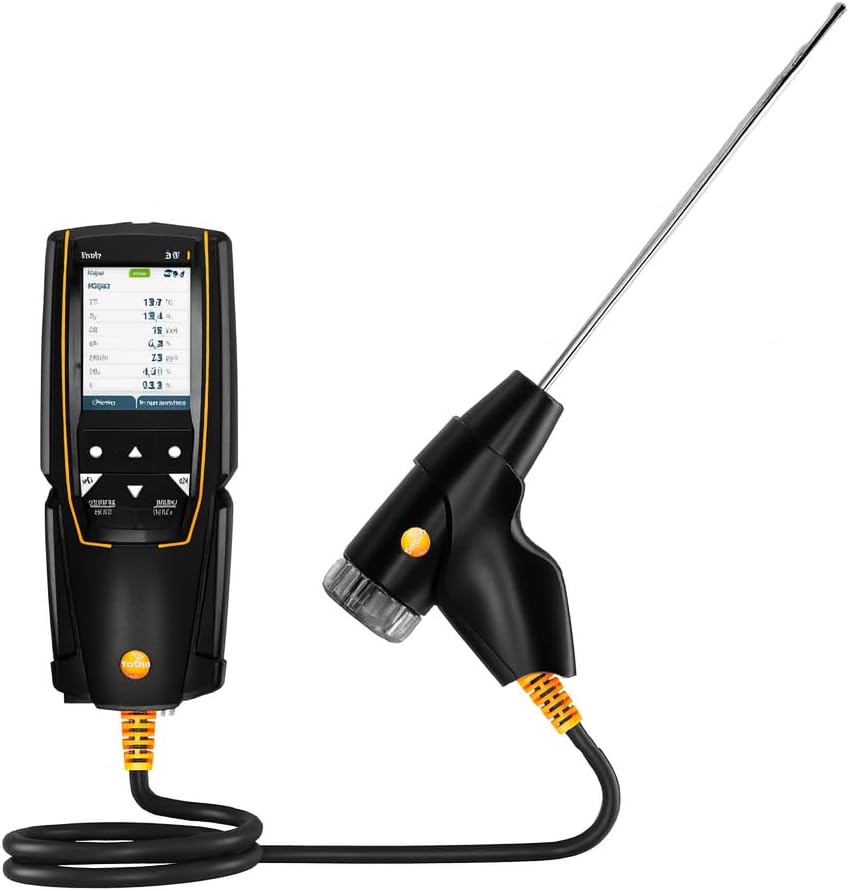


This residential combustion analyzer has a 4.6 customer rating and is positioned as a dedicated instrument for combustion testing. Its principal attraction is the combination of a residential focus and an LCD display, although the available product information does not provide a detailed list of measurements, sensor specifications, probe configurations, or included accessories.
We may earn a commission when you buy through this link, at no additional cost to you.
That limited disclosure requires a more careful purchasing approach. The listing identifies the category as Test Instruments — Combustion Testing, confirming that it belongs in the same broad category as the full flue gas analyzers covered by this guide. However, buyers who depend on parameters such as carbon monoxide, oxygen, carbon dioxide, flue temperature, draft, differential pressure, or combustion efficiency should request the complete manual before making a final decision.
The main trade-off is uncertainty. It is impossible to confirm from the supplied information whether the analyzer includes a pump, pressure capability, replaceable sensors, a temperature probe, or a carrying case. The California shipping restriction is another important limitation that can prevent an otherwise convenient purchase from reaching a specific customer.
This product makes the most sense for a residential technician who wants a straightforward LCD combustion instrument and has verified the required specifications and shipping eligibility. It is not the strongest recommendation for someone who needs a fully documented multi-parameter kit, smartphone reporting, a printer, or a known set of included probes.
Because the product is expressly classified for residential combustion testing, it may align well with routine furnace and boiler service. Confirm that its available outputs cover the readings needed for the intended service workflow.
The short listing leaves important questions about sensors, probes, pressure measurement, and kit contents unanswered. Obtaining those details can prevent a mismatch with common HVAC service requirements.
We may earn a commission when you buy through this link, at no additional cost to you.
The testo 300 Residential HVAC Kit carries a 4.2 rating and offers a broad set of measurements for furnaces and boilers. It combines carbon monoxide, oxygen, temperature, draft, differential pressure, and ambient CO readings in a single housing, making it a practical choice for technicians who regularly diagnose residential heating systems.
We may earn a commission when you buy through this link, at no additional cost to you.
The kit is particularly strong regarding sensor longevity and operational convenience. The sensitive CO and O2 sensors are stated to have an expected service life of up to six years, while the CO measurement range extends to 4,000 ppm. A large HD smart-touch display organizes measurements clearly, and strong rear magnets allow the meter to remain positioned during testing without constant hand support.
The included package also supports field readiness. It contains long-life O2 and CO sensors, the main unit, a basic flue gas probe, spare dirt filters, a rugged hard-shell case, and easyHeat software. A spare probe reduces the likelihood of an interruption when the primary probe needs cleaning or servicing, although the product is still a substantial equipment investment.
Choose this kit when broad residential coverage, convenient hands-free testing, and a generous accessory package matter more than achieving the highest customer rating. It is especially relevant to service professionals who already recognize the testo interface or need differential pressure and ambient CO in addition to standard flue gas readings.
The combination of CO, O2, temperature, draft, differential pressure, and ambient CO covers several common stages of residential heating diagnostics. It reduces the need to move between separate instruments during a service call.
The stated sensor life and included spare probe support better field readiness. Filters and the spare probe help preserve measurement reliability while protecting the investment in the analyzer.
We may earn a commission when you buy through this link, at no additional cost to you.
The Fieldpiece SOX3 earns a 4.3 rating and offers one of the most approachable ways to perform core combustion testing. It measures flue temperature and oxygen while calculating carbon dioxide, excess air, and combustion efficiency, covering the principal outputs needed for furnace tuning and combustion checks.
We may earn a commission when you buy through this link, at no additional cost to you.
Its built-in electric pump automatically draws flue gas, which supports faster and more consistent sampling. A magnetic back helps keep the analyzer positioned during service work. The SOX3 also supports natural gas, fuel oil No. 2, and propane, plus programmable custom fuel settings for additional combustion applications.
Maintenance receives thoughtful attention. The oxygen sensor can be replaced in the field, and calibration information stored on the sensor helps simplify that process. A triple-line display makes the readings easier to interpret, while the included thermocouple handle, filter kit, and protective case support organized field use.
This is the strongest budget-oriented pick for technicians who prioritize the essentials, automatic sampling, and easy sensor service. It lacks the explicitly listed pressure, app, printer, and retrofit sensor features found in more elaborate kits, but it covers the central measurements needed for routine combustion analysis with less emphasis on integrated reporting.
Flue temperature, oxygen, carbon dioxide, excess air, and combustion efficiency provide a solid core set for combustion checks. These values help establish whether a furnace is operating within its selected fuel configuration.
A field-replaceable O2 sensor is valuable because it can reduce downtime and simplify calibration-related maintenance. The protective case and filter kit also make the analyzer easier to organize and transport.
We may earn a commission when you buy through this link, at no additional cost to you.
The INFICON Flue-Mate Combustion Analyzer has a 5.0 rating and stands out as the most complete feature package in this comparison. It displays efficiency, oxygen, carbon dioxide, carbon monoxide, and flue gas temperature together, giving technicians an immediate overview of combustion performance.
We may earn a commission when you buy through this link, at no additional cost to you.
Modern reporting and field serviceability distinguish it from more basic instruments. Reports can be saved and shared through the FLUE-Mate app on a smartphone or tablet, and a QR code supports quick report access. The analyzer includes a built-in manometer and hose kit for system pressures, while field-replaceable sensors can extend the useful life of the instrument.
Safety-oriented design is another strength. Automatic carbon monoxide sensor protection is included, and an external water trap helps prevent internal electronic and sensor damage. The analyzer is also ready for future NO measurement through an upgrade, while its broad fuel list supports natural gas, propane, several fuel oils, diesel, wood, coal, biofuel, LPG, butane, bagasse, and B100.
For a technician who wants an all-screen combustion overview, digital report delivery, pressure testing, and support for varied fuels, this is the most balanced top pick. The main caveat is that the app and upgrade path add complexity that may not be necessary for occasional users, but the included capabilities justify the Editor's Choice designation.
Efficiency, O2, CO2, CO, and flue gas temperature are visible together, reducing the need to cycle through menus for basic assessment. This layout supports faster interpretation during furnace and boiler diagnostics.
The FLUE-Mate app and QR-based report workflow suit technicians who need to save or share service records. Upgradeable NOx measurement and replaceable sensors add flexibility as service requirements evolve.
Automatic CO sensor protection and the external water trap address common field hazards. These features help protect sensitive internal components during real-world service conditions.
We may earn a commission when you buy through this link, at no additional cost to you.
The UEi C161C is a residential combustion analyzer with a carrying case and a 3.1 customer rating. Its most visible interface advantage is the large six-line backlit display, which can make multiple readings easier to inspect in varied lighting conditions.
We may earn a commission when you buy through this link, at no additional cost to you.
It includes heat exchanger testing and two levels of sensor protection, both of which are meaningful for residential service work. Support is backed by UEi Service+, while the product can be covered by an up-to-ten-year warranty when annual recertification is completed. The included case makes storage and transport more practical.
The principal concern is the low customer rating, which is notably below every other rated instrument in this guide. The supplied information does not identify the full set of flue gas measurements, sensor types, probe specifications, or included accessories. Potential buyers should therefore evaluate those details carefully rather than relying on the display and warranty alone.
The C161C is most appropriate for a residential technician who values a large display, heat exchanger testing, protective features, and a formal service pathway. Prospective buyers should verify current warranty terms and measurement requirements, and consider whether the limited published information provides enough confidence for their service operation.
The six-line backlit display offers room to view several values at once. That readability can help technicians working in basements, mechanical rooms, or other locations with inconsistent lighting.
UEi Service+, annual recertification, and two sensor protection levels support continued use. Buyers should confirm the warranty terms applicable to their specific unit and usage pattern.
We may earn a commission when you buy through this link, at no additional cost to you.
The testo 310 II Combustion Analyzer has a 3.8 rating and is built for detailed flue and exhaust gas analysis. It measures temperature, flue gas oxygen, draft, flue gas loss, efficiency, pressure, carbon monoxide without hydrogen compensation, and ambient carbon monoxide.
We may earn a commission when you buy through this link, at no additional cost to you.
The smart app supports the diagnostic workflow and can facilitate simultaneous display of key parameters. Its intuitive menu structure is designed to make complex analysis easier to navigate, while highly sensitive sensors are stated to provide dependable measurements across various ranges.
The package is well supplied for field service. It includes a rechargeable battery, a calibration protocol for oxygen, carbon monoxide, pressure, and temperature measurements, a 180 mm probe with cone, a silicon hose for pressure measurement, five particle filters, and a sturdy carrying case. One limitation is that the listed CO measurement does not include hydrogen compensation.
This analyzer suits technicians who want comprehensive measurements, mobile connectivity, and a ready-to-use accessory package. Its middling customer rating deserves attention, but the stated feature breadth makes it a credible option for maintenance professionals who need flue gas and pressure information in one portable platform.
Temperature, O2, draft, efficiency, pressure, ambient CO, and CO without hydrogen compensation cover many common service needs. The range supports furnace and boiler analysis rather than a single-purpose combustion check.
Smart app connectivity can streamline inspection and report workflows. The rechargeable battery, probe, pressure hose, filters, calibration protocol, and case provide a cohesive kit for mobile technicians.
We may earn a commission when you buy through this link, at no additional cost to you.
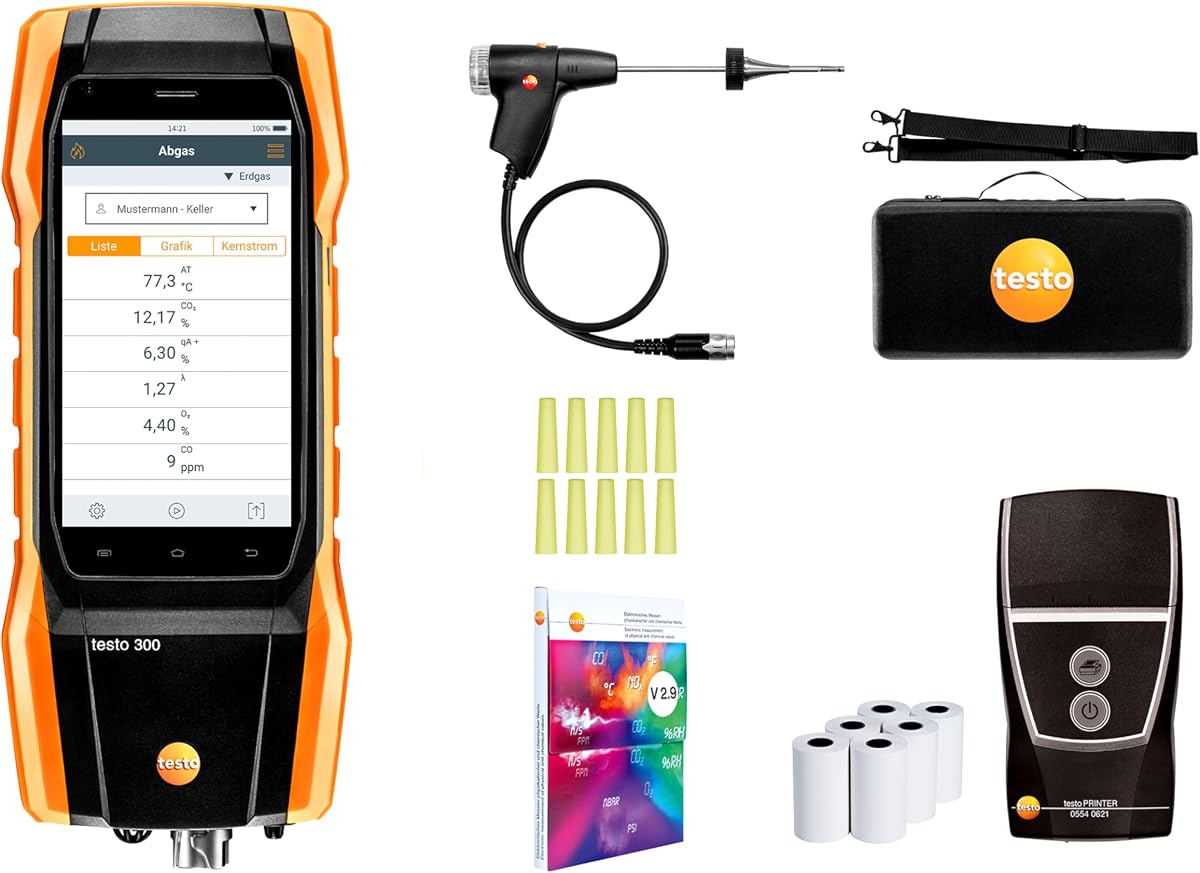
The testo 300 HVAC Kit with Printer has a 3.7 rating and differentiates itself through a complete, reporting-focused package. It measures carbon monoxide, oxygen, temperature, draft, differential pressure, and ambient carbon monoxide in furnaces and boilers.
We may earn a commission when you buy through this link, at no additional cost to you.
Its strongest specialty is the included wireless printer, which is supported by spare thermal paper. That combination can be valuable for technicians who want immediate printed documentation rather than relying entirely on an electronic workflow. The kit also includes a retrofittable NO sensor, multiple probes, and filters inside a sturdy case.
The instrument retains the testo 300 platform's large HD smart-touch display, one-button start from standby, and strong rear magnets for hands-free positioning. Sensitive CO and O2 sensors are stated to offer a measuring range up to 4,000 ppm and an expected service life of up to six years.
This configuration is best for professionals who produce written service records and want a flexible residential analyzer with printing and optional NO capability. The complete set may be more than a new technician needs, and the 3.7 rating warrants checking recent customer feedback, but the supplied accessories create a particularly service-ready package.
The wireless printer creates a tangible record of combustion readings while the technician is still at the system. Spare thermal paper ensures the documentation function remains usable during extended field days.
The retrofittable NO sensor allows the analyzer to grow beyond standard CO and O2 measurements. Multiple probes and filters make it easier to handle changing residential service requirements.
We may earn a commission when you buy through this link, at no additional cost to you.
The Gold Label Combustion Leak Detector Kit has a 4.4 rating but serves a fundamentally different purpose from the HVAC instruments in this guide. It is designed to locate internal engine combustion leaks, including possible blown head gaskets, rather than analyze the flue gas of a heating appliance.
We may earn a commission when you buy through this link, at no additional cost to you.
Its block-test design supports professional mechanics and do-it-yourself vehicle repair work. The kit is advertised as capable of more than 100 tests and includes 18 ounces of tester fluid. Clear instructions and an easy-to-use design aim to speed the identification of faulty engine blocks and head gaskets.
The honest limitation is that it cannot substitute for a residential or commercial combustion analyzer. It does not provide the flue gas readings, carbon monoxide and oxygen analysis, temperature, draft, differential pressure, efficiency calculations, or pressure monitoring used in HVAC service. Its value is specialized engine diagnostics.
Choose this kit for automotive cooling-system leak testing, especially when investigating head gasket or engine block failures. HVAC professionals should instead focus on the flue gas analyzers in this comparison. The distinction matters because searching only for the phrase combustion analyzer can otherwise lead buyers toward a tool built for an entirely different diagnostic process.
The tester's purpose is to reveal internal combustion leaks in an engine block. It helps narrow down failures involving head gaskets or other sealing problems.
The advertised test capacity and included fluid volume suit repeated automotive diagnostic work. Users should still follow the supplied instructions and allow the fluid to circulate for the required period.
We may earn a commission when you buy through this link, at no additional cost to you.
The Fieldpiece CAT85K2 has a 3.8 rating and is built around three prominent capabilities: live draft measurement, a built-in manometer, and an integrated printer. These features concentrate several common combustion and pressure tasks into one field instrument.
We may earn a commission when you buy through this link, at no additional cost to you.
Live draft is particularly useful when observing how draft behaves during a test rather than relying only on a static value. The built-in manometer adds pressure measurement without requiring a separate gauge, while the printer enables direct output of results at the appliance.
The supplied product data provides the model name and headline features but does not list sensor ranges, calculated combustion outputs, supported fuels, display specifications, probe details, or the exact report format. Those limitations make careful comparison with formal kit specifications important before purchase.
The CAT85K2 is a strong candidate for technicians who specifically want live draft, manometer functionality, and printing in one housing. It is less suitable for a buyer seeking a fully documented specification package from the listing alone. Confirming those details with the manufacturer or seller can prevent surprises.
Live draft measurement can show how draft behaves while the system is operating. This adds context that a static reading may not provide during setup and troubleshooting.
A built-in manometer and printer reduce the need to carry separate pressure and documentation accessories. Integration can streamline service calls when these functions are part of the normal workflow.
We may earn a commission when you buy through this link, at no additional cost to you.
The testo 300 Pro Commercial Analyzer Kit is positioned as a premium commercial configuration. It arrives with oxygen and carbon monoxide sensors installed, a wireless printer, and the ability to add a nitrogen oxide sensor in the field. The listing does not provide a customer rating, so its evaluation must focus on configuration rather than social proof.
We may earn a commission when you buy through this link, at no additional cost to you.
Its commercial focus makes it a natural option for technicians who routinely service larger heating systems and want the testo 300 platform at a higher specification level. Installing O2 and CO from the outset means the analyzer is ready for fundamental combustion analysis, while NO expansion creates room for more advanced diagnostics.
The printer is a meaningful addition for professionals who need physical documentation of commercial inspections or service results. The long-life sensor positioning also supports the goal of maintaining measurement capability over an extended ownership period, although exact sensor life and calibration requirements should be confirmed for the specific configuration.
This kit is best for established commercial service operations that value a premium platform, immediate reporting capability, and future NO measurement. It is less compelling for a newly trained technician or a homeowner seeking a basic residential check. Because no rating is listed, buyers should examine current professional reviews and confirm the exact included accessories before ordering.
Oxygen and carbon monoxide sensors are installed from the beginning, providing the fundamental inputs for combustion analysis. This suits operators who need a ready-to-deploy commercial instrument.
Field-upgradable NO capability allows a technician to expand the analyzer as diagnostic requirements become more advanced. It offers flexibility without requiring a completely different platform.
The wireless printer supports immediate creation of physical service records. For commercial work, that can simplify handoff and make measured results easier to retain with job documentation.
We may earn a commission when you buy through this link, at no additional cost to you.
Choosing a combustion analyzer test kit means matching measurement requirements, fuel support, field accessories, and documentation needs to the type of service you perform. The most expensive-looking kit is not automatically the right choice, and a simpler instrument may better serve a technician performing only routine furnace checks.
Begin by listing every measurement your work requires rather than choosing from the number of features printed on the box. Core combustion analysis commonly includes oxygen, carbon monoxide, carbon dioxide, flue gas temperature, excess air, and combustion efficiency. Some service procedures also require draft, differential pressure, ambient CO, flue gas loss, or pressure readings. The Fieldpiece SOX3 covers flue temperature, O2, CO2, excess air, and efficiency, while the INFICON Flue-Mate places efficiency, O2, CO2, CO, and flue temperature on one screen. The testo 310 II adds draft, pressure, flue gas loss, and ambient CO to its measurement list.
Choose the narrowest kit that fully satisfies your normal workload. Extra measurements can be useful, but they may add interface complexity, probe requirements, sensor cost, or bulk without improving the actual diagnostic process. A compact analyzer with the correct readings and reliable sensors is often more valuable than an advanced unit with features you will never use.
Fuel support determines whether calculated readings can be trusted for the equipment being inspected. Natural gas is central to many residential systems, but propane, fuel oil, diesel, wood, coal, and other fuels may also appear in a technician's workload. The Fieldpiece SOX3 provides dedicated settings for natural gas, oil No. 2, and propane, along with programmable custom fuel settings. INFICON lists a particularly broad range that includes multiple fuel oils, diesel, wood, coal, biofuel, LPG, butane, bagasse, and B100.
Verify whether the manufacturer or service organization has approved a fuel configuration before relying on a custom profile. Correct fuel selection affects calculated values such as excess air and efficiency. If your work is limited to one fuel type, choose the product whose supported configuration directly matches that equipment rather than paying for broad compatibility you do not need.
Sensors are among the most important ownership considerations in an analyzer because they influence accuracy, maintenance, and long-term operating cost. The testo 300 Residential HVAC Kit states that its sensitive CO and O2 sensors have an expected life of up to six years. The Fieldpiece SOX3 and INFICON Flue-Mate both provide field-replaceable sensors, while the SOX3 stores calibration data on the replacement O2 sensor to simplify servicing.
A replaceable sensor can be a major advantage in a busy service operation. Instead of sending the entire instrument away, a qualified technician may be able to restore measurement capability in the field. Confirm replacement procedures, calibration requirements, approved parts, and sensor protection features before purchase. Also consider whether automatic CO protection and an external water trap are appropriate for the environments in which you work.
The sampling system affects how consistently the analyzer draws combustion gas from a flue. The Fieldpiece SOX3 has a built-in electric automatic pump and a magnetic back, allowing it to remain positioned during service. The testo 300 Residential kit also uses strong rear magnets for hands-free operation. By contrast, the basic residential LCD model has no published pump details, making that specification particularly important to verify.
Consider pressure requirements separately from gas sampling. The testo 310 II includes a silicon hose for pressure measurement, and the INFICON Flue-Mate includes a built-in manometer and hose kit. Probe length and shape also matter: the testo 310 II package specifies a 180 mm probe with cone, while the Fieldpiece SOX3 includes a thermocouple handle. Choose accessories that match the appliance and the physical space where you need to work.
A display should make readings understandable at a glance, particularly in dark mechanical rooms or tight working areas. The Fieldpiece SOX3 uses a triple-line display, the UEi C161C uses a six-line backlit display, and the INFICON Flue-Mate uses a backlit screen with all major combustion readings together. The testo 300 models use an HD smart-touch interface with a structured measurement menu.
Think beyond the physical screen. The INFICON FLUE-Mate app supports saved and shared reports through a smartphone or tablet, with QR-based access, while the testo 310 II includes smart app connectivity. Printed output remains useful for some workflows, making the printer-equipped testo 300 configurations attractive. The best interface is the one your team can use quickly, interpret correctly, and use to produce records that satisfy the job.
A complete kit can be more useful than a bare instrument if it includes the probes, filters, hoses, batteries, software, cases, and documentation needed for normal service. The testo 300 Residential HVAC Kit includes a spare probe, dirt filters, a hard-shell case, and easyHeat software. The testo 310 II adds a rechargeable battery, calibration protocol, pressure hose, and five particle filters. The Fieldpiece SOX3 includes a thermocouple handle, filter kit, and protective case.
Printer-equipped kits add another layer of readiness by including both the printer and spare thermal paper. The commercial testo 300 configuration similarly includes a printer. Compare the actual package rather than assuming similarly named products contain identical accessories. Extra components can improve field readiness, but they also add weight, storage requirements, and potential opportunities for loss or damage.
The intended service environment should guide the entire selection. Residential kits commonly emphasize furnaces, boilers, ambient CO, and straightforward field operation. Commercial analyzers may justify greater investment, broad fuel support, NO expansion, and formal printed reporting. The Gold Label Engine Block Kit serves an entirely different automotive purpose: locating internal engine combustion leaks and possible blown head gaskets.
Do not equate the words combustion analyzer and combustion leak detector without checking the output. An automotive block tester does not measure flue gas composition, combustion efficiency, draft, or differential pressure, while an HVAC analyzer is not designed to pressurize and inspect an engine cooling system. Separating these use cases can prevent an expensive mismatch and help you choose the right tool for the diagnostic task.
Ratings offer a useful but incomplete view of product quality. The INFICON Flue-Mate has the highest listed rating at 5.0, followed by the residential LCD analyzer at 4.6 and the automotive block tester at 4.4. The Fieldpiece SOX3 holds a 4.3 rating, while the testo 300 Residential kit is rated 4.2. The commercial testo 300 does not have a listed rating, so professional reviews and manufacturer documentation become especially important for that model.
Read customer comments alongside the score, focusing on ease of setup, sensor stability, probe durability, battery life, software reliability, and support availability. Also compare the feature set with your actual service needs rather than using rating alone. A slightly lower-rated product may be the better fit when it provides the measurements and accessories your team uses every day.
Before operating an analyzer, read the manufacturer instructions for the specific model, probe, fuel setting, and sensor arrangement. Confirm that the instrument passes its startup checks, the selected fuel matches the appliance, and the probe and filters are clean. Use the analyzer only in an area with appropriate ventilation and never allow its sample inlet or internal components to come into contact with liquid unless the model expressly supports that condition.
Position the probe at the location specified by the appliance manufacturer and service procedure, then confirm that the sample flow is stable before evaluating readings. For powered-pump models, allow the automatic pump to draw a consistent sample. Compare draft, pressure, oxygen, carbon monoxide, temperature, and calculated efficiency with the equipment specifications and the expected operating condition, rather than treating one reading as a complete diagnosis.
After service, turn off the instrument according to its instructions, disconnect the probe safely, empty or replace moisture-affected components as directed, and inspect filters for soot or debris. Keep sensors dry, replace filters on schedule, protect the display and case from impact, and store the kit in a stable, clean environment. Arrange calibration and recertification as required, and use only compatible replacement sensors, probes, software, and approved accessories.
A useful residential analyzer commonly measures oxygen, carbon monoxide, carbon dioxide, flue gas temperature, and combustion efficiency. Draft, differential pressure, ambient carbon monoxide, and flue gas loss are also valuable when the service procedure requires them. The right combination depends on the appliances and diagnostic standards used in your operation.
No. An automotive block tester is designed to reveal internal combustion leaks in an engine and help diagnose possible head gasket failures. It does not perform flue gas analysis or calculate HVAC combustion efficiency. These products should be chosen as separate pieces of equipment for separate jobs.
Sensors can degrade, become contaminated, or reach the end of their useful service life. A field-replaceable sensor may allow a qualified technician to restore the instrument without shipping the complete unit away. Always follow calibration requirements and use compatible replacement parts specified by the manufacturer.
A printer is useful when customers, managers, or service departments require immediate physical records. An app can streamline saved reports, sharing, and smartphone-based review. If your workflow does not require either feature, prioritize measurement quality, sensor life, probe design, and the accuracy of your standard diagnostics instead.
Match the analyzer to the fuels you actually service. Natural gas, propane, fuel oil, diesel, wood, coal, and biofuels can require different calculations and operating conditions. A product with several presets or custom fuel settings offers flexibility, but the selected profile must correspond to the appliance being tested.
A standard draft measurement provides a value at a particular moment, while live draft lets the technician observe changes as the system operates. The live view can reveal instability or pressure changes that are easier to recognize when displayed continuously. It is particularly useful during setup and combustion troubleshooting.
They can improve field readiness, especially when the primary probe is dirty or when different appliances require different access arrangements. Spare filters are especially useful because contamination can affect sampling and measurement quality. The necessity of a complete accessory package depends on service frequency, travel conditions, and the manufacturer's recommended maintenance schedule.
Follow the calibration protocol included with the instrument and the service requirements applicable to your organization. Calibration may involve known gas, ambient reference checks, sensor procedures, or verification with an external reference. Do not improvise calibration methods, and arrange recertification when required by the manufacturer, warranty terms, or local practice.
The INFICON Flue-Mate is the strongest all-around choice because it combines efficiency, O2, CO2, CO, and flue temperature on one screen with app-based reporting, a built-in manometer, replaceable sensors, and NOx expansion. The Fieldpiece SOX3 is the best budget-focused pick for core combustion analysis, automatic sampling, multiple fuel settings, and field-replaceable O2 sensor maintenance.
For residential technicians who need a broad kit with a spare probe, the testo 300 Residential HVAC package offers extensive measurements and strong accessories. The printer-equipped testo 300 kits serve users who value immediate documentation, while the commercial testo 300 configuration is the premium option for a professional operation that wants NO upgrade capability. The Gold Label engine block kit belongs in an automotive toolbox rather than an HVAC kit.
Before purchasing, verify the exact measurements, probe type, pressure capabilities, fuel profiles, sensor terms, included accessories, and warranty conditions for the specific model and seller. Pricing and availability change, so compare current listings carefully and use the product details, support documents, and current customer feedback to make the final decision.