
WD-40 Specialist Contact Cleaner
4.8Editor score
Removes flux and condensation
Quick-drying formula
Safe on most plastics
Discover the best contact cleaners for electronics with this expert guide comparing residue, drying speed, material compatibility, application range, and
Contact cleaners for electronics help remove dust, flux residue, light oils, grease, oxidation, and other contaminants from sensitive electrical connections. A suitable cleaner should dry quickly, leave little or no residue, and work without damaging plastics, rubber, or metal components. The right formula can improve conductivity, restore signal quality, and help prevent intermittent contact failures.
This guide compares ten electronic contact cleaners based on residue, drying speed, material compatibility, application range, precision, and the contaminants each formula is designed to remove. It includes aerosol cleaners, a brush-applied treatment, single-can options, and multipack choices for technicians, electronics hobbyists, and owners of consumer devices.
Each pick highlights a different reason to consider it, from versatile cleaning of printed circuit boards to targeted treatment of oxidized connectors and fine electrical contacts. Product specifications and availability can change, and current prices should be checked before purchasing. Always disconnect power, follow the label, and test on a small area when material sensitivity is possible.
4.8Editor score

4.8Editor score

4.8Editor score
The table below compares the ten cleaners by format, cleaning focus, material compatibility, residue level, and intended electrical applications, making it easier to identify the right option for routine maintenance or targeted contact restoration.


CRC 05103 QD Electronic Cleaner combines a fast-evaporating petroleum-distillate-and-alcohol formula with a residue-free result, earning it a 4.8 rating. Its strongest attraction is versatility: the same cleaner can be used around computer components, sockets, switches, circuit breakers, plugs, relay switches, lighting, plastics, nylon, and PVC. That broad scope makes it a practical choice for general electronics maintenance rather than a product tied to one device or connector type.
We may earn a commission when you buy through this link, at no additional cost to you.
The quick-drying formula is especially useful when equipment must return to service without waiting for a long evaporation period. Residue-free performance is equally important because a conductive or oily film can undermine the very connection the cleaner is intended to improve. The listed plastic-safe characteristic also expands the potential applications, although users should still test a small hidden area if a component is particularly sensitive.
Its main trade-off is the aerosol delivery format. Precise work demands controlled spraying, careful positioning, and adequate ventilation. The supplied product information does not mention an extension straw, so operators may need to apply it in short bursts or reposition the can more frequently than they would with a precision-straw design. Despite that limitation, the formula's speed, residue control, and material versatility make it the strongest all-purpose option here.
Choose CRC 05103 when you maintain a mixed collection of electronics and want one cleaner for contacts, sockets, relays, circuits, and light contamination. It is especially attractive for technicians, repair hobbyists, and electronics owners who value fast drying over the targeted mechanical application offered by a brush product. For broad routine cleaning, it offers an effective and well-rounded balance.
The fast-evaporating formula reduces the amount of time equipment must remain out of service after cleaning. It is particularly useful for contacts, switches, and circuit assemblies where a quick return to operation matters.
This cleaner is not limited to one type of connector. Its listed applications include circuit breakers, coin mechanisms, sockets, plugs, relay switches, printed circuits, lighting, and several plastics, giving it broad usefulness across electronics work.
We may earn a commission when you buy through this link, at no additional cost to you.
WD-40 Specialist Contact Cleaner carries a 4.8 rating and is designed to remove four common sources of contact contamination: oil, dirt, flux residue, and condensation. Its quick-drying, residue-free formula gives it a strong foundation for routine maintenance of sensitive electrical equipment. The result is a familiar, accessible cleaner suited to household electronics, control panels, instruments, switches, and printed circuit boards.
We may earn a commission when you buy through this link, at no additional cost to you.
A major strength is the explicit guidance about material compatibility. The formula is stated to be safe on most plastics, rubbers, and metals, while the instructions also recommend testing on plastic and avoiding adhesives, device screens, and keyboards. This makes it easier to plan responsible use around a repair bench or household cleaning kit without assuming every surface will react in the same way.
The limitation is that a broadly useful cleaner still requires careful application around modern devices. Screens, keyboards, adhesives, and unknown plastics should be kept away from the spray. A blanket application can also be less controlled than a brush-applied contact treatment, especially around fine connectors. Those constraints are manageable with a test area, short bursts, and power disconnected, but they should be considered before spraying.
This is a sensible choice for people who want a single aerosol for multiple electrical tasks without moving to a specialized corrosion treatment. It works especially well when the problem is likely to involve mixed grime, light oil, or flux residue. If the main objective is restoring a visibly oxidized connector, the DeoxIT brush product offers a more targeted approach.
Oil, dirt, flux residue, and condensation can all interfere with a stable electrical connection. Addressing these contaminants with one quick-drying formula simplifies routine maintenance and reduces the need to keep multiple cleaners for common bench tasks.
The stated compatibility with most metals, rubbers, and plastics is useful, but the product guidance still calls for a plastic test. Avoiding screens, keyboards, and adhesives helps reduce the chance of cosmetic or functional damage.
We may earn a commission when you buy through this link, at no additional cost to you.
BW-100 earns a 4.6 rating by combining non-flammable, quick-evaporating cleaning with zero residue and an included extension straw. It is intended to remove dust and contaminants from sensitive electrical equipment, with particular attention to contacts. The product information also identifies computers, printed circuit boards, and game-controller Joycons as possible applications, giving it a recognizable consumer-electronics focus.
We may earn a commission when you buy through this link, at no additional cost to you.
The extension straw is the standout practical feature. It makes the cleaner easier to direct into narrow spaces and around individual connections, reducing unnecessary overspray compared with an unstructured aerosol burst. The quick evaporation and zero-residue claims are also valuable for users who need to clean and then promptly return a device to operation. Its non-flammable formulation may further suit work areas where an aerosol with a lower flash point would be less desirable.
Compatibility still deserves attention. The cleaner is stated to be safe on rubber, metal, and most plastics, but a small-area test is recommended. Screens, keyboards, and adhesives should be avoided. As with other aerosols, the nozzle must be directed carefully because a straw helps with placement but does not make spraying directly into an enclosure safe. The 8-ounce can is also smaller than several competitors.
Choose BW-100 when pinpoint access and quick drying matter, particularly for dusty contacts in compact electronics. It is a solid fit for repair hobbyists who want to clean Joycons, computers, or circuit boards with controlled delivery. For extensive oxidation removal or long-term contact protection, a dedicated treatment such as DeoxIT may offer a more specialized function.
The attached extension straw helps place the spray at dusty contacts in compact assemblies. More controlled delivery is especially useful when cleaning game controllers, computer internals, and crowded circuit-board areas.
Fast evaporation and zero residue support a clean return to use. The formula is non-flammable and intended to clear dust and other contaminants without leaving a lasting film on treated contacts.
We may earn a commission when you buy through this link, at no additional cost to you.
Hosa CAIG Laboratories D5S-6 CAIG DeoxIT Contact Cleaner has a 4.7 rating and offers a compact 5-ounce aerosol with a 5% spray formula. It is a straightforward option for users who recognize the DeoxIT contact-maintenance name and want a smaller-format product for targeted work around electrical connections. The limited package information means buyers should assess the label and their own equipment type before application.
We may earn a commission when you buy through this link, at no additional cost to you.
The main advantage is specialization. Unlike general-purpose lubricants, this product is explicitly positioned as a contact cleaner, giving users a clear reason to select it when the task involves maintaining electrical contact points. Its small can is also convenient for a technician's smaller tool kit or for owners who want to maintain only a limited collection of devices without carrying a large aerosol into a crowded workspace.
The 5-ounce size is also the product's clearest compromise. It may require more frequent replacement than an 11-ounce or 14-ounce can during substantial cleaning sessions, and it provides less coverage for users maintaining many devices. The supplied data is concise, so there is no basis here for claiming compatibility with every rubber, plastic, or metal encountered in the field. Label directions and a small test remain sensible precautions.
This DeoxIT spray is best for routine contact maintenance when portability and a focused contact-cleaning product matter more than maximum container size. It can serve as a companion to the D100L-2DB brush applicator: the spray offers aerosol coverage, while the brush product provides controlled treatment for specific connections. For extensive corrosion restoration, the brush-applied formula better matches that task.
A product explicitly formulated for contact cleaning can be easier to justify than a general household spray. It is a practical option for routine care of switches, connectors, and other electrical contact points.
The 5-ounce container takes up relatively little space and is easy to carry. Users with a small number of devices or limited bench space may find that scale more useful than a larger maintenance supply.
We may earn a commission when you buy through this link, at no additional cost to you.
The WD-40 Specialist Contact Cleaner twin pack has a 4.7 rating and extends the familiar Specialist formula with two 11-ounce cans and an included Smart Straw. It is designed to remove oil, dirt, flux residue, and condensation from printed circuit boards, controls, switches, precision instruments, and electric panels. The paired format is useful for users who expect regular cleaning or want to keep supplies in separate workspaces.
We may earn a commission when you buy through this link, at no additional cost to you.
The Smart Straw improves control when reaching switches, edge connectors, and crowded electrical panels. Combined with the quick-drying, residue-free formula, it supports controlled maintenance without leaving a visible oily aftermath. Compatibility with most metals, rubbers, and plastics broadens the potential repair applications, while the stated avoidance of screens, keyboards, and adhesives keeps the intended use reasonably clear.
As a multipack, it naturally suits users who clean more frequently or maintain several pieces of equipment. Someone performing only an occasional light cleaning may not consume both cans quickly, and the larger combined package can also be less convenient to store than the single-can version. The product still shares the general limitations of aerosol application, including the need to control spray direction and keep the product away from incompatible surfaces.
This twin pack is a good match for serious electronics hobbyists, repair technicians, and owners of multiple devices who want the WD-40 Specialist contact cleaner in a ready supply. It combines the versatility of a broad contaminant remover with more precise delivery. If a small toolkit is the priority, the single can provides the same core formula in a more compact purchase format.
The included straw helps target controls, switches, circuit boards, and other contact points with greater intent. It is a useful feature when cleaning a dense assembly where wide overspray is undesirable.
The twin-pack format supports regular maintenance and provides flexibility for separate work areas. It is best suited to users who know they will perform more than a single isolated cleaning.
We may earn a commission when you buy through this link, at no additional cost to you.
CRC 05103 Case 5103 carries a 4.8 rating and packages 12 cans of 11-ounce Quick Dry Electronic Cleaner. It is the clear bulk-supply choice in this group, intended for workshops, service teams, schools, or other settings where electronics cleaning is routine rather than occasional. The standard can size allows each technician to keep a cleaner near a workbench instead of sharing one container.
We may earn a commission when you buy through this link, at no additional cost to you.
A multi-can supply is operationally useful because aerosol cleaners can be used across many different assemblies, from computer components and circuit breakers to switches, sockets, plugs, relays, lighting, and plastics. The quick-drying emphasis helps reduce waiting before equipment returns to service, while the broader CRC contact-cleaning formula is designed to address common contamination without leaving residue.
The obvious drawback is that twelve cans represent a much larger commitment than a single household can or a compact brush applicator. Storage, organization, and canister replacement also need consideration. A universal fit designation does not mean the cleaner is appropriate for every surface or device, so label directions and compatibility testing remain important. Bulk availability should be matched to genuine usage rather than chosen simply because many units are included.
This case is a strong option for repair departments, electronics classrooms, maintenance teams, and serious hobbyists who clean contacts routinely. It provides a consistent format and convenient distribution across workstations. For a person restoring one connector or performing occasional maintenance, however, a smaller can or precision brush is likely to be more proportionate and easier to store.
Twelve identical cans are easy to distribute among benches, service areas, or technicians. This makes the case practical where cleaning is a regular part of maintaining multiple electronic systems.
Each unit uses an 11-ounce aerosol format familiar from the single-can CRC product. Consistent packaging simplifies replacement and allows users to keep cleaner within easy reach at multiple workstations.
We may earn a commission when you buy through this link, at no additional cost to you.
The CAIG DeoxIT D100L-2DB has a 4.8 rating and is built for precise, contact-level treatment rather than broad surface spraying. Its 7.4mL package uses a brush applicator, allowing the user to place product directly on battery terminals, switch contacts, relay connections, jacks, plugs, grounding blocks, and other metal electrical interfaces. That makes it especially useful for a single oxidized or unreliable connection.
We may earn a commission when you buy through this link, at no additional cost to you.
Its standout benefit is the combination of cleaning and protection. The product information says it removes oxidation and corrosion, improves conductivity and signal quality without causing shorts, displaces moisture and contaminants, and lubricates and seals contacts against wear and vibration. It also supports a broad range of connections, including RCA, XLR, USB, HDMI, Ethernet, wiring harnesses, and light-bulb contacts.
The brush applicator is both the chief advantage and the main consideration. It provides more control than aerosol spray, but users must apply a controlled amount and avoid flooding adjacent components. The 7.4mL capacity is sufficient for targeted work rather than cleaning an entire collection of devices, so replacement frequency depends on how many connections require treatment. It is also more of a dedicated contact treatment than a general-purpose solvent for every kind of board contamination.
This is the premium pick for users who want to restore or maintain a specific connection with controlled application. Choose it for oxidized terminals, tarnished metal contacts, intermittent connector issues, or preventive care on high-wear electrical interfaces. For sweeping dust removal across an entire enclosure, an aerosol contact cleaner remains more efficient, but for focused work the brush format is especially valuable.
A brush allows the treatment to be placed on the intended contact surface instead of covering a large nearby area. That precision is valuable around USB, HDMI, Ethernet, RCA, XLR, battery, relay, and switch connections.
Beyond removing oxidation and corrosion, the listed formula lubricates, seals, and protects contacts. It also displaces moisture and contaminants, supporting reliability and signal quality after treatment.
We may earn a commission when you buy through this link, at no additional cost to you.
Semlos Electrical Contact Cleaner has a 4.6 rating and comes as two 14-ounce cans for cleaning batteries, circuit boards, and other electronic components. Its formula is described as precision-oriented, residue-free, plastic-safe, and fast-drying. The result is a high-capacity maintenance product for users who want quick turnaround across multiple types of electrical equipment without switching between several specialized cleaners.
We may earn a commission when you buy through this link, at no additional cost to you.
The two-can configuration offers useful flexibility. One can can remain at a workbench while the other is used in a different area, and the 14-ounce size supports users who clean large circuit boards, sockets, plugs, relay switches, computer components, coin mechanisms, and lighting. Rapid evaporation helps equipment return to use, while the stated zero-residue result avoids leaving a lasting film on treated surfaces.
Its limitations are similar to those of other aerosol cleaners. Precise application takes practice, and a formula described as plastic-safe should still be evaluated against unusual or sensitive materials. The supplied information does not identify an extension straw or emphasize a non-flammable formulation, so buyers who require those specific features may prefer another option. The broad contact-cleaning claims also do not make it a substitute for a dedicated corrosion-restoration treatment.
Choose Semlos when you maintain several devices or need a generous supply of a quick-drying, residue-free contact cleaner. It is a practical option for circuit-board, battery, socket, and plug maintenance where fast evaporation is a priority. If a single delicate connector needs controlled application, the DeoxIT brush product may be more suitable.
Two 14-ounce cans offer more cleaning solution than several single-can options. This is helpful for technicians or hobbyists who routinely service circuit boards, batteries, sockets, plugs, and relay switches.
The quick-drying formula is designed to minimize waiting after cleaning. A zero-residue outcome further supports equipment that needs to be reassembled or returned to service soon after treatment.
We may earn a commission when you buy through this link, at no additional cost to you.
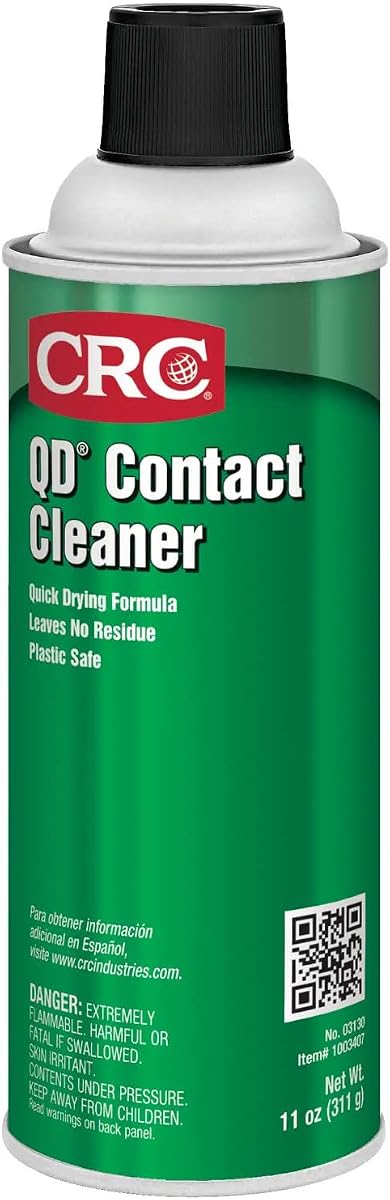
CRC QD Contact Cleaner earns a 4.8 rating with a quick-evaporating formula that removes dust, light oil, grease, and dirt from sensitive electronic equipment. It is designed to leave no residue and is stated to be safe for all plastics. Its listed uses cover telephones, computers, relays, edge connectors, tape heads, busbars, circuits, contacts, printed circuit boards, switches, and breakers.
We may earn a commission when you buy through this link, at no additional cost to you.
The product's strongest quality is its balance of quick drying, residue control, and broad plastic compatibility. That combination makes it suitable for routine maintenance across many materials and device categories. The NSF K2 registration adds a specific documented designation, while the long application list helps users confirm whether their own electrical equipment falls within the intended uses.
One qualification comes directly from the product information: it should be used where lower-flashpoint cleaners are acceptable. That condition may matter in specialized work environments governed by solvent handling rules. The aerosol format also requires controlled spraying to prevent overspray around nearby components. Although the formula is described as safe for all plastics, unusual or stressed parts should still be evaluated carefully according to the label.
CRC QD is a strong general cleaner for computers, telephones, switches, boards, and edge connectors. It is especially suitable when quick drying and plastic-safe cleaning are the leading requirements and the work setting permits a lower-flashpoint solvent. Users seeking a specifically non-flammable option can look to BW-100, while those needing targeted corrosion treatment may prefer the DeoxIT brush.
Dust, light oil, grease, and dirt are all listed targets. This range covers common contamination encountered around switches, relays, busbars, computer equipment, and circuit-board contacts.
The formula is stated to be safe for all plastics, making it useful around mixed-material assemblies. Users should still observe the lower-flashpoint condition and use controlled application.
We may earn a commission when you buy through this link, at no additional cost to you.
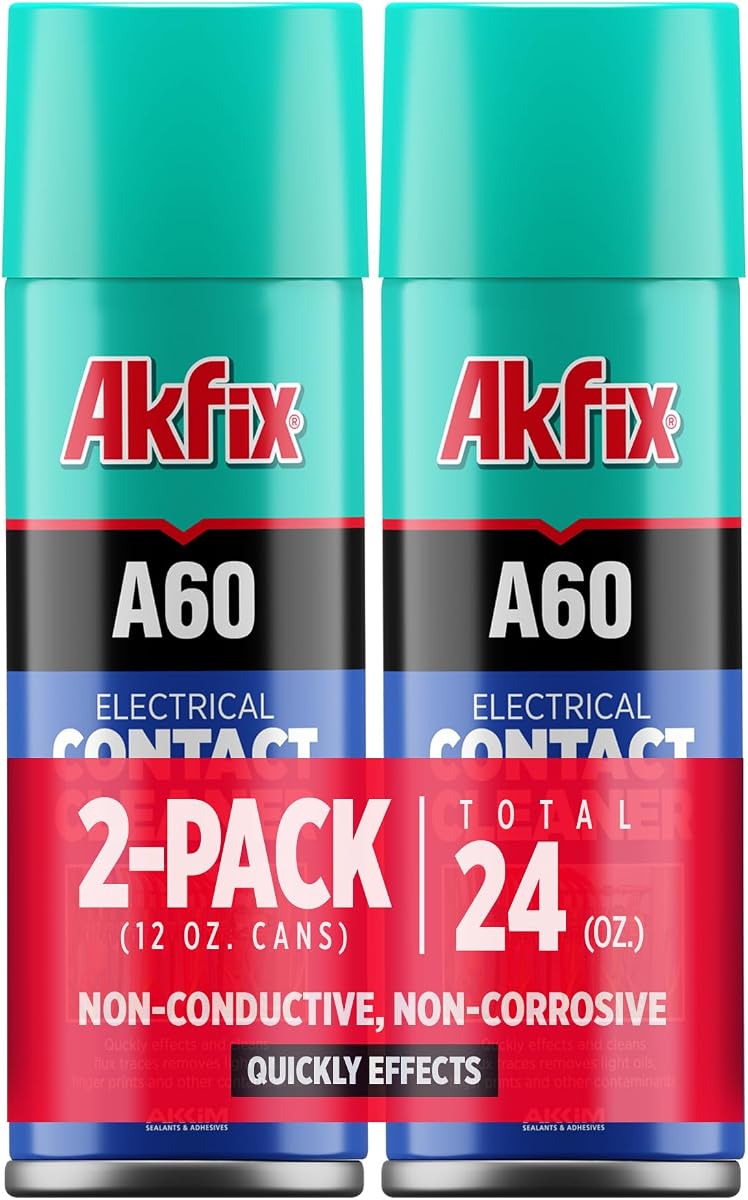
Akfix A60 Electrical Contact Cleaner has a 4.5 rating and is packaged as two 12-ounce aerosol cans. It is designed to remove dirt, light oil, grease, flux, and dust from electrical equipment and electronic devices. Its quick-evaporating formula leaves no residue, while the listed non-corrosive treatment is intended to support efficient connector and contact performance.
We may earn a commission when you buy through this link, at no additional cost to you.
The product's broad contaminant list makes it relevant to a variety of repair tasks. It can be considered for computer equipment, batteries, keyboards, digital devices, and metal connectors, provided the particular keyboard or device is compatible with the spray. The two-can configuration provides a reasonable balance between supply and portability, making it easier to maintain more than one system without moving to a large case of cans.
The important caution concerns sensitive plastics and stressed components. Akfix recommends testing on sensitive plastics and adhesive-mounted or stressed parts before treating them. This makes careful inspection and a small trial area essential, especially in modern devices where adhesives, display assemblies, and delicate finishes may be nearby. Although the formula is non-corrosive, non-corrosive does not mean appropriate for every surface or application.
Choose the Akfix A60 when you need a straightforward cleaner for mixed electronics and multiple metal connectors, particularly where flux, dust, and light oils are present. Its two-can pack provides more supply than a single aerosol, and the residue-free formula supports a quick return to use. For advanced oxidation removal or brush-level control, consider a dedicated contact-maintenance treatment instead.
Dirt, light oil, grease, flux, and dust are named targets. That range makes the product relevant for routine cleaning across computers, batteries, digital equipment, and exposed metal connectors.
Rapid evaporation helps the treated area return to use without a lasting film. The non-corrosive formula is beneficial for contacts and connectors, but sensitive plastics still require a compatibility test.
We may earn a commission when you buy through this link, at no additional cost to you.
The right contact cleaner depends on the contaminants, connector materials, working environment, and level of control required. These factors help distinguish a broad maintenance aerosol from a precision treatment for a single oxidized connection.
Dust, flux residue, condensation, light oil, grease, oxidation, and corrosion are not identical problems. General contact cleaners often emphasize dust, dirt, oil, and flux removal, while a treatment designed for oxidation may also restore conductivity, displace moisture, and protect contacts from wear. Identify what is actually present before choosing. If the surface is coated with oxidation rather than simply dirty, a broad solvent may clean the area without fully restoring the underlying contact.
A cleaner that evaporates quickly can reduce downtime and make reassembly easier. Residue-free performance is equally important because an oily or conductive film can create new problems after the visible dirt is gone. Compare products specifically designed for contact cleaning rather than assuming a general maintenance spray will behave the same way. The best options in this guide emphasize rapid evaporation, zero residue, or a residue-free result.
Printed circuit boards, plastics, rubber feet, keyboards, screens, adhesives, and metal contacts may not respond equally to a solvent. Look for explicit compatibility statements, but also test unusual or stressed plastics in a hidden area. Adhesive-mounted parts, display surfaces, and keyboard assemblies deserve particular caution because a cleaner intended for metal contacts can still damage adjacent materials.
Aerosol cleaners cover larger areas and reach multiple contacts quickly, but precise application depends on technique. Extension straws and Smart Straws can improve direction around dense assemblies. A brush applicator gives even greater control on a single connector, terminal, relay, or switch, making it useful for oxidation restoration. Consider how much area you need to service and how tightly controlled the application must be.
Some formulas are non-flammable, while others are intended for settings where lower-flashpoint cleaners are acceptable. Ventilation, local rules, and the nature of the equipment all matter. A product labeled for marine, automotive, industrial, household, or electronic work should still be used according to its instructions. For a home workbench, clear the area, disconnect power, and avoid spraying where the mist can reach an ignition source or an unprotected surface.
Single cans suit occasional cleaning, while twin packs and cases are intended for frequent use, multiple workstations, or a larger collection of devices. The amount of product needed depends on the number of contacts, the size of the assemblies, and whether the cleaner is being used for a broad sweep or targeted treatment. Buying a large case for a single repair adds storage and handling burden, while repeatedly running out of a small can can interrupt a maintenance routine.
The type of contact cleaner alone does not guarantee a successful repair. Disconnect power, remove batteries where appropriate, hold components securely, and keep the product away from screens, keyboards, adhesives, vents, speakers, and other sensitive assemblies. If a device is still under warranty, check whether cleaning voids coverage. For oxidation or corrosion, distinguish external contamination from internal damage that may require replacement rather than chemical treatment.
Some contact treatments do more than remove contamination. They can lubricate, seal, displace moisture, and protect surfaces from wear and vibration, which may be valuable for a frequently used connector. These added functions are most relevant to plugs, switches, relays, battery terminals, and other metal interfaces. A basic residue-free cleaner remains appropriate when the task is limited to removing loose dust, dirt, oil, or flux.
Begin by disconnecting the equipment from power and removing the battery when the manufacturer permits it. Identify the contacts, protect nearby screens, adhesives, keyboards, speakers, and plastics, and move the device to a ventilated work area. Read the can's full instructions, shake it as directed, and test the cleaner on a small hidden area whenever material compatibility is uncertain.
Hold the aerosol upright and begin with a brief spray or a controlled brush application. Work from less visible areas toward the target, keep the nozzle or brush away from openings, and avoid saturating connectors. For a straw-equipped can, aim close to the contact without inserting the straw into a powered assembly. After treatment, allow the solvent to evaporate fully before reconnecting power or closing the enclosure.
Keep the can away from heat, sparks, open flames, and hot surfaces, and do not puncture or incinerate a pressurized container. Store it where children cannot reach it, with the nozzle protected as directed. If a product contacts skin, eyes, or is inhaled, follow the label's first-aid guidance and seek appropriate help. Dispose of the container according to local rules because aerosol contents may require special handling.
Many products in this guide are explicitly designed for printed circuit boards and sensitive electronic equipment. Apply them only after disconnecting power, keep the product away from screens, adhesives, keyboards, and other sensitive areas, and use controlled bursts. Check the label and perform a small compatibility test when the board contains unusual plastics, coatings, or stressed components.
A residue-free formula reduces the likelihood of leaving an oily film, but safety still depends on the materials and device involved. Some plastics, adhesives, coatings, and display surfaces may be damaged even by a cleaner intended for contacts. Always follow label precautions, test hidden areas, and never spray directly into a powered or sealed device.
Contact cleaner is formulated to remove contamination from electrical interfaces and evaporate cleanly. A general lubricant may be appropriate for hinges or mechanical parts but can leave an oily film that is undesirable on contacts. For a connection that merely needs dust, dirt, or flux removed, choose a cleaner explicitly labeled for electronic contacts.
Several products in this guide specifically instruct users to avoid keyboards because the spray can reach switches, membranes, labels, or plastic housings. For a keyboard, separate removable keycaps if the manufacturer permits it and use a method designed for that device. Do not assume a contact cleaner is safe merely because it is labeled plastic-safe.
Begin by disconnecting the device and cleaning away loose dirt with a product appropriate for the connector. If oxidation or corrosion remains, a brush-applied contact treatment may provide more controlled delivery to the affected metal surface. Products such as the DeoxIT D100L-2DB specifically list oxidation removal, conductivity improvement, moisture displacement, and contact protection. Replace a connector if damage is severe or the treatment does not restore reliable operation.
It may be preferable when the cleaning environment includes materials or conditions where a lower-flashpoint product is unsuitable, but safety still depends on ventilation and label directions. A non-flammable formula is not automatically suitable for every component, and a product containing a lower-flashpoint solvent may still be appropriate when used as directed. Compare compatibility, residue, and delivery features as well as flammability.
Yes, allow the cleaner to evaporate fully before reconnecting power or reassembling the device. Quick-drying and fast-evaporating products are designed to minimize waiting, but trapped solvent can still be problematic. Keep the area ventilated during the drying period and follow the product's specific instructions for handling and curing.
No. Cleaning can address problems caused by contamination, oxidation, light corrosion, or moisture on a contact surface, but it will not repair cracked solder, damaged traces, burned components, broken insulation, or failed semiconductors. If the symptom persists after cleaning, inspect the device more deeply or consult a qualified repair technician.
CRC 05103 QD stands out as the most versatile all-around option because it combines fast evaporation, residue-free cleaning, plastic-safe use, and a wide range of electronics applications. WD-40 Specialist Contact Cleaner is an attractive budget-minded choice for routine removal of oil, dirt, flux, and condensation, while the CAIG DeoxIT D100L-2DB earns the premium position for precise restoration of oxidized or moisture-affected connections.
Prioritize the contaminant and the surface before choosing a format. A fast-drying aerosol suits broad maintenance, a straw improves access in tight assemblies, and a brush is preferable when a single metal contact needs controlled treatment. Also check the direction to avoid screens, keyboards, and adhesives, confirm that the material is compatible, and use only the amount needed to do the job.
Current product details and prices can change, so check the listing and label before purchasing. The most effective cleaner is not necessarily the largest or most specialized one; it is the product that addresses the contamination, suits the materials, and can be applied safely to the equipment in front of you.


