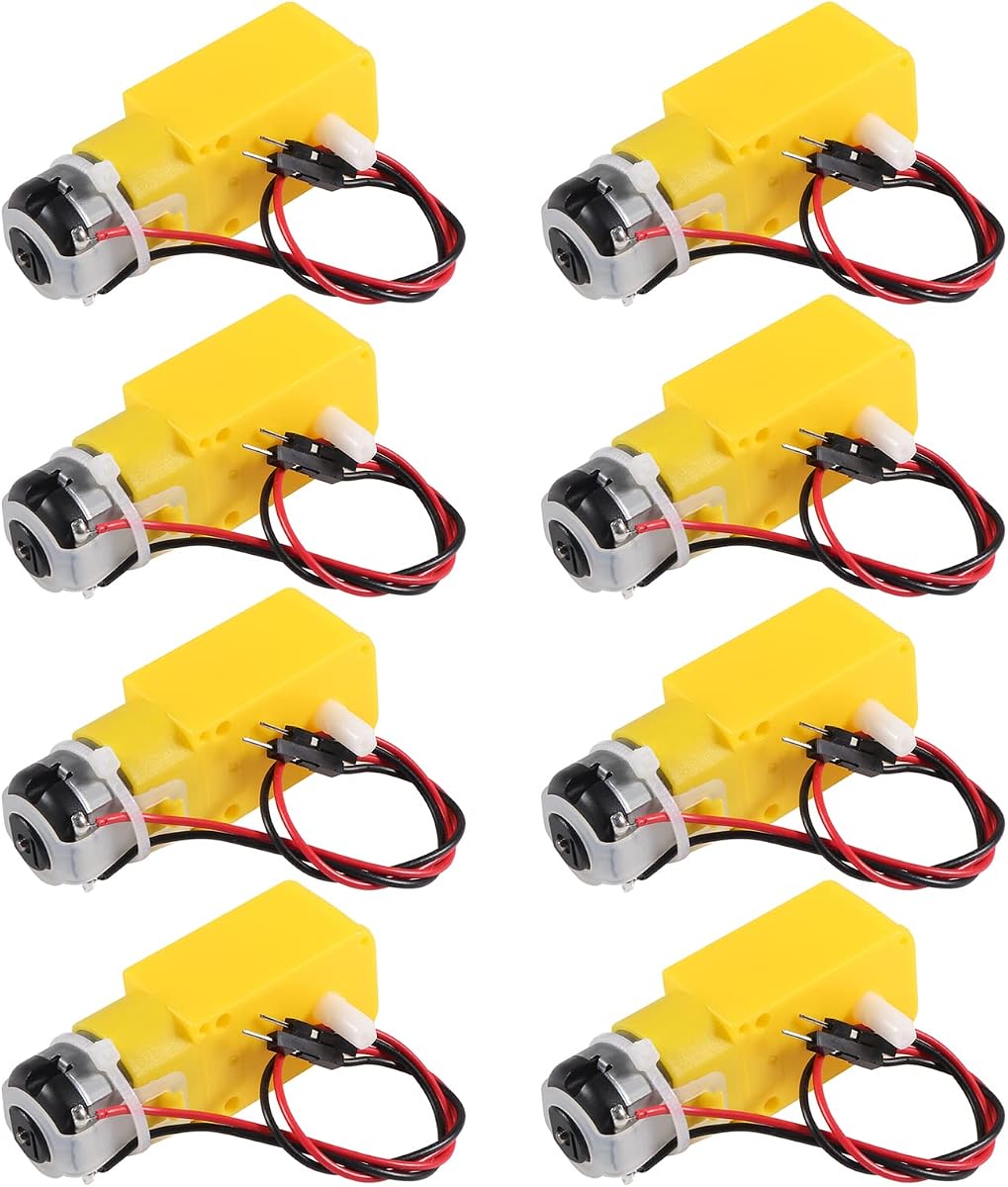
8pcs TT Motor Dual DC
4.5Editor score
1:48 reduction gearbox
Eight motors included
Breadboard-friendly leads
Explore the best DC motors for robots, comparing torque, speed, gearing, encoders, voltage, mounting options, and overall suitability.
DC motors for robots range from tiny brushed units for lightweight line followers to metal-geared models capable of moving heavier platforms. A useful motor must match the robot’s voltage, wheel size, load, speed requirements, and control system, so motor size alone is rarely a reliable buying guide.
This guide compares ten real options using the specifications and customer ratings supplied for each listing. It covers planetary gearboxes, TT gearboxes, encoder motors, encoder gearboxes, and general-purpose brushed DC motors, with attention to torque, speed, shaft compatibility, and intended robot applications.
Each review explains where a particular motor fits best, from small Arduino cars to custom robotic mechanisms. Ratings indicate the supplied customer feedback, while features and limitations help distinguish motor types. Product availability and prices can change, so compare the current listing details before purchasing.
4.5Editor score

4.7Editor score

4.6Editor score
The comparison below places all ten motors side by side, emphasizing gearbox design, operating voltage, speed, feedback capabilities, and the practical robot projects each motor is designed to support.


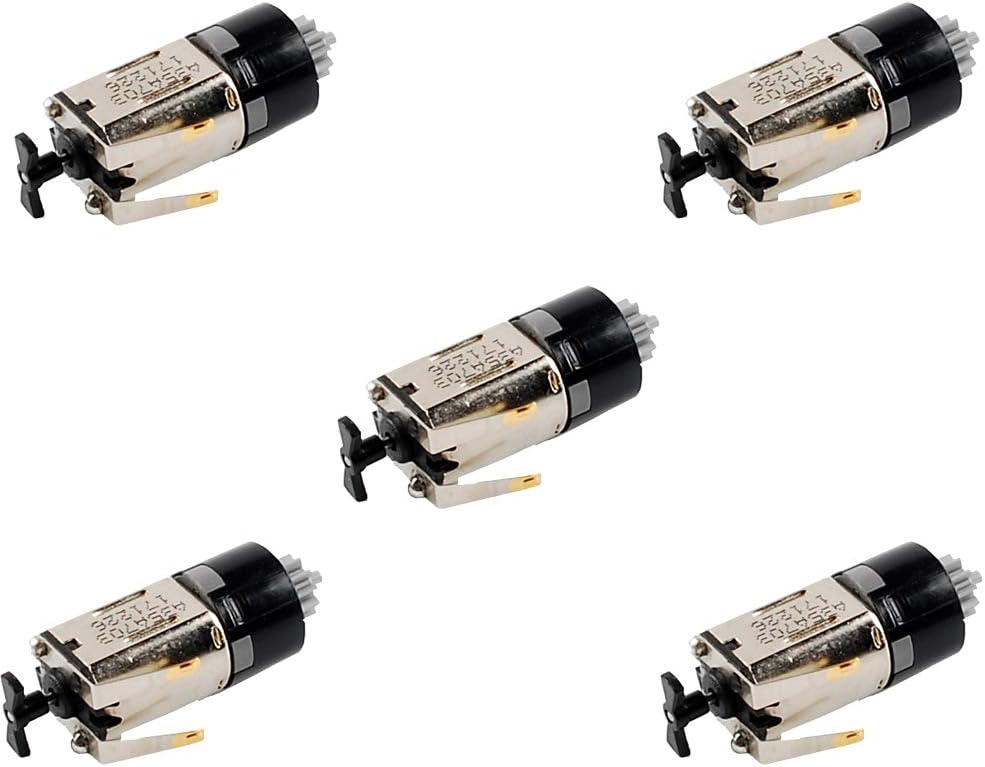

The Acxico Mini Micro N20 is a compact, slow-speed DC gear motor intended for small DIY robot cars. It carries a supplied rating of 4.6 and arrives as a three-pack, which makes it practical for prototypes that need several identical drive components. Its 3–6V operating range also aligns well with common low-voltage battery systems.
We may earn a commission when you buy through this link, at no additional cost to you.
The defining feature is the full metal gearbox. That construction is attractive in a compact motor because it suggests resistance to the impacts and repeated loading common in small mobile robots. The 3mm D-shaped shaft offers more positive coupling than a completely round shaft, while the listed 9mm shaft length helps when planning a wheel or pulley fit.
The main limitation is that the listing does not provide detailed output speed, stall torque, or current figures. That makes it harder to model performance precisely than the more fully specified alternatives. There is also no encoder, so applications requiring accurate wheel position, speed measurement, or stall detection will need separate sensing hardware.
This motor is best suited to compact line followers, mini cars, light pan-tilt mechanisms, and educational robot builds where low weight and a metal gearbox matter more than precise motion feedback. It is a sensible budget-oriented choice for makers who want a ready-to-use geared motor but do not need highly documented performance figures.
The small N20 format makes this motor easy to incorporate into lightweight robot chassis. It can work directly from a small battery or regulated supply, although matching the motor voltage to the control system remains essential.
The all-metal gearbox is a meaningful advantage for small robots that encounter bumps or frequent direction changes. It pairs with the three-pack format to support multi-wheel builds without mixing unrelated motor models.
We may earn a commission when you buy through this link, at no additional cost to you.
This 6–22V planetary gear motor is positioned as a high-torque option for robots, rotating tables, locks, curtains, and other mechanically demanding projects. Its supplied rating is 4.6, while the headline specification of 90 kg.cm makes it substantially stronger than the compact motors in this guide.
We may earn a commission when you buy through this link, at no additional cost to you.
Its broad operating range gives builders flexibility when working with different DC supplies. The listing describes a 200W rating, a mini metal planetary gearbox, and an 8mm D-shaped output shaft. Changing the wiring connection can reverse motor rotation, which is useful for symmetrical mechanisms or robots that need selectable travel directions.
This level of torque comes with size and power requirements that may not suit a palm-sized rover. The 90 kg.cm figure also needs careful interpretation because stall torque, continuous torque, speed, and gearbox condition are not interchangeable. Although the listing names many potential applications, the power source and controller should be sized to handle the motor rather than treating it like a small hobby unit.
Choose this motor for a larger robot arm, geared rotary table, actuator, or heavier mobile platform where strong output is the priority. It is less appropriate for miniature educational robots or lightweight chassis where excess size, current draw, and mechanical stress would outweigh the benefits.
The stated 90 kg.cm output torque gives this motor considerable leverage for resisted movement and high static loads. That makes it more appropriate for robotic mechanisms than for simple high-speed wheel drives.
A 6–22V operating window allows use with several common DC supply arrangements. Reversing the wiring connection adds another layer of control convenience for symmetrical mechanisms.
We may earn a commission when you buy through this link, at no additional cost to you.
This TT motor set is one of the most directly useful packages for beginner and intermediate robot cars. It includes eight 3–6V dual-shaft TT gear motors, four wheels, and 200mm leads with 2.54mm connectors. Its supplied rating is 4.5, and the documented 1:48 ratio and 200RPM speed make the package especially approachable for Arduino builds.
We may earn a commission when you buy through this link, at no additional cost to you.
The included quantity allows builders to create a four-wheel vehicle with spare motors, or work on multiple projects without purchasing small quantities separately. The male 2.54mm connectors are designed for convenient breadboard or terminal-block connections, reducing setup time. At 6V, the listed stall torque is 0.8 kg.cm, giving a useful indication of the motor’s load limit.
These are simple brushed gear motors rather than encoder-equipped units. A control system can still operate them successfully using motor drivers and speed commands, but it cannot directly determine wheel rotation from the motor itself. The 0.8 kg.cm stall figure is also modest compared with the higher-torque options, making them better for small cars than heavily loaded robots.
The set is best for smart cars, line followers, distance-measurement demonstrations, educational robots, and competition prototypes. It is especially attractive when a maker wants several consistent drive motors and matching wheels. For projects that require precise closed-loop positioning, choose an encoder version instead.
Eight motors and four wheels create a convenient foundation for a complete small vehicle. Matching drive components also simplify troubleshooting because identical motors behave more consistently than an assortment of unrelated models.
The 200mm, 28 AWG leads with 2.54mm connectors make the motors approachable for Arduino prototypes. They can connect quickly to a breadboard or terminal blocks while the robot layout is still evolving.
We may earn a commission when you buy through this link, at no additional cost to you.
The 12V encoder gear motor is designed for smart cars, robot models, and similar 12V builds. It combines a 500RPM full-metal gear reduction stage with a magnetic encoder, mounting bracket, and rubber tire wheel. Its supplied rating is 4.4, making it a well-rounded option for makers who want more assembly included than a bare motor.
We may earn a commission when you buy through this link, at no additional cost to you.
The encoder is the main technical advantage over ordinary TT and micro gear motors. It provides the information needed to monitor wheel movement and support more accurate control than open-loop speed commands alone. The listed pure-copper coil, one-piece molded rotor, and full-metal gears are presented as durability and efficiency features, while the enclosed structure helps reduce weight and space requirements.
The listing does not state the encoder’s exact pulses per revolution, output voltage, wiring arrangement, or detailed electrical current data. Those details should therefore be confirmed before designing the control PCB. A 500RPM geared output may also be faster than a slow crawler or precise positioning platform needs, depending on wheel diameter and control method.
This is a strong choice for an Arduino or controller-based smart car requiring encoder feedback and a tire already matched to the motor. It suits builders who want a smart-car package with a bracket and wheel, while still checking electrical details before committing to the design.
The integrated encoder gives a controller a way to measure wheel motion rather than simply applying voltage. This is valuable for straight-line correction, speed regulation, and repeatable movement.
The rubber tire and mounting bracket reduce the need to source separate parts immediately. That makes the package convenient for smart-car experiments and complete model builds.
We may earn a commission when you buy through this link, at no additional cost to you.
The TT Motor with Encoder combines a geared drive, metal shaft, and 12PPR hall encoder in a package designed for robots and smart cars. It has the highest supplied customer rating in the group at 4.7 and is our Editor's Choice because it balances useful feedback, compact gearing, broad voltage support, and stronger mechanical construction.
We may earn a commission when you buy through this link, at no additional cost to you.
Its all-metal 1:90 gearbox is designed for higher torque and load capacity, with 1.0 kg.cm rated torque and 1.8 kg.cm stall torque. The AB-phase encoder provides two quadrature signals, allowing a controller to determine speed and angular position more accurately than a single unidirectional pulse output. At 3–12V, the motor offers flexibility across common battery and regulated supply systems.
The encoder itself operates from 3.3–5V, so its signal level must be compatible with the microcontroller. A dedicated PH2.0 anti-reverse connection interface and status LED simplify wiring, but the exact cable and connector arrangement should be confirmed for the intended controller. The reduced output speed of 113 RPM under no-load conditions also makes this better for controlled, torque-oriented robots than for speed runs.
Choose this motor for a smart car, small tracked robot, robotic platform, or educational system where wheel feedback is important. It is the most technically complete pick for makers who want encoder-assisted control without moving to a much larger geared motor.
The two AB-phase encoder outputs let a controller determine direction as well as detect motion. This supports speed regulation, position tracking, and more reliable correction of heading errors.
The all-metal gearbox and shaft address common wear points in compact drive motors. A 1:90 ratio trades speed for torque, producing 113 RPM at no load under the listed conditions.
We may earn a commission when you buy through this link, at no additional cost to you.
The CQRobot 70:1 Metal DC Gearmotor is the most substantial conventional drive motor in this group. It measures 37mm in diameter and 54.8mm in length, includes a metal MNT bracket, and offers six- or twelve-volt versions. Its supplied rating is 4.6, and the clearly stated speed and torque figures make it suitable for more engineered robot platforms.
We may earn a commission when you buy through this link, at no additional cost to you.
At 6V, the motor has a maximum power of 5W, no-load speed of 75 RPM, and stall torque of 15 kg.cm. The 12V version increases those figures to 10W, 150 RPM, and 27 kg.cm. These differentiated ratings help builders select a supply and calculate drivetrain performance without relying on generic motor claims.
This is still an open-loop motor, so precise position or speed measurement requires an external encoder or other sensor. Its 70:1 reduction produces more torque and less speed than common TT gearboxes, which can be beneficial for traction but may feel slow in small vehicles. The included bracket and 6mm D-shaped shaft simplify mechanical integration into larger custom chassis.
This motor is best for robust wheeled robots, balancing platforms, small RC-style models, smart appliances, and educational mechanisms that need dependable torque. Choose it over a micro motor when durability, mounting hardware, and clearly specified performance matter more than minimum size.
Separate voltage-specific figures for power, speed, and stall torque make planning much more transparent. Builders can choose between a slower six-volt version and a faster twelve-volt version.
The included metal bracket supports more rigid chassis mounting than a loose motor body. A 6mm D-shaped shaft also resists slipping when fitted to a properly sized hub or pulley.
We may earn a commission when you buy through this link, at no additional cost to you.
The 2Pcs 12V High Torque Gear Motor is a compact dual-shaft option for smart robot cars, RC projects, toys, and other electronic mechanisms. It has a supplied rating of 5.0 and comes as a pair, allowing both sides of a two-wheel drive system to use the same motor model. Its 6–12V range and 350RPM speed are easy to match to common hobby power systems.
We may earn a commission when you buy through this link, at no additional cost to you.
The listing emphasizes heat- and wear-resistant metal gears, a pure copper rotor, and a low-noise operating profile. A 4mm steel D-shaped shaft provides positive mechanical engagement, while the double-shaft layout allows hubs or additional components to be fitted on either end. The motor is only 25mm in diameter, making it smaller than the CQRobot unit.
The listing does not provide a numerical torque rating, so the high-torque description should be treated as a product claim rather than a precise engineering value. There is also no encoder, meaning motor position and speed cannot be measured directly. The two-motor pack may be unnecessary for a four-wheel platform that already requires four units.
This pair works well for compact RC-style cars and small smart robots where an open-loop drive is sufficient. It is a good choice for makers prioritizing a small footprint, metal gearing, and matching dual motors, while avoiding it for projects that depend on precise wheel feedback.
A two-motor pack is convenient for small cars and symmetrical mechanisms. Installing equivalent units on both sides can make assembly and maintenance more consistent.
The 25mm diameter keeps the motor manageable for small chassis layouts. The double-shaft arrangement expands mounting options, while the D-shaped profile helps prevent hub slippage.
We may earn a commission when you buy through this link, at no additional cost to you.
The Gikfun Type 130 set is a collection of six miniature brushed DC motors for Arduino projects, hobby vehicles, fans, windmills, and brush bots. Its supplied rating is 4.2, the lowest in this group, but the motors offer a simple and highly versatile foundation for lightweight mechanisms. The recommended operating point is 3V within a broader 1.5–6V range.
We may earn a commission when you buy through this link, at no additional cost to you.
Each motor measures 15 by 20mm and uses a 2mm shaft with a listed length of 9mm. Black and red leads are 15cm long, and the reference current is approximately 0.35–0.4A. At 3V, the listed speed is 16,000 RPM, making these suitable for high-speed mechanisms when paired with appropriate reduction stages.
The absence of a gearbox means the motors are not ready-made wheel drives for typical robot chassis. They also provide no encoder feedback, and their high speed makes direct low-speed control difficult without gearing. Users must match current capacity in the driver and power supply to the stated reference draw.
These motors are best for miniature fans, windmill models, brush bots, solar cars, and custom moving mechanisms. They are less suitable for robots that need strong wheel torque or accurate motion feedback, but they remain useful when flexibility and a multi-pack of consistent components are the priority.
The Type 130 format is useful wherever a small, fast motor is more appropriate than a geared wheel drive. It can power fans, indicators, miniature mechanisms, or a custom reduction assembly.
The 15cm red and black leads make the motors convenient to connect to basic circuits. Six matching units also help when a project needs repeated motion elements.
We may earn a commission when you buy through this link, at no additional cost to you.
The NW 5pcs Micro Planetary Reducer Motor is a low-voltage set intended for compact DIY robot and gearbox projects. Its supplied rating is 4.4, and the package includes five 9161C-style planetary reducer motors. Performance is documented at several voltages, making it easier to estimate how speed and current change with the power source.
We may earn a commission when you buy through this link, at no additional cost to you.
At 3V, the motor is listed at 42mA and 110 RPM. It reaches 135 RPM at 3.7V and 48mA, 154 RPM at 4.2V and 52mA, and 180 RPM at 5V and 58mA. This data makes the motor especially suitable for single-cell or low-voltage battery systems where operating current must remain modest.
The listing is concise and does not provide shaft dimensions, a formal gear ratio, continuous torque, or encoder options. It also does not include wheels, controllers, or mounting hardware. As a result, makers must verify physical compatibility before finalizing a chassis or drivetrain.
This motor set is well suited to tiny mechanisms, lightweight robot arms, and compact gear-driven experiments using 3–5V supplies. It is less suitable for high-load robots, outdoor vehicles, or precise wheel control. Its appeal lies in the five-motor pack, planetary reduction, and clearly listed low-current performance.
Speed and current increase predictably across the listed 3–5V points. This helps builders select a battery configuration that balances mobility against available power.
Five units allow several mechanisms or test rigs to be built with consistent motors. The planetary reducer adds useful motion-control options in a compact package.
We may earn a commission when you buy through this link, at no additional cost to you.
The 12V Mini DC Motor is a straightforward brushed motor for RC cars, toy vehicles, small tools, models, and hobby repair projects. It carries a supplied rating of 4.4 and operates from 6–12V. With a listed maximum speed of 12,000 RPM and a 2.3mm shaft, it is best treated as a versatile power source rather than a finished robot drive.
We may earn a commission when you buy through this link, at no additional cost to you.
The compact format and approximately 12mm shaft length allow it to replace a compatible motor in an existing model. Its 2.3mm shaft can also connect to suitable gears, pulleys, couplers, and other DIY assemblies. The listing specifically recommends checking the original motor dimensions, voltage, shaft, and wiring before ordering, which is sensible for replacement purchases.
The high no-load speed creates substantial demands on the controller and power source. Without a gearbox, the motor may be unsuitable for direct connection to a typical robot wheel because it can rotate too quickly and offer too little low-speed torque. There is no integrated encoder, torque specification, or included mounting hardware.
This motor is best for small RC cars, model projects, science experiments, custom mechanisms, and hobby repair work. It can serve as a robot component after adding suitable reduction gearing, but builders who want an immediately usable drive should favor a TT, planetary, or encoder gear motor instead.
The motor’s small dimensions and conventional 6–12V operation make it a practical option for replacing a compatible component. It is also useful as the input stage of a custom gear train.
A listed maximum of 12,000RPM makes gearing or careful power management important. Direct drive is most appropriate when rapid rotation is desired rather than controlled low-speed movement.
We may earn a commission when you buy through this link, at no additional cost to you.
Choosing a robot motor requires matching mechanical strength, speed, power, feedback, and mounting needs to the finished design. The following factors help narrow the field before you evaluate shafts, gearboxes, and electrical ratings.
Voltage is the first constraint because it determines which power source and motor driver can safely power the motor. The selections here range from 1.5V miniature hobby units to a model rated as high as 22V. Matching the motor to the battery chemistry, regulator, and controller avoids excess heat, accelerated wear, or inadequate performance. A motor rated for a broad range can accommodate more than one supply, but its output speed and torque still change with voltage.
Choose a motor whose listed voltage range comfortably contains your planned supply. For a 12V lead-acid system, a nominal 12V motor is the natural fit; for a 3.7V lithium cell, look for a low-voltage option or confirm that the motor can safely operate at the cell’s fully charged voltage.
Torque determines whether a motor can move its own mechanism, lift a load, or push through resistance. The guide includes motors advertised at 0.8 kg.cm stall torque, 1.8 kg.cm stall torque, 15 to 27 kg.cm stall torque, and a 90 kg.cm output figure. These values come from different product designs and measurement approaches, so compare them only as rough indicators unless the test conditions are identical.
Calculate the force required at the wheel or joint, add a safety allowance, and then choose a geared motor with enough output. Remember that stall torque describes a brief maximum rather than dependable continuous output; heat, gearbox efficiency, and duty cycle ultimately limit sustained performance.
A gearbox reduces motor speed and increases torque, making it easier to control a robot wheel or joint. Ratios in this group range from the 1:48 TT gearbox to the 1:90 encoder gearbox and 70:1 metal gearmotor. The CQRobot also provides useful no-load speeds at both six and twelve volts, while the standard TT motor is listed at 200 RPM.
Match output speed to the task. Faster motors suit speed-oriented cars, while high ratios are useful for crawlers, lifting mechanisms, and precise positioning. Remember that wheel RPM, vehicle speed, and motor RPM are different measurements, so account for wheel diameter and the full drivetrain when estimating performance.
Encoder feedback allows a robot controller to measure wheel rotation, detect movement, and correct speed or heading errors. The 12V encoder gear motor and TT encoder model are better choices when closed-loop control matters, with the latter providing AB-phase quadrature output at 12PPR. Open-loop motors can still work in simpler line followers or educational cars, but position and speed must be inferred indirectly.
Choose an encoder when the robot must make repeatable turns, hold a heading, monitor distance, detect a stalled wheel, or perform coordinated movement. Check its output voltage and signal type against the microcontroller, and plan proper wiring to prevent encoder noise from affecting the motor drive.
Shaft diameter and shape determine whether a wheel, pulley, coupler, or gear can mount securely. D-shaped shafts appear on several stronger motors and resist slipping better than a purely round shaft, while miniature Type 130 and 12V replacement motors use much smaller shafts. Shaft length and the flat dimensions must also fit the intended hub.
Measure the existing component before buying a replacement, and include the shaft flat when calculating clearance. For new builds, choose a motor and wheel as a matched mechanical set rather than forcing an adapter onto an unfamiliar shaft. The six- and ten-millimeter shafts used by larger geared motors are generally more substantial for custom platforms.
Housing and gearbox construction affect heat dissipation, impact resistance, noise, weight, and service life. Full-metal gearboxes appear in the Acxico N20, the 12V encoder gear motor, the TT encoder model, and the CQRobot gearmotor. The general Type 130 and 12V mini motor are simpler brushed units intended for lighter or more specialized mechanisms.
For a robot that bumps obstacles, starts and stops repeatedly, or carries a meaningful load, a metal gearbox is generally a more durable choice. For a fan, windmill, or lightweight test rig, a simpler motor can be adequate. Always consider the complete gearbox rather than assuming that a metal housing alone guarantees long life.
The motor’s physical envelope affects chassis design, wheel placement, center of gravity, and battery space. The Type 130, N20, and NW planetary motors are suited to small builds, while the 37mm-diameter CQRobot requires a more substantial platform. The high-torque planetary unit is larger still and may function better as an actuator than as a compact wheel motor.
Compare the complete motor dimensions, shaft geometry, bracket, and wheel package before ordering. A multi-pack is useful for symmetry or spares, but it can be unnecessary if the robot requires a different number of motors. Buying a matched set can simplify assembly, although careful mechanical design should take priority over package quantity.
A motor’s voltage is only one part of the electrical design; current capability and heat management are equally important. Some listings include current data, such as approximately 0.35–0.4A for the Type 130 motor and 42–58mA across the NW motor’s voltage range. Other products do not publish detailed current figures, making conservative driver selection and current measurement especially important.
Use a motor driver rated for both the motor’s stall current and the robot’s supply, include adequate bulk capacitance near the driver, and avoid leaving a motor stalled against an obstruction. Motors that run warm, stall frequently, or operate near their limits need a lower duty cycle or a more capable power system.
Begin by confirming the motor voltage, current, shaft dimensions, and intended load against the robot design. Mount the motor rigidly with its shaft aligned to the wheel or driven mechanism, and use the appropriate screws, brackets, hubs, and shaft collars rather than relying on friction alone. For D-shaped shafts, make sure the hub flat matches the motor shaft flat.
Power the motor through an appropriate DC motor driver rather than directly from a microcontroller pin. Keep the motor supply and logic supply properly regulated, connect the encoder or other sensors according to their wiring instructions, and confirm that the controller can tolerate the selected encoder voltage. Add a flyback or suppression circuit as specified by the driver manufacturer to protect switching components.
Test each drive in short bursts before attaching the full chassis. Watch for unexpected rotation, vibration, gearbox noise, excessive current, loose wheels, and inconsistent encoder readings. During use, avoid prolonged stalls, keep connections secure, and protect the motor from dust, moisture, and excessive heat. Replace worn wheels, loose collars, or damaged leads before they affect control accuracy.
A geared motor is usually the most convenient choice because it provides more usable wheel torque than a bare brushed motor. TT gear motors suit lightweight Arduino cars, while planetary or metal gear motors offer additional strength for larger platforms. The best option depends on the robot’s weight, wheel size, battery voltage, and whether encoder feedback is required.
Encoders are not mandatory for every robot, but they are valuable when the controller must measure speed, position, distance, or direction. They enable corrective steering and wheel-speed regulation that open-loop motors cannot provide directly. A simple line follower may work without them, while a navigating or accurately turning robot will benefit substantially from encoder feedback.
Use the voltage supplied by the robot’s battery system as the starting point, then confirm that it lies within the motor’s rated range. A 3.7V lithium cell is not equivalent to a nominal 12V lead-acid battery, and a motor’s speed and torque will change across its operating range. Always account for the battery’s fully charged voltage and the current required during startup and stall.
No. A higher gear ratio generally increases output torque while reducing output speed, but it can make a robot slow or less responsive. Lower ratios favor speed, while higher ratios favor climbing, lifting, and controlled movement. Choose the ratio based on the mechanism, wheel diameter, and desired performance rather than treating one ratio as universally superior.
A bare motor can be used, but it usually spins very quickly and provides limited low-speed torque. Most robot builders add a gearbox to make the motor easier to control. If using a bare motor, verify shaft compatibility, fit the wheel securely, provide a strong enough motor driver, and accept that closed-loop speed control will be difficult without an external sensor.
A TT motor is a compact, commonly available drive motor with a relatively high speed and modest gearbox ratio. A planetary gearmotor uses a planetary gear arrangement and often offers a larger body, more torque, and a more precisely specified output. TT motors are convenient for beginner smart cars, while planetary motors are generally better for stronger, slower, or more mechanically demanding mechanisms.
Use a hub that matches the shaft diameter and shape, then prevent movement with a shaft collar, set screw, or other positive locking method. D-shaped shafts require a matching flat. Do not rely solely on a tight friction fit because vibration and changing loads can loosen it. Check the connection after the first test and periodically thereafter.
Metal gears are generally preferable for robots that encounter impacts, carry loads, or run for long periods. They improve strength and impact resistance compared with basic plastic gear trains, although they do not make a motor immune to overheating or overload. Match the gearbox size and torque rating to the mechanism, and still prevent the output shaft from stalling.
The 8pcs TT Motor set stands out as a practical budget choice for Arduino smart cars because it includes eight motors, four wheels, and breadboard-friendly connections. The TT Motor with Encoder is the most capable precision-oriented selection, offering AB-phase feedback, an all-metal 1:90 gearbox, and a wide 3–12V operating range. For heavy-duty conventional drives, the CQRobot 70:1 gearmotor provides clearly documented torque, speed, and mounting hardware.
Prioritize voltage compatibility first, followed by the load and output speed your mechanism requires. Choose an encoder when your robot must measure or correct movement, select a metal gearbox for repeated or demanding use, and verify shaft and mounting dimensions before ordering. A multi-pack is useful for matching drive wheels, while a high-torque actuator may suit a robot arm better than a mobile chassis.
Finally, review the current listing before buying because motor specifications, availability, and prices can change. Compare the motor with your battery, motor driver, wheels, and controller as one complete system. A technically suitable motor paired with inadequate electronics or mismatched hardware can still produce poor results, while careful matching creates a more dependable robot.