
Honeywell TurboForce Air Circulator
4.6Editor score
Compact tabletop format
Three selectable speeds
Ninety-degree pivoting head
Quiet personal airflow
Dorm room fans must balance useful airflow with a compact footprint, quiet operation, and features that work well in a shared or tightly arranged space. The right model can improve circulation around a desk or bed while remaining easy to store, direct, clean, and operate throughout a busy study day or restful night.
This guide compares ten tower, pedestal, desk, and compact air circulators using the information supplied for each product. We focused on room coverage, sound levels, motor type, oscillation, controls, timers, power requirements, cleaning access, and the practical value of each feature in dorm environments.
Each pick highlights a different approach, from budget-friendly personal fans to smart models and adjustable standing circulators. Ratings reflect the supplied customer feedback, while specifications and feature details are taken from the product listings; prices and availability can change, so verify current details before purchasing.
4.6Editor score

4.7Editor score

4.7Editor score
As an Amazon Associate we earn from qualifying purchases.
The table below compares all ten fans by their physical format, airflow reach, sound characteristics, controls, and practical dorm-friendly features. It highlights the differences between personal desk models, room circulators, smart fans, and adjustable standing fans.




The DREO 28-Foot Tower Fan combines a narrow vertical profile with relatively broad control over airflow, making it a practical consideration for dorm desks, bedside tables, and tight study corners. Its supplied rating is 4.5, and the most notable strengths are the brushless DC motor, eight speed settings, four operating modes, and a maximum airflow velocity of 28 feet per second.
We may earn a commission when you buy through this link, at no additional cost to you.
The tower format is particularly useful when horizontal desk space is limited. Its airflow can project as far as 34 feet, while 90-degree oscillation helps spread that stream across a broader portion of the room. Normal, Natural, Sleep, and Auto modes make it easier to shift between a focused breeze, variable airflow, quieter nighttime operation, and automatic adjustment.
The fan is not as powerful as the largest high-output circulators in this guide, so it is better suited to personal cooling and steady room circulation than large-space air movement. A possible inconvenience is that it requires a power outlet during use. Its detachable rear grille and impeller, however, simplify routine cleaning, and safety features include a pinch-proof grille, fused plug, and circuit protection.
This tower fan is a strong recommendation for students who want several operating modes, unobtrusive storage, and flexible directional cooling without investing in a larger pedestal model. It works particularly well for a dorm desk where a traditional wide-blade fan would take up too much room or obstruct study materials.
Eight speeds and four modes let you tune the fan more precisely than a basic three-speed desk model. The remote and touch controls also make it easy to change settings without reaching across a crowded desk.
The upright body preserves desk space, while 90-degree oscillation distributes the narrow tower's stream. This format is well suited to dorms where every horizontal inch of work surface matters.
We may earn a commission when you buy through this link, at no additional cost to you.
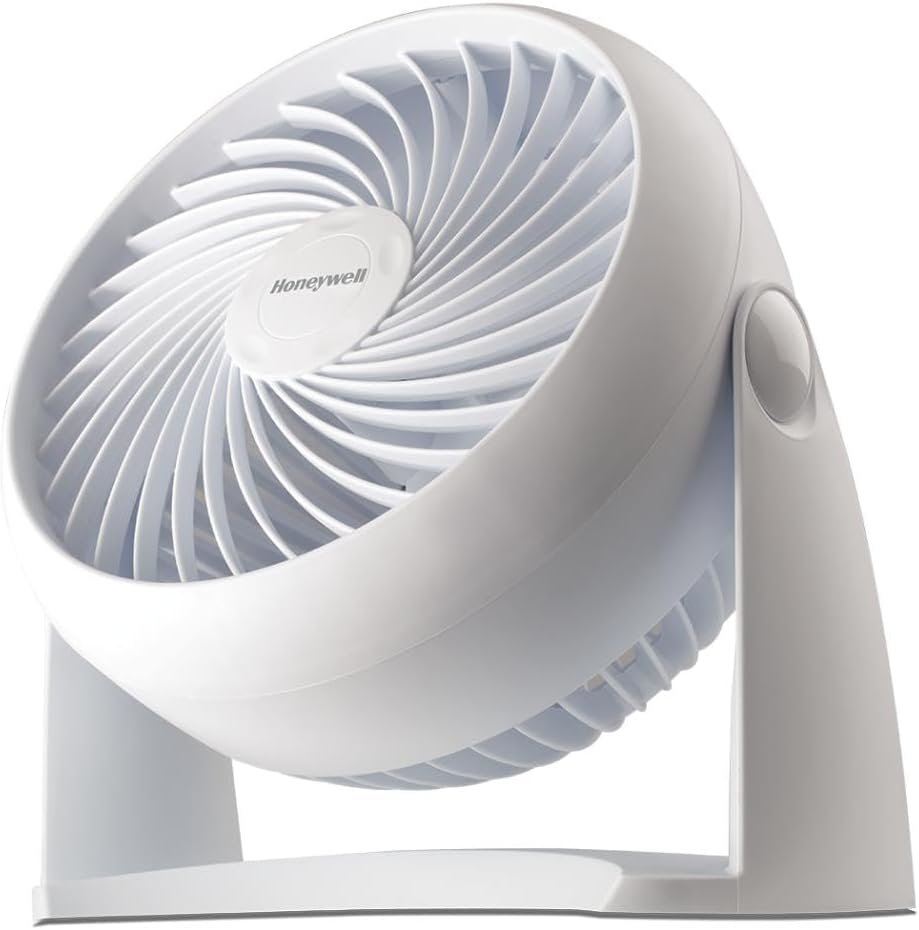
The Honeywell TurboForce HT900 is a compact, uncomplicated personal fan with a supplied rating of 4.6. It can sit on a desk, small table, or floor and may also be wall-mounted, giving dorm residents multiple ways to position it without occupying much space.
We may earn a commission when you buy through this link, at no additional cost to you.
Its aerodynamic turbo design is intended to maximize air movement and power for cooling or circulation. Honeywell states that the airflow can be felt from up to 25 feet away. The three speed settings cover a range from a gentle personal breeze to stronger circulation, while the adjustable head can pivot through 90 degrees to redirect the stream toward a chair, bed, or desk.
This model does not offer the app integration, timers, automatic modes, or broad speed selection found on newer models. Its appeal comes from straightforward design and portability rather than extensive features. Because it operates as a personal circulator and can be positioned at different heights or angles, it can remain useful in several parts of a dorm room.
The Honeywell HT900 is an excellent choice for students who want a simple, affordable personal fan that is easy to direct and carry. It is particularly well suited to a compact study desk where a larger fan would be inconvenient and where basic three-speed control is preferable to complicated menus.
Three speeds and a pivoting head cover the main needs of a personal fan without a learning curve. You can redirect or reduce the breeze quickly when studying, resting, or sharing the room.
The fan can be used on a table, placed on the floor, or mounted on a wall. Those options help students adapt its position as furniture, bedding, and study schedules change.
We may earn a commission when you buy through this link, at no additional cost to you.
The Levoit Tower Fan is designed around low-noise operation, a portable form, and a strong focused breeze. It has a supplied rating of 4.4 and maintains sound output from 20 to 43 decibels across its speed levels, with optional display and sound shutoff functions for a quieter environment.
We may earn a commission when you buy through this link, at no additional cost to you.
VortexAir Technology and an efficient DC motor support airflow reaching up to 23 feet per second. Five normal speeds plus a Turbo setting offer more variation than most compact personal fans, while oscillation can be set at 30, 60, or 90 degrees. The maximum operating power is listed at 7.5 watts, making it suitable for extended daily use.
Its soft carrying handle and minimalist tower shape make it easy to move between a desk, bedside table, and another room. One limitation is that it must remain connected to an outlet, and the supplied information does not list a timer. The focused nature of its airflow may also make it less suitable than full-room circulators for rapidly moving air throughout a large space.
This Levoit model fits students who prioritize quiet operation, low power use, and portability. It is a thoughtful choice for late-night study, shared rooms, or anyone sensitive to the constant hum of a conventional fan, especially when the narrow footprint is more valuable than sweeping room circulation.
The 20-decibel minimum and optional sound and display shutoffs are useful during reading, online classes, and sleep. Even at higher settings, the design aims to keep the fan's presence less distracting.
A built-in carrying handle makes room-to-room movement simple, while the listed maximum of 7.5 watts supports extended use. The trade-off is the need for a nearby outlet.
We may earn a commission when you buy through this link, at no additional cost to you.
The DREO Smart TurboWind Fan is the most feature-rich model in the guide, with a supplied rating of 4.7 and a combination of strong airflow, quiet operation, smart controls, and scheduling. Its 12-inch body is still compact enough for a dorm, but it is more substantial than the smallest personal circulators.
We may earn a commission when you buy through this link, at no additional cost to you.
TurboWind technology is listed to deliver up to 950 CFM and send airflow as far as 85 feet. The next-generation brushless DC motor can run as low as 20 decibels, offering a potentially useful balance for study and sleep. Vertical and horizontal 90-degree oscillation help the fan distribute air around the room rather than confining it to one narrow target.
Remote-free operation is possible through the DREO app, Alexa, or Google Home, while the controls also support nine speeds, six airflow modes, and eight- or twelve-hour timers. A child lock, power-off memory, and automatic screen shutoff add convenience in a shared room. The trade-offs are a more complex control setup and a larger body than basic tabletop models.
This is the most versatile recommendation for a modern dorm that already uses smart-home devices or whose resident wants precise scheduling and remote adjustment. Its airflow reach and dual-axis movement also make it suitable for students who expect to use one fan for both focused desk cooling and broader circulation.
App and voice control make it convenient to change speed, mode, oscillation, or timing without leaving the bed or desk. Power-off memory helps preserve your last setting between uses.
The stated 950-CFM output and 85-foot reach exceed the capability of most personal desk fans here. Dual-axis oscillation further reduces the chance that one side of the dorm remains stagnant.
We may earn a commission when you buy through this link, at no additional cost to you.
The DREO Adjustable Standing Fan is built for stronger whole-room movement than the compact personal models in this guide. It carries a supplied rating of 4.7 and is listed to circulate up to 1,000 CFM as far as 90 feet, making it a strong option for dorms with awkward airflow, high ceilings, or multiple occupants.
We may earn a commission when you buy through this link, at no additional cost to you.
Its adjustable height ranges from 38 to 42 inches, allowing the airflow to be aimed lower for pets or children, at mid-level for general room use, or higher toward someone lying in bed. The head also pivots through 105 degrees and the fan oscillates horizontally through 90 degrees. Eight speeds plus Auto mode provide a good range of manual and automatic operation.
A DC motor supports smooth airflow and quiet operation, while a remote control can mute button beeps and the fan offers an eight-hour timer. The blade, front grille, and rear grille separate for cleaning, and a built-in aroma pad can add fragrance. The trade-off is its larger physical footprint compared with desk and tower fans, along with the need for a power outlet.
This standing model is recommended for students who want a single fan to serve multiple parts of the room. It is especially useful when the fan must move beyond a desk and reach across the sleeping and study areas, making it a premium alternative to buying several smaller personal fans.
Height adjustment, a 105-degree pivoting head, and horizontal oscillation provide more ways to shape airflow than a basic desk model. That flexibility is valuable when the room's use changes throughout the day.
The listed 1,000-CFM output is among the strongest here, while removable blades and grilles simplify cleaning. An aroma pad adds an optional scent feature, though the fan still requires a wired connection.
We may earn a commission when you buy through this link, at no additional cost to you.
The DREO Eleven-Inch Circulator offers a balanced combination of power, compactness, and straightforward operation. Its supplied rating is 4.5, and the listing describes airflow of up to 750 CFM reaching 65 feet through TurboSilent and an airfoil blade design.
We may earn a commission when you buy through this link, at no additional cost to you.
The fan can oscillate horizontally through 90 degrees and tilt manually through 120 degrees, allowing the stream to cover both the bed and desk when properly positioned. Four speeds and two wind modes are controlled through a remote or the control panel. An eight-hour timer supports longer operating periods, and the automatic screen shutoff prevents the display from interrupting a sleeping environment.
At a minimum sound level of 25 decibels, it is quieter than many conventional fans but not as low as the 20-decibel models in this guide. Cleaning is improved by detachable front grille and blades. Compared with the DREO Smart TurboWind, it has fewer speeds and no smart-home integration, but it also avoids the more complicated setup.
This model is a strong all-around choice for a student who wants more reach than a personal fan without using a large pedestal. It fits well on a sturdy desk or cabinet near the center of the room, provided the power cord can reach an outlet and the furniture is stable enough to support the fan.
Horizontal oscillation and a broad manual tilt let the fan cover several areas around a desk or bed. The included remote makes direction and speed changes convenient after positioning.
A low 25-decibel operating level and automatic screen shutoff make the model considerate for nighttime use. The eight-hour timer also allows scheduled operation without continuous supervision.
We may earn a commission when you buy through this link, at no additional cost to you.
The Honeywell TurboForce HT-904 is a compact personal fan whose supplied rating is 4.6. It is designed for desks, tables, small floors, or wall mounting, making it a natural fit for students who want a straightforward breeze without occupying much space.
We may earn a commission when you buy through this link, at no additional cost to you.
The aerodynamic design is intended to maximize movement and cooling, with the manufacturer stating that the fan's power can be felt from up to 25 feet away. Users select from three speeds and pivot the head through 90 degrees, allowing the fan to be aimed toward a work area during the day and a bed at night.
Its main strength is simplicity. There is no timer, app, voice assistant, or complicated mode selection in the supplied specifications. The result is a fan that can be understood and operated almost immediately, which can be valuable in a temporary living environment where convenience and portability matter more than elaborate automation.
The HT-904 is a good recommendation for anyone who values uncomplicated controls and a small footprint. It works particularly well as a personal cooling fan for one desk, one bed, or one corner of a room, although students seeking full-room circulation should choose a model with a larger stated CFM output.
Three speeds and a movable head cover the essential cooling controls. This makes the fan quick to set up and easy for multiple roommates to understand.
The small housing works on a desk, table, or floor and can be wall-mounted. That flexibility lets you adapt it to dorm furniture that may change position during move-in or move-out.
We may earn a commission when you buy through this link, at no additional cost to you.
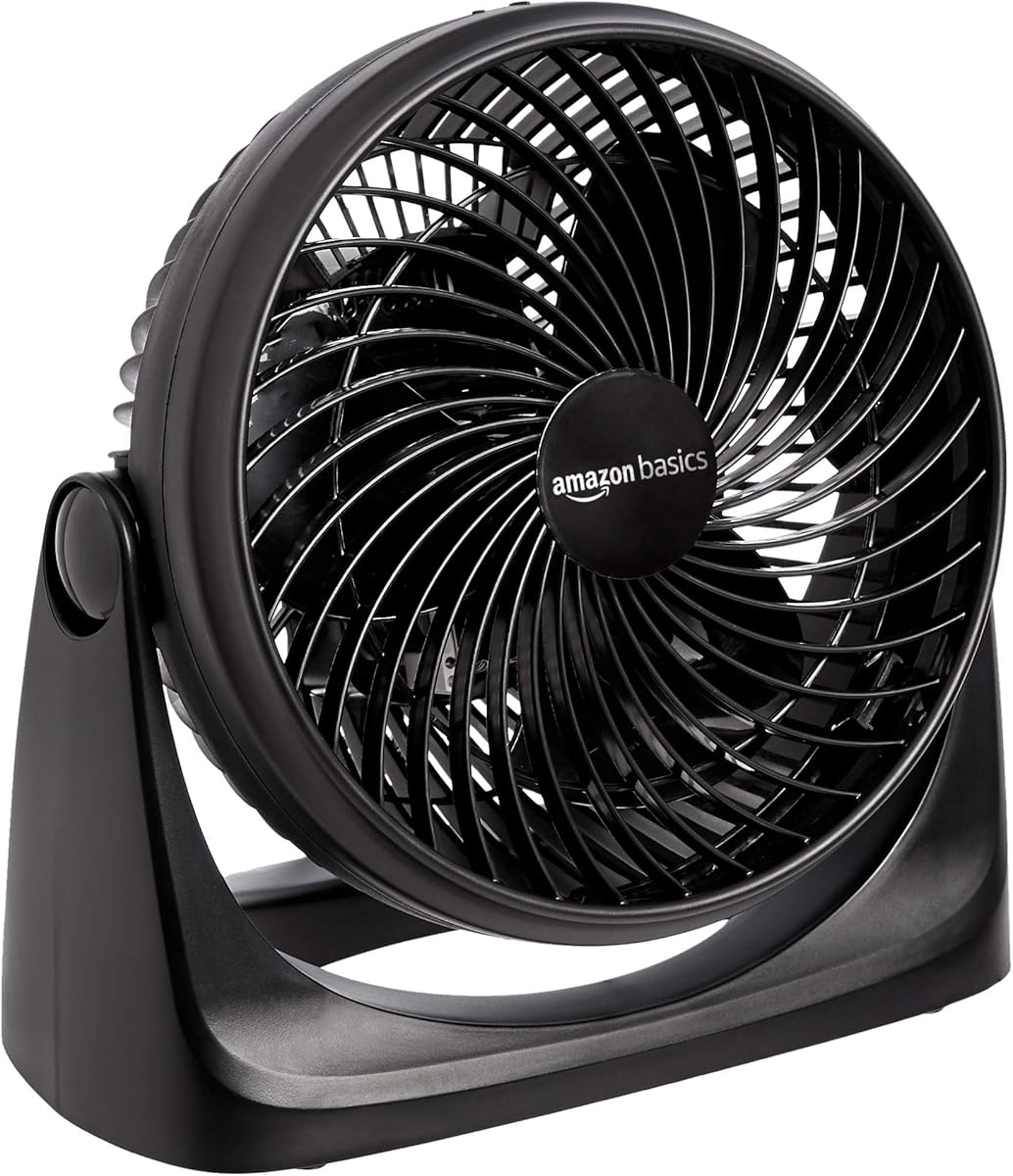
The Amazon Basics Air Circulator is a basic but versatile desk fan with a supplied rating of 4.3. Its 11.1-inch width, 6.3-inch depth, and 10.9-inch height allow it to fit on desks, counters, small tables, or floors in bedrooms, offices, and kitchens.
We may earn a commission when you buy through this link, at no additional cost to you.
A 90-degree variable tilt directs airflow toward different parts of the room, while three speed settings are selected with a rear-mounted control knob. The three seven-inch blades are designed to enhance airflow without requiring a large housing. At 35 watts and 120 volts, it provides a conventional level of energy-efficient operation for a small personal fan.
The model does not include a remote, timer, oscillation, or advanced airflow mode, so it is less flexible than the DREO and Levoit models. Its three-pound weight does make it easy to carry between rooms, and the basic control interface reduces the likelihood of accidental changes. The listed power draw is higher than that of several DC-motor alternatives in this guide.
This Amazon Basics fan is most appropriate for students who want a simple, lightweight circulator and do not need remote operation or scheduling. It may also serve as a useful backup fan for a desk, study group room, or shared space where multiple basic units can each provide a personal breeze.
The rear knob provides clear low, medium, and high selections, while the tilting head lets you redirect the stream. These uncomplicated controls suit dorms and shared spaces.
The fan weighs only three pounds and occupies relatively little space. It can be moved easily when you need your desk for notebooks, a laptop, or coursework.
We may earn a commission when you buy through this link, at no additional cost to you.
The DREO TurboSilent Table Fan combines high stated airflow with a low 20-decibel operating level. It has a supplied rating of 4.4 and is designed to circulate up to 800 CFM as far as 60 feet, offering more room-level capability than a conventional personal desk fan.
We may earn a commission when you buy through this link, at no additional cost to you.
The fan's turbine-inspired airflow design is intended to move air quickly and reduce stagnant areas. A manual tilt range from minus 30 to 90 degrees provides broad vertical direction, and the integrated handle also supports wall mounting. That mounting option can improve circulation above a desk or bed while freeing the work surface.
Three speeds are controlled with a simple knob, providing light, moderate, and stronger airflow. There is no listed timer, remote, or smart-home control, so this is not the most automated option. Even so, the combination of high CFM, 20-decibel minimum noise, and simple physical controls can make it highly practical for focused dorm use.
This model is recommended for students who want serious air movement without a large standing fan. It works especially well when low noise is important, such as during late-night study or sleeping, and when wall mounting can place the airflow closer to the ceiling for broader distribution.
The specified 20-decibel low mode is useful for bedrooms and study areas, while 800 CFM provides substantial movement. It is a capable alternative to larger fans when desk space is limited.
The built-in handle supports wall mounting, allowing you to elevate the fan and direct its output across the room. The broad tilt range adds further control over the airflow path.
We may earn a commission when you buy through this link, at no additional cost to you.
The IRIS USA WOOZOO Circulator is a compact remote-controlled fan with a supplied rating of 4.4. At 3.5 pounds and measuring 7.09 inches long and wide by 9.84 inches high, it is small enough for desks, countertops, and nightstands.
We may earn a commission when you buy through this link, at no additional cost to you.
Its auto-oscillation function can sweep through 65 degrees to distribute airflow toward multiple corners of a room. The head also offers six manual tilt settings, letting users combine vertical positioning with side-to-side movement. Three speeds range from a whisper-quiet breeze to a stronger gust for personal cooling.
The included remote controls power, mode, speed, oscillation, and the timer without requiring the user to leave a seat. One-, two-, and four-hour shutoff options are useful for winding down before sleep, although there is no stated all-night timer. Compared with the most advanced smart models, the WOOZOO lacks app and voice-assistant integration, but it offers the relevant features in a simpler format.
This fan is a good fit for students who want remote and timer convenience in a compact unit. It works well for a nightstand or desk where a small footprint and simple remote are more important than the very high airflow output of larger DREO standing circulators.
Changing speed, mode, oscillation, or timing without getting up is convenient when the fan operates from a nightstand. It also reduces the need to reach across a cluttered desk.
The one-, two-, and four-hour timer choices suit short cooling sessions and bedtime routines. Although shorter than some extended timers elsewhere, the options are straightforward and easy to understand.
We may earn a commission when you buy through this link, at no additional cost to you.
The right dorm fan depends on your room layout, noise tolerance, outlet placement, and desired level of control. These factors help narrow a large catalog of circulation claims into the features that will matter most after move-in.
Airflow specifications help distinguish focused personal fans from models intended to circulate air across a dorm room. Reach measurements indicate how far the stream is designed to travel, while CFM figures describe the volume of air moved per minute. A compact desk fan may feel powerful when aimed directly at one person but may not distribute air evenly around the room. Conversely, a high-output circulator can move more air across a larger area.
Choose based on your room and positioning. Personal airflow is enough for a desk or bedside setup, while long reach and high CFM are preferable when the fan must serve both a bed and a study area.
Sound specifications matter most in small rooms where fan noise travels directly to the sleeper or study area. Models with a 20- or 25-decibel minimum are especially interesting for quiet bedrooms, while higher-output fans may create more noticeable sound during operation. Display shutoff, sleep modes, and muted button tones can further reduce distractions.
Prioritize a low minimum sound level if you work late, study in your room, or sleep with the fan nearby. Always consider whether you will use the lowest or highest setting most often.
Dorm rooms often contain limited desk space and narrow gaps between furniture. A tower fan uses a narrow vertical footprint, a personal circulator fits neatly on a desk, and a standing model provides more height and room coverage but takes up additional floor area. Portable handles and lightweight construction matter when dorm furniture is rearranged frequently.
Measure your intended surface and clearance before choosing. Favor a slim tower or compact tabletop model if every inch of desk space is important; consider a pedestal fan only when floor area is available.
Basic knob controls are fast and reliable, remotes are convenient when the fan is out of reach, and apps can offer more precise scheduling. Timers are useful for limiting overnight operation, while display shutoff prevents bright controls from disturbing sleep. More features are not automatically better if they make the fan difficult to operate.
Choose simple three-speed controls for a shared room or a basic setup, and consider remote or app operation when you want to change airflow without leaving your bed or desk.
Oscillation moves the fan horizontally, while tilt or pivoting controls change the vertical direction. Combining both features helps a compact unit cover a wider portion of the room. Fixed-direction fans are often adequate for a single desk but can leave other corners feeling stagnant. Consider whether the fan will be placed near the center of the room or along a wall.
Look for broad horizontal movement and useful vertical tilt if you plan to direct air toward multiple surfaces. Personal fans with a pivoting head are sufficient when the target area stays in one position.
Every model in this guide is intended for use with an outlet, and several explicitly identify themselves as plug-in rather than cordless. Outlet placement can determine where a fan is practical, especially if the desk has no accessible socket. A carrying handle or low weight makes it easier to move the unit to another surface or room.
Check cord length and outlet location before buying. Even portable-looking fans become difficult to relocate when they must remain tethered to a specific wall or floor outlet.
Dust on blades and grilles can reduce airflow and affect how a fan sounds over time. Removable blades, front grilles, rear grilles, and impellers make routine cleaning easier. Because dorm rooms often contain books, clothing fibers, and other airborne debris, a design that can be disassembled without complicated tools deserves additional consideration.
Choose models with accessible removable components when possible. Follow the manufacturer's cleaning instructions and disconnect the fan from power before removing any guard or blade assembly.
A stable base, protected grille, fused plug, and automatic shutoff can be valuable in a crowded room. The DREO tower fan specifically lists a pinch-proof grille, fused plug, and circuit safety features, while several smart models include child locks. Wall-mounted options should be installed according to the manufacturer's instructions and kept away from bedding.
Look for recognized safety markings and stable placement surfaces. Avoid placing a fan where it can be knocked over easily or where its controls and grille can be obstructed.
Begin by placing the fan on a stable surface with adequate clearance around the grille and blades. Position it where the airflow can reach you without being blocked by bedding, curtains, books, or other objects. Connect the unit to a suitable outlet, read the control instructions, and begin with a low setting to determine how the airflow feels in your specific room.
Adjust speed, mode, oscillation, and timer according to your activity. Use lower settings and sleep or quiet modes while resting, and reserve higher settings for quick cooling in a closed room. For a circulator, place it near the center of the available floor space when possible, and experiment with tilt and oscillation to reduce stagnant areas around the bed and desk.
For cleaning, switch the fan off, unplug it, and let the blades stop completely before removing any accessible grille or component. Wipe dusty surfaces with a soft, slightly damp cloth, avoid spraying liquid into openings, and do not immerse the motor or electrical parts. Reassemble every guard and blade correctly, check that the base is stable, and schedule occasional cleaning to keep airflow consistent.
Tower fans are often better when desk space is limited because their narrow bodies can fit beside a monitor or between other objects. Desk fans are usually easier to reposition and may offer more precise aiming at one workstation. The right choice depends on whether your priority is compact storage, personal cooling, or broader room circulation.
Look for the lowest published sound level and a model with sleep mode or display shutoff. The Levoit and DREO TurboSilent models offer 20-decibel minimum operating levels, while the DREO Eleven-Inch Circulator lists 25 decibels. Actual noise varies with room acoustics, fan speed, and surface vibration, so lower settings are usually the quietest.
A fan improves comfort by moving air across your skin and circulating warmer air, but it does not lower the actual room temperature like an air conditioner. It can make a room feel more comfortable and may reduce the need to run cooling equipment, but it is not a substitute for active refrigeration in extreme heat.
Oscillation is useful when you want air to reach both a bed and a desk or several people sharing a room. A fixed or manually aimed fan is sufficient if the airflow only needs to reach one area. Auto oscillation is convenient but not essential, and a broad manual tilt can provide similar flexibility.
Smart controls are useful for changing settings remotely, creating schedules, and integrating with a voice-assistant setup, but they are not essential for basic cooling. The DREO Smart TurboWind offers the broadest connected features, while simpler remotes and timers may be enough for students who want fewer controls and easier operation.
Turn the fan off, unplug it, and wait for the blades to stop before touching removable parts. Wipe the housing and grille with a soft damp cloth, and clean accessible blades according to the manual. Do not spray cleaner directly into the motor or immerse the unit in water, and reinstall all guards securely before use.
Only use the fan overnight if the manufacturer permits continuous operation and you select an appropriate timer. Several models include timers, while others may not. Keep the fan stable, away from bedding that could block airflow or create heat buildup, and follow all cleaning and electrical safety instructions.
Place it on a stable surface near the area where you want the strongest airflow, while leaving clearance around the grille. For circulation, position the fan where it can move air toward an open area rather than directly into a wall or tight corner. Ensure the cord does not obstruct walkways and that the outlet remains accessible.
The DREO Smart TurboWind Fan stands out as the most versatile overall option because it combines high stated airflow, low-noise operation, dual-axis oscillation, smart controls, and extended timers. The Honeywell TurboForce HT900 is the simplest budget-oriented choice, while the DREO Adjustable Standing Fan offers the strongest premium feature set for moving air around an entire room.
For most students, the best choice is the fan that matches the available space and the desired cooling pattern. Choose a slim tower when desk space is scarce, a compact personal circulator for focused cooling, a high-output desk model for stronger circulation, and a standing fan when one unit must cover both the bed and study area. Quiet operation, accessible outlets, and easy cleaning deserve as much attention as maximum airflow.
Before purchasing, compare the current product listing, room dimensions, outlet location, and included features. Customer ratings and specifications can change over time, and prices and availability also fluctuate. Checking the current listing helps ensure that the model still meets your dorm's noise, space, control, and airflow requirements.