
GQ GMC-300S
4.6Editor score
Internal data logging
Rechargeable battery
PC data viewer
Dosimeter buying guide comparing 10 portable radiation monitors for accuracy, alarm features, displays, data logging, battery life, and ease of use.
A dosimeter measures ionizing radiation so you can understand dose rates, accumulated exposure, and changing conditions around you. The right device depends on the sensor technology, measurement range, alert options, portability, and amount of historical data needed for home, laboratory, medical, or professional monitoring.
We compared the ten featured dosimeters using their published specifications, detector types, supported radiation types, displays, alarm systems, logging capabilities, power options, and intended environments. The list covers Geiger-Müller instruments, semiconductor devices, a personal card detector, and a CsI scintillator model for buyers with different needs.
Each review explains the product's strongest qualities, limitations, and ideal use case, while the comparison table highlights the differences at a glance. Ratings and availability can change, and prices fluctuate, so confirm current listings and technical details before purchasing.
4.6Editor score

4.6Editor score

4.6Editor score
The comparison below places the ten featured dosimeters side by side, focusing on sensor technology, measurable radiation, alert systems, data handling, and practical portability.


The GQ GMC-800 is a feature-rich dosimeter rated 4.6 out of 5 among customers. It combines Geiger-counter functions, real-time and timed measurements, personal dose monitoring, and location monitoring in a portable unit with a large color TFT display. Its standout quality is the unusually broad range of alerts and data-management options for a handheld device.
We may earn a commission when you buy through this link, at no additional cost to you.
Five alarm types are listed, including visual LED, audio, vibration, voice, and the additional alert presentation built into the interface. Users can set thresholds, select color schemes, switch between light and dark modes, and use graphic or large-font displays. The main screen presents readings in dosimeter units, while built-in memory can preserve data for as long as ten years. Software, firmware updates, an open protocol, and global data sharing add value for users who want to review or transfer records.
The device also supports four function screens reached with a shortcut key, giving it more flexibility than a basic spot-checking meter. It detects beta, gamma, and X-ray radiation, uses a rechargeable and replaceable battery, and includes Type-C charging and data transfer. The trade-off is complexity: buyers interested only in a simple current reading may find the menus and advanced features more than they need.
This GMC-800 is a strong choice for people who want one instrument for personal monitoring, environmental checks, timed surveys, and stored records. It is particularly useful when a readable screen, multiple alert methods, and long-term data retention matter. For straightforward pocket checks, a less elaborate model may be easier to operate.
Sound, light, vibration, voice, and on-screen warnings allow the GMC-800 to remain useful in noisy workplaces, dim rooms, and situations where a visual-only meter could be missed. Adjustable thresholds also make the alerting system more adaptable to changing monitoring needs.
Long-term memory, history previews, downloadable records, and global sharing support repeated surveys rather than isolated spot checks. This makes the unit more relevant for educators, collectors, facility staff, and anyone building a documented monitoring record.
We may earn a commission when you buy through this link, at no additional cost to you.
The GQ GMC-300S is a compact digital radiation meter with a 4.6 customer rating. It is designed for users who want dependable dosimeter, CPM count, and graph views without the broadest menu of advanced features. Its main advantage over a simple spot-check meter is the ability to log data every second and download the history to a computer.
We may earn a commission when you buy through this link, at no additional cost to you.
Readings are stored internally, and the included data viewer software makes later review possible. A rechargeable battery supports regular use, while the three available operating modes cover cumulative dose, counts per minute, and graphical presentation. That combination is useful for tracing how readings change during a task or comparing readings across different parts of a room.
The GMC-300S does not list the GMC-800's color interface, broad alarm suite, voice alerts, or decade-scale memory. Buyers wanting a large display, many notification styles, or extensive storage may need to spend more. Conversely, that simpler feature set makes this model attractive when straightforward logging is the main requirement.
The GMC-300S is a sensible choice for home users, students, inspectors, and field workers who want downloadable records without a large learning curve. It is especially suitable for basic environmental monitoring and radiation education. Users should confirm the current display, unit, and alarm configuration in the product listing before purchase.
Automatic one-second recording turns the meter into more than a momentary indicator. Users can retain a sequence of readings, download it through the supplied PC software, and examine it later instead of relying on a single number glimpsed during a survey.
Dosimeter, CPM, and graph modes cover the most common ways of interpreting radiation activity. This concise structure makes the GMC-300S approachable for new users while retaining the recorded data needed for follow-up analysis.
We may earn a commission when you buy through this link, at no additional cost to you.
This second GQ GMC-800 listing shares the model's 4.6 customer rating and broad Geiger-counter, dosimeter, real-time, and timed measurement capabilities. It is especially relevant to buyers who want global sharing, open-protocol support, and long-term records in a portable color-screen instrument.
We may earn a commission when you buy through this link, at no additional cost to you.
The display is readable in direct sunlight and supports selectable color schemes, light and dark modes, graphics, and large fonts. Five alarm types cover visual, audible, vibration, and voice notifications, with user-controlled thresholds. Built-in memory stores data for up to ten years, while free processing software and firmware updates support continued management of records.
Its portability is balanced by a broad feature set. A user interested in a single instantaneous measurement may find the navigation and configuration unnecessary. Those who need historical monitoring, group use, or exportable data are more likely to benefit from the additional functions and the claim of compliance with US national standards.
Choose this listing when data sharing and long-term monitoring are central to your requirements. It suits facilities, educators, environmental monitors, and serious enthusiasts who want a device that can handle both casual surveys and structured measurement sessions. The included rechargeable battery, Type-C connection, and ability to stand or lie flat make it adaptable to different working positions.
Ten-year memory and downloadable history make the instrument suitable for projects in which individual readings are insufficient. Timed measurement, data processing, and online storage help create a more complete record of changing conditions.
Sunlight-readable graphics and selectable display modes improve visibility indoors and outdoors. Its light, thin, anti-drop construction and hands-free placement options support surveys where holding the instrument would be inconvenient.
We may earn a commission when you buy through this link, at no additional cost to you.
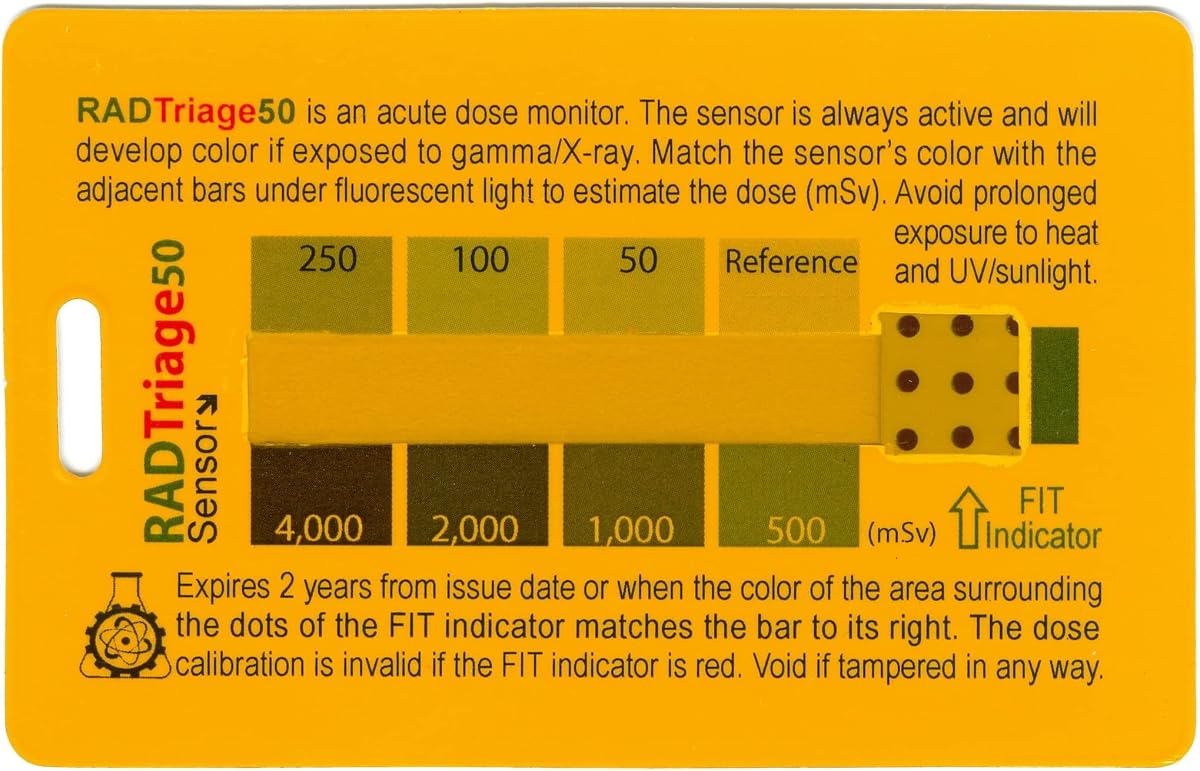
The Rad Triage 50 is a pocket-sized personal radiation detector with a 4.4 rating. Unlike conventional digital meters with active displays, it is designed to fit in a wallet or badge holder and provide a compact means of monitoring beta, gamma, and X-ray radiation.
We may earn a commission when you buy through this link, at no additional cost to you.
Its greatest convenience comes from having no battery requirement and no stated need for calibration. The product is described as made in the United States, military-grade, field tested, and approved by the US Department of Homeland Security. It is marketed for detecting radiation associated with reactors, weapons fallout, and dirty bombs, making it primarily a preparedness-oriented personal tool.
The trade-off is the absence of the sophisticated readings, data logs, graphs, and custom alarms found in full-size electronic dosimeters. Its shelf life may be extended by freezer storage according to the supplied description, and once removed it has a usable life of at least two years. Buyers who forget this maintenance consideration may eventually get an expired detector.
The Rad Triage 50 is best for travelers, emergency-prepared households, and people who want a simple detector to carry at all times. It is not the first choice for laboratory records, detailed dose analysis, or professional survey documentation. Its value lies in portability and readiness without batteries.
The wallet and badge-holder dimensions solve a problem larger meters cannot: consistent portability. Users can keep the detector close without carrying a rechargeable device, charging cable, or separate display.
Because the product relies on a finite usable life rather than a conventional battery, storage conditions matter. Reviewing the supplied shelf-life guidance before relying on the detector is essential for responsible preparedness.
We may earn a commission when you buy through this link, at no additional cost to you.
The APOWER RD-3 is a lightweight color-screen Geiger counter rated 4.4 by customers. It detects gamma, beta, and X-ray radiation through a built-in precision sensor, with a stated energy response of 33 keV to 3 MeV and a cumulative dose equivalent range of 0.05 μSv to 50 mSv.
We may earn a commission when you buy through this link, at no additional cost to you.
Its alert system combines audible alarms, visual indication, and a flashing red light. When a threshold is exceeded, the sound begins and the displayed numbers turn red, providing several ways to notice unusual conditions. The interface also supports alarm thresholds, alarm modes, measurement units, screen brightness, and language selection. A timed measurement function stores historical data for later review.
The rechargeable lithium battery can run for up to eight days with particle sound disabled, making it practical for extended monitoring. A Type-C cable is included, along with a hand strap, manual, and package box. The main limitation is fragility: the supplied description warns that accidental knocks may damage internal components and cause abnormal readings.
The RD-3 is a good match for home renovation checks, vehicle inspection, geological work, laboratories, radiology environments, and compact everyday carry. It is less appropriate where rugged professional use, very long-term data retention, or advanced reporting is the priority. The included warranty adds reassurance for a general-purpose consumer instrument.
Sound, numerical color changes, and a flashing top indicator make threshold events easier to notice in a noisy or distracting environment. Adjustable settings let users match the alerts to their monitoring routine.
The timed function automatically stores readings after a session, helping users compare conditions over time. It is a practical middle ground between a momentary detector and a more elaborate professional logging system.
We may earn a commission when you buy through this link, at no additional cost to you.
The AEGTEST Radar-5633 is a portable color-screen dosimeter with a 3.9 customer rating, the lowest among the featured products. It uses semiconductor technology to detect beta, gamma, and X-ray radiation and presents several useful measurements together on one screen.
We may earn a commission when you buy through this link, at no additional cost to you.
Dose rate in μSv/h, exposure rate in μR/h, counts per minute, and cumulative dose in μSv are visible simultaneously, along with average and maximum readings. The stated energy response is 33 keV to 3 MeV, while cumulative dose spans 0.1 μSv to 9999 mSv. For 137Cs gamma radiation, the listed accuracy is -17% to +20%, a range worth considering when measurement precision is critical.
Visual and audible alerts use red indicators and customizable thresholds, and the alarm can operate while the display is sleeping. Timed measurements are stored automatically, while Type-C charging and a stated battery life of up to 18 days make the unit well suited to ongoing monitoring. The lower customer rating does not identify a specific defect, but it does suggest checking recent owner feedback before committing.
The Radar-5633 is a strong option for users who want real-time dose, average dose, count rate, and cumulative data visible without changing screens. It suits environmental monitoring, facility checks, and users who prefer semiconductor-based detection. Buyers with regulatory or safety-critical requirements should assess the stated tolerance and intended use carefully.
Showing core metrics together makes it easier to understand context immediately. A user can compare instantaneous and average readings while keeping cumulative exposure visible during the same task.
A battery life of up to 18 days with particle sound off reduces the need for frequent charging. Automatic session storage adds a practical audit trail for multi-day environmental checks.
We may earn a commission when you buy through this link, at no additional cost to you.
The HFS-50-CsI is a premium personal dosimeter with a 4.6 customer rating. Its defining feature is a CsI scintillator sensor with an energy-compensation mechanism, designed to resist interference and maintain more stable measurements than a traditional Geiger-Müller tube.
We may earn a commission when you buy through this link, at no additional cost to you.
The stated measurement range extends from 0.01 μSv/h to 20 mSv/h with an error of ±10%. A dynamic 200-second waveform curve and colored dose-rate bar make trends easy to interpret, while the display supports dose rate, total dose, staged dose, average dose rate, and maximum dose rate.
The instrument refreshes every second, retains up to 100 recent records, and preserves total dose and cumulative time after power-off. Its triple alarm uses sound, flashing lights, and on-screen numerical alerts, with a response time under three seconds and adjustable thresholds. A telescopic rod helps maintain distance from a source, an important benefit when observing X-ray or CT-related exposure.
The built-in 2000mAh battery can deliver up to 1700 hours in screen-sleep mode and recharges in three hours through Type-C. This model is best for users who value stable readings, trend visualization, long endurance, and source-distance accessories. Its stated gamma and X-ray coverage is narrower than devices explicitly listing beta, and buyers should confirm the radiation types relevant to their application.
The live waveform reveals short-lived changes that a single numerical reading can conceal. It is particularly valuable when comparing a nearby source, walking away from an area, or monitoring the effect of distance.
The included telescopic rod supports safer observation of medical or industrial radiation sources. Meanwhile, sleep-mode runtime of up to 1700 hours makes the detector practical for deployments where frequent charging would be inconvenient.
We may earn a commission when you buy through this link, at no additional cost to you.
The GQ GMC-500Plus is an enhanced Geiger counter and dosimeter with a 4.6 customer rating. It differentiates itself through two Geiger tubes with independent calibration factors and a detection range whose upper limit is listed as ten times higher than earlier models.
We may earn a commission when you buy through this link, at no additional cost to you.
Its large LCD can rotate between horizontal and vertical layouts, with automatic large-font display for easier reading. Onboard flash memory, an installed rechargeable battery, a built-in speaker, and audio output support field operation. The ability to submit data automatically to servers worldwide expands the unit's role from an immediate meter to a connected logging instrument.
Its main complication is the need to configure server logging, which may be unnecessary for a homeowner seeking a simple radiation check. Compared with the GMC-800 listings, the published feature description is less specific about display color, alarm variety, and long-term internal capacity. The GMC-500Plus is also presented as an older model in the supplied listing.
The GMC-500Plus is a good fit for professionals or advanced users who need dual tubes, independent calibration, automatic data submission, and a larger effective measurement range. It is less compelling for casual pocket checks. Confirm server compatibility, current specifications, and included accessories before purchasing.
Two tubes with independent calibration factors can provide redundancy and broader operational capability. This is useful for users who want more than the simple performance of a single-tube consumer meter.
Rotatable large-font presentation makes the unit easier to use in the field. Automatic worldwide server logging is a notable advantage for distributed monitoring, provided the user is comfortable configuring remote data collection.
We may earn a commission when you buy through this link, at no additional cost to you.
The MOESAPU FS5000 is a yellow handheld Geiger counter with a 4.2 customer rating. It uses a J321 sensor to detect beta, gamma, and X-ray radiation, provides a stated response of 0.5 seconds, and converts detected particles into audible clicks as well as numerical readings.
We may earn a commission when you buy through this link, at no additional cost to you.
The 2.4-inch TFT display shows real-time dose rate from 0.01 μSv/h to 50 mSv/h alongside a live graph. Total dose is listed from 0 μSv to 1000 Sv, timed dose is available, and the latest data remains in memory even without power and can be downloaded using PC software.
Audio, light, and vibration warnings cover three notification styles. The supplied default thresholds are dose rate above 2.5 μSv/h or total dose above 1 mSv, and users can customize them. A rechargeable 1800mAh battery provides up to 720 hours of standby time with the shortest backlight setting, plus a low-battery warning.
The FS5000 is a useful all-purpose meter for home renovation, antique uranium glass, medical radiology, nuclear facilities, and environmental work. Its graphic presentation and three-mode alerts are more informative than a minimal detector, although the published range of 48 keV to 1.5 MeV and 4.2 rating are factors to consider when high-energy applications matter.
A live graph makes it easier to spot rising trends and compare readings at different positions. Timed-dose controls also help users limit the amount of time spent in an area with a higher dose rate.
Combining sound, light, and vibration ensures that a threshold event can be noticed under different working conditions. Customizable limits let buyers align the warnings with their own monitoring needs.
We may earn a commission when you buy through this link, at no additional cost to you.
The Soogua Geiger Counter is a portable handheld radiation monitor with a 4.2 customer rating. Its built-in GM sensor detects gamma, beta, and X-ray radiation, with a stated 48 keV to 1.5 MeV energy range and a cumulative dose equivalent from 0.00 μSv to 500.0 mSv.
We may earn a commission when you buy through this link, at no additional cost to you.
The color LCD and straightforward menu support real-time readings, alarm thresholds, alarm modes, measurement units, brightness, and language selection. Four alert formats are offered: sound, vibration, alarm light, and display-screen notification. The alerts can activate whether the screen is operating or asleep, which improves the chance that a high reading will not be missed.
The 1800mAh lithium battery supports continuous work, while the compact body makes the unit suitable for field tasks. Listed applications include home improvement, imported food and cosmetics, medical radiation, geological surveying, nuclear power plants, chemical laboratories, outdoor environments, and radiation-producing industries. These examples illustrate versatility rather than guaranteeing suitability for every specialized procedure.
The Soogua is a practical general-purpose option for users who want rechargeable operation and a choice of alerts without the more elaborate storage systems found in premium models. The stated 137Cs sensitivity tolerance of ±30% and 4.2 customer rating deserve attention if precision is critical. For casual checks and education, the feature set is otherwise capable.
Sound, vibration, a warning light, and a screen notification give users several ways to recognize elevated readings. Sleep-state alerts help the instrument remain useful when its display is not continuously visible.
The combination of compact size, rechargeable power, and configurable units fits a broad range of field and household checks. It is especially useful for users who need to move between locations without managing disposable batteries.
We may earn a commission when you buy through this link, at no additional cost to you.
Choosing a dosimeter requires matching the sensor and radiation coverage to your environment, then balancing measurement detail, alerts, logging, power, and portability. A meter that looks impressive but cannot be calibrated, configured, or interpreted confidently may be less useful than a simpler device.
The sensor is the heart of a dosimeter. Geiger-Müller instruments use a gas-filled tube and commonly produce audible particle clicks, making them intuitive for spot checks and teaching. Semiconductor sensors can offer compact construction and broad displayed data. A CsI scintillator uses a crystal and photodetector to measure energy-related radiation events, which can support stable readings and detailed trend monitoring. The best choice depends on the measurement environment, expected energy range, and the importance of stability versus simplicity.
Look for the specific radiation types relevant to your work. Many products in this roundup detect beta, gamma, and X-ray radiation, while the HFS-50-CsI focuses on gamma and X-ray detection. Energy response matters when comparing devices: listed ranges include 33 keV to 3 MeV for the APOWER RD-3 and AEGTEST Radar-5633, and 48 keV to 1.5 MeV for the MOESAPU FS5000 and Soogua. Always compare figures in the same units and consider the source rather than relying only on a broad headline.
A useful instrument must cover the dose rates and cumulative doses expected in your environment. Published ranges vary dramatically, from lower-rate environmental monitoring to broad cumulative-dose scales. Accuracy is equally important. The HFS-50-CsI states a ±10% measurement error, the AEGTEST Radar-5633 lists -17% to +20% for 137Cs gamma, and the Soogua lists ±30% for 137Cs. These tolerances provide useful context but are not automatically interchangeable without reviewing the test conditions and sensor behavior.
Alerts should remain noticeable in the environment where the meter will be used. Visual and audible warnings are common, while vibration adds a discreet option in noisy workplaces. The GMC-800 listings add voice alerts and describe five alarm types, while the HFS-50-CsI and several other models use three-part systems. Screen readability also matters: a color TFT display, large-font mode, sunlight visibility, and a colored dose-rate bar can make rapid interpretation easier.
Data logging turns isolated readings into a record that can be reviewed, compared, and exported. The GMC-300S logs every second and includes PC viewer software. The GMC-800 claims storage for up to ten years and supports data sharing, while the GMC-500Plus can submit records to servers. Smaller devices may offer only timed session histories. Consider whether you need raw data, cumulative dose, graphs, software compatibility, or simply a live reading before paying for an elaborate storage system.
Rechargeable batteries are the norm among the handheld electronic models, but runtime varies dramatically. Published maximums range from roughly eight days for the APOWER RD-3 to eighteen days for the AEGTEST and up to 1700 hours in sleep mode for the HFS-50-CsI. The Rad Triage 50 requires no battery but has a finite usable life. Weight, pocket fit, lanyard or clip design, and hand strap should be evaluated alongside runtime because a long-lasting meter is less useful if it is cumbersome to carry.
A dosimeter should make the important value readable without prolonged menu navigation. The GMC-800 offers a large color TFT, light and dark themes, graphics, and large fonts. The AEGTEST Radar-5633 is unusual in displaying dose rate, exposure rate, CPM, and cumulative dose together. Other units provide simpler screens and fewer controls. Beginners may benefit from fewer modes, while experienced users often prefer configurable units, brightness, alarms, and graph views.
Match the instrument to where it will be used. Portable color-screen meters suit home surveys, vehicle inspections, antiquing, medical radiology, and field work. The HFS-50-CsI includes a telescopic rod to help maintain distance from a source and a storage box. The Rad Triage 50 is made for a wallet or badge holder. Review included cables, straps, boxes, manuals, and warranty terms, and note manufacturer warnings about impact damage or storage conditions.
Begin by reading the manual and identifying the correct detector, radiation coverage, units, and calibration status. Charge the device fully if it uses a rechargeable battery, and verify that it powers on, displays a stable reading, and responds to the alarm controls. If the meter offers multiple operating modes, select the one that matches your task: instantaneous spot check, timed survey, count rate, graph, or accumulated dose. Avoid interpreting one unfamiliar unit as though it were another.
For a basic survey, stand at a representative point away from the suspected source and let the reading stabilize before recording it. Move systematically through the area or material, maintaining consistent distance and measuring the same surfaces each time. Set thresholds to suit the environment rather than choosing arbitrary values. Use sound, vibration, and light alerts together when conditions are noisy, and do not approach a source merely to make an alarm stop without understanding the radiation hazard and the instrument's measurement limitations.
After use, turn the detector off, disconnect the charging cable, and return it to its case or box. The APOWER description specifically warns that bumps or knocks may damage internal parts and produce abnormal readings, so use the hand strap and protect the instrument from drops. Keep contacts clean, follow the stated storage instructions, and review the Rad Triage 50's usable-life guidance if you rely on it. Download and back up records before resetting software, clearing memory, or changing the computer used for data analysis.
A dosimeter is designed to measure radiation exposure or dose, including accumulated exposure in some models. A Geiger counter typically reports radiation events or count rate, although many handheld units combine both functions. The distinction has become less rigid because several products in this guide provide dosimeter mode, CPM mode, graphs, and dose-rate readings in one device.
A personal dosimeter can help identify changing radiation levels and prompt further investigation, but it does not guarantee that a building is safe. Normal background readings and natural variation should be understood, and unexpectedly elevated results should be interpreted with appropriate expertise. For suspected contamination or a known source, contact the relevant local or professional radiation-safety authority.
The choice depends on the material and the depth of information required. The compact, rechargeable models listed here are suitable for basic screening, while the GMC-800 and HFS-50-CsI provide more detailed trends, logs, and alerts. Buyers should also consider whether they need beta, gamma, and X-ray coverage, an easy-to-read display, and the ability to save measurements for later review.
It depends on the source and the purpose of the measurement. Some listed devices explicitly cover all three, while the HFS-50-CsI is described as detecting gamma and X-ray radiation. The source's energy and behavior matter as much as the broad type, so confirm the device's published energy response and intended applications before relying on it for a particular task.
Different sensors have different energy responses, sensitivities, statistical behavior, and stated tolerances. A Geiger tube, semiconductor detector, and CsI scintillator do not necessarily produce identical numbers under every condition. Placement, distance, source direction, timing, units, and calibration also affect results, so comparisons should use matched settings and appropriate measurement methods.
A color screen can make alerts, graphs, dose-rate bars, and operating modes easier to distinguish at a glance. Models such as the GMC-800 and Radar-5633 can display multiple values, which may reduce the need to switch screens. Color is helpful but secondary to sensor performance, accuracy, logging, and the ability to interpret the reading correctly.
Rechargeable models are better for repeated electronic monitoring, graphs, alarms, and data logging because they provide active displays and flexible features. The Rad Triage 50's battery-free card format is convenient for always-carry preparedness, but it offers less measurement detail and has a finite usable life. Choose based on portability, expected monitoring duration, and the amount of information required.
Keep the instrument in its supplied case or a suitable protective container, away from impact, moisture, extreme heat, and direct pressure on the display or sensor. Use the correct charging cable and avoid leaving a rechargeable battery depleted for long periods. For the Rad Triage 50, follow the stated freezer-storage and shelf-life guidance, and periodically verify that electronic meters still power on and produce sensible readings.
The GQ GMC-800 leads this roundup for its combination of a large color display, flexible five-part alerts, extensive monitoring modes, and long-term storage with global sharing. The GQ GMC-300S is the practical budget pick for buyers who mainly want internal logging and downloadable PC records, while the HFS-50-CsI is the premium choice for stable scintillator measurements, waveform visualization, source-distance accessories, and exceptional sleep-mode endurance.
For most buyers, the right dosimeter is the one that covers the needed radiation types, fits the expected measurement range, and provides alerts and data that can actually be used. A compact model may be ideal for occasional checks, while professional or institutional work may justify advanced logging, server submission, larger screens, and stronger measurement specifications. Always check the displayed units, energy response, accuracy conditions, calibration details, and intended environmental limits.
Customer ratings and product availability can change, and prices fluctuate across sellers and over time. Review the current Amazon listing, package contents, warranty, and technical documentation before purchasing. The comparison and reviews here are designed to narrow the field, but the final choice should reflect your source, environment, and need for portability, precision, alerts, and documentation.