
Bread Proofing Box Folding
4.3Editor score
50–113°F temperature control
48-hour timer
Three-zone heating
Dough proofing warming boxes create a controlled, warm environment for bread, pizza dough, yogurt, kombucha, and other fermentation projects. A useful model combines consistent temperature regulation, effective insulation, adequate capacity, and enough visibility to monitor progress without repeatedly opening the enclosure.
The 10 options in this guide were compared using the information supplied for each product. The evaluation considers heating coverage, temperature and timer ranges, interior space, insulation, accessories, viewing access, foldability, and practical fermentation uses rather than assigning a score based on appearance alone.
Each review identifies the feature that makes a particular proofer most useful, along with the compromises a buyer should understand. Ratings reflect the supplied customer feedback, while current availability and prices can change, so shoppers should confirm the latest listing details before making a purchase.
4.3Editor score

4.6Editor score

4.8Editor score
As an Amazon Associate we earn from qualifying purchases.
The comparison below highlights the major differences in heating, temperature control, timing, capacity, visibility, and storage convenience, making it easier to identify the proofer that fits a particular baking routine.

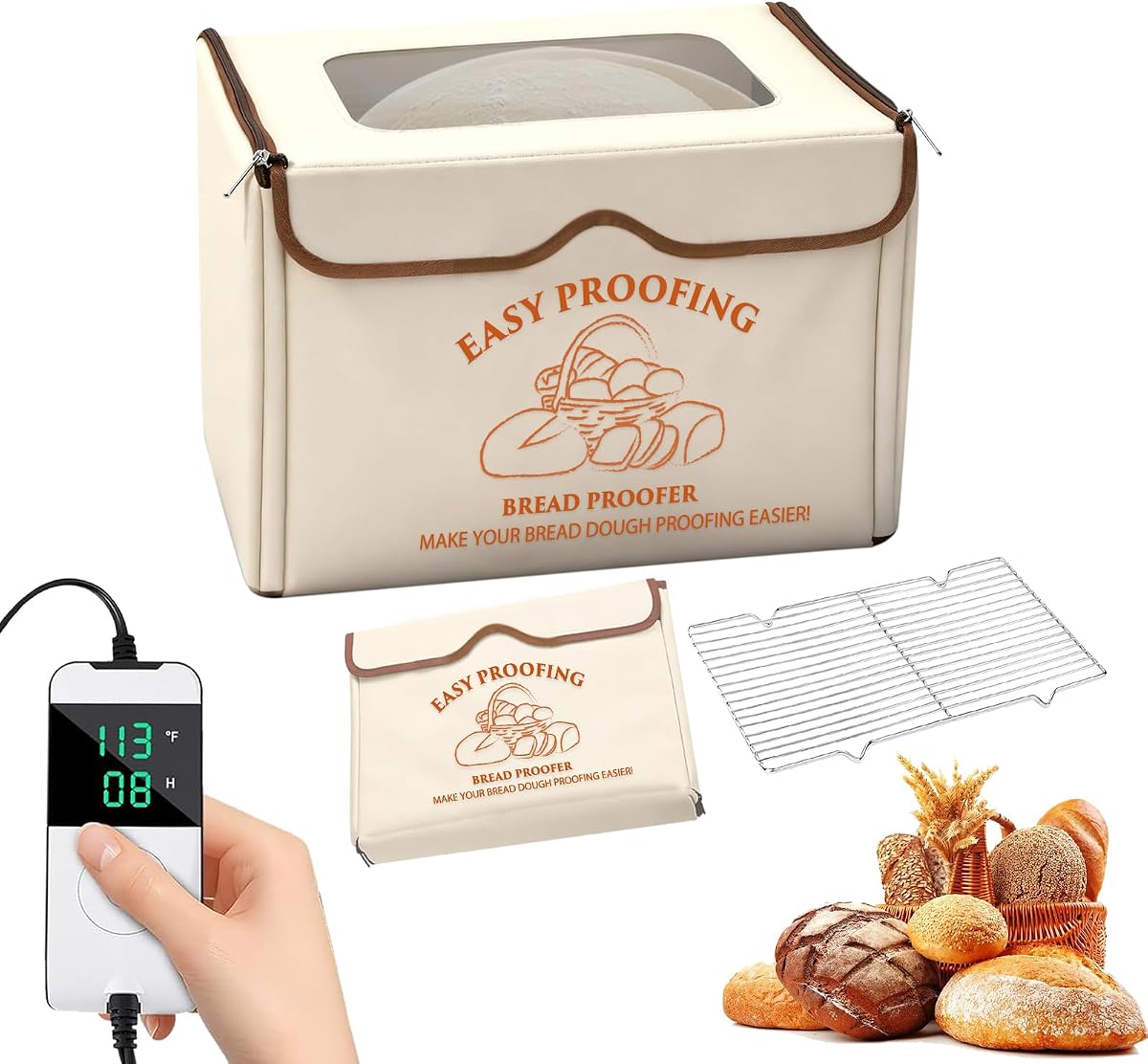


The XPLI Folding Proofing Box combines a wide 50–113°F adjustment range, a 48-hour timer, and three heating zones in a straightforward enclosure. Its 4.3 rating indicates generally favorable customer feedback, although the supplied information does not provide enough detail to explain every variation in individual experiences.
We may earn a commission when you buy through this link, at no additional cost to you.
Heating is distributed across the front, back, and bottom rather than being confined to one surface. That arrangement is useful when a bowl or dough container sits inside the box, since the goal is to limit cold zones. The layered construction combines an Oxford fabric exterior, insulation, a heating layer, a support layer, and an aluminum foil lining to help retain heat.
The main compromise is capacity. The description specifically highlights space for a proofing basket and starter, making it best aligned with one standard proofing bowl. It does not offer the multi-container capacity of several extra-large models, and the maximum temperature is lower than options reaching 130–132°F.
This is a sensible choice for home bakers who want programmable warmth, three-sided heating, and a foldable design without moving into a larger-format proofer. It is particularly useful for sourdough, pizza crusts, yogurt, and starter maintenance, provided the baker's containers fit comfortably inside.
Front, back, and bottom heating gives the enclosure more balanced warmth than a bottom-only arrangement. That design is particularly helpful during cool household conditions or when proofing a single large bowl.
The folding structure and transparent observation window support a simple workflow. Bakers can monitor expansion without fully opening the box, then collapse the enclosure when the fermentation cycle is complete.
We may earn a commission when you buy through this link, at no additional cost to you.
The GIYUDOT Folding Proofing Box earns an Editor's Choice recommendation because it balances thoughtful temperature management, compact dimensions, and flexible monitoring. Its 4.6 rating is among the stronger results in this group, and the supplied feature set covers the essential needs of a recurring home bread baker.
We may earn a commission when you buy through this link, at no additional cost to you.
A 12-by-12-by-12-inch interior is sized for fermentation jars or a single proofing bowl. The window can be used on the front or top, allowing a baker to monitor a starter jar through the front or inspect a bowl from above. Five insulating layers, a waterproof interior, and a stainless steel shelf support stable conditions and help prevent direct bottom overheating.
The NTC sensor continuously monitors the air temperature, while the 50–113°F range covers ordinary bread and pizza proofing. An automatic shutoff at 131°F provides an additional safeguard against overheating. The limitation is that this is primarily a single-bowl chamber, and its upper temperature setting is lower than that of several high-capacity models.
Bakers who value clear controls, easy cleaning, compact storage, and a choice of viewing angles will find this model especially practical. It is a strong all-around selection for weekly sourdough, pizza dough, yogurt, or kombucha work in a kitchen where permanent counter space is limited.
The repositionable window is a distinctive convenience. Positioning it on the front suits a fermentation jar, while the top orientation makes it easier to observe expansion inside a proofing bowl without changing the box's footprint.
Five layers of insulation, a waterproof lining, and a metal shelf work together to create a more controlled environment. The shelf also elevates dough or containers away from the bottom heating area for gentler, more even warming.
We may earn a commission when you buy through this link, at no additional cost to you.
The Cozy Bread Proofing Mat and Insulation Box offers a different approach from fully enclosed warming cabinets. It combines a thermostat-controlled mat with a lightweight insulated cover, earning a 4.6 rating and standing out for quick setup and flexibility.
We may earn a commission when you buy through this link, at no additional cost to you.
The mat warms in approximately one to two minutes, making it appealing for short-notice baking or a routine that does not require preparing the chamber far in advance. Its 10-by-21-inch dimensions provide a defined surface for a dough, proofing container, or starter jar, while the box helps retain warmth around the work area.
This setup is less enclosed than a cabinet-style proofer and does not list a programmable timer range in the supplied information. It may therefore be better suited to bakers who value quick access, simple setup, and compact storage than those who want to leave an unattended fermentation running for many hours without monitoring it.
The bundle is versatile for sourdough, pizza dough, rolls, enriched doughs, and starter care. It is especially attractive for occasional bakers or users with limited storage space who want a dedicated warming surface rather than another bulky appliance.
A mat that reaches its warming condition in about one to two minutes removes much of the preparation involved with a larger cabinet. That makes the system convenient when a dough needs a controlled environment shortly before baking.
The lightweight insulation box and flat mat can be moved between a counter and storage area more easily than a rigid appliance. The setup also works for varied dough types rather than being limited to one bowl format.
We may earn a commission when you buy through this link, at no additional cost to you.
The Temperature Timer Proofer focuses on a straightforward combination of adjustable heat, timed operation, and an external sensor. Its 4.3 rating reflects positive feedback, while the detailed controller description makes this model appealing to bakers who want more direct temperature feedback.
We may earn a commission when you buy through this link, at no additional cost to you.
The most notable feature is the NTC sensor, which can be placed on a proofing container to measure the actual temperature of the dough or proofing body rather than relying only on the enclosure's air. The LED display shows the current reading, and the controller can maintain the selected setting within a 50–113°F range.
The 0–48-hour timer includes an always-on position at zero, which addresses a potential limitation in some timed controllers. The trade-off is the chamber's single-bowl capacity and the fact that the enclosure is not presented as a multi-rack or dual-view system.
This proofer suits home bakers who value clear readouts, a sensor near the actual dough, and a timer that can run overnight. It also supports less conventional uses such as sauerkraut, tempeh, kombucha, homemade wine fermentation, and nursery applications, giving it broader utility than a bread-only appliance.
The repositionable NTC sensor can be placed on the proofing container, offering a useful reference for the actual proofing body. This is more informative than a controller that only reports the temperature of the air inside the enclosure.
A clear LED temperature display and a timer extending to 48 hours make the controller easy to set for extended fermentation. The zero-hour always-on setting adds flexibility for long or continuously monitored processes.
We may earn a commission when you buy through this link, at no additional cost to you.
The Extra Large Three-Side Heater combines a spacious interior, a broad 50–130°F range, and an audible 24-hour timer. Its 4.5 rating places it among the more highly rated options here, and its ability to hold multiple bowls or jars makes it attractive to busy home bakers.
We may earn a commission when you buy through this link, at no additional cost to you.
The interior can accommodate two large mixing bowls, several bannetons, or quart jars at the same time. Heating surrounds the front, back, and bottom to reduce the cold spots associated with bottom-only warmers. Five layers of insulation and an NTC sensor help maintain a steady environment, while a clear window allows expansion to be checked without lifting the lid.
The 24-hour timer is shorter than the 48- and 99-hour options elsewhere, although the audible buzzer makes the endpoint easier to notice. The stated 130°F maximum is also higher than the common 113°F limit, and a one-touch Celsius/Fahrenheit switch simplifies recipe matching.
This model is a strong fit for households that proof multiple batches, maintain several starters, or work with an assortment of containers. It also folds flat for storage and includes a stainless steel rack, making it a versatile high-capacity option without requiring a permanently installed appliance.
The extra-large interior can handle two mixing bowls, multiple bannetons, or several jars at once. That makes it more useful for batch bakers than proofers designed around a single standard bowl.
The one-touch Celsius and Fahrenheit control helps bakers follow recipes written in either unit. A 130°F maximum provides additional flexibility for specialized fermentation work while an audible alarm signals the timer.
We may earn a commission when you buy through this link, at no additional cost to you.
The Four-Side Heating Proofer is the strongest premium selection because it combines the highest listed rating, 4.8, with a genuinely comprehensive feature set. Its 22-by-12-by-12-inch interior and four-side heating system are designed for consistent fermentation across a larger chamber.
We may earn a commission when you buy through this link, at no additional cost to you.
Heating on the front, rear, left, and right reduces cold areas that can develop in cabinet-style proofers. The adjustable range is 68–131°F, and a 0–99-hour countdown timer with an audible alarm supports both ordinary proofing and extended unattended processes. Seven layers of insulated fabric support heat retention and environmental stability.
Capacity is a major strength. The box can hold two 9-inch round bannetons or one 9-inch round and one 10-inch oval banneton. A clear top window allows the baker to inspect dough without opening the enclosure, while the included wire rack and silicone mat support airflow and dough handling.
The accessory bundle adds a water tray and hygrometer, giving users more tools for managing humidity and monitoring the chamber. The tradeoff is size and complexity compared with a folding single-bowl model, but for regular bakers the added capacity, heating coverage, and monitoring equipment justify the premium positioning.
Four-side heating addresses one of the most common weaknesses of compact proofers, where the far corners remain cooler. Distributing warmth around all four walls is especially valuable when several containers occupy the enclosure.
The water tray, hygrometer, wire rack, silicone mat, and storage bag create a more complete fermentation station. These accessories allow a baker to think beyond simple warming and manage the chamber's internal conditions more deliberately.
We may earn a commission when you buy through this link, at no additional cost to you.
The PID Foldable Proofing Box stands out for precise control and a remarkably compact stored profile. It has a 5.0 rating in the supplied data, and its stated PID accuracy within ±1°F makes it a compelling choice for bakers who prioritize repeatable conditions.
We may earn a commission when you buy through this link, at no additional cost to you.
Temperature can be adjusted from 70–122°F, while a 24-hour timer supports sourdough, yeast dough, pizza dough, and general fermentation. The controller includes overheat protection, and the waterproof food-grade interior is designed for straightforward cleaning and everyday use.
Its most striking practical feature is the ability to fold to just 45 millimeters, or 1.77 inches. That makes the unit substantially easier to store than a rigid cabinet, though the enclosed format still requires a suitable baking container and the 70°F minimum excludes very cool ambient conditions.
This model is ideal for a baker with limited cabinet space who wants precise temperature regulation and a compact footprint. Its stated ±1°F PID performance and strong supplied rating justify an Editor's Choice recommendation, especially for users who repeatedly work from the same recipe and need consistent results.
PID control continuously adjusts the heater to reduce temperature swings, with the product information claiming precision up to ±1°F. That level of control is useful for bakers refining a schedule or working with a delicate recipe.
A folded depth of 45 millimeters is considerably slimmer than the supplied dimensions of many competing proofers. The box can be unfolded for use and stored flat when the baking cycle is complete.
We may earn a commission when you buy through this link, at no additional cost to you.
The LIFVCNT Folding Proofer combines a wide 68–132°F range, a 0–99-hour timer, and a large foldable interior. Its 4.3 rating is respectable, and the inclusion of both a rack and water tray makes it appealing for bakers who want to manage heat and humidity together.
We may earn a commission when you buy through this link, at no additional cost to you.
Dual heating zones are intended to warm the chamber rapidly and evenly, while a built-in bottom temperature sensor supports stable settings. The enclosure uses seven insulating layers to reduce heat loss, and the clear front window allows monitoring without lifting the lid.
The supplied dimensions offer enough room for multiple dough batches, while the folding construction reduces storage demands. One limitation is that the heating system is described as dual-zone rather than three- or four-side, which may make it less comprehensive for very large mixed-capacity loads.
The broad upper temperature limit and 99-hour timer offer excellent scheduling flexibility for sourdough, pizza, yogurt, or kombucha. This is a good general-purpose proofer for bakers who want generous capacity, humidity accessories, and long programmable cycles in a foldable design.
A timer reaching 99 hours is useful for multiday sourdough routines and other extended processes. The zero-hour option can keep the chamber on continuously when a user prefers to monitor the cycle manually.
The included water tray can add moisture to the enclosure, while the metal rack keeps dough elevated and supports airflow. Both accessories are directly relevant to managing the proofing environment rather than simply warming the room.
We may earn a commission when you buy through this link, at no additional cost to you.
The Cozy Bread Collapsible Proofer is a simple, approachable option for home bakers who want fast setup and a compact form. Its 4.2 rating is the lowest among the listed products, but the supplied information still describes a focused feature set for sourdough and other doughs.
We may earn a commission when you buy through this link, at no additional cost to you.
Thermostat control provides adjustable warmth, and the heating system reportedly reaches operating temperature in about one to two minutes. A built-in timer supports hands-off proofing, while the collapsible construction allows the box to be stored in a drawer or cabinet after use.
The product information is less technically detailed than several competing listings. It does not provide a specific temperature range, interior dimensions, sensor type, or exact timer range, so buyers seeking tightly quantified control may need to inspect the current listing more closely.
This proofer is well suited to sourdough bread, pizza dough, rolls, and enriched doughs, particularly for someone replacing improvised warmth from an oven light, microwave, or countertop. Its quick warmup and fold-flat design make it convenient for flexible home routines.
The stated one-to-two-minute warmup allows the box to be prepared quickly. That is useful for short-notice doughs, late-afternoon pizza plans, or bakers who do not want to start a long appliance preheating process.
A dedicated thermostat-controlled enclosure can provide a more organized place for dough and starter. The collapsible form also addresses the kitchen-clutter problem created by leaving an open towel or container warming on the counter.
We may earn a commission when you buy through this link, at no additional cost to you.
The XL Folding Proofer offers a roomy enclosure, a 68–104°F range, and a 48-hour timer, complemented by a 4.4 rating. Its 16.5-by-12-by-12-inch interior and accessory package make it a versatile choice for dough, starters, and other fermentation projects.
We may earn a commission when you buy through this link, at no additional cost to you.
Front, back, and bottom heating provides a three-zone warming pattern, while five layers of construction support insulation. The metal rack and water tray create a straightforward setup: the tray can add humidity at the bottom, the rack elevates the dough, and the controller manages time and heat.
The 104°F maximum is lower than several alternatives and may not suit recipes that require a warmer chamber. The timer is adjusted in one-hour increments, and the product's broad household uses include softening butter or chocolate, which can be convenient but may share space with active bread fermentation.
A large acrylic viewing window provides a generous view of the dough without opening the enclosure. The box folds to two inches and includes carry handles, making it easy to move and store despite its extra-large capacity. It is well suited to multi-container use and bakers who value flexibility beyond bread alone.
The stated interior can accommodate approximately one large bowl and four large bottles. That flexibility is useful for maintaining starters alongside a main dough or for proofing several smaller portions.
The extra-large transparent window lets the baker observe rise and expansion without breaking the insulated enclosure. This helps limit the need to open the box during a sensitive proofing period.
We may earn a commission when you buy through this link, at no additional cost to you.
The most useful proofing box is one that maintains the correct environment for the dough, fits the available containers and space, and fits the baker's routine. The following factors help narrow the choices without treating any single specification as the only measure of quality.
Choose a range that covers the temperatures required by the recipes you make most often. Many bread and pizza applications fall within the listed 50–113°F ranges of several products, while higher limits near 130–132°F provide additional flexibility for specialized fermentation or temperature-sensitive tasks. A thermostat or PID controller is also important because a wide printed range alone does not guarantee that the chamber will hold the selected setting accurately.
Prioritize a control system that reports the actual internal temperature and provides enough adjustment precision for repeatable schedules. If you bake the same recipe frequently, stable control is often more valuable than a broader range you rarely use.
Heating can be distributed across the bottom, front and back, or all four sides. More surrounding zones generally reduce the chance that a bowl in a corner will sit in a cool area, especially in a cold kitchen. The NTC sensor mentioned in several listings can improve monitoring, although sensor placement and the chamber's design determine how representative that reading is.
Look for a configuration that matches the load. Three-sided heating is often sufficient for one or two containers, while four-sided heating provides more uniform warmth for a larger or more crowded chamber.
Capacity is not useful unless the baker's bowls, jars, bannetons, and trays fit without touching the heating elements or walls. Some products are designed for a single standard proofing bowl, while others accommodate two mixing bowls, multiple bannetons, or several quart jars. Measure both the interior dimensions and the containers before buying, and consider clearance needed to place dough inside safely.
For occasional bakers, a single-bowl model is usually sufficient. Regular batch bakers and sourdough households maintaining multiple starters should prioritize a wider, deeper interior and removable rack.
A timer makes unattended proofing easier, but the appropriate range depends on the fermentation style. A 24-hour timer accommodates many overnight and same-day routines, while 48- or 99-hour settings are useful for long sourdough cultures and multi-day processes. Some controllers also include an audible alarm, which is valuable when the proofer operates in another part of the home.
Choose a timer that can be disabled or set to continuous operation if you prefer to judge readiness by dough expansion. For most automated routines, a clear countdown display and a distinct end alert are the most useful features.
Insulation helps the heater maintain a stable temperature without cycling excessively. The products range from five-layer to seven-layer construction, and several include an aluminum foil or waterproof inner lining. Humidity is a separate consideration: a water tray, water bowl, hygrometer, or silicone mat can help create a more suitable surface and environment for dough.
Look for an interior that is easy to clean and accessories that support the humidity level appropriate for the recipe. A rack also matters because it elevates dough and reduces direct contact with a bottom heating area.
A large chamber can be useful during baking but frustrating to store year-round. Foldable or collapsible models solve this problem by reducing the enclosure to a thin panel or a stated folded depth. Buyers should compare both the expanded dimensions and the storage profile, including whether a drawer, shelf, or cabinet can accommodate the folded unit.
If space is limited, prioritize a compact model with a viewing window and sufficient heating coverage over an oversized box with a long accessory list. Portability matters for people who alternate between a kitchen counter and a pantry or utility area.
A transparent window lets the baker check expansion without opening the insulated enclosure. This reduces heat loss and avoids repeatedly disturbing a sensitive proof. Some models place the window on the front, others on top, and the GIYUDOT model allows either orientation, which is useful when working with different container shapes.
Consider where the bowl will sit before choosing based on window placement. A top window is convenient for watching rise from above, while a front window may work better with a tall starter jar or a proofing container positioned near the wall.
A proofer can be used for sourdough, pizza dough, rolls, yogurt, kombucha, sauerkraut, tempeh, and other fermentation tasks, but the design still matters. A removable rack, water tray, silicone mat, bowl, and hygrometer can make one chamber useful across several workflows. Additional uses such as softening butter or chocolate are convenient when the unit is not actively proofing bread.
Accessories are most useful when they serve the intended process. A rack is valuable for airflow, a water tray influences humidity, and a hygrometer provides a reference. Avoid paying attention to a long list without considering whether each included item will be used regularly.
Before placing dough inside, inspect the interior and confirm that the chosen bowl, jar, or tray sits safely above the heating area. If the model includes a rack or silicone mat, install it according to the product instructions. Add water to the water tray or bowl if humidity is needed, taking care not to place loose water where it can contact the controller, electrical connections, or heating element.
Set the temperature and timer based on the recipe and the dough's stage. A starter, a shaped loaf, pizza dough, and yogurt may require different conditions, so use the recipe as the starting point and observe the dough rather than relying entirely on the clock. Keep the viewing window clear and check the chamber periodically, especially during the first use or when conditions in the kitchen change.
After the cycle, remove food and any remaining water, wipe the waterproof lining with a damp cloth, and allow the enclosure to dry completely before folding or storing it. Do not immerse the electrical controller, and follow the manufacturer's instructions regarding heat, cleaning, and placement. Store the unit folded only after it has cooled and no moisture is trapped inside.
Many sourdough recipes are developed around a temperature near 75–85°F, but the correct setting depends on the flour, starter activity, ambient kitchen temperature, and desired schedule. Start with the recipe's recommendation, then adjust based on how quickly the dough expands. A warmer chamber generally speeds fermentation, while a cooler setting slows it down. Consistent control and insulation are often more important than choosing one universal temperature.
A timer is convenient but not essential for every workflow. It allows unattended proofing and helps establish a repeatable schedule, while a continuous setting offers more manual control. Short timers suit pizza dough and rolls, while longer settings benefit overnight sourdough and multi-day fermentation. Always combine timer settings with visual checks of dough volume and texture.
Yes, provided the selected temperature matches the culture's requirements. Yogurt and many kombucha cultures need a stable warm environment rather than bread-level heat, so precise thermostat or PID control is valuable. Keep containers sealed or covered as appropriate for the culture, and maintain the recommended humidity without allowing loose water to contact electrical components.
No. Dough containers should generally remain elevated and clear of direct heat, which helps prevent one area from becoming excessively warm or dried. Models with a removable metal rack or silicone mat are designed to provide that separation. Follow the product instructions for placement, and confirm that the bowl does not block the heating airflow.
A foldable box can be just as capable when its insulation, heating coverage, and sensor system are well designed. The fold is primarily a storage advantage, allowing a usable chamber to fit into a drawer or cabinet when not needed. Compare the number of heating zones, insulation layers, temperature precision, and interior capacity rather than judging performance by foldability alone.
The ideal humidity depends on the dough and recipe. Some proofing methods use a water bowl or tray to maintain moisture, while others rely on a covered dough surface and limited ventilation. Add water gradually and monitor condensation, dough surface texture, and crust development. Too much moisture can make the interior damp or cause condensation on the walls, while too little may allow the dough surface to dry.
A model explicitly designed to fit one standard proofing bowl will suit many home routines, but the bowl's full dimensions should still be checked. Extra-large models accommodate two mixing bowls, multiple bannetons, or several jars. Allow room around the container for airflow, and confirm that a rack, mat, or jar lid will fit without contacting the heating wall or viewing window.
Yes, as long as each task requires compatible temperature, humidity, and container conditions. The same enclosure can support sourdough, pizza dough, yogurt, kombucha, and other ferments, but the accessories and settings should change between uses. Remove residue, clean the interior, and allow it to dry before moving from bread proofing to another food fermentation task.
The XPLI Folding Proofing Box provides a straightforward and affordable three-zone option, while the GIYUDOT model offers a more refined balance of sensor control, insulation, and flexible viewing. For bakers who want exceptional precision without giving up compact storage, the PID Foldable Proofing Box is the most compelling choice in the group.
The Four-Side Heating Proofer is the leading premium option because of its large interior, 99-hour timer, four-side heating, and extensive accessory bundle. The remaining models fill distinct needs: the Cozy Bread system prioritizes quick setup, the Extra Large Three-Side Heater supports multiple containers, and the LIFVCNT model offers a broad temperature range and long scheduling window.
Before buying, check the chamber dimensions against your bowls and jars, prioritize the temperature range and heating layout used by your recipes, and confirm that the folded size fits your available storage. Product listings and prices can change, so review the current specifications, included accessories, and customer feedback before placing an order.