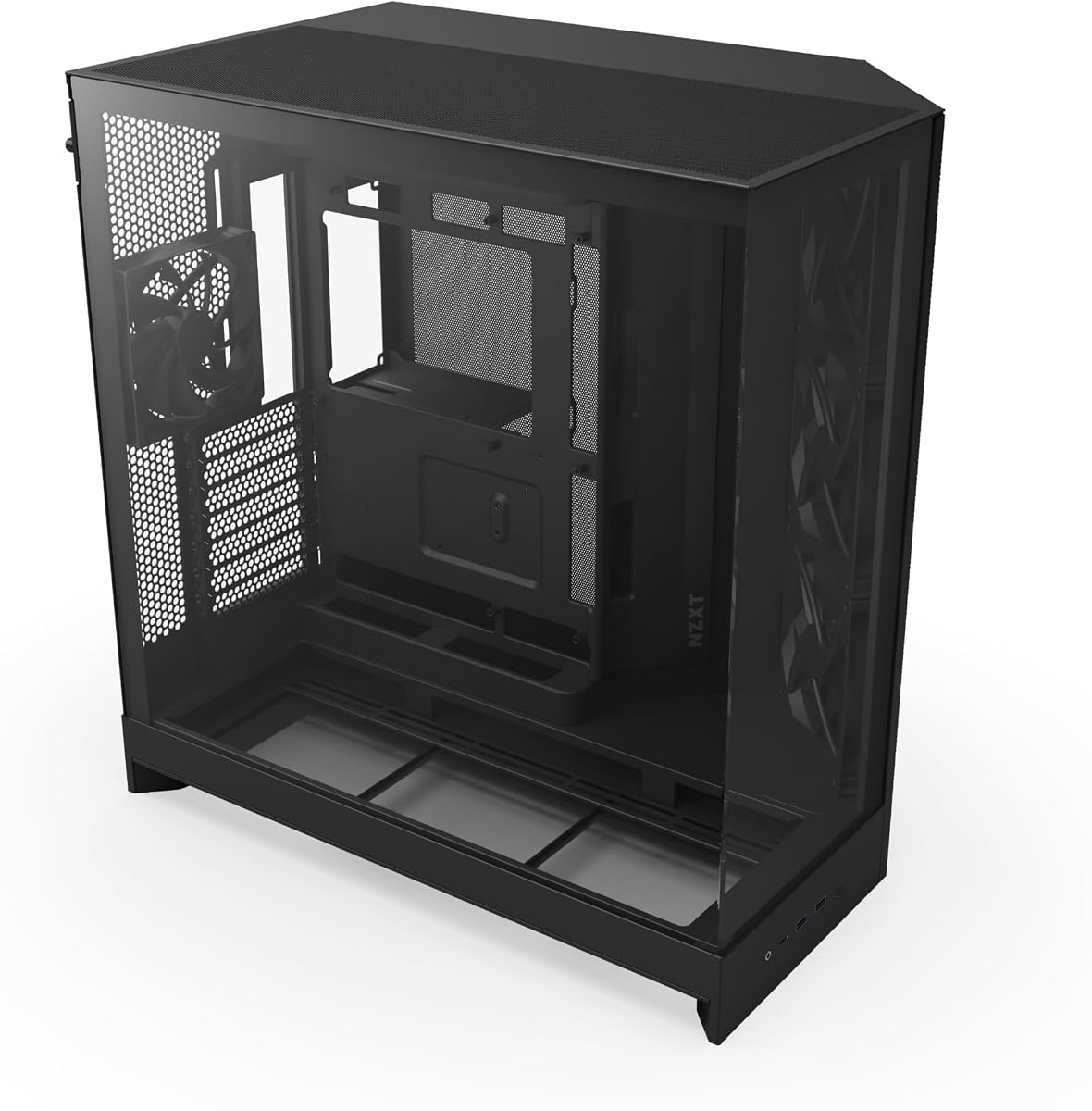
NZXT H9 Flow
4.7Editor score
Four preinstalled case fans
Up to nine 140mm fans
420mm radiator support
Dual-chamber cable separation
Explore our expert guide comparing the 10 best dual chamber PC cases, with analysis of airflow, cooling, cable management, aesthetics, and build flexibility.
Dual chamber PC cases separate the main hardware compartment from the power supply and storage area, creating a cleaner interior while supporting dedicated cooling paths. The best examples combine tempered glass presentation, useful cable-management features, flexible radiator options, and enough room for modern graphics cards and powerful processors.
We compared these cases using the supplied specifications, focusing on chassis layout, included fans, radiator support, motherboard format, graphics-card clearance, front connectivity, and practical space for cables and drives. The list covers compact ATX designs, spacious mid-towers, and full-tower options for elaborate enthusiast builds.
Each review shows where a particular case stands out, while also identifying compromises that may matter to builders. Ratings reflect the supplied customer feedback, and features should be checked against your own hardware before ordering. Prices and availability can change, so compare the current listing before making a final decision.
4.7Editor score

4.7Editor score

4.6Editor score
The comparison below highlights each chassis format, cooling configuration, major hardware limits, and practical feature set, making it easier to identify the dual chamber case that matches your planned build.


The Thermaltake View 380 TG ARGB receives a 4.7 rating and stands out as a polished, balanced option for builders who want a recognizable dual chamber layout without moving into a full-tower footprint. Its pillarless front and side tempered-glass panels create a broad view of the main compartment, while the separated lower chamber keeps the power supply and storage out of sight.
We may earn a commission when you buy through this link, at no additional cost to you.
Four hydraulic-bearing 120mm ARGB Lite fans arrive preinstalled, giving the system immediate airflow and illumination. The case accepts a radiator up to 360mm and accommodates graphics cards up to 415mm, making it suitable for long modern GPUs. A front I/O panel includes a USB 3.2 Type-C port, two USB 3.0 ports, and HD audio.
The principal trade-off is that the maximum radiator size is 360mm rather than 420mm, so builders hoping to install a 420mm liquid cooler must look elsewhere. The bundled lighting is also described as ARGB Lite, which may not provide the same control options as a full ARGB ecosystem. Neither limitation diminishes the case's strong visual and cooling foundation.
This is the strongest all-around recommendation for buyers who value a clean display case, useful preinstalled fans, modern connectivity, and straightforward ATX compatibility. It works especially well for mixed gaming and productivity builds where a 360mm radiator is sufficient and a full-tower would be unnecessarily large.
The front and side tempered-glass panels turn the separate main and lower chambers into a coordinated display. The pillarless construction preserves the visual continuity of the glass, helping installed components, lighting, and the power-supply area remain neatly organized.
Four preinstalled hydraulic-bearing ARGB Lite fans reduce the need to buy a basic intake and exhaust set immediately. The 360mm radiator ceiling and 415mm graphics-card room provide enough flexibility for a powerful conventional ATX system.
We may earn a commission when you buy through this link, at no additional cost to you.
The NZXT H9 Flow also holds a 4.7 rating, making it an attractive choice for builders who prioritize practical cooling and cable organization. Its dual chamber divides the power supply and drives from the main components, while angled front-right fans help direct air toward the hottest parts of the system.
We may earn a commission when you buy through this link, at no additional cost to you.
Three F140Q case-version fans are installed in the front-right position, with an F120Q case-version fan at the rear. The chassis supports up to nine 140mm fans across the top, front-right, and bottom, plus one 120mm rear fan. It can also carry radiators as large as 420mm on the top and front-right sections.
The included fans use three-pin DC, so they are not the same as PWM-controlled four-pin models. NZXT also does not include integrated lighting in this configuration, which may disappoint buyers expecting the RGB treatment associated with some of its other cases. Even so, the airflow capacity, wraparound tempered glass, and cable-management provisions make the H9 Flow versatile.
It is the strongest budget-oriented pick for someone who wants a modern dual chamber design, 420mm radiator compatibility, and substantial included cooling. It is particularly well suited to gamers building around 140mm fans, while leaving plenty of room for future expansion.
Angled front-right intake positions support a 140mm-heavy cooling strategy, and the listed ten-fan capacity gives enthusiasts considerable freedom. The 420mm radiator option adds another route for a high-capacity liquid-cooling loop.
Extra-wide routing channels, built-in Velcro straps, and dedicated tie-down points help keep wires away from fans and behind the motherboard tray. Back-connecting motherboards can create an especially clean result when their cable and connector positions align with the case.
We may earn a commission when you buy through this link, at no additional cost to you.
The HAVN HS 420 earns a 4.6 rating and represents the premium end of this list, with cooling capacity that appeals to serious enthusiasts. Its hybrid dual chamber is designed to send bottom-intake air toward a centrally positioned graphics card while dividing cooling zones for the processor and GPU.
We may earn a commission when you buy through this link, at no additional cost to you.
The defining feature is support for eleven 140mm fans, a 420mm radiator on each of the top, right, and bottom positions, and a three-way adjustable GPU support bracket. Custom ventilation, a removable dust filter, and a heat-formed curved glass panel support both performance and presentation. A PWM fan hub and SimpliCable routing system simplify system organization.
It does not include fans, so the total cooling cost and installation effort will be higher than with cases that arrive populated. Its substantial mid-tower design may also be less appealing to users with limited space. However, if the goal is to accommodate multiple large radiators or create a carefully balanced high-airflow system, the available mounting space is exceptionally useful.
The HS 420 is the premium choice for experienced builders who want to design cooling around 140mm components and 420mm radiators. It is less suitable for a simple first build, but for a showcase system with a custom loop or several high-performance air-cooled components, its flexibility is difficult to ignore.
Eleven 140mm fan positions and support for three 420mm radiators allow a builder to create separate intake, exhaust, and dedicated component-cooling paths. That makes the chassis suitable for ambitious configurations rather than only standard internal layouts.
The tightly curved uni-sheet glass panel minimizes visual distortion, while grooved top-to-bottom cable guides keep wiring orderly. The included three-way adjustable GPU bracket supports large cards while preserving a tidy interior.
We may earn a commission when you buy through this link, at no additional cost to you.
The NZXT H6 RGB+ carries a 4.4 rating and targets builders who want a compact ATX system with a clean, carefully controlled appearance. Its dedicated secondary chamber isolates power and cables, while angled front-right fans are positioned to deliver targeted airflow to the main components.
We may earn a commission when you buy through this link, at no additional cost to you.
A single piece of tightly curved tempered glass reduces seams and visual distortion. Ultra-fine mesh covers the top, front-right, and right panels, and a removable bottom nylon filter handles dust without choking the main intake path. The chassis supports standardized 120mm fan positions across the top, front-right, bottom, and rear.
The H6 RGB+ ships without fans, and its name refers to the product family rather than guaranteeing that lighting hardware is bundled. That makes the case less convenient for a first-time builder who wants a working cooling and lighting setup immediately. The standardized 120mm mounts also offer less freedom than the HS 420's extensive 140mm arrangement.
Despite those limitations, it is a strong fit for builders with limited desk or floor space who value a refined glass enclosure, compact dimensions, and integrated GPU support. It rewards those willing to select and install every fan themselves.
The dual-chamber arrangement separates power and cables even within the compact enclosure. Standardized 120mm mounting positions preserve familiar cooler compatibility and make it easier to use a mix of intake, exhaust, and dedicated airflow fans.
Curved single-piece tempered glass provides a continuous view of the hardware, while fine mesh and the removable bottom filter combine open airflow with routine dust maintenance. The integrated anti-sag bracket protects the alignment of heavy graphics cards.
We may earn a commission when you buy through this link, at no additional cost to you.
The HYXN H1 HYXN ATX has a 4.4 rating and offers an unusually generous collection of visible and functional features. Its dual-cavity structure is presented through two transparent tempered-glass panels, creating a panoramic 270-degree view of a rectangular mid-tower interior.
We may earn a commission when you buy through this link, at no additional cost to you.
Seven PWM ARGB fans are preinstalled: three reverse-blade fans at the bottom, three on the side, and one forward-blade fan at the rear. The listed dimensions are 420 by 285 by 430 millimeters, and the case supports ATX, micro-ATX, and ITX motherboards, graphics cards up to 400mm, and PSUs up to 200mm.
Although the heading highlights support for up to three 360mm radiators simultaneously, the detailed product information states that two 360mm radiators can be installed at the same time on the top and side. That discrepancy is worth confirming with the manufacturer. The listed air-cooler allowance of 170 millimeters also uses centimeters in the product copy, making the exact intended unit especially important to verify.
Despite the listing inconsistencies, the case is attractive for builders who want many preinstalled ARGB fans, a dramatic glass presentation, and broad motherboard compatibility. The vertical intake-and-exhaust arrangement, top and bottom filters, Type-C port, and flexible drive mounts create a versatile foundation for a gaming system.
The daisy-chain approach simplifies the installed fan wiring, while software fan-speed control and ARGB motherboard control make the lighting easier to manage. Reverse-blade fans help maintain a consistent visual effect at lower and side-facing positions.
Separate internal spaces organize the main components and power-supply area, while the stated motherboard, GPU, PSU, storage, and expansion-slot support covers a wide range of standard builds. The roomy layout also provides space for air coolers and liquid-cooling hardware.
We may earn a commission when you buy through this link, at no additional cost to you.
The HYXN H2 2026 has a 4.3 rating and takes a spacious approach to dual chamber design. Its transparent tempered-glass construction exposes the main hardware compartment, while an enlarged lower chamber separates the power supply and drives and creates more room for cable routing.
We may earn a commission when you buy through this link, at no additional cost to you.
Eight PWM ARGB fans are included, consisting of six 140mm reverse-blade fans and two 120mm forward-blade fans. The listed hardware support includes E-ATX through ITX motherboards, graphics cards up to 455mm, PSUs up to 220mm, two hard drives, and three solid-state drives. A high-speed USB Type-C 3.2 connection is listed for the front panel.
The product information describes support for 420mm and 360mm radiators, including two 420mm or three 360mm radiators simultaneously. As with any unusually dense mounting specification, builders should confirm the exact mounting arrangement and connector access before ordering. The case's 500 by 285 by 485 millimeter dimensions also make it one of the larger mid-towers in the group.
It is a strong option for a visually dramatic gaming build that already has space for a large chassis. The combination of eight illuminated fans, broad graphics-card clearance, vertical GPU support, and a dedicated rear cable area gives it considerable appeal, even though the more restrained 4.3 rating suggests checking fitment details is essential.
Six included 140mm fans create a strong foundation for high-airflow configurations, while the case's mounting areas are designed around 420mm and 360mm radiators. This makes it appropriate for builders who intend to use substantial cooling hardware.
Support for E-ATX boards, GPUs up to 455mm, and PSUs up to 220mm gives the case flexibility beyond a basic ATX build. The extra-large rear compartment includes Velcro straps and mounting points for keeping a broad collection of leads organized.
We may earn a commission when you buy through this link, at no additional cost to you.
The Antec C8 Full-Tower holds the highest supplied rating in the group at 4.8, making it a confident recommendation for builders who want an open platform. Its dual chamber and large full-tower format create ample separation between the primary components and the power-supply and storage area.
We may earn a commission when you buy through this link, at no additional cost to you.
Fans are not included, but that freedom allows the enclosure to accommodate precisely the airflow arrangement a system needs. The top and bottom sections can each hold three 140mm fans or two 160mm fans, and thick 360mm radiators are supported simultaneously at the top, bottom, and side. Interchangeable 120mm and 140mm fan brackets add another layer of flexibility.
A full-tower enclosure needs more desk or floor space than a conventional mid-tower, and a no-fan configuration means the builder must purchase a complete cooling solution. Seamless front and side edges preserve the clean visual presentation, but a custom fan plan is essential if the system needs immediate airflow.
For experienced builders assembling a high-end PC, the C8 can be an excellent base. Its combination of E-ATX support, multiple thick-radiator positions, and adaptable fan mounts is unusually accommodating, especially for a dual chamber design.
Interchangeable brackets let the owner choose between 120mm and 140mm components instead of accepting a fixed mounting standard. The ability to use thick radiators at the top, bottom, and side creates multiple possible cooling paths.
E-ATX support and a dual-chamber full-tower layout leave considerable room for extended motherboards, powerful graphics cards, extra storage, and organized power connections. It is best suited to builders who value future expansion over a compact footprint.
We may earn a commission when you buy through this link, at no additional cost to you.
The FOIFKIN F1 has a 4.6 rating and combines a dual chamber layout with a straightforward set of features for gaming builds. The power supply and drives are separated from the main hardware, and the transparent high-hardness tempered-glass panel provides a clear view of the illuminated components.
We may earn a commission when you buy through this link, at no additional cost to you.
Six 120mm PWM ARGB fans come preinstalled, with five reverse-blade fans and one forward-blade fan. A 360mm radiator is supported at the top, while the motherboard area accepts ATX, micro-ATX, and ITX boards. Graphics cards up to 400mm, PSUs up to 200mm, one hard drive, and three solid-state drives fit within the stated layout.
The front panel offers USB Type-C 3.0, one USB 3.0 port, two USB 2.0 ports, microphone and audio connections, an LED switch, and power and restart buttons. The cooling description lists support for an air cooler up to 170 centimeters, which is presumably intended to mean millimeters; that unit should be confirmed before ordering. The case also has less radiator capacity than several larger alternatives.
The F1 is a good middle ground for a builder who wants an attractive glass chassis, a meaningful set of preinstalled ARGB fans, and modern Type-C access. It is especially convenient for standard ATX gaming configurations that do not require multiple large radiators.
Six PWM ARGB fans provide both airflow and a coordinated visual treatment. Using five reverse-blade and one forward-blade fan gives the builder a sensible starting arrangement while leaving the top radiator position available for liquid cooling.
The Type-C 3.0 connection, two USB 2.0 ports, USB 3.0, dedicated audio, an LED switch, and separate power and restart controls provide a useful front-panel feature set for a gaming-oriented system.
We may earn a commission when you buy through this link, at no additional cost to you.
The ASUS TUF Gaming GT502 receives a 4.6 rating and delivers a refined dual chamber approach for gaming systems. Rather than treating the interior as one undivided space, it divides the main and rear chambers so the CPU and GPU can receive independent cooling configurations.
We may earn a commission when you buy through this link, at no additional cost to you.
The included vertical mount lets builders display a graphics card on edge, while a bundled support bracket protects a conventionally mounted card from sagging. Tool-free side panels can be removed by pressing a button at the rear of the chassis, making routine component access less disruptive. Tempered-glass panels at the front and side offer a tactfully tinted view.
The supplied product data does not state the number of included fans, the radiator-size limit, graphics-card clearance, or storage configuration. Those omissions are significant when comparing a case directly with models that publish a detailed mounting list. Buyers should inspect the current product listing or manufacturer specifications to confirm cooling hardware before assembling a complete system.
The GT502 is most attractive to gamers who value clean cable separation, flexible GPU presentation, and easy access to the interior. Its front panel includes USB 3.2 Gen 2 Type-C, two USB 3.0 ports, and an RGB button, making it a polished choice for a modern gaming desktop.
The division between main and rear chambers allows builders to direct different fan configurations toward the processor and graphics card. This flexibility is useful for tuning airflow rather than forcing one uniform cooling pattern across the chassis.
The included vertical mount creates a dramatic side-on presentation, while the bundled bracket supports a card installed in its conventional position. This makes the GT502 adaptable to both showcase and functional layouts.
We may earn a commission when you buy through this link, at no additional cost to you.
The darkFlash DY470 has a 4.6 rating and stands apart visually with its top-angled glass design. That distinctive panel provides a broad view of the interior while giving a full-tower gaming system a more architectural appearance than a conventional rectangular glass tower.
We may earn a commission when you buy through this link, at no additional cost to you.
The dual-chamber layout separates the main components from the power supply and supports vertical graphics-card mounting. It accommodates ATX back-mounted motherboards, graphics cards up to 410mm, and dual 360mm radiators. Four PWM ARGB fans are preinstalled, while a bottom dust filter, snap-on construction, and a rear cable cover help simplify maintenance and organization.
The case does not include an RGB hub controller, so builders should plan how the installed lighting and any added fans will be controlled. Four preinstalled fans are also fewer than several cases in this roundup, which can be ideal for a clean custom layout but may require additional purchases. The full-tower dimensions and angled presentation should also be checked against available space.
The DY470 is a compelling option for a gamer who wants a spacious, visually distinctive case with vertical GPU support and liquid-cooling room. It fits particularly well in an elaborate build where the angled glass, neat rear compartment, and broad hardware clearance can form the visual centerpiece.
The top-angled panel changes how the hardware is presented compared with a standard side window. It creates a distinctive center-of-attraction case for a gaming setup while still keeping the internals visible.
Support for back-mounted motherboards, vertical GPU mounting, 410mm graphics cards, and dual 360mm radiators provides a flexible foundation. Velcro straps, a rear cover, and a bottom dust filter support a cleaner and more maintainable installation.
We may earn a commission when you buy through this link, at no additional cost to you.
The best dual chamber case is determined less by its exterior styling than by how well its compartment layout, cooling mounts, hardware limits, and cable pathways match your system. Use the following factors to narrow the field before choosing a model.
Start by identifying the motherboard format and physical space available. ATX mid-towers cover a broad range of mainstream systems, while E-ATX and full-tower cases provide room for wider boards, more drives, extra fans, and elaborate cable routing. The Antec C8 is explicitly positioned for E-ATX, the HYXN H2 lists support from E-ATX to ITX, and the NZXT H6 RGB+ targets a more compact ATX format. Measure the desk, floor, or stand before ordering, because full-tower dimensions and top-angled glass can affect placement as well as component fit.
In short, choose a chassis size that suits the hardware you already own without adding room you will never use.
A dual chamber can improve cooling only when the fan and radiator arrangement makes sense for the rest of the system. The NZXT H9 Flow supports 420mm radiators and nine 140mm fans, while the HAVN HS 420 goes further with eleven 140mm slots and three possible 420mm radiator positions. The HYXN H1 supports two 360mm radiators at once, and the FOIFKIN F1 lists a top 360mm position. Also check radiator thickness, connector clearance, and whether mounting a large radiator blocks a drive cage or reduces usable intake space.
In short, prioritize the exact radiator size and mounting location needed by your CPU cooler rather than relying on a broad compatibility claim.
Modern graphics cards are long, heavy, and thermally demanding, so clearance should be checked against the exact model you plan to install. The HYXN H2 provides the largest stated GPU allowance at 455mm, followed by the Thermaltake View 380 TG ARGB at 415mm and the darkFlash DY470 at 410mm. The HYXN H1 and FOIFKIN F1 support up to 400mm, while several others omit a published length in the supplied data. Include the graphics card's power connectors, cooler thickness, and support bracket in the final fitment check.
In short, allow extra margin for bulky coolers, power cables, and the possibility of replacing the graphics card later.
The defining practical benefit of a dual chamber is a clean separation between power wiring and the visible hardware area, but the quality of that separation depends on the routing hardware. Look for wide spaces behind the motherboard tray, tie-down points, Velcro straps, and a removable or well-fitted rear cover. The NZXT H9 Flow offers wide channels and built-in straps, the HAVN HS 420 uses grooved SimpliCable guides, and several other cases support back-mounted motherboards. If your board has rear-facing connectors, verify that its cable sockets align with the case's management layout.
In short, favor a chassis with dedicated routing channels rather than assuming every dual chamber produces a tidy build automatically.
Cases with preinstalled fans can reduce both cost and setup time, but check the fan type, count, and control method. The Thermaltake View 380 TG ARGB includes four ARGB Lite fans, the HYXN H1 includes seven PWM ARGB fans, the HYXN H2 includes eight, and the FOIFKIN F1 includes six. By contrast, the NZXT H6 RGB+, Antec C8, and HAVN HS 420 ship without fans. Three-pin DC case fans, such as those listed for the NZXT H9 Flow, should not be confused with four-pin PWM models, and the absence of an RGB hub may require a separate controller.
In short, count the fans as a system rather than judging only by the number, and confirm motherboard or controller support for the lighting standard.
Tempered glass can give a dual chamber case a strong showcase presence, but the viewing experience depends on panel shape, tint, seams, and reflections. The Thermaltake View 380 TG ARGB uses pillarless front and side panels, the NZXT H6 RGB+ uses a curved single piece of glass, and the HAVN HS 420 uses heat-formed glass with a tight curve. The darkFlash DY470 takes a different approach with angled glass. A darker or tinted panel may conceal cables and reduce visual clutter, whereas clearer glass can expose both the desirable components and any unfinished wiring.
In short, select the glass style that matches how much of the interior you want to display and how much visual maintenance you prefer.
A useful airflow design needs a way to keep dust from collecting on radiators, fans, filters, and heatsinks. The NZXT H6 RGB+ includes a removable bottom nylon filter, the HYXN H1 has top and bottom filters, the FOIFKIN F1 includes a 360mm radiator position and dust-filter details, and the darkFlash DY470 has a bottom filter. Confirm whether filters are removable, where they sit in relation to intake fans, and whether replacing them requires dismantling part of the case. Tool-free side panels, as offered by the ASUS TUF Gaming GT502, can also make routine inspections easier.
In short, choose filters you can remove and clean without turning routine maintenance into a full rebuild.
Front-panel connections should match how you actually use the system. USB Type-C is increasingly important for modern phones, headsets, external drives, and other accessories, while multiple USB-A ports remain useful for controllers, keyboards, and flash storage. The Thermaltake View 380 TG ARGB includes USB 3.2 Type-C, the HYXN H2 lists Type-C 3.2, the ASUS TUF Gaming GT502 uses USB 3.2 Gen 2 Type-C, and the FOIFKIN F1 provides Type-C 3.0. Also note the number of audio jacks, hard-drive controls, reset buttons, and RGB controls.
In short, prioritize the connector types and controls you will use every day rather than treating front I/O as a minor specification.
Begin by assembling the system outside the case where possible. Install the motherboard, processor, memory, and storage first, then test the major components before moving them into the chassis. Consult the case manual for the correct screw locations, cable-routing paths, and fan orientation. Reverse-blade fans usually look best at lower or side-facing intake positions, while forward-blade fans generally suit rear or upper exhaust positions. Connecting fans and RGB lighting to the correct motherboard headers allows the software to manage speeds and effects.
Route power-supply leads through the secondary chamber, leaving only the short connections needed by the motherboard, graphics card, and front panel visible in the main compartment. Use the included straps, clips, and tie-down points without compressing cables too tightly. Verify that every air intake has a corresponding exhaust path, confirm radiator fittings do not block drive mounts or cable channels, and check that the graphics card and its power cables clear the side panel. Installing a temporary system outside the chassis can make these checks easier.
Maintain the case by cleaning removable dust filters every few months or more often in dusty environments. Hold fan blades stationary while using compressed air or a soft brush, and avoid directing debris into the chassis. Keep the glass clean with a lint-free microfiber cloth and a suitable cleaner, while making sure liquid never reaches the panel edges. Recheck cable ties and fan connections after transport or maintenance, and periodically confirm that dust has not accumulated between the power supply and intake areas.
A dual chamber separates the main components from the power supply, storage, and much of the cable clutter. This can improve the appearance of a glass-sided build while reducing the amount of wiring visible around the motherboard and graphics card. The separation may also support more deliberate cooling paths, although actual performance still depends on the case's fan layout, filters, and radiator compatibility.
They can be, but the dual chamber itself does not guarantee better temperatures. A case with a well-planned intake and exhaust path, unobstructed radiators, and suitable fan positions may cool more effectively than a conventional design. Compare fan count, radiator locations, drive-cage placement, and airflow direction rather than relying on the chamber arrangement alone.
No. A 360mm radiator can work well with many high-performance CPUs, particularly when paired with a capable pump, good fans, and sensible case airflow. A 420mm radiator is useful when the CPU, graphics card, or ambient conditions create sustained heat loads. The larger radiator also requires a chassis with the physical space, mounting points, and connector clearance to support it.
Preinstalled fans are convenient because a basic airflow configuration may already be present when the system arrives. Check whether the included fans are PWM or three-pin DC, confirm the mounting pattern, and make sure their lighting can be controlled by the board or a separate hub. Builders creating a specialized custom loop may prefer an empty chassis so every fan position can be planned in advance.
Most can, but you should compare the card's exact length against the case's published clearance. Thick graphics-card coolers and power plugs also need space beyond the bare card dimensions. Cases such as the HYXN H2 and Thermaltake View 380 TG ARGB list generous allowances, while products without a published GPU limit require careful verification before purchase.
Some do. The NZXT H9 Flow is listed as ready for rear-connecting motherboards, while the HYXN H2 and darkFlash DY470 also list support for back-mounted boards. Compatibility is more than a yes-or-no question: the board's rear connector positions must align with the case's access points, and the processor cooler and graphics card must still fit the available space.
Use the supplied or compatible dust filters and clean them regularly, particularly if the computer sits on a carpeted floor or near a dusty intake. Remove filters carefully, clear debris with a soft brush or controlled airflow, and let them dry fully before reinstalling. Also keep the area behind the power supply tidy, since restricted airflow around a secondary chamber can undermine the benefits of the dual layout.
A full tower is preferable when you need more radiator positions, wider motherboards, additional storage, or more space for complex cable management. A mid-tower is usually easier to place and can still handle standard ATX hardware in a more compact footprint. Choose the smaller chassis when its published component limits comfortably cover your build rather than paying for unused space.
The Thermaltake View 380 TG ARGB is the most balanced overall choice, pairing dual tempered-glass panels, four ARGB fans, Type-C connectivity, and useful ATX hardware room. The NZXT H9 Flow stands out for budget-conscious builders who want 420mm radiator support and a 140mm-focused cooling strategy, while the HAVN HS 420 is the premium recommendation for elaborate systems requiring extensive fan and radiator capacity.
Your priorities should determine the remaining choice. HYXN models offer large sets of preinstalled ARGB fans, the Antec C8 provides exceptional radiator flexibility for a custom build, the ASUS TUF Gaming GT502 emphasizes tool-free access and versatile GPU mounting, and the darkFlash DY470 delivers a distinctive full-tower presentation. Always compare motherboard format, graphics-card measurements, radiator position, fan type, and front connectors before ordering.
Product availability and prices can change, so check the current listing and manufacturer documentation before purchasing. Confirm the exact case revision, included components, dimensions, and clearance figures against your hardware. That final verification will help ensure the selected dual chamber case supports both the performance and appearance of your finished build.