
Gardner Bender DS-110N Duct Seal Compound
4.7Editor score
Simple hand application
Blocks drafts and moisture
Noise-dampening utility
Duct seal putty compound is a moldable sealant used to close gaps around pipes, conduits, electrical boxes, HVAC openings, and service penetrations. A useful formula conforms to irregular surfaces, blocks drafts and dust, and can sometimes remain soft enough for later adjustment. The right product depends on the surface, environment, permanence, and size of the opening.
This guide compares ten duct seal putty products spanning traditional one-pound blocks, compact multipacks, continuous rolls, and a fiber-reinforced paste sealant. We evaluated the supplied ratings and product descriptions, focusing on application flexibility, material compatibility, moisture resistance, non-hardening or fast-curing behavior, and suitability for professional or household sealing work.
Each pick reveals where it stands out through its construction, intended uses, and practical trade-offs. The recommendations cover everything from reusable putty for minor openings to heavier-duty compounds and certified HVAC sealants. Product availability, ratings, and prices can change, so confirm the current listing and specifications before making a purchase.
4.7Editor score

4.7Editor score
4.7Editor score
As an Amazon Associate we earn from qualifying purchases.
The comparison below highlights each compound's format, key capabilities, application range, and practical limitations, helping readers distinguish reusable putties from curing sealants and larger jobsite blocks.


RectorSeal Duct Seal 81880 is a gray, putty-type general-purpose compound with a 4.7 rating. It is designed to adhere to most clean, dry surfaces and can be hand-shaped into whatever form the opening requires. Its combination of a soft consistency, broad compatibility, and immediate paintability makes it an especially practical option for technicians, maintenance workers, and homeowners dealing with irregular penetrations.
We may earn a commission when you buy through this link, at no additional cost to you.
The formula is advertised as creating an air- and watertight seal while resisting water, alcohol, and mild acids and bases. It is asbestos-free, non-corrosive, non-irritant, and described as safe for plastics and metals. Importantly, it does not require special mixing, dispensing equipment, or curing time before painting, allowing the installation to blend into a finished surface with minimal disruption.
Its applications extend well beyond conventional duct joints. The description identifies electrical conduit ends and boxes, flashings, service mast entries, plumbing, HVAC/R work, metal fabrication, and general household sealing. The material can also be reused if necessary, making it a sensible choice for a temporary fix that may later need to be removed, reshaped, or replaced. That flexibility is a real advantage compared with a rigid curing sealant.
The principal limitation is that it is a gap-sealing compound rather than a repair system for active plumbing leaks or structural failures. Users should also consider whether a full one-pound block is appropriate for a small installation. Even so, its wide application range, non-damaging chemistry, and easy finishing make RectorSeal 81880 the strongest all-around recommendation for most duct seal putty tasks.
The soft, hand-moldable consistency is the product's defining advantage. It can be pressed into uneven gaps around conduit boxes, wall penetrations, flashings, and service entries without requiring a perfectly smooth cavity or specialized application tool.
The compound may be painted immediately after application, and the supplier states that it will not bleed through dry paint film. This is useful for visible indoor installations where a raw gray patch would otherwise remain prominent.
We may earn a commission when you buy through this link, at no additional cost to you.
Gardner Bender DS-110N is a straightforward one-pound duct seal compound with a 4.7 rating. Its dough-like consistency is easy to thumb over holes and gaps, giving it the feel of a traditional worker's putty. The formula is particularly well suited to small openings where drafts, dust, moisture, or noise need to be blocked without a complicated application process.
We may earn a commission when you buy through this link, at no additional cost to you.
The product information identifies several practical electrical uses. It can seal conduit openings, protect terminal boxes, pot heads, and bushings from corrosive elements, and deaden switch-gear panel noise. Although the description does not present the compound as a full coating system, these applications show its value as a practical sealant around components where small openings can create air movement or expose internal parts.
Compared with more elaborate products, Gardner Bender focuses on doing a narrow job with minimal fuss. The compound requires no mixing, dispensing gun, or special curing schedule. It is simply shaped by hand and pressed into the gap. That makes it approachable for a first-time DIY user while still being relevant to electricians and maintenance personnel who may use it repeatedly.
Its main trade-off is that the supplied specifications are less extensive than those of several competitors. It does not explicitly describe its removable behavior, outdoor performance, or compatibility with painted surfaces. Nevertheless, its 4.7 rating, straightforward application, and focus on common conduit and panel gaps make DS-110N a strong budget-oriented choice when the task calls for a dependable, thumbable duct seal.
The compound is designed to be thumbed directly over holes and gaps, reducing the learning curve. It suits small openings around conduit, terminal boxes, and related electrical components where precision and speed matter more than a decorative finish.
By sealing openings and protecting exposed components, the putty can also help reduce drafts, dust, moisture, and panel noise. Those secondary benefits add value in workshops, closets, basements, and equipment rooms.
We may earn a commission when you buy through this link, at no additional cost to you.
This 12-pack of 30-gram duct seal putty blocks has a 4.6 rating and focuses on small, accessible household gaps. The soft material is pressed and shaped around pipe entries, wall penetrations, electrical boxes, outlet edges, cable entry points, and HVAC openings. Because each block is individually packed, the set is particularly convenient for projects that are scattered around a home or require only modest amounts of material.
We may earn a commission when you buy through this link, at no additional cost to you.
A major selling point is the non-hardening formula. The putty is described as staying flexible after application without cracking or shrinking, which helps it continue filling irregular spaces rather than creating a rigid plug. It also requires no mixing or specialized tools. Users knead or press the compound into the gap, allowing it to conform to the edges of pipes, walls, boxes, and other household structures.
The packaging offers a different approach from large one-pound blocks. Each portion remains clean until needed, making the set easier to store in a toolbox, utility cabinet, or maintenance drawer. It is well suited to kitchens, bathrooms, utility rooms, and other areas where small leaks and drafts are common. The individual packets also reduce the chance that a large block will dry out or become contaminated during storage.
This is deliberately limited to indoor or covered sealing and is explicitly not intended to repair plumbing leaks or pressurized water leaks. Users needing exposed outdoor protection or an active leak repair should select a different product. For household draft control and small gap sealing, however, the flexible formula, low-waste packaging, and easy application make this multipack a convenient and economical choice.
Twelve individually packed 30-gram portions let a homeowner use a small amount without exposing the remainder to handling or storage. This format suits maintenance kits and several small jobs around a property.
The stated ability to remain flexible without cracking or shrinking is valuable around moving or irregular edges. It supports an adaptable seal rather than a hard, brittle plug that may pull away.
We may earn a commission when you buy through this link, at no additional cost to you.
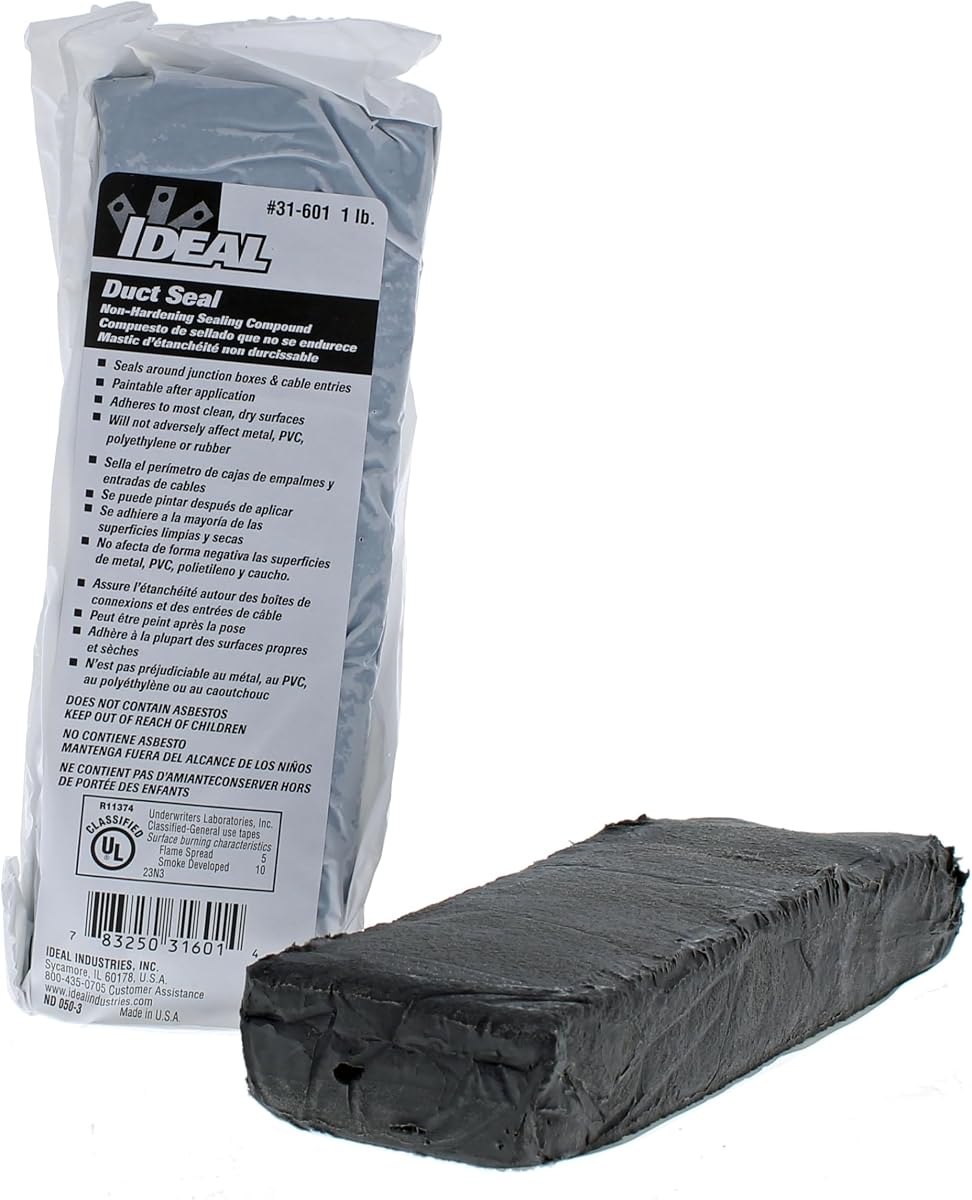
IDEAL Industries 31-601 is a one-pound gray duct seal compound with a 4.7 rating. It is designed for junction boxes, service entrances, HVAC penetrations, electrical boxes, conduit, and wall openings. The compound combines a permanently soft putty consistency with immediate paintability and compatibility across metal, masonry, wood, and plastic, giving it a broad profile for maintenance and installation work.
We may earn a commission when you buy through this link, at no additional cost to you.
Its main advantage is that it is described as remaining flexible over time without hardening, cracking, or shrinking. This makes it easier to apply, remove, and rework. A user can correct an imperfect placement or adjust the material around a penetration rather than cutting away a rigid, cured plug. The ability to adhere to several surface types is particularly useful when a job involves mixed materials or when the exact substrate is not perfectly known beforehand.
The listed protections cover air leaks, drafts, dust, and moisture in both indoor and outdoor settings. It is also described as non-corrosive and safe around plastics and metals. For visible work, immediate painting helps the installation fit into the surrounding finish. The one-pound block provides enough material for multiple penetrations, which can be useful for contractors or maintenance professionals dealing with more than one opening.
The product should not be confused with a certified mastic for sealing entire duct systems, and its large block may be more than a homeowner needs for one small repair. Even so, its durable flexibility, broad substrate compatibility, outdoor and indoor claims, and clean-finish option justify its position as a premium general-purpose pick for penetrations.
A permanently soft consistency makes installation corrections less destructive. Instead of scraping or chiseling away a rigid cured seal, the compound can be removed, reshaped, and reapplied as the opening or fit-up changes.
Adhesion to metal, masonry, wood, and plastic reduces the need to search for separate products as project conditions change. That versatility is especially valuable during repair work around mixed building materials.
We may earn a commission when you buy through this link, at no additional cost to you.
The five-foot continuous-roll duct seal putty is the highest-rated product in this group, carrying a 4.8 rating. Its 3/8-inch-thick material is marketed as a waterproof sealant mastic for HVAC openings, pipe openings, electrical conduit entries, cable points, ducts, vents, and wall penetrations. The roll format offers a continuous length that can be cut to fit the job rather than divided into preset portions.
We may earn a commission when you buy through this link, at no additional cost to you.
Installation follows a simple cut, knead, and press process. The material is cut to the desired length, kneaded until soft, and pressed firmly into the opening. Because putty is inherently conformal, this method allows the compound to follow irregular surfaces and produce a continuous bead or patch. The stated design reduces waste and can speed work compared with using a short, premeasured piece.
Weather resistance and flexibility are the product's central performance claims. It is described as creating a long-lasting seal that helps block air leaks, moisture, and dust while remaining flexible in indoor and outdoor applications. The continuous format also makes it practical for a long perimeter around a larger wall opening or a row of cable entry points. Users are instructed to begin with clean, dry surfaces for best adhesion.
This product is specifically designed for gaps and openings rather than structural repairs or active leak fixing. That limitation is understandable, but it means it should not be chosen to stop flowing water from a damaged pipe. Slight deformation during shipping is also noted as harmless to performance. For adjustable, weather-resistant sealing around penetrations, the roll's versatility and strong rating make it a compelling choice.
The roll lets installers determine the exact length needed for each opening. That control is useful for long perimeter seals, several nearby penetrations, or an installation that does not align neatly with a preformed block.
The product is advertised as flexible and weather resistant while remaining tool-free to apply. It therefore offers a different use pattern from a paste that must be spread and allowed to dry.
We may earn a commission when you buy through this link, at no additional cost to you.
Red Devil 0841DX F-Seal 181 is a one-gallon, gray, fiber-reinforced, water-based duct sealant with a 4.5 rating. Unlike the moldable putties in this guide, it is a paste-style product intended for HVAC ductwork. Its UL 181 A-M and B-M certification makes it the clearest choice when a project calls for a recognized sealant for metal, fiberglass, or flexible duct systems.
We may earn a commission when you buy through this link, at no additional cost to you.
The fiber-reinforced construction is intended to create a durable seal while improving system performance and energy efficiency. It is described as weather resistant, suitable for both interior and exterior conditions, and able to withstand varied environments. The product is also low in volatile organic compounds, which can be advantageous in occupied buildings, workshops, and other sensitive work areas.
Fast drying is another meaningful benefit for installers who cannot leave a duct joint exposed for a prolonged period. The product is stated to exceed SMACNA pressure and sealing classes, adding a second layer of professional relevance beyond its UL listing. Those claims distinguish it from general-purpose sealants intended only to fill a small visible gap around a pipe or wall penetration.
The trade-off is that this is not a reusable, hand-moldable duct seal putty. It is a one-gallon sealant that must be applied according to its own procedure and allowed to dry. The supplied information also does not provide detailed surface-preparation, coverage, or cure-time guidance. For a full HVAC sealing application where certification matters, it is more purpose-built than the putties; for a tiny household gap, it may be excessive.
UL 181 A-M and B-M certification is the decisive feature for ductwork where system integrity and applicable standards matter. It distinguishes this product from compounds marketed only for general gap filling.
A water-based, low-VOC formula that dries quickly can simplify occupied or time-sensitive installations. It offers a smoother workflow than a long-curing paste, although proper preparation remains essential.
We may earn a commission when you buy through this link, at no additional cost to you.
This 8-pack of waterproof sealing clay has a 4.3 rating and is positioned as a multipurpose repair material for household gaps. Its listed uses include wall holes, AC-unit openings, sink drains, pipe connections, and odor-blocking applications. Each 30-gram portion is sealed separately, giving the user several small units for scattered repairs without losing unused material to handling or storage.
We may earn a commission when you buy through this link, at no additional cost to you.
Unlike traditional non-hardening duct putty, this clay is intended to cure into a rock-hard, durable barrier. The application process involves kneading the clay, pressing it into the crack or hole, and allowing it to dry for three to five days. Once cured, it is described as creating an airtight and waterproof seal that blocks moisture. That makes it a potential option around drain and wall holes where a soft repair would be undesirable.
The formula can also act as an odor blocker, a characteristic not emphasized by many competing products. This broadens its use around sink drains and pipe connections, provided it is applied only to the gap rather than used as a repair for a leaking pressure line. No mixing or special tools are required, and the manufacturer recommends clean, dry surfaces for the strongest result.
Its primary weakness is the curing requirement. The user must keep the area dry and wait the full stated period before exposing the seal to moisture, which can be inconvenient. The 4.3 rating is also lower than the leading products in the group. Even so, the eight individually packed portions, waterproof cured result, and household drain-and-wall applications make this a useful choice when a rigid permanent barrier is desired.
The clay cures hard after application, distinguishing it from removable or reusable putties. That behavior can be preferable around a drain or wall opening where a durable, moisture-resistant barrier is wanted.
Eight separate 30-gram bags keep small quantities available for different tasks. This is helpful for property managers, landlords, and homeowners who want a compact kit instead of one large block.
We may earn a commission when you buy through this link, at no additional cost to you.
The three-pack silicone putty has a 3.8 rating and offers a lightweight, reusable approach to small household sealing tasks. Across the set, the total stated weight is 8.8 ounces. The compound remains soft and pliable, allowing it to be shaped, repositioned, and reapplied without a formal curing process. It is intended for indoor and covered outdoor projects rather than exposed weather conditions.
We may earn a commission when you buy through this link, at no additional cost to you.
Its stated uses include pipes, wall openings, sinks, bathtubs, conduit entries, cable holes, cracks, and other small gaps. The material can adhere to metal, glass, wood, ceramic, plastic, and masonry, which makes it versatile for repairs that involve different household surfaces. Because the putty is removable and reusable, a misaligned application can be corrected rather than discarded and replaced.
The lack of mixing, curing, or special tools makes this product straightforward for routine maintenance. It is particularly relevant for temporary sealing during a repair process, where a later adjustment may be necessary. The water-resistant formula is designed to reduce the entry of water, air, dust, and moisture while preserving the flexible consistency that makes the putty useful in the first place.
The 3.8 rating is the lowest among the products compared, and its covered-outdoor restriction is important. It also contains less total material than the large one-pound blocks or the five-foot roll. These factors limit its appeal for larger or exposed jobs. For small, covered household gaps and situations where reusability is the priority, however, the three-pack provides a useful and uncomplicated solution.
The reusable, non-hardening design lets a user remove and reshape the putty when the first placement is not ideal. This is especially useful for temporary work or penetrations that may be adjusted later.
Compatibility with metal, glass, wood, ceramic, plastic, and masonry expands the possible uses. The material can handle small sealing jobs in several rooms without switching products.
We may earn a commission when you buy through this link, at no additional cost to you.
The one-pack moldable silicone putty is a gray solid roll measuring 1.5 feet by 1 inch, with a 4.4 rating. It is a non-hardening, multipurpose gap sealant intended for voids, cracks, seams, and openings where air, water, or wildlife may enter. The continuous roll gives users freedom to cut or shape a custom amount for a particular penetration.
We may earn a commission when you buy through this link, at no additional cost to you.
Its silicone base supports a broad list of applications. The product is described as suitable for plastic, metal, masonry, wood, ceramic, glass, electrical conduit ends and boxes, flashings, and service mast entrances. It can also form a custom barrier intended to divert or block liquids. For maintenance work that crosses material boundaries, that compatibility is a meaningful advantage.
The putty can be hand-molded and reused when necessary, giving installers time to shape it before committing to a location. It is advertised as heat resistant, weather resistant, moisture resistant, and suitable for both indoor and outdoor applications. Excellent dielectric strength is also claimed, which supports its use around electrical penetrations by helping prevent the passage of electrical current through the material.
Some wording in the listing is internally inconsistent, including references to curing and epoxy putty even though the product is described as non-hardening. The one-inch width may also be more suitable for narrow runs than for filling a large cavity. Despite those caveats, the roll remains a versatile option for custom gaskets, small barriers, and general sealing across many surfaces, with a rating stronger than most of the lower-ranked flexible putties.
Because the material is supplied as a continuous roll, a user can form it into a fitted strip, blob, gasket, or custom barrier. This flexibility makes it useful when off-the-shelf block shapes are inconvenient.
The stated dielectric strength and heat resistance make the putty relevant around conduit and electrical boxes. Its moisture and weather resistance also support outdoor applications when the substrate is properly prepared.
We may earn a commission when you buy through this link, at no additional cost to you.
The two-pack moldable silicone putty has a 4.0 rating and supplies two rolls of gray putty. It is positioned as a non-hardening, multipurpose sealant for voids, cracks, and seams where air, water, or wildlife intrusion is a concern. Like the other flexible silicone options here, its defining quality is that it can be shaped and corrected instead of being permanently fixed at first placement.
We may earn a commission when you buy through this link, at no additional cost to you.
The putty can be removed, reshaped, and reused, reducing the need for scraping, sanding, or messy cleanup when an installation goes wrong. It is easy to apply by hand around conduit ends, boxes, flashings, and service mast entrances. It can also form custom barriers to block or redirect liquids, making it useful for small, irregular sealing situations around a home or workshop.
The listed compatibility includes plastic, metal, masonry, wood, ceramic, and glass. Heat resistance, weather resistance, moisture resistance, and dielectric strength are all claimed, supporting indoor and outdoor work around pipes and electrical openings. Two rolls provide a little more material than a single-roll option and make it easier to complete separate tasks without dividing one continuous length.
The rating is lower than the products in the upper half of the guide, and some listing language refers to curing or epoxy despite describing the product as non-hardening and reusable. It should also be treated as a gap sealant rather than a substitute for repairing an active leak in a pressurized line. For plumbing-adjacent gaps, custom gaskets, and adjustable household sealing, it remains a practical two-pack with useful material versatility.
The non-hardening formula can be removed and reapplied without aggressive cleanup. This makes the product approachable for a first sealing attempt and useful where access or fit may change during the task.
The putty is advertised for pipe and drain-adjacent sealing, custom barriers, and small water-entry concerns. It can complement broader plumbing repairs, although it is not a substitute for fixing the underlying leak.
We may earn a commission when you buy through this link, at no additional cost to you.
Choosing a duct seal compound starts with the opening, substrate, and expected service conditions. Format, curing behavior, certification, and environmental exposure determine which product is most appropriate.
The most noticeable difference among these products is whether the material arrives as a block, a roll, individually wrapped portions, or a paste sealant. One-pound blocks offer substantial material for technicians and repeated jobs but may be unnecessary for a single small opening. A roll can be cut to a precise length and is helpful for long perimeter seals or multiple penetrations. Individual packets preserve small unused quantities and simplify storage. A gallon of paste is a different tool entirely, intended for broader coating or certified duct-sealing work rather than thumb placement.
Non-hardening putty is valuable when a seal may need to be removed, reshaped, or reused. RectorSeal, Gardner Bender, IDEAL Industries, and the flexible silicone products are positioned around this advantage. Flexible material is also useful near surfaces that may shift slightly or where an irregular opening benefits from continuous conformance. By contrast, a curing clay becomes rigid after drying. That may be advantageous where a firm, permanent barrier is wanted, but it removes the option of easily correcting the installation later.
The surfaces around a penetration may include metal, plastic, wood, masonry, glass, or ceramic. The IDEAL Industries, Red Devil, and silicone putty listings specify broad compatibility, while several other products mention particular surfaces without providing a full list. Clean, dry substrate is consistently important. A sealant that seems suitable can still perform poorly if it is applied over dust, oil, moisture, loose material, or a moving surface that the compound cannot accommodate.
Indoor, covered outdoor, and fully exposed outdoor environments present different demands. Several listings claim weather resistance, but one clearly limits the 12-pack to indoor or covered areas, while the 3-pack silicone product is also best limited to covered outdoor use. The continuous roll, IDEAL Industries block, and two silicone rolls are described for indoor and outdoor use. Red Devil adds a specific weather-resistance claim for varied interior and exterior conditions. Review these limits rather than assuming that the word putty guarantees universal exposure tolerance.
A general-purpose putty that blocks a draft around a pipe is not automatically the same as a sealant approved for sealing an entire HVAC duct assembly. Red Devil 0841DX F-Seal 181 carries UL 181 A-M and B-M certification and is explicitly positioned for metal, fiberglass, and flexible ductwork. For a minor penetration where no formal duct standard applies, a moldable compound may be more convenient. For a system-level duct sealing specification, certification, joint compatibility, and the manufacturer's application procedure should take priority over convenience.
A non-hardening compound can be installed and adjusted without waiting for a cure. That is useful in occupied spaces, around equipment that must remain operational, or when a trial fit may be necessary. The 8-pack sealing clay requires three to five days of drying and recommends keeping the area dry throughout that period. Red Devil is fast drying but remains a paste sealant with its own application method. Before buying, consider whether the location can remain undisturbed, whether paint or finish will be applied, and whether immediate operation is necessary.
Sealing an opening can provide benefits beyond stopping air. Gardner Bender specifically mentions deadening switch-gear panel noise, and the 8-pack clay is described as an odor blocker. Products that remain soft can also accommodate a visible installation better than materials that crack or shrink. RectorSeal and IDEAL Industries can be painted immediately, while a cured product may eventually produce a hard, finished patch. Consider these secondary effects when choosing a product for equipment rooms, living spaces, or visible exterior penetrations.
Begin by identifying the opening and inspecting the surrounding surfaces. Remove loose debris, dust, oil, and standing moisture, then allow the area to become completely dry. Confirm that the compound is compatible with the substrate and suitable for indoor or outdoor exposure. For a block, cut or pinch off only the amount needed; for a roll, cut a measured length; and for a packet-based product, open one portion at a time to preserve the rest.
Knead the putty until it is uniform and pliable, then press it firmly into the opening with clean fingers or a suitable shaping tool. Work the material into corners and irregular edges so that it makes continuous contact rather than sitting as a loose plug. Build up slightly where needed, smooth the visible surface, and remove excess material. Do not use a moldable gap compound as the sole repair for an active leak, a failed pressure line, or a structural failure, and follow the specific curing directions for products that harden.
After placement, allow non-hardening putty to make full contact with the substrate and inspect it periodically as temperature, moisture, and building movement change the opening. Store unused putty in a sealed, cool, dry place, and keep individual packets closed until needed. For paintable products, apply paint only when the installation is secure and follow the manufacturer's surface and drying guidance. For certified or curing sealants, follow the listed application instructions and allow the full stated cure before operation or moisture exposure.
Duct seal putty compound is used to close gaps around pipes, conduits, electrical boxes, HVAC openings, service entrances, flashings, and wall penetrations. It can block drafts, dust, moisture, and sometimes noise or odors. Most moldable versions are intended for gap sealing rather than repairing active leaks or damaged duct sections.
It depends on the product. Some listings specifically permit indoor and outdoor use, while others limit their compound to indoor or covered areas. Check the environmental claims on the exact product, make sure the surface is clean and dry, and confirm that the formula is intended for the rain, sunlight, and temperature conditions at the installation site.
No. General-purpose putty is primarily designed to fill gaps by hand, while a certified HVAC sealant may be a liquid or paste engineered for duct joints and listed under a specific standard. Red Devil 0841DX F-Seal 181 carries UL 181 A-M and B-M certification; that distinction makes it more appropriate when complete ductwork specifications are involved.
RectorSeal Duct Seal 81880 and IDEAL Industries 31-601 are specifically described as paintable immediately after application. Other products may have different finishing or curing requirements, so check the instructions before applying paint. Ensure the material is firmly seated and use a compatible finish over a clean, dry surface.
Non-hardening putty stays soft and can often be removed, reshaped, or reused, making it useful for adjustable or temporary work. Curing clay hardens after application and is better suited to a permanent barrier. The 8-pack waterproof sealing clay, for example, requires a three-to-five-day drying period and must remain dry during that interval.
Generally, no. These products are intended to seal gaps around penetrations, not replace pipe repair methods or solve pressurized leaks. The 12-pack explicitly states that it is not for plumbing leaks or pressurized water leaks, and the roll product limits itself to gap sealing. Repair the underlying pipe or fitting first if there is active flow.
The required amount depends on the opening's dimensions, depth, number of penetrations, and whether you are filling a cavity or placing a thin bead. A one-pound block suits repeated jobs, a roll suits custom lengths, and individual packets suit scattered small repairs. Buying the smallest practical format reduces the chance of unused material aging or being contaminated.
Compatibility varies by formula. Listed options mention metal, masonry, wood, plastic, glass, and ceramic, but not every product claims every surface. Clean and dry the area before application and select a compound explicitly rated for the materials involved, especially where outdoor exposure or electrical proximity is involved.
RectorSeal Duct Seal 81880 stands out as the best overall choice because it combines broad trade usefulness, hand-molding, material compatibility, and immediate paintability. Gardner Bender DS-110N is a straightforward budget option for small electrical and conduit gaps, while IDEAL Industries 31-601 offers a premium block that remains flexible, adheres to several materials, and supports indoor and outdoor work.
Prioritize the job rather than the label. Choose a non-hardening product when the seal may need adjustment, a curing clay when a hard permanent barrier is needed, and a certified paste for complete HVAC ductwork. Clean, dry surfaces matter regardless of the formula, and none of these gap sealants should be treated as a substitute for repairing an active pipe leak or structural damage.
Ratings, product listings, and prices can change, so review the current Amazon page and manufacturer specifications before buying. Check package size, exposure limitations, surface compatibility, and cure or drying requirements to ensure that the selected duct seal putty compound fits both the opening and the conditions it will face.