
Electric Insulin Cooler Travel Case Box
3.2Editor score
Twelve-pen storage capacity
Two rechargeable batteries
Cooling and heating controls
Our electric insulin cooler box mini fridge guide compares 10 portable models for temperature control, capacity, battery life, travel readiness, and everyday
An electric insulin cooler box mini fridge is a compact, temperature-controlled medication cooler designed for people who need reliable insulin storage at home or while traveling. A useful model should combine accurate temperature adjustment, enough room for your medication, dependable power options, and ventilation that supports consistent cooling.
We compared the ten products in this guide using their stated temperature ranges, internal capacity, battery runtime, charging methods, physical dimensions, displays, portability features, and travel-related claims. The comparison covers box-style coolers for multiple pens and vials as well as a compact electric cooler cup for simpler medication routines.
Each review highlights the strongest reason to consider a model while also noting practical trade-offs such as limited capacity, shorter battery life, or the need to keep ventilation openings clear. Product availability, features, and prices can change, so readers should verify the current listing and their medication's storage requirements before purchasing.
3.2Editor score

4.8Editor score

5.0Editor score
The following comparison brings the ten electric medication coolers together, focusing on capacity, temperature control, battery support, and the convenience of home, vehicle, and travel operation.


This electric insulin cooler travel case is a compact semiconductor-powered refrigerator with a stated 2.9 rating. It combines a 36–64°F operating range, a real-time LED touchscreen, and a rechargeable battery, making it relevant for travelers who want more control than a conventional insulated medication bag can offer.
We may earn a commission when you buy through this link, at no additional cost to you.
Its strongest feature is the flexible power arrangement. The cooler can run from household power, vehicle power, a power bank, or its built-in battery, and the separate battery-charging and refrigerator-power wires reduce setup confusion. The internal compartment measures 6.88 by 2.4 by 1 inches, which the product description says can accommodate two to three insulin pens or bottles.
The trade-offs are meaningful. A 2.9 rating is lower than those of the leading products in this guide, and the small internal dimensions may not suit someone carrying several pens, multiple vial types, or additional supplies. Semiconductor cooling also needs space around its ventilation openings, so the case should not be placed in a tightly packed bag while operating.
This is best for a user with a modest medication load who values power flexibility and straightforward temperature monitoring. It is less compelling for frequent flyers, larger families, or anyone whose stored medication requires strict validation under a specific clinical protocol. Buyers should compare the available capacity and consult the insulin manufacturer's storage instructions before choosing it.
The ability to switch among household power, vehicle power, a power bank, and the internal battery makes this case suitable for home, road trips, and brief outings. Battery life varies with the selected temperature, so a full charge is best reserved for occasions when no external source is available.
The touch display shows the internal temperature in real time, which is useful for checking the case at a glance. Its shallow compartment is designed for only two or three pens or bottles, making medication quantity the most important factor to confirm before purchase.
We may earn a commission when you buy through this link, at no additional cost to you.
The Portable Insulin Cooler Box is the strongest all-around model in this guide, combining a 4.8 rating with the broadest stated medication capacity among the box-style products. It is explicitly FAA approved for air travel and includes a portable carrying bag, making it particularly attractive for frequent travelers.
We may earn a commission when you buy through this link, at no additional cost to you.
Capacity is a major advantage. The interior measures 7.1 by 2.9 by 1.8 inches and can accommodate up to three extra-large GLP-1 pens, ten insulin pens, fifteen vials, or 48 cartridges. The manufacturer also reports laboratory cooling from 73.4°F to 38.4°F in 14 minutes and offers a 41°F setting with a one-touch lock.
The main limitation is its larger footprint compared with compact cases. While the portable bag helps with transport, this is still a fuller-size travel appliance, and a TSA or airline representative should confirm how the specific medication, battery, and case will be handled. The product description's laboratory result also does not guarantee the same cooling speed in every ambient environment.
This cooler is the most balanced recommendation for a traveler who wants substantial capacity, a highly rated design, and explicit travel positioning. It suits commuters, families managing several medications, and anyone who prefers a broader range of storage options over a minimal pen-only case.
The ability to hold ten standard pens, fifteen vials, or 48 cartridges gives this model exceptional flexibility. It can serve as a consolidated medication cooler rather than a dedicated container for only one or two daily supplies.
The one-touch lock helps prevent accidental control changes during transit, while the 41°F setting is designed around a commonly used storage target. Clear temperature monitoring and rapid cooling also make the product practical for road trips and flights.
We may earn a commission when you buy through this link, at no additional cost to you.
This electric insulin cooler travel case offers a focused 2–8°C range, an LED temperature display, and a stated 3.2 rating. It is designed for people who need straightforward temperature monitoring and a compact case that can accommodate three to five insulin pens.
We may earn a commission when you buy through this link, at no additional cost to you.
Its dimensions are 9.2 by 6.5 by 5 inches, with an interior of 7.32 by 4.13 by 1.57 inches. The rechargeable battery supplies two to four hours of operation when external power is unavailable, while household AC, vehicle power, and a power bank are also supported for longer journeys.
The battery runtime is shorter than that of several competing models, making external power important for extended travel. The 3.2 rating also suggests that buyers should examine current customer feedback carefully. In addition, the stated 2–8°C range may not be appropriate for every medication or storage protocol, so users should follow the instructions supplied with their medicine.
This is a reasonable option for daily commuting, business trips, and moderate medication loads. It is most appropriate for someone who values simple controls, external power flexibility, and a deeper interior than a narrow pen-only cooler without needing the exceptional capacity of the top-rated model.
The stated 2–8°C control range keeps the product focused on cold-chain medication storage. The LED display allows users to monitor the internal temperature and make adjustments without navigating a complicated interface.
Support for household, vehicle, and power-bank power gives the cooler flexibility across common travel settings. The internal battery is best treated as a short-term backup, particularly when a lower setting increases power consumption.
We may earn a commission when you buy through this link, at no additional cost to you.
The Nother Insulin Cooler Case is a mini medicine refrigerator with a 3.7 rating and a stated 2–8°C cold-storage range. It offers a clear touchscreen, fast cooling, broad power compatibility, and an internal design intended to reduce medication movement during travel.
We may earn a commission when you buy through this link, at no additional cost to you.
Its most useful advantage is battery endurance. The product description states that the portable battery provides more than ten hours of standby time and lists USB, wall charger, power bank, vehicle, home, and battery operation among its supported options. The case can reportedly hold about three insulin pens, six bottles, or 20 refills.
The environmental limitation is important: the stated operating temperature is below 77°F, and the description says the case cannot cool below 46.4°F when the room temperature exceeds 77°F. That means it should not be treated as a universal solution for hot-car or hot-climate use without appropriate environmental management.
This model fits commuters and travelers who need more standby time than the typical two-to-four-hour models. It is particularly suitable for cooler indoor and travel environments where the case can operate within its stated ambient limit and where three pens or a small number of other supplies are enough.
A stated standby time of more than ten hours offers a comfortable buffer for a workday, an overnight train journey, or travel between external power sources. Actual runtime will depend on temperature, ambient conditions, and how often the door is opened.
The high-definition touchscreen combines power and temperature information in one display, which may be helpful for older users or anyone who wants an uncomplicated interface. The curved inner tank is also intended to keep medication from striking the walls during movement.
We may earn a commission when you buy through this link, at no additional cost to you.
This electric insulin cooler travel case box has a 2.8 rating, a 2–18°C adjustable range, and a distinctive two-layer partition. It is designed to hold four to five insulin pens or bottles while allowing users to organize medication in separate zones.
We may earn a commission when you buy through this link, at no additional cost to you.
The dual-layer design is the defining feature. According to the product information, the upper layer runs slightly warmer than the lower layer, which can accommodate products with different temperature requirements without forcing everything into one compartment. A display shows both internal temperature and remaining battery life, while the detachable lithium battery provides four to six hours of continuous cooling.
Its overall dimensions of 9.06 by 7.09 by 5.51 inches make it larger than many portable cases. More importantly, the differing zone temperatures require attention: users should confirm that the warmer upper zone remains appropriate for every medication placed there. The 2.8 rating is another reason to review recent customer feedback.
This case is best for a user who wants organized storage and a wider temperature-adjustment range. It may suit travelers carrying several pens with slightly different storage needs, provided those differences can be safely accommodated by the two-zone arrangement.
Separate upper and lower compartments help organize four to five pens or bottles and can prevent all medication from sharing one crowded area. Because the upper section is described as slightly warmer, medication compatibility should be checked before use.
Showing both temperature and remaining battery life helps users decide when to connect external power. The detachable battery and four-to-six-hour runtime are useful for road trips, camping, and brief outages.
We may earn a commission when you buy through this link, at no additional cost to you.
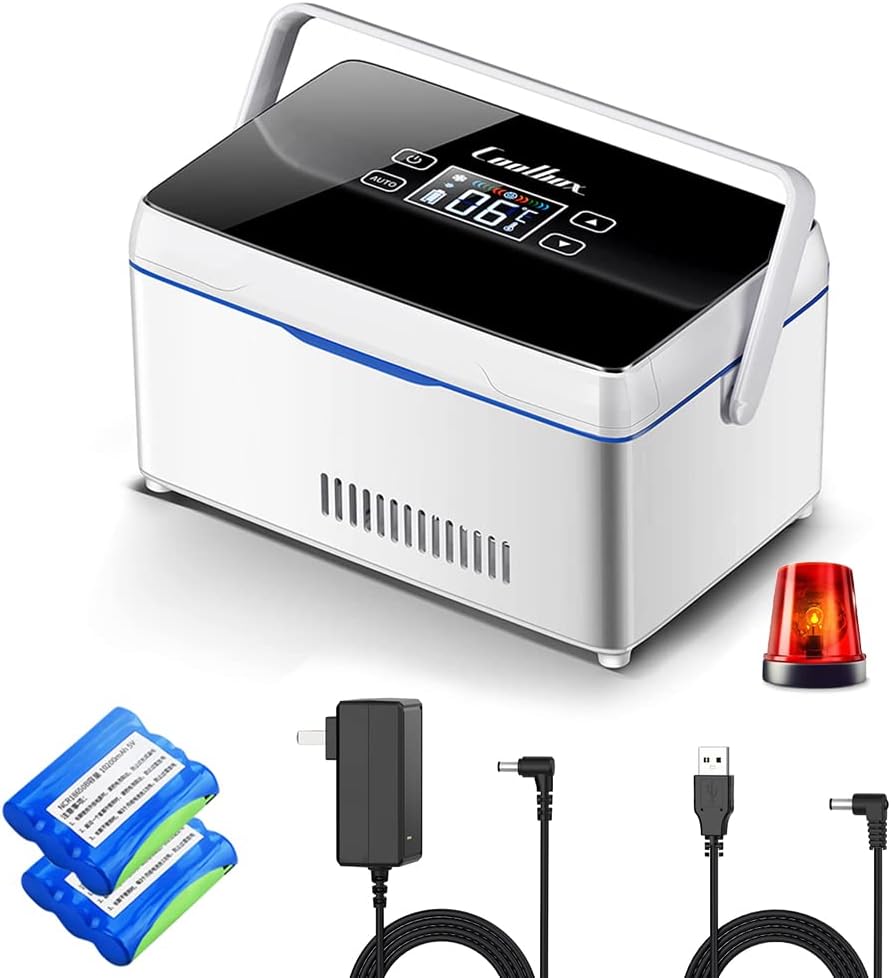
The Electric Insulin Cooler Travel Case Box is the best budget-oriented selection in this guide, offering a 3.2 rating, 12-pen capacity, and two rechargeable batteries. It also supports cooling and heating across a 2–18°C range, making it one of the more versatile small electric appliances here.
We may earn a commission when you buy through this link, at no additional cost to you.
The product listing emphasizes a 6–8-hour standby period, two rechargeable batteries, a low-battery buzzer, and multiple power sources including USB, wall outlet, vehicle adapter, and battery power. It reportedly reaches the desired temperature in 10–20 minutes when ventilation is adequate. A matching carrying pouch is included, and the stated capacity reaches up to 12 insulin pens.
The distinction between standby and continuous cooling deserves attention. Standby time is not necessarily the same as sustained low-temperature operation, so users traveling for extended periods should plan to connect external power when possible. The 3.2 rating also indicates that the product may not satisfy every buyer, even though its stated specifications are generous.
This cooler is a strong fit for value-conscious users who carry several pens, want both cooling and heating controls, and appreciate battery alerts. It is also useful for temperature-sensitive biologics beyond insulin, provided the user confirms that the selected range meets the storage instructions for each medicine.
The stated ability to hold up to 12 pens is unusually high for a compact cooler. This makes the model practical for users who want one device for multiple daily supplies rather than rotating medication between containers.
A low-battery buzzer provides a useful warning before the case loses its backup power. The 2–18°C range and combined cooling and heating functions offer more control than a basic cold pack, although users must allow the displayed temperature to settle toward the selected setting.
We may earn a commission when you buy through this link, at no additional cost to you.
This Portable Insulin Cooler Travel Case is a shallow, compact option with a 3.0 rating. Its exterior measures 8.46 by 5.9 by 2.36 inches, and its 7.3 by 2.36 by 1-inch interior is designed for two to three insulin pens.
We may earn a commission when you buy through this link, at no additional cost to you.
Temperature can be adjusted within a 2–18°C range using the LED display, and the case can be powered by household AC, vehicle power, or a power bank. Its built-in lithium battery provides two to four hours of operation away from external power, making it suitable for short commutes and travel days.
The narrow one-inch interior is the decisive limitation. It may fit a few slim pens but will not accommodate larger bottles or a large assortment of supplies. At approximately 1.5 kilograms, it is also not the lightest option, even though its shape is relatively easy to place in a handbag or backpack.
This model is best for a minimal daily load carried by someone who values a low-profile shape over generous storage. Travelers taking more medication, or anyone needing to store vials alongside pens, should choose a deeper case.
The shallow enclosure can slide more readily into a handbag or backpack than a deep box-style refrigerator. That makes it convenient for users who carry only a few slim pens and need the cooler to take up little space.
A selectable 2–18°C range provides more flexibility than a fixed cold-storage design. The two-to-four-hour battery extends cooling when an outlet, vehicle connection, or power bank is unavailable.
We may earn a commission when you buy through this link, at no additional cost to you.
This electric insulin cooler travel case is a compact semiconductor refrigerator with a stated 2.6 rating. It offers a 36–64°F range, an LED touchscreen, and a rechargeable battery in an 8.6 by 4.7 by 5-inch housing.
We may earn a commission when you buy through this link, at no additional cost to you.
Its straightforward controls are designed to make the appliance approachable for seniors and beginners. A one-touch mode changes cooling settings, while the display shows the internal temperature in real time. Household power, vehicle power, a power bank, and the built-in battery cover most common travel and home scenarios.
The 2.6 rating is the lowest in this comparison, so it should be considered with more caution. Capacity is also limited to two or three pens or bottles. Although the power flexibility is appealing, users who carry a larger medication load should prioritize a case with a deeper interior and stronger customer feedback.
This product may suit a small-scale user who values a simple interface and numerous power options over high capacity. It is best for short trips or as a home backup for a small medication quantity, with close attention to the product's ventilation requirements.
The one-touch temperature control reduces the learning curve for new users, and the real-time display provides a quick visual check. It is designed to be approachable for older adults and anyone who wants fewer settings to manage.
Four operating modes allow the case to adapt to outlets, vehicles, power banks, and its own rechargeable battery. The internal battery lasts two to four hours and is most useful as a bridge between external power sources.
We may earn a commission when you buy through this link, at no additional cost to you.
The Upgraded Insulin Cooler Case combines a 4.0 rating with a one-year warranty, making it one of the better-established options in this guide. It uses an LED temperature touch screen, supports 0–8°C cooling, and can hold six to nine insulin pens, 25 bottles, or 60 refills.
We may earn a commission when you buy through this link, at no additional cost to you.
Two portable rechargeable batteries are included, each described as working for three to six hours. The case can be charged through a 110–240V adapter, USB connection, car outlet, home outlet, or portable battery, making it adaptable to offices, hotels, vehicles, and travel. A handle and TSA approval add to its travel positioning.
The unusually broad 0–8°C range requires careful setting and monitoring because a lower target is not automatically appropriate for every insulin product. The listing also warns against high-temperature environments and water immersion, and it advises keeping the ventilation slots unobstructed.
This is a good option for users who want more capacity than a narrow pen cooler and value a warranty alongside a strong rating. It is especially suitable for trips where two batteries can be alternated, provided the selected temperature is confirmed against the medication's instructions.
A stated capacity of six to nine pens, 25 bottles, or 60 refills makes this one of the more versatile box-style coolers. The included one-year warranty adds an ownership benefit that is not highlighted by every competitor.
Two rechargeable batteries reduce dependence on a single power source and can each provide three to six hours of operation. Alternating them can help maintain cooling during long travel, subject to the product's charging and environmental guidelines.
We may earn a commission when you buy through this link, at no additional cost to you.
The Sendowtek Insulin Electric Cooler Cup is a compact alternative to conventional box-style coolers. It has the highest stated customer rating in the guide at 5.0 and uses a cup format that prioritizes portability, quick access, and simple operation over bulk medication capacity.
We may earn a commission when you buy through this link, at no additional cost to you.
Its electronically controlled temperature range is 35–68°F, and the insulated interior is designed to maintain a consistent cool environment. The built-in battery offers approximately 2.5 to 3.5 hours of operation after charging, while the universal USB-C port allows recharging through a vehicle, power source, computer, laptop, or outlet.
The major limitation is capacity and battery endurance. Unlike models that hold multiple pens or vials, the cup is intended for a smaller quantity, and its battery runtime is shorter than most box-style alternatives. Users planning an extended trip should carry a charged power bank or plan to recharge frequently.
This premium pick is best for someone who wants a discreet, backpack-ready cooler for a small medication load and values a highly rated, modern design. It is less suitable for travelers carrying extensive supplies or expecting an entire day of cooling without access to external power.
The cup format takes up less room than a full rectangular medical refrigerator and allows quick access to medication. It is especially appealing for short outings, commutes, and travel days where carrying several separate containers would be inconvenient.
Universal USB-C charging makes the cooler convenient to replenish from many familiar devices and outlets. Double-layer insulation supports stable temperatures, while wired and wireless modes allow users to choose between continuous external power and cordless operation.
We may earn a commission when you buy through this link, at no additional cost to you.
Choosing an electric insulin cooler requires balancing medication-storage requirements against capacity, cooling performance, power availability, portability, and the environmental conditions in which the case will operate.
Begin with the temperature range your medication requires rather than comparing numbers in isolation. The products in this guide span approximately 35–68°F, 36–64°F, 2–8°C, 0–8°C, and broader 2–18°C or 2°C–18°C ranges. A narrow medical range may be easier to manage, while a broader range offers more flexibility for different temperature-sensitive products. A clear real-time display is also valuable because it lets the user confirm the internal temperature instead of relying entirely on the selected setting.
Capacity is not comparable using exterior dimensions alone because usable depth and pen diameter determine what actually fits. Stated capacities range from two or three pens to as many as ten or twelve, with one model offering multiple configurations for GLP-1 pens, standard insulin pens, vials, and cartridges. Measure your medication and include syringes, needles, or other supplies in the space calculation. A case that is technically large on the outside but only one inch deep may hold fewer items than its overall dimensions suggest.
Battery life determines whether the case can function during outages, flights, camping, and other periods without an outlet. Listed runtimes range from roughly 2.5 hours for the compact cup to more than ten hours of standby for one box model, with many cases offering two to four hours. Runtime can vary with the selected temperature, ambient heat, door openings, and use of continuous cooling versus standby. USB, USB-C, vehicle adapters, AC adapters, and power-bank support make it easier to replenish the battery, so compare both endurance and charging compatibility.
A cooler that performs well at home may still be inconvenient on a trip if it is heavy, deep, or difficult to balance. Box models generally provide more room, while the Sendowtek cup trades capacity for a smaller carrying footprint. Consider the dimensions with the carrying bag, the weight of the unit and medication, and whether it fits within your backpack, handbag, or carry-on. A handle helps with retrieval, but it does not eliminate the need to keep the case upright if its design or instructions call for that.
Semiconductor cooling requires ventilation, and many manufacturers warn against blocking the openings or enclosing the unit while it operates. Heat also affects performance: one product explicitly cannot cool below 8°C when the surrounding temperature is above 77°F. A case left in a hot vehicle, direct sunlight, or an unventilated bag may fail to maintain its selected temperature. Follow the manufacturer's environmental instructions, allow space around the cooling vents, and avoid assuming that a selected display value means the internal temperature has already stabilized.
FAA approval, TSA approval, and permission to carry a case on an airplane are related but not necessarily identical claims. Review the exact wording and verify current rules with the airline and relevant authority before departure. Battery type, medication labeling, ice packs, and the way insulin is packaged can affect screening and carry-on decisions. A portable bag makes handling easier, but it should not compress the ventilation openings. Travelers should also carry their medication in the original labeled packaging and follow the storage advice from the manufacturer or pharmacist.
LED and touchscreen controls vary from a basic on-and-off function to lockable, adjustable temperature settings. A lock can prevent accidental changes in a bag, while a low-battery buzzer or battery-level display helps users act before cooling is interrupted. Simplicity can be a major benefit for older adults or anyone managing medication on a busy schedule, but a clear display should also be readable under different lighting conditions. Choose the interface you can comfortably read and operate without unlocking a complicated menu.
Proper care extends the life of the cooler and helps protect medication. Clean the removable interior surfaces according to the instructions, avoid immersing the electrical unit, and keep moisture away from ports and controls. Do not obstruct ventilation or expose the appliance to extreme heat unless the manufacturer permits it. Medication should be kept in clean, separate containers to reduce cross-contamination, and expired or temperature-exposed medication should be handled according to guidance from the pharmacist or prescriber. The appliance should complement, not replace, sound clinical storage practices.
Before first use, read the manufacturer's instructions, inspect the case and power accessories, and confirm that the cooling vents are unobstructed. Place the unit on a stable, ventilated surface away from direct sunlight and heat sources. Charge the internal battery fully if one is included, then set the desired temperature while the case is empty or contains only medication that is safe to cool during the initial test. Allow the displayed temperature to move gradually toward the selected value rather than assuming the set point has been reached immediately.
Place medication in clean, separate containers and arrange it so it will not be crushed when the case is closed. Leave the circulation paths described in the instructions clear, and do not pack the appliance so tightly that its vents are covered. When traveling, carry the unit in its bag without sealing it in a space that blocks airflow, and use external power whenever it is reasonably available. Confirm the chosen temperature with the display and with the storage instructions supplied with the medication.
Clean the interior only as directed, unplugging the appliance and avoiding immersion or spraying liquids into openings. Dry the compartment before replacing medication, inspect cords and battery condition, and keep the unit away from excessive heat and water. If the temperature is not maintained, the battery alert sounds, or medication may have been exposed to unsuitable conditions, stop relying on the case and contact a pharmacist or the medication manufacturer for guidance.
Runtime depends on the model, battery condition, selected temperature, ambient heat, and how often the case is opened. Listed battery figures range from approximately 2.5 hours to more than ten hours of standby, so the shorter runtime usually describes continuous operation while the longer figure may refer to standby. For a full trip, check the current instructions and plan to recharge from a wall outlet, vehicle, or compatible power bank.
No. These products use electronic semiconductor cooling and an internal battery or external power rather than relying on frozen packs. Ice packs can still be useful as a separate backup under appropriate travel guidance, but adding them to an electric case may affect airflow or create condensation. The appliance should be operated according to its instructions with the ventilation openings kept clear.
Some models in this guide are described as FAA or TSA approved, but travelers should verify the current rule with the airline and relevant authority. Approval for one product does not automatically guarantee approval for every medication, battery configuration, or itinerary. Keep insulin in its original labeled packaging and carry the necessary documentation and cooling supplies specified by the medication manufacturer, pharmacist, or airline.
The appropriate range depends on the exact insulin product, whether it is unopened, in active use, or being carried. Many of the reviewed coolers include 2–8°C or 36–64°F as a central range, while some offer wider adjustment. Follow the labeling and storage instructions for the specific medicine, and ask a pharmacist or prescriber when the range is unclear.
Capacity varies substantially by design. The listed products hold between two and three pens in the narrowest cases, while larger models claim space for ten, twelve, or even multiple vials and cartridges. Exterior size can be misleading, so compare the internal measurements with the dimensions of the user's pens, bottles, syringes, and other essential supplies.
Cooling may take time, especially with a room-temperature load, and the display may gradually move toward the set value. High ambient temperatures, blocked vents, frequent opening, direct sunlight, or operation inside a sealed bag can also reduce performance. Leave space for ventilation, allow the temperature to stabilize, and verify the internal reading with an appropriate independent thermometer when accurate medication storage is critical.
They should be used only within the manufacturer's environmental limits. One reviewed product explicitly notes that it cannot cool below 8°C in room temperatures above 77°F, while others warn against high-temperature environments. If a journey involves extreme heat, a passive validated cooler or medically appropriate insulated travel kit may be a safer primary or backup method.
Many semiconductor coolers can also hold other biologics or temperature-sensitive medicines, provided each item's required range is compatible. Do not place incompatible products together, allow for air circulation, and keep every medication in its original labeled container. The appliance does not replace professional advice about the storage or stability of a particular medicine.
The Portable Insulin Cooler Box stands out as the most complete option because it combines a 4.8 rating, substantial capacity for pens or vials, rapid cooling, and explicit FAA positioning. The Sendowtek Insulin Electric Cooler Cup offers the highest rating and a particularly compact design for small medication loads, while the Electric Insulin Cooler Travel Case Box provides notable capacity and two batteries at a value-focused level.
Prioritize the medication's labeled storage range, actual internal capacity, and the environment where the cooler will operate. Battery life and charging compatibility matter most during outages and long journeys, while ventilation and ambient temperature determine how consistently any semiconductor cooler can perform. A higher customer rating is useful evidence, but it should complement—not replace—checking the detailed specifications.
Features, availability, and prices can change, so review the current product listing and manufacturer instructions before buying. Compare the final dimensions, included accessories, battery behavior, and warranty information, and consult a pharmacist or healthcare professional if you are uncertain how a particular insulin or biologic should be transported and stored.