
WG-026 10-Piece Test Lead Set
4.7Editor score
Ten color-coded test leads
Nickel-plated steel clips
22 AWG copper wire
Compare the best electrical alligator clips with wires for testing, wire gauge, length, clip size, insulation, voltage rating, and overall versatility.
Electrical alligator clips with wires give technicians, electronics hobbyists, and repair professionals a reliable way to make temporary connections during testing. A strong spring, secure wire attachment, suitable insulation, and an easy-to-reach length all contribute to dependable performance.
This guide compares ten products using their stated wire gauges, clip construction, electrical ratings, lead lengths, color coding, and intended applications. It covers sets ranging from compact laboratory jumpers to longer, higher-current leads for automotive and general electrical diagnostics.
Each review explains the standout features, practical trade-offs, and likely buyer for every product in the ranking. Product details and availability can change, so readers should verify current specifications and listings before purchasing.
4.7Editor score
4.8Editor score
4.7Editor score
The table below compares all ten sets by lead length, wire gauge, stated electrical rating, and clip construction, making it easier to match a lead set to a specific testing task.


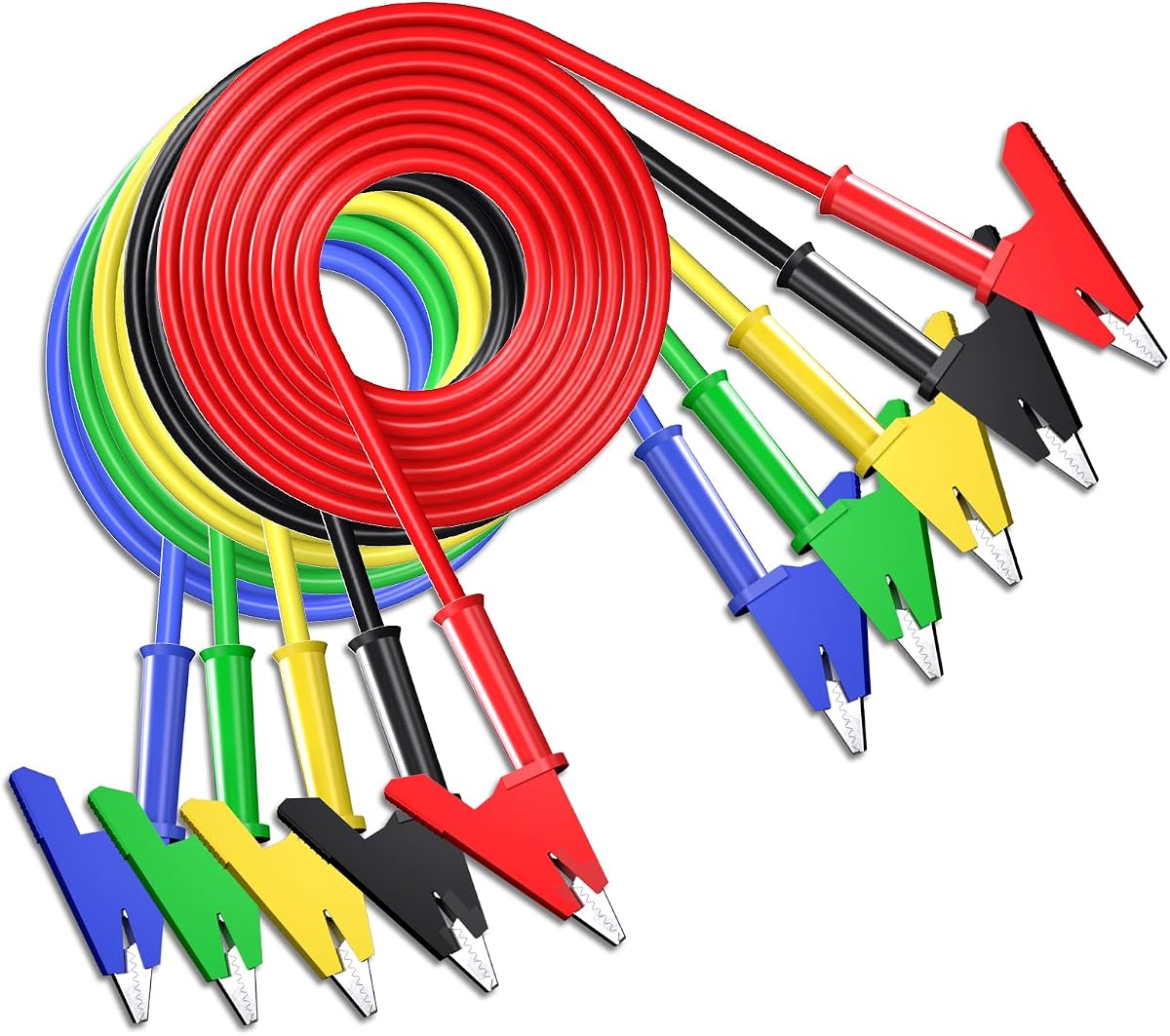
The WG-026 set earns a 4.7 rating and stands out as a balanced, economical choice for electronics work. Its ten leads cover five colors, while the 22 AWG copper wire and 20.5-inch length make the set convenient for breadboards, prototypes, basic diagnostics, and general laboratory experiments.
We may earn a commission when you buy through this link, at no additional cost to you.
The clips use nickel-plated steel with strong springs, and their PVC insulation and vinyl coating help protect both the user and the contact surfaces. Each clip is soldered and stamped to its lead, which is preferable to a loose or easily separated connection during repeated testing. The color organization also makes it easier to keep positive, negative, and signal paths visually distinct.
Its main limitation is that the product information does not state a voltage or current rating. The relatively light 22 AWG construction is better suited to signal, low-voltage, and light-current testing than to demanding high-current work. Buyers should therefore treat the stated wire gauge and clip construction as the important selection criteria rather than assuming suitability for a particular heavy-load application.
This is a strong choice for students, electronics hobbyists, and general repair technicians who want a useful assortment without carrying multiple unrelated lead sets. It also suits users who value clear color coding more than a long reach. For routine experimentation and temporary circuit connections, the WG-026 provides the most versatile balance in this ranking.
Two leads each in red, black, yellow, green, and white make it easier to follow several connections without repeatedly checking printed labels. This organization is particularly useful when working with breadboards, small circuits, and troubleshooting setups involving multiple test points.
At 20.5 inches long, the leads are long enough to bridge several bench components without creating excessive loops. The smaller 1.6-inch clips fit common small-gauge terminals and component leads while remaining easy to position by hand.
We may earn a commission when you buy through this link, at no additional cost to you.
With a 4.7 rating, the SWANLAKE set is a practical choice when reach and explicit electrical ratings matter most. Its two 3.5-foot, dual-ended leads can bridge distant test points or access components inside equipment, making it useful for battery checks, circuit board testing, and general diagnostics.
We may earn a commission when you buy through this link, at no additional cost to you.
The copper clips are designed for conductivity and strong contact, while the insulated cables are stated to handle up to 15 amps and 1000 volts. That makes the product description more useful for initial screening than sets that provide no electrical limits. The rubber insulation cover and protected cable construction also reduce the chance of accidental contact or damage during routine work.
Only two leads are included, so the package is less convenient for projects requiring numerous color-coded connections. Users who routinely work with dense circuits may need to coordinate separate leads or use a larger kit. As with any temporary lead, the stated rating should not be treated as permission to exceed the rating of the meter, circuit, or surrounding equipment.
This set is best for technicians who need a moderate amount of extra reach, especially when testing enclosed or awkwardly arranged components. It can also serve as a hands-free connection between two points while the user operates a multimeter or observes equipment behavior.
The 3.5-foot length gives enough separation for a component on one side of a chassis and a meter on the other. It also reduces strain when a connection needs to remain in place while hands are occupied elsewhere.
The stated 1000-volt and 15-amp limits give buyers a clearer basis for comparing this set with alternatives. Those figures still need to align with the intended circuit, connector, meter, and applicable safety practices.
We may earn a commission when you buy through this link, at no additional cost to you.
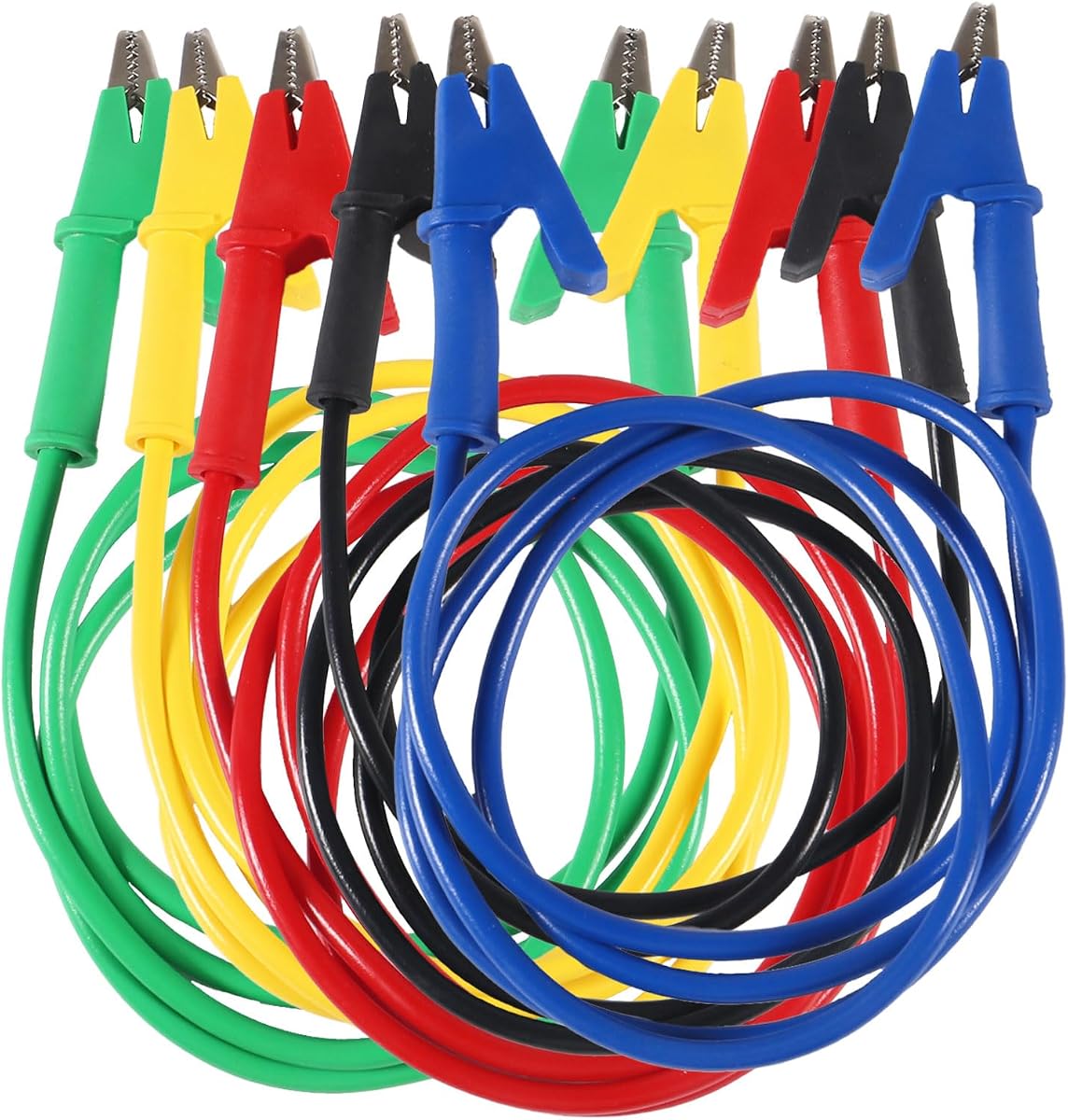
The EDGELEC 12-piece set has a 4.5 rating and offers a generous assortment for breadboards, prototypes, experiments, and troubleshooting. Six colors give users more ways to distinguish signal paths than most compact kits, while the total lead length of 23.5 inches provides enough span for common bench layouts.
We may earn a commission when you buy through this link, at no additional cost to you.
Its UL1015 18 AWG tinned copper wire is heavier than the 22 AWG lead found in the top-ranked set. The nickel-plated steel clips measure 1.77 inches, have a maximum opening of 0.67 inches, and feature non-slip rubber sleeves. These details make the set useful when a connection must hold securely on a relatively large terminal or component lead.
The information does not include a specific voltage or current rating, so buyers should not infer one from the wire type alone. The 23.5-inch length may also be less convenient for very compact work areas. In addition, a larger assortment is only an advantage when the user actually needs a broad selection of colors and terminal sizes.
This product is best for electronics learners, lab users, and hobbyists who regularly move between breadboard, prototype, and troubleshooting projects. Its combination of a larger wire gauge, secure soldered construction, six colors, and broad clip opening makes it a versatile laboratory-oriented choice.
The 12-piece assortment provides multiple leads in six colors, making it easier to map separate functions across a prototype. That organization can reduce connection mistakes and make temporary setups easier to inspect or revise.
A 0.67-inch maximum opening accommodates more than a narrow pin header or small component lead. The 1.77-inch body and rubber sleeve improve grip while reducing the chance that the clip will slide off.
We may earn a commission when you buy through this link, at no additional cost to you.
The Preminum 20-piece set has a 4.3 rating, but its large assortment is the main reason to consider it. Twenty leads in five colors provide ample options for temporary circuit connections, power testing, motor testing, appliance checks, and digital-product testing without needing to reuse the same clip constantly.
We may earn a commission when you buy through this link, at no additional cost to you.
The leads use a PVC cable covering, and the clips are described as premium 1.38-inch or 35-millimeter units designed to resist slipping. Their detachable-style approach makes temporary connections straightforward. The total length of approximately 21.7 inches sits in a useful middle ground, long enough to bridge components but not so long that it becomes cumbersome.
The product information includes an important warning that the metal clip terminals must not be used above the rated voltage, although no specific rating is provided in the supplied details. It also identifies the metallic terminal as a potential exposure point despite the PVC covering. Users who require a clearly documented voltage and current rating may be better served by one of the sets that states both limits.
This kit is most appropriate for users who want many ready-to-use leads and frequently build temporary connections. Its generous count and color variety can be particularly helpful in educational environments or busy repair benches where maintaining a clear connection map matters.
A large inventory lets a user assign separate leads to different nodes and retain those connections while troubleshooting another part of the circuit. This is especially helpful when the same test points need to remain connected during observation.
The stated 35-millimeter clip length is designed to grip terminals securely without slipping. Buyers should still inspect the exposed metal and confirm that the lead is suitable for the voltage and current present at the test point.
We may earn a commission when you buy through this link, at no additional cost to you.
The EDGELEC 14-gauge set carries a 4.6 rating and is the most clearly oriented toward demanding test leads in the group. Its UL3135 14 AWG tinned copper wire, silicone insulation, and stated 1500-volt rating distinguish it from the lighter PVC-based options.
We may earn a commission when you buy through this link, at no additional cost to you.
The clips use nickel-plated copper, measure 2.2 inches, and open to 10 millimeters. They are also soldered and stamped to the wires for a secure attachment. The red and black color scheme makes polarity easy to identify, and the included cable ties help with storage. The supplied description specifically mentions automotive and motorcycle inspection alongside laboratory and troubleshooting uses.
Because the package contains only two leads, it is less convenient for complex circuits than the 10-, 12-, or 20-piece sets. The stated 1500-volt and 15-amp figures also describe the leads rather than guaranteeing that every connected component can handle those conditions. Users must still select proper instruments, connectors, and protective procedures.
This is the strongest choice in the list for technicians who regularly work with higher-current circuits, vehicles, motorcycles, or heavier test leads. The silicone jacket and robust wire gauge add useful durability, while the cable ties address a common bench-storage problem.
Flexible silicone insulation makes the heavy lead easier to route around components and vehicles. It also stays pliable in cold working conditions, which can be useful during outdoor or automotive diagnostics.
The 14 AWG conductor is substantially heavier than the lighter wires used in many standard jumper sets. That makes the pair better suited to testing applications where lower resistance and greater current capacity are priorities.
We may earn a commission when you buy through this link, at no additional cost to you.
This four-group, one-meter set has a 4.4 rating and is designed for temporary electrical testing, circuit connection, experiments, prototyping, and troubleshooting. Each lead has alligator clips at both ends, allowing connections to be made without a separate probe at either side.
We may earn a commission when you buy through this link, at no additional cost to you.
The clips are made from nickel-plated steel with strong springs, while their insulating sleeves can slide to adjust the amount of exposed metal. That adjustability is useful when working around terminals of different shapes. The one-meter length offers enough distance for larger bench projects, and the red and black colors make positive and negative connections easy to distinguish.
The two-color scheme provides less flexibility than kits with four, five, or six colors. The supplied information also does not state a voltage or current rating, so buyers should not infer safe operating limits from the nickel plating or insulation alone. Adjusting the sleeve does not make an otherwise unsuitable lead safe for a higher-energy circuit.
This set is a good fit for students, electronics hobbyists, and repair professionals who often need paired, dual-ended jumpers. The grouped arrangement and one-meter reach make it especially suitable for temporary circuit links across a workbench.
Sliding the clip insulation changes how much of the metal remains exposed. That flexibility helps accommodate terminal sizes while keeping more of the clip covered when it is not in use.
Having a clip at both ends makes it easy to link two points directly. The arrangement reduces the need to hold a probe in place while the user works with a meter, circuit, or component.
We may earn a commission when you buy through this link, at no additional cost to you.
The Goupchn set earns a 4.8 rating, the highest in this comparison, and offers a balanced combination of contact quality, color organization, length, and stated electrical limits. Its five dual-ended leads provide practical flexibility without creating an unwieldy collection of nearly identical cables.
We may earn a commission when you buy through this link, at no additional cost to you.
Both ends use pure copper alligator clips, and each clip opens to 10 millimeters. The clips are firmly fixed to the wire, while rubber insulation helps prevent slipping. Stated limits of 1000 volts and 15 amps make the set easier to evaluate for battery, automotive-accessory, motorcycle, vintage-vehicle, and general circuit testing.
The description notes that the product is appropriate for testing circuits using a 15-amp fuse or smaller, which is an important qualification even though the leads themselves state a 15-amp maximum. The set contains five leads rather than a much larger assortment, so complex prototypes may still need extra wire. Users should also avoid exceeding the limits of the fuse, meter, vehicle circuit, or device being tested.
This is a strong all-around recommendation for technicians and advanced hobbyists who want a moderate number of dependable, color-coded leads with explicit ratings. It combines a useful 3.3-foot length with copper contacts and strong springs, making it particularly handy for automotive and temporary circuit testing.
Pure copper contacts are specified for the clip ends, providing a straightforward conductive path for temporary measurements. Firm attachment and strong spring tension help maintain contact during repeated electrical checks.
Five colors make it easier to distinguish separate test circuits at a glance. The moderate count also keeps the kit portable enough for a tool bag without sacrificing useful cable length.
We may earn a commission when you buy through this link, at no additional cost to you.
The EBOOT four-piece set has a 4.4 rating and offers a straightforward option for users who need dual-ended temporary connections. It consists of two color-coded groups, with alligator clips attached at both ends of each lead, making it convenient for joining circuit points across a workbench.
We may earn a commission when you buy through this link, at no additional cost to you.
The leads use copper wire with PVC insulation, while the clips have vinyl-covered bodies and strong springs. A one-meter length provides enough separation for components mounted farther apart on a board or in an enclosure. Red and black coloring also helps users maintain basic polarity discipline and reduce crossed connections.
With only four leads, the kit is less versatile for projects requiring many simultaneous test points. There is no stated voltage or current rating in the supplied information, and its PVC-covered, general-purpose construction does not position it as a heavy-current lead set. For demanding automotive or high-energy circuits, a product with explicit current and voltage ratings may be more appropriate.
EBOOT is best for students, lab users, and hobbyists who need a simple set of temporary jumpers for experiments and component connections. It is particularly useful when a handful of dependable, color-coded leads is all the task requires.
Red and black leads provide immediate visual separation between the two sides of a basic circuit. This is useful for teaching, prototyping, and simple troubleshooting where crossed polarity could create confusion.
Both ends of every cable are ready to grip a terminal. That configuration saves time when making temporary links and allows connections to remain in place while another instrument or component is handled.
We may earn a commission when you buy through this link, at no additional cost to you.
The DROK two-lead set has a 4.6 rating and combines a compact size with a relatively high stated current capacity. Its 14 AWG copper wires are reinforced for higher-current testing, while the clips use copper-nickel plating to resist corrosion during repeated diagnostic work.
We may earn a commission when you buy through this link, at no additional cost to you.
The cables are 50 centimeters long, making them easy to carry in a toolbox and suitable for connections within a compact electrical assembly. Their stated maximum current of 19 amps distinguishes them from the 15-amp-rated products in the guide. The durable PVC insulation is intended to protect the wire during regular use and exposure to demanding testing environments.
The package includes only two jumper wires, so it is better suited to focused testing than to building a large temporary network. No voltage rating is stated, and the relatively short cable may not reach distant test points in a large vehicle, panel, or enclosure. The 19-amp figure must also remain within the limits of the attached meter and source.
This product is a good option for automotive diagnostics and compact electrical tests where a durable, relatively high-current pair is needed. Users who prioritize portability and conductor strength over assortment size will find the two-wire format easy to manage.
The 14 AWG conductor provides more current capacity than the 18 and 22 AWG leads elsewhere in the guide. That makes the pair suitable for more demanding diagnostic connections when the rest of the test setup supports the stated limit.
At 50 centimeters, the leads are easy to coil and carry without excess cable. They work particularly well for battery terminals and nearby electrical components where a full meter of reach is unnecessary.
We may earn a commission when you buy through this link, at no additional cost to you.
This five-piece set has a 4.7 rating and is the premium pick because it combines stated 1000-volt and 15-amp limits, pure copper contacts, and flexible silicone-style cabling. It is suited to laboratory testing, breadboarding, prototyping, troubleshooting, and broader temporary circuit work.
We may earn a commission when you buy through this link, at no additional cost to you.
The 3.3-foot cables are described as smooth, kink-free, easy to coil, and flexible in cold weather. Each alligator clip has a 10-millimeter maximum opening and is securely attached to the wire. A rubber insulation layer supports grip, while the robust spring is designed to resist deformation through daily use.
The product description identifies silicone insulation, but it does not state the conductor gauge. As a result, buyers cannot compare current capacity by wire size from the supplied information and must rely on the stated 15-amp limit. Five leads also form a modest assortment, which is adequate for focused testing but light for projects with many simultaneous connections.
This set is best for users who value flexible, easily stored cables and want explicit voltage and current figures. It is a strong addition to a professional diagnostic kit, especially where cold ambient conditions or repeated setup and coiling could make stiffer leads inconvenient.
Smooth, kink-resistant insulation bends around components without presenting the same resistance as a stiffer general-purpose cable. The result is easier routing around crowded terminals and more convenient coiling between jobs.
Pure copper contacts and a strong spring are designed to keep temporary connections stable. The rubber layer improves handling and helps the clip remain positioned while measurements are taken.
We may earn a commission when you buy through this link, at no additional cost to you.
The right electrical alligator clip lead depends on the circuit, wire gauge, required reach, number of connections, and handling conditions. Comparing those factors before buying helps prevent a lead set that is awkward, underpowered, or poorly suited to the intended test.
Wire gauge is one of the clearest indicators of a lead's intended electrical role. Lower-numbered AWG wires are physically heavier and generally support greater current than higher-numbered wires. The products in this guide range from 22 AWG for general electronics and light-current work to 14 AWG for heavier diagnostic loads. The EDGELEC 14-gauge silicone pair is stated for up to 15 amps, while the DROK pair is stated for up to 19 amps. These ratings are product claims rather than proof that every circuit can safely be tested at the maximum.
Choose a heavier wire when the source may deliver substantial current or when lower conductor resistance matters. For signal work, breadboards, and low-voltage electronics, a lighter lead may be easier to handle and sufficient for the task.
A lead without a stated rating can still be useful, but it gives the buyer less information for initial screening. Products such as the SWANLAKE, Goupchn, EDGELEC 14-gauge, DROK, and five-piece 1000-volt set list voltage or current figures. A stated rating should be treated as the product's intended operating limit, not as permission to ignore the ratings of the meter, fuse, connector, or device under test.
Always select the lowest limiting component in the test setup. If the intended application exceeds the published lead rating, choose a purpose-built test lead designed and certified for that environment.
Lead length determines whether clips can comfortably reach between distant test points without leaving excess cable in the way. Options range from the DROK set's 50-centimeter leads to the EDGELEC heavy-duty pair at about 3.86 feet, while most other products fall around 20 to 23.5 inches or approximately one meter. Longer leads are helpful in vehicle diagnostics, large enclosures, and bench layouts, while shorter leads are easier to carry and less likely to snag.
Match the lead length to the distance normally encountered. More cable is not always better, since excess length can droop, tangle, or make a small work area feel crowded.
The clip must fit the terminal being contacted without squeezing a conductor in a way that could damage it. Several sets use clips with a 10-millimeter maximum opening, which accommodates many battery posts, pins, and component leads. The EDGELEC 12-piece set advertises a larger 0.67-inch opening, while the Preminum set uses clips approximately 35 millimeters long. Clip length and opening are different measurements, so both should be checked.
Consider the shape of the terminal as well as its width. A broad spring and a secure jaw are useful for holding onto posts, while smaller clips may be better for delicate circuit-board connections.
Most sets use PVC-insulated cables, while the EDGELEC 14-gauge model uses silicone insulation and the five-piece 1000-volt set is described as having flexible silicone-style cabling. Silicone is particularly useful where cables must bend repeatedly, remain stored in varied temperatures, or be used during cold automotive work. PVC is a common general-purpose option but may become less flexible in cold conditions.
Inspect the insulation for cracks, pinholes, or exposed conductors before every job. A color jacket helps identify leads, but it does not replace intact insulation or appropriate test procedures.
The number of included leads affects how easily a user can maintain several connections at once. Large kits with 10, 12, or 20 leads offer more color and endpoint options, while two-, four-, and five-piece sets are simpler to organize. Red and black are especially useful for polarity, while additional colors help separate signals, power rails, or test nodes. The WG-026 and EDGELEC 12-piece sets provide particularly broad color-coded assortments.
Choose based on the complexity of your typical work. More leads are valuable for dense prototypes, while a smaller set is easier to store and less likely to suffer from tangled cables.
A temporary test connection is only useful if it remains electrically stable. Several products specify that the clips are soldered and stamped to the wires, which supports a firm mechanical and electrical connection. Pure copper contacts appear in the Goupchn and five-piece 1000-volt sets, while other products use nickel-plated steel or copper-nickel plating. These conductive metals are intended to resist corrosion and maintain contact through repeated use.
Look for strong springs, a positive jaw action, and a wire joint that does not move when the clip is repositioned. Inspect the jaw for oxidation, contamination, or bent teeth, since any of these can increase resistance or make a secure grip less likely.
The intended setting can determine which construction is most useful. General electronics work may favor compact, color-coded leads with moderate reach. Automotive, motorcycle, and industrial inspection may call for heavier wire, silicone insulation, robust springs, and cable ties for storage. The EDGELEC heavy-duty set includes ties, while the five-piece premium set emphasizes smooth coiling and cold-weather flexibility.
Choose a lead set that fits the storage and handling conditions it will encounter. A durable cable that is difficult to coil or a large assortment that constantly tangles can undermine otherwise good performance.
Begin by confirming that the circuit is de-energized whenever the test procedure allows. Inspect each cable and clip for damaged insulation, exposed conductors, loose wire joints, corrosion, or a weakened spring. Connect the leads to the appropriate meter or test equipment first, then attach the clips to the intended points with the correct polarity.
When energizing the circuit, keep hands and loose clothing away from exposed conductors, and never use a lead beyond its stated voltage or current rating. Do not clip onto a conductor unless the clip opening and jaw are suitable for the terminal. For temporary testing, attach the leads firmly enough to maintain contact without crushing delicate components or damaging an insulation layer.
After use, switch off and disconnect the circuit before removing the clips. Wipe the jaws gently, coil the cables without sharp bends, and store them away from heat, moisture, sharp edges, and direct sunlight. Periodically check that the spring action remains firm and that the wire-to-clip connection shows no movement or discoloration.
For low-voltage electronics, signal checks, and breadboard work, 18 or 22 AWG is often convenient and easy to handle. For higher-current diagnostics, 14 AWG is a more substantial choice. Match the gauge to the source, the expected load, and the published rating of the complete test setup.
They can be, but the lead rating must match the vehicle circuit and the meter rating. Higher-current vehicle systems generally call for robust 14 AWG leads with suitable insulation and secure contacts. Always disconnect the battery or de-energize the circuit according to the vehicle manufacturer's service procedure when applicable.
It indicates the stated maximum voltage the lead is designed to handle under the conditions represented by the manufacturer. It does not make the entire test setup safe at that voltage. The meter, probes, connectors, circuit protection, and user procedures must all be appropriate for the energy involved.
Dual-ended leads are convenient when you want to connect two circuit points directly or leave both hands free for a meter. Single-ended probes can be better for controlled probing of small component leads. Many general-purpose sets use dual ends because they are useful for temporary circuit connections.
Color coding helps you identify power, ground, and individual signal paths at a glance. Red and black are useful for polarity, while yellow, green, white, or additional colors can distinguish separate nodes. Consistent color use also makes a breadboard or troubleshooting setup easier to inspect.
Many products are designed as test leads and are intended to work with multimeters, probes, and banana-terminal equipment. Confirm the connector type, meter compatibility, voltage limit, and current limit before attaching the clips. The meter and connected circuit must never exceed the limits of the less capable component.
Common causes include corrosion, dust, grease, a weakened spring, a narrow jaw, or a loose wire connection. Clean the jaw gently and check the mechanical action, but discontinue use if the insulation is damaged or the attachment moves. A replacement lead is safer than forcing an unreliable connection.
Disconnect and de-energize the circuit, then coil each lead loosely without creating sharp bends. Keep the clips from striking one another and store the set in a dry area away from direct heat, oil, corrosive material, and sharp edges. A protective pouch or tie can help prevent tangling.
The WG-026 10-piece set is the strongest all-around value, combining ten color-coded leads, 22 AWG copper wire, compact length, and soldered nickel-plated clips. The Goupchn five-piece set stands out through its highest rating, copper contacts, and explicit 1000-volt and 15-amp ratings, while the five-piece 1000-volt set earns the premium position for flexible, easily stored cabling.
Prioritize the factor that most directly matches your work: wire gauge for heavier current, explicit ratings for controlled diagnostic use, length for access, clip opening for terminal size, and color count for complex circuits. Sets with more leads are convenient, but a smaller set with the right gauge and construction can be more valuable in a focused toolkit.
Before purchasing, verify the current product listing, connector style, electrical ratings, and intended applications. Specifications and prices can change, so checking the latest listing helps ensure that the selected alligator clip leads match both your equipment and the conditions in which they will be used.