
EMP Shield – Home EMP & Lightning Protection
4.6Editor score
Breaker-box pulse protection
Lightning and over-voltage coverage
Long-term warranty support
An Emp Blocker for Home can take several forms, from outlet-entered harmonizers to breaker-box shields and Faraday enclosures for individual routers. The right choice depends on whether the goal is broad environmental support, surge and pulse protection, or blocking a nearby signal source, and each approach uses very different technology.
We compared all ten products by examining their stated protection method, coverage, installation requirements, electrical compatibility, warranty information, and suitability for common household scenarios. The list includes compact plug-in devices, a concealed breaker-box system, a generator-focused shield, a large router enclosure, and two DIY Faraday fabric kits.
Each review identifies the product’s most useful features and honest limitations so readers can distinguish signal blocking from frequency neutralization. Ratings and specifications reflect the supplied product information, while availability and prices may change, making it worthwhile to confirm current listing details before purchasing.
4.6Editor score

4.0Editor score

5.0Editor score
As an Amazon Associate we earn from qualifying purchases.
This side-by-side comparison highlights the major approaches available for home electromagnetic protection, including plug-in harmonizers, whole-home shielding, router enclosures, and DIY Faraday materials.




The EMP & EMF Shield for Home Gen 2 is a compact outlet device built around a combination of EMP shielding and EMF harmonization. Its listed rating is 4.0, but its most appealing qualities are practical rather than purely numeric: a small housing, broad electrical compatibility, and coverage stated at up to 2,000 square feet. It is designed for households wanting a simple device that can be moved among standard outlets without complicated installation.
We may earn a commission when you buy through this link, at no additional cost to you.
Unlike a conventional Faraday enclosure, this product does not rely on a physical barrier to stop electromagnetic emissions. The manufacturer describes resonant-frequency technology that neutralizes disruptive energies and balances household electrical emissions. It can be connected to a 110V or 220V outlet and is also listed as compatible with inverters and portable generators, making it more flexible than products restricted to a particular outlet type.
The most important limitation appears in the product’s own explanation: an EMF meter may not register a reduction because the device is intended to work at an energetic field level rather than simply block a measurable signal. That distinction matters because a buyer expecting reduced router readings or complete cellular attenuation may consider the performance disappointing. It also makes objective before-and-after meter comparisons unsuitable for evaluating this model.
This is a sensible pick for someone seeking a discreet, travel-friendly household device without running wires or modifying a breaker panel. It may suit homes, offices, and temporary spaces where broad plug-in support is more important than signal isolation. For users who need verifiable attenuation from a known source, a Faraday cage is the more logically aligned option. For households primarily concerned with pulse and surge events, a breaker-box shield deserves closer consideration.
Overall, the Gen 2 model offers one of the easiest ways to add a claimed EMP and EMF protection layer across a broad living area. Its value lies in convenience, versatility, and its dual-protection concept, while buyers should remain realistic that it is a harmonizer rather than a physical blocker.
With coverage stated at up to 2,000 square feet, the device is aimed at common residential and office environments. Its compact format and outlet-powered design make it easier to position than a permanently installed system, particularly when moving between a primary residence, office, or travel location.
The device is explicitly described as neutralizing rather than blocking electromagnetic energy. That distinction preserves normal WiFi and cellular use but means it should not be purchased as a substitute for a physically sealed Faraday enclosure.
We may earn a commission when you buy through this link, at no additional cost to you.
The EMP Shield Concealed Model is the most clearly defined premium option in this guide. Rated 4.6, it is intended for flush-mounted breaker boxes and is advertised as protecting an entire home against electromagnetic pulses, coronal mass ejections, lightning, and over-voltage. Unlike the compact plug-in harmonizers, this is a purpose-built home infrastructure product designed around the point where household electrical circuits are distributed.
We may earn a commission when you buy through this link, at no additional cost to you.
Its strongest differentiator is the breadth of stated event protection. The manufacturer says the system can withstand up to 228,000 amps per phase and also highlights a ten-year limited lifetime warranty that includes replacement at a stated fee if the unit fails. A further assurance of up to $25,000 in insurance is offered if the device does not protect covered electronics, subject to the provider’s stated terms.
Installation is the trade-off. Because the product is made for a flush-mounted breaker box, it is not a portable or universally compatible plug-in solution. The concealed format is attractive for new construction, remodeling, or planned electrical upgrades, but a household with an exposed panel may need a different model or professional guidance before purchase. It is also more narrowly targeted than a whole-home harmonizer.
This option best fits homeowners who are making a serious infrastructure investment in pulse, lightning, and surge resilience. It may be particularly relevant to households in regions exposed to lightning, those with valuable electronics, and people preparing for emergency scenarios where prolonged grid and communication disruption could become a serious concern. Installation by a qualified electrician is advisable whenever mains-connected equipment is involved.
Among the ten options, it stands out for specificity, warranty support, and direct whole-home event protection. It is the premium recommendation for a permanent installation, while plug-in harmonizers and router covers remain easier to add to an existing home.
Installing shielding near the breaker distribution point can address multiple downstream circuits at once. That makes this model more suitable for comprehensive home infrastructure than a device intended to address one router or a small local area.
The ten-year limited lifetime warranty and stated insurance backing provide unusual support for a home electrical accessory. Buyers should retain documentation and review the warranty’s exclusions and installation requirements before making a final decision.
We may earn a commission when you buy through this link, at no additional cost to you.
This EMP Shield Whole Home Generator product is designed for homes that rely on a standby or portable generator rather than for a generic wall outlet. It carries a 4.0 rating and is presented as a single-unit solution intended to provide electromagnetic pulse shielding and lightning protection across the residential property.
We may earn a commission when you buy through this link, at no additional cost to you.
The manufacturer emphasizes advanced shielding technology, American manufacturing, and a veteran-owned company. It also states that the product is Department of Homeland Security-listed and meets residential safety standards. Those details support buyers who place importance on domestic production and formal listing, although a listing should not be confused with independent laboratory validation of every protection claim.
Compared with the concealed breaker-box model, this unit is more narrowly tied to generator use. That focus can be an advantage: buyers who already have a compatible generator system may want a purpose-designed shield rather than a general household harmonizer. The single-unit design also avoids a multi-device arrangement, which may simplify planning around a generator installation.
Before ordering, however, a homeowner should confirm that the shield supports the exact generator, connection configuration, and installation environment. Product descriptions do not establish universal compatibility, and incorrect placement or improperly terminated shielding can undermine performance. A qualified installer familiar with generator systems and conductive enclosures should assess the setup.
This is a compelling recommendation for households with a whole-home generator who want focused pulse and lightning protection around that infrastructure. It is less relevant to apartments, normal-grid-only homes, or people seeking a simple outlet device. For those users, the broader plug-in and router-focused choices in this guide better match the application.
A generator becomes especially important when utility infrastructure is disrupted, and it can also create its own electrical environment. A dedicated shield is intended to add a protective layer around that home-scale system rather than merely treating ambient household fields.
The single-unit approach may simplify ownership, but accurate sizing and installation remain essential. Buyers should treat compatibility confirmation as a required part of the purchase, not an afterthought.
We may earn a commission when you buy through this link, at no additional cost to you.
The Large WiFi Router Cover is a practical Faraday cage designed to address one identifiable source of home radio-frequency emissions. It has a listed rating of 5.0 and centers on a honeycomb mesh enclosure that the manufacturer says reduces router EMF and 5G emissions by up to 93 percent while allowing WiFi connectivity to continue.
We may earn a commission when you buy through this link, at no additional cost to you.
Its dimensions are listed as 12.8 inches long by 5.39 inches wide and 12.2 inches high, which the product information identifies as larger than many competing router covers. The goal is to enclose a typical home or office router without crowding cables or obstructing airflow. Installation requires separating the top and bottom, placing the router inside, and closing the enclosure.
That setup is notably uncomplicated. It involves no tools, disconnected wires, or router resets, making it easier to integrate than a DIY fabric project. The seller also emphasizes that the cover can be used continuously, including in a bedroom, nursery, or office, without the need to remove the router during the day. A three-year warranty provides a stronger stated support period than many similar accessories.
The important limitation is scope. This enclosure addresses the router placed inside it, not every electromagnetic source throughout the home. It also depends on a secure close and proper dimensions for effective enclosure behavior. Buyers should compare the router’s widest points, antenna arrangement, and cable exits with the listed measurements before ordering.
For someone seeking an affordable, understandable, and immediately usable way to reduce emissions from a WiFi router, this is an excellent choice. It is particularly practical for a bedroom, home office, nursery, or other area where one device is the clear concern. It does not replace surge protection, whole-home pulse shielding, or a comprehensive approach to other sources.
The prebuilt enclosure removes the most difficult part of a fabric Faraday cage: creating continuous conductive seams. Its two-part design makes it quick to deploy while keeping the router in service.
A router cover can be a more concrete choice than a broad harmonizer because it targets a visible, known device. Its benefits remain local to the enclosure, so a room with several other electronic sources may still need broader mitigation.
We may earn a commission when you buy through this link, at no additional cost to you.
The EMF House Shield is a broad, plug-in protection product with a listed rating of 4.0 and coverage of up to 2,000 square feet per level. It is designed to harmonize electromagnetic emissions associated with household appliances and electrical energy by using more than 240 embedded and encoded harmonic resonant frequencies.
We may earn a commission when you buy through this link, at no additional cost to you.
Installation is refreshingly direct. The unit plugs into a standard outlet and works with both U.S. and European 110V and 220V systems. A travel adapter expands its portability, making it suitable not only for a primary residence but also offices and temporary accommodation. Unlike a router cage, it does not require identifying and enclosing a particular transmitter.
The manufacturer describes a process in which electrical emissions are transformed into what it calls a natural, beneficial, subtle energy field. It presents the device as a way to support balance, grounding, and general well-being in a high-electronic environment. These wellness-oriented claims should be considered separately from the clearly stated installation and compatibility facts.
As with other harmonizer products, an EMF detector may not show a difference because the technology is not intended to block the environmental signal. That makes conventional meter readings a poor tool for evaluating performance. It also means the product should not be understood as a Faraday shield, surge protector, or complete EMP defense system.
The EMF House Shield is the editor’s choice for buyers who want a simple whole-level device with broad stated coverage and flexible international use. It is well suited to apartments, offices, and conventional homes where outlet installation is preferred. For measurable signal attenuation, choose a Faraday enclosure instead; for serious pulse-event infrastructure, consider a breaker-box solution.
A single unit’s stated 2,000-square-foot coverage makes it convenient for open-plan homes and offices where placing a device beside every router or appliance would be inconvenient. Actual results depend on the product’s stated operating method and the home environment.
Dual-voltage support and the included travel adapter make this one of the more flexible choices in the roundup. It can move between outlets without requiring a separate voltage-conversion arrangement.
We may earn a commission when you buy through this link, at no additional cost to you.
The EMF Neutralizer Whole House is a plug-in device intended to address the biological effects attributed to man-made electromagnetic fields, including environments affected by 5G. Its listed rating is 3.8, making it one of the lower-rated products in this collection, but its core feature set is clear and easy to understand.
We may earn a commission when you buy through this link, at no additional cost to you.
The product does not require a complicated installation procedure. It works by introducing what the manufacturer describes as coherent natural energy intended to neutralize incoherent energy from man-made EMFs. Importantly, the listing states that it will not affect cellular phone reception or transmission, which can be valuable for people who want environmental support without disabling communications.
The listed range of applications includes computers, microwaves, televisions, and baby monitors. This makes it a broad household choice rather than a shield for one device. However, the product information provides fewer detailed specifications than some competing listings, including no clear square-foot coverage figure or formal shielding range.
Claims involving DNA or biological effects should be evaluated with care, and buyers should not confuse the product with a measurable Faraday shield. As a neutralizer, it is better suited to those seeking a non-disruptive household device than those wanting an instrument to show lower field readings. A surge protector or panel-level EMP shield remains more appropriate for electronic damage prevention.
The main appeal is its simplicity. It offers a straightforward way to add a claimed neutralizing layer throughout a home without hiding equipment or interrupting service. It is best suited to buyers who value convenience and normal device operation, while users wanting a specific, independently visible reduction in emissions should consider a physical enclosure.
Preserving cellular reception is a meaningful benefit for a whole-house device. It can remain connected in a central location without intentionally preventing phones or other networked equipment from communicating.
The product’s simple format avoids installation work and changes to router settings. It is therefore most attractive to users who want minimal disruption and are comfortable with the harmonizer concept.
We may earn a commission when you buy through this link, at no additional cost to you.
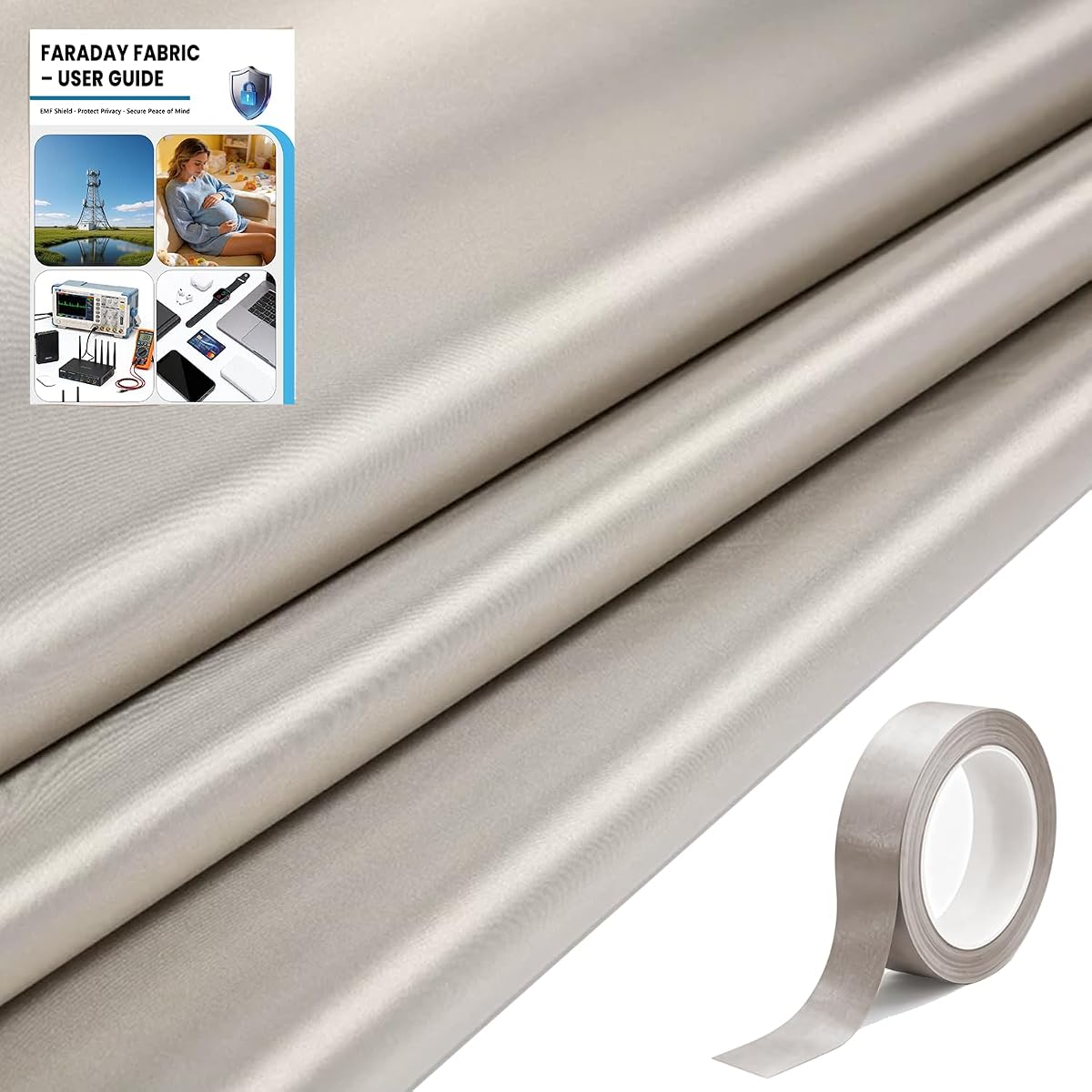
The OMKHE Faraday Fabric and Tape Kit offers one of the most versatile ways to build a home shielding system. It has a listed rating of 4.8 and includes a large 43-by-118-inch sheet of multi-layer composite shielding fabric plus 200 inches of conductive tape. The material is designed to cover a broad frequency range from 10KHz to 30GHz and deliver up to 90dB of shielding effectiveness when properly used.
We may earn a commission when you buy through this link, at no additional cost to you.
Unlike a prebuilt router cover, the kit can be cut and shaped into custom pouches, sleeves, curtains, tents, or equipment enclosures. The supplied information recommends fully sealing seams with conductive tape and notes that two or three layers may be appropriate for especially sensitive electronics. A simple phone-call test can provide a rough indication that the enclosure is blocking signals.
This flexibility is the main advantage. The same material can protect key fobs, support a privacy pouch, line a laptop compartment, or contribute to a larger room-shielding project. Because the fabric is conductive, seams and entry points are critical; a loose opening can undermine performance, so careful fabrication matters more than simply wrapping an item once.
The product requires some skill and patience. It is not machine washable, should be air dried if wet, and should be stored away from prolonged sunlight and extreme heat. Manual cutting also introduces potential size variation, which the seller acknowledges. For buyers who want a ready-made solution, this kit offers less convenience than an assembled enclosure.
This is an excellent choice for technically inclined users, preparedness-minded households, and anyone who needs a custom shape or multiple smaller projects from one kit. It is less suitable for someone wanting immediate, tool-free protection. In the right hands, the generous material and included tape make it a capable and economical DIY shielding solution.
The generous sheet can be divided among several projects, from compact privacy pouches to a medium curtain. This makes the kit practical when no single ready-made enclosure fits the intended application.
A Faraday enclosure needs a continuous conductive barrier, including where the conductive tape joins the fabric. Careful measuring, cutting, overlapping, and sealing are essential for reliable attenuation.
We may earn a commission when you buy through this link, at no additional cost to you.
The EMF Harmonizer for Home is a plug-in device with a listed rating of 5.0 and a stated coverage area of up to 2,000 square feet per floor. It combines a 110V-to-240V power range with simple outlet installation, allowing it to serve homes, offices, and travel locations without complicated configuration.
We may earn a commission when you buy through this link, at no additional cost to you.
The product operates continuously and quietly, with optional soft lighting rather than a noisy indicator or mechanical activity. It is designed to work without interfering with WiFi, cell service, or the operation of nearby electronics. The listing also emphasizes a bio-resonance approach intended to harmonize disruptive fields associated with WiFi routers, phones, and other devices.
User-reported outcomes mentioned in the product information include improved sleep, reduced stress, greater mental clarity, and increased energy. These are subjective experiences and should not be treated as guaranteed medical results. The product’s own note also says that EMF meters will not detect changes, which is expected because it is designed as a harmonizer rather than a physical blocker.
The lack of signal interference is a meaningful advantage for a device intended to remain plugged in around the clock. Its global voltage support also reduces the chance of compatibility problems when moving between countries. As with any wellness-oriented electronics product, however, the absence of measurable attenuation means buyers should assess the technology according to their own priorities.
This model is best for people who want an unobtrusive, continuous device and do not want to interfere with household connectivity. It is less suitable for users seeking independently verifiable field reduction or protection for sensitive electronics. The EMF House Shield offers a similar category with more detailed frequency information, while the router cage provides a physically measurable alternative.
The device is designed to remain active without audible disruption, making it suitable for bedrooms and work areas where fan noise or indicators could be distracting.
Because its claimed effect is harmonization, it can remain in use without intentionally attenuating WiFi or cellular signals. This supports the product’s role as a continuously available household wellness device.
We may earn a commission when you buy through this link, at no additional cost to you.
This Whole House Plug-in EMF Protection device offers the largest stated coverage in the roundup at up to 3,000 square feet per floor. Its listed rating is 3.9, and the product uses a compact, dual-voltage format intended for homes, offices, hotels, and international travel.
We may earn a commission when you buy through this link, at no additional cost to you.
The operating principle is harmonic resonance rather than signal blocking. The product information says it reformats chaotic frequencies associated with WiFi routers, smart meters, and 5G towers into a natural, subtle energy field. A 110V-to-220V range allows use in a broad set of outlets, while the compact shape is intended not to obstruct neighboring sockets.
Installation requires only plugging the unit into a standard outlet. That convenience extends to travel, where the device can move between familiar and unfamiliar spaces without a separate wiring project. The stated coverage makes it especially interesting for large homes, open offices, and multi-level properties where placing a smaller unit in every area would be inconvenient.
The same cautions that apply to other harmonizers apply here. The device is not intended to block WiFi or cellular signals, and a meter is unlikely to show the claimed effect. Reports of better sleep, reduced mental fatigue, and revitalization are user experiences rather than guaranteed outcomes. The stated 3,000-square-foot area may also differ from real-world results depending on construction, layout, and nearby sources.
This is a good fit for buyers who prioritize wide stated coverage, travel readiness, and a small footprint. It is not the right choice when objective attenuation, surge suppression, or protection against a specific electromagnetic event is the main requirement. In those cases, a router cage, panel shield, or purpose-built surge and lightning system is more directly aligned.
The 3,000-square-foot claim gives this model an advantage for large homes and open commercial spaces. It reduces the need to distribute multiple small devices, although structural and placement variables still influence the experience.
Its small dual-voltage design is easy to pack and deploy in temporary spaces. Users traveling internationally should verify the correct outlet adapter for the destination rather than assuming every plug configuration is supported.
We may earn a commission when you buy through this link, at no additional cost to you.
The ATMOSURE Faraday Fabric and Tape Kit provides a smaller, highly versatile DIY option for home users. It has a listed rating of 4.2 and includes one yard of 44-by-36-inch copper-nickel fabric along with 197 inches of conductive tape. The manufacturer states that the material delivers 85 to 105dB of shielding from 1MHz to 10GHz when fully enclosed and grounded.
We may earn a commission when you buy through this link, at no additional cost to you.
Its possible uses include a Faraday pouch, wallet, blanket, router shield, curtain liner, or breaker-box enclosure. The soft fabric can be cut, folded, sewn, or wrapped, while the tape handles conductive seams. That makes it a useful building material for targeted protection where a ready-made product is too large or inflexible.
The central requirement is complete enclosure. Partial coverage will not produce the stated shielding, and every seam, opening, and entry point must be addressed. Grounding is also mentioned in the performance condition, so users should understand the project’s intended electrical configuration before cutting material. A test with a connected phone can provide a basic indication of signal containment.
Compared with the larger OMKHE kit, ATMOSURE provides less total fabric but offers a high stated upper shielding figure and a similarly useful length of tape. It is well suited to several smaller projects rather than a very large curtain. Users should also account for the extra material required to overlap seams and form a reliable closure.
This kit is best for careful DIY builders, privacy-conscious users, and anyone needing a custom enclosure. It is less convenient for a quick plug-and-play purchase, but it offers substantial control over shape and placement. For a router with no interest in fabrication, the prebuilt Large WiFi Router Cover is the more direct solution.
The one-yard sheet is large enough for several pouches or one carefully planned enclosure, making the kit adaptable without the space demands of a larger fabric roll. Accurate templates help conserve material.
Users should measure the target before cutting, allow enough overlap for seams, and seal every conductive joint with the included tape. These steps are more important than the number of fabric layers when creating a consistent barrier.
We may earn a commission when you buy through this link, at no additional cost to you.
The most suitable choice depends on the threat, source, room, electrical system, and degree of installation effort you are willing to manage. Comparing these variables prevents a signal blocker, a broad harmonizer, and a surge-oriented EMP shield from being treated as interchangeable products.
A physical blocker uses conductive shielding to reduce signals passing through an enclosure, while a harmonizer claims to transform or neutralize energetic effects without stopping communications. Products that advertise meter reductions, Faraday cages, or signal attenuation are aimed at the first approach; plug-in devices described as resonant, bio-resonance, or energy-field products belong to the second. Decide which outcome you actually want before comparing coverage language, because a harmonizer’s normal operation should not be expected to create a lower meter reading.
Electromagnetic pulse, coronal mass ejection, lightning, over-voltage, and routine radio-frequency exposure are not identical problems. The concealed breaker-box model is specifically positioned for EMP, CME, lightning, and surge protection, while the generator model is tailored to a home generator environment. Router covers and fabric kits address radio-frequency shielding. A surge protector may be a sensible complementary purchase when the main concern is damage to plugged-in electronics rather than broad field exposure.
Plug-in models require only an outlet and are the easiest to move, test, or use in a rental. Prebuilt router covers require little more than placing the router and closing the lid. Fabric kits demand measuring, cutting, overlapping, and sealing seams, while breaker-box and generator shields involve permanent electrical infrastructure and are best reviewed by a qualified installer. Consider both your technical comfort and whether future access to the panel, generator, or router will be needed.
Coverage claims range from 2,000 square feet per level for several harmonizers to 3,000 square feet for the largest-area plug-in model. These figures describe the manufacturer’s intended operating range, but walls, floors, wiring, appliances, and room geometry can affect conditions. A router cover covers only the equipment inside it, while panel-level systems may protect multiple circuits. Compare coverage with floor plan and source location rather than treating square footage as a universal guarantee.
Several plug-in products support 110V and 220V outlets, one specifies compatibility from 110V to 240V, and some include a travel adapter. That flexibility can be useful for international use, but a voltage range does not guarantee that every physical plug or outlet configuration will fit. Check the plug shape, grounding requirements, adapter included, and local outlet standards. Traditional battery chargers and surge strips are not substitutes for a dedicated EMP shield.
For any Faraday product, performance depends on continuity. The cover must close properly around the router, while DIY fabric must overlap at every seam and have no unshielded openings. The product listings repeatedly emphasize that partial coverage will not fully block signals. A router that is too large for the stated dimensions, cables that prevent a tight closure, or gaps around doors can reduce practical effectiveness even when the material itself is capable.
Warranty length can be a useful differentiator, but the details matter more than the headline. The router cover includes a three-year warranty, while the concealed EMP Shield includes a ten-year limited lifetime warranty and stated insurance support. Read replacement conditions, coverage exclusions, and installation expectations before purchasing. For fabric products, proper storage and careful fabrication are also important because cutting, moisture, and incomplete seals may affect long-term use.
Some products provide specific frequency ranges, dB figures, current handling, or third-party-style verification language, while others rely on descriptions of energetic effects and user-reported wellness outcomes. A credible purchase should make its intended mechanism clear. Signal attenuation can often be checked with a meter or basic connectivity test; harmonization may produce no visible instrument change by design. Avoid expecting one product to satisfy a measurable shielding test, subjective wellness goal, and full-home surge protection simultaneously.
Begin by identifying the source or threat you want to address. For a plug-in harmonizer, choose a centrally positioned outlet within the stated coverage area, confirm voltage and plug compatibility, and connect the device without using extension cords unless the manufacturer specifically permits them. For a router cover, measure the router and its antennas, place the router inside, route the cables without forcing the lid open, and verify that WiFi performance remains satisfactory.
For a DIY Faraday project, measure the target, plan overlapping seams, cut the fabric cleanly, and seal each join with conductive tape. Test a basic build by placing a connected phone inside and attempting a call; a lack of connection is a sign that the enclosure is blocking signals, though it is not a complete measurement of shielding performance. Keep fabric dry, avoid machine washing, and store it away from prolonged sunlight and extreme heat.
For breaker-box or generator protection, follow the manufacturer’s installation instructions and have a qualified electrician or relevant specialist handle connections to mains equipment. Do not open, bypass, or modify a protective device after installation. Periodically review physical connections, signs of damage, warranty documentation, and the condition of cables or seams, and replace components according to the manufacturer’s guidance.
It depends on the product. Physical Faraday cages are designed to attenuate signals passing through the enclosure, while many plug-in EMP and EMF devices are described as harmonizers that leave communications functioning normally. A harmonizer may produce no visible change on an EMF meter, so its intended effect should not be confused with measurable signal blocking.
An EMP shield is intended to protect electrical systems from large transient events such as electromagnetic pulses, lightning, or over-voltage. An EMF blocker more commonly refers to a Faraday enclosure that reduces radio-frequency emissions from a particular source. Some products combine terminology, so carefully review the stated mechanism, threat coverage, and installation requirements.
A properly sized panel-level or generator-focused system may protect multiple household circuits, and certain plug-in products advertise broad floor coverage. Their mechanisms and installation requirements differ, however. A router cover protects only the router inside it, while a harmonizer is intended to influence an environment rather than form a physical shield.
A correctly installed panel or enclosure solution may be designed to preserve normal communications, but the effect depends on the product and installation. Plug-in harmonizers explicitly state that they do not affect connectivity. A Faraday router cover allows WiFi to remain usable while reducing emissions from the enclosed router.
Professional installation is strongly advisable whenever the device connects to a breaker box, generator system, or other mains electrical infrastructure. Plug-in units and prebuilt router covers are much simpler, while DIY fabric kits require careful construction but not mains wiring. Always follow the product instructions and local electrical requirements.
Compare the router’s length, width, height, antenna position, and cable clearance with the cover’s stated dimensions. A tight but complete closure is important, so a router that merely fits may still leave the enclosure unsealed. Measure the widest fixed points rather than relying only on the retail box dimensions.
A phone-call test is a simple preliminary check. Place the phone in a fully sealed enclosure and attempt a call or data connection; difficulty connecting suggests that signals are being reduced. The test is not a calibrated measurement of shielding effectiveness, so it should not replace appropriate professional testing.
No. A surge protector is designed to divert or limit sudden voltage spikes and protect connected equipment. An EMF harmonizer is presented as a device that transforms or balances electromagnetic energies and generally does not provide the same direct electrical-surge protection. Homes with a primary concern about damaged electronics should consider suitable surge protection as a separate or complementary measure.
The strongest overall choice depends on the level of protection sought. The EMP Shield Concealed Model is the premium pick for permanent whole-home pulse, lightning, and over-voltage protection, while the Large WiFi Router Cover is the budget pick for focused, measurable shielding of a single device. The EMF House Shield is the editor’s choice for convenient plug-in coverage across a broad living area.
Prioritize mechanism before features. Choose a panel or generator system for event resilience, a Faraday cage for source-specific attenuation, a fabric kit for custom construction, or a plug-in harmonizer when the goal is non-disruptive environmental support without interrupting communications. Check dimensions, voltage, coverage, installation demands, warranty terms, and the product’s own caveats before finalizing a purchase.
Current product availability, seller information, and prices can change over time, so review the latest listing and compare it with the specifications in this guide. The best choice is not simply the product with the largest coverage claim; it is the one whose protection method, installation, and evidence align with the risk you most want to address.