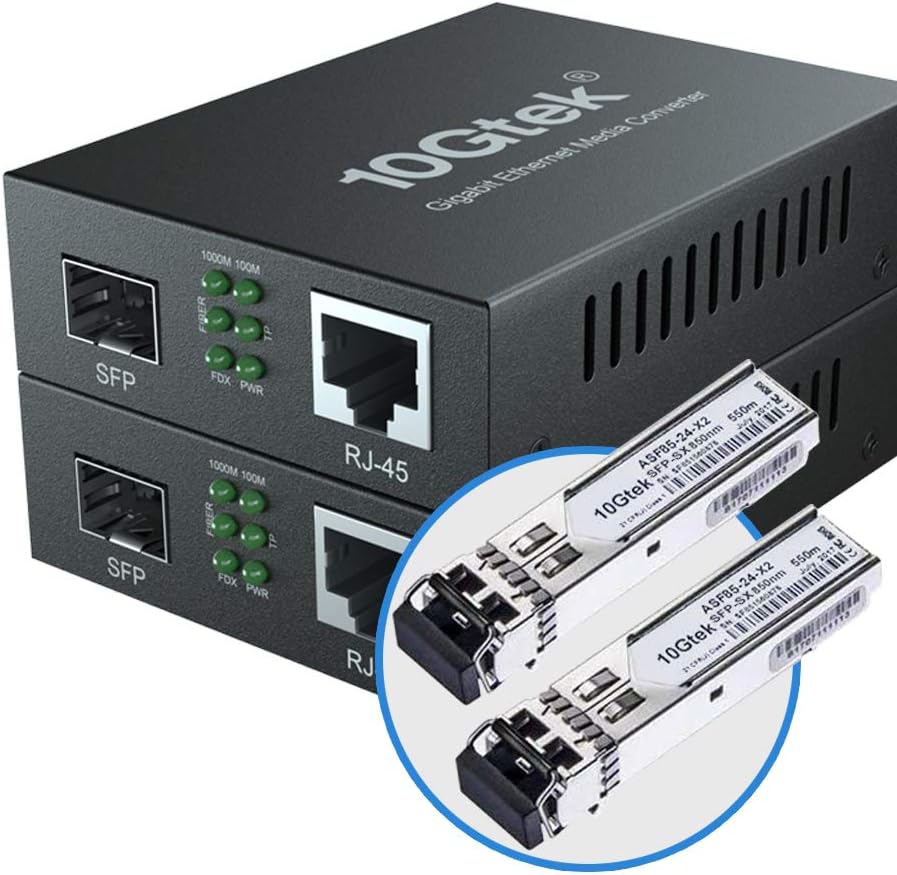
10Gtek Gigabit Ethernet Media Converter
4.7Editor score
Two-converter pack
Included multimode SFP modules
550-meter optical reach
Explore the best Ethernet Fiber Media Converter options, comparing compatibility, reach, ports, features, and installation for demanding networks and businesses
An Ethernet fiber media converter bridges conventional copper Ethernet with fiber-optic cabling, extending a network beyond copper limits while preserving a familiar RJ45 connection. The right model depends on fiber type, connector format, transmission distance, data rate, deployment environment, and the transceiver arrangement required by your existing infrastructure.
We compared the ten featured converters using their stated port designs, optical specifications, copper-side capabilities, reach, monitoring features, and installation details. The guide covers fixed-transceiver models, open-SFP designs, single-mode and multimode systems, bidirectional optics, and a 10GbE converter for higher-capacity networks.
Each review shows where the converter is most practical and which trade-offs deserve attention before installation. Ratings reflect the supplied customer feedback, while technical descriptions are based on the listed product information. Prices and availability can change, so confirm current listings and verify that your fiber, connector, distance, and equipment are fully compatible.
4.7Editor score

4.6Editor score

5.0Editor score
The table below compares all ten converters by optical interface, supported data rates, reach, and the most important installation consideration for each model.


This two-pack converts 10/100/1000Mbps Ethernet over 850nm multimode fiber and carries a 4.7 customer rating. Its main strength is the unusually complete configuration: each converter has an RJ45 port, a duplex LC optical interface, and an included 1.25G multimode SFP transceiver. The result is a practical package for connecting two locations with multimode fiber.
We may earn a commission when you buy through this link, at no additional cost to you.
The copper side supports full- or half-duplex operation through automatic negotiation, while auto MDI/MDIX crossover removes the need to worry about straight-through versus crossover cabling. Cat.5e or better twisted-pair runs up to 100 meters are supported, and the UL-certified 5V, 1A power supply suits a straightforward desk, cabinet, or small communications installation.
The trade-off is that this is a purpose-built multimode model rather than a universal converter. Its included transceiver is fixed at 850nm and 1.25G, and the optical interface expects dual LC fiber. It therefore suits a new link with known multimode infrastructure but offers little flexibility if the installation later changes to single-mode fiber, different connector types, or a different optical standard.
This is a strong selection for a small business, branch office, surveillance location, or campus project that needs a ready-made Gigabit fiber pair. Buy it when the existing cable plant is 850nm multimode with LC connectors and a link distance no greater than 550 meters. For a broad range of future applications, an open-SFP converter may be the wiser long-term choice.
The pack includes two converters and matching multimode SFP modules, removing the need to source separate optics for both ends. That symmetry is particularly useful when building a complete point-to-point fiber link.
Automatic speed, duplex, and crossover handling makes the RJ45 side straightforward to connect to switches, routers, cameras, or access points. It reduces configuration time without hiding useful diagnostic behavior.
We may earn a commission when you buy through this link, at no additional cost to you.
The Omada MC220L combines a Gigabit RJ45 port with an open SFP slot and holds a 4.7 customer rating. It is designed to move 1000BASE-SX or 1000BASE-LX fiber onto 10/100/1000Base-T copper, or to convert copper back to fiber, with the optical standard and distance determined by the transceiver selected for the installation.
We may earn a commission when you buy through this link, at no additional cost to you.
Its greatest advantage is flexibility. A multimode SFP can support an appropriate short-range installation, while a single-mode module extends the same basic converter to a much longer run. The listed maximums are 20 kilometers for single-mode transmission and 550 meters for multimode transmission. The hot-swappable SFP port also makes future optical changes more practical than replacing a permanently fixed optical interface.
Installation is uncomplicated. The unit operates as plug-and-play without software installation or configuration, and the RJ45 side automatically negotiates half- or full-duplex operation while supporting auto MDI/MDIX. The trade-off is that no transceiver is specified as included, so the buyer must match a compatible SFP to the fiber type, connector, wavelength, and required distance.
Choose the MC220L when the network team values a standardized transceiver platform and may need to change optical reach or fiber type. It is well suited to managed infrastructure work, but a buyer building a simple fixed link should compare the convenience of a bundled optical module before making a final decision.
The open SFP slot allows administrators to match the converter to an established cabling plan. That makes it useful where multimode and single-mode infrastructure coexist or where future changes are likely.
Automatic negotiation and plug-and-play operation keep initial configuration minimal. The converter concentrates on bridging the physical media rather than adding another managed network device.
We may earn a commission when you buy through this link, at no additional cost to you.
This matched pair of 1.25G Gigabit media converters is supplied with BiDi LC dual multimode transceivers, power supplies, and a user manual. Its 4.5 rating reflects a broadly useful fixed Gigabit package, although the listing's terminology includes both multimode and SMF language, so buyers should carefully confirm the exact characteristics of the supplied optics before ordering.
We may earn a commission when you buy through this link, at no additional cost to you.
The RJ45 side supports 10, 100, and 1000M automatic negotiation, full or half duplex, and MDI/MDIX auto-crossover. On the fiber side, the 1.25Gbps SFP port connects the included LC dual BiDi transceivers for links up to 550 meters. Status LEDs cover transmission, optical link or activity, power, and full-duplex operation, providing useful information when bringing a link into service.
Several installation details distinguish this package. It supports jumbo frames up to 9K bytes, complies with the listed IEEE 802.3 family standards, and has a stated operating range from 0°C to 60°C. The wide 100V–240V input range and UL-certified 5V, 1A supplies add flexibility, although buyers still need appropriate local power connections.
This is a sensible option when a complete two-end multimode system is needed and BiDi LC optics align with the available patch cords. It is less suitable for a highly generalized environment because the transceiver arrangement is specialized. Confirm connector, wavelength, fiber grade, and both ends of the path before installation.
The package includes two converters, two transceivers, and two power supplies. This makes it easier to deploy a symmetric point-to-point link without mixing separately sourced components.
Separate indicators for transmit, optical link or activity, power, and duplex status speed up basic troubleshooting. They provide immediate confirmation of whether the media path is active.
We may earn a commission when you buy through this link, at no additional cost to you.
This converter is built for networks that have outgrown ordinary Gigabit bridging, and it carries a 4.6 customer rating. Its copper RJ45 port can adapt to 100M, 1G, 2.5G, 5G, and 10G Base-T connections, while the opposite side uses a 10GBase-X SFP+ slot for suitable 10G optical transceivers.
We may earn a commission when you buy through this link, at no additional cost to you.
One of its strongest features is the range supported on the familiar copper side. A single unit can connect a high-speed fiber segment to equipment with a slower 1G, 2.5G, or 5G RJ45 interface, provided the link partner supports the corresponding rate. Auto MDI/MDIX eliminates crossover-cable concerns, and visible LEDs show diagnostic and DIP-switch configuration states.
The optical side has a firm boundary: the slot accepts only 10G SFP+ transceivers, such as 10GBase-SR or 10GBase-LR modules, and will not accept an ordinary Gigabit SFP. A 10G SFP+ module is not listed among the included items. Deployment is otherwise versatile because the unit can operate stand-alone or in a compatible 1U, 12-slot chassis.
This is the most forward-looking choice in the guide for administrators who need 10GbE fiber transport and may encounter mixed copper-side capabilities. It is a better fit for data centers, aggregation points, and high-capacity enterprise links than for a simple office-to-office Gigabit extension. Confirm the required SFP+ type, fiber distance, and cooling or chassis requirements before purchasing.
Supporting 100M through 10G on the RJ45 port gives the converter unusual flexibility. It can bridge heterogeneous equipment without requiring a separate converter for each copper rate.
Standalone operation suits smaller installations, while compatibility with a 1U, 12-slot chassis supports centralized deployments. LED diagnostics remain available in either arrangement.
We may earn a commission when you buy through this link, at no additional cost to you.
This 10Gtek pack is a fixed Gigabit solution for 20-kilometer single-mode links and earned a 4.8 customer rating. Each converter includes a 1.25G, 1310nm optical interface using dual SC connectors, paired with an RJ45 port that supports 10, 100, and 1000Mbps Ethernet.
We may earn a commission when you buy through this link, at no additional cost to you.
Single-mode fiber is the defining feature. Its listed reach is substantially greater than that of a conventional multimode converter, making the pack appropriate for links between buildings, remote network closets, or other locations where copper cannot reach. Automatic full- or half-duplex negotiation and MDI/MDIX auto-crossover simplify the copper side, while Cat.5e or better cabling is supported out to 100 meters.
The trade-off is a highly specialized footprint. Dual SC rather than duplex LC connectors must match the installed fiber termination and patch-cord arrangement. The optics are also limited to 1.25G single-mode operation, so this is not a 10GbE path and cannot accept arbitrary SFP modules. Buyers must verify that both ends use the correct 1310nm single-mode interface.
Choose this model for a planned Gigabit point-to-point link where the site already uses SC-terminated single-mode fiber and 20 kilometers of reach is useful. The two-unit format, straightforward copper port, and strong customer rating make it a practical choice for organizations extending existing single-mode infrastructure.
A listed 20-kilometer range makes the converter practical for crossing larger campus or building complexes. Single-mode infrastructure can carry the link without the shorter reach associated with common multimode optics.
Both endpoints are supplied in one pack with the same fixed optical design. This reduces the chance of mismatched media components during a straightforward installation.
We may earn a commission when you buy through this link, at no additional cost to you.
This two-pack of Gigabit converters carries one of the strongest customer ratings in the selection, at 4.9. It is configured for 20-kilometer, 1310nm single-mode links over dual LC fiber and includes matching 1.25G Gigabit SFP LC modules, making it a ready-to-deploy option for appropriate infrastructure.
We may earn a commission when you buy through this link, at no additional cost to you.
The RJ45 port provides Gigabit performance and remains backward compatible with 10 and 100Mbps copper connections. Full and half duplex operation, jumbo frame support, and visible status LEDs are useful in practical networks. The product also complies with the listed IEEE 802.3, 802.3u, 802.3z, 802.3ab, and 802.3x standards, and installation requires no software.
Powering is handled through a wide 100V–240V input supply with a 5V, 1A operating voltage, and technical support is described as U.S.-based and available on weekdays. The trade-off lies in the fixed optical configuration: the built-in module is for single-mode LC fiber, not multimode, and the converter is limited to Gigabit rather than 10GbE.
This pack is well suited to administrators who know their network uses 1310nm single-mode LC fiber and need a long link between two points. Its bundled components reduce procurement complexity, while the high rating and broad copper compatibility make it an appealing all-in-one Gigabit conversion solution.
The built-in single-mode LC modules and paired converters provide a matched hardware set. That is convenient for a new point-to-point installation where optical components would otherwise need to be selected separately.
Status LEDs simplify link checks, while full- or half-duplex support and jumbo frame handling give the converter useful behavior beyond basic physical conversion. Listed IEEE compliance adds confidence for standard Gigabit equipment.
We may earn a commission when you buy through this link, at no additional cost to you.
This single-mode LC converter includes a fitted 1310nm 1000Base-LX transceiver and earned a 4.7 rating. It is designed for OS2 9/125-micron duplex single-mode fiber and offers a 20-kilometer reach, while the standard SFP cage allows the included module to be changed when the run changes.
We may earn a commission when you buy through this link, at no additional cost to you.
The product stands out for its unusually complete accessory set. The package includes the converter, the LC SFP, a 5V AC/DC power adapter, a Cat6 patch cable, wall-mount ears, and a cable clip. Rear DIP controls can select 1000Base-LX or 100Base-LX and also govern link-fault pass-through, broadcast storm control, and forced speed settings.
The copper side automatically negotiates 10Base-T, 100Base-TX, and 1000Base-T with auto MDI/MDI-X, making it usable with switches, cameras, network video recorders, routers, and computers. Link-fault pass-through can propagate a fiber-side break to the copper connection, helping remote equipment recognize the failure rather than presenting a misleadingly active port.
It is a strong choice for a single endpoint of a 20-kilometer single-mode link, particularly when wall mounting and a Cat6 patch cable are useful additions. The limitation is straightforward: this listing provides one converter, so a complete link needs a second compatible unit. Buyers should also confirm that 1310nm LC single-mode optics match the available fiber.
DIP settings provide direct control over fiber speed, link-fault behavior, storm control, and forced port speeds. The controls are especially helpful when integrating with an existing 100M or Gigabit fiber plant.
A preinstalled transceiver, power adapter, Cat6 patch cable, mounting hardware, and cable clip cover the main accessories needed to deploy one side of the link. The package is particularly convenient for installers.
We may earn a commission when you buy through this link, at no additional cost to you.
The StarTech MCM1110SFP is a TAA-compliant Gigabit converter with an open SFP slot and a 4.7 customer rating. It is designed for both enterprise edge work and structured data-center or server-room installations, where the ability to choose an MSA-compliant multimode or single-mode transceiver is more valuable than a permanently fixed optical module.
We may earn a commission when you buy through this link, at no additional cost to you.
Its RJ45 port automatically negotiates 10, 100, and 1000Mbps, allowing it to bridge different-speed devices to a Gigabit fiber network. Link-fault pass-through improves troubleshooting by propagating a physical fault, while IEEE 802.1Q VLAN tag pass-through and 9K jumbo frame support help preserve traffic characteristics across the media change.
Physical installation is also flexible. The compact converter can operate almost anywhere with little configuration and can be mounted in MCM7-MEDIA-CHASSIS or MCM15-MEDIA-CHASSIS equipment for professional integration. The main trade-off is that the appropriate SFP must be sourced separately, and its optical reach, wavelength, connector, and fiber type will reflect that module rather than the converter itself.
Choose the MCM1110SFP for institutional, enterprise, and managed edge deployments that value open standards, fault propagation, and chassis integration. The included lifetime 24/5 multilingual technical assistance adds appeal for organizations that want support beyond a simple consumer installation. Verify the desired transceiver and chassis requirements before ordering.
Using an MSA-compliant open SFP slot lets network architects standardize the optical side independently of the converter. Separate multimode or single-mode modules can be selected for the actual route and expected growth.
Compatibility with dedicated media-converter chassis supports cleaner data-center and server-room deployment. The same unit can also be installed where a standalone footprint is more appropriate.
We may earn a commission when you buy through this link, at no additional cost to you.
This converter is tailored to existing multimode fiber and carries a 4.5 rating. Its preinstalled 1.25G 1000BASE-SX module is factory matched to the unit, while the optical interface uses duplex LC. It converts 10/100/1000Base-T copper to 850nm multimode fiber and back, with a listed 550-meter reach over OM2 and better fiber.
We may earn a commission when you buy through this link, at no additional cost to you.
The specifications are unusually clear about distance. It works over 62.5/125 OM1 and 50/125 OM2, OM3, OM4, and OM5, but the full 550-meter rating applies to OM2 and better. Under IEEE 802.3z, OM1 is described as carrying Gigabit for approximately 275 meters. This distinction matters when evaluating a link against a generic multimode distance claim.
Four rear DIP switches control link-loss forwarding, broadcast storm control, a forced 100Base-SX fiber speed, and a forced 100M copper speed. The converter also supports 9K-byte jumbo frames and transparent stacked VLAN tags, including QinQ. Its supplied package includes the power adapter, a one-meter Cat6 patch cord, wall-mount ears, rubber feet, and dust caps.
This is a good fit for campuses and businesses with established LC-terminated multimode infrastructure, especially where the installed fiber grade determines the usable distance. The trade-off is that it cannot serve a single-mode route, and the required LC duplex multimode patch cords are external. The included accessories still make each endpoint relatively complete.
Support for OM1 through OM5 is useful when a building has mixed fiber types. Always check the grade and use its appropriate reach instead of assuming every multimode run supports the maximum distance.
Jumbo frames and transparent stacked VLAN support make the converter relevant beyond a basic office link. Those features are particularly helpful for storage, backup, or tagged enterprise traffic.
We may earn a commission when you buy through this link, at no additional cost to you.
The StarTech ET91000SFP2 has a 5.0 customer rating and offers an open SFP design for MSA-compliant Gigabit single-mode or multimode optics. It is intended for extending Gigabit Ethernet over fiber in settings such as data centers, server rooms, and links between buildings, where the correct transceiver can be selected for the route.
We may earn a commission when you buy through this link, at no additional cost to you.
Advanced operational features distinguish it from simpler converters. Link-loss forwarding helps a connected device recognize a downstream fault, remote monitoring provides status information, and two frame-length options offer control over accepted Ethernet frame behavior. The unit also supports jumbo frames, full- or half-duplex operation, and is designed for straightforward installation.
The principal trade-off is again the open transceiver slot: no specific SFP is listed as included, so the optical module, connector, wavelength, and distance remain separate purchasing and compatibility decisions. The product's information also states that it is compatible with a NETGEAR ProSAFE JGS524NA and comparable to the ET91000LC2, which may be useful when matching an established equipment ecosystem.
This converter is a strong premium pick for enterprise buyers who prioritize open standards, remote status visibility, and the ability to select optics for different single-mode or multimode routes. The perfect supplied rating is encouraging, but the final decision should still be based on transceiver availability and the requirements of the existing network.
Remote status monitoring is valuable in server rooms, data centers, and unattended network closets. It gives administrators more insight than a basic link LED when diagnosing an extended connection.
MSA-compliant transceiver support makes the converter adaptable to single-mode and multimode routes. It also supports established deployment patterns such as connecting separate buildings over an Ethernet-over-fiber link.
We may earn a commission when you buy through this link, at no additional cost to you.
The most important buying decision is not simply whether a converter supports Gigabit Ethernet. Optical type, connector, distance, data rate, transceiver arrangement, and the surrounding equipment must all align for a reliable link.
In short, match the converter and transceiver to the installed fiber before considering anything else.
Match every optical endpoint before ordering, including connector and wavelength.
Use the shortest relevant reach specification and include patch cords in your plan.
Select a rate supported by both ends, including the required optical module.
Choose fixed optics for simplicity; choose open SFP for flexibility.
Prioritize fault visibility and mounting options for remote installations.
Confirm frame, VLAN, duplex, and traffic-control support for complex networks.
Inventory cables, adapters, mounts, and both link endpoints before purchase.
Begin by documenting the complete path, including the fiber type, connector, transceiver, cable grade, copper cable category, and maximum distance. Install the converter with its power disconnected, connect the RJ45 side to the network device using a suitable Cat.5e or better patch cord, and connect the optical side to the correct fiber. If the unit includes a preinstalled transceiver, verify that its wavelength, connector, and fiber mode match the route before inserting any fiber cable.
Apply power only after both media connections are secure. Observe the power, link, activity, duplex, or speed indicators to confirm that the converter is operating. If a link does not establish, check the fiber type and connector first, then inspect the transceiver and power supply. On models with DIP controls, confirm that forced-speed, link-fault pass-through, and storm-control settings match the surrounding equipment. For open-SFP units, verify that the module is seated correctly and is compatible with the converter.
Protect the optical interface with dust caps when it is not in use, and avoid touching exposed fiber or connector ends. Keep the converter within its stated operating-temperature range, provide ventilation, and avoid placing it where a power adapter or cable can be pulled loose. Periodic checks should include link errors, LED activity, connector cleanliness, and the stability of the power supply. If the unit supports chassis mounting, wall mounting, or desktop placement, use the intended hardware and preserve the airflow around the enclosure.
An Ethernet fiber media converter bridges a copper Ethernet RJ45 connection with a fiber-optic connection. It allows a network device such as a switch, router, camera, or access point to communicate over fiber without requiring a native fiber interface. The converter performs the physical-layer translation while preserving Ethernet traffic and negotiation behavior.
No. The optical transceiver must match the fiber type, wavelength, connector, and supported distance. A multimode transceiver generally cannot communicate directly with a single-mode strand because the light source and optical characteristics differ. Use matching media at both ends or choose an open-SFP converter with the appropriate transceiver installed.
A point-to-point fiber link normally requires compatible media conversion at both ends when the devices on each side use copper Ethernet. Both ends should use matching data rates, fiber modes, wavelengths, and compatible transceiver arrangements. Some one-way or asymmetric arrangements are possible, but standard bidirectional Ethernet links should be planned symmetrically.
LC and SC are connector formats, and the chosen converter must match the physical connectors and fiber configuration at the site. LC is a small-form-factor connector, while SC uses a larger push-pull interface. Connector shape alone does not determine whether the link works; fiber type, wavelength, polarity, and transceiver compatibility must also match.
The supported distance depends on the optical module, fiber type, and fiber grade. The featured multimode products list up to 550 meters, with one product noting a shorter Gigabit reach over OM1, while the featured single-mode products list up to 20 kilometers. Actual distance also depends on losses, topology, patch cords, and the transceiver specification.
Most of the featured products are Gigabit converters and operate at 10, 100, or 1000Mbps on the copper side. The dedicated 10G model supports 100M through 10G on its RJ45 port, but its optical slot accepts only compatible 10G SFP+ modules such as 10GBase-SR or 10GBase-LR. A standard Gigabit SFP will not fit the 10G requirement.
They require the buyer to select a compatible transceiver, but the converter itself is generally still installed without software. Match the SFP to the desired fiber type, wavelength, connector, and reach, then insert it into the cage and connect the appropriate patch cord. Open-SFP models are often preferable when transceiver standardization and future changes matter.
You may need an appropriate fiber patch cord, RJ45 patch cord, compatible SFP module, and power source, depending on what is included. Single-unit packages often cover one endpoint, while two-packs can cover both ends. Also check whether wall-mount hardware, dust caps, or rack-chassis equipment are required for the intended location.
The 10Gtek multimode two-pack stands out as a value-oriented choice for a known 850nm LC multimode installation, while the 10G converter is the most compelling option for higher-speed links and flexible copper-side rates. The StarTech ET91000SFP2 takes the premium position because of its open transceiver platform, remote monitoring, fault-forwarding features, and strong customer rating.
Before choosing, prioritize compatibility over every other feature. Confirm the fiber type, connector, transceiver, wavelength, distance, copper rate, and equipment at both ends. Then consider monitoring, mounting, VLAN handling, and whether a fixed bundled module is more convenient than an open SFP slot. A carefully matched converter will be more dependable than a newer model with incompatible optics.
Finally, check the current listing before ordering because availability, included components, and prices can change. Review the seller's current package contents and specifications, and compare the selected unit with the exact fiber path you intend to build. That final verification helps ensure the media converter functions as a dependable bridge rather than becoming the weak point in the link.