
Industrial 8-Ch ESP32-S3 WiFi Relay Module
4.8Editor score
Ethernet, WiFi, and Bluetooth
Isolated RS485 interface
Eight digital inputs
PoE network-and-power connection
Compare 10 Ethernet Relay Module options across channels, protocols, inputs, isolation, PoE, installation, and control features to help you choose the right
An Ethernet relay module turns networked commands into physical switching for lights, pumps, doors, lighting circuits, and other equipment. A strong model should combine dependable Ethernet control, useful relay capacity, clear input options, safe isolation, flexible power options, and installation hardware suited to its environment.
The products in this guide were compared using the supplied specifications, including channel count, supported protocols, digital inputs, RS485 availability, PoE support, voltage range, isolation circuits, housing design, and control features. The list covers compact two-way boards, industrial eight-channel units, wireless-capable ESP32-S3 models, and a larger 30-channel controller.
Each review explains where a module stands out and where its feature set may require extra planning. The top picks highlight strong all-around performance, premium connectivity, and a practical smaller alternative, while every product has distinct strengths. As with all electronics, availability, configurations, and prices can change, so confirm current listing details before ordering.
4.8Editor score

4.9Editor score

4.8Editor score
This side-by-side comparison highlights the major differences among the ten modules, focusing on relay capacity, communication paths, power options, isolation, physical inputs, and installation format. The chart makes it easier to distinguish compact board-level controls from industrial rail-mounted systems and wireless-capable alternatives.


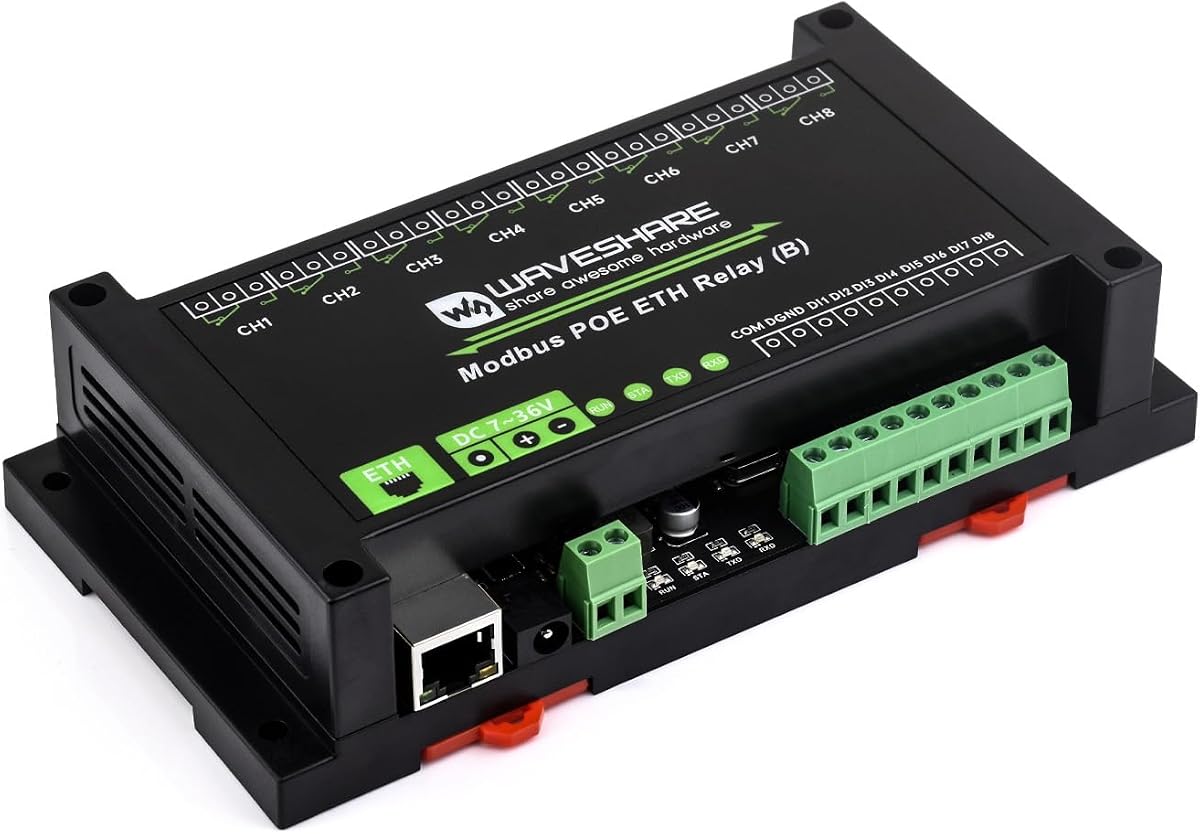

This 8-channel Ethernet relay module is a conventional industrial controller for projects that need physical outputs over a wired network. Its supplied rating is 3.4, the lowest among the ten products, but the specification sheet presents a broad set of functions: Modbus RTU, Modbus TCP, MQTT control, PoE power, DC 7-36V input, and an ABS rail-mount case.
We may earn a commission when you buy through this link, at no additional cost to you.
The module's main strength is the combination of eight outputs and several power paths. PoE can carry network communication and power in one Ethernet connection, while the wide-range DC input accommodates installations that already have a low-voltage DC source. Relay contacts are rated up to 10A at 250V AC or 30V DC, making the unit relevant to lighting, pumps, fans, access equipment, and other switchable loads.
Its flash-on and flash-off function is useful for temporary outputs, such as activating a device for a defined interval. Optocoupler isolation helps reduce interference between the control electronics and high-voltage circuitry, while reverse-proof circuitry is intended to reduce damage from incorrect connections. These protections are valuable in a permanent installation, although users still need proper wiring and electrical safeguards.
This option makes more sense for a builder who prioritizes Ethernet, Modbus, MQTT, and PoE in a DIN-rail-style enclosure. The comparatively low rating and less detailed input specification make it less compelling than some competing eight-channel models, so buyers should review the current documentation and verify application requirements before committing to it.
PoE support can reduce the number of cables needed at the controller, while the DC 7-36V input provides an alternative for installations with their own supply. This flexibility is particularly useful when the module is installed away from a convenient power outlet.
Modbus support suits structured automation workflows, and MQTT provides a path to cloud-oriented or broker-based control. The timed flash-on and flash-off command is a convenient addition for repeatable, short-duration switching.
We may earn a commission when you buy through this link, at no additional cost to you.
The Waveshare 8-Ch Ethernet Relay Module is designed for industrial and automation projects that value a protected enclosure, network control, and visible operating status. It holds a supplied rating of 4.1 and supports Modbus RTU, Modbus TCP, MQTT, PoE, DC 7-36V input, flash-on and flash-off commands, and eight relay channels rated up to 10A at 250V AC or 30V DC.
We may earn a commission when you buy through this link, at no additional cost to you.
The rail-mounted ABS case is one of its most practical attributes. It creates a more permanent and organized installation than an exposed circuit board, which matters in control cabinets, equipment rooms, smart-building installations, and agricultural environments. The enclosure is paired with optocoupler isolation and a reverse-proof circuit to help protect the internal electronics from electrical stress and accidental polarity mistakes.
The module also offers four LEDs and network indicators for MCU and signal-transceiving status. That hardware feedback can simplify diagnosis when checking whether the controller is running or whether it is communicating. MQTT support adds flexibility for users who want to integrate relay commands with a broker, while Modbus provides a familiar option for industrial control software.
This Waveshare model is a solid general-purpose option for a cabinet-based eight-output installation. It is less obviously suited to projects needing digital input monitoring because that capability is not detailed in the supplied information. Buyers who require input channels or extensive configuration options should compare it with the clearly specified digital-input version before making a final selection.
Optocoupler isolation reduces the chance that high-voltage switching activity will interfere with the control side of the board. Reverse-proof circuitry adds another layer of resilience against a common connection mistake during installation or maintenance.
MCU and network indicators make basic system checks more convenient. They help distinguish a failed local process from a network communication problem when a relay does not respond as expected.
We may earn a commission when you buy through this link, at no additional cost to you.
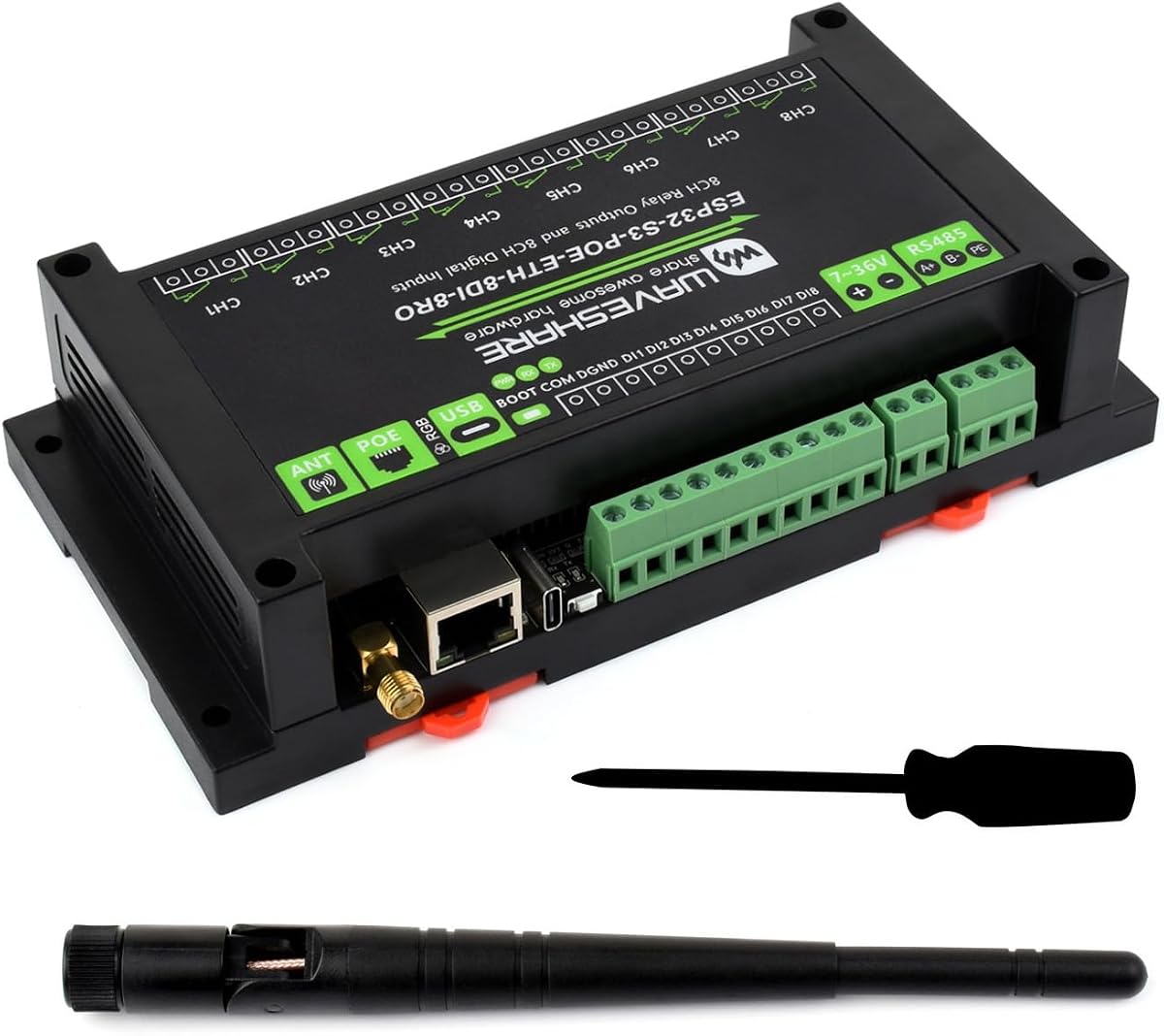
This Industrial 8-Ch ESP32-S3 WiFi Relay Module combines eight relay outputs, eight digital inputs, Ethernet, WiFi, Bluetooth LE, RS485, and PoE in one platform. Its supplied rating is 4.8, and the ESP32-S3 uses a 32-bit LX7 dual-core processor operating up to 240MHz, making it the strongest choice here for projects that benefit from flexible connectivity.
We may earn a commission when you buy through this link, at no additional cost to you.
The digital inputs are a major functional advantage. They support passive dry contacts and active wet contacts through bidirectional optocoupler isolation, allowing the module to monitor switches, sensors, and equipment states as well as switch outputs. The onboard RS485 interface broadens its usefulness in industrial environments where serial Modbus devices or sensors are present. A built-in PoE module carries both network connectivity and power over one cable.
The ESP32-S3 also integrates 2.4GHz WiFi and Bluetooth LE, so Ethernet is not the only communication route. The platform supports Arduino IDE, which makes it appealing for users who want to build custom automation logic or integrate the controller with a broader development workflow. Power isolation and optocoupler isolation add protection appropriate to an industrial control module.
The trade-off is complexity. Users seeking a simple browser-controlled relay board may find the ESP32-S3 ecosystem unnecessarily broad, while a programmer may find it much more adaptable. For installations that need local Ethernet plus wireless fallback, remote I/O, serial expansion, and PoE, however, this model delivers the most comprehensive feature combination in the guide.
Ethernet supports stable controller-based communication, while WiFi and Bluetooth LE offer additional ways to configure or operate the module. This makes it easier to accommodate both fixed infrastructure and local maintenance workflows.
Eight digital inputs complement the eight relays, allowing the controller to react to external conditions instead of merely issuing outputs. Bidirectional optocoupler isolation supports dependable signal interfacing across dry and wet contacts.
We may earn a commission when you buy through this link, at no additional cost to you.
The 8-CH Ethernet Relay Module (B) is the strongest all-around choice in this guide, combining eight relay outputs, eight digital inputs, broad protocol support, PoE, and flexible configuration. Its supplied rating of 4.9 is the highest among the ten options, and the feature set is unusually complete for an industrial-style Ethernet controller.
We may earn a commission when you buy through this link, at no additional cost to you.
The module supports TCP Server, TCP Client, UDP, UDP Multicast, HTTP, and MQTT, as well as Modbus RTU and Modbus TCP. That range allows it to fit different automation architectures, from direct Modbus polling to HTTP-based control or brokered MQTT messaging. Configuration can be handled through software or a web browser, with dynamic IP acquisition through DHCP and DNS support for connecting through a domain-name server.
Its eight digital inputs accept passive dry contacts and active wet contacts with bidirectional optocoupler isolation. That makes the unit suitable for monitoring feedback signals, switches, and sensors rather than serving only as an output controller. Power can come through a DC power port, a screw terminal accepting DC 7-36V, or an IEEE 802.3af-compliant PoE connection. The supplied information also identifies an ABS rail-mount case.
This is the module to choose when a project needs balanced, professional capabilities rather than the smallest possible board. The breadth of communication modes may require more setup than a basic two-channel controller, but it creates a flexible foundation for industrial control, building automation, smart agriculture, and remote equipment management.
TCP Server and TCP Client modes cover different network relationships, while UDP, multicast, HTTP, and MQTT broaden the integration options. Modbus support remains available for industrial workflows that rely on registers and structured commands.
Browser-based configuration makes network setup approachable, while DHCP and DNS support improve deployment within managed networks. Software configuration is also available for more advanced control-room workflows.
We may earn a commission when you buy through this link, at no additional cost to you.
This Industrial 8-Ch ESP32-S3 WiFi Relay Module is a programmable alternative to standard Modbus-focused relays. It carries a supplied rating of 4.6 and combines eight relays, eight digital inputs, Ethernet, RS485, WiFi, and Bluetooth LE around an ESP32-S3 dual-core processor rated up to 240MHz.
We may earn a commission when you buy through this link, at no additional cost to you.
The module's major advantage is flexibility. Arduino IDE compatibility, a comprehensive SDK, online development resources, tutorials, and technical support are supplied, allowing the unit to be adapted to custom automation rules. It can use its wired Ethernet connection in a control system, communicate wirelessly, or work with serial equipment through RS485. Eight digital inputs accepting both dry and wet contacts create a balanced input-output controller.
Power isolation and optocoupler isolation are incorporated for safer, more stable operation, and relay contacts are rated up to 10A at 250V AC or 30V DC. The unit can therefore control common household appliances or lower-voltage DC devices, subject to correct ratings, protection, and local electrical requirements.
The main consideration is that this is a development-oriented product. A user who only wants a basic browser interface may prefer a simpler Ethernet relay. In return, programmers and technically experienced builders receive more control over logic, connectivity, and integration. It is best suited to custom IoT, environmental monitoring, equipment control, and mixed wired-wireless automation.
Arduino IDE support and provided SDK resources make it possible to build behavior around the relay outputs and digital inputs. This is useful when a fixed command-and-response interface is not enough.
RS485 opens the door to compatible industrial modules and sensors, while WiFi and Bluetooth LE complement Ethernet. Multiple communication methods make the controller suitable for both fixed and mobile maintenance scenarios.
We may earn a commission when you buy through this link, at no additional cost to you.
The Waveshare 30-Ch Ethernet Relay Module is the high-capacity option, providing thirty relay outputs in a rail-mounted industrial enclosure. Its supplied rating is 4.2, and the module supports Ethernet control through Modbus RTU, Modbus TCP, and MQTT. PoE and DC 7-36V power options provide deployment flexibility for larger distributed control systems.
We may earn a commission when you buy through this link, at no additional cost to you.
Thirty channels make the unit useful when many independent circuits must be controlled from one network endpoint. It can serve industrial control, smart-home integrations, smart agriculture, and breeding or farming operations where numerous lights, pumps, valves, or other devices need centralized switching. A flash-on and flash-off function supports temporary activations, while four LEDs and network indicators reveal MCU and communication status.
A dedicated relay driver chip and built-in flyback diode protection strengthen the switching stage. The relay contacts are rated up to 10A at 250V AC or 30V DC. Optocoupler isolation and reverse-proof circuitry add further protection, making the enclosure suitable for organized control-cabinet deployment rather than casual exposed-board placement.
The main limitation is obvious: more channels mean a larger and more complex installation than the eight-channel alternatives. Digital inputs are not identified in the supplied details, so this model is best understood as a high-count output controller. Buyers should also calculate wiring, load distribution, and enclosure space before selecting it for a large project.
Thirty independent outputs reduce the need for multiple relay controllers in a large installation. Centralized Modbus or MQTT control can simplify management when loads are distributed across rooms, buildings, or agricultural zones.
The dedicated relay driver supports stable output control, while flyback diode protection helps manage inductive loads. These features make the module more purposeful for demanding switching arrangements than a basic hobby board.
We may earn a commission when you buy through this link, at no additional cost to you.
The Waveshare Industrial 8-Channel ESP32-S3 WiFi Relay Module is a feature-rich controller for users who need more than simple relay switching. It has a supplied rating of 4.7, an Xtensa 32-bit LX7 dual-core processor running up to 240MHz, integrated 2.4GHz WiFi and Bluetooth LE, eight relays, and support for passive and active digital inputs.
We may earn a commission when you buy through this link, at no additional cost to you.
Its isolated RS485 interface is a standout for industrial compatibility because it can connect to Modbus modules or sensors while helping maintain cleaner communication. An Ethernet chip is included, and the supplied information notes PoE as an optional version. USB Type-C provides power, debugging, and firmware downloading, while a wide 7-36V input range supports permanently powered installations.
An onboard RTC chip enables scheduled tasks, which is useful for recurring lighting, irrigation, ventilation, or equipment routines without requiring the host system to send every command. Built-in indicators help with device-status monitoring. The relay contact rating reaches up to 10A at 250V AC or 30V DC, and bidirectional optocoupler isolation is used with the digital inputs.
This module is a particularly good fit for engineers building sophisticated controls where serial devices, local scheduling, and multiple network paths are valuable. The trade-off is complexity and the need to confirm whether the specific purchased version includes PoE. Official Wiki resources are offered to help users understand setup and development options.
The RTC-based scheduling capability allows repeatable local routines to continue even when external control traffic is limited. It is especially useful for time-based lighting, watering, climate, and maintenance schedules.
USB Type-C supports power, debugging, and firmware downloads, simplifying maintenance. Wide-voltage input and optional PoE give installers more choices for permanent cabinet deployment.
We may earn a commission when you buy through this link, at no additional cost to you.
The Waveshare 8-Ch Ethernet Relay Module (B) is especially interesting for installations where relay outputs should respond to physical input conditions. Its supplied rating is 4.2, and the product combines eight Modbus-controlled relay outputs with digital input linkage, toggle control, PoE, and a rail-mounted ABS enclosure.
We may earn a commission when you buy through this link, at no additional cost to you.
The digital inputs support passive dry contacts and active wet contacts with bidirectional optocoupler isolation. A built-in debouncing algorithm helps prevent brief mechanical or electrical noise from causing unintended switching. The relay outputs can be linked to digital input changes or configured for toggle behavior, making the module more than a manually commanded collection of outputs.
A dedicated relay driver chip and flyback diode protection support dependable operation, while reverse-proof circuitry helps guard against accidental incorrect connections. Contacts are rated up to 10A at 250V AC or 30V DC. Four LEDs and network indicators show MCU and signal-transceiving status, helping installers diagnose activity during setup.
This model is a good fit for interlocks, presence-based lighting, simple automation panels, and projects in which a field contact should directly influence an output. It is less versatile than the ESP32-S3 products for custom wireless or firmware-driven behavior, but its focused Ethernet, Modbus, PoE, and input-linkage design is straightforward for industrial workflows.
Linkage control allows a physical input event to influence a relay output without requiring every decision to happen in a remote application. That can simplify local automation and create a useful fallback behavior.
Bidirectional optocoupler isolation supports both dry and wet contacts, while the debouncing algorithm reduces the chance that minor contact changes will create unintended actions. These details are important in real-world control panels.
We may earn a commission when you buy through this link, at no additional cost to you.
The Pinhaijing LAN Ethernet 2 Way Relay Board is the compact and budget-conscious choice in this guide. It has a supplied rating of 4.8 despite being much simpler than the industrial eight- and thirty-channel products. The module provides two relay outputs, TCP and UDP control, a web server, delay-switch functionality, and local password protection.
We may earn a commission when you buy through this link, at no additional cost to you.
Its footprint is only 6.8 by 4.8 centimeters, and mounting holes are provided for easier installation. The 1.6mm-thick PCB uses FR-4 material, while an STC microcontroller serves as the control chip. A power indicator and per-relay status lights make it straightforward to determine whether the board is active and which outputs are engaged.
The module accepts either 5V or 9-24V input, making it more accommodating than a design tied to one supply voltage. It supports control through a local web interface and can also be managed through TCP or UDP commands. Password protection adds a useful security layer for local network access, although appropriate network segmentation is still necessary.
This relay board suits small automation projects such as one or two lights, a fan, a sign, or a basic access-control output. It does not match the channel count, industrial isolation, or power delivery of the featured rail-mounted models. Its appeal lies in delivering focused remote control in a small, understandable package without requiring a large enclosure.
The built-in web server provides a straightforward way to manage two outputs, while TCP and UDP support allows integration with scripts and network controllers. It is approachable for both browser-based and programmatic users.
A small 6.8 by 4.8 centimeter board fits inside tighter project boxes. Support for both 5V and 9-24V inputs also makes it easier to use with common low-voltage power arrangements.
We may earn a commission when you buy through this link, at no additional cost to you.
The 8-CH Multi-Mode Ethernet Relay is a flexible cabinet controller that supports TCP Server, TCP Client, UDP, UDP Multicast, HTTP, and MQTT. Its supplied rating is 4.0, and the unit also supports Modbus RTU and Modbus TCP. It provides eight relay channels, a rail-mounted ABS case, PoE, and status indicators.
We may earn a commission when you buy through this link, at no additional cost to you.
The breadth of communication modes gives it useful compatibility with different host systems. Modbus suits industrial control software, HTTP is convenient for browser or web-service workflows, MQTT supports broker-based messaging, and the TCP and UDP modes accommodate direct network clients. A flash-on and flash-off command allows an output to be activated temporarily and then switched off automatically.
Configuration can be completed through software or a web browser. DHCP can provide a dynamic IP address, and DNS support allows the module to connect through a domain-name server. Power is flexible: a DC power port accepts a plug, a screw terminal accepts DC 7-36V, and the PoE port complies with IEEE 802.3af. Optocoupler isolation helps protect the control electronics from high-voltage interference.
This product is a sensible choice for installers who want several established control methods and straightforward configuration. The supplied information does not identify digital inputs, so it is not as clearly suited to projects that need eight monitored input states. Buyers should also verify protocol details and documentation against their intended controller software.
Supporting TCP, UDP, HTTP, and MQTT lets the module work with direct clients, browser-based tools, and messaging infrastructure. That versatility can reduce the need to change hardware when a control architecture evolves.
Browser configuration, DHCP, and DNS support streamline network deployment. PoE, a DC plug input, and a 7-36V screw-terminal input offer alternative power paths for different installation sites.
We may earn a commission when you buy through this link, at no additional cost to you.
The right Ethernet relay module depends on the number and type of loads, the control software, the power available at the installation site, and the electrical environment. The most important step is to map those requirements before comparing protocols or enclosure styles.
Choose a channel count that provides enough independent outputs for the intended loads without leaving a large amount of hardware unused. The reviewed range starts with a two-way board and expands to eight- and thirty-channel industrial controllers. A two-channel unit is appropriate for a small lighting, fan, sign, or access-control project, while eight channels are more practical for control rooms, smart buildings, irrigation zones, and equipment panels. The thirty-channel model can consolidate a larger number of outputs into one network controller, but it also requires more space, wiring, and load planning.
In practice, count actual switched circuits rather than only the number of devices. A single appliance may need a maintained power contact, while a lighting group may be split across phases or zones. Leave suitable spare capacity if future expansion is likely, but avoid paying for unused channels when a smaller board will be easier to install.
Protocol compatibility must match the software that will operate the module. Modbus TCP and Modbus RTU are common in industrial environments, while HTTP is convenient for web-based control and MQTT works well with message brokers and cloud-oriented systems. TCP Server mode may suit a controller that initiates connections, whereas TCP Client mode may be more appropriate when the relay connects to a remote host. UDP and multicast can also be useful, provided the receiving application handles their connectionless behavior correctly.
Prioritize a module supporting the protocols your existing tools already use. If multiple methods are required, confirm that each mode is operational in the firmware and understand whether only one mode can be active at a time. Reviewing the documentation before ordering is more reliable than assuming that every listed protocol offers identical capabilities.
An Ethernet relay module is well suited to stable local-network control, but some installations benefit from additional communication paths. The ESP32-S3 products in this guide add 2.4GHz WiFi and Bluetooth LE, providing wireless configuration or local access. Several also include RS485, which can connect compatible Modbus industrial modules and sensors over a serial link. This combination is useful when the controller must bridge modern network commands with older field equipment.
Wireless support does not automatically make the module better for every project. A stable wired connection may be preferable in a metal cabinet or an environment with congested WiFi, while RS485 requires correct addressing, grounding, and communication settings. Choose extra interfaces only when they solve a real integration requirement.
Power options determine how easily a module fits its installation. DC 7-36V models accept a broad range of low-voltage supplies, and some also offer a dedicated DC power port. PoE combines network communication and power over a single cable, reducing wiring in locations where a PoE switch or injector is available. The two-way board accepts 5V or 9-24V, which can be convenient for smaller systems but does not offer the same PoE option.
Confirm the available supply, connector type, voltage range, and PoE standard before purchasing. Also consider whether the load's power requirements could cause supply overheating or unreliable operation. Relay control current and connected load power are separate concerns, so the module's power input should be sized for the electronics while the relay contacts and wiring should be sized for the loads.
Digital inputs allow a module to monitor switches, sensors, contactors, and equipment states instead of only issuing outputs. The best input-equipped models provide eight channels and accept passive dry contacts or active wet contacts. Dry contacts are useful for simple switches and relay contacts, while active inputs can carry a defined electrical state. Bidirectional optocoupler isolation improves compatibility with field signals.
A built-in debounce algorithm is another valuable feature because mechanical contacts and noisy wiring can otherwise cause multiple unintended events. Confirm the number of inputs, supported contact types, isolation method, linkage behavior, and any voltage limitations in the documentation. More inputs can add value by enabling status feedback and local interlocking.
Optocoupler isolation helps separate sensitive control electronics from relay and field circuits, while power isolation adds another layer of protection. Reverse-proof circuitry can reduce damage from incorrect polarity, and flyback diode protection is important when switching inductive loads such as solenoids, contactors, or some motors. Dedicated relay driver circuitry can improve switching consistency.
Protection features are valuable, but they do not remove the need for correct installation. Use appropriately rated wiring, protective devices, grounding where required, and suitable enclosures. Never assume that a relay's stated contact rating permits every load under every switching condition. Motor, capacitive, and highly inductive loads can produce transients that demand additional engineering.
Physical format affects both installation speed and ongoing maintenance. Rail-mounted ABS cases provide a more organized solution for control cabinets and industrial panels, while compact PCBs suit small projects and custom enclosures. The Pinhaijing board measures only 6.8 by 4.8 centimeters and includes mounting holes, making it easy to fit into a restricted enclosure. The larger thirty-channel unit demands considerably more planning because of its cable count and physical footprint.
Consider cable entry, terminal access, ventilation, service clearance, and whether operators need to see status indicators. An exposed board can work perfectly inside a suitably rated enclosure, but a purpose-built housing may reduce assembly time and improve physical protection. Ensure the selected module fits the available DIN rail or panel space before ordering.
Some Ethernet relay modules are controlled through a standard web interface or documented network commands, while ESP32-S3 products are designed to be programmed. Arduino IDE support, an SDK, tutorials, and development resources make custom behavior possible, including schedules, local interlocks, and integration with broader IoT systems. Browser-based configuration is easier for a basic installation and often preferable when a technician should not need specialized software.
Choose a programmable controller if the project needs custom logic or if future requirements are likely to change. Choose a standard interface if the goal is rapid deployment with minimal development. Verify the current Wiki, examples, protocol documentation, and support resources, especially for a model intended for long-term operation rather than a one-time demonstration.
Begin by documenting every relay and input, the load connected to each terminal, the required control logic, and the module's available power source. Update the firmware or configuration software as appropriate, connect the controller to the network, and assign a stable method of addressing it. Browser-based modules can usually be configured directly, while programmable ESP32-S3 products require the Arduino IDE, its SDK, and the appropriate development workflow.
Before attaching full loads, test each relay with a low-power test device and verify that commands correspond to the intended physical output. Check input states, linkage behavior, scheduled actions, and any automatic shutdown functions. For installations using PoE, confirm that the network switch or injector supports the required standard and that the cable and connector are suitable for both data and power.
For long-term use, keep the module in a clean, dry, suitably protected enclosure, secure all terminals, and inspect wiring periodically for heat, discoloration, looseness, and corrosion. Do not exceed the documented voltage or relay contact ratings, and take suitable precautions for inductive loads. If a relay behaves inconsistently, verify the command, power supply, network connection, and load before resetting the module.
An Ethernet relay module receives network commands and switches connected electrical loads through relay contacts. It can control lights, pumps, fans, contactors, access equipment, irrigation valves, and other compatible devices. Ethernet is especially useful for automation systems that need centralized, software-driven control across a local network.
A two-channel module provides two independent relay outputs, while an eight-channel module provides eight. The smaller unit suits a limited set of loads and is easier to fit into compact projects. An eight-channel controller is more appropriate for building automation, equipment panels, irrigation, and other installations that need several separately controlled circuits.
PoE can provide both network communication and power when the connected switch or injector supports PoE and the module's PoE implementation is compatible. Some models offer a DC input as an alternative, while others do not. Confirm the specific module's PoE version, connector, and supported standard before relying on a single-cable installation.
No. Several industrial models in this guide explicitly support Modbus RTU and Modbus TCP, but the compact two-way controller and programmable ESP32-S3 models are described with different interfaces. Review the communication specifications and software commands for the exact product rather than assuming every Ethernet relay follows the same protocol.
Yes, if it includes digital inputs. The relevant eight-channel models support passive dry contacts and active wet contacts, with bidirectional optocoupler isolation. Digital input support is not listed for every model, so confirm the channel count, electrical type, and isolation features before choosing one for feedback or interlock functions.
The ESP32-S3-based models are the strongest candidates because they support Arduino IDE development, SDK resources, and custom logic. They also add WiFi, Bluetooth LE, and RS485 in different combinations. A standard web-controlled module is usually simpler for routine switching, while the ESP32-S3 platform is better when custom behavior or mixed connectivity is essential.
The stated 10A rating describes a contact limit under specified conditions, not a guarantee that every 10A load is safe. Load voltage, current, coil characteristics, switching frequency, and the relay manufacturer's guidance all matter. Motors, lamps, and inductive devices can also produce transients, so suitable protection and conservative derating are important.
A rail-mounted enclosure is already included with many of the industrial models, while compact board-level products generally need a suitable enclosure. The enclosure should provide the required mechanical protection, safe access to terminals, and appropriate environmental protection. Verify local electrical codes and the needs of the connected loads before final installation.
The 8-CH Ethernet Relay Module (B) stands out as the best overall choice because it combines eight relays, eight digital inputs, extensive protocol support, PoE, and flexible browser or software configuration. The ESP32-S3 8-CH PoE Relay earns the premium recommendation for projects that need Ethernet, WiFi, Bluetooth LE, RS485, and programmable control in one device. The Pinhaijing LAN 2-Way Relay Board is the best budget option for a smaller, more compact installation.
Start with the number of outputs and inputs your project actually needs, then match those requirements to the available protocols, control software, and power infrastructure. Add wireless or serial connectivity when it solves a genuine integration problem rather than simply making the specification list longer. Physical enclosure, isolation, protection, documentation, and ease of maintenance deserve attention alongside relay count.
Before ordering, verify the current listing details, supported documentation, accessories, and module version, especially when PoE is described as optional. Product configurations and prices can change, so compare the latest seller information against your wiring plan and control requirements. The most suitable Ethernet relay module is not simply the one with the most features, but the one that fits the installation cleanly and can be operated reliably.