
Heavy Duty Air Conditioner Extension Cord
4.8Editor score
Heavy-duty 14-gauge construction
Three-prong grounded connection
Right-angle space-saving plug
UL-listed safety standard
Explore the 10 best extension cord for sewing machine options, comparing length, gauge, safety, plug design, and sewing machine compatibility in 2026 today.
An extension cord for a sewing machine should provide reliable power without restricting where you place your machine, light, or worktable. Cord length, wire gauge, grounding, plug clearance, and compatibility with the machine’s power connector all influence safety, convenience, and everyday usability.
We compared ten extension cords using their stated electrical ratings, construction, certifications, connector designs, and practical space-saving features. The list includes a dedicated sewing-machine cord, heavy-duty appliance cords, flat-plug models, multi-outlet designs, and cords intended for indoor or outdoor use.
Each selection illustrates a different approach to extending power for a sewing space, from compact appliance-friendly designs to models that can reach farther across a room. Product details and availability can change, so verify the current specifications and your sewing machine’s power requirements before ordering.
4.8Editor score

4.8Editor score

4.8Editor score
This side-by-side comparison highlights cord length, conductor gauge, electrical capacity, connector style, and intended environment so readers can find the right extension cord for their sewing machine and workspace.




This six-foot power cord is the most purpose-specific option in the guide, with a two-slot sewing-machine connector rather than a standard wall plug and female outlet. It carries a 4.8 customer rating and is intended as a direct replacement when a machine’s original cord has been lost or damaged.
We may earn a commission when you buy through this link, at no additional cost to you.
Its main strength is the unusually broad compatibility list, which includes selected Brother, Singer, Bernina, Baby-Lock, Viking, and Pfaff models. The product information also identifies the relevant certification, 18 AWG wire, over-current protection, and over-temperature protection, making it more informative than a generic cord sold by appearance alone.
The important limitation is connector compatibility. The product description explains that one end is square and the other is round, and explicitly advises buyers to check the machine interface and product imagery first. It is a single-purpose cable rather than an extension block, so it cannot serve multiple powered devices at once.
This is the strongest recommendation when your machine appears on the compatibility list and its connector matches. It is especially useful for replacing a missing dedicated cord, while buyers with incompatible models should choose a standard three-prong extension cord instead.
A dedicated connector is safer and more convenient than forcing a sewing machine to use a mismatched household-style extension cable. Confirm the socket shape, model number, and physical proportions before ordering.
The stated over-current and over-temperature protections add confidence for a cable intended to sit close to a powered craft machine. Those protections do not replace proper circuit loading or careful cord placement.
We may earn a commission when you buy through this link, at no additional cost to you.
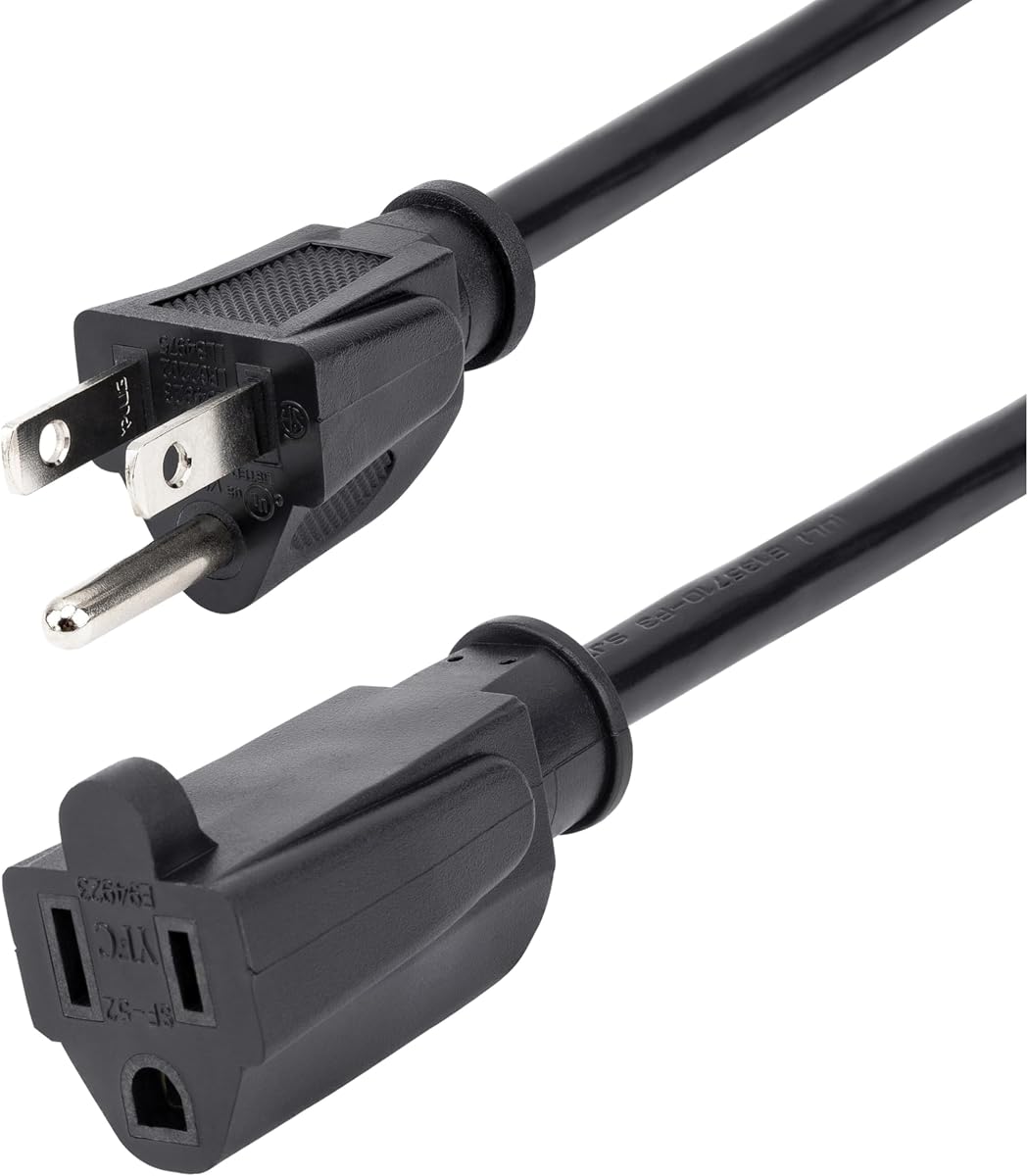
This six-foot, 14-gauge extension cord is built for demanding loads and holds a 4.8 customer rating. Its stated capacity of 15 amps at 125 volts, or 1875 watts, gives it substantially more headroom than the common 13-amp extension-cord format.
We may earn a commission when you buy through this link, at no additional cost to you.
The angle plug is a standout feature for a sewing area. It remains flush to a wall outlet, which can reduce the gap behind a sewing table, cabinet, or narrow craft station. Heavy-duty vinyl insulation, a grounded three-prong configuration, and UL listing add useful construction and safety details.
Its trade-offs are related to its appliance-focused design. Six feet is enough to bridge a nearby wall outlet but not ideal when the machine sits across the room. The heavier construction is also less convenient to coil and carry than a slim 16 AWG cable, although that extra bulk is appropriate for the capacity it offers.
Choose this model when your sewing machine is close to an outlet, you want a grounded cord with generous electrical capacity, or you also need to support other suitably rated equipment. It is the premium heavy-duty choice in this roundup.
The low-profile plug helps a sewing machine sit closer to a wall without sharply bending the cable. It also leaves more room around adjacent outlet access in busy work areas.
A 14 AWG conductor and 1875-watt rating make this cord more appropriate than lighter options when equipment demand is high. Never combine extension cords or exceed the rating of the connected machine.
We may earn a commission when you buy through this link, at no additional cost to you.
The Eaton Tripp Lite P024-006 is a conventional six-foot heavy-duty extension cable with a 4.8 customer rating. It is intended for larger servers, power distribution units, computers, monitors, laser printers, household appliances, and other equipment that benefits from heavier-gauge wiring.
We may earn a commission when you buy through this link, at no additional cost to you.
Its NEMA 5-15P-to-NEMA 5-15R configuration is familiar and useful in a home sewing studio because the male plug fits a standard North American receptacle and the female end accepts grounded appliance plugs. The stated 14 AWG wire, 15-amp rating, UL listing, and RoHS compliance make it suitable for equipment beyond a lightweight electronics lead.
The six-foot length is the main practical limitation. It works well for a sewing table positioned near a wall, but it may not reach a distant outlet. Its single-outlet design also keeps the setup simple and avoids a multi-outlet strip becoming an accidental overload point.
This is a good pick for buyers who value a recognizable, durable, warranty-backed standard extension cord and already have a nearby outlet. For a more compact table setup, consider a three-foot option; for greater reach, choose a longer model.
The combination of 14 AWG construction and familiar NEMA connectors offers a practical balance of capacity and compatibility. It suits grounded machines that use a standard North American power plug.
A lifetime limited warranty adds confidence in the product’s construction. Keep the cord away from sharp edges and follow the connected machine’s voltage and current requirements.
We may earn a commission when you buy through this link, at no additional cost to you.
The StarTech PAC10110 is a ten-foot indoor extension cable rated for 13 amps at 125 volts. It has a 4.8 customer rating and uses standard NEMA 5-15P and 5-15R connectors, making it broadly recognizable for workstations, home offices, printers, and household equipment.
We may earn a commission when you buy through this link, at no additional cost to you.
Molded strain relief at the connectors is particularly relevant because repeated bending near the plug is a common source of wear. The product is UL listed under UL62 and UL817, has a VW-1 fire rating, and uses 100% copper wire within a PVC SJT jacket. It is also backed for life with technical assistance.
Unlike a flat cable, this round cord is easier to see and handle in a busy area, which can be an advantage around a high-traffic craft table. On the other hand, it takes up more visual and physical space than a slim profile model and is specifically described for indoor use.
The StarTech PAC10110 is a balanced general-purpose choice for a sewing room where the machine is farther from the outlet than a six-foot cord can reach. It also works well for nearby lamps, computers, and other standard North American equipment.
The extra length provides useful flexibility for moving a table or changing outlet positions. Route it along a wall or under a suitable cord cover rather than across an open walking path.
Fully molded strain relief helps protect the points where cables commonly fray. It makes this a sensible option for a frequently rearranged sewing station.
We may earn a commission when you buy through this link, at no additional cost to you.
This three-foot indoor extension cord is built around 12/3 SJTW construction and has a 4.8 customer rating. Its stated capacity of 15 amps, 125 volts, and 1875 watts is among the highest in the guide, while its short length keeps excess cable away from the work area.
We may earn a commission when you buy through this link, at no additional cost to you.
The product uses pure copper wire, a flexible vinyl jacket, reinforced plug blades, and a grounded three-prong design. ETL listing adds a recognized safety certification, and the listed operating range of minus 40 to 140 degrees Fahrenheit indicates attention to temperature resistance.
A 12-gauge conductor is more than many sewing machines require, but the extra capacity can be reassuring when the cord is also expected to serve appropriately rated workshop equipment. The three-foot length is the decisive trade-off: it is excellent behind a table or beside an outlet, but insufficient for a more distant sewing station.
Choose this model for a compact indoor setup where the machine is close to the receptacle. It is also a useful heavy-duty option for nearby appliances and tools, provided the connected equipment remains within the cord’s stated ratings.
Keeping the cord short reduces excess loops beside a sewing table. Position the machine within the three-foot reach and route the cable along the wall or behind the table.
Reinforced blades, robust insulation, and thick pure copper conductors create a durable option for indoor equipment. The stated rating remains the limit for connected loads.
We may earn a commission when you buy through this link, at no additional cost to you.
The Vockjour 10-foot cord is designed for both indoor and outdoor use and carries a 4.8 customer rating. Its 16 AWG, three-conductor construction is rated for 13 amps at 125 volts, or 1625 watts, giving it enough capacity for many standard household appliances.
We may earn a commission when you buy through this link, at no additional cost to you.
Its polyethylene sheath is described as weatherproof, flame retardant, cold resistant, frost resistant, heat resistant, and abrasion resistant. The product also states an IP65 waterproof-material rating, a broad temperature range of minus 58 to 158 degrees Fahrenheit, and ETL/cETL approval. Added hanging hooks make it easier to store neatly.
Outdoor suitability does not make the cord immune to every wet condition. Connections should remain dry, and the cable should not be submerged or placed in standing water. Its 16-gauge rating also provides less headroom than the 14- and 12-gauge choices in the guide.
This is the most versatile option for a sewing area that doubles as a craft workspace, patio project area, or market stall. It is also useful for powering small appliances, lamps, media equipment, and suitable tools where weather exposure may occur.
The combination of indoor and outdoor ratings makes this cord useful beyond a permanent sewing table. It can support craft demonstrations, market stalls, and temporary work areas when connections are protected from moisture.
Integrated hooks provide a simple way to keep the cord off the floor and organized when not in use. Coil it loosely rather than wrapping it tightly around a small radius.
We may earn a commission when you buy through this link, at no additional cost to you.
This three-foot, 14/3 extension cord has a 4.8 customer rating and is designed to support up to 15 amps, 125 volts, and 1875 watts. Its compact format is particularly useful when a sewing machine stands close to an outlet but a standard plug blocks the receptacle or prevents the table from sitting flush.
We may earn a commission when you buy through this link, at no additional cost to you.
The low-profile right-angle plug is the defining feature. Its 45-degree configuration is intended to keep the second wall outlet accessible and allow furniture or equipment to move closer without putting stress on the cable. The cord also uses 100% copper wiring, SPT-3 insulation, and a heat-resistant vinyl jacket.
The obvious limitation is reach. Three feet is suitable for close positioning but offers little flexibility if the nearest outlet is several feet away. Because the product is described for indoor use, it should not be treated as a garden or exposed-weather cable.
This is a particularly good match for compact sewing tables, craft desks, and appliances positioned against walls. It combines short reach with high capacity and a space-conscious plug, making cable management easier than with a conventional straight plug.
The low-profile plug reduces the protrusion created by a standard extension cord. That lets a sewing table or cabinet sit more closely against the wall without sharply bending the connection.
The 14-gauge construction and 1875-watt rating make the short length more than a temporary light-duty lead. Confirm the machine and any attached equipment remain within the stated electrical limits.
We may earn a commission when you buy through this link, at no additional cost to you.
The TROND Rightward Flat Plug Extension Cord is a six-foot, three-outlet model with a 4.8 customer rating. Unlike a single-outlet extension cable, it provides three grounded outlets on different sides, allowing a sewing machine, task lamp, and small accessory to share one wall receptacle.
We may earn a commission when you buy through this link, at no additional cost to you.
Its patented right-angle plug measures 0.33 inches in profile and is designed to fit tightly against a wall while leaving the neighboring outlet accessible. The flat cable can run along a baseboard or beneath a rug, and the body uses flame-retardant PC and ABS materials with SPT 16/3 copper conductors and PVC insulation.
The product information notes that it is not intended for recessed floor outlets, and the sockets are described as tight, requiring firm insertion. Its 1625-watt, 13-amp maximum is shared across the connected devices, so adding a high-draw machine to several other loads requires care.
This model is ideal when outlet access is limited and a sewing station has multiple small powered accessories. It is less appropriate for recessed or unusually tight receptacles, and it should not be treated as unlimited power for several high-load appliances.
Side-positioned outlets help organize several low-draw devices around a sewing station. The flat body takes up less wall space than a bulky rectangular power strip.
The 13-amp and 1625-watt rating applies to the extension cord as a whole. Add up the connected loads and leave margin below the stated maximum.
We may earn a commission when you buy through this link, at no additional cost to you.
The Amazon Basics Extension Cord is a simple ten-foot indoor lead with a 4.8 customer rating. It uses 16 AWG wire, supports 13 amps at 125 volts, and plugs into a standard three-prong wall receptacle through a female connector that accepts both two- and three-prong device plugs.
We may earn a commission when you buy through this link, at no additional cost to you.
Its main advantage is uncomplicated utility. The ten-foot length is long enough to reposition a sewing table without demanding a special cord, while the neutral white color blends easily with home craft rooms and offices. It is suitable for consumer electronics, tools, media equipment, and other standard indoor devices.
This is not a multi-outlet strip, and it does not provide a rotating or angled plug. If an outlet is hidden behind a table or cabinet, a standard plug may take up more room than desired. The 13-amp rating also offers less capacity than the heavier cords in the guide.
Choose this model when you want a recognizable, uncomplicated extension cord without specialized features. It is a practical selection for many sewing spaces, especially when the machine uses a standard grounded plug and the outlet is not directly behind the table.
A standard three-prong connection and broad plug acceptance make this cord easy to integrate into an existing sewing room. It also avoids adding another bulky multi-outlet block.
Ten feet provides practical positioning flexibility, while the white jacket is easy to notice against darker floors. Route it carefully to avoid creating a trip hazard.
We may earn a commission when you buy through this link, at no additional cost to you.
The Maximm 15-foot flat extension cord combines a long reach with a thin cable and rotating plug. It has a 4.8 customer rating and uses 16-gauge copper conductors rated for 13 amps, 125 volts, and 1625 watts.
We may earn a commission when you buy through this link, at no additional cost to you.
The 360-degree rotating wall plug allows the cable to be directed in a convenient direction without forcing an awkward bend immediately after it leaves the receptacle. The flat SPT-2 wire is 3.8 millimeters thick and 9.6 millimeters wide, making it easier to run beneath carpeting, along furniture, or behind compact spaces.
The flat design can be less visible than a round cord, which is useful around a sewing table, although concealing it completely may make it harder to notice. The fifteen-foot length also introduces more cable that must be routed safely, and the one-outlet configuration limits simultaneous devices.
This is an attractive option for a sewing room where the outlet is far from the machine but a low-profile route is desired. Its rotating plug, long length, and space-saving profile offer a useful combination for flexible craft-room layouts.
The rotating plug helps the cable leave the wall in a natural direction, reducing strain near the connector. It is especially useful when a standard straight plug would force a sharp bend.
Fifteen feet of flat wire can span a larger sewing area while taking up less room than a conventional round cable. Keep the full length visible in traffic areas and avoid pinching it under furniture.
We may earn a commission when you buy through this link, at no additional cost to you.
The right extension cord depends on the machine’s power connector, electrical requirements, table layout, and the amount of extra equipment connected. These factors help narrow the field without overlooking safety.
Start with the socket on the sewing machine rather than the plug on the wall. Most sewing machines use a specialized two-slot or figure-eight-style connector that differs from a standard household appliance plug. A dedicated sewing-machine power cord may therefore fit while a general extension cord does not. Record the model number and compare the connector shape, dimensions, and polarity with the seller’s compatibility information before purchasing.
A standard three-prong extension cord is appropriate only when the sewing machine has a matching grounded or two-prong wall plug. Do not force an unusual connector into a receptacle or alter the cord’s terminals.
Check the amperage, voltage, and wattage shown on the machine’s power label, then choose an extension cord with equal or greater capacity. A 13-amp, 1625-watt cord is suitable for many ordinary sewing machines, while heavy-duty 14- and 12-gauge options provide more headroom for demanding equipment. The connected machine, attached accessories, and any other loads on a multi-outlet cord all count toward the total.
Choose a conductor gauge that comfortably covers the load rather than matching only the connector. Higher-gauge construction also tends to be more durable under sustained use.
Measure from the wall outlet to the farthest point of the sewing table, allowing a little slack for movement. Three feet is useful behind a table or cabinet, six feet covers many room layouts, and ten to fifteen feet offers greater flexibility. Excess cord should be coiled and secured rather than left in a loose loop on the floor.
Choose the shortest length that comfortably reaches the intended equipment. A longer cord can add unnecessary clutter, while an undersized cord may force the machine into an awkward position.
A grounded three-prong cord provides an earth path and is appropriate for equipment designed for that connection. The wall plug and female outlet should also be grounded, and users should never defeat or remove the grounding pin. Some sewing-machine-specific cords use a two-slot interface because the machine itself does not require a standard three-prong household connection.
Match the extension cord’s outlet configuration to the device. Two-prong device plugs can be accepted by certain three-prong receptacles, but a two-prong wall plug should never be used where grounding is required.
The plug’s physical shape can determine whether a sewing table can sit flush against a wall. Right-angle plugs reduce the gap created by a straight connector, rotating plugs help direct the cable, and flat bodies are useful beneath desks or behind appliances. A low-profile design is especially helpful when an outlet is partly hidden by furniture.
Check both the wall-side plug and the device-side outlet for clearance. A space-saving plug on one end does not guarantee that the female connector will also fit into a recessed or unusually tight receptacle.
A one-outlet extension cable gives you a direct connection and reduces the temptation to overload a multi-device block. A three-outlet model is useful for a sewing machine, task lamp, small iron, or other low-draw accessories. Its total rating still applies across all connected devices, so do not treat the extra outlets as independent circuits.
Avoid daisy-chaining extension cords or power strips. If multiple tools have substantial power requirements, use separate suitable circuits and outlets instead of forcing them through one extension assembly.
Look for an extension cord with a recognized safety listing such as UL or ETL, along with clear voltage and amperage information. Molded strain relief, reinforced prongs, durable insulation, and copper conductors are useful indicators of everyday robustness. Specifications should also state whether the cord is designed for indoor or outdoor use.
A listed certification does not make improper use safe. Continue to inspect the cable, keep connections dry, avoid exposed heat sources, and replace any cord with damaged insulation or bent blades.
The best extension cord for a sewing machine is one that fits the room without becoming a trip hazard. Consider whether the cord will run behind a table, under a rug, along a baseboard, or across an open floor. A flat or angled model may be preferable in a tight workstation, while a long round cable can be easier to see and handle when routed properly.
Plan the route before ordering and add cable covers or clips where the cord crosses a walking area. Keep the cord clear of sewing needles, moving machine parts, hot irons, and pinch points.
Before use, inspect the entire cord from the wall plug to the machine connection. Look for cracked insulation, exposed conductors, loose prongs, discoloration, or damaged strain relief, and do not use a cord showing any of these problems. Confirm that the connector, voltage, amperage, and grounding configuration are appropriate for the sewing machine and its manual.
Connect the extension cord to a grounded wall outlet when required, then position the sewing machine without pulling the cable taut. Route the cord behind the table, along a wall, or through a suitable cover. Keep plugs and connections dry, avoid placing the cord beside a hot iron or under a moving machine, and never daisy-chain extension cords or power strips.
Unplug the machine before disconnecting the extension cord, and disconnect the cord from the wall before changing its placement. When storing it, coil the cable loosely and secure the loop with a reusable tie. Periodically check the plug, jacket, and connections, and retire the cord promptly if bending, pulling, or age causes visible damage.
Only if the sewing machine has a standard wall-plug connector and the extension cord matches its voltage, amperage, and grounding requirements. Many machines use a dedicated two-slot connector, so check the machine manual and the shape of the existing power cord before ordering. Never force a mismatched plug into a socket or modify the terminals.
A 12-gauge cord provides more electrical capacity and robust construction than a typical 16-gauge household extension cord. It can be useful for a high-load machine or a shared heavy-duty setup, but it does not automatically make a poorly matched connector suitable. Connector compatibility and correct voltage remain the first priorities.
Choose enough length to position the table comfortably without leaving a large loop of unused cable. Three to six feet works for close indoor layouts, while ten to fifteen feet is useful when the nearest outlet is farther away. Measure first and secure any excess cord so it does not become a trip hazard.
Flat construction does not inherently determine capacity; the conductor gauge, insulation, plug, and stated amperage do. The Maximm model, for example, uses 16 AWG copper and is rated for 13 amps, while the other flat designs state their own limits. Check the listed rating rather than assuming all flat cords are identical.
A sewing machine can generally be connected to a suitable power strip, but the strip and extension cord must both have adequate ratings and proper grounding. Do not daisy-chain power strips, and do not exceed the combined load limit. A dedicated single-outlet extension cord can be simpler and easier to manage.
It is not necessary unless the cord will be exposed to outdoor conditions. An indoor-rated cord may be easier to handle and is designed for dry environments. If you do use an outdoor-rated model, keep the connections dry, avoid standing water, and follow its temperature and electrical specifications.
Route the cord behind the table or along a wall so it cannot be caught by pedals, wheels, or moving machine parts. Keep it away from hot irons, pins, cutting tools, and trip paths, and never leave a loop where someone could step on it. Inspect the insulation and connector regularly for signs of damage.
A dedicated replacement cord is usually more convenient when the connector and model are listed as compatible because it provides the intended direct connection. A standard extension cord is appropriate when the machine already has a normal wall plug. Confirm the connector design and electrical ratings rather than choosing solely by cord appearance.
The Sewing Machine Power Cord is the clearest choice when your machine appears on its compatibility list and uses the matching dedicated connector. For a standard grounded plug near the table, the Amazon Basics cord provides practical ten-foot reach, while the heavy-duty air-conditioner cord offers greater capacity and a space-saving right-angle plug.
Prioritize connector compatibility first, then match voltage, amperage, grounding, and conductor capacity to the equipment. For a compact studio, consider a three- or six-foot model; for a farther outlet, a ten- or fifteen-foot cord may be more useful. Plug shape, outlet clearance, and safe cable routing deserve equal attention.
Finally, verify the current product details and manufacturer information before purchasing, particularly the exact machine model, connector shape, certification, and electrical rating. Those details can change across product revisions, and only an accurate match will deliver the convenience and safety a sewing workspace needs.