
Digital AC Voltage Frequency Meter
4.3Editor score
Measures 80–500 volts
Displays voltage and frequency
Supports embedded installation
Discover the best frequency meter for generator, comparing voltage range, accuracy, displays, power readings, installation needs, and compatibility.
A frequency meter for generator helps users monitor AC frequency alongside voltage, current, power, and operating time. The right instrument should match the generator output, provide a readable display, support safe installation, and clearly identify any signal limitations. Accurate frequency monitoring is especially useful for portable, standby, RV, and industrial generator setups.
We compared all ten products by examining their supported electrical ranges, measurement functions, display formats, installation methods, accuracy claims, generator compatibility, and available customer feedback. The list covers compact digital meters, analog panel instruments, three-function monitors, and comprehensive generator panels designed for fixed installations.
Each review explains the strongest feature, practical trade-offs, and the type of user most likely to benefit. Ratings and specifications reflect the supplied product information, while technical details should be verified before installation. Product availability and prices can change, so compare current listings and confirm compatibility with your generator before buying.
4.3Editor score

4.6Editor score

4.7Editor score
This side-by-side comparison highlights the electrical ranges, display styles, measurement functions, and installation approaches offered by each generator frequency meter.


The KETOTEK Digital AC Voltmeter Panel Mounting Meter is a compact dual-function instrument that displays generator voltage and frequency at the same time. It carries a 4.6 rating, placing it among the better-reviewed products in this guide. Its most immediately useful feature is the separate red and green LED indication, which makes it easier to distinguish voltage from frequency without navigating menus or changing screens.
We may earn a commission when you buy through this link, at no additional cost to you.
The specified measurement ranges are 80 to 300 volts AC and 45 to 65 hertz, with an accuracy of 1% plus or minus two digits. Readings refresh twice per second, which is fast enough to follow meaningful changes during generator operation. Because the meter can connect directly to two wires and obtain its operating power from the measured circuit, it avoids the need for a separate external supply. That simplifies permanent installation, although appropriate electrical protection and installation practices remain essential.
Its main limitation is the 300-volt ceiling, which is lower than the 500-volt range offered by several alternatives. It also cannot safely be used with square-wave output, inverter output, or modified sine-wave circuits. These restrictions mean it is best suited to a generator that produces the supported pure AC signal within its voltage range. It is not a universal instrument for every generator architecture, and those limitations should be checked before installation.
This is the strongest general recommendation for a compact generator panel because it combines two essential readings, straightforward two-wire wiring, fast updates, and a housing small enough to fit many control panels. Choose it when the generator operates within 80–300 volts AC and produces a supported waveform. Buyers working with higher system voltages should consider one of the broader-range digital meters instead.
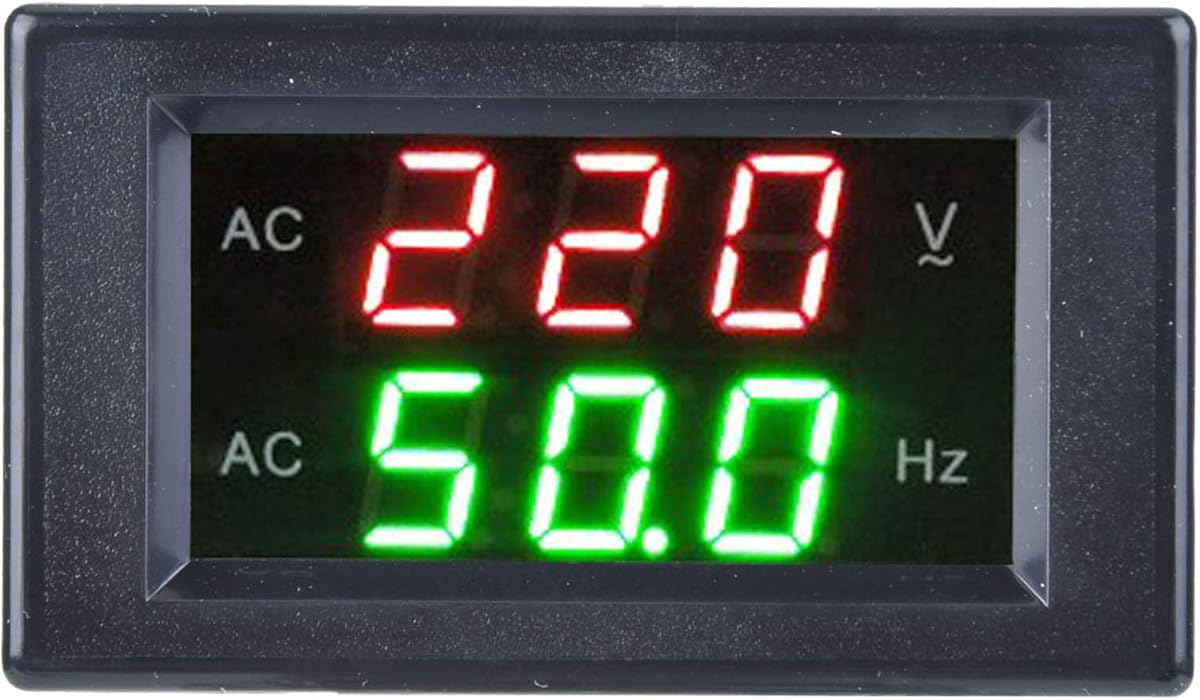
Voltage appears in red and frequency in green, giving both values a fixed place on the display. This arrangement is useful during startup, load changes, and routine monitoring because the operator can check both values at a glance.
The panel-mount housing measures 2.68 by 1.65 by 1.5 inches. Its small footprint makes it practical for generator control boxes, maintenance panels, and compact mobile installations where space is limited.
We may earn a commission when you buy through this link, at no additional cost to you.
The Digital AC Voltage Frequency Meter is a straightforward 80–500-volt instrument designed to display generator voltage and frequency simultaneously. Its 4.3 rating is positive, although it does not lead the category in customer feedback. The important advantage is range: it accommodates more system voltages than the top-ranked KETOTEK model while retaining the same two-wire, self-powered operating concept.
We may earn a commission when you buy through this link, at no additional cost to you.
Frequency is measured from 45 to 65 hertz, and the display updates twice per second. The bright LED screen is described as clear and easy to read, while low power consumption suits continuous monitoring. The embedded buckle installation method is intended to produce a stable panel fit. This model is also identified for gasoline and diesel generator applications, motors, and recreational vehicles, giving it broader appeal than a meter intended only for laboratory or panel work.
The essential trade-off is signal compatibility. The meter is restricted to pure 45–65 hertz AC and expressly cannot be used with square waves, inverter outputs, or AC converted from DC through an inverter. As a result, a portable generator with conventional alternator output may suit it, while a generator relying on an inverter stage may require a purpose-designed frequency instrument. The 4.3 rating also suggests slightly less consensus than the leading products, though the supplied information does not identify a specific defect.
This is a compelling budget-oriented choice for a user who wants straightforward voltage and frequency monitoring across a broad pure-AC voltage range. It is particularly useful for RV, motor, and conventional generator installations where the two-wire connection and embedded format simplify integration. Confirm output type and voltage first, then choose this meter if the generator falls within its specified operating conditions.
The 80–500-volt range gives the meter more flexibility than compact alternatives with lower ceilings. That makes it easier to use across different conventional generator systems without changing the instrument.
Connecting two wires allows the meter to test automatically and draw power without a separate supply. Embedded installation adds stability for users who intend to keep the display in a control panel.
We may earn a commission when you buy through this link, at no additional cost to you.
The Hertz Meter for Generator Frequency is a digital voltage-and-frequency display aimed at users who want a clear, permanent monitor in a generator panel. It has a 4.6 rating, matching the strongest customer feedback among the products with detailed specifications. The red-and-green LED presentation separates voltage from frequency, allowing both values to remain visible at the same time.
We may earn a commission when you buy through this link, at no additional cost to you.
Its electrical coverage includes 80 to 500 volts AC and 45 to 65 hertz. The stated measurement accuracy is 1% plus or minus two digits, with a minimum frequency resolution of 0.1 hertz and minimum voltage resolution of one volt. Testing occurs twice per second. Installation uses an embedded buckle for a more stable fit, and the instrument connects directly to the AC source without a separate power supply.
The most significant limitation is waveform compatibility. The specification says the meter fits only a pure AC 45–65 hertz supply and should not be connected to square-wave or inverter output. That is a material distinction for owners of modern inverter generators. A broad voltage range cannot compensate for an unsupported signal, so verifying the generator's output type is more important than comparing voltage ceilings alone.
This product is well suited to a conventional generator, motor, or other pure-AC system that operates within the stated range. Its combination of a wide voltage ceiling, precise stated resolution, dual-color display, and stable panel installation makes it a strong choice for fixed monitoring. The user who values clear real-time information more than a larger feature set will likely find this meter particularly effective.
Frequency resolution down to 0.1 hertz gives the display enough granularity for routine generator checks. The one-volt voltage resolution complements the frequency reading without requiring a separate screen.
The embedded buckle is intended to keep the instrument stable after installation. This is useful for mobile generator panels exposed to vibration as well as stationary equipment cabinets.
We may earn a commission when you buy through this link, at no additional cost to you.
The AC 50–500V 120A Digital Volt Amp Meter expands the usual generator frequency display into a three-parameter monitor. It shows voltage, current, and frequency simultaneously and carries a 4.4 rating. This makes it more relevant when operating load matters as much as frequency, because the operator can compare power draw and frequency behavior without moving between separate instruments.
We may earn a commission when you buy through this link, at no additional cost to you.
The voltage range extends from 50 to 500 volts AC, current reaches 120 amps, and frequency covers 10 to 99.9 hertz. The wider frequency span distinguishes it from the many 45–65-hertz-only devices in the guide. A current transformer is included to proportionally convert high current into a lower signal that the meter can measure, while the 74-by-74-millimeter digital display provides a bright readout.
The trade-off is complexity. A two-function self-powered meter can usually be connected with a simpler two-wire arrangement, whereas a current measurement adds transformer placement, ratio considerations, and more demanding installation work. The supplied information also does not state waveform restrictions, so users should verify the electrical characteristics rather than assume compatibility from the broad frequency range alone.
This meter is the right choice for fixed generator panels where the operator wants voltage, current, and frequency in one view. It also fits distribution cabinets, power plants, automation equipment, stabilizers, and electromechanical systems. For a portable setup needing only frequency and voltage, a dual-function model would be easier to install, but this unit delivers a much more complete operating picture.
Showing three values at once makes it easier to identify whether a frequency change coincides with voltage or load variation. That context is useful for troubleshooting and routine generator supervision.
The included CT enables high current to be converted proportionally for measurement. Proper sensor placement and ratio configuration are essential for dependable current readings.
We may earn a commission when you buy through this link, at no additional cost to you.
The SQ-72 AC Frequency Table is the list's clearest alternative to digital LED instruments. It uses a traditional pointer and analog scale, giving users an immediate visual indication of generator frequency. The product has a 4.6 rating, and its straightforward power-system application makes it appealing for permanent control panels where users prefer a conventional panel gauge.
We may earn a commission when you buy through this link, at no additional cost to you.
The instrument displays 45 to 65 hertz and uses a 220-volt AC supply. Its stated accuracy level is 2.5, while the outer housing measures 72 by 72 by 61 millimeters. The installation cutout is 67 by 67 millimeters. A transparent front allows the scale to remain readable, and the pointer dial includes a fine-tuning control for calibration.
Unlike the small digital meters that power themselves from the measured lines, this unit requires its own 220-volt AC supply. That adds wiring and installation complexity, but it also separates the instrument's power requirements from the generator circuit. The analog pointer cannot provide the same detailed numerical view or operating history as a multi-function digital panel, although it may be easier to interpret at a glance.
Choose this meter for an established panel that uses analog frequency gauges or for a user who values a simple scale over digital menus. Its 220-volt supply and 45–65-hertz range must match the installation. For a new generator system requiring current, power, or logged operating time, a digital multi-function panel offers greater information and flexibility.
The pointer moves across a transparent frequency scale, allowing an operator to judge the operating point quickly. This can be easier than interpreting changing digital values in a bright or dusty environment.
The square housing and specified 67-by-67-millimeter cutout support a standardized panel layout. The independent 220-volt supply should be routed and protected according to the installation's electrical design.
We may earn a commission when you buy through this link, at no additional cost to you.
The Generator Panel Meter 6-in-1 is the most comprehensive monitoring instrument in this guide. It has a 4.7 rating, the highest listed customer score among the ten products. Rather than focusing only on frequency, it displays single-phase AC voltage, current, frequency, power, power factor, and accumulated working time.
We may earn a commission when you buy through this link, at no additional cost to you.
The 78-by-78-by-63-millimeter unit uses a three-screen LED interface and a screen-change button, allowing users to move among groups of readings. The current transformer ratio can be configured, an important feature when matching the meter to the generator's sensing arrangement. Its front reaches IP54 protection, and the specified panel cutout is 67 by 67 millimeters.
The additional functions bring installation complexity. A basic frequency meter may need only two wires, while this panel must be configured around current sensing, transformer ratio, accumulated time, and the correct power measurements. It is therefore less convenient for a quick portable test and more appropriate for a carefully planned permanent installation. Buyers should also verify that the generator's system type and intended functions align with the meter's capabilities.
This is the top choice for operators who need a complete generator dashboard rather than a single frequency reading. It offers the broadest set of operational measurements and the strongest available rating in the list, making it particularly attractive to workshops, power-management installations, and owners of larger stationary systems. Those needing only voltage and frequency can find a simpler, less involved solution.
Voltage, current, frequency, power, power factor, and runtime provide a broad operational record. The grouped screens keep the housing compact while making more information available than a basic counter.
Adjusting the current transformer ratio allows the displayed current information to be aligned with the monitored system. Correct setup remains essential for accurate and useful power monitoring.
We may earn a commission when you buy through this link, at no additional cost to you.
The D7YA 55Hz Frequency Table is presented as a fixed electrical monitoring instrument for generator maintenance engineers. It does not have a supplied customer rating, so its buyer feedback cannot be compared numerically with the rated products. The model designation identifies a 55-hertz version, while the listing emphasizes straightforward monitoring and a user-friendly interface.
We may earn a commission when you buy through this link, at no additional cost to you.
This fixed-frequency focus may be useful in equipment designed around a nominal 55-hertz supply, where the operator needs to know whether output remains near the expected value. Its placement specification identifies the front of a vehicle, suggesting a panel position where the reading can be checked during operation. The product is aimed at maintenance monitoring rather than a broad consumer electronics application.
The sparse supplied information is the main limitation. No voltage range, accuracy value, housing dimensions, or installation method is provided, so buyers cannot make a fully informed comparison from the available data alone. It is also not clear whether the unit offers a moving pointer, digital display, or another indication method. These details should be confirmed with the seller before purchase.
This product may suit maintenance professionals working with a known 55-hertz generator installation who already understand the panel and electrical requirements. It is less suitable for buyers comparing general-purpose meters because the published information does not reveal enough detail to confirm waveform support, accuracy, or connection requirements. Confirm the complete specification before selecting it over a documented digital meter.
The 55-hertz version targets a specific operating frequency. That specialization can be useful in fixed equipment where operators know the expected nominal output.
The stated audience is generator maintenance engineers, and the front placement suits a visible instrument location. Users should confirm the detailed installation requirements because limited dimensions are supplied.
We may earn a commission when you buy through this link, at no additional cost to you.
The D69-60 Generator Digital Display is a panel-oriented frequency and voltage monitor designed for generator detection and monitoring. No customer rating is supplied, making customer sentiment impossible to quantify from the available information. Its title identifies a 45–65-hertz measurement band and an AC operating range of 150 to 500 volts.
We may earn a commission when you buy through this link, at no additional cost to you.
The product name references power, voltage, and multiple nominal voltage classes, suggesting a broader generator-monitoring role than a simple two-wire counter. Its digital display format is appropriate for a control panel where numerical information is more useful than a pointer. The specified 150–500-volt range gives it a higher ceiling than many compact models and makes it potentially relevant to higher-output generator systems.
The relatively high 150-volt lower threshold is an important limitation for low-voltage systems. It also shares the same 45–65-hertz focus as most conventional meters, so it may not suit a generator with a substantially different frequency range. Because the listing does not provide detailed accuracy, waveform restrictions, dimensions, or current-measurement capabilities, those points require verification before installation.
This digital tester is a sensible option for a fixed generator panel that operates within the 150–500-volt AC range and uses a standard 45–65-hertz supply. It is especially relevant when an operator wants frequency and voltage information in digital form. Those with lower-voltage systems or broader frequency needs should choose a meter whose published minimum limits and measurement band suit their equipment.
The 150–500-volt range is suited to higher-output systems and provides more headroom than compact meters with lower ceilings. Confirm that the generator's nominal voltage remains comfortably within this interval.
A digital panel display offers precise values for frequency and voltage monitoring. It pairs naturally with fixed equipment where the meter remains visible and permanently connected.
We may earn a commission when you buy through this link, at no additional cost to you.
The Generator Electrical Parameter Monitoring Device with Intuitive Digital Readout is a frequency-meter option configured for 380-volt systems. It does not have a customer rating in the supplied data, so its reception is unknown. The product's primary appeal is its focus on generator electrical parameters rather than a broad collection of consumer testing features.
We may earn a commission when you buy through this link, at no additional cost to you.
The 380-volt configuration makes the device relevant to three-phase or industrial generator environments where a standard residential meter would not match the system voltage. The digital readout is described as intuitive, which can help maintenance personnel interpret operating values without navigating complex controls. Front placement supports visibility when the instrument is integrated into a control enclosure.
The published data is limited. It does not state the frequency range, voltage tolerance, accuracy, dimensions, current handling, or whether a current transformer is included. Those omissions make direct technical comparison difficult, particularly against products with clearly specified limits. Installation should not proceed until the manufacturer or seller confirms those electrical details and the correct wiring configuration.
The device is best considered for a technician or facility operator who has already identified a 380-volt generator system and needs a dedicated digital parameter monitor. It may be attractive for industrial panel upgrades, but a fully documented frequency meter is the safer choice for general buyers. Confirm compatibility, protective requirements, and sensor connections before making a final selection.
A dedicated 380-volt model is more relevant to industrial generator environments than a low-voltage household counter. The exact voltage tolerance should still be verified before connection.
The intuitive digital display is intended to make operating parameters easy to interpret. It suits a fixed panel where a technician can check values during routine inspection.
We may earn a commission when you buy through this link, at no additional cost to you.
The VFT Digital Readout Meter is a direct-replacement instrument for generator panels that display voltage, frequency, and operating hours. It carries a 4.4 rating and targets popular generator brands including Westinghouse, DuroMax, DuroStar, Pulsar, WEN, RYOBI, and CAT RP Series gas or dual-fuel models. That brand-oriented focus makes it a natural fit for a replacement rather than a new custom-built monitor.
We may earn a commission when you buy through this link, at no additional cost to you.
The unit provides real-time voltage, frequency, and hour readings, giving the owner a compact record of generator performance. It also includes enhanced safety features intended to alert users to abnormal voltage or frequency levels. Its panel format is designed as a direct replacement, and the listing says it can share maintenance updates with a VFT Data Center.
The major trade-off is loss of historical hours when replacing the original hour meter. The product information explicitly advises recording previous readings before replacement because those values will not transfer. Model-level compatibility is also essential; the broad brand names in the title do not guarantee that every generator variant uses the same connector, voltage, or physical opening.
This is a good match for a portable generator owner with a failed or outdated panel meter, particularly when the existing unit is a compatible VFT-style assembly. It is less appropriate for a new system requiring current, power factor, or comprehensive electrical analytics. Verify the generator model, connector layout, voltage, and panel dimensions before ordering, and record existing hour information beforehand.
The display combines three commonly needed generator parameters in one panel unit. That makes it a useful maintenance reference for owners of compatible portable generators.
Direct replacement can simplify a repair, but the user must record the old hour reading because the new unit starts without transferred history. Connector and model compatibility should be checked before removal.
We may earn a commission when you buy through this link, at no additional cost to you.
The right generator frequency meter depends on output type, voltage, installation environment, display preferences, and the amount of diagnostic information required. These factors help narrow the field before comparing individual models.
Start with the generator's rated output voltage and the range of voltages it may produce during startup, load changes, and normal operation. The meter must cover that entire range, not merely the nominal value. Options include 50–500 volts, 80–300 volts, 80–500 volts, 150–500 volts, and dedicated 380-volt configurations. A meter that begins above the generator's output is useless, while one with an unnecessarily low ceiling may fail during a transient.
Pure AC, square-wave, modified sine-wave, and inverter output are not interchangeable measurement conditions. Several digital meters in this guide expressly support only pure 45–65 hertz AC and warn against connecting them to inverter or square-wave outputs. A conventional alternator generator may be suitable, but an inverter generator requires a meter whose documentation explicitly covers its output. Ignoring this distinction can produce incorrect readings or damage the instrument.
A basic frequency counter may be enough for a quick frequency check, but many generator owners also need voltage, current, power, power factor, or runtime. Dual-function meters cover voltage and frequency, while the 6-in-1 panel adds current, power, power factor, and accumulated working time. A three-function model is useful when load behavior matters, and a comprehensive panel is better for fixed installations. Avoid paying for unnecessary complexity if the generator is only being serviced occasionally.
Consider the environment rather than choosing only by display type. A bright digital LED is convenient in dim areas and provides exact numerical values, while an analog pointer can be intuitive in an established industrial panel. Dual-color displays help separate voltage from frequency without switching screens. A three-screen interface supports many readings but requires a screen-change button, and an analog scale may be easier to interpret at a glance but cannot offer detailed diagnostics.
Some compact meters draw power directly from two measured wires, simplifying wiring but requiring an appropriate supported AC source. Other instruments need a separate 220-volt supply, and multi-function models may also require a current transformer. Check panel cutout dimensions, mounting depth, connector style, and available space before purchasing. Fixed installations benefit from a stable embedded fit, while portable systems may need a meter that can be connected and removed more easily.
Accuracy specifications vary across the list, with several digital meters claiming 1% plus or minus two digits and the analog SQ-72 listing a 2.5 accuracy level. Faster update rates make changes easier to observe, and two readings per second is common among the documented digital products. Resolution also matters: 0.1-hertz frequency resolution can show subtle variation more clearly than a coarser display. Compare accuracy, resolution, and update speed together rather than focusing on a single number.
A general-purpose meter can suit many conventional generator installations, while a direct-replacement readout may be more convenient for a specific generator family. Brand compatibility does not guarantee that every model uses the same connector or panel dimensions. The VFT product in particular lists several supported brands but also warns that replacing an hour meter can reset historical information. Always match the exact model, electrical rating, and physical layout.
The 6-in-1 panel states that its front reaches IP54, which provides useful information about resistance to dust and water when correctly installed. Other models do not provide equivalent protection details. Portable generators may encounter vibration, moisture, dust, and temperature changes, so a permanently installed meter should be protected by its enclosure and suitable system design. Check operating-temperature claims where relevant and ensure the panel or control box prevents inappropriate exposure.
Before installation, identify the generator's rated voltage, output waveform, frequency band, and connection requirements. Compare those values with the meter's published specifications, then isolate and de-energize the circuit according to proper electrical procedures. Confirm panel dimensions, polarity where applicable, transformer requirements, and the need for protective devices. Record any existing hour-meter information before replacing an original unit.
Install the meter in a dry, visible location using the stated mounting method. Connect the voltage and frequency sensing wires only to a supported AC source, observing the manufacturer's instructions. If current measurement is included, install the current transformer according to its specified orientation and set the ratio correctly. Restore power only after checking connections, then compare the displayed voltage and frequency with the generator's known operating condition.
During operation, observe both frequency and voltage rather than treating frequency as the only indication of generator health. Watch for abrupt changes as loads start or stop, and use the additional power, current, or runtime readings when available to investigate unusual behavior. Keep the enclosure closed, avoid exposing the meter to moisture or excessive heat, and have the installation inspected periodically by someone qualified for the generator's electrical system.
A generator frequency meter displays the frequency of the generator's AC output, usually in hertz. Many combined units also show voltage, and more advanced models can display current, power, power factor, and operating time. The information helps reveal whether the generator is maintaining a stable output during startup, no-load operation, or use with connected loads.
No. Frequency and voltage are separate electrical properties. A 120-volt or 240-volt system may operate at 60 hertz, but its rated voltage does not imply its frequency. The generator nameplate and manual should state both values, and the selected meter must be compatible with the voltage range and frequency band.
Only if the manufacturer explicitly says the meter supports inverter output. Many compact meters in this guide are limited to pure 45–65 hertz AC and warn against square-wave, modified sine-wave, and inverter output. Connecting an unsupported meter may produce unreliable readings or damage it, so verify the generator's output architecture before installation.
It depends on the model. Several compact digital meters draw power from the two measured wires and operate without an extra supply. The SQ-72 analog panel meter requires a 220-volt AC supply, while more comprehensive panels may need additional current-sensing connections. Follow the specific product instructions and plan the wiring accordingly.
Choose a meter whose specified range includes 50 hertz. The 45–65-hertz instruments in this guide cover both 50- and 60-hertz systems, while the 10–99.9-hertz model offers a broader span. The broader range is not automatically necessary, but it can be useful if one meter will monitor different equipment or a generator with a wider operating range.
Yes, dual-function models display AC voltage and frequency simultaneously. They are especially convenient for routine generator checks because both values remain visible. For current or power analysis, consider a three-function or multi-function panel, but also verify that the required current transformer and other accessories are included.
It can. The VFT Digital Readout Meter specifically states that historical hours will not transfer and advises recording the previous reading before replacement. Other replacement displays may behave similarly, so preserve the existing information before removing the original instrument.
Check the generator's exact model and the meter's voltage, frequency, waveform, dimensions, and connector requirements. Brand-level compatibility alone is not enough because versions within the same brand can use different interfaces. Compare the original meter and panel opening with the replacement specifications before removing or modifying anything.
The KETOTEK Digital AC Meter is the best overall choice for a compact, permanently installed dual readout, while the Digital AC Voltage Frequency Meter offers a budget-friendly path with a wider 500-volt ceiling. The Generator Panel Meter 6-in-1 stands apart as the premium selection for users who need current, power, power factor, and runtime in addition to frequency and voltage.
Prioritize waveform compatibility, voltage limits, and the measurements you actually need before considering display style. A two-function counter is ideal for straightforward frequency and voltage checks, an analog pointer may suit an established panel, and a multi-function digital unit is better for comprehensive fixed monitoring. Confirm panel dimensions, wiring, sensor requirements, and exact model compatibility before installation.
Customer ratings can help identify popular products, but they should not replace checking the technical specifications. Product listings, configurations, and prices change, so review the current Amazon listing and seller information before purchasing. Use the links in this guide as a starting point, then verify the latest specifications, accessories, warranty terms, and compatibility.