
ROVE R2-4K Dual
4.5Editor score
Dual front and rear cameras
STARVIS 2 night sensor
Built-in GPS tracking
5.8GHz Wi-Fi transfers
128GB card included
Our Go Kart Dash CAM guide compares ten compact and multi-camera recorders on video quality, night vision, parking coverage, app control, and installation ease.
A dash camera can be useful on a go-kart because it records what happens ahead, behind, and beside the kart without requiring a permanent installation. The most suitable models offer a wide field of view, reliable low-light recording, secure mounting, straightforward power connections, and enough storage for extended sessions. Compact, screen-free designs also help preserve visibility and reduce distractions.
We compared ten available dash cameras on the specifications and features most relevant to recreational karts and other small vehicles. The list covers front-only, front-and-rear, and multi-camera systems, along with waterproof motorcycle models, screen-equipped designs, Wi-Fi app control, GPS, parking surveillance, G-sensor event locking, and different night-vision technologies. Not every model is designed specifically for a go-kart, so installation requirements deserve close attention.
Each selection below highlights the product's strongest use, technical capabilities, and practical limitations. Ratings reflect the supplied customer feedback, while the recommendations consider image quality, coverage, installation flexibility, and ease of transferring footage. Product prices and availability can change, so compare the current listing, included accessories, and compatibility requirements before purchasing.
4.5Editor score

4.6Editor score

4.1Editor score
This side-by-side comparison evaluates each dash camera by recording resolution, viewing coverage, night performance, storage, connectivity, and suitability for a compact kart installation. The table also highlights important limitations, including separate hardwire kits, missing memory cards, proprietary power requirements, and the need to confirm vehicle compatibility.




The ROVE R2-4K Dual is a front-and-rear recorder aimed at drivers who want more than a basic windscreen camera. It combines a front sensor with a separate 1080P rear camera, built-in GPS, dual-band Wi-Fi, and a 3-inch IPS screen. Its supplied 4.5 rating reflects generally positive customer feedback, while the included 128GB card makes the package ready for immediate use.
We may earn a commission when you buy through this link, at no additional cost to you.
The front camera records at 2.5K and upscales the result to 4K, while the rear records at Full HD. That distinction matters when judging the headline resolution: the front image is not native 4K, but the QHD source and Sony STARVIS 2 IMX675 sensor can still provide useful detail. An F1.5 front aperture, HDR, and the claimed super night vision make the camera more attractive for evening karting or dim indoor tracks where lighting changes quickly.
Its rear camera fills the most obvious coverage gap in a single-camera setup. The ROVE app supports playback and transfers over dual-band 5GHz and 2.4GHz Wi-Fi, with stated downloads of up to 20MB per second. GPS records routes, locations, and speed stamps that can be reviewed in the free ROVE GPS Player, while the G-sensor, emergency lock, and parking modes add practical evidence protection. These extras do bring more cables, mounts, and setup considerations than a compact single-camera design.
The R2-4K Dual is a strong choice for a kart that has room for two cameras and a reliable hardwired power arrangement. It is less convenient for a very small vehicle with minimal windshield area or no suitable accessory socket. Buyers should also understand that 24-hour parking operation requires an additional hardwire kit. Despite those limitations, its combination of image quality, rear coverage, GPS, fast wireless transfer, and included storage makes it the strongest premium-oriented recommendation here.
Recording simultaneously in front and behind is especially useful when another kart or vehicle is approaching from the rear. The 2.5K front source and 1080P rear stream also provide more usable detail than two basic 1080P cameras, provided the upscaled front output is considered accurately.
Dual-band Wi-Fi, the ROVE app, and GPS metadata reduce the need to remove the card at the track. The driver can review, download, and organize recordings with route and speed information available for later reference.
We may earn a commission when you buy through this link, at no additional cost to you.
The galphi 4K Dash Cam is a compact, front-only camera built around native 4K UHD recording. Its 4.4 rating indicates solid customer reception, and the screen-free design is especially attractive for a go-kart because it leaves the driver's forward view largely unobstructed. A 32GB memory card is included, allowing the camera to be used without an immediate extra purchase.
We may earn a commission when you buy through this link, at no additional cost to you.
The 160-degree lens provides broad coverage across multiple lanes, while the F1.6 aperture and wide dynamic range help balance headlights, sky, and darker portions of a track. Built-in 5GHz Wi-Fi supports transfers stated at up to 8MB per second, which is faster than a typical 2.4GHz connection. The app allows phone-based preview, playback, downloads, settings, and sharing without repeatedly handling the memory card.
Loop recording and a G-sensor provide the two most important everyday safeguards. Older unlocked clips are overwritten when the card fills, while a detected impact or sudden shake can lock a clip so it is less likely to disappear during continued recording. Time-lapse parking mode is also supported, although it requires a Type-C hardwire kit that is not included. The product supports cards up to 256GB, making it easy to increase capacity later.
This is an excellent pick for a single forward-facing camera that prioritizes image detail, a compact footprint, and convenient wireless transfer. It cannot record behind the kart without adding a separate camera, and the included 32GB card may be modest for frequent long sessions. For drivers who want the cleanest single-camera installation and do not need rear coverage, the galphi remains an easy, capable recommendation.
Unlike cameras that upscale a lower-resolution source, this model records directly at 4K UHD. The compact screen-free body then avoids adding a display to the windshield while preserving higher potential detail for license plates, signs, and kart markings.
The 5GHz connection makes the companion app a central part of the experience. Preview, playback, and download functions are available without removing the card, while the G-sensor protects collision footage from routine overwriting.
We may earn a commission when you buy through this link, at no additional cost to you.
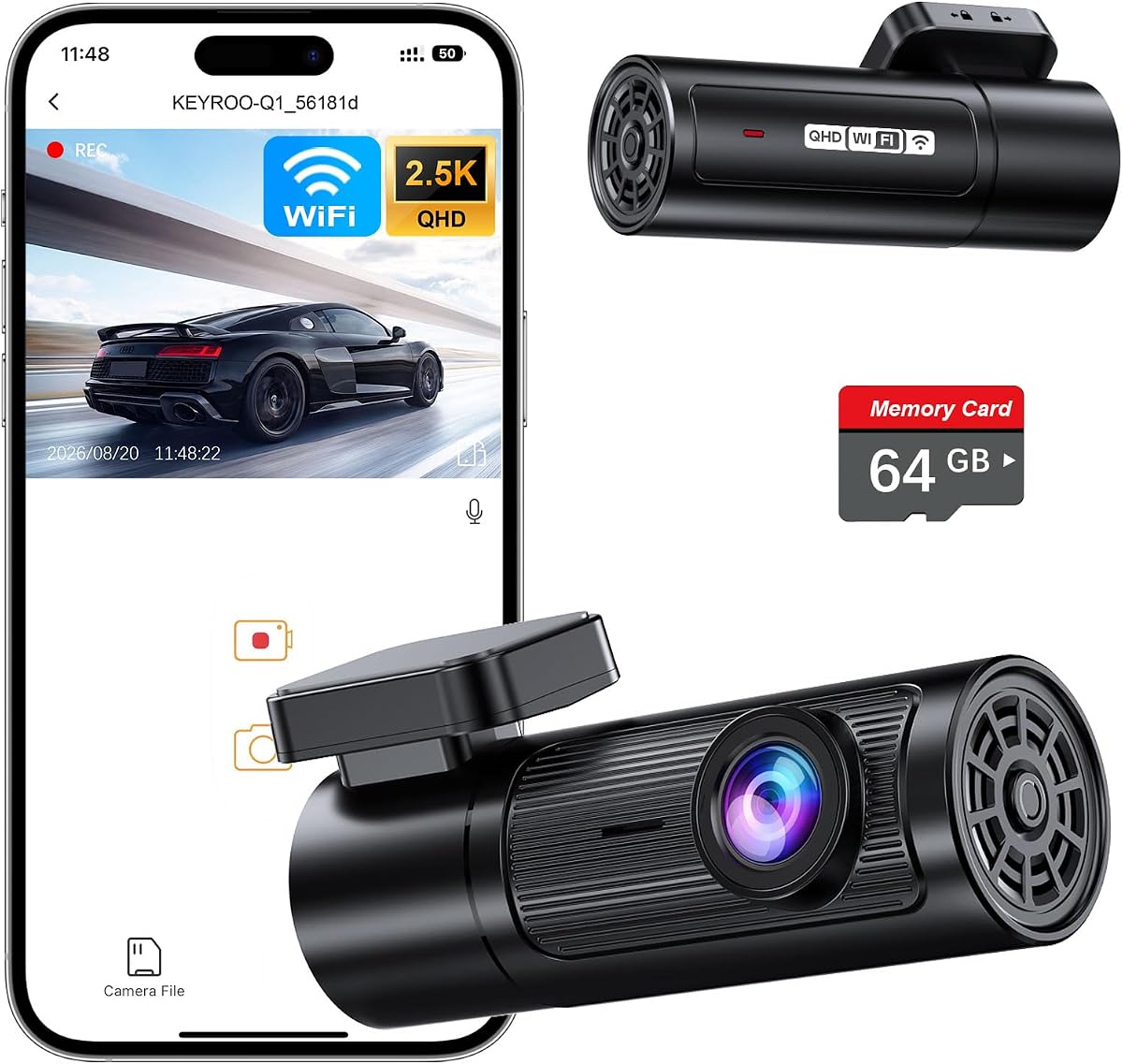
The KEYROO Q1 2.5K is a compact front camera with a 4.7 customer rating, the highest among the products in this guide. It records at 2560 by 1440 pixels through a six-layer, 160-degree lens and includes a preinstalled 64GB high-endurance card. Its small, screen-free body is designed to sit near a rearview mirror without creating a distracting display.
We may earn a commission when you buy through this link, at no additional cost to you.
A notable advantage for go-kart use is the 360-degree rotatable lens. The same camera can be aimed toward the road, the driver, or part of the passenger area, making it useful for rideshare-style recording as well as forward-facing track footage. The detachable bracket also allows the unit to be removed easily. Wi-Fi and a free app provide live preview, replay, downloads, and sharing for both iOS and Android devices.
Image quality is supported by the six-layer lens and a night-vision-oriented aperture, with the manufacturer describing the camera as suitable for low light and high-contrast scenes. Seamless loop recording manages limited storage, and the G-sensor locks a clip after a collision or abrupt shake. A time-lapse parking mode is also available, but the separate professional hardwire kit must be purchased to use it.
The Q1 is a strong all-around choice for a small kart because it balances resolution, generous included storage, compact installation, and angle flexibility. It does not offer a rear camera, and its listed parking-mode requirements add a potential accessory cost. Still, for a driver who values a clean dashboard and wants to redirect the camera easily, its 4.7 rating and included 64GB card make it an especially compelling option.
The 360-degree lens rotation makes the Q1 more adaptable than many fixed forward-facing models. A kart owner can fine-tune the view after installation or temporarily redirect the camera without changing the mount.
The preinstalled 64GB high-endurance card gives the camera a useful amount of recording capacity out of the box. Cards up to 256GB are supported, so storage can be expanded when more recording time is important.
We may earn a commission when you buy through this link, at no additional cost to you.
The CAMECHO Dual Camera is one of the few options in this guide designed with powersports vehicles in mind. It is marketed for motorcycles, motorbikes, dirt bikes, trikes, UTVs, ATVs, and golf carts, making its handlebar mounting and weather resistance potentially relevant to an outdoor kart setup. It uses a 1080P front camera, a 720P rear camera, and a 2-inch split-screen display.
We may earn a commission when you buy through this link, at no additional cost to you.
The IP65 dash-camera body and IP67 cameras are designed to handle rain, snow, dust, and general outdoor exposure. A wired controller includes an LED recording indicator and buttons for locking footage, taking photos, pausing or starting recording, and resetting the unit. The hardwired controller approach is convenient on a kart with accessible handlebar controls because it lets the driver manage recordings without interacting with a tiny camera screen.
Seamless loop recording overwrites older clips as needed, while the G-sensor can emergency-lock footage following a bump or collision. A short controller press can also manually protect a clip. The front camera uses a 120-degree field of view, while the rear camera has a 90-degree angle, giving the rear image a narrower but still useful view. HDR is included to improve the balance of bright and dark areas.
This model makes the most sense for a kart used outdoors, on rough paths, or in an environment where water and dust are meaningful concerns. It is less appropriate for a smooth road-legal vehicle because its installation and controls are designed around powersports equipment. A compatible memory card is not included, so buyers should plan to add one. Within that niche, its dual-camera coverage and rugged construction are compelling.
The camera and accessories carry stated IP65 and IP67 protection, making this a more weather-conscious choice than most conventional car dash cams. That is valuable for outdoor karting where spray, rain, and dust are common.
The handlebar-mounted wired controller makes recording status visible at a glance. Manual lock, photo, pause, and reset functions are easier to operate than navigating a small menu while wearing driving gloves.
We may earn a commission when you buy through this link, at no additional cost to you.
The Garmin Dash Cam Mini 3 is a small, front-facing camera built around simple operation and a low-profile appearance. It records crisp 1080p video through a wide 140-degree lens and has a supplied customer rating of 4.2. For a go-kart, its compact dimensions can be helpful on a small windscreen where every additional centimeter of device might obstruct the driver's view.
We may earn a commission when you buy through this link, at no additional cost to you.
The built-in Garmin Clarity polarizing lens is a meaningful feature when bright sunlight reflects from a windscreen. It can reduce glare and preserve more visible detail in the recorded image. Voice control allows the driver to save video or manage audio without handling the camera. The device also records automatically and saves detected events, reducing the need to begin or stop recording manually.
Garmin's connected services extend the basic camera through the Garmin Drive app. Parking Guard can send a phone notification when an event is detected, and compatible users can remotely view real-time footage when away from the parked vehicle. Those remote features require a paid Vault plan, an active Wi-Fi network, constant power, and the app on a compatible smartphone. The distinction matters because local recording and remote surveillance are not identical capabilities.
This Mini 3 is a good fit for a driver who values a small, polished setup and fewer visible controls. It is not the most economical option because storage is not listed as included and the advanced remote features carry a subscription requirement. It also records only ahead. Nevertheless, its glare-reducing lens, voice controls, automatic incident handling, and durable construction make it a refined choice for fair-weather recreational driving.
The integrated polarizer is particularly useful for daytime karting on open tracks or roads. Reducing reflected glare can help preserve signs, lane markings, and vehicle details in the 1080p image.
The small housing can sit close to the glass, while voice commands and automatic event saving minimize driver interaction. Remote features add convenience when constant power and the required Garmin service are available.
We may earn a commission when you buy through this link, at no additional cost to you.
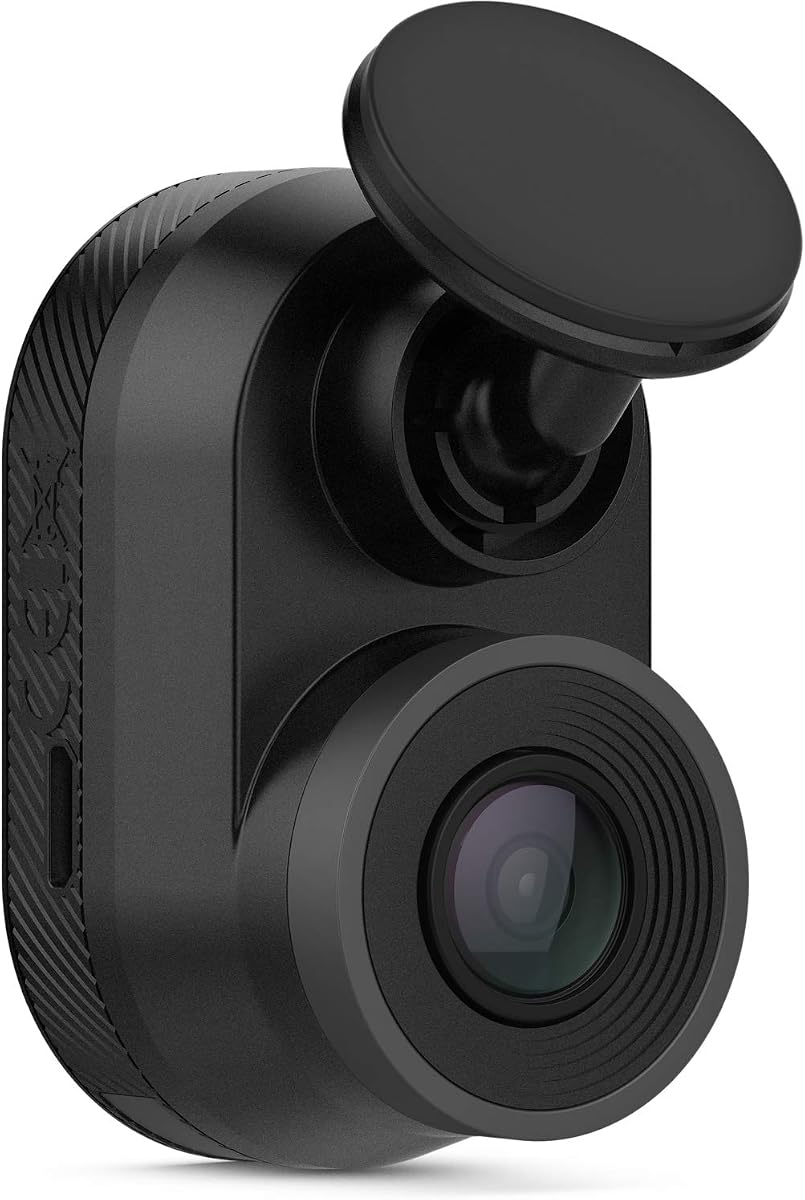
The original Garmin Dash Cam Mini is a car key-sized recorder with a 4.2 rating and a design centered on simplicity. It captures 1080P HD footage through a 140-degree lens and automatically records and saves detected incidents. Its very small body makes it one of the least intrusive choices for a small kart windscreen or handlebar area.
We may earn a commission when you buy through this link, at no additional cost to you.
A low-profile adhesive mount keeps the installation close to the surface, while the supplied vehicle power cable and USB cables provide the basic connection options. A compatible 8GB or larger Class 10 microSD card is required but not included. This means the camera is not ready to record immediately unless the buyer already owns an appropriate card.
Built-in Wi-Fi connects the camera to a smartphone running the Garmin Drive app. The Dash Cam Auto Sync feature can control and play back footage from as many as four cameras through that app, which is useful for a multi-camera installation even though this particular listing focuses on the front view. The app-based approach avoids the need to remove the card whenever a clip needs to be reviewed.
This is a dependable pick for a driver who wants minimal visual clutter and a straightforward forward view. Its age and basic 1080p specification mean it lacks several conveniences found in newer models, including a built-in polarizer, voice control, and the more advanced remote functions of the Mini 3 listings. It is still highly relevant for a kart because small size can matter more than maximum resolution. Confirm that the kart's power arrangement works with the supplied cable and that a suitable memory card is available.
The key-sized housing takes up very little visual space and can be mounted near the edge of a small windscreen. That makes it less likely to interfere with the kart driver's view of the track.
Although the basic resolution is modest, the app can synchronize as many as four cameras. A buyer may therefore add compatible units around a kart if wider multi-angle evidence is more important than a single 4K image.
We may earn a commission when you buy through this link, at no additional cost to you.
This Garmin Mini 3 listing shares the core strengths of the established Mini 3 design: an ultracompact housing, 1080p HD recording, a 140-degree field of view, and a built-in Garmin Clarity polarizer. It receives a 4.0 customer rating, making it the lowest-rated product in this comparison, though it still provides a broad set of features for a very small camera.
We may earn a commission when you buy through this link, at no additional cost to you.
Voice control supports saving video and starting or stopping audio recording in several listed languages. The Garmin Drive app can present synchronized clips from as many as four separately sold dash cameras, allowing front, rear, and side views to be reviewed together. This capability may be particularly useful if a kart owner wants complete coverage but prefers several small units over one larger multi-camera housing.
The online Vault automatically stores important saved clips, and the app can provide dash-cam live view when the driver is away from the vehicle. Parking Guard can notify the user of a detected event. These advanced remote functions require a paid subscription, active Wi-Fi, constant power, and the compatible app. Without those conditions, the camera remains a conventional local recorder with Wi-Fi access near the unit.
Its key strengths are the tiny footprint, glare reduction, voice control, and multi-camera synchronization. The subscription-dependent nature of the headline connected features and the need to buy additional cameras for full coverage are important trade-offs. For a straightforward kart setup, it is most convincing when the owner values a nearly invisible camera and already uses Garmin's connected ecosystem.
The synchronized viewing feature is a standout among the compact models in this guide. Installing compatible Garmin Mini units at the front, rear, and sides can create a more complete record than a single forward-facing camera.
Voice commands help reduce physical interaction with the camera. The integrated polarizer counters reflected sunlight, while the compact body keeps the windshield area clear and understated.
We may earn a commission when you buy through this link, at no additional cost to you.
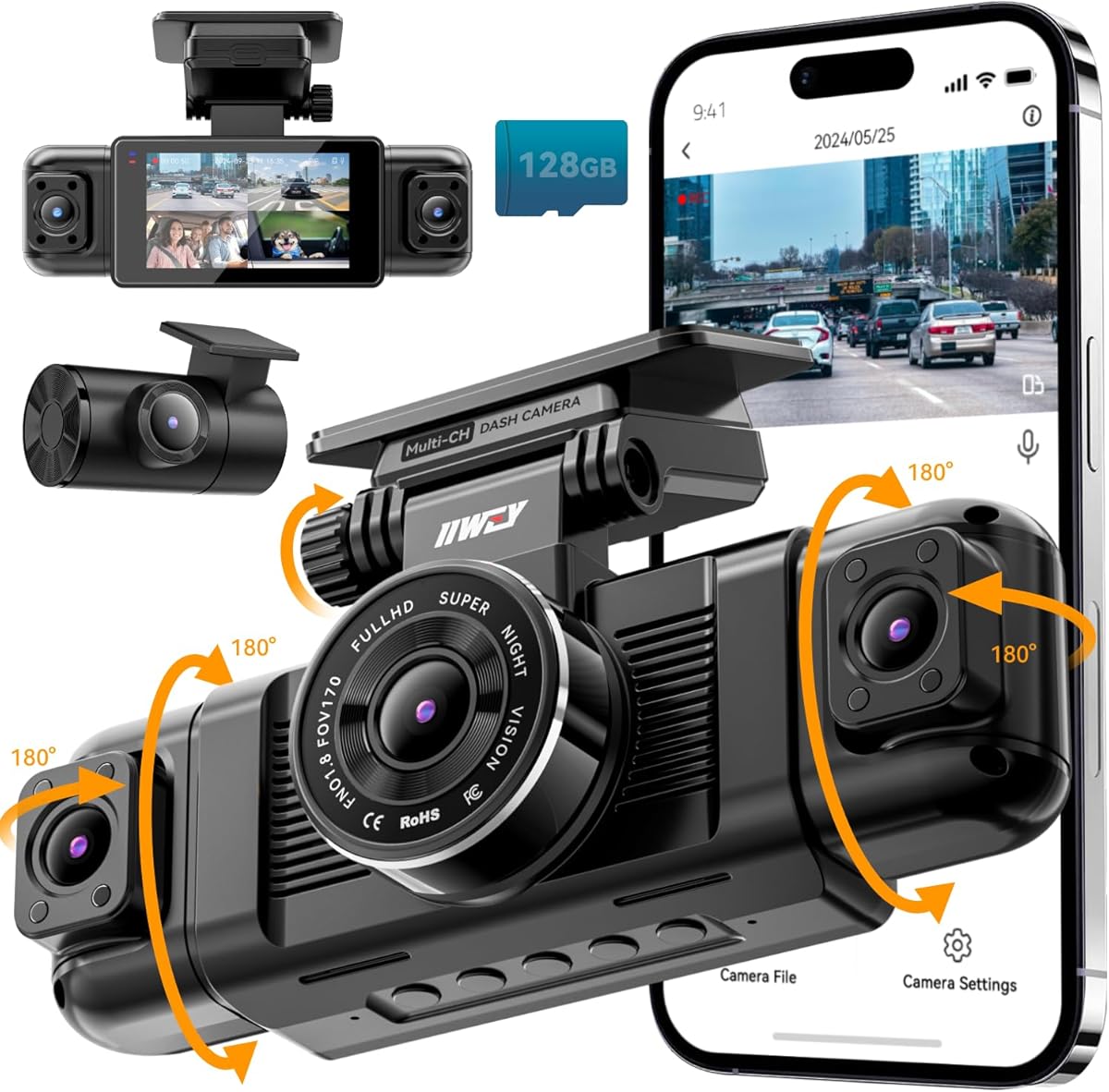
The IIWEY N5 is built for comprehensive coverage, with a front, rear, two side cameras, and an interior channel. Its supplied rating is 4.4, and the system can record 360 degrees around a vehicle. That makes it a natural fit for a kart if the owner can accommodate several mounting positions and the necessary wiring.
We may earn a commission when you buy through this link, at no additional cost to you.
The front and rear cameras use 170-degree lenses, while the side cameras provide 150-degree coverage. A 2.5K front mode combines a 2.5K front stream with three 1080p channels, and a separate 1080p mode covers all four directions. The main unit has a 3-inch IPS screen, making it easier to frame the cameras and review status directly, although that size may be less discreet in a small kart.
A preinstalled 128GB card is included and capacity up to 256GB is supported. Loop recording begins after the engine starts, and the G-sensor automatically creates and locks emergency footage after a collision. The 5GHz Wi-Fi connection works with either the iiwey or viidure app for preview, downloads, sharing, and settings. Wi-Fi must be turned on manually, and it shuts off after five minutes without an app connection to reduce overheating.
The N5's major advantage is the number of perspectives it can capture. The trade-offs are installation complexity, no GPS, and a strict power requirement: the original cigarette-lighter charger is required, while USB and Type-C power are not suitable. The rear camera also has to be wired to the front unit. A hardwire kit is optional for parking operation but sold separately. For a kart with sufficient space and a compatible power socket, it provides the broadest coverage in this roundup.
Four channels capture the road, rear, sides, and cabin at the same time. This is valuable at busy karting venues where a single front camera may miss contact from another direction.
The included 128GB card and 5GHz Wi-Fi make the system ready for regular use. Fast wireless transfer, adjustable mounts, and G-sensor locking improve both installation flexibility and evidence management.
We may earn a commission when you buy through this link, at no additional cost to you.
The GKU D600 Pro Max combines native 4K front recording, a 1080P rear camera, GPS, and a STARVIS 2 sensor. Its 4.6 rating is among the strongest in this guide. The package includes a 64GB card, a car charger, and both suction and adhesive mounting options, giving a kart owner some flexibility when deciding how to secure the cameras.
We may earn a commission when you buy through this link, at no additional cost to you.
The front and rear cameras provide wide 170-degree and 150-degree views, respectively, and add time, date, and license-plate stamps to recordings. WDR, HDR support in front-only mode, and Super Night Vision are intended to improve difficult lighting. A dual-band Wi-Fi 6 connection supports stated downloads of up to 20MB per second, while the GKU GO app handles preview, playback, downloads, and clip management.
Built-in GPS records route, speed, and location data that can be viewed on a PC or Mac with the free GKU GPS Player. Loop recording automatically removes the oldest unlocked footage when the card fills, and the G-sensor locks recordings after impacts or sudden vibration. Voice control permits hands-free management of important recording functions. A supercapacitor is used instead of a conventional battery for better heat resistance and longevity.
The D600 Pro Max is a compelling all-around recommendation for a kart because it provides high-resolution front evidence, rear coverage, low-light features, and useful metadata in one package. The hardwire kit needed for 24-hour parking is not included, and a USB cable is also absent, though the supplied car charger handles ordinary use. Buyers should verify that the kart's power connector and mounting surfaces are compatible. With that planning in place, it offers an excellent balance of resolution, coverage, and smart features.
A native 4K front stream and 1080P rear stream provide more detail than a basic front-and-rear setup. Wide lenses and identifying stamps add context that can be useful when reviewing a session.
The built-in GPS can preserve route, speed, and location information for later review. STARVIS 2, WDR, and the available HDR mode help manage the contrast changes common on outdoor tracks.
We may earn a commission when you buy through this link, at no additional cost to you.
The Veement V300 is a straightforward front-facing camera designed to provide more resolution than standard 1080p without moving into a higher-cost multi-camera system. It records at 2304 by 1296 pixels, has a 4.1 customer rating, and uses a wide 170-degree lens. Those characteristics make it a practical option for a small kart where broad forward visibility matters.
We may earn a commission when you buy through this link, at no additional cost to you.
An F1.7 aperture and six-layer glass lens help the camera collect more light during nighttime driving and other dim conditions. The app, named VeeCar, connects locally over Wi-Fi for live preview, playback, downloads, and sharing. This local connection does not provide internet access, and the camera must remain connected to a power cable during use.
The V300 avoids a traditional lithium battery and instead uses an RTC circuit and continuous USB-C power. That design reduces the potential overheating concerns associated with small internal batteries. TS stream technology supports fast and reliable storage, while seamless loop recording manages the microSD card. Cards up to 256GB are supported, although one must be purchased separately.
This is the best budget-oriented recommendation for a buyer who wants a compact camera, app access, and a wide lens without paying for rear coverage. A 24-hour parking mode is listed, but its effectiveness still depends on a suitable hardwired power arrangement. The missing memory card and lack of a rear camera are the main compromises. For straight-ahead road or track evidence, the V300 remains a simple and capable entry point.
The 1296p stream captures more image data than a standard 1080p camera. Combined with the 170-degree lens, it provides broad forward coverage for lane position, oncoming traffic, and track activity.
The VeeCar app handles preview, playback, downloads, and sharing over a local Wi-Fi link. The battery-free design requires continuous USB-C power but reduces internal battery-related heat concerns.
We may earn a commission when you buy through this link, at no additional cost to you.
A suitable go-kart dash camera should combine a compact or rugged design with dependable power, broad field of view, and footage that is easy to retrieve. Because most products are designed for cars, motorcycles, or other vehicles, compatibility with the kart's size, wiring, and operating environment deserves careful attention.
Choose a higher-resolution front camera when fine details, such as markings, signs, or vehicle identifiers, are important. For general track documentation, 1080p can be sufficient, especially with a wide lens and a capable low-light sensor.
Prioritize the coverage you actually need. A single 160- or 170-degree front camera is usually the easiest kart solution, while dual cameras are valuable in busy areas and multi-camera systems are best suited to larger vehicles.
For nighttime use, prioritize a good aperture, sensor, HDR or WDR, and credible night mode. For rough outdoor use, check whether the camera and its mounting hardware are weather resistant.
Match the camera to the kart's actual power outlet and electrical limits. Treat 24-hour parking as a separate installation project, not a feature that works immediately out of the box.
Check the included capacity against how long you expect to drive before reviewing footage. A larger card reduces overwrite pressure, while local Wi-Fi app control is usually more useful than repeatedly removing a card in the paddock.
Measure the available surface before ordering and check the size of the mounting base. Favor a screen-free, adjustable design when visibility is the priority.
Use G-sensor locking and loop recording together, and learn the manual save controls before an incident. Heat resistance and environmental protection matter for long days outdoors.
Begin by identifying the power source, mounting area, and desired camera angle. Clean the surface with the supplied wipe or a suitable safe cleaning material, attach the mount, and route cables so they cannot interfere with the steering wheel, pedal area, or moving kart components. If using a rear or multi-camera system, install every camera before adjusting the main unit, then confirm the live view shows the intended road, rider, and surrounding area.
Format and insert a compatible memory card according to the manufacturer's instructions, then verify the date, time, recording resolution, and loop or parking settings. Connect the camera to the correct power adapter, start a short test drive, and check both image stability and file transfer through the relevant app. Download a sample clip and play it back on a phone or computer before relying on the system for evidence.
For ongoing care, inspect the mount and cables periodically, especially after rough sessions. Keep the lens clean and avoid leaving the device in direct heat when it is not in use. Review storage capacity, locked clips, and GPS or network features as needed, and remove the camera before cleaning the kart around the mounting area. If parking mode requires a hardwire kit, use the specified installation method and verify that the vehicle's power system remains protected.
Yes, many car dash cams can record on a go-kart as long as the unit can be mounted securely and powered safely. Check the power connector, cable length, field of view, and local rules governing cameras. A hardwired model should be installed with an appropriate fuse and the correct low-voltage cutoff behavior.
A rear camera is useful in crowded areas or when you want evidence of vehicles approaching from behind. A front-only camera is simpler, lighter, and less expensive, so it may suit a recreational kart with a clean forward view. Dual-camera systems are more comprehensive but require additional mounting space and wiring.
No. A native 4K recording can preserve more detail, but lens quality, sensor performance, exposure, and low-light capability also affect the result. Some products advertise 4K output through upscaling, so it is important to check the native recording mode. For many uses, a well-tuned 1080p camera can still provide clear, useful evidence.
Use a card with a speed rating and capacity supported by the camera. A high-endurance card is generally preferable for repeated recording and overwrite cycles. Check whether the manufacturer includes a card and whether it is already installed, because several comparable cameras are sold without one.
Any continuously powered camera can consume some power, especially with parking mode enabled. Use the manufacturer's recommended car charger or hardwire kit, protect the circuit with an appropriate fuse, and confirm that the device has a suitable low-voltage cutoff. The ROVE, IIWEY, and GKU use supercapacitor-based power designs, but their parking behavior still depends on correct installation.
Recording rules vary by country, state, and venue. Some jurisdictions restrict dash camera use or limit how footage may be handled, and privacy rights can apply to recordings of people. Check local laws, karting venue rules, and any signage before recording or sharing footage.
A camera with meaningful water and dust resistance is preferable when a kart is used in rain, dusty conditions, or on unpaved paths. The CAMECHO dual system lists IP65 protection for the main unit and IP67 for the cameras, making it the most explicitly weather-oriented selection here. Electrical connections and the controller should still be protected from water.
Use the G-sensor to lock collision footage or the camera's manual lock control, then download it through the app or remove the memory card. Most loop-recording systems overwrite only unlocked, older files. Downloading a backup is still wise because locked files can be deleted when the card is reformatted or storage is manually cleared.
The ROVE R2-4K Dual stands out as the premium all-around choice with front-and-rear coverage, GPS, fast dual-band Wi-Fi, and a generous included card. The GKU D600 Pro Max offers native 4K front recording, a STARVIS 2 sensor, rear coverage, and useful GPS metadata, while the Veement V300 represents the budget-oriented option with a wide lens and straightforward app control.
The right choice depends on the kart and the owner's priorities. Choose a compact single camera for simplicity, a dual setup for evidence in both directions, or the IIWEY N5 when complete multi-angle coverage justifies additional wiring. For rough outdoor use, consider the CAMECHO's environmental protection; for low-light work, favor a capable sensor and aperture over resolution alone.
Before buying, verify memory-card inclusion, power requirements, hardwire-kit needs, mounting space, and the availability of the stated app features. Product prices, bundles, and specifications can change, so check the current listing and confirm compatibility with the kart before making a final purchasing decision.