
Pulse One
5.0Editor score
Tracks VPD, light, and dew point
Supports unlimited sensor locations
Stores data for offline analysis
Alerts for power and connectivity
Grow Room Monitoring guide comparing ten smart sensors for temperature, humidity, VPD, CO2, alerts, data history, and setup for indoor growers.
Grow room monitoring helps growers recognize environmental changes before they affect plant health. A useful monitor tracks temperature, relative humidity, VPD, and other room conditions, while adding alerts and historical charts that make day-to-day adjustments easier and more consistent.
The products in this guide were compared by the measurements they provide, connectivity, alert options, data retention, display readability, mounting flexibility, and compatibility with grow tents, greenhouses, and indoor growing areas. The list includes basic Bluetooth sensors, Wi-Fi systems, multipoint kits, and specialized CO2 monitors.
Each review identifies the strongest feature and the principal trade-off of its monitor, helping you match the device to your room and workflow. Product availability, features, and prices can change, so confirm the current listing and specifications before purchasing.
5.0Editor score

4.6Editor score

4.5Editor score
The comparison covers sensor breadth, connectivity, alert functions, data history, display design, and the number of monitoring locations available, helping distinguish simple room gauges from comprehensive grow-room systems.




Pulse One is the most grow-specific monitor in this guide, earning a 5.0 rating for its broad environmental coverage. It measures VPD, relative humidity, temperature in Fahrenheit or Celsius, dew point, and light intensity, providing a more complete picture than a standard temperature and humidity meter.
We may earn a commission when you buy through this link, at no additional cost to you.
Its standout feature is the management system built around multiple sensors. The app can show readings from different locations, retain data offline, calculate day and night averages for selected periods, and alert users about connectivity or power interruptions. Those features are especially relevant when a grower wants to compare a canopy zone, a propagation area, and a reservoir or ambient location.
The practical limitation is that this is a more advanced and expensive system than a simple room gauge. It also works on 2.4 GHz Wi-Fi networks, so a compatible network must be available. The stated battery life ranges from three to nine months, and the splash-resistant enclosure adds confidence for a grow environment, but it should not be assumed to be fully waterproof.
Pulse One is best for growers who want VPD, light, and dew-point information in one platform rather than a collection of unrelated meters. It is particularly compelling for multi-location operations and users who value historical analysis, outage notifications, and a dedicated dashboard. For a single tent with basic temperature and humidity needs, a simpler sensor may be sufficient, but this is the most capable dedicated grow monitor listed.
VPD, light, and dew point give growers a more useful context than temperature alone. The measurements can help connect environmental changes with plant conditions and support more deliberate adjustments throughout the day and night cycle.
Support for sensors at different locations, offline storage, period averages, and outage notifications makes the system appropriate for growers who monitor more than one room or need continuous awareness away from the tent.
We may earn a commission when you buy through this link, at no additional cost to you.
The GoveeLife 5-in-1 3-Pack combines three display-equipped sensors with a gateway, earning a 4.6 rating and standing out for flexible whole-room monitoring. It measures temperature and humidity, displays real-time trends and a color-coded comfort indicator, and can add a local weather forecast when used with the specified H5044 gateway.
We may earn a commission when you buy through this link, at no additional cost to you.
Connectivity is the main attraction. The gateway provides an open-air range of up to 1,640 feet and is designed to work through areas such as thick walls, basements, and garages. The system also supports push, app, email, and gateway-buzzer alerts, giving users several ways to learn about out-of-range conditions even when they are not looking at a display.
The listed accuracy reaches plus or minus 0.36 degrees Fahrenheit and plus or minus 2% relative humidity, with readings refreshing every two seconds across a wide measurement range. Each unit has a large 3.7-inch high-contrast LCD. The sensors can run for up to two years over Bluetooth or approximately one year when connected through the gateway, making the stated battery life suitable for low-maintenance placement.
This is an excellent choice for a house, greenhouse, basement, or multi-zone growing setup where one display is insufficient. The three-pack provides a stronger starting point than buying isolated sensors separately. The trade-off is complexity: setup involves a gateway, and not every function is available without it. It also measures temperature and humidity rather than dedicated CO2, VPD, or light, so those measurements still require another instrument.
A gateway can reach sensors across a much larger area, while push, app, email, and buzzer notifications make threshold breaches hard to overlook. These features suit growers who cannot continually watch a tent display.
The three large screens let each zone display its own conditions, making comparisons easier. Color comfort indicators add a quick visual cue when checking humidity status.
We may earn a commission when you buy through this link, at no additional cost to you.
The AC Infinity B1 Smart Hygrometer is a focused temperature, humidity, and VPD monitor with a 4.1 rating. Its defining advantage is the corded probe, which can measure a spot away from the display while the main unit remains convenient to read from outside a tent or along a shelf.
We may earn a commission when you buy through this link, at no additional cost to you.
The probe provides fast-refresh readings and tracks daily highs and lows. Bluetooth connectivity opens remote climate monitoring, configurable alarms, data graphs, and CSV charts through the associated app. A backlit LCD can be used on a desktop, wall, or magnetic mount, so the display can remain visible while the probe occupies a more representative location within the monitored space.
The main limitation is that Bluetooth does not provide the same kind of remote reach as a Wi-Fi gateway. The user generally needs to be within range of the device to interact with it. The cord is also a deliberate trade-off: it makes remote probing possible but limits how freely the sensor can be repositioned after installation.
The B1 is a strong match for a grower who wants VPD readings, a clear local display, and a probe positioned near foliage rather than beside a door or ventilation opening. It is also suitable for greenhouses, grow tents, guitar rooms, and basements. Choose it when a wired sensor is acceptable and a focused three-measurement display is more useful than a larger multi-device system.
The corded probe allows the sensing element to be separated from the display. That can make measurements more representative of a selected room location while keeping the screen easy to access.
Graphs, daily highs and lows, and CSV charts make the B1 useful when a grower wants to review changes rather than rely only on instantaneous readings.
We may earn a commission when you buy through this link, at no additional cost to you.
The Govee H5103 is a Wi-Fi temperature and humidity monitor with a 4.2 rating, offering a restrained electronic ink display and broad app-based control. It is designed to blend into a grow room or nearby living space while providing remote access through the Govee Home app.
We may earn a commission when you buy through this link, at no additional cost to you.
Its Swiss-made sensor is listed at plus or minus 0.54 degrees Fahrenheit and plus or minus 3% relative humidity accuracy, with readings refreshing every two seconds. Preset temperature and humidity ranges can trigger app alerts, while online graphs and data export cover a 13-day online view and up to two years of exported history.
The electronic ink screen is easy to read and avoids the visual glow of a continuously illuminated display, which may be preferable in a dark room or living area. The trade-off is that it does not offer a traditional backlight. It also supports 2.4 GHz Wi-Fi only, and the listed battery life is around six months with replaceable 1.5-volt AA alkaline batteries.
The H5103 fits growers who want a sensor that can be seen from a distance without looking like a complicated control panel. It is a good option for a tent, basement, greenhouse, wine cellar, or other indoor space where quiet, continuous remote monitoring matters. It is less suitable for users who need VPD, CO2, light, dew point, or multiple monitoring locations.
The electronic ink format keeps the display visually simple while presenting current readings. It is well suited to spaces where a bright screen would be distracting.
Configurable thresholds and long exportable history help growers identify recurring daily changes and respond when a room moves outside an intended range.
We may earn a commission when you buy through this link, at no additional cost to you.
The Temtop CO2 Monitor is the only product here dedicated to measuring carbon dioxide in addition to temperature and humidity, earning a 4.3 rating. It fills a distinct monitoring gap and is useful in occupied rooms, offices, schools, and grow tents where CO2 behavior may influence environmental decisions.
We may earn a commission when you buy through this link, at no additional cost to you.
Its Swiss-engineered NDIR sensor measures CO2 from 400 to 5,000 parts per million with a stated accuracy of plus or minus 40 parts per million plus 5% of the reading within the 400 to 2,500 parts per million range. The one-part-per-million resolution and five-second refresh make it possible to observe smaller changes, while the screen simultaneously tracks temperature from 14 to 140 degrees Fahrenheit and humidity from 0% to 99% relative humidity.
The product supports portable placement, flexible mounting, and customizable alerts. Audio and display illumination can be disabled for quieter use. A stated battery life of up to 70 days offers flexibility, but the manufacturer recommends keeping it plugged in for real-time monitoring, which is sensible when continuous awareness is the priority.
This monitor is best for growers who specifically need CO2 data and do not already own a dedicated CO2 instrument. It is not a carbon monoxide detector, and it cannot replace every other environmental sensor. It also does not provide the VPD and light measurements found in the Pulse One. As an air-quality complement, however, it offers the most specialized measurement set in the guide.
NDIR sensing, one-part-per-million resolution, and rapid refresh provide a more detailed view of CO2 fluctuations than a conventional temperature and humidity display can offer.
Adjustable alerts and the ability to disable sound and illumination make the monitor easier to use in sensitive spaces. Continuous powered operation is recommended when real-time tracking is important.
We may earn a commission when you buy through this link, at no additional cost to you.
The GoveeLife 5-in-1 3-Pack is one of the strongest choices for monitoring several parts of a property, earning a 4.6 rating. Three wireless sensors connect through a gateway, and every sensor has a large, high-contrast display, allowing users to check conditions without opening an app.
We may earn a commission when you buy through this link, at no additional cost to you.
The listed open-air range reaches 1,640 feet, while the gateway is designed to reach through walls and into basements or garages. The system uses a precision humidity sensor with stated accuracy up to plus or minus 0.36 degrees Fahrenheit and plus or minus 2% relative humidity. A two-second refresh rate keeps the displayed values current across a broad range from minus 4 to 140 degrees Fahrenheit and 0% to 99% relative humidity.
Four levels of alerts support push notifications, app messages, email, and a gateway buzzer. This variety is useful because different users may monitor the system differently: a grower may prefer push notifications, while a household may benefit from an audible reminder in another room. The gateway also enables the listed local weather forecast function when paired as specified.
The package is ideal for a house with a grow area, a greenhouse with multiple zones, or a property where basement and garage conditions matter. Its limitations are the need for gateway setup and its focus on temperature and humidity. It does not calculate dedicated VPD, monitor CO2, measure light, or record dew point. Even so, it is one of the most complete and accessible connected climate-monitoring packages in the guide.
Three separate screens help identify differences between zones instead of forcing one reading to represent an entire property. This is valuable where airflow, sunlight, or equipment creates uneven conditions.
Push, app, email, and buzzer options provide redundancy when a grower wants awareness through more than one notification channel. The gateway acts as the central connection point.
We may earn a commission when you buy through this link, at no additional cost to you.
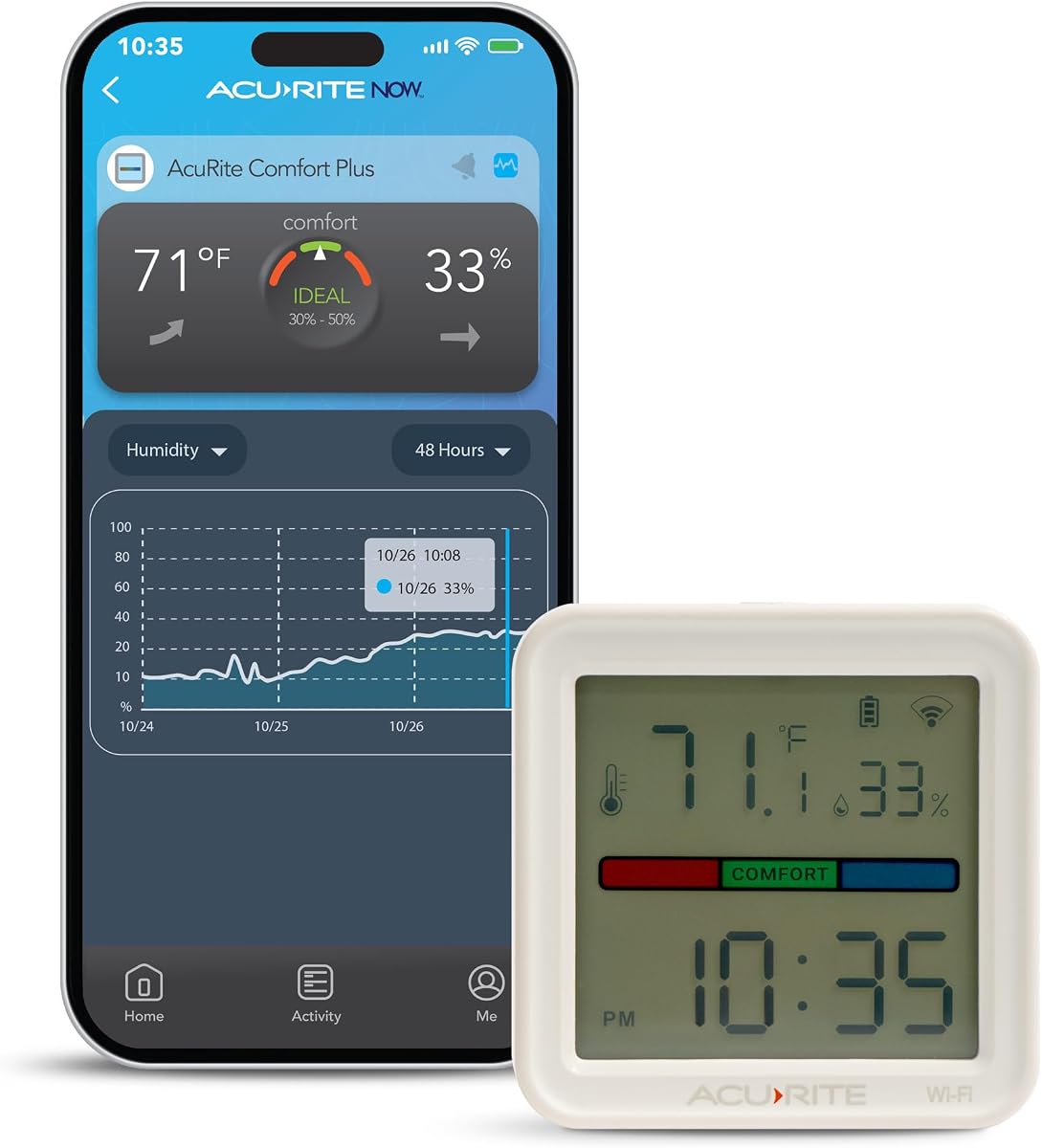
The AcuRite 17017M is a straightforward connected comfort meter with a 4.5 rating. It combines a local digital display with 2.4 GHz Wi-Fi connectivity, allowing a grower to view temperature and humidity, set alerts, and track history through the AcuRite NOW app.
We may earn a commission when you buy through this link, at no additional cost to you.
Its strongest quality is ease of use. The screen presents room measurements alongside a digital clock with A.M. and P.M. indicators, and the clock sets automatically after app connection. A momentary backlight button preserves nighttime readability without requiring the display to remain illuminated, while an integrated keyhole hanger simplifies wall placement.
The remote update interval is five minutes, which is less immediate than the two-second refresh used by several Govee models. It is still suitable for tracking broad climate trends and receiving notifications when a preset range is crossed. The product is powered by three AAA batteries, which are not included, and its compact size makes it easy to position in a cigar humidor, filament container, grow space, or regular living area.
The AcuRite is a good fit for a grower who values a simple display, uncomplicated app monitoring, and useful home-style features without a dense technical interface. It is less appropriate for fast-changing research, frequent remote checks, or multi-room monitoring. It also does not provide dedicated VPD, CO2, light, or dew-point measurements, so it should be treated as a focused indoor climate monitor.
The automatic clock and momentary backlight make the meter useful outside a strict monitoring application. They are particularly convenient when the device is also used as a general indoor comfort display.
After connecting to 2.4 GHz Wi-Fi, the app provides history and configurable alerts. Five-minute updates are best suited to gradual environmental trends rather than second-by-second monitoring.
We may earn a commission when you buy through this link, at no additional cost to you.
The Govee H5179 is a versatile single-room thermometer hygrometer with a 4.3 rating. It supports both Bluetooth and Wi-Fi through the Govee Home app, giving users a local connection option while retaining remote monitoring over a compatible network.
We may earn a commission when you buy through this link, at no additional cost to you.
The sensor is listed at plus or minus 0.54 degrees Fahrenheit and plus or minus 3% relative humidity accuracy, with readings refreshing every two seconds. Custom temperature and humidity ranges can trigger app notifications. The data section offers a 20-day online storage view and export of up to two years of readings, while widget support provides another way to check conditions from a phone.
A notable configuration detail is that alert settings support Bluetooth only. This means the user should configure thresholds in the appropriate connection mode rather than assuming every feature follows the Wi-Fi connection. The device also does not support 5 GHz Wi-Fi. Its lanyard loop makes placement straightforward, but the package includes one monitor rather than a multi-sensor set.
The H5179 is a balanced choice for a single grow tent, propagation shelf, basement, or baby room. It offers more connection flexibility than a Bluetooth-only meter and a faster refresh than the AcuRite model. It is not intended for users who need CO2, light, dedicated VPD, or a large collection of simultaneous room displays.
Bluetooth and Wi-Fi support accommodate both nearby setup and remote access. The requirement for 2.4 GHz Wi-Fi should be confirmed before installation.
A 20-day online graph and two-year export allowance make it possible to compare short-term patterns with a much longer record when troubleshooting environmental changes.
We may earn a commission when you buy through this link, at no additional cost to you.
The Govee H5075 2-Pack offers an effective way to monitor two nearby spaces, earning a 4.5 rating. It includes two room thermometers with large LCD screens, Bluetooth app control, and an accessible 164-foot range, making it a practical option for a tent and adjacent room or for two zones within a greenhouse.
We may earn a commission when you buy through this link, at no additional cost to you.
Both sensors use a Swiss-made sensing component with listed accuracy of plus or minus 0.54 degrees Fahrenheit and plus or minus 3% relative humidity. Readings refresh every two seconds. The displays show real-time temperature and humidity, maximum and minimum records, and three dry, comfort, or wet indicators, providing useful context without opening the app.
Preset temperature and humidity ranges produce notifications when conditions move out of range. The app provides a 20-day online history and curve graph, and users can export up to two years of data in CSV format. The limitation is connectivity: without a gateway, the devices rely on Bluetooth and therefore have a more limited operating distance than Wi-Fi systems.
The H5075 2-Pack is best for growers who want two readable monitors and straightforward alerts without managing a complex hub. It suits nearby grow areas, propagation rooms, basements, nurseries, and wine cellars. It does not provide VPD, CO2, light, or Wi-Fi remote access, but its two included sensors, fast updates, and exportable history make it a well-rounded two-location monitoring solution.
The included pair allows users to compare two nearby locations without purchasing two unrelated devices. Bluetooth range is sufficient for many single-room or adjoining-space arrangements.
Large numbers, high and low records, comfort labels, and a two-second refresh make the screens useful for routine checks while the app supports deeper analysis.
We may earn a commission when you buy through this link, at no additional cost to you.
The GoveeLife 2.0 6-Pack is designed for distributed monitoring, earning a 4.5 rating. It includes six compact wireless sensors and a gateway, allowing a grower to track conditions across numerous rooms, shelves, or grow zones without requiring a large display at every location.
We may earn a commission when you buy through this link, at no additional cost to you.
The gateway can pair with up to ten sensors, so the included set leaves room for expansion. It connects through 2.4 GHz Wi-Fi, while Bluetooth is also listed for app data access. A Swiss-made sensor provides stated accuracy of plus or minus 0.54 degrees Fahrenheit and plus or minus 3% relative humidity, with two-second refresh and an estimated battery life of up to two years.
Custom temperature and humidity thresholds trigger app and email notifications. Online trend charts cover the past 20 days, and data from as much as two years can be exported. The sensors are compact and equipped with lanyards, making them suitable for corners, drawers, cabinets, grow cases, or other locations where a larger display would be inconvenient.
The central trade-off is the absence of local screens. Users must check the app to view current readings, making the gateway and phone central to the experience. Alarm functionality is also limited to specified H5151 and H5042 gateways, so compatibility should be verified. This package is a strong fit for a grower who values broad sensor coverage and long battery life over immediate glanceable displays.
Six compact sensors can be distributed across separate grow zones, while the gateway can pair with up to ten. This is useful when one room-level reading would conceal meaningful differences.
Up to two years of stated battery life, two-second refresh, app and email alarms, and long exportable history support low-maintenance environmental monitoring.
We may earn a commission when you buy through this link, at no additional cost to you.
The right grow room monitor depends on the measurements you need, the size of your setup, and how you prefer to receive information. Connectivity, alert behavior, display style, and placement flexibility should be considered alongside sensor specifications.
Begin by identifying the conditions that directly affect your workflow. Every standard thermometer hygrometer tracks temperature and relative humidity, but only certain products add VPD, CO2, light, or dew point. The Pulse One covers the broadest grow-specific set, while the Temtop monitor specializes in CO2 and provides temperature and humidity as supporting readings.
Choose a sensor that measures what you will actually act upon. Extra data is useful when it guides adjustments, but unnecessary readings can complicate setup without improving control.
Bluetooth is convenient for nearby setup and compact rooms, but its practical range can limit remote access. Wi-Fi through a gateway supports more distant monitoring and multiple sensors, making it better for greenhouses, basements, detached growing areas, or larger properties. Some products support both Bluetooth and Wi-Fi, although individual features may still be limited to one connection type.
Check the network requirements carefully. Several products support 2.4 GHz Wi-Fi but not 5 GHz, and the Temtop's continuous powered operation is preferable when immediate readings are important.
A single sensor is appropriate when the growing space is small and conditions are uniform. Two-pack systems help compare neighboring zones, while three-, six-, or unlimited-sensor arrangements are better for multiple rooms or a property-wide view. Displays at each location improve convenience but consume more space and add another device to maintain.
Match the number of sensors to the number of distinct conditions you need to compare rather than simply choosing the largest available set.
Alerts are most useful when they reach you through a channel you already use. Push notifications and app messages are common, while email, gateway buzzers, and audible alarms provide useful redundancy. A CO2 monitor may also offer alert customization, including the ability to disable sound and display illumination for quieter operation.
Set thresholds around the conditions that matter to your plants. Also check whether remote alerts require a gateway and whether the stated app or email features remain available through the connection mode you plan to use.
Local displays let you check conditions without opening a phone, which is valuable when working near the tent. Large high-contrast screens are easy to check from a distance, while electronic ink displays are quieter and less distracting. Compact sensors without displays take up less space but require the app for every reading.
Consider lighting, viewing distance, and whether the monitor will be checked during dark hours. A backlight, momentary illumination button, color comfort indicator, and high-low records can all improve routine use.
Placement can change the meaning of a measurement. A corded probe allows the sensing element to sit away from the display, while wireless sensors can be moved among rooms. Integrated probes may be best for a specific spot, and lanyards or hanging hardware simplify placement in cabinets, greenhouses, and grow tents.
Install the sensor where it can represent the area you care about without being exposed to direct airflow, condensation, or another heat source that could distort its readings.
Instant readings are only part of effective monitoring. Historical graphs reveal daily patterns, recurring humidity swings, and the effect of equipment or ventilation changes. Products range from 13 or 20 days of online graphs to storage and export covering two years, while the Pulse One emphasizes offline storage and day and night averages.
Choose a retention period that matches your troubleshooting habits. Exportable data is especially useful for comparing changes over time or recording the effect of a new environmental routine.
Compare stated accuracy, measurement range, and refresh speed rather than focusing on a single specification. The GoveeLife 5-in-1 has a listed accuracy of plus or minus 0.36 degrees Fahrenheit and plus or minus 2% relative humidity, while several other products use plus or minus 0.54 degrees Fahrenheit and plus or minus 3% relative humidity. Battery life ranges from several months to several years depending on the model and connection method.
The most precise device is not automatically the most useful one. Consider whether its range, refresh rate, and power requirements match the conditions in the room where it will operate.
Start by deciding what the monitor should measure, where it will be placed, and which readings will trigger action. Set temperature, humidity, VPD, or CO2 thresholds that reflect your growing goals, then place the sensing element away from direct sun, heaters, vents, humidifiers, and cold surfaces that could distort the reading.
Connect the sensor using the required Bluetooth or 2.4 GHz Wi-Fi route, complete app pairing, and confirm that remote readings, alerts, history, and any gateway features work as expected. A local display should be checked against the app during setup, and notification tests should be completed before relying on them for unattended monitoring.
Review trends regularly rather than reacting only to a single value. Compare daytime and nighttime patterns, note the effect of ventilation or irrigation, and export data when a recurring issue appears. Replace batteries as recommended, keep sensors free of dust and condensation, and confirm the app and gateway remain connected before making major changes to the grow environment.
A dedicated VPD display is useful when you actively manage vapor pressure deficit or want the calculation visible without deriving it from temperature and humidity. The Pulse One and AC Infinity B1 include VPD, while the VIVOSUN sensor also provides visualized VPD data. If you only need general temperature and humidity awareness, a simpler hygrometer may be sufficient.
Bluetooth works well for a single room and straightforward nearby setup because it does not require a separate hub. Wi-Fi and a gateway are more suitable for remote access, long-distance placement, and multiple sensors distributed across different areas. Check whether the product supports only 2.4 GHz Wi-Fi, as several options in this guide do.
Place it in the area whose conditions you want to understand, ideally near plant height but away from direct sunlight, heaters, cooling equipment, vents, and wet surfaces. Placement near a door can reflect the rest of the room less accurately than a representative central or canopy-level location. Keep the sensor consistent once it is installed so readings remain comparable over time.
Only a system with multiple sensors or support for multiple paired sensors can monitor different rooms. The GoveeLife 2.0 includes six compact sensors and supports up to ten through its gateway, while the GoveeLife 5-in-1 includes three display-equipped sensors. A gateway expands communication reach, but each sensor still needs to be placed in its intended area.
A CO2 monitor is helpful if ventilation patterns, sealed rooms, or daytime carbon dioxide changes are central to your environmental strategy. The Temtop is the dedicated CO2 option in this guide and also measures temperature and humidity. It is not a carbon monoxide detector and should not be used as one.
A quick local reading each day is useful, while historical charts help explain broader patterns over several days or weeks. App alerts can identify conditions that need attention between routine checks. If an alert appears, confirm the live reading, check sensor placement, and assess the room before changing equipment.
A faster refresh rate makes short-term changes easier to see, but it is not automatically necessary for every grow. Two-second updates are useful in fast-changing or closely observed rooms, while five-minute updates may be sufficient for slower environmental trends. The more important consideration is whether the update interval matches the changes you need to detect.
Historical data makes it easier to identify recurring humidity swings, temperature peaks, daily patterns, and the effects of ventilation or lighting changes. Devices with long graph views and CSV export allow comparisons across considerably more than a single day. Retaining records is especially useful while refining a climate routine or troubleshooting a recurring issue.
Pulse One is the strongest choice for comprehensive grow-specific tracking because it combines VPD, temperature, humidity, light, and dew point with offline storage, multi-location support, and outage notifications. GoveeLife 5-in-1 3-Pack stands out for connected multi-room visibility, long gateway range, readable displays, and several alert methods, while the Govee H5075 2-Pack delivers the most straightforward two-sensor setup.
Prioritize the measurements and notifications that will shape your decisions. Choose a dedicated CO2 device for air-quality analysis, a wired probe for a specific remote location, or a multi-sensor gateway system for several zones. In every case, check connection requirements, local display needs, history options, and the amount of equipment the package actually includes.
Prices and product configurations can change, so review the current listing before buying. Confirm the supported connections, measurement range, alert restrictions, included accessories, and power requirements to ensure the monitor fits your room and the way you plan to use it.