
10MHz Band-Pass Filter
4.8Editor score
Low 1.3dB insertion loss
Wide 7–11MHz bandwidth
SMA female connector
Our Ham Radio Bandpass Filters guide compares filtering, power handling, band coverage, connector types, portability, and interference rejection for models.
Ham radio bandpass filters help separate wanted signals from unwanted energy, reducing interference while protecting sensitive receivers and improving the clarity of communications. A useful filter must match the target band, transmitter output, operating mode, and connector arrangement, so the best choice depends on whether you need portable, high-power, or multiband filtering.
We compared the listed filters by examining their stated frequency coverage, power handling, filter functions, connector types, construction, size, portability, and intended applications. The roundup includes dedicated filters for common HF and VHF bands, a multiband filter bank, and several compact options for portable stations, allowing readers to match equipment with specific operating needs.
Each review highlights the strongest documented feature and also identifies practical limitations, such as narrow band coverage, low maximum input levels, or the need for suitable station interfaces. Ratings reflect the supplied customer feedback where available, while unrated products are presented without a numeric customer score. Product availability and pricing can change, so confirm current details before purchasing.
4.8Editor score

5.0Editor score

5.0Editor score
The comparison below organizes all ten filters by their documented band, power rating, interface, and primary use, making it easier to identify the right model for a home station, portable setup, or specialized receiver.

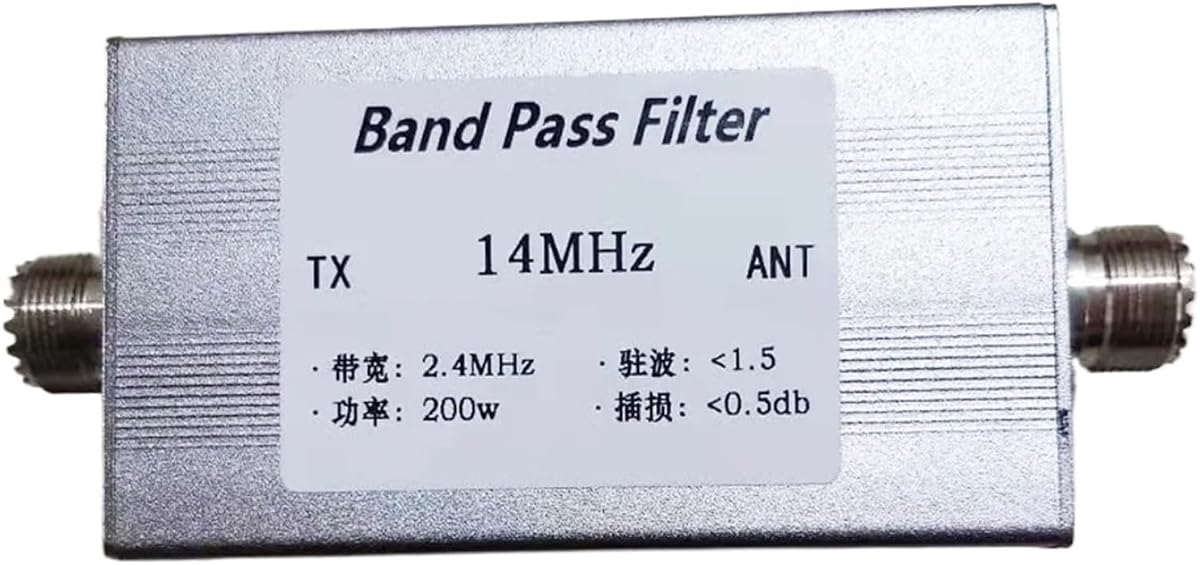


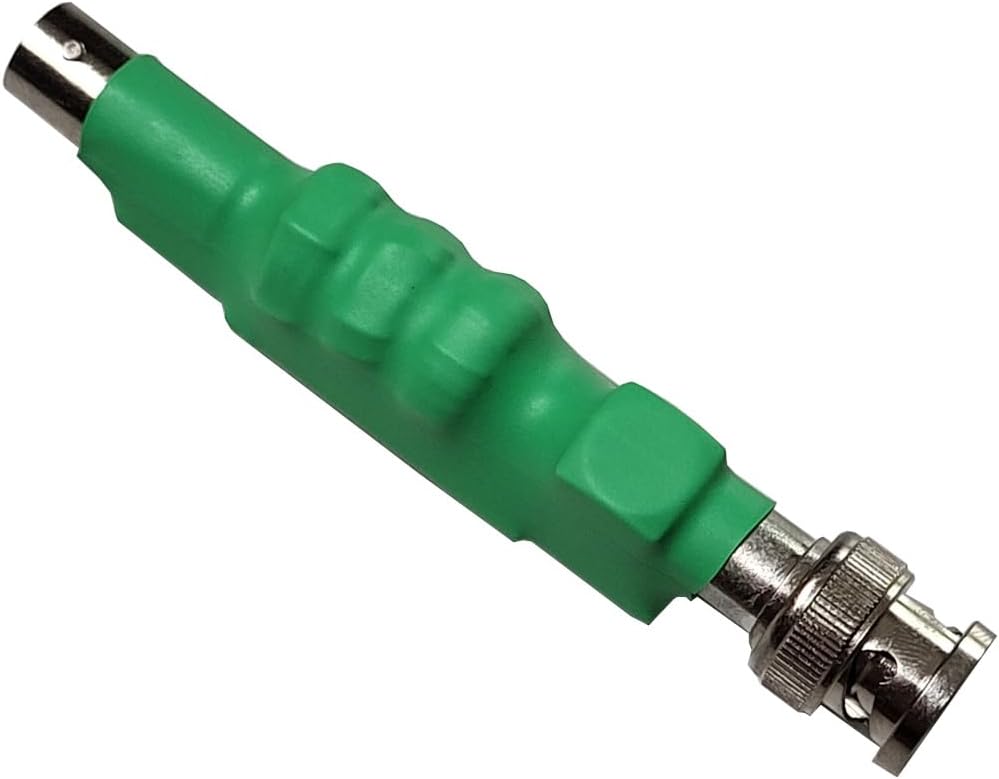
The 200W Shortwave Band Pass Filter is a focused 14MHz solution for stations that need to suppress unwanted energy without moving beyond the amateur radio 20-meter band. It has a supplied customer rating of 5.0 and stands out for its high power rating, LC filter circuit, and stated emphasis on high isolation. Its narrow-band focus makes it more practical as a dedicated station accessory than as a universal filter for every HF frequency.
We may earn a commission when you buy through this link, at no additional cost to you.
The most important strength is the claimed ability to handle up to 200W, making the filter suitable for demanding applications and contest-style operation. Its LC design is intended to improve signal reception and transmission quality by passing the desired 14MHz region while reducing unwanted signals. The M-type female connector also gives operators a defined interface for integrating the filter with compatible radio equipment and antenna feed-line hardware.
There are clear limits to consider. Because this model is centered on 14MHz, it will not replace filters for 40, 30, 20, 17, 15, 12, or 10 meters. The M-type female interface may not directly match the connector on every transceiver, amplifier, or antenna relay, so appropriate cables or adapters may be necessary. As with any high-power filter, operators should still confirm their actual station output and stay within the published handling limit.
This is our leading recommendation for operators who specifically want a high-power 14MHz filter and already have compatible connections. It combines a strong customer rating with the power capability and targeted interference control sought by many home stations. Portable operators with low-power equipment may gain less from its emphasized 200W capability, while multiband users should favor a more flexible filter bank.
The stated 200W ceiling makes this filter relevant to stations using SSB, CW, AM, FM, or FSK within the product's intended limits. That capacity gives it more relevance to contest and fixed-station work than a low-power accessory designed only for receiving.
A dedicated 14MHz passband can help reject signals outside the wanted region. The design also places isolation and focused filtering at the center of its stated performance goals, making it a logical choice when local interference is a recurring concern.
We may earn a commission when you buy through this link, at no additional cost to you.
The Nooelec Ham Filter Bank Barebones is the broadest VHF and UHF option in this roundup, combining five separate bandpass filters with a passthrough path. Its supplied rating is 4.1, and its most notable distinction is coverage across the 2m, 1.25m, 70cm, 33cm, and 23cm amateur radio bands. That makes it appealing to operators who work across more than one upper-frequency band.
We may earn a commission when you buy through this link, at no additional cost to you.
Each channel corresponds to a documented range: 144–148MHz for 2 meters, 220–225MHz for 1.25 meters, 420–450MHz for 70 centimeters, 902–928MHz for 33 centimeters, and 1240–1300MHz for 23 centimeters. The module is described as suitable for selective signal processing and transceiver protection. Its pushbutton-controlled 4.5V bias tee can also simplify integration with equipment that expects bias power at the SMA input.
The main drawback is scope: none of the listed filters covers the traditional HF bands. Operators working 20 or 40 meters will need a separate solution. It is also a barebones module rather than a fully enclosed consumer accessory, so its implementation and mechanical protection depend on the station arrangement. Users should verify connector orientation, switching expectations, and whether the antenna system can support each selected filter path.
Choose the Nooelec filter bank when one compact module can replace several separate upper-band filter purchases. It is especially relevant to experimenters, repeater builders, and operators moving among common VHF and UHF amateur frequencies. It is less appropriate for an HF-only station or for someone seeking a simple, protected, ready-to-install enclosure.
The separate filters let an operator select among five widely used amateur allocations rather than committing to one narrow passband. This is valuable for multiband stations that want more targeted filtering than a single fixed-frequency accessory can offer.
The pushbutton bias tee applies 4.5V to the input SMA when enabled. That feature can reduce installation friction when connecting compatible bias-powered devices, although users should confirm the electrical behavior of their own equipment first.
We may earn a commission when you buy through this link, at no additional cost to you.
The Multi-Band High Isolation Filter is designed for operators who want a single filter family to cover several HF choices rather than commit to one band. Its title identifies 7, 14, 18, 21, 24, 27.5, and 28MHz options, with the listed configuration corresponding to 14MHz. No customer rating was supplied, so its evaluation here rests on the stated specifications and intended applications.
We may earn a commission when you buy through this link, at no additional cost to you.
Its major strength is the combination of frequency choice and a claimed 200W capacity across SSB, CW, AM, FM, and FSK. The high-isolation bandpass design is intended to separate signals, minimize interference, and enhance sensitivity. At 140 by 53 by 38mm and between 245 and 255 grams, it also presents a reasonably manageable size for a fixed station or a carefully planned portable setup.
Its interface requires more attention. The stated SL16-F, or stand M, connection is not universal across every radio and antenna system, so operators may need a suitable transition cable. The title's inclusion of several frequency options also leaves some ambiguity about whether the purchased unit is configured for one selected band; buyers should confirm the actual configuration before checkout. The absence of customer feedback also makes independent station testing more important.
This filter is a strong candidate for high-power HF operators who need several common band options and can accommodate the SL16-F interface. It is less suitable for buyers seeking a simple universal connector or abundant published reviews. Confirm the selected frequency, connector requirements, and applicable power limits before integrating it into a permanent station.
The seven listed center-frequency options span several popular HF allocations, from 7 through 28MHz. This gives a buyer more planning flexibility than a single-band filter and may reduce the need to maintain several separate units.
The 140×53×38mm housing is compact enough to fit into many equipment arrangements while remaining easier to handle than a large external filter bank. Its stated weight of 245–255 grams also makes it less burdensome than a heavy, permanently mounted assembly.
We may earn a commission when you buy through this link, at no additional cost to you.
The 40m Band Pass Filter is a dedicated solution for the 7MHz amateur radio band. It carries a supplied rating of 5.0 and emphasizes two highly practical goals: improving receiver sensitivity and reducing interference. Its stated 200W handling capability also makes it relevant to transmitting stations, not merely a receiver-side accessory.
We may earn a commission when you buy through this link, at no additional cost to you.
The filter is specified for 40 meters with a 7MHz center frequency and a listed maximum of 200W for SSB, CW, AM, FM, and FSK. Its anodized aluminum casing suggests a durable enclosure for fixed-station use, while the Type-N female connector offers a defined high-frequency interface. The stated anti-interference function focuses on reducing out-of-band noise that can degrade sensitivity during weak-signal listening.
The trade-off is specificity. This model does not provide the broader band options of a multiband filter bank or the portable dimensions of the K9DP designs. A Type-N female connector may require adapters depending on the rest of the station, and operators should account for those connections in a permanent installation. Its published power figure should not be interpreted as a guarantee for every mode or duty cycle without confirming the product's detailed operating conditions.
For an operator focused on 40 meters, this is a persuasive choice because it combines high power handling, a stated interference-reduction purpose, and a strong customer rating. It is best suited to home stations, contest setups, and dedicated 40-meter receive installations where a narrow passband is an advantage rather than a limitation.
A 7MHz-centered passband limits the frequencies that can pass through the filter and helps reduce out-of-band noise. That focus is particularly useful when strong local signals or transmitter harmonics threaten the 40-meter band's quieter listening environment.
The anodized aluminum case is well suited to a permanent station environment. It provides a more substantial feel than a lightweight receive-only accessory while keeping the filter focused on one manageable package.
We may earn a commission when you buy through this link, at no additional cost to you.
The BPF-3.8 200W Filter is a highly specialized bandpass model centered on 3.8MHz for shortwave communication. No customer rating was provided, and the available description contains fewer technical details than many competing products. Nevertheless, its stated 3.8MHz target and 200W rating clearly identify the kind of station for which it is intended.
We may earn a commission when you buy through this link, at no additional cost to you.
Its core appeal is focused selectivity. A filter built around 3.8MHz can help a shortwave operator emphasize that part of the radio spectrum and reduce the effect of unwanted energy outside the intended region. The 200W designation suggests that it can accommodate a substantial signal level, which is useful for fixed shortwave installations or contest-style activity when other components are also compatible.
The limited documentation is the important caveat. Buyers should confirm passband width, insertion loss, connector type, exact power conditions, and grounding requirements before installation. A narrow target frequency also means this is not a general-purpose HF filter, and the 3.8MHz center may not align with a particular local band plan. With no supplied customer score, it should be evaluated as a specialty component rather than an obvious first choice for everyone.
This model makes most sense for an operator with a defined need to filter a 3.8MHz shortwave signal and the technical confidence to verify its electrical details. It may suit a dedicated experimental or point-to-point setup, but a broader multi-band filter will be easier to justify for general station use. Confirm compatibility before ordering.
Rather than trying to cover many bands, the filter concentrates on 3.8MHz. That specificity can be useful in a controlled shortwave installation where the operator knows exactly which part of the spectrum needs protection.
The 200W designation positions the filter for more demanding installations than a low-power receiver accessory. Operators should still verify the exact test conditions and ensure that cables, connectors, and surrounding station equipment meet or exceed the same standards.
We may earn a commission when you buy through this link, at no additional cost to you.
The JMT Multi-Frequency Filter is aimed at low-power signal processing, particularly RFID receiver work, rather than conventional high-power amateur radio station use. It has a supplied customer rating of 4.0 and offers configurations associated with 868MHz, 915MHz, 433MHz, and 1200MHz. These frequency options make it a useful addition to a bench full of receivers, sensors, and compact radio experiments.
We may earn a commission when you buy through this link, at no additional cost to you.
The 915MHz configuration covers 902–928MHz, and the 868MHz version covers 867–869MHz. The 433MHz option is described as a mini VTX bandpass filter, while the 1200MHz configuration is actually a low-pass filter providing a 5–1200MHz pass-through range. The product uses imported SMD components and a shielded design, with passband ripple and out-of-band suppression as the stated performance priorities.
Power limits are the most important consideration. The 915MHz and 433MHz versions are limited to 1W, and the 1200MHz low-pass option also has a 1W maximum load. The 868MHz configuration lists a maximum withstand power of no more than 20W. These figures make direct transmitter use inappropriate for most versions, so the filter should be treated as a receiver-side or low-level accessory.
The JMT filter is a good match for a compact experimental station or an RFID-focused receiving setup. It is also worth considering by amateur operators exploring 902–928MHz or nearby equipment, provided the signal level remains well within the stated limit. It is not a substitute for a high-power VHF/UHF duplexer or an HF bandpass filter.
The 915MHz option's 902–928MHz passband directly matches the documented range of many RFID receivers. That focus can be more useful than a generic broad low-pass filter when the goal is to preserve a specific industrial or experimental frequency while attenuating unwanted energy.
The shielded construction and SMD components are intended to support stable operation in compact assemblies. Because the power limits are modest, reliable performance depends on keeping the connected source within the documented 1W range for the relevant configuration.
We may earn a commission when you buy through this link, at no additional cost to you.
The 10MHz Band-Pass Filter is a straightforward option for stations that want low insertion loss around the amateur 30-meter region. It has a supplied customer rating of 4.8, a stated bandwidth of 7–11MHz, and an insertion-loss figure described as better than 1.3dB. Those specifications make it appealing to operators seeking a focused filter without a large feature list.
We may earn a commission when you buy through this link, at no additional cost to you.
The low-loss design is the primary advantage. A filter that passes the desired signal with minimal loss can help preserve the available signal level while limiting unwanted energy outside the 7–11MHz range. The SMA female interface is familiar to many compact radio setups, and the single-filter package keeps the installation concept straightforward. It could be useful in a receive chain, a small transmitting arrangement, or an experimental antenna system where the operator has verified the power and impedance requirements.
The product data does not state a maximum power rating, so it should not automatically be treated as a high-power station filter. It also does not mention a bias tee, making it less convenient for certain active antenna or powered-device arrangements. The fixed connector and narrow band limit flexibility, while the absence of detailed isolation and passband-ripple figures means technical buyers may want additional measurements before committing.
This is our budget recommendation for an operator seeking a simple 10MHz filter with a favorable customer rating and low claimed loss. It is particularly attractive for receive-oriented or low-power setups where preserving signal quality is more important than supporting 200W. Confirm the connector, impedance, and safe input level before integrating it.
The stated insertion loss of better than 1.3dB is the product's most useful performance claim. Low loss is valuable when the desired signal is weak, because the filter should minimize additional attenuation while still rejecting energy outside the 7–11MHz range.
A 7–11MHz bandwidth covers the commonly used 30-meter allocation around 10MHz. This focused range is simpler to integrate than a full multiband assembly and well suited to stations that only need one additional HF filter.
We may earn a commission when you buy through this link, at no additional cost to you.
The K9DP 100W BCI Filter addresses a specific and common amateur radio problem: front-end overload caused by nearby AM broadcast stations. It has a supplied rating of 5.0 and is designed for HF radios and receivers. Rather than serving as a conventional bandpass filter for one amateur allocation, its purpose is to reduce the effects of strong out-of-band AM energy entering a receiver's front end.
We may earn a commission when you buy through this link, at no additional cost to you.
The product is documented as tested up to 100 watts with SSB, CW, and digital FT8, giving it more relevance to transmitting stations than many lightweight receiver filters. It uses high-quality C0G, also identified as NP0, capacitors and Micrometals toroids. SO-239 UHF connectors on both ends support familiar amateur radio station connections, while the 102mm length and 78-gram weight make the unit practical for portable use.
Its most important limitation is that it is a broad shortwave filter rather than a precisely documented 14MHz or 7MHz passband. Buyers seeking a narrow filter with a specified center frequency, bandwidth, and sharp out-of-band attenuation should choose a dedicated bandpass product instead. The presence of a bias tee is also not documented, so operators should account for any antenna or device power requirements separately.
The K9DP 100W BCI Filter is an excellent choice for portable or home stations troubled by AM broadcast overload, particularly operators using SSB, CW, or FT8. Its compact size, 100W testing, quality components, and strong customer rating support a practical portable recommendation. It works best as a problem-solving filter rather than as a substitute for a band-specific contest filter.
Strong local AM broadcast stations can force a receiver's front end into a nonlinear region, causing weak amateur signals to disappear or become difficult to hear. This filter is specifically designed to help reduce that source of overload before it compromises reception.
At only 102mm long and 78 grams, the filter is designed for POTA, SOTA, and Field Day rather than a permanent shelf. The SO-239 connectors and stated 100W testing also preserve a useful balance between portability and practical station capability.
We may earn a commission when you buy through this link, at no additional cost to you.
The K9DP QRP 20 Meter Portable Bandpass Filter is built for low-power operators who need a small 20-meter filter for portable stations. It has a supplied rating of 4.8 and a maximum stated power handling of 20 watts. At 85mm long and just 35 grams, it is the lightest and most compact dedicated amateur band filter in this group.
We may earn a commission when you buy through this link, at no additional cost to you.
Its purpose is to reject interference from nearby stations operating on different bands. That makes it useful for operators sharing a restricted operating environment, working portable locations, or trying to improve the behavior of a receive chain. The filter is documented as tested up to 20 watts with SSB, CW, and digital FT8, giving it credible relevance for QRP and lightweight portable rigs.
The 20W ceiling is the defining constraint. It should not be used with a conventional high-power amplifier or a transmitter whose output exceeds that limit, regardless of the filter's receive-side usefulness. The male/female BNC arrangement is also less universal than SO-239, and a station may need suitable cable or adapter arrangements. As with other K9DP products, the use of C0G capacitors and Micrometals toroids supports a stable, repeatable filter design.
Choose this filter for a small SSB, CW, or FT8 station that operates on 20 meters with up to 20 watts. Its low weight, compact size, targeted interference rejection, and strong customer rating make it an excellent portable companion. It is not the right choice for a high-power home station, but it can be exactly the right size for a backpack radio.
The 85mm length and 35-gram weight are particularly useful for POTA, SOTA, and Field Day. The filter adds focused 20-meter selectivity without asking a portable operator to carry a larger fixed-station accessory.
The stated 20W maximum makes the filter suitable for low-power SSB, CW, and FT8 operation. This clearly defined ceiling helps operators select the right filter for their transmitter instead of assuming every bandpass model can handle high-power signals.
We may earn a commission when you buy through this link, at no additional cost to you.
The 7MHz Band Pass Filter is a high-power alternative for operators focused on the 40-meter amateur radio band. No customer rating was supplied, so the product's stated attributes provide the primary basis for evaluation. It advertises 200W handling, a 7MHz center frequency, improved sensitivity, and interference reduction in a compact anodized aluminum enclosure.
We may earn a commission when you buy through this link, at no additional cost to you.
The filter is listed for SSB, CW, AM, FM, and FSK, making its stated power capacity relevant to a broad range of operating modes. A dedicated 7MHz passband can reduce out-of-band noise and help preserve receiver sensitivity during weak-signal listening. The Type-N female connector provides a defined station interface, although it may require suitable adapters depending on the connected equipment.
Its single-band focus is both its strength and its limitation. An operator running several HF bands may prefer a multi-frequency model, while a station that primarily operates 40 meters can gain a cleaner and simpler signal path. The lack of customer feedback means buyers should examine the unit carefully on receipt and confirm its specifications before relying on it in a critical contest or emergency-communications setup.
This filter is best suited to a dedicated 40-meter station with up to 200W of output and a Type-N-compatible arrangement. It offers a compelling combination of focused filtering, stated high power handling, and practical construction. Stations that require broader HF coverage or more established user feedback should consider one of the dedicated multi-band options instead.
The filter's 7MHz focus is designed to let the desired band pass while reducing out-of-band noise. In a noisy environment, that narrow targeting can improve the listening experience without requiring a larger multiband system.
The anodized aluminum housing is appropriate for a fixed installation where the filter will be handled infrequently. Combined with the stated 200W capacity, it presents a straightforward high-power option for 40-meter operators.
We may earn a commission when you buy through this link, at no additional cost to you.
The right bandpass filter depends on your bands, power level, connector layout, operating modes, and tolerance for added complexity. Reviewing these factors before buying helps avoid a filter that is technically impressive but poorly matched to the station.
Begin with the frequencies the filter is intended to pass. Dedicated models such as the 3.8MHz, 7MHz, 10MHz, 14MHz, and 20-meter options each serve a particular part of the radio spectrum, while the Nooelec filter bank covers 2m through 23cm and the multi-band HF model lists seven frequency choices. A single-band filter can be simpler and more focused, whereas a multiband product offers flexibility. Match the published range to your operating plan rather than selecting on bandpass as a generic term.
Power handling is one of the most consequential choices. Filters listed for 200W suit fixed stations with substantial transmitters, the K9DP BCI model is tested to 100W, the K9DP QRP model is limited to 20W, and several of the JMT configurations support only 1W. Match the filter to the maximum output of your radio, amplifier, and digital mode, including the modes you plan to use. Never assume a receive filter can safely accept full transmitter output.
The products in this guide use several interfaces, including M-type female, SMA, Type-N female, SO-239, and BNC. A filter is only useful if it can connect cleanly to the rest of the station without introducing loss, poor grounding, or an improvised interface. Check connector gender as well as type, and confirm whether your radio, amplifier, antenna relay, and feed line use the same standard. Appropriate coaxial adapters can solve a mismatch, but a direct, correctly rated connection is preferable.
Different interference problems call for different responses. A conventional bandpass filter targets signals outside a desired amateur band, while the K9DP BCI filter is specifically intended to combat front-end overload from AM broadcast stations. The JMT products serve specialized RFID and low-level receiver applications. Consider whether the unwanted energy is simply out of band, is strong enough to overload a receiver, or originates in another entirely different service. The correct filter should address the actual source of noise.
Insertion loss indicates how much signal the filter itself adds to the received path. The 10MHz filter states a loss better than 1.3dB, while many of the other products do not publish a comparable figure. Lower loss is generally attractive for weak-signal work because the filter does not further reduce an already delicate signal. For transmitting filters, loss affects the power presented to the antenna and therefore may also be considered alongside power handling and impedance.
Fixed-station and portable requirements lead to very different choices. The K9DP QRP filter weighs 35 grams and measures 85mm, the K9DP BCI filter weighs 78 grams and is 102mm long, while the multi-band high-isolation filter measures 140×53×38mm and weighs roughly 245–255 grams. Consider cabinet space, mounting needs, cable strain, weather exposure, and the amount of equipment you will carry. A barebones module may also require additional enclosure and mechanical protection.
The roundup includes conventional LC and bandpass designs, a five-filter module with a passthrough path, and a lower-frequency JMT option that includes a low-pass configuration. More selectable paths can be convenient, but they also require correct switching and integration. Confirm the filter architecture, number of channels, bias tee behavior, and intended receive or transmit role. A feature is useful only when it matches the way your station is actually assembled.
Construction details can indicate how a filter is intended to be used. The 40-meter models use anodized aluminum cases, the K9DP products cite C0G capacitors and Micrometals toroids, and the JMT model uses a shielded design with SMD components. Customer ratings also provide useful context, but several products in this roundup have no supplied score. When evidence is limited, request detailed electrical specifications and inspect the product carefully before depending on it for a critical station function.
Before connecting the filter, confirm that its target frequency, power limit, connector type, and operating mode are appropriate for your station. Arrange the system so the filter sits between the intended signal path and the protected receiver or transmitter section, following the manufacturer's connection guidance. Use suitable coaxial cable, verify that connectors are fully tightened, and avoid adding improvised adapters unless they are mechanically secure and electrically rated for the application.
Test at a low output level first. Listen for the intended signal, compare receiver noise and sensitivity with and without the filter, and watch for reflected power at the transmitter. If your station includes an antenna switch, relay, or power amplifier, confirm that the filter's rated path is used consistently and that a connected device does not apply voltage that the filter cannot accept. A bias tee should only be enabled when the connected equipment requires it and the filter's bias provision has been verified.
Keep the enclosure dry, clean, and mechanically secure, and inspect the connectors periodically for corrosion, looseness, or damaged insulation. Do not exceed the published power or voltage limits, even if the station seems to operate normally. For portable use, protect the filter from impact and repeated flexing of the cable connections. If behavior changes, disconnect it and check the installation rather than continuing operation with an uncertain signal path.
A bandpass filter passes signals within a selected frequency range and attenuates unwanted energy outside that range. It can reduce interference, protect a receiver front end, and improve the signal presented to the radio. A single-band filter targets one amateur allocation, while a multiband filter or filter bank offers several selectable paths.
Only if the filter is specifically designed as a multiband unit and the selected path matches the frequency you are operating. Dedicated filters such as the 7MHz, 10MHz, 14MHz, and 20-meter models are intended for narrower applications. Even a multiband filter has passband and power limits, so verify both frequency and transmission requirements.
Power handling varies considerably across the products reviewed here. Several 40-meter and HF filters are listed for 200W, the K9DP BCI filter was tested to 100W, the K9DP QRP filter supports up to 20W, and some JMT configurations are limited to 1W. Use the lowest relevant limit in the connected signal path and confirm the mode-specific conditions before transmitting.
It can make weak signals easier to receive by rejecting strong out-of-band energy that causes overload or raises the receiver's noise floor. It does not increase transmitter power or create additional signal gain. The benefit is most apparent when a strong nearby signal is degrading reception on the desired band.
A bandpass filter passes a selected range of frequencies while attenuating frequencies both above and below that range. A low-pass filter allows frequencies below its cutoff to pass while attenuating higher frequencies. The JMT 1200MHz option is described as a low-pass configuration with a 5–1200MHz pass-through range, while the other products are presented as bandpass filters.
The K9DP QRP 20 Meter filter is the smallest dedicated amateur band option reviewed, weighing 35 grams and measuring 85mm long, but it is limited to 20 watts. The K9DP BCI filter is also portable at 78 grams and 102mm long, with stated testing up to 100 watts. Choose according to power, target band, and the type of interference you need to control.
Possibly. These filters use M-type female, SMA, Type-N female, SO-239, and BNC connectors, so a station may require a cable or adapter between the filter and other equipment. Choose an adapter or cable with the correct connector gender, impedance, frequency rating, and power capacity. Properly seated, rated connectors are important for both signal quality and safety.
Begin with a receive-only or low-power test, compare the desired signal and noise floor with and without the filter, and check for reflected power at the transmitter. Gradually increase output only after confirming that the operating mode, frequency, power level, and any bias requirements are all within the filter's documented specifications.
The leading choice for a high-power, focused 20-meter setup is the 200W Shortwave Band Pass Filter, while the 10MHz Band-Pass Filter stands out as the budget-minded low-loss option. For a broader upper-band station, the Nooelec Ham Filter Bank covers five amateur bands, and the multi-band high-isolation model offers the most flexible listed HF frequency choices. The dedicated 7MHz and 40m filters, meanwhile, suit operators who want a straightforward high-power solution for 40 meters.
Prioritize the filter that matches your actual operating conditions. Confirm the target band, maximum input power, connector interface, bias requirements, and the specific source of interference before deciding. Portable users should balance filtering capability against weight and size, while fixed-station operators may place more emphasis on power capacity, isolation, and enclosure. A low-power receive filter should never be treated as a transmitter-rated accessory without supporting specifications.
Product details, customer ratings, availability, and pricing can change, so check the current listing before ordering. Review the published specifications against your radio, amplifier, antenna system, and operating mode, and allow time to test the filter in a safe, low-power configuration. With those checks in place, the right ham radio bandpass filter can materially improve interference control, receiver behavior, and confidence in the station.