
StarTech 6ft High Speed HDMI Cable
4.8Editor score
Certified 18Gbps HDMI 2.0
4K resolution at 60Hz
Gold-plated connector construction
Braid shielding for signal protection
Our HDMI 2 0 Cable 4K guide compares ten cables for 4K resolution, bandwidth, gaming features, build quality, compatibility, and setup needs with modern setups.
An HDMI 2 0 cable designed for 4K video must do more than fit a television or monitor. It needs dependable signal integrity, adequate bandwidth, suitable physical construction, and compatibility with the devices in your entertainment or gaming setup. The right length and supported features matter just as much as the specification printed on the package.
This guide compares ten HDMI cables against resolution support, bandwidth, refresh-rate capabilities, gaming functions, audio features, shielding, connector durability, length, and device compatibility. It includes focused HDMI 2.0 options alongside newer HDMI 2.1 and HDMI 2.2 models, giving home theater buyers, PC gamers, and everyday users several practical ways to build a dependable connection.
Each recommendation reveals what its cable is best suited to, from standard 4K at 60Hz viewing to high-refresh gaming, long-distance placement, and future-oriented bandwidth. Ratings and technical specifications reflect the supplied product information, while product prices and availability can change, so confirm the current listing and connector requirements before purchasing.
4.8Editor score
4.8Editor score

4.7Editor score
The following comparison organizes each cable by its headline bandwidth, 4K capability, physical length, and most useful special features. It makes it easier to separate conventional 18Gbps HDMI 2.0 cables from newer 48Gbps and 96Gbps models designed for demanding gaming, 8K displays, and expanded feature support.



The Highwings 8K 10K 4K HDMI Cable is a certified Ultra High Speed HDMI 2.1 cable rated for 48Gbps. Its 4.7 rating and support for 4K at 120Hz, 4K at 240Hz, and 8K at 60Hz make it a strong option for a modern gaming display. The six-foot-plus length also offers more placement flexibility than many short desktop-oriented cables.
We may earn a commission when you buy through this link, at no additional cost to you.
Its headline advantage is bandwidth headroom. A 48Gbps cable can carry much more data than a conventional 18Gbps HDMI 2.0 connection, which is valuable when a television, graphics card, or game console supports high-refresh 4K. The manufacturer also lists variable refresh rate support, allowing compatible gaming hardware to synchronize frame delivery more effectively and reduce visual tearing.
This model is not a strict HDMI 2.0 cable, and that distinction matters for shoppers searching by that exact specification. HDMI 2.0 cables are fully suitable for ordinary 4K at 60Hz use, while this newer cable provides additional headroom for 4K at 120Hz or higher. A buyer with only an HDMI 2.0 television may gain little practical benefit from the extra bandwidth.
The cable is best for gamers using a PS5, Xbox Series-class hardware, or a capable PC and a compatible high-refresh television or monitor. It is also a sensible choice for someone who wants one connection to handle several generations of display equipment. Those who only need stable 4K60 in a basic living room setup can still consider it, but they should do so for the broader compatibility rather than the 2.1 specification itself.
The cable's support for 4K at 120Hz and 4K at 240Hz is its most important feature for PC and console gaming. Actual resolution and refresh rate remain limited by the television, monitor, graphics hardware, and game being displayed, so every device in the chain should support the target mode.
An upgraded anti-bending design at the connector tail addresses the area that usually experiences the most stress. The product information also describes military-grade tensile nylon construction, which is intended to improve resistance to repeated flexing and normal wear.
We may earn a commission when you buy through this link, at no additional cost to you.
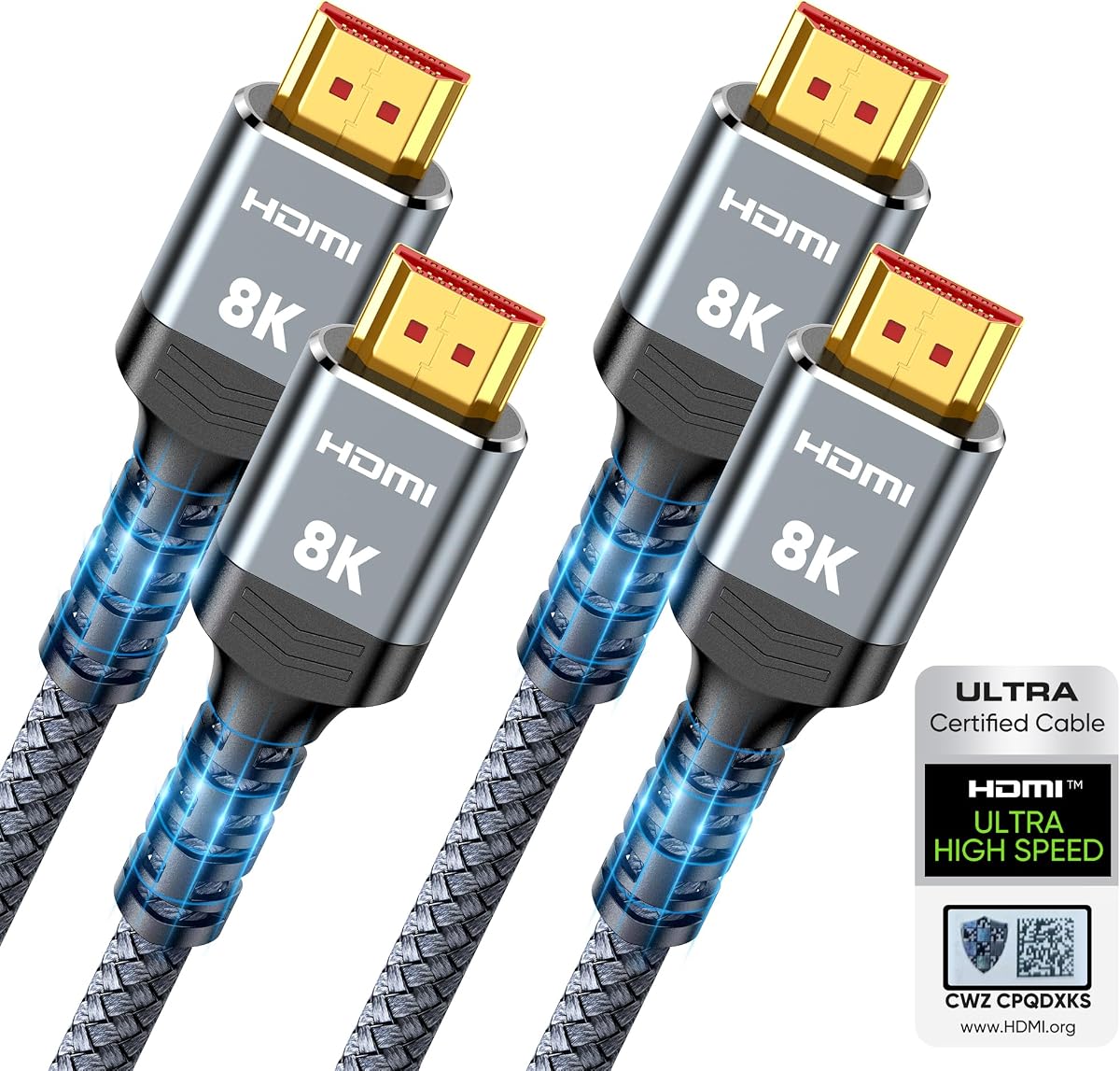
The Highwings 8K HDMI 2.1 Cable 2-Pack provides two 6.6-foot cables with 48Gbps bandwidth and a 4.7 rating. It is intended for users who want high-end 4K gaming performance in more than one location, such as a gaming television in the living room and a high-refresh monitor on a desk. The two-pack also gives an owner a spare for replacement or a second device.
We may earn a commission when you buy through this link, at no additional cost to you.
Each cable supports 8K at 60Hz and 4K at 120Hz or 240Hz according to the supplied specifications. The product description highlights variable refresh rate support and 48Gbps data capacity. These features are relevant to modern consoles and graphics cards because they help the system drive smooth high-resolution output when the display, source device, and content all support the selected mode.
The main caveat is that this is not a conventional HDMI 2.0 product. Its bandwidth and feature set go well beyond the 18Gbps needed for 4K at 60Hz. A shopper who owns older equipment and has no interest in 4K gaming may find the standard HDMI 2.0 options in this guide more rational, while a multi-device enthusiast may appreciate having matching high-bandwidth cables ready.
This two-pack is best for gamers and home theater users with two compatible displays, or for anyone who prefers to keep a spare cable on hand. The extra cable can connect a second television, monitor, projector, or game system, reducing the need to move one fragile connection around a room. It is especially attractive when every connected device benefits from 48Gbps features.
Keeping a second matching cable avoids the inconvenience of continually disconnecting a gaming setup. It also gives a user a ready replacement if a cable is damaged, although buyers should still inspect connectors carefully and avoid sharp bends near either end.
The 48Gbps specification gives this pack room for 4K gaming well beyond 60Hz. Compatibility still depends on the source and display, but buyers with current-generation consoles or a powerful PC can select one of the high-refresh modes supported by their equipment.
We may earn a commission when you buy through this link, at no additional cost to you.
The StarTech 6ft High Speed HDMI Cable is a certified HDMI 2.0 option with a 4.8 rating. It provides 18Gbps bandwidth, 4K at 60Hz, HDR10, ARC, HDCP 2.2, and CEC support. That feature set closely matches the needs of mainstream 4K televisions, monitors, Blu-ray players, game consoles, and docking stations without introducing the complexity of a newer cable standard.
We may earn a commission when you buy through this link, at no additional cost to you.
Its build quality is a central selling point. Gold-plated connectors are rated for more than 10,000 insertions, while the braided shielding is intended to protect the signal from electromagnetic interference. The jacket and strain relief are described as durable, halogen-free, and RoHS compliant, with testing for 2,000 bending cycles at minus and plus 60 degrees.
This cable cannot support 4K at 120Hz because its 18Gbps bandwidth is the defining limit of HDMI 2.0. That is not a flaw for the product's intended use; it simply defines the class. Users shopping for a television that primarily operates at 4K60, a 1440p high-refresh monitor, or a standard docking station will find the stated capabilities more relevant than newer 8K specifications.
It is best recommended as a straightforward, dependable 4K60 connection with stronger construction details than a generic lead. It also makes sense as a secondary cable for a desktop, conference room, bedroom television, or device that does not need 4K120. For gaming above 60Hz at 4K, move to a 48Gbps model instead.
The 18Gbps bandwidth and 3840 by 2160 at 60Hz capability cover the most common 4K television mode. It also supports 1440p at 144Hz and 1080p at 240Hz, making it more versatile for mixed-resolution desktop setups than the headline 4K figure alone suggests.
Connector insertion rating, strain relief, shielding, and bend testing all contribute to long-term dependability. These details matter in a permanent entertainment center or desktop installation where a cable may remain plugged in for months and be handled repeatedly.
We may earn a commission when you buy through this link, at no additional cost to you.
The Cheges HDMI Cable 4K 60 Hz 20 ft is designed for long-distance HDMI 2.0 connections. It carries 18Gbps bandwidth and supports 4K at 60Hz, 1080p, 1440p, ARC, HDCP 2.2, 3D, and hot plugging. The 4.7 rating and broad device compatibility make it a practical choice when a television, projector, or wall-mounted display is far from the source device.
We may earn a commission when you buy through this link, at no additional cost to you.
The physical construction includes an ultra-durable nylon braid and 24K gold-plated connectors. The product information claims a bend lifespan of more than 10,000 cycles, while tinplate metal shielding is intended to reduce external interference. These features make the long lead more appropriate for a fixed installation than for frequent handheld use.
There is an important listing inconsistency to consider. The product title states 20 feet, while part of the supplied about section refers to a 6.6-foot cable and warranty. Shoppers should verify the selected variation and actual length before ordering, especially when wall routing, furniture placement, or a long distance between components is central to the setup.
The cable is best for connecting a distant 4K television, projector, monitor, or entertainment device to an HDMI source. It can serve PS5, PS4, Xbox One, Fire TV, computers, and other compatible HDMI equipment. Buyers seeking 4K gaming above 60Hz should choose a newer 48Gbps cable, while those with nearby equipment may gain little from the extra reach.
A longer lead can carry the signal between a wall-mounted display and a console or receiver positioned elsewhere. Route it carefully along walls or under furniture, because repeated pulling from the connector can create stress even when the jacket is braided.
Support for earlier HDMI versions expands compatibility with legacy game systems, computers, and displays. ARC and HDCP 2.2 are useful for common home theater and protected-content applications, provided the connected equipment also supports those features.
We may earn a commission when you buy through this link, at no additional cost to you.
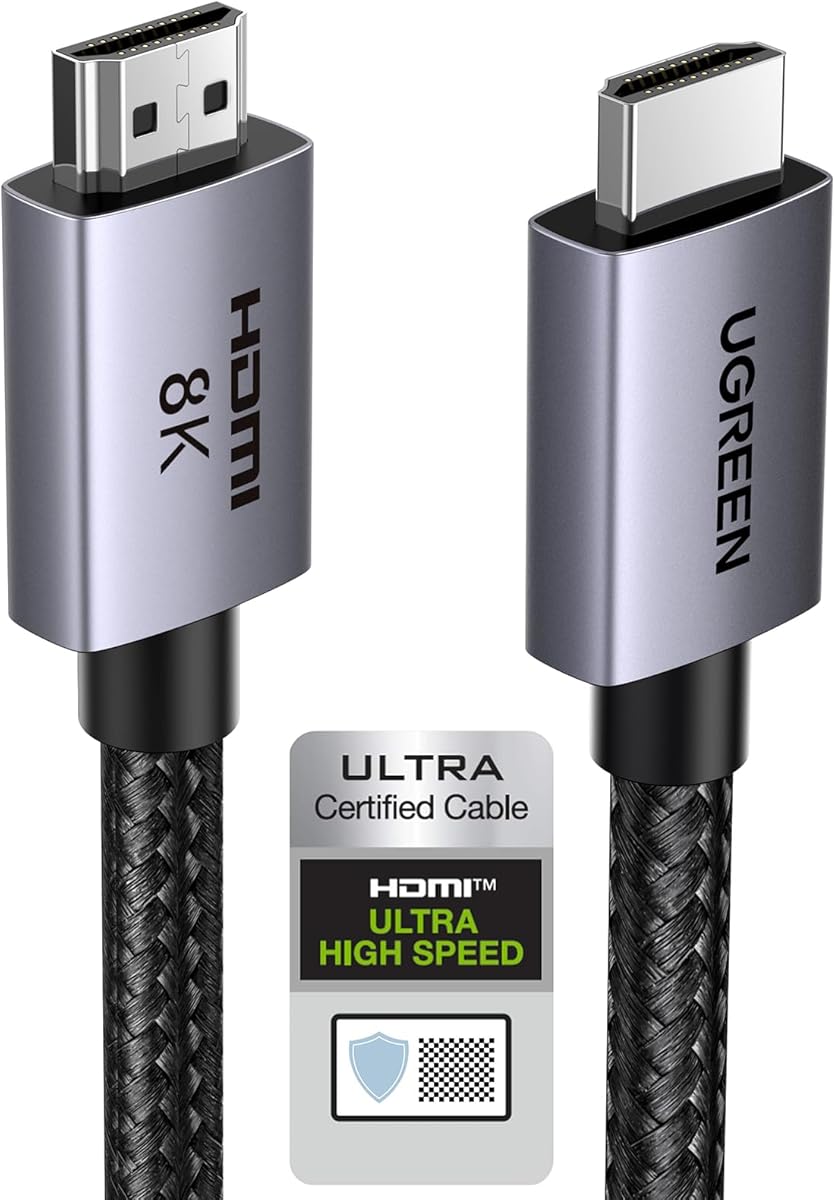
The UGREEN 8K HDMI 2.1 Cable combines a 4.8 rating with certified 48Gbps bandwidth and broad support for modern video and audio features. It supports 8K at 60Hz and 4K at 240Hz, along with variable refresh rate, quick frame transport, auto low latency mode, quick media switching, Dynamic HDR, and eARC. That combination makes it a strong all-around choice for a current-generation gaming and home theater setup.
We may earn a commission when you buy through this link, at no additional cost to you.
The cable is not limited to video. Its eARC support is intended to carry full-resolution audio such as Dolby Atmos and DTS:X from a television to a compatible soundbar or receiver. HDCP 2.3 and 2.2, Ethernet, and 3D support add further utility, while the listed device compatibility covers consoles, streaming devices, computers, projectors, televisions, and audio equipment.
All advanced capabilities depend on the connected devices. A television that only accepts 4K at 60Hz will not gain 4K120 or 240Hz merely because the cable supports it. This limitation is normal, but it means buyers should compare the cable's capabilities with the specific modes available from their console, graphics card, display, and audio system.
This is the best general recommendation for someone wanting more than a basic 4K60 lead without moving to the newest HDMI generation. The 6.6-foot length suits most entertainment centers and desks, while the aluminum alloy housing, nickel-plated connectors, and nylon braid add physical protection. It is especially compelling for high-refresh PC gaming, VRR-capable consoles, 8K televisions, and eARC audio installations.
Support for 4K240, variable refresh rate, and auto low latency mode makes the cable relevant to capable gaming hardware. The source and display must offer matching features, and many games must also include a high-refresh 4K presentation mode before users see the full intended benefit.
Dynamic HDR and eARC help the cable serve more than a game console connection. It can support richer color information and return high-quality audio to a compatible soundbar or receiver, reducing the number of separate connections required in a modern entertainment center.
We may earn a commission when you buy through this link, at no additional cost to you.
The Silkland Certified HDMI 2.1 Cable is a 6.6-foot Ultra High Speed cable rated for 48Gbps, with a 4.7 rating. It supports 4K at 120Hz or 144Hz, 8K at 60Hz, 5K at 90Hz or 120Hz, and 2K at 165Hz or 240Hz. The product information also highlights certification that can be checked through a QR-code scanner application.
We may earn a commission when you buy through this link, at no additional cost to you.
Its premium distinction comes from the combination of performance and physical refinement. The E-Braid construction uses double-layer fishnet winding and nylon braiding, while copper cores and ferrite magnetic beads are intended to support consistent signal transmission. The cable also supports Dynamic HDR, eARC and ARC, DTS:X, Dolby Atmos, HDCP 2.2, and 2.3, and backward compatibility with HDMI 2.1 through HDMI 1.1.
One point of comparison is the range of supported display modes. Silkland explicitly lists 4K144 and 4K120, while some competing cables emphasize a theoretical 4K240 target. Neither description automatically makes one cable better for every user, since the selected mode must be offered by the source, graphics hardware, and display. The important issue is whether the cable and all connected equipment agree on the desired format.
It is best recommended for buyers who value a certified 48Gbps connection, robust braided construction, and broad high-refresh support in a 6.6-foot format. Console gamers, PC enthusiasts, and home theater users with compatible devices can take advantage of the bandwidth and audio support. Those looking only for uncomplicated 4K60 can choose a less advanced 18Gbps model and spend nothing on features their setup cannot use.
The stated certification and QR-code verification process make it easier to distinguish the cable from cables that merely use HDMI 2.1 terminology. Buyers can confirm what they receive rather than relying solely on a broad bandwidth claim printed on retail packaging.
Double-layer braiding, copper conductors, and ferrite beads form a system intended to preserve signal quality while withstanding regular flexing. These details are particularly helpful in a gaming desk setup where the connector may be moved or routed around furniture more often than in a fixed wall installation.
We may earn a commission when you buy through this link, at no additional cost to you.
The Highwings 16K 4K 480Hz HDMI 2.2 cable represents the most future-oriented product in this guide. It is listed at 96Gbps and supports 4K at 480Hz, 8K at 240Hz, 12K at 120Hz, and potential 16K resolution. Its 4.6 rating is slightly below the leading group, but the specifications place it in a class aimed at next-generation displays and high-bandwidth installations.
We may earn a commission when you buy through this link, at no additional cost to you.
The cable also includes variable refresh rate, auto low latency mode, Dynamic HDR, and Dolby Vision support according to the supplied information. Its eARC capability is designed to return high-quality, uncompressed audio such as Dolby Atmos from a television to a compatible soundbar or receiver. A built-in Ethernet channel can share an internet connection between compatible devices, reducing the need for a separate network cable in certain installations.
Physical construction includes a double-braided nylon jacket, 24K gold-plated connectors, and aluminum foil shielding for electromagnetic and radio-frequency interference. Those protections make the cable suitable for demanding installations, although the advanced specifications still depend on source and display hardware. Current devices generally operate below the cable's maximum capabilities.
This product is best for early adopters building a home theater around very high-end displays, experimental computing equipment, or installations intended to remain relevant through several hardware generations. For a conventional 4K60 television, its 96Gbps capacity offers little visible advantage. Most buyers should instead decide whether a certified 48Gbps cable already provides enough future headroom for their actual devices.
A 96Gbps rating is designed to accommodate resolutions and refresh rates that are beyond most current consumer setups. The benefit is potential longevity and reduced concern about cable limitations as display technology advances, not an automatic improvement in today's standard 4K picture.
Variable refresh rate, auto low latency mode, Dynamic HDR, and eARC address different parts of the viewing and gaming experience. The source device, display, game, and audio equipment must all support the relevant feature for it to have a meaningful effect.
We may earn a commission when you buy through this link, at no additional cost to you.
The Highwings HDMI Cable 6.6 ft is a straightforward 18Gbps HDMI 2.0 cable built around 4K at 60Hz. Its 4.7 rating and support for audio, video, photos, and full 4K resolution make it a familiar option for a television, monitor, laptop, projector, or game console. It also includes an Ethernet channel, which can be useful for compatible networked HDMI devices.
We may earn a commission when you buy through this link, at no additional cost to you.
The connector design is one of the product's more notable points. Gold-plated connectors are intended to support high-speed signal transmission, while a special strain-relief joint at each end is designed to reduce connector cracking. The manufacturer reports that the cable can withstand more than 15,000 bends in laboratory testing, making it a credible option for a frequently adjusted desktop connection.
The 18Gbps limit means this cable cannot support 4K at 120Hz or 240Hz. It also operates within HDMI 2.0 and is backward compatible with HDMI 1.4, 1.3, and 1.2, so it is best for 4K60 displays rather than the highest-refresh gaming modes available on newer televisions. Those limitations are predictable and should be considered before installation.
This cable is best for a standard 4K television, office monitor, laptop, or console setup that runs at 60Hz. The 6.6-foot length is long enough for most desks and entertainment units without introducing the bulk of a 20- or 25-foot lead. Buyers seeking 4K120 gaming should move up to a 48Gbps HDMI 2.1 cable instead.
The cable carries 4K at 60Hz with up to 18Gbps bandwidth, matching the capabilities of most standard 4K content. Plug-and-play operation also means it does not require software, drivers, or configuration beyond connecting the relevant source and display.
The easy-grip connector body and reinforced joint design address common weak points in HDMI leads. These features are useful for users who repeatedly disconnect the cable, although the connector should still be pulled straight rather than twisted when removed.
We may earn a commission when you buy through this link, at no additional cost to you.
The Amazon Basics Nylon-Braided HDMI 2.0 Cable is a 25-foot A-to-A connection designed to bridge substantial distances. It supports 4K at 60Hz, 2160p, 48-bit color depth, 18Gbps bandwidth, Ethernet, 3D, and ARC. The 4.7 rating and explicit device compatibility make it an accessible option for a distant television, projector, or gaming system.
We may earn a commission when you buy through this link, at no additional cost to you.
The nylon-braided exterior is designed to resist everyday wear and reduce tangling. That makes a long lead more practical in a permanent entertainment arrangement, particularly when the source sits in one room and the display is positioned across another area. The cable can also serve as a single connection to devices that support the HDMI Ethernet function.
Its most important limitation is clearly stated: the cable supports up to 4K at 60Hz and will not work properly if a source requires an output above that standard. A modern gaming television with 4K120 support may therefore need a newer cable. The 18Gbps bandwidth also places it in the conventional HDMI 2.0 category rather than the high-end HDMI 2.1 group.
The cable is best for reaching a wall-mounted 4K television, a projector positioned away from the media console, or a gaming system located in a different part of a room. It is also compatible with Blu-ray players, Fire TV, Apple TV, PS4, PS3, Xbox One, Xbox 360, computers, televisions, displays, and A/V receivers that use HDMI.
Twenty-five feet gives enough flexibility to work around furniture, walls, and room layouts that would require multiple shorter cables. Buy only when the measured distance genuinely requires it, because a long lead can be harder to conceal and route cleanly than a shorter alternative.
Support for 4K60, Ethernet, 3D, and ARC allows the cable to handle video and compatible network or audio-return functions. The source and display must support each feature independently, and the cable will not add capabilities that the connected equipment lacks.
We may earn a commission when you buy through this link, at no additional cost to you.
The StarTech 6ft Premium Certified HDMI 2.0 Cable supports 4K at 60Hz, 18Gbps bandwidth, HDR10, ARC, and 32-channel audio formats. Its male-to-male configuration is intended for direct connections between two HDMI-enabled devices. The listed 4.3 rating is lower than the other products here, but the specification set remains appropriate for many mainstream television and home theater arrangements.
We may earn a commission when you buy through this link, at no additional cost to you.
Its connectors use corrosion-resistant gold plating and die-cast aluminum housings to protect signal integrity and reduce electromagnetic interference. A molded soft TPE strain relief absorbs stress around the cable-to-connector transition, while the jacket is described as non-toxic, halogen-free, and RoHS certified. The product is also listed as tested for more than 10,000 insertions and 600 bend cycles.
The cable is strictly suited to the HDMI 2.0 bandwidth envelope, so 4K above 60Hz is outside its capability. It also lists broad audio support, including 5.1, 7.1, Dolby TrueHD, and Atmos, plus BT.2020 colorimetry, ultra-wide aspect ratios, and 3D. These features only apply when the connected source, television, and audio equipment support them in a matching format.
It is best suited to a 4K60 television, computer, projector, home office, or travel arrangement that benefits from a compact, certified lead. The title identifies a 6-foot length, while the supplied description says 6.6 feet, so buyers should check the selected variant. It is a credible premium HDMI 2.0 option, though the 48Gbps cables are more appropriate for high-refresh 4K gaming.
HDR10, 32-channel audio, BT.2020 colorimetry, and 18Gbps bandwidth make this more than a basic video cable. The combination works well for compatible televisions, projectors, receivers, and source devices that are designed to take advantage of those formats.
Gold plating helps resist corrosion, while the die-cast aluminum enclosure adds mechanical protection around the connector. Molded TPE strain relief is intended to reduce stress at the joint, one of the most common places for an HDMI cable to fail after repeated handling.
We may earn a commission when you buy through this link, at no additional cost to you.
A useful HDMI 2.0 cable for 4K should combine an honest 18Gbps specification with dependable connectors, suitable shielding, and enough length for the installation. Modern gaming and home theater needs can justify 48Gbps or 96Gbps alternatives, so the right choice depends on the resolutions, refresh rates, and features supported by the source and display.
Begin with the output mode your source can produce and the mode your television or monitor can accept. A conventional 18Gbps HDMI 2.0 cable is designed for 4K at 60Hz, which covers many streaming services, standard 4K television content, and console gaming. If the setup needs 4K at 120Hz or a higher refresh rate, an HDMI 2.1 cable with 48Gbps bandwidth is the relevant choice. A cable cannot make unsupported display modes available, so compatibility must be checked on both ends of the connection.
Choose an 18Gbps cable for ordinary 4K60 use and a 48Gbps model for high-refresh 4K gaming. Future-oriented 96Gbps products are best reserved for unusually advanced equipment.
HDMI version terminology can be confusing because some retail listings advertise high resolution numbers without clearly explaining the underlying bandwidth. HDMI 2.0 generally refers to 18Gbps bandwidth and 4K at 60Hz, while HDMI 2.1 introduces 48Gbps bandwidth and higher refresh-rate possibilities. HDMI 2.2 models in this list reach 96Gbps. Certification and the listed bandwidth provide more useful guidance than broad claims such as ultra high speed or 8K ready.
For an exact HDMI 2.0 purchase, prioritize a product that specifically identifies HDMI 2.0, 18Gbps, and 4K60. If 4K120 or 4K240 is important, choose a certified 48Gbps HDMI 2.1 cable instead.
Variable refresh rate, auto low latency mode, and quick frame transport can make a meaningful difference on compatible gaming displays and consoles. Variable refresh rate synchronizes the display refresh with the frames produced by the source, helping reduce tearing. Auto low latency mode is intended to reduce input lag when the connected television or monitor supports it. These features do not work merely because the cable advertises them; the source device, display, game, and sometimes the specific HDMI mode must all align.
Prioritize a 48Gbps cable with VRR and ALLM for competitive or high-refresh console gaming. For standard 4K60 gaming, those extra features are optional rather than essential.
ARC and eARC allow a television to return audio to a soundbar or A/V receiver over HDMI, reducing the number of cables required in a home theater. Basic ARC is commonly included with 4K HDMI 2.0 cables, while newer 48Gbps models may add enhanced eARC for higher-bandwidth audio. Dolby Atmos and DTS:X support depends on the entire chain, including the source, television, and sound system. A cable carrying an eARC label cannot create lossless or object-based audio where the television does not support it.
Choose eARC when using a compatible modern television and soundbar and you want one-cable audio return. Choose standard ARC for a simpler 4K60 setup with supported audio equipment.
Measure the complete path from the source to the display rather than estimating from the wall. Include furniture, cable routing, and the space needed to keep connectors from being sharply bent. A 6.6-foot cable usually suits a television stand or gaming desk, while 20- and 25-foot options are intended for wall-mounted displays, projectors, and equipment in another area. Excess cable should be loosely coiled rather than tightly bent behind a cabinet.
Choose the shortest length that completes the installation without strain. Use a longer lead when distance is genuinely required, and confirm the selected variation because some listings contain conflicting length descriptions.
Gold-plated connectors, reinforced strain relief, braided jackets, and shielded conductors are useful indicators of a well-made cable. Plating helps resist corrosion, while a flexible strain-relief section reduces stress where the wire enters the connector. Braiding can improve resistance to everyday abrasion and helps with cable management. Bend-test figures are also useful when comparing models, although they describe a specific laboratory procedure rather than every real-world installation.
Prioritize reinforced connectors and a braided jacket for a gaming desk or frequently handled lead. Choose a well-routed conventional jacket for a permanent, less frequently moved installation.
Check the connector type, source-device support, display capabilities, and any audio or networking functions before buying. Most products use standard male-to-male HDMI connectors, but adapters or converter cables may be needed for unusual arrangements. Ethernet, CEC, HDCP, HDR, 3D, and audio-return functions must also be supported by the connected equipment. Certification markings can help distinguish a verified cable from one making broad compatibility claims without corresponding technical details.
Create a short list of required features, then confirm that both the cable and every connected device support them. This prevents paying for advanced modes that the television, console, or receiver cannot actually use.
Shielding is intended to protect the digital signal from electromagnetic and radio-frequency interference, while proper routing helps preserve the cable's construction and performance. Run the lead away from power cables when practical, avoid coiling it tightly around a power supply, and do not place it beneath sharp furniture edges. Long runs should also be routed with gentle bends and enough slack to avoid tension on the connectors. These practices complement rather than replace a properly specified cable.
Use shielded construction in crowded entertainment centers and route every cable without sharp bends. Secure excess length loosely and check both ends after installation for a stable connection.
Before connecting the cable, identify the correct HDMI input on the television or monitor and review its supported resolution and refresh rate. Connect the source device first, then attach the cable to the display, and power on the equipment in the order recommended by the manufacturer. If the image is missing, try another source input and confirm that the display has selected that input. High-refresh and gaming modes may also need to be enabled in the television or monitor settings.
When routing the cable, avoid pulling it by the connector. Hold the plug housing when inserting or removing it, keep the strain-relief section straight, and avoid tight loops or bends smaller than the cable's natural radius. In a permanent installation, label both ends so the source is easy to identify. For a long lead, coil unused slack loosely and secure it with a soft tie rather than a tight fastener.
Periodically inspect the exposed cable, connector shells, and strain relief for cracks, sharp creases, corrosion, or loose fittings. Do not repair a damaged cable with tape if the conductor, shielding, or connector has been compromised. Keep the connection dry and away from direct heat, and reconnecting a loose-fitting plug can help determine whether the issue is the plug rather than the display. When changing resolution or refresh settings, verify that the selected mode is supported by every device in the chain.
Yes. A properly specified HDMI 2.0 cable with 18Gbps bandwidth supports 4K at 60Hz, which is suitable for most 4K streaming, movies, television content, and standard console gaming. The connected source and television must also support 4K60. If the setup requires 4K at 120Hz or a higher refresh rate, choose a 48Gbps HDMI 2.1 cable instead.
A better cable cannot exceed the capabilities of the source or display, so it will not turn a 1080p device into a 4K system. A higher-bandwidth cable does help when the equipment supports higher modes, and a well-constructed cable can reduce connection problems caused by poor shielding, damaged connectors, or inadequate signal integrity. For a stable 4K60 setup, a reputable certified cable is generally sufficient.
Only if the desired game and hardware support a mode above HDMI 2.0's 4K60 limit. A PS5, Xbox Series X, or modern PC may offer 4K at 120Hz when paired with a compatible display, and those setups benefit from a certified 48Gbps HDMI 2.1 cable. At 4K60, an HDMI 2.0 cable remains appropriate, provided it has a reliable connection and adequate bandwidth.
No. HDMI 2.0's 18Gbps bandwidth is insufficient for 4K at 120Hz, including the associated high-refresh and HDR payload requirements. A cable cannot overcome that standard's limit. Users who need 4K120 should select a certified 48Gbps HDMI 2.1 cable and confirm that the game, console or graphics card, and television all support the selected mode.
A quality cable at a suitable length should support its advertised resolution and refresh rate. Longer runs can be more sensitive to poor construction, sharp bends, interference, and loose connections, which is why shielding and proper routing become important. A 25-foot cable is practical for a distant display, but it is unnecessary for nearby equipment and can make cable management more difficult.
The Ethernet channel can carry network data between compatible HDMI devices, allowing some setups to share an internet connection without a separate network cable. The source, display, and any intermediary device must support the HDMI Ethernet function. It does not make a standard television into a network device or bypass the need for compatible network equipment.
ARC returns audio from a television to a soundbar or receiver over HDMI, while eARC provides enhanced return-channel bandwidth for higher-quality audio formats. Support for formats such as Dolby Atmos or DTS:X also depends on the source content, television, and sound system. The cable must support the return function, but it cannot enable eARC on a television that only offers basic ARC.
First, reconnect both ends and try a different HDMI input on the television or monitor. Check that the selected resolution and refresh rate are supported by the source and display, and temporarily disable high-refresh, HDR, or variable refresh rate settings to isolate the cause. Inspect the cable for damage, sharp bends, or a loose connector. If the problem persists with another cable, review the device settings and manufacturer support documentation.
The StarTech 6ft High Speed HDMI Cable stands out as the best budget-oriented choice for a straightforward certified 4K60 connection, with an 18Gbps bandwidth and a 4.8 rating. The UGREEN 8K HDMI 2.1 Cable is the editor's choice for buyers who want a broad set of modern gaming, HDR, and eARC features, while the Silkland Certified HDMI 2.1 Cable earns the premium designation through its 48Gbps specification, high-refresh support, and layered braided construction.
Prioritize the capabilities of the complete device chain rather than the largest number printed on the package. Standard 4K viewing, office use, and 4K60 gaming are well served by an 18Gbps HDMI 2.0 cable. 4K120 or 4K240 gaming calls for a 48Gbps HDMI 2.1 model, and exceptionally advanced future equipment may justify 96Gbps. Match the cable length to the measured route and inspect connector quality before finalizing the purchase.
Product prices, promotions, ratings, and availability can change, so review the current listing and recent customer feedback before buying. Confirm the selected cable length, especially where the supplied information differs, and verify that the source, display, audio equipment, and game support the resolution, refresh rate, and special features you intend to use.