
UGREEN USB C Hub 5 in 1
4.6Editor score
4K HDMI output
100W power delivery
Three USB-A ports
Compact multiport design
Our HDMI Dongle guide compares 10 wired and wireless options for laptops, tablets, and phones, covering resolution, ports, charging, range, and compatibility.
An HDMI dongle is a compact adapter that lets a compatible USB-C laptop, tablet, or phone send video to a television, monitor, or projector. The right choice depends on whether you want a simple wired connection, a multiport hub, or wireless screen mirroring with greater freedom of movement.
We compared ten HDMI dongles and USB-C display adapters using resolution, refresh rate, charging support, data ports, wireless range, device compatibility, portability, and ease of use. The list includes focused adapters for travel, all-in-one hubs for desk setups, and wireless transmitters for presentations and shared viewing.
Each review highlights the most useful features, limitations, and ideal buyer for that model. Features such as 4K output, charging, storage access, and multi-device support are not interchangeable, so match the adapter to your devices and routine. Product pricing, availability, and feature details can change over time.
4.6Editor score

4.6Editor score

The comparison below separates wired display adapters, multiport USB-C hubs, and wireless screen-sharing dongles. Use the output, charging, data, range, and compatibility details to identify the model that best fits your devices and setup.




The Anker USB C to HDMI Adapter is a focused solution for anyone who wants to connect a modern USB-C computer to an HDMI display without installing drivers or assembling a larger hub. It carries a 4.6 rating and stands out for straightforward operation, broad compatibility, and support for video up to 4K resolution.
We may earn a commission when you buy through this link, at no additional cost to you.
Its main advantage is restraint. The adapter turns a compatible USB-C port into an HDMI connection, making it suitable for a laptop that otherwise has only USB-C or Thunderbolt ports. It works with USB-C DisplayPort Alternate Mode, USB4, and Thunderbolt connections, which covers many current laptops, although the computer still needs the appropriate video and power features.
The aluminum housing helps dissipate heat, while the reinforced braided-nylon cable is designed to tolerate the repeated bending and pulling associated with portable use. Plug-and-play operation also reduces setup friction. The meaningful trade-off is that it does not support charging or Power Delivery, so users who need to keep a laptop powered during a long presentation should carry a separate charger or choose a hub with pass-through charging.
This is the strongest general recommendation for someone seeking a dependable, uncomplicated HDMI dongle. It is particularly useful for travel, borrowed meeting rooms, and home displays where the goal is simply to get a clean video connection from a compatible USB-C device. Anyone who also needs data ports or simultaneous charging should look toward the more versatile hubs later in the guide.
The adapter supports video output up to 4K resolution, making it useful for modern televisions, desktop monitors, and presentation displays. Actual resolution remains dependent on the source computer, display, operating system, and connection requirements.
Its lightweight aluminum body and reinforced braided cable balance a small footprint with durability. The permanently attached short cable is convenient for a bag, office drawer, or travel kit.
We may earn a commission when you buy through this link, at no additional cost to you.
The UGREEN USB C Hub 5 in 1 offers one of the most balanced feature sets in this guide. It combines 4K HDMI output, 100W Power Delivery, and three USB-A data connections in a compact package, earning a 4.6 rating and a place as the value-focused top pick.
We may earn a commission when you buy through this link, at no additional cost to you.
This hub is aimed at users who arrive at a desk with only one USB-C port but need to connect a display, power the laptop, and attach peripherals. The 5Gbps USB-A port is the best choice for flash drives, external storage, and other data-heavy accessories, while the two 480Mbps ports are more appropriate for keyboards, mice, and similar devices.
The tradeoff is that the adapter does not provide a Thunderbolt-style USB-C data port, and the faster USB-A connection uses one of the hub's limited data lanes. It is also a dock rather than an extremely tiny travel dongle. Users seeking the highest possible display refresh rate or a broad selection of USB-C peripherals may prefer another model.
Choose this UGREEN hub when one adapter must handle display, charging, and common USB-A accessories. It is especially attractive for office desks, home workstations, and study setups where a single compact hub can replace several separate connections. For basic display-only travel, however, the simpler Anker adapter may be more appropriate.
Combining display, charging, and three USB-A ports reduces cable clutter around a workstation. A single USB-C connection can serve a laptop's display and peripheral needs while the hub also accepts a charger.
Use the 5Gbps port for storage transfers and the two 480Mbps ports for input devices. Assigning ports according to bandwidth needs helps prevent slower accessories from constraining demanding data tasks.
We may earn a commission when you buy through this link, at no additional cost to you.
The 2027 Wireless HDMI Display Dongle is built for people who want to mirror a phone or laptop to a larger screen without running a cable across the room. It supports 1080p at 60Hz, 4K decoding, Airplay for Apple devices, and Miracast for Android and Windows systems, and it holds a 4.5 rating.
We may earn a commission when you buy through this link, at no additional cost to you.
Its direct wireless connection is the key attraction. The product does not require an app, Bluetooth link, or existing Wi-Fi network, reducing dependence on the surrounding environment. A 2.4GHz and 5GHz dual-band antenna system supports stable transmission, while the listed latency of approximately 100ms and range of up to 16 feet suit nearby viewing and presentation situations.
The important limitation involves streaming services protected by HDCP. Netflix, Amazon Prime Video, Hulu, Comcast TV, Xfinity, Vudu, Sky Go, and BT Sport may not work because their content protection can block wireless mirroring. The 16-foot maximum range also means the adapter is less suitable for large conference rooms or presentations across substantial distances.
This model is a compelling choice for quick wireless sharing in a living room, classroom, or small meeting space, provided the desired content is not protected. Buyers who regularly stream subscription video should verify app support first. Those needing long-range presentation freedom should consider the Belkin ConnectAir model instead.
The dongle creates a direct connection and supports a one-click mirroring flow. That makes it useful in locations where joining an unfamiliar Wi-Fi network is inconvenient, slow, or restricted.
HDCP controls can prevent certain subscription apps from appearing on the larger display. Confirm that your intended services support mirroring or use a wired adapter when copyright-protected playback is the priority.
We may earn a commission when you buy through this link, at no additional cost to you.
The Anker USB-C Hub 5-in-1 is a capable desk adapter for users who need video, laptop charging, and several USB-A connections. Its 4.6 rating reflects a balanced feature set, with 4K display output, 90W pass-through charging, one 5Gbps USB-A port, and two 480Mbps USB-A ports.
We may earn a commission when you buy through this link, at no additional cost to you.
The charging design deserves attention. A USB-C Power Delivery input accepts a wall charger, and up to 90W is passed through to the laptop from a total 100W input while the hub reserves 10W for operation. The wall charger is not included, so users should verify that their existing charger and cable provide adequate power.
Display performance reaches 4K at 30Hz in both mirror and extend modes. The product is listed as compatible with MacBook models running macOS 12 or newer, Windows 10 and 11, ChromeOS, and laptops supporting DisplayPort Alternate Mode and Power Delivery. Linux is explicitly excluded, and some USB-C devices may provide data or charging but not display output.
This hub is well suited to office desks, home workstations, and recurring presentations where a laptop should remain powered while peripherals are connected. It is less appropriate for Linux users or high-refresh gaming. Users who require 4K at 60Hz should examine a more specialized adapter, while those who also need memory-card access can consider the MOKiN option.
The combination of display, charging, and USB-A ports reduces the number of accessories required at a shared desk. Fast data and slower peripherals can remain connected simultaneously when the hub is powered correctly.
The hub accepts 100W input and reserves 10W for itself, leaving up to 90W for the host laptop. A suitable charger and USB-C cable remain necessary to achieve the full pass-through capability.
We may earn a commission when you buy through this link, at no additional cost to you.
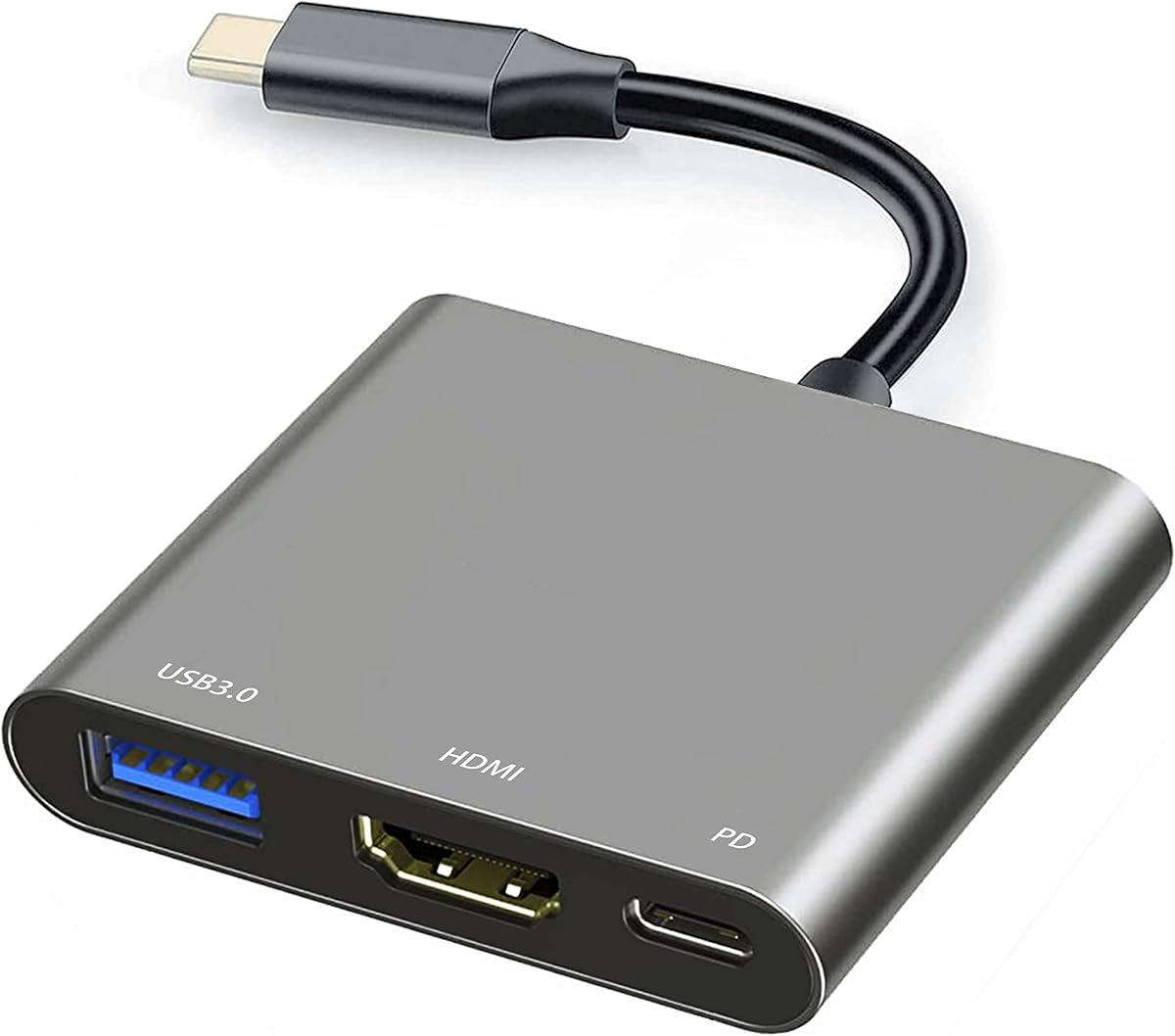
The Acer USB C to HDMI Adapter is a compact three-in-one hub for compatible USB-C devices that need display output, host charging, and one USB-A data connection. It carries a 4.4 rating and supports HDMI output at up to 4K resolution and 30Hz.
We may earn a commission when you buy through this link, at no additional cost to you.
Its versatility is clearest when moving between a television, projector, and monitor. The USB-A port supports data transfers up to 5Gbps, while the separate USB-C power port can deliver up to 100W to the host device. Acer notes that actual charging speed depends on the computer, cable, and charger, with a charger and cable of at least 45W recommended for better results.
Compatibility requires care. The source USB-C port must support DisplayPort Alternate Mode, and the product is not designed for portable monitors or USB-C devices lacking video output. The supplied information also excludes iPhone models, Lightning-equipped iPads, certain Galaxy A and Tab A devices, GoPro cameras, Motorola phones, and Fire tablets.
This adapter is a sensible choice for a traveler who wants one small hub rather than separate charging and display accessories. It suits Windows, ChromeOS, Linux, and macOS users, provided the connected device has the required USB-C capabilities. Buyers needing more than one USB-A accessory or a higher-refresh display should select a larger hub.
Three functions in a compact aluminum housing make the adapter convenient for travel. It can add an HDMI display, preserve host charging, and provide a fast data connection without occupying multiple separate adapters.
A USB-C connector alone does not guarantee display capability. Confirm DisplayPort Alternate Mode support, inspect the excluded device categories, and verify that your charger and cable meet the required power level.
We may earn a commission when you buy through this link, at no additional cost to you.
The Battony USB C to HDTV Adapter is a pocketable three-port solution for connecting a compatible USB-C device to an HDTV, monitor, or projector. Its 4.3 rating reflects useful display, charging, and data functions in a compact form factor.
We may earn a commission when you buy through this link, at no additional cost to you.
The HDMI output supports resolutions up to 3840 by 2160 at 30Hz, while the USB-A connection supports data transfer up to 5Gbps. The hub is designed to work with flash drives, cameras, removable hard drives, mice, keyboards, and other USB-A devices. An HDTV 2.0 or better cable is recommended for the stated 4K output.
As with other compact adapters, the source device determines what works. The listed compatibility covers a range of older and newer MacBook, Dell, HP, Acer, Lenovo, Huawei, and other USB-C computers, but there is no claim that every USB-C product supports video. It also lacks the broader operating-system guidance and precise charging-power rating found in some competing models.
Choose the Battony adapter for compact travel kits, classroom demonstrations, exhibitions, and presentations where carrying a small converter is more important than having a broad collection of ports. It is less compelling as a permanent desk dock because it offers only one USB-A data connection and no explicitly stated USB-C data port.
The slim housing and portable form make the adapter easy to carry between home, office, and event venues. It is a practical way to bridge a USB-C computer and a display when only a few connections are needed.
The stated 4K output depends on the computer, adapter, display, and cable working together. An HDTV 2.0 or newer cable is recommended to reduce the chance of signal limitations.
We may earn a commission when you buy through this link, at no additional cost to you.
The Belkin ConnectAir Wireless HDMI Display Adapter is designed for larger rooms and professional collaborative setups where cable length would be restrictive. It supports 1080p at 60Hz, extends up to 131 feet or 40 meters, and can serve up to eight transmitters connected to a single receiver.
We may earn a commission when you buy through this link, at no additional cost to you.
Its wireless setup does not depend on an existing Wi-Fi network, apps, or drivers. That makes the system more predictable in offices, classrooms, and meeting venues where network access is limited. The advertised compatibility spans laptops, tablets, and phones across major operating systems, allowing a presenter to move around without being tethered to a display.
The main practical question is whether a compatible receiver is already part of the setup. The multi-transmitter feature clearly points toward a receiver-based environment, such as a conference room with a shared display, rather than a casual one-screen home arrangement. The product information also does not provide a customer rating, so there is no numerical feedback score to use as a comparative measure.
This Belkin system is the premium choice for organizations that value room-wide mobility, network-independent operation, and multi-user sharing. It is less compelling for a traveler who only needs a compact adapter and a nearby television. Confirm the full system requirements, including receiver availability, before purchasing multiple transmitters.
A stated range of 131 feet gives presenters and collaborators more freedom than a conventional HDMI cable. The wireless link removes the need to route a cable across a conference table, stage, or classroom.
Support for up to eight transmitters makes the adapter suitable for coordinated use in classrooms and meeting rooms. Users can take turns casting to the same receiver without physically passing a cable around the room.
We may earn a commission when you buy through this link, at no additional cost to you.
The USB C to HDMI Multiport Adapter combines display output, host charging, and several data interfaces in a compact aluminum body. Its 4.2 rating makes it a practical option for users who want more connectivity than a simple display adapter without carrying a full-size dock.
We may earn a commission when you buy through this link, at no additional cost to you.
HDMI 2.1 output is backward compatible with HDMI 2.0 and supports 4K as well as 2K, 1080p, and 720p. The separate USB-C data connection provides up to 10Gbps, while USB-A 3.0 and USB-A 2.0 ports support data transfer, OTG, and peripherals such as a mouse, keyboard, flash drive, hard disk, or card reader.
Host charging is capped at 27W, a meaningful limitation compared with the 90W and 100W pass-through options in this guide. The product also does not provide a detailed maximum refresh rate for its 4K output, so buyers seeking high-refresh gaming or demanding video work should verify the full signal specifications before committing.
This adapter fits users who need a fast USB-C data path, legacy USB-A accessories, and display connectivity in one small package. It is well suited to productivity setups and travel kits, while laptop users who require substantial charging headroom should favor a higher-wattage model.
The 10Gbps USB-C data port offers a quick path for compatible storage and accessories. Pairing it with USB-A 3.0 and USB-A 2.0 allows modern and legacy peripherals to remain connected at the same time.
A maximum 27W host charging output is suitable for lighter tasks but may be insufficient for some demanding laptops. Heavy users should look for a dock with a higher Power Delivery budget.
We may earn a commission when you buy through this link, at no additional cost to you.
The Wireless HDMI Display Adapter 4K is a screen-mirroring dongle for phones, tablets, MacBooks, and Windows computers. It carries a 5.0 rating and supports Airplay, Miracast, and DLNA-related connectivity, with 4K decoding and 1080p at 60Hz output.
We may earn a commission when you buy through this link, at no additional cost to you.
Setup involves plugging the dongle into a television or projector, powering it, and initiating screen mirroring from the source device. Android and Windows users can cast directly, while iOS users need an additional connection step. Mirror Mode supports 1080p or 720p shared viewing, and Extend Mode allows a larger screen and the source display to be used for different tasks.
Several limitations require attention. The product information states that Windows 11 is not supported, and iOS cannot mirror HDCP-protected apps such as Netflix, Prime Video, or HBO Max. Google Pixel phones and iPhone 17 users may need to access the dongle's local address and complete an online chip upgrade before mirroring.
This is a strong option for casual home viewing, demonstrations, and presentations involving unprotected content. Its 5.0 rating is the highest in the group, though ratings alone do not remove the platform restrictions. Buyers using Windows 11 or relying on protected streaming applications should choose a wired adapter or another wireless model with clearly stated support.
Mirror Mode suits watching content together, while Extend Mode can keep messages or controls on a phone while media appears on a large display. The choice makes the dongle useful beyond simple television streaming.
Windows 11 is excluded, and iOS content protected by HDCP may not appear on the larger display. The possibility of a firmware or chip upgrade on newer phones also makes advance compatibility checks worthwhile.
We may earn a commission when you buy through this link, at no additional cost to you.
The MOKiN USB C Hub HDMI Adapter is a feature-rich seven-port hub aimed especially at photographers, designers, video editors, and power users. It has a 4.6 rating and combines 4K at 60Hz display output, 100W power input, two USB 3.0 ports, a USB-C data port, and microSD and TF card readers.
We may earn a commission when you buy through this link, at no additional cost to you.
The built-in card readers are the distinguishing feature. They allow a compatible laptop to access files from microSD or TF cards without a separate reader, which is convenient when importing media from a camera. The two USB-A ports each support data rates up to 5Gbps for compatible storage and accessories, while the separate USB-C data port supports other USB-C devices.
Power delivery can accept 100W and pass up to 87W to the laptop for safety. Storage use requires some caution: because hard drives and solid-state drives can demand more power, the hub allows only one HDD or SSD at a time and does not support Apple USB SuperDrive. The seven-port design also makes it less pocket-friendly than a simple display adapter.
Choose the MOKiN for a permanent creative workstation where display refresh, card importing, charging, and multiple storage connections matter together. It is a particularly compelling option for compatible MacBook Pro, MacBook Air, M1 and M2 models, iMac, iPad Pro, iPhone 15 Pro models, Dell XPS, Surface, HP, and other USB-C devices. Minimal travelers should choose a smaller display-only adapter.
Integrated microSD and TF slots shorten the workflow for photographers and designers who routinely move media from a camera to a laptop. The reader is especially useful when desk space or carried accessories need to remain minimal.
Only one HDD or SSD can be connected because of power demands, and Apple USB SuperDrive is unsupported. Users with multiple high-power drives should plan a separate powered storage solution.
We may earn a commission when you buy through this link, at no additional cost to you.
The right HDMI dongle depends on your source device, display requirements, need for charging, number of peripherals, and preference for wired or wireless operation. Review these factors before comparing the ten options.
A USB-C connector does not automatically mean that a device can send video. The source computer or tablet should support DisplayPort Alternate Mode, while some newer systems use USB4 or Thunderbolt connections. Adapters also need an operating system and graphics configuration that permit the desired mirroring or extended-display mode.
Check the manufacturer specifications for your exact model before purchasing. Pay particular attention to exclusions for portable monitors, older phones, Lightning-equipped tablets, and less common device families.
A 4K-capable adapter does not guarantee that every source, display, or application will output 4K. Refresh rate matters for video editing, gaming, and smooth desktop movement. Some models support 4K at 60Hz, while others list 4K at 30Hz, and wireless products may decode 4K while outputting 1080p at 60Hz.
Choose based on the demanding device in your setup. High-refresh displays, detailed timelines, and games deserve 4K at 60Hz or higher when supported, while standard office presentations and television viewing may be adequately served by lower refresh rates.
A display adapter that does not support Power Delivery can still work perfectly well, but it may leave a laptop dependent on a separate charger. Multiport hubs can accept power through a dedicated USB-C input and pass a portion to the host while reserving some for the adapter. Available charging levels range from 27W to as much as 100W for the host.
Match the hub's power delivery to the laptop or tablet. A high-wattage device used for several hours may need more than a modest charging budget, while a smaller portable computer can often work with a lower limit.
A single-function HDMI adapter is smaller and simpler, while a multiport hub can add charging, USB-A data ports, a USB-C data port, and memory-card readers. Every added function increases size and can create questions about power allocation, data bandwidth, and host compatibility.
List the accessories you genuinely need. A mouse and keyboard require little bandwidth, while external storage may need a 5Gbps or 10Gbps connection. Creative users may save time and reduce desk clutter by prioritizing a hub with built-in card readers.
Wired adapters generally offer a stable direct connection, predictable latency, and fewer concerns about app compatibility. Wireless dongles remove cables and allow screen sharing across a room, but they introduce range limitations, potential latency, setup differences, and content-protection restrictions.
Use a wired adapter for protected streaming, gaming, detailed editing, and dependable office presentations. Choose a wireless model when mobility, shared viewing, or quick group collaboration matters more than those constraints.
Wireless range figures describe ideal conditions and should not be treated as guaranteed coverage through walls or around furniture. The two wireless options in this guide list different reach, with one designed for nearby use and the other for room-wide presentations. Latency can also affect interactive applications, games, and video chat.
For a small living room, a compact short-range dongle may be sufficient. For classrooms, stages, and conference rooms, a long-range system is more useful. Test the complete presentation, including the source device and network environment, before relying on it for an important event.
HDCP protects many subscription-video and television applications. A compatible-looking dongle may still fail to mirror those services because the source device or content system prevents protected playback from appearing through a wireless or mirrored display. The wireless models in this guide both include clear warnings about affected services.
Review the app limitations for the product and your chosen platform. If protected video is essential, a wired display connection is generally the safer approach. Also check operating-system exclusions, particularly for newly released devices and system versions.
A travel dongle should be small enough to remain attached or fit easily into a laptop sleeve. A desk hub can afford a larger body if it improves cable organization. Aluminum housings are common because they dissipate heat effectively, while braided or reinforced cables are useful in frequently handled setups.
Consider the length and rigidity of the attached cable, the footprint when connected, and the number of ports that must remain accessible. The most capable hub is not necessarily the easiest one to use if it is awkward to carry or blocks neighboring connectors.
Before connecting an adapter, inspect the USB-C port, adapter connectors, and display ports for dust or damage. Confirm that the source device supports video output, connect the dongle to the laptop or tablet, and then attach its HDMI lead to the television, monitor, or projector. Select the correct input source on the display and adjust the computer's resolution and refresh rate if the image does not appear immediately.
For a hub with host charging, attach the appropriate USB-C power cable and wall charger before beginning demanding work. Use the fastest data port for external storage, slower ports for keyboards and mice, and avoid connecting more high-power drives than the adapter supports. Wireless users should follow the manufacturer's connection sequence and complete any indicated device or chip update before troubleshooting the casting function.
To keep the adapter in good condition, coil its cable loosely rather than making a tight bend around a small radius. Do not leave a display adapter plugged into a hot car dashboard, expose it to moisture, or pull it sideways from the USB-C port. Disconnect it before changing devices, and periodically inspect the connector, housing, and cable for wear. If a display is unstable, test another cable, a different display input, and the source device with its built-in video output.
No. The source must support video output through USB-C, commonly through DisplayPort Alternate Mode, USB4, or a compatible Thunderbolt connection. Some USB-C devices support charging or data but not display output, and certain phone, tablet, and portable-monitor models are excluded by specific manufacturers. Check the exact device requirements before purchasing.
An HDMI dongle is usually a compact, focused adapter that adds video output and may include charging. A USB-C hub generally adds several ports, such as USB-A data connections, memory-card readers, and Power Delivery. Choose a dongle for a simple travel connection and a hub when you need peripherals, sustained charging, or a more organized desk setup.
Only if the model includes a USB-C Power Delivery input and identifies a charging power limit. Several options in this guide pass power to the host, ranging from 27W to higher levels, while the simplest Anker display adapter does not support charging. The wall charger may not be included, so check the package contents and your device's power requirements.
A 4K-capable adapter still depends on the source computer, operating system, display, cable, and selected refresh rate. Some products output 4K at 30Hz, while others support 4K at 60Hz. Wireless dongles may decode 4K content but transmit a 1080p signal, so verify both output resolution and refresh rate.
Many streaming services use HDCP or related content protection to prevent unauthorized mirroring. Even when a dongle supports Airplay or Miracast, protected applications may show a blank screen or refuse to connect. A wired adapter is generally the more dependable option for protected subscription video.
The dongle itself connects to the display through its HDMI port, so a physical HDMI cable is typically needed only to connect that port to the television or projector. Wireless communication occurs between the dongle and the source device. A suitable display cable and reliable power connection remain important even though the source-to-display link is wireless.
The products reviewed here primarily provide one HDMI output, so they are not designed for multiple independent external displays. A single mirrored screen can often be viewed on several room displays if the setup and source device support that arrangement, but true multi-monitor support generally requires a more advanced USB-C dock and a compatible computer.
Use a wireless adapter with a strong direct connection, minimize obstructions between the transmitter and receiver, and keep both devices reasonably close. Wired adapters generally avoid wireless lag entirely. For demanding games, video editing, or interactive calls, a direct wired HDMI connection is usually the more responsive choice.
The Anker USB C to HDMI Adapter is the most straightforward all-purpose recommendation for a compatible laptop that needs clean 4K video without extra ports. The UGREEN USB C Hub 5 in 1 is the stronger value choice for desk users who also need charging and USB-A accessories, while the Belkin ConnectAir Wireless HDMI Display Adapter leads the premium group for long-range, multi-user presentations.
Prioritize the capabilities your setup genuinely requires. Simple users should focus on source compatibility and display resolution, permanent workstations benefit from adequate charging and fast data ports, and creative workflows may place card readers near the top of the list. Wireless convenience is valuable, but range, latency, operating-system restrictions, and protected-app limitations deserve equal attention.
Before ordering, confirm the exact compatibility of your computer or mobile device, inspect the adapter's port list, and determine the display resolution and refresh rate you need. Current product pricing, availability, and technical details can change, so recheck the latest listing information and included accessories before making a final purchase.
