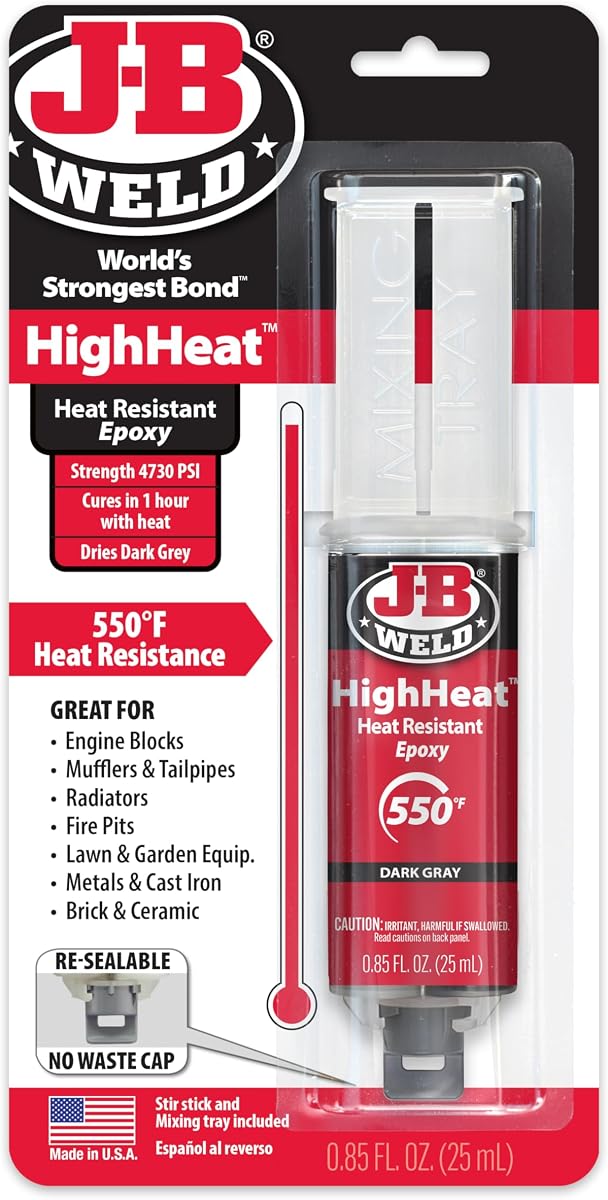
J-B Weld High Heat Epoxy Syringe
4.6Editor score
Permanent two-part epoxy bond
Handles temperatures up to 550°F
Chemical and fuel resistant
Explore the best Heat Resistant Adhesive options, comparing temperature ratings, curing times, sealing ability, materials, and ideal high-heat repair applicatio
Heat Resistant Adhesive is designed to bond, seal, or repair materials exposed to elevated temperatures, steam, smoke, vibration, or changing heat levels. Unlike ordinary household glue, qualified products retain flexibility and strength under demanding thermal conditions. The right choice depends on temperature exposure, substrate compatibility, curing time, and whether you need a flexible gasket or a rigid repair.
This guide compares ten heat-resistant adhesives based on stated temperature limits, curing behavior, sealing performance, material compatibility, and intended applications. It covers silicone sealants, two-part epoxies, metallic compounds, and sodium silicate for refractory work. Each review explains the product's strongest benefits, practical limitations, and the jobs for which it appears best suited.
Every pick reveals a different approach to high-temperature bonding: rapid-curing appliance sealants, flexible RTV gasket makers, permanent epoxy repairs, metal-repair pastes, and ceramic-fiber binders. Ratings reflect the supplied customer feedback, while specifications come from product descriptions. Availability and prices can change, so check the current listing before purchasing.
4.6Editor score

4.6Editor score

4.2Editor score
The comparison below places all ten options by adhesive type, stated heat limit, curing profile, and best-fit uses, helping you narrow the field before reading the detailed reviews.


This high-temperature silicone sealant earns the Editor's Choice position because it balances a wide operating range, rapid initial drying, and lasting flexibility. It carries a 4.6 customer rating and is described as stable from -50°C to 550°C. That makes it a versatile option for household appliances, grills, fireplaces, and heat-shielding projects where an ordinary adhesive would soften or fail.
We may earn a commission when you buy through this link, at no additional cost to you.
Its main strength is the combination of sealing and bonding. The cured material is described as elastic, waterproof, and moisture resistant, allowing it to tolerate vibration and thermal expansion without cracking. The pointed nozzle makes it easier to place material in narrow joints, while the short surface-dry time of 3–5 minutes helps speed up repairs. Full curing takes 2–4 hours, so the assembly should remain undisturbed during that period.
The adhesive is not ideal for every job. It is a sealant rather than a structural metal cement, and the product's performance depends on proper application to clean, compatible surfaces. It also requires patience until full cure despite the fast initial skin or surface dry. These are reasonable limitations for a flexible appliance and gasket seal, where movement tolerance matters more than an immediate rigid bond.
Choose this sealant when repairing an oven, microwave, induction cooktop, fireplace, or grill and you need a flexible barrier against heat, moisture, and smoke. It is particularly attractive for narrow appliance seams and visible repairs. For rigid joints requiring a load-bearing bond, the J-B Weld High Heat epoxy may be a better match, but this silicone is the more versatile sealer for this overall list.
The elastic cure is especially useful where heat causes different materials to expand and contract at different rates. It remains pliable rather than becoming a brittle, crack-prone seal, while also resisting water and moisture during everyday use.
A pointed nozzle gives the user better control over thin seams and localized repairs. The surface dries within minutes, making the product convenient for maintenance work that should not remain open indefinitely.
We may earn a commission when you buy through this link, at no additional cost to you.
J-B Weld High Heat is a two-part epoxy for permanent repairs where a rigid, durable bond is more important than flexibility. It has a 4.6 rating, a stated 4730 PSI strength, and a heat limit of 550°F. Those characteristics make it suitable for repairing metal assemblies, components, or household parts that encounter sustained heat without needing the movement tolerance of a silicone gasket.
We may earn a commission when you buy through this link, at no additional cost to you.
Mixing is straightforward but important: the two components combine at a 1:1 ratio. At room temperature, the epoxy sets in one hour and cures fully in 24 hours. Applying heat can accelerate the cure, with the product description noting a one-hour cure at 250°F. Once cured, the permanent bond is described as chemical resistant and fuel resistant, giving it an advantage for demanding mechanical applications.
The primary drawback is that epoxy is not as forgiving as a single-component sealant. Mixing must be thorough, the ratio must be correct, and the repair should not be disturbed while it cures. It is also a poor substitute for a flexible RTV gasket when the joined surfaces repeatedly expand, contract, or vibrate. For a rigid repair, however, those trade-offs are acceptable.
This epoxy is a strong choice for metal repairs, fuel-exposed parts, and compact components exposed to heat up to 550°F. It is especially attractive when you want a hard permanent bond and can allow the required curing time. Use the flexible silicone options for moving seams and oven gaskets, and reserve this epoxy for structural-style fixes that benefit from high strength.
The stated 4730 PSI strength makes this epoxy more appropriate than ordinary sealant for rigid components that need a durable connection. Its chemical and fuel resistance also broadens its usefulness in workshop-style repair situations.
A one-hour room-temperature set and 24-hour full cure offer a normal epoxy schedule, while controlled heat can accelerate curing. This makes it useful for planned repairs where the assembly can safely be warmed after application.
We may earn a commission when you buy through this link, at no additional cost to you.
Rutland Black High Temp Silicone is a tough, flexible RTV sealant rated to withstand up to 500°F. Its 4.6 rating and broad surface compatibility make it useful beyond ovens and grills. The stated applications include fireplace inserts, heat shielding behind stoves, ceramic tiles on fireplace surrounds, and solar-panel repairs.
We may earn a commission when you buy through this link, at no additional cost to you.
Its versatility comes from the ability to adhere to clean glass, metal, plastics, fiberglass, wood, brick, and stone. A flexible seal is particularly valuable around fixtures and structures that experience temperature changes, because it can accommodate movement better than a rigid bond. It also works as a gasket maker, turning a simple bead into a durable seal around a compatible joint.
One limitation is the heat ceiling. Although 500°F is substantial for many household repair projects, it does not cover the very high temperature range of the metallic paste or refractory binder in this list. The black color may also be less desirable where a translucent or clear repair would blend more closely with the surrounding surface.
Choose this RTV sealant for fireplace work, heat shields, tiles, solar panels, or multi-material household projects. It is a sensible general-purpose option for someone who wants one sealant for several compatible surfaces and moderate-to-high heat. Verify the substrate and temperature conditions before applying it to a critical assembly.
Compatibility with glass, metal, plastics, fiberglass, wood, brick, and stone makes this sealant useful for mixed-material repairs. Cleaning the surface thoroughly remains essential for reliable adhesion.
The stated fireplace and heat-shielding uses demonstrate its suitability for thermal barriers and protected joints. It is a practical option for DIY sealing tasks where a flexible, durable bead is needed.
We may earn a commission when you buy through this link, at no additional cost to you.
This black silicone adhesive stands out for a stated -50°C to 650°C operating range, the highest among the flexible silicone options in this guide. It holds a 4.4 customer rating and emphasizes stable bonding, sealing, and elasticity. That combination makes it a compelling candidate for demanding appliance, fireplace, and grill applications.
We may earn a commission when you buy through this link, at no additional cost to you.
The cured seal is described as resistant to heat, moisture, smoke, weather, vibration, and repeated expansion and contraction. This flexibility helps it remain intact as components warm and cool. The pointed nozzle improves placement in joints, although the surface-drying period is 10–15 minutes rather than the faster five-minute window offered by some rivals.
Its main drawback is the 24-hour full-cure period. Even if the surface appears dry sooner, the joint should not be placed under load or exposed to washing or moisture before curing is complete. The maximum temperature is a stated capability, not a guarantee for every substrate or installation, so the manufacturer instructions and a small test remain important.
This sealant is best for users who value a higher upper temperature range than the 500°F products offer. It suits compatible oven, microwave, induction-cooktop, fireplace, and grill projects. Choose it when flexibility, weather resistance, and a broad thermal range matter more than a quick full cure.
The stated 650°C upper range distinguishes this product from the 500°F silicone options. It is worth considering for compatible joints exposed to more intense heat, while still observing safe application and curing practices.
Resistance to vibration, expansion, and contraction helps preserve the seal over repeated temperature changes. The material remains flexible after curing, reducing the likelihood of brittle cracking in moving joints.
We may earn a commission when you buy through this link, at no additional cost to you.
This 100ml high-temperature silicone sealant focuses on controlled application and a clean finished appearance. It carries a 4.2 rating and operates from -60°C to 300°C, equivalent to 572°F. That range suits many ovens, microwaves, induction cooktops, range hoods, ceramic glass, metal panels, and glass-panel seams.
We may earn a commission when you buy through this link, at no additional cost to you.
The product applies white, making it easier to see exactly where material has been placed, and then cures to a semi-translucent finish. A precision nozzle helps direct the sealant into narrow gaps, while the included scraper helps spread and smooth the bead. These details are particularly useful for visible appliance seams and small edge repairs.
The tradeoff is that the stated upper limit is lower than that of several high-performance silicones in the guide, and the final appearance is not fully transparent. As with all sealants, compatibility depends on the metal, glass, ceramic, or other surface involved. The instructions recommend testing a small area and allowing full cure before use.
Choose this option when appearance, controlled placement, and a useful 572°F maximum are the main priorities. It is well suited to visible household equipment seams that need neat gap filling rather than extreme refractory work. For hotter assemblies, choose a silicone or metallic compound with a higher stated ceiling.
The white uncured color makes coverage easy to inspect before it becomes translucent. This helps users avoid missed patches and makes it easier to judge whether narrow seams have been filled evenly.
The pointed nozzle and included scraper support both targeted placement and a smoother bead. Together, they are useful for appliance edges, glass panels, and other repairs where a rough application would be difficult to disguise.
We may earn a commission when you buy through this link, at no additional cost to you.
J-B Weld ExtremeHeat is the premium pick for high-temperature metal repair. Its stated resistance extends to 1000°F, far beyond the adhesives and sealants in the guide that top out around 500°F to 650°C. It has a 4.2 rating and is formulated for iron, steel, and metal components operating in extreme environments.
We may earn a commission when you buy through this link, at no additional cost to you.
Once cured, the metallic compound creates a permanent bond described as stronger than steel. It can be drilled, machined, or sanded, allowing the repaired part to be restored to a functional shape. Suitable jobs include exhaust manifolds, mufflers, catalytic converters, outdoor grills, fire boxes, commercial furnaces, pipe connections, and water heaters.
This is not a general-purpose gap filler or flexible gasket. It is designed primarily for iron and steel repairs, and users must allow it to fully cure before attempting machining. It also contains no solvents or volatile organic compounds and is nonflammable, which are meaningful benefits in hot environments.
Choose ExtremeHeat when repairing metal that faces genuine extreme heat and you need a rigid, permanent result. It is the clear choice among these ten for exhaust systems, fire boxes, and commercial furnace work. For appliance seals, consider silicone instead; for true refractory ceramic work, sodium silicate may be more appropriate.
A permanent metal bond is more appropriate than a flexible sealant for cracks, holes, small gaps, and seam connections in iron and steel. The cure creates a rigid repair intended to withstand demanding thermal environments.
The ability to drill, machine, or sand the cured compound restores shape after the repair. That versatility makes the paste useful when the finished part must be adjusted or fitted after bonding.
We may earn a commission when you buy through this link, at no additional cost to you.
J-B Weld Red High Temperature RTV has a 4.7 rating, the highest customer rating among the ten products. It is a room-temperature-vulcanized silicone designed for mechanical assemblies with higher continuous temperatures up to 550°F or intermittent exposure up to 650°F. Its identity is clear: a flexible gasket maker for demanding assembled systems.
We may earn a commission when you buy through this link, at no additional cost to you.
Curing occurs through exposure to moisture in the air, producing a tough, waterproof seal. The cured material is described as resistant to shrinking, cracking, and weathering. It is particularly useful for automotive applications involving metal, oil pans, exhaust manifolds, water pumps, timing covers, differential covers, drive housings, and oven doors.
Its limitations are inherent to its purpose. This is not a high-strength metal adhesive, and its red color is more noticeable than a neutral or clear sealant. It also should be applied with proper joint preparation and given time to cure into a continuous seal. Applications requiring a rigid fill or a machined repair are better served by epoxy or metallic paste.
Buy this RTV for mechanical gasketing, especially automotive or metal assemblies that combine heat, vibration, oil exposure, and changing temperatures. Its strong rating, flexibility, and dual temperature specification make it a leading choice when the goal is a lasting gasket rather than a permanent rigid bond.
The product addresses both sustained high temperatures and shorter bursts of more intense heat. This makes it adaptable to mechanical systems whose operating conditions can change.
Air moisture cures the RTV into a tough waterproof seal that resists weathering, shrinkage, and cracking. The result is particularly appropriate for covers, pans, manifolds, and other jointed assemblies.
We may earn a commission when you buy through this link, at no additional cost to you.
Rutland Clear High Temp RTV combines a clear finish with automotive-grade sealing characteristics. It has a 4.6 rating and is rated for temperatures up to 500°F. It is intended to replace traditional paper gaskets with a flexible silicone bond in transmission pans, water-pump housings, differential covers, valve covers, radiators, and other mechanical joints.
We may earn a commission when you buy through this link, at no additional cost to you.
The formula is described as resistant to gasoline, oil, coolant, and transmission fluid. It forms a durable silicone gasket that resists cracking and shrinking, while bonding to metal, aluminum, and composite surfaces. These characteristics make it particularly relevant to engine rebuilds and maintenance projects where fluid resistance matters as much as heat resistance.
The clear appearance is useful for visible seams, but it should not be mistaken for structural adhesive strength. Its 500°F limit also makes it less suitable than the 650°C silicone or 1000°F metallic paste for extreme heat. Correct surface preparation and a continuous bead remain important to achieving a reliable gasket.
Choose this sealant for flexible automotive gasketing when appearance and resistance to common fluids matter. It is especially relevant to cars, trucks, motorcycles, and equipment with compatible covers or housings. Use a rigid epoxy or metallic compound instead when the repair must carry mechanical load or restore a damaged metal component.
Resistance to gasoline, oil, coolant, and transmission fluid separates this sealant from products intended only for dry household joints. It is a stronger consideration for engine and transmission-area repairs.
The clear finish is less distracting on visible components, while the flexible cure replaces rigid paper gaskets. Metal, aluminum, and composite compatibility broadens its use across different assemblies.
We may earn a commission when you buy through this link, at no additional cost to you.
Lynn Manufacturing's sodium silicate solution is the specialist high-temperature adhesive in this guide. It has a 4.4 rating and is described as a 40% water-based solution that dries to a clear solid capable of withstanding temperatures up to 2000°F. Its most established use is as an adhesive for ceramic-fiber blankets, boards, and other refractory materials.
We may earn a commission when you buy through this link, at no additional cost to you.
Unlike a ready-to-use silicone or epoxy, sodium silicate is a liquid binder that must be applied to compatible refractory materials and allowed to dry. Its viscosity is compared with maple syrup, which helps explain how it can coat and bind porous ceramic-fiber products. It is also used in pottery, ceramics, concrete sealing, automotive repair, and fire-protection applications.
This product is not a convenient universal glue for household surfaces. Its purpose is specialized, and its water-based nature demands attention to drying conditions and handling. The very high temperature figure describes the cured solid's heat resistance, not a guarantee that every assembly will behave identically under load or thermal shock.
Choose sodium silicate when bonding ceramic-fiber insulation, refractory boards, pottery, or ceramic materials for severe heat. It is the logical pick for furnace, kiln, fireproofing, and industrial insulation work. For small appliance seams or metal joints, the silicone, epoxy, or metallic products are far more convenient.
The product is specifically described for securing ceramic-fiber blankets and boards. Its liquid form can penetrate and coat porous surfaces before drying into a clear solid binder.
A stated 2000°F limit is suitable for severe industrial thermal environments. This performance is specialized and most valuable in furnace, kiln, fireproofing, and thermal-insulation applications.
We may earn a commission when you buy through this link, at no additional cost to you.
This clear oven heat-resistant glue is designed for high-temperature electrical equipment and visible household appliance gaps. It has a 4.6 rating, works from -60°C to 300°C, and offers a clear finish that can blend more discreetly into repaired seams. Its stated uses include induction cookers, microwave ovens, barbecue grills, hardware glass panels, and ovens.
We may earn a commission when you buy through this link, at no additional cost to you.
The adhesive is waterproof and moisture resistant, allowing it to function as both a bonding and sealing material. A pointed nozzle provides controlled placement in gaps, and the fast-curing formula becomes tack-dry in five minutes. Full curing takes 6–8 hours, offering a faster complete schedule than the 24-hour silicone in the guide while still requiring patience before use.
The upper limit of 572°F covers many common appliance and grill applications but is lower than several other high-temperature options. It should not be selected for extreme furnace, exhaust, or refractory work. Compatibility and the manufacturer's curing instructions remain important, especially on electrical equipment where the adhesive must not interfere with components.
Choose this product for clear appliance seams, glass-panel edges, microwave or oven gaps, and barbecue-grill maintenance where quick handling and a discreet finish are priorities. For much hotter assemblies, select a higher-temperature silicone, the metallic paste, or sodium silicate.
The clear formulation is well suited to seams and edges where black sealant would stand out. It can restore the appearance of compatible appliances while forming a protective seal.
A five-minute tack-dry time helps move the repair forward, while the stated 6–8 hour full cure provides a relatively convenient schedule. The assembly should remain undisturbed until curing is complete.
We may earn a commission when you buy through this link, at no additional cost to you.
Choosing heat-resistant adhesive means matching the chemistry and service temperature to the exact repair. Consider the materials, movement, required strength, cure time, and exposure conditions before making a selection.
The stated maximum temperature is the first specification to check, but it should be compared with the real operating conditions of the repair. Continuous exposure, intermittent exposure, local hot spots, and thermal cycling can affect materials differently. A sealant rated for 500°F may be appropriate behind a stove, while an exhaust manifold or furnace may call for a 1000°F metallic compound or a 2000°F refractory binder.
Silicone excels as a flexible, weather-resistant sealant; epoxy provides a rigid permanent bond; metallic paste repairs extreme-heat metal; sodium silicate binds refractory ceramic materials. These categories should not be treated as interchangeable. A flexible RTV gasket is unlikely to replace a rigid structural repair, while a rigid epoxy cannot accommodate the movement expected in a repeatedly heated joint.
The surfaces being joined matter more than the general label on the tube. Some products are described for glass, metal, ceramics, plastics, fiberglass, wood, brick, stone, aluminum, and composites, while others focus narrowly on iron and steel. Cleanliness is also important because oils, dust, release agents, and moisture can prevent a seal from wetting the surface properly.
A joint that expands, contracts, vibrates, or flexes benefits from an elastic silicone or RTV. Flexible products can dissipate movement without splitting, whereas rigid epoxies and metallic compounds can crack if the joined materials move at different rates. Conversely, a permanent rigid repair may require load-bearing strength that a flexible sealant cannot provide.
Surface-dry time is not the same as full cure. Some sealers feel dry in five to fifteen minutes but require many additional hours before they should be heated, washed, loaded, or disturbed. Two-part epoxy often needs careful mixing and a full day to reach its final strength. Sodium silicate relies on water-based drying, while silicone cures through exposure to moisture in the air.
A sealer is designed to close a gap and prevent heat, smoke, water, or smoke from passing through. A structural adhesive is intended to join components and resist mechanical loads. J-B Weld High Heat offers a stated 4730 PSI strength, while ExtremeHeat is intended for permanent metal repair. Silicone products are better viewed as flexible barriers and gasket makers than as rigid load-bearing cements.
A household oven seal has different demands from a commercial furnace, automotive exhaust manifold, or ceramic-fiber kiln lining. Exposure to fuel, oil, coolant, rain, vibration, and repeated heat cycles can narrow the practical choices. Products with specific chemical resistance are better for mechanical systems, while specialized sodium silicate is more appropriate for refractory insulation and ceramic-fiber bonding.
Color can matter for appliance doors, glass panels, fireplace surrounds, and other visible surfaces. Black and red silicones create visible, functional seals, while clear options can blend more discreetly into compatible assemblies. A metallic paste can also be sanded or machined after curing, which may be more important for mechanical restoration than visual appearance.
Begin by identifying the surface, the required temperature resistance, and whether the joint needs flexibility or rigidity. Remove grease, dust, loose material, and old adhesive, then make sure the area is dry. Test a small concealed patch when the product instructions call for it or when the substrate is unfamiliar. Assemble tools and replacement parts before beginning, since several products need uninterrupted curing time.
Apply the adhesive in a controlled bead or measured mix. Two-part epoxies must be combined at the stated 1:1 ratio and mixed thoroughly. Silicone and RTV products benefit from a pointed nozzle and consistent pressure, while metallic paste and sodium silicate should be spread evenly over the intended bonding area. Use a scraper or suitable tool where the instructions recommend one, and remove excess material before it cures.
Hold the parts in position and leave them undisturbed for the full stated cure. Do not test the bond with heat before curing is complete. After curing, inspect the joint for gaps, movement, cracking, or incomplete coverage and remove excess cured material only when safe and appropriate. Store the container tightly closed, keep unused epoxy components properly separated, and follow the manufacturer's storage and safety directions.
A flexible high-temperature silicone sealant is generally the most suitable option for an oven seam or compatible gasket. Products in this guide are specified for temperatures around 500°F to 650°F, with one clear formulation reaching 572°F. Check the oven's compatibility requirements, clean the surfaces, and allow the adhesive to cure fully before heating the appliance.
It depends on the product and the service conditions. J-B Weld High Heat is a rigid two-part epoxy for permanent repairs, while ExtremeHeat is a metallic compound intended for iron and steel in extreme environments. Flexible RTV sealants are better for moving or gasketed joints, while sodium silicate is designed mainly for ceramic-fiber and refractory materials.
It indicates the product's stated ability to withstand temperatures up to 1000°F in appropriate applications. The actual result still depends on substrate preparation, joint design, cure completeness, load, and the severity of the exposure. J-B Weld ExtremeHeat is formulated for metal repairs such as exhaust manifolds, fire boxes, furnaces, mufflers, and pipe connections.
Several products state compatibility with glass, ceramic glass, metal panels, or related materials. High Temp Silicone Sealant 100ml is specifically described for ceramic glass, glass panels, and metal edges, while Rutland Black High Temp Silicone lists glass and other surfaces. Test first, ensure the joint is clean and dry, and avoid products not approved for the exact material.
Sodium silicate is generally better suited to ceramic-fiber blankets, refractory boards, pottery, ceramics, concrete sealing, and industrial heat-protection work than to ordinary appliance seams. For ovens, microwaves, cooktops, and grills, a purpose-formulated silicone sealant usually offers easier application and more predictable curing.
Wait for the product's full cure time rather than relying on surface dryness. The products listed have different schedules, ranging from 2–4 hours for one silicone to 24 hours for an epoxy or another silicone. J-B Weld High Heat can cure faster under suitable heat, but the repaired component should still be handled according to the manufacturer's instructions.
It can be less visible after curing, but visibility during placement depends on the formula. The 100ml white-to-translucent sealant is easier to see while wet and becomes semi-translucent afterward. The fully clear oven adhesive is better suited to discreet finished repairs, while pointed nozzles help both products reach narrow seams accurately.
Heat-resistant adhesive generally emphasizes the strength of the bond between components, while sealant emphasizes closing gaps and preventing heat, moisture, smoke, or fluid leakage. Epoxy and metallic compounds are more bond-focused, whereas silicone and RTV are generally flexible sealing materials. Choose based on whether the repair must carry load, remain rigid, or accommodate movement.
The strongest all-around choice in this guide is the High Temp Silicone Sealant because it combines a wide temperature range, rapid surface drying, flexible curing, and sealing versatility. J-B Weld High Heat Epoxy is the practical rigid-repair option, while ExtremeHeat stands apart for extreme-heat metal work. The J-B Weld Red RTV is especially compelling for automotive gasketing, and sodium silicate serves the most demanding refractory applications.
Prioritize the operating temperature, substrate compatibility, required flexibility, and full cure schedule rather than choosing solely by adhesive category. A flexible RTV is usually best for moving seams; two-part epoxy suits rigid permanent bonds; metallic paste serves hot metal repairs; and sodium silicate binds refractory ceramic-fiber materials. Test uncertain combinations in a hidden area before committing to a critical joint.
Ratings and product descriptions provide a strong starting point, but availability, formulations, and prices can change over time. Check the current Amazon listing for updated details, customer feedback, package size, and instructions before buying. Confirm that the advertised temperature limit and curing schedule fit the exact repair and allow the adhesive to cure fully before returning the equipment to service.