
Thrustmaster T-Flight Hotas X
4.5Editor score
Twelve programmable action buttons
Five programmable control axes
Detachable ergonomic throttle
Adjustable stick resistance
Hotas Setup for Space Sims guide compares precision controls, throttles, buttons, sensors, mounting options, and platform compatibility.
A Hotas setup for space sims combines a joystick and throttle into one focused control surface, helping pilots manage attitude, thrust, weapons, and navigation without constantly moving between separate devices. A strong setup should feel precise, remain comfortable, and provide enough programmable inputs for demanding spacecraft and combat scenarios.
We compared the ten products in this guide using their published control layouts, sensor technology, programmability, adjustability, platform support, and intended role in a flight or space simulation setup. The list includes conventional HOTAS systems, standalone flight controls, and mounting accessories that can complete or organize an existing cockpit.
Each review explains what the product offers, who benefits from its particular design, and where it may fall short for a space-sim pilot. Ratings and product details can change over time, while prices and promotions vary frequently, so readers should verify current listings and compatibility before purchasing.
4.5Editor score
4.0Editor score
3.0Editor score
This side-by-side comparison covers dedicated HOTAS systems, flight sticks, and cockpit-mounting accessories, with particular attention to the controls, sensors, programmability, adjustment options, and compatibility that matter when piloting spacecraft in simulation software.


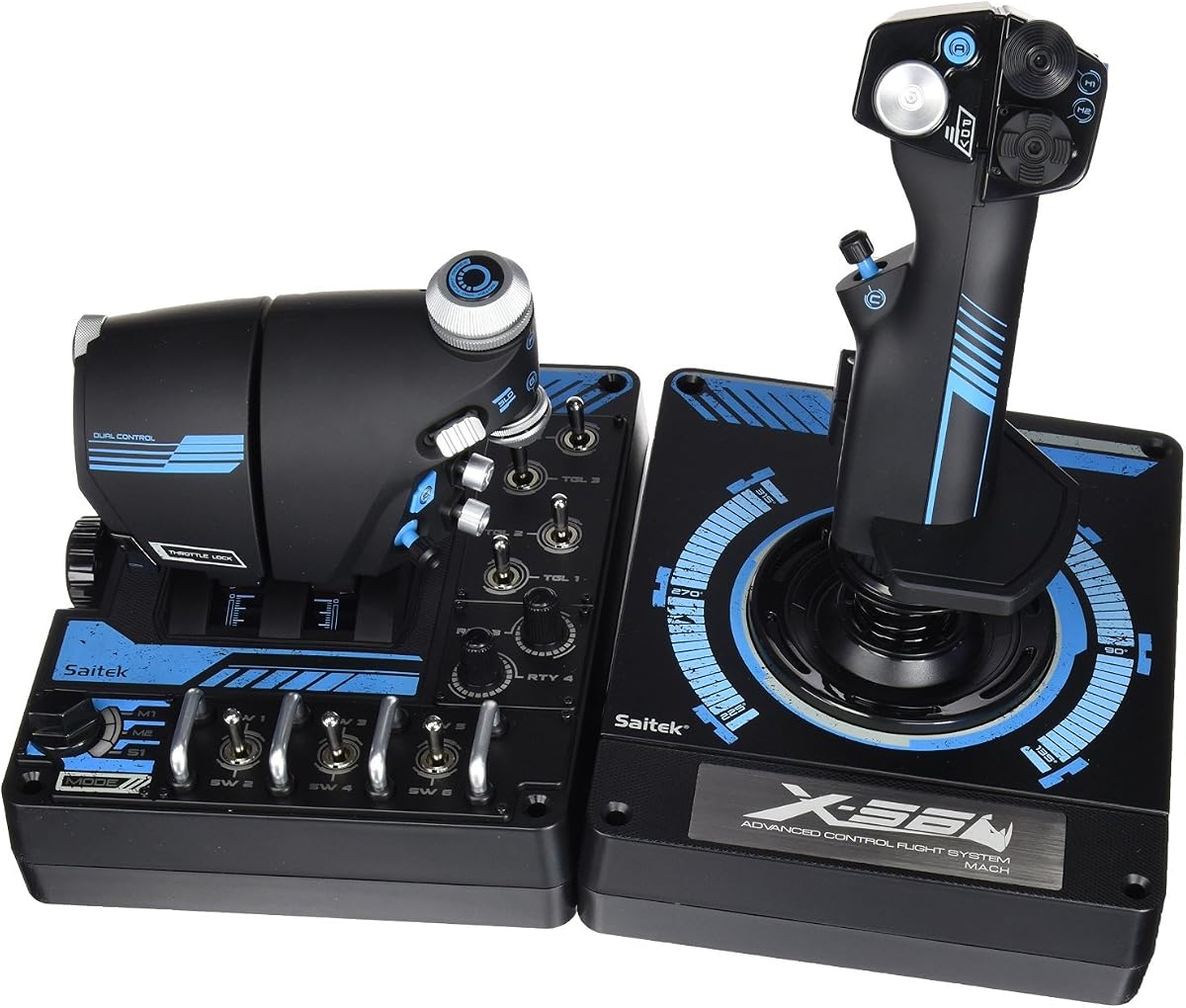
The Logitech G X56 H.O.T.A.S earns a 4.0 rating and stands out as a comprehensive PC control system for space and flight simulators. Its combination of a main flight stick, twin throttles, numerous programmable controls, and a separate mini analog stick gives pilots several ways to operate a spacecraft without relying on a mouse and keyboard.
We may earn a commission when you buy through this link, at no additional cost to you.
Its most important feature is the adjustable four-spring stick system, which lets users tune the feel of the main axes rather than accepting a single fixed response. The 16-bit aileron and elevator axes use hall-effect sensors, while the twin throttles include a friction adjuster and throttle lock. The mini stick can handle directional movement and separately controlled gimballed weapons, which is particularly relevant in games featuring independent turret or weapon targeting.
The trade-off is complexity. A 4.0 rating suggests the X56 is capable and well established, but its many inputs, two USB connections, and extensive configuration requirements can overwhelm new pilots. It also targets Windows PC rather than a broader console ecosystem, and the physical arrangement of the throttle controls and weapon stick may take time to master. Even so, these are manageable issues for a space-sim enthusiast willing to invest time in setup.
This is a strong recommendation for PC players who want a full-featured HOTAS arrangement with independent weapons control and adjustable physical feedback. It is less suited to someone seeking a simple controller, a console-compatible system, or a compact desktop setup. For those priorities, the T-Flight Hotas X offers a more approachable route.
The four-spring system is the X56's most useful feature for matching a control stick to a particular simulator or spacecraft. Combined with 16-bit aileron and elevator axes, it offers meaningful control over movement and resistance rather than a single fixed configuration.
The mini analog stick provides dedicated pitch, roll, yaw, forward, backward, and directional control for spacecraft weapons. That separation can make it easier to keep weapon targeting independent from the main flight axes during complex maneuvers.
We may earn a commission when you buy through this link, at no additional cost to you.
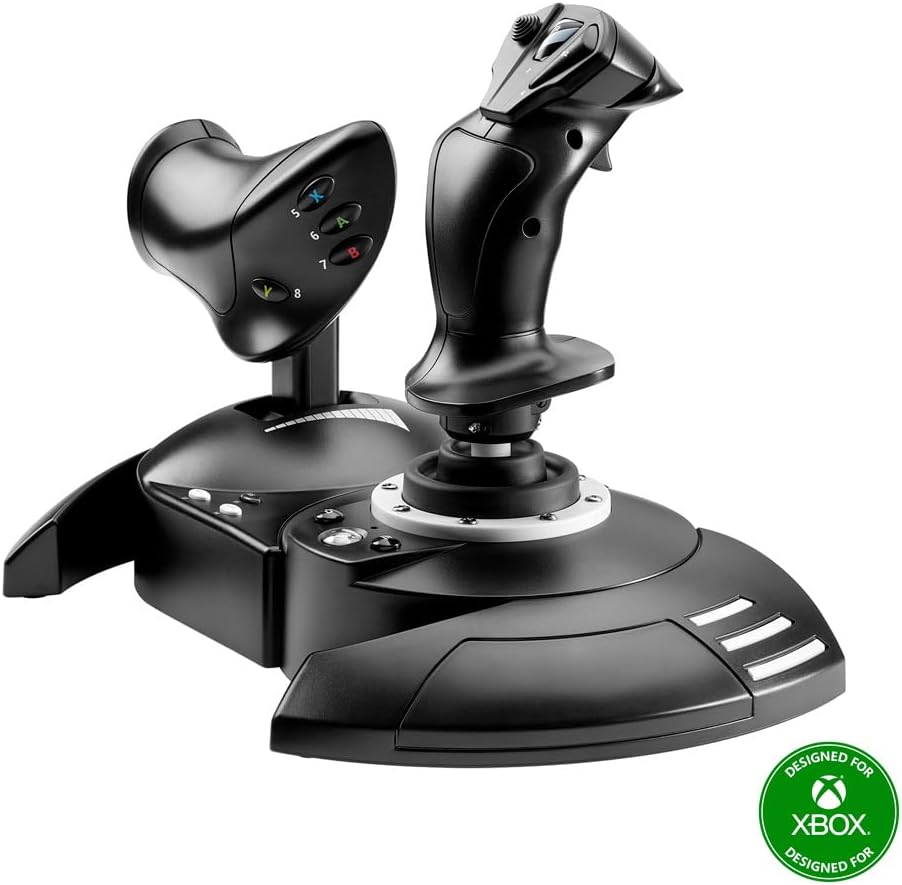
The Thrustmaster T-Flight Hotas X carries a 4.5 rating and provides one of the most approachable ways to enter a dedicated HOTAS arrangement. It joins a flight stick and full-size throttle, but the detachable design lets a pilot keep both components together on a desk or position them separately for a more comfortable control layout.
We may earn a commission when you buy through this link, at no additional cost to you.
All 12 action buttons and five axes are programmable, while the resistance dial adjusts the main stick. A dedicated mapping button permits functions to be switched between profiles during a session, and built-in memory retains custom programming after the device is disconnected. The included preset and plug-and-play configuration reduce setup friction, making the system easier to recommend to pilots who are still learning how flight controls map to simulator functions.
Compared with the Logitech X56, the Hotas X offers fewer programmable inputs and less elaborate mechanical adjustment. Its twin-throttle and multi-axis arrangement is not described with the same level of sensor and resistance detail, so buyers seeking extensive customization may find the X56 more capable. Nevertheless, the Hotas X covers the essential needs of a space-sim pilot: attitude control, thrust management, programmable commands, and a stable weighted base.
Choose the Hotas X if you want a capable, comfortable, and approachable PC HOTAS without moving directly to a premium, highly complex system. It is particularly suitable for new space-sim players, desktop pilots, and anyone who values a detachable throttle and quick profile switching.
The detachable throttle gives the setup unusual flexibility for an entry-level HOTAS. It can remain beside the stick for a compact arrangement or move to a separate surface when desk space, cable routing, or arm positioning requires a different layout.
The mapping button allows functions to be switched between configurations while the game is running, while onboard memory preserves customized settings. This is useful when one spacecraft benefits from different bindings than another.
We may earn a commission when you buy through this link, at no additional cost to you.
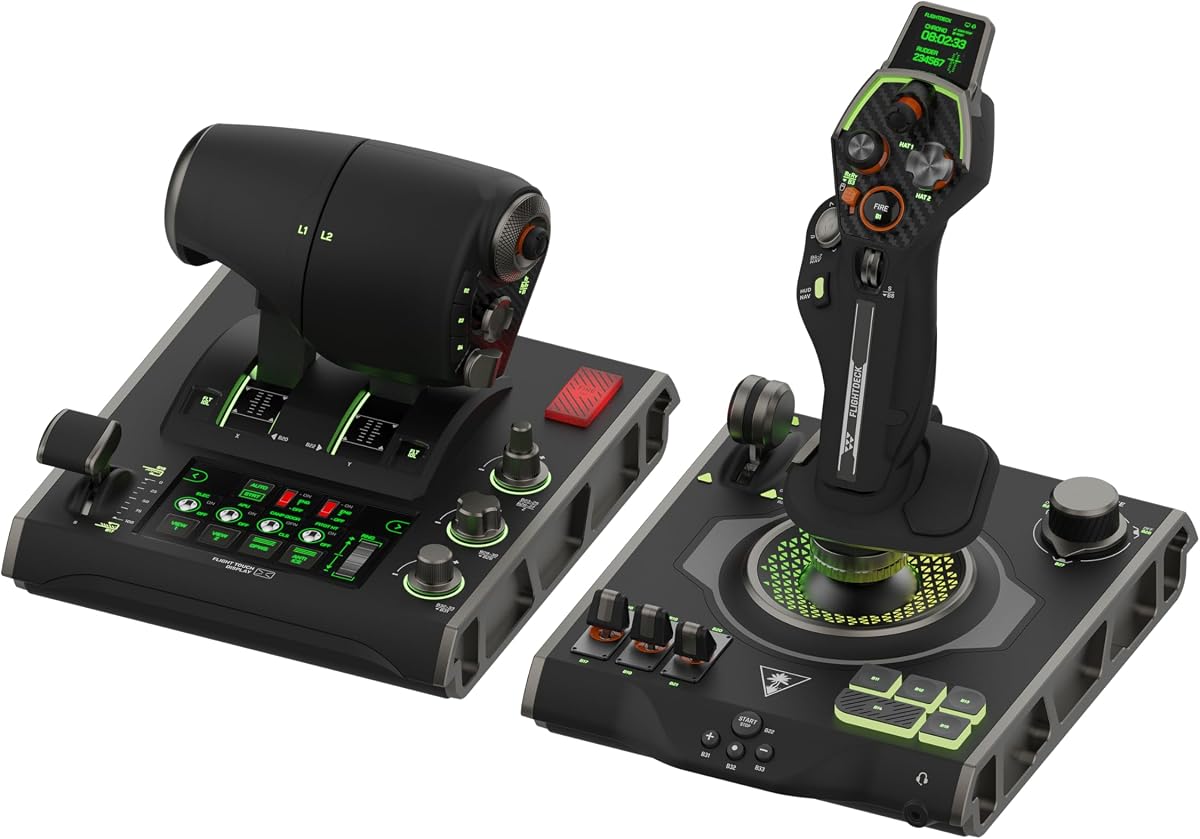
The Turtle Beach VelocityOne Flightdeck is the most feature-dense dedicated HOTAS in this roundup, holding a 3.0 rating while offering a remarkable 139 programmable buttons. Its stick module includes a gear lever, a three-position rotary dial, and 39 buttons, making it a natural fit for space-sim pilots who want direct access to many systems from one device.
We may earn a commission when you buy through this link, at no additional cost to you.
The Flightdeck differentiates itself with an innovative flight touch display and a customizable OLED head-up display. Those screens can provide information and touch control close to the stick, reducing the need to depend exclusively on an in-game interface. Contactless hall-effect controls, adjustable stick height, haptic throttle detents, onboard headset audio enhancements, and multi-zone RGB lighting add further ways to tailor the experience.
The main concern is that the listed rating of 3.0 is lower than those of the other dedicated systems reviewed. Its complexity, large control surface, and extensive setup also demand more desk space and a deliberate configuration process. The Flight Hangar desktop app is provided for customization, but a buyer should be prepared to invest meaningful time assigning controls and learning the layout rather than expecting every advertised function to be immediately useful.
Buy the Flightdeck when maximum input capacity, integrated flight information, and a premium control surface matter more than a simpler setup or a higher listed rating. It is aimed at dedicated simulation enthusiasts with demanding software preferences and enough space for a cockpit-like arrangement.
The full-color touch display and customizable OLED provide two ways to surface relevant flight information directly on the control unit. For space sims, this can keep speed, attitude, or system data visible without requiring every readout to occupy a separate game display.
With 139 programmable buttons and a stick module containing 39 buttons, a gear lever, and a rotary dial, the Flightdeck supports highly individualized layouts. It is especially compelling for pilots who want direct access to numerous spacecraft systems.
We may earn a commission when you buy through this link, at no additional cost to you.
The Thrustmaster T16000M FCS holds a 4.2 rating and is built around a precise 3D stick with hall-effect magnetic sensors. Although its product title identifies it as a HOTAS for PC, the supplied specifications emphasize a standalone joystick design, so it should be considered when a pilot prefers a conventional flight stick rather than an integrated throttle console.
We may earn a commission when you buy through this link, at no additional cost to you.
The controller provides four independent axes, including twist rudder, and offers a substantial selection of physical controls. The supplied description refers to 16 action buttons while also listing 14 action buttons alongside the controls, a small inconsistency in the product information. The practical appeal remains clear: hall-effect sensing, an eight-way point-of-view hat, two four-way switches, a two-position slider, and a push mini-stick create several ways to map commands.
The main limitation is the absence of a dedicated throttle in the stated feature set. A space-sim player who already owns a throttle could use the T16000M FCS as the attitude-control half of a larger setup, but new pilots seeking a ready-made HOTAS should verify exactly which components are included. Its Windows compatibility also makes it more suitable for PC than console users.
The T16000M FCS is best for experienced PC pilots who value a precise stick, conventional buttons, and twist-rudder control. It is less convenient as a complete first HOTAS purchase because the advertised setup does not clearly include the throttle hardware needed for a full spacecraft control arrangement.
The three-axis hall-effect magnetic sensors are the product's central technical feature. They support pilots who want a conventional precision stick rather than a crowded all-in-one HOTAS layout.
Because the published feature set focuses on the stick and does not identify a bundled throttle, space-sim pilots may need an additional thrust control. Matching that separate device can also make it easier to arrange controls ergonomically.
We may earn a commission when you buy through this link, at no additional cost to you.
This Logitech bundle combines the X56 H.O.T.A.S with Pro Flight Rudder Pedals and carries a 4.6 rating, the highest listed rating among the ten products. It provides a broad control foundation for space and flight sims in which yaw, directional control, and braking add useful realism or make a landing approach more manageable.
We may earn a commission when you buy through this link, at no additional cost to you.
The X56 portion contributes 16-bit aileron and elevator axes, a four-spring stick system, twin throttles, RGB lighting, and a separate mini analog stick for directional and weapons-related input. The pedal component adds smooth, self-centering rudder control, an adjustable tension dial for a lighter or more robust response, and differential toe brakes for directional stopping control.
The tradeoff is footprint and redundancy. A complete three-piece arrangement takes more desk space than a self-contained HOTAS, and pilots flying spacecraft that rely mainly on rotational controls may not use the pedals constantly. The bundle also combines two established control functions, which is convenient but less flexible than assembling a stick, throttle, and pedal set individually according to personal preference.
This is a strong recommendation for PC pilots who want the X56's broad control set and realistic rudder movement in one package. Choose it when landing maneuvers, ground handling, and directional control are important parts of your simulator experience and you are willing to reserve space for the pedals.
The self-centering rudder pedals provide a dedicated way to manage yaw input. In spacecraft that demand controlled rotation, that axis can be easier to handle with pedals than with a hand-controlled rudder input.
The pedal tension dial can provide a lighter response for small aircraft or a firmer feel for heavier vehicles. That adjustability helps the same bundle serve a wider range of simulated flight styles.
We may earn a commission when you buy through this link, at no additional cost to you.
The Logitech G Pro Flight X56 Rhino earns a 4.0 rating and represents a proven style of HOTAS design: a large flight stick, twin throttles, and a separate mini stick within a single frame. Its specification emphasizes the same control depth that makes the X56 family appealing to dedicated PC simulation pilots.
We may earn a commission when you buy through this link, at no additional cost to you.
The 16-bit aileron and elevator axes use hall-effect sensors, and the Advanced 4-Spring System makes the main stick's physical response adjustable. Twin throttles come with a friction adjuster and lock, while the mini analog stick can independently control pitch, roll, yaw, and weapon-related movement. RGB backlighting allows the unit to match the rest of a gaming setup and can make controls easier to identify.
As with the standard X56, the primary disadvantage is the density of the learning curve. The stick, throttles, mini stick, and numerous switches demand careful binding and physical practice. A pilot accustomed to a simple gamepad may initially struggle to remember which surface performs each action, while a pilot with prior HOTAS experience may find the layout intuitive.
The X56 Rhino is a compelling choice for PC players who want a traditional, densely equipped HOTAS with precise axis resolution and adjustable mechanics. It is particularly useful for space sims that separate flight, thrust, and weapons commands across different control surfaces.
Four spring settings allow pilots to choose how strongly the stick returns toward center. This is valuable for matching the feel of a small agile craft with that of a larger, more stable spacecraft.
Twin throttles with an adjustable friction control and locking function can represent separate propulsion or system inputs. The lock can also keep a selected setting stable during a maneuver.
We may earn a commission when you buy through this link, at no additional cost to you.
The Meza Mount-HOTAS Desk Mount is a two-piece mounting system with a 4.6 rating, and it targets pilots who already own a compatible Thrustmaster Warthog, WinWing Orion 2, VPC WarBRD-D, or VPC MongoosT-50CM 2/3 setup. It can place the joystick and throttle on opposite sides of the desk for a more stable and cockpit-like arrangement.
We may earn a commission when you buy through this link, at no additional cost to you.
Both mounting brackets support height and position adjustment, which helps bring controls to a comfortable level and reduces the need to prop up equipment at awkward angles. The construction uses reinforced metal mounting plates and aluminum profile support columns, giving heavier HOTAS hardware a rigid base during takeoff, landing, combat maneuvers, and training sessions.
This is an accessory rather than a flight controller. No joystick, throttle, yoke, panel, or other control is included, and the listed compatibility should be checked carefully before purchase. It also does not solve the need for software, sensors, or programmable inputs; it simply improves the physical placement of compatible hardware.
Choose the Meza mounts when your priority is a stable, organized, height-adjustable home cockpit. They are particularly useful for dedicated pilots who find a loose desk-mounted stick shifts under force or who want independent placement of the joystick and throttle.
Rigid metal plates and aluminum columns reduce movement compared with an unsupported or lightly braced device. That stability can make aggressive spacecraft maneuvers feel more consistent.
Mounting the joystick and throttle separately allows each hand to remain in a natural position. Adjustable height and position also help reduce cable clutter and make a complete setup more comfortable.
We may earn a commission when you buy through this link, at no additional cost to you.
The Dardoo Multi-functional Racing Flight Simulator Cockpit Stand carries a 4.3 rating and is designed for pilots who want one physical platform to support both flight and racing equipment. It is compatible with a broad list of controls, including Logitech G29, G920, X56, X52, and Pro Rudder Pedals, as well as several Thrustmaster, Turtle Beach, and VKB products.
We may earn a commission when you buy through this link, at no additional cost to you.
Three interchangeable mounting panels allow the stand to convert between flight and racing arrangements. The side panels can move forward, backward, up, down, and left, as well as rotate 90 degrees. The center panel offers movement and tilt, while the pedal panel can be repositioned and tilted. A 40-by-40-millimeter square alloy steel frame and right-angle welded joints form the structural core.
The limitation is that this is a stand, not a HOTAS or flight-control package. No electronic devices are included, and the frame may take more space than a simple desk setup. A buyer should also check the precise dimensions and listed device compatibility, particularly when combining accessories or less common control units.
The Dardoo stand is most useful for space-sim pilots who also race, value repeated layout changes, or want a more permanent installation. It can turn a mixed-use gaming space into a flexible flight and racing station without buying separate support structures for each activity.
The interchangeable panels let the same frame support different control arrangements. This is a practical advantage for enthusiasts who regularly move between spacecraft flight simulations and vehicle racing games.
The broad movement and rotation ranges make it possible to place a stick, wheel, or pedal unit close to the pilot. Fine positioning can improve comfort and make repeated access to controls more consistent.
We may earn a commission when you buy through this link, at no additional cost to you.
The Turtle Beach VelocityOne H.O.T.A.S has a 2.6 rating and combines PC and Xbox support with 73 programmable inputs and 15 axes. Its stated feature set gives it the appearance of a versatile modern command center for pilots who want more programmability than a conventional flight stick without moving to the highest-density premium system.
We may earn a commission when you buy through this link, at no additional cost to you.
The product uses 16-bit hall-effect sensors for the Flightstick II control and includes a full-color display for real-time flight data and quick tuning. Swappable dual-throttle detents provide tactile thrust reference points, while adjustable throttle resistance and stick tension let users alter the physical response. An adjustable left- or right-handed grip, customizable RGB lighting, and expandable support for pedals and mounting solutions broaden the setup options.
The 2.6 rating is the lowest listed among the products here and is the most important reason for caution. A lower score can reflect limited customer history, unmet expectations, or specific compatibility and usability issues, and the supplied data does not explain the underlying causes. Buyers should therefore examine recent customer feedback and confirm software support for their exact simulator and platform.
The VelocityOne H.O.T.A.S is worth considering for cross-platform players who prioritize a display, adjustable grip, swappable detents, and a broad set of programmable inputs. It is a less secure recommendation than the higher-rated traditional HOTAS systems, but the feature combination may appeal to pilots building a modern PC-or-Xbox setup.
Support for both PC and Xbox makes the controller useful to players who switch hardware. The 73 programmable inputs and 15 axes provide a broad foundation for individual spacecraft commands.
Swappable dual-throttle detents create tactile reference points that can be recognized without looking. Adjustable resistance and stick tension add further control over the feel of the main flight axes.
We may earn a commission when you buy through this link, at no additional cost to you.
The Thrustmaster T-Flight Hotas One has a 4.4 rating and offers a straightforward PC-and-Xbox option for space and flight simulation. Its combination of an adjustable-resistance flight stick, responsive trigger, hat switch, programmable buttons, and detachable throttle gives players the main inputs required for basic spacecraft control.
We may earn a commission when you buy through this link, at no additional cost to you.
The detachable throttle can remain with the stick for a desktop arrangement or be placed separately, making it adaptable to different room and cockpit layouts. USB connectivity and preconfigured behavior simplify setup, while compatibility with Windows PC and Xbox Series X|S broadens its appeal beyond desktop simulation.
Compared with premium HOTAS systems, the Hotas One has less control density and no elaborate integrated display. It also lists compatibility with Thrustmaster TFRP rudder pedals, but those pedals are sold separately, so pilots who want full rudder control will need an additional purchase. The benefit is a less intimidating system that should be easier to introduce to newer players.
The Hotas One is a strong pick for console and PC pilots who want a detachable HOTAS without a complex configuration process. It works particularly well for players who value clear ergonomics, straightforward installation, and the flexibility to use the throttle on a separate surface.
PC and Xbox support gives the product a useful place in a mixed hardware setup. The plug-and-play approach also reduces the need for complicated configuration before entering a simulator.
The detachable throttle can be kept beside the stick or moved to a separate position around the desk. That flexibility helps pilots create a more comfortable arrangement without moving the entire controller.
We may earn a commission when you buy through this link, at no additional cost to you.
The right Hotas setup for space sims depends on how you fly, which programs you use, and how much control density and physical adjustability you need. Consider the hardware, software, ergonomics, and expansion path together rather than focusing on a single specification.
A true HOTAS places flight and thrust controls on one accessible surface, while modular systems let the joystick and throttle sit together or independently. Space sims often demand both attitude input and thrust management, so a detachable throttle can help place each hand naturally and reduce the need to reach across a crowded desk. The T-Flight Hotas X and Hotas One are particularly flexible in this respect, while the Logitech X56 family places both functions in a more integrated frame.
Choose an integrated layout for a unified cockpit feel, or a modular layout for easier positioning. Make sure the controls include enough physical movement for the aircraft types and maneuvers you expect to fly.
Hall-effect sensors are prominent across the higher-feature controls in this guide, including the Logitech X56, Thrustmaster T16000M FCS, Turtle Beach VelocityOne Flightdeck, and VelocityOne H.O.T.A.S. The Logitech models also specify 16-bit aileron and elevator axes, while the VelocityOne H.O.T.A.S identifies 16-bit hall-effect sensors for its Flightstick II control. These details matter when a pilot wants fine control during slow maneuvers, close flying, or precise spacecraft positioning.
Prioritize sensor technology and axis resolution when precision is your main concern. Also consider whether the control feels stable and comfortable, because numerical resolution cannot compensate for an unsuitable layout.
Space simulators often expose more commands than a gamepad can reasonably handle, including targeting, subsystems, views, communications, and spacecraft management. The Turtle Beach Flightdeck leads the supplied products with 139 programmable buttons, while the VelocityOne H.O.T.A.S offers 73 programmable inputs and 15 axes. The Logitech X56 and Thrustmaster T-Flight Hotas X also provide extensive controls, including separate mini-stick or button assignments.
Match capacity to your software and preferred mapping style. More inputs can improve access, but only if you can identify and remember them comfortably during a busy maneuver.
Stick resistance, throttle friction, spring settings, detents, and grip position determine how a control feels over time. The Logitech X56 family uses an Advanced 4-Spring System, the T-Flight products include adjustable resistance, and the VelocityOne H.O.T.A.S provides adjustable throttle resistance, stick tension, and swappable detents. These features are especially useful when one setup must cover different spacecraft with distinct handling characteristics.
Adjustability is more valuable than a one-size-fits-all feel. Test the range of settings when possible, and prioritize controls that can be changed without forcing you to rebuild the entire desk arrangement.
A flight controller is only as useful as the software used to assign commands. The T-Flight Hotas X includes preconfigured controls, a mapping button, and built-in memory. The Turtle Beach Flightdeck uses the Flight Hangar desktop app for product customization, while the VelocityOne H.O.T.A.S uses VelocityOne Flight Hangar for settings and personalization. Logitech models also support software-based control and lighting customization.
Check the required software, operating system, and compatibility with your simulator. A system with abundant buttons is less valuable if mapping is difficult or profiles cannot be saved reliably.
Integrated displays can keep useful flight information close to your hands and reduce screen space required for auxiliary readouts. The Turtle Beach Flightdeck combines a flight touch display with a customizable OLED, while the VelocityOne H.O.T.A.S uses a full-color display for real-time data and tuning. These features are most valuable in complex space sims where multiple systems compete for attention.
A display is useful only if the software supports it clearly. Verify what information can be placed on-screen and whether touch controls add value for your preferred simulator.
PC support is common in this category because many detailed flight simulators are PC-focused. The Logitech X56 and T16000M FCS list Windows compatibility, and the T-Flight Hotas X is designed for PC. By comparison, the T-Flight Hotas One supports both Windows PC and Xbox Series X|S, while the VelocityOne H.O.T.A.S lists Xbox and PC compatibility. Confirm the exact system before buying, especially if you alternate between platforms.
Do not assume a gamepad-compatible device will function identically in every simulator. Check the controller's connection method, supported platform, and required software before making a final decision.
A stable control surface can make a significant difference during extended sessions. The Meza Mount-HOTAS provides two adjustable metal desk mounts for compatible Thrustmaster, WinWing, and VPC hardware, while the Dardoo stand supports a wider range of flight and racing equipment using interchangeable panels. Neither accessory includes electronic controls, so they should complement rather than be mistaken for a complete HOTAS.
Choose a mount when your existing hardware shifts, sits at an uncomfortable height, or leaves cables and controls in the way. Confirm exact compatibility, available space, and whether a rigid fixed layout will be more useful than a portable desktop arrangement.
Begin by installing the supplied control software and connecting the joystick, throttle, and any separate pedals. Open the device configuration page, update the control center if available, and confirm that the simulator recognizes each axis, button, hat switch, and throttle direction. Test the setup in a simple or empty environment before flying a demanding mission.
Create a clear binding scheme instead of assigning commands randomly. Reserve consistent locations for attitude, thrust, targeting, views, and spacecraft systems, and save the layout under a descriptive profile. If the controller supports in-game profile switching, use it to alternate between light fighter, heavy spacecraft, and transport configurations. Take time to learn the physical position of each control without looking down.
For long sessions, adjust the throttle and stick to the limits of your movement and mount the equipment securely. Keep cables clear of the control path, clean the housing with a soft dry cloth, and avoid pulling the controller by its cables. Periodically check the software for updates and revisit the resistance, tension, and friction settings as your preferred control style evolves.
A HOTAS is a flight control system that combines or closely integrates a joystick and throttle so both can be operated without moving to separate devices. In space sims, it can simplify access to attitude controls, engine thrust, targeting, and other spacecraft commands. A modular HOTAS may also allow the joystick and throttle to be positioned independently.
A HOTAS is generally better when you want more precise and immersive control over movement and thrust. A gamepad may be simpler for casual play, but it offers fewer physical inputs and less direct control of a spacecraft. The best choice depends on your experience, preferred game style, and willingness to customize bindings.
They are not essential for every spacecraft or simulator, but they can make yaw and directional maneuvers feel more natural. The Logitech X56 bundle and the Dardoo stand support pedal-based setups. If you fly aircraft that frequently require rudder control during takeoff, landing, or ground movement, pedals can add meaningful control.
The Thrustmaster T-Flight Hotas X and T-Flight Hotas One are approachable options because they use straightforward layouts and require relatively little initial configuration. The Hotas X includes preconfigured controls, profile mapping, and onboard memory. As with any flight controller, a beginner will still need time to memorize inputs and practice basic maneuvers.
Hall-effect sensors use magnetic sensing to register control movement, which is a key feature of several products in this guide. They are associated with precise, contactless sensing in the listed specifications. The overall experience also depends on axis resolution, control feel, software, and ergonomic fit.
An integrated design offers a unified cockpit layout and keeps related controls on one surface. A detachable design gives you more freedom to position the throttle where it feels comfortable and may work better on smaller desks. The Logitech X56 illustrates the integrated approach, while both T-Flight Hotas products allow the throttle to be separated.
A compact modular system may fit on a modest desk, while a dense unit such as the Turtle Beach Flightdeck needs more room for the control surface, mouse, keyboard, and display. Add extra space if you plan to use rudder pedals or a fixed mount. Checking the product's dimensions and your own seated reach is essential before ordering.
Most of the listed devices support customizable controls, but each simulator may require a separate mapping or profile. Products such as the T-Flight Hotas X and VelocityOne systems make profile management a notable feature. Save one configuration per simulator and verify that every required command is assigned before beginning a mission.
The Thrustmaster T-Flight Hotas X is the best budget starting point for a PC pilot because it combines an approachable detachable layout, 12 programmable buttons, five axes, adjustable resistance, and quick profile mapping. The Logitech G Pro Flight X56 Rhino is the editor's choice for pilots who want a traditional, densely equipped HOTAS with 16-bit axes, hall-effect sensing, twin throttles, and an adjustable spring system.
The Turtle Beach VelocityOne Flightdeck is the premium selection for a high-control-density setup, offering 139 programmable buttons, a touch display, an OLED, contactless hall-effect controls, and adjustable haptic throttle detents. Before choosing any model, prioritize the control layout, software support, platform compatibility, and adjustability that match the spacecraft you actually fly rather than selecting solely on input count.
Finally, check current prices, recent customer feedback, software requirements, and physical dimensions before purchasing. Product ratings, availability, promotions, and compatibility can change, and the best setup is ultimately the one that feels natural under your hands while providing the commands your simulator requires.