
Dell Precision 7680 RTX 2000
5.0Editor score
NVIDIA RTX 2000 Ada
64GB DDR5 CAMM memory
Two terabyte NVMe storage
Four external 4K displays
Workstation-class connectivity
Choosing a laptop for electrical engineering means balancing processor performance, memory capacity, graphics capability, display quality, and the need to move between a desk, laboratory, classroom, and field site. Electrical engineering workloads can range from circuit simulation and PCB design to programming, embedded development, power-system analysis, and machine learning. The right system must handle demanding applications while remaining dependable and manageable throughout a demanding academic or professional schedule.
This guide compares the processor, memory, storage, graphics, display, connectivity, operating system, portability, and stated application compatibility of ten available laptops and engineer-themed accessories. It covers workstation-class Dell, Lenovo, and HP systems, an everyday HP laptop, and two sticker sets for personalizing engineering gear. The comparison emphasizes documented specifications and intended workloads rather than claiming personal testing or independent laboratory validation.
Each review explains who the product is best positioned to serve, what makes it useful for electrical engineering, and where compromises may appear. The leading workstation options offer stronger processing, memory, and graphics resources, while the more portable models emphasize field productivity and efficient everyday performance. Product configurations, software requirements, ratings, and prices can change, so readers should verify the current listing and technical details before making a final purchase decision.
5.0Editor score

4.4Editor score

5.0Editor score
As an Amazon Associate we earn from qualifying purchases.
The following side-by-side comparison covers workstation performance, mobile engineering use, everyday computing, and engineer-themed accessories. Specifications are summarized from the supplied product listings and should be checked against the live listing for final configuration details.




The Dell Precision 7680 i9 is a high-performance mobile workstation with a 4.4 rating and a configuration built around the Intel Core i9-13950HX vPro processor, which can reach 5.5GHz. It combines that processor with 32GB of DDR5 CAMM memory and a 1TB PCIe NVMe M.2 SSD, creating a strong foundation for electrical engineering simulations, code development, data processing, and demanding multitasking.
We may earn a commission when you buy through this link, at no additional cost to you.
Its standout qualities are workstation-class connectivity and practical screen support. The 16-inch FHD+ anti-glare display has a 1920-by-1200 resolution, while the system supports up to three external monitors at 4K and 60Hz without a docking station. Two Thunderbolt 4 ports, USB-C, two USB-A ports, HDMI, Ethernet, Wi-Fi 6E, Bluetooth, a backlit keyboard, a numeric keypad, and a privacy-shutter webcam make it adaptable to a laboratory, office, or mobile engineering setup.
The principal compromise is that this configuration lists integrated Intel UHD Graphics rather than a dedicated NVIDIA GPU. It should be particularly attractive to engineers whose work centers on SPICE simulation, MATLAB, Python, embedded tools, automation, large datasets, and professional applications that rely heavily on the processor and system memory. Buyers planning intensive 3D rendering, GPU-accelerated machine learning, or other graphics-intensive analysis should consider one of the RTX-equipped Precision configurations instead.
Overall, this is the most balanced top choice for an electrical engineering student or professional who needs substantial CPU performance, ample storage, enterprise features, and extensive connectivity without requiring a discrete graphics card. Windows 11 Pro, 32GB of memory, and the fast NVMe drive make it especially suitable for multitasked technical work. It is our Editor's Choice because it delivers the strongest general-purpose workstation balance in the list, while the RTX 2000 version is the more specialized premium option.
The Core i9-13950HX provides the strongest stated processor specification among the general recommendations here. That headroom is useful when compiling large codebases, running circuit and control simulations, processing measurement data, or keeping several virtualized development environments open at once.
Thunderbolt 4, HDMI, USB-C, USB-A, and Ethernet make this laptop easier to integrate with oscilloscopes, programmable instruments, network equipment, test benches, and multiple monitors. The three-display support is valuable when separating schematics, simulation results, instrumentation, and documentation.
We may earn a commission when you buy through this link, at no additional cost to you.
This Dell Precision 7680 configuration earns a 4.3 rating and stands out by combining a Core i5-13600HX vPro processor with an NVIDIA RTX 1000 Ada GPU and 6GB of dedicated graphics memory. That discrete GPU makes it a more relevant option for electrical engineers who occasionally use 3D models, computational rendering, GPU-assisted analysis, or visualization rather than relying exclusively on integrated graphics.
We may earn a commission when you buy through this link, at no additional cost to you.
The Core i5 processor can reach 4.8GHz, while 32GB of DDR5 CAMM memory and a 1TB PCIe NVMe M.2 SSD support multitasking and fast application loading. Its 16-inch FHD+ anti-glare display works well for detailed design and analysis. Connectivity is particularly strong, with two Thunderbolt 4 ports, USB-C, two USB-A ports, HDMI, Ethernet, Wi-Fi 6E, and Bluetooth, plus support for up to four external 4K monitors without a docking station.
The RTX 1000 Ada card adds valuable graphics capability, but its 6GB of memory is the limiting factor for very large visualization projects or demanding GPU workloads. The processor is also one tier below the Core i9 configuration in this roundup. For routine electrical engineering work, however, the combination may provide a better balance of general computation and graphics than the first Dell model without stepping up to the larger-memory premium workstation.
This laptop is best suited to an engineer who needs occasional accelerated graphics, a broad port selection, and 32GB of memory for development or simulation. It is less attractive for users whose simulations exclusively require maximum CPU performance, but it is a sensible option for students and professionals working across circuit analysis, CAD, visualization, and general office or field tasks.
The NVIDIA RTX 1000 Ada GPU offers a clear advantage over integrated graphics for 3D visualization and GPU-supported engineering applications. It is a practical middle ground for users who need dedicated graphics but do not require the additional memory of the RTX 2000 Ada configuration.
Supporting up to four external 4K displays is useful for engineers who want to keep a schematic editor, simulation output, instrumentation interface, and reference documentation visible simultaneously. Built-in Ethernet also supports dependable wired connections in offices and laboratories.
We may earn a commission when you buy through this link, at no additional cost to you.
The Lenovo ThinkPad P16s Gen 4 has a 4.0 rating and targets users who need workstation-class practicality without moving to the largest desktop-replacement systems. Its Intel Core Ultra 7 255H processor has eight cores and can reach 5.1GHz, while 32GB of DDR5 memory and a 1TB PCIe SSD provide a capable platform for engineering software, code, virtual machines, and document-heavy workflows.
We may earn a commission when you buy through this link, at no additional cost to you.
The 16-inch WUXGA display uses a 1920-by-1200 resolution, narrow bezels, 400-nit brightness, and an anti-glare coating. Three external monitors can be connected at up to 4K and 60Hz without a docking station. Wi-Fi 7, Bluetooth 5.4, two Thunderbolt 4 ports, two USB-A ports, HDMI 2.1, Ethernet, a fingerprint reader, and a backlit keyboard make it a well-rounded mobile system for technical work.
Its main limitation is the absence of a stated discrete GPU. This means the P16s may not be the best choice for heavy 3D rendering, GPU-based machine learning, or visualization involving very large models. The 400-nit panel is also less bright than the 500-nit display listed for the Precision 7780, which may matter in bright outdoor or industrial settings. For code-heavy electrical engineering, control systems, simulation, and productivity, however, the configuration is balanced and appealing.
The P16s is a good recommendation for students and professionals who regularly carry a laptop between classes, offices, laboratories, or client locations. Its combination of a 16-inch workspace, 32GB of memory, modern connectivity, and portable workstation positioning makes it a strong alternative to a heavier mobile workstation. Verify discrete-graphics requirements before choosing it for GPU-centered analysis.
The P16s Gen 4 is designed around a larger display and workstation-class capability while remaining more portable than heavier performance systems. This makes it well suited to an engineering student who needs a full-sized workspace or a professional visiting laboratories and project sites.
Wi-Fi 7 and Bluetooth 5.4 offer current wireless standards, while the fingerprint reader and Windows 11 Pro features add convenience and administrative options. BitLocker, Remote Desktop, Hyper-V, and Group Policy support are particularly relevant to managed academic or corporate environments.
We may earn a commission when you buy through this link, at no additional cost to you.
The 64GB Dell Precision 7680 configuration has a 5.0 rating and is the most resource-rich option in the guide. It combines an Intel Core i7-13850HX vPro processor, 64GB of DDR5 CAMM memory, a 2TB PCIe NVMe M.2 SSD, and an NVIDIA RTX 2000 Ada GPU with 8GB of dedicated graphics memory.
We may earn a commission when you buy through this link, at no additional cost to you.
This combination is well suited to large electrical models, complex simulations, extensive datasets, several virtual machines, and professional applications used in design and engineering. The 16-inch FHD+ anti-glare display supports a four-monitor arrangement at 4K and 60Hz without a docking station. Two Thunderbolt 4 ports, USB-C, two USB-A ports, HDMI, Ethernet, Wi-Fi 6E, and Bluetooth 5.2 create a strong instrument and peripheral interface.
Trade-offs come from the scale of the workstation configuration. A 64GB memory capacity may exceed the needs of a typical student, while the professional GPU and larger storage make this option more specialized than a general-purpose laptop. The listed 45% NTSC color coverage also deserves consideration for color-critical visualization. It is less compelling for users who only need office productivity, lightweight simulation, or maximum mobility.
This is the best premium choice for an engineer or advanced student whose work includes large simulations, graphics-heavy design, substantial memory demand, or heavy multitasking. It is also a logical option for research, controls, power systems, embedded development, and machine-learning workflows that benefit from professional application certification. Users should confirm that their required engineering software is supported in its final hardware configuration.
Sixty-four gigabytes of DDR5 CAMM memory gives the system more room than the other configurations for large data sets, virtualized development environments, and parallel simulation tasks. It also provides headroom for years of evolving academic and professional software requirements.
The RTX 2000 Ada GPU provides eight gigabytes of dedicated graphics memory for visualization and accelerated applications, while the two-terabyte NVMe drive reduces pressure to store large simulation archives locally. The combination is aimed at sustained, technically demanding workloads.
We may earn a commission when you buy through this link, at no additional cost to you.
This Precision 7680 configuration pairs the NVIDIA RTX 2000 Ada 8GB GPU with a Core i7-13850HX vPro processor, 32GB of DDR5 CAMM memory, and a 2TB PCIe NVMe M.2 SSD. Its 3.9 rating places it near the lower end of the rated laptop group, but the underlying specification is well suited to professional engineering applications.
We may earn a commission when you buy through this link, at no additional cost to you.
The dedicated GPU is a major strength for 3D CAD, electrical equipment visualization, rendering, and software with accelerated compute features. The system supports four external 4K monitors, and its two Thunderbolt 4 ports make it convenient to connect high-bandwidth storage, docks, and test equipment. Wi-Fi 6E, Bluetooth 5.2, Ethernet, USB-A, HDMI, and USB-C cover most workstation needs.
The main difference from the 64GB version is memory. Thirty-two gigabytes remains a capable amount for engineering applications, but heavy users running very large simulations, many virtual machines, or memory-intensive AI workflows may encounter less flexibility. The 45% NTSC panel is also less generous for color work than the higher-coverage display offered by the Precision 7780. Its substantial workstation chassis also reduces portability.
This model is a strong recommendation for an engineer who values the RTX 2000 Ada GPU and fast storage but does not need 64GB of memory. It is particularly relevant to CAD, architecture, engineering visualization, video, and design workloads. Compared with the Core i9 integrated-graphics model, it adds a more capable professional GPU; compared with the 64GB model, it offers a more moderate memory allocation.
The eight-gigabyte RTX 2000 Ada is better suited to professional visualization than integrated graphics, particularly for 3D models, rendering, and graphics-assisted engineering applications. It gives users a practical reason to choose this Precision configuration for CAD-heavy work.
The two-terabyte NVMe drive provides useful capacity for simulation outputs, datasets, source repositories, virtual machines, and project archives. Fast storage also improves application loading and transfer responsiveness compared with a conventional hard drive.
We may earn a commission when you buy through this link, at no additional cost to you.
The HP ZBook Firefly 14 G11 combines a 5.0 rating with a notably portable mobile-workstation design. It weighs 3.13 pounds and pairs an Intel Core Ultra 7 165U processor with 32GB of DDR5 memory and a 1TB SSD. The ten-core processor can reach 4.9GHz, making it a capable platform for engineering software, code, and multi-application work.
We may earn a commission when you buy through this link, at no additional cost to you.
Its strongest differentiator is stated certification for professional applications including AutoCAD, CREO, SolidWorks, ANSYS, and MATLAB. That makes the listing particularly relevant to electrical engineers who use a mix of CAD and analysis tools. The 14-inch WUXGA IPS display has a 1920-by-1200 resolution, 300-nit brightness, and anti-glare treatment, while three external monitors can be connected at up to 4K and 60Hz.
The trade-offs are the smaller, less bright screen and the absence of a stated discrete GPU. The 56Whr battery supports fast charging to 50% in 30 minutes, though actual runtime varies with workload and settings. This is also a mobile workstation rather than a basic notebook, so buyers seeking the lowest possible acquisition cost may find other options. Within this guide's professional selections, it is the most mobility-focused recommendation.
The Firefly 14 G11 is ideal for students and professionals who regularly work in laboratories, at equipment sites, or on the move. Its 32GB memory, application certifications, compact weight, and broad port selection create a persuasive mobile engineering package. It is our Best Budget pick within the professional workstation group, although buyers should confirm discrete-GPU needs before ordering.
At 3.13 pounds, the Firefly is substantially easier to carry than the larger 16-inch and 17.3-inch workstation models. Its fast-charging battery system also makes it more practical for a full day of field notes, diagnostics, measurements, and collaboration.
Stated certifications for AutoCAD, CREO, SolidWorks, ANSYS, and MATLAB directly support the needs of many engineering students and professionals. Certification does not replace checking hardware requirements, but it provides a stronger stated foundation than an uncertified general-purpose laptop.
We may earn a commission when you buy through this link, at no additional cost to you.
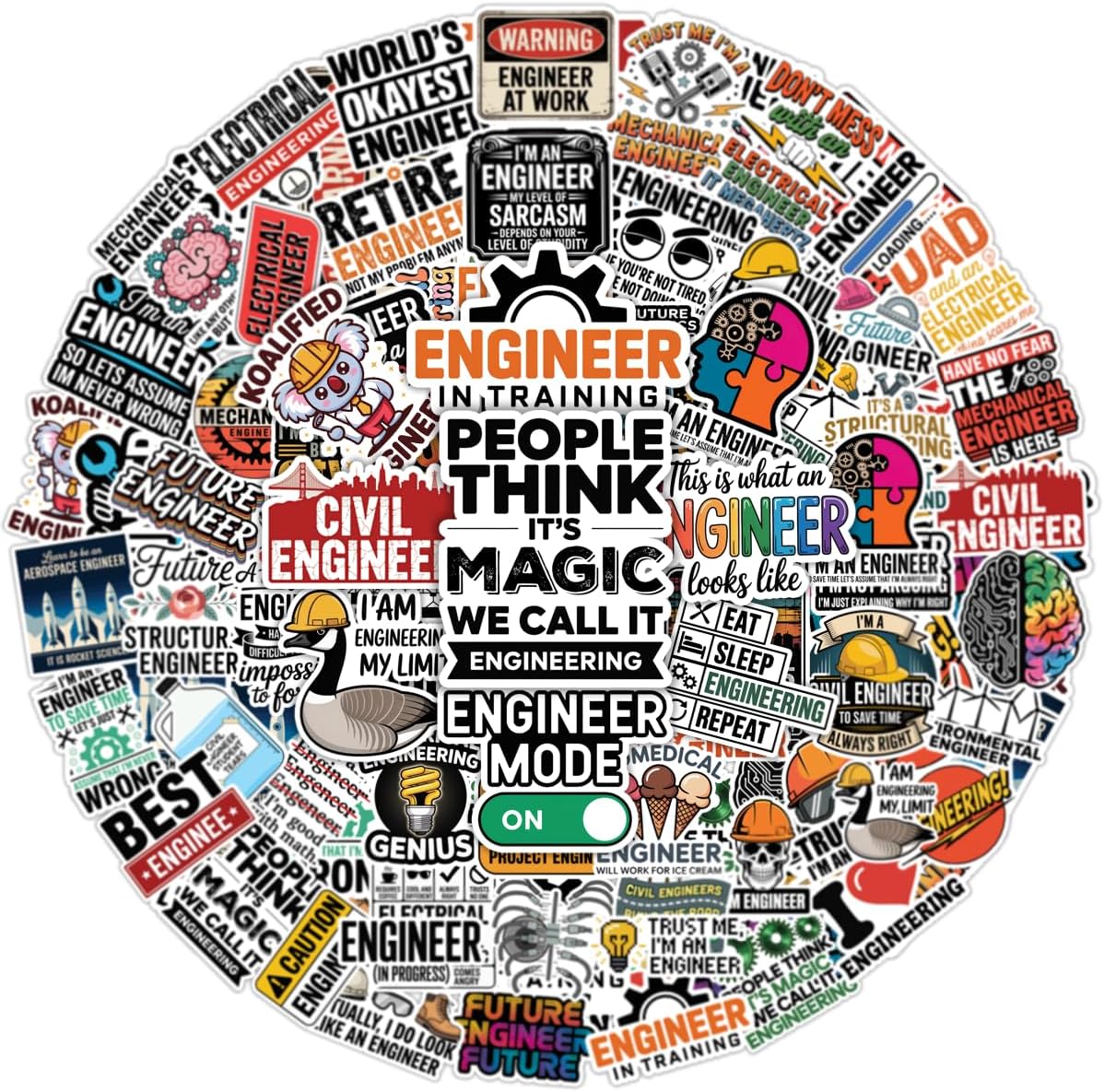
The 64PCS Engineer Stickers set is a personalization accessory rather than a computing device, and no customer rating is available in the supplied data. Nevertheless, it ranks seventh in the source list and may appeal to electrical engineering students, technicians, professors, interns, and professionals who want to decorate a laptop, water bottle, notebook, or toolbox.
We may earn a commission when you buy through this link, at no additional cost to you.
The set contains 64 decals with mechanical, civil, electrical, aerospace, environmental, structural, robotics, and broader STEM themes. The designs include technical graphics, humorous quotations, and engineering-related imagery, offering far more variety than a single decal. Premium PVC vinyl is described as waterproof, UV resistant, and scratch resistant, making the stickers suitable for both indoor and outdoor use.
The stickers are designed to peel and apply to clean surfaces while adhering firmly. The product information also states that they can be removed without leaving residue, although results can depend on surface condition, cleaning, exposure, and removal technique. This is a minor style and gift item, so it should not be confused with a laptop recommendation or considered when assessing compute performance.
This set is best for someone seeking a low-fuss gift, a STEM club activity item, or a way to personalize engineering gear. It can help mark ownership on a shared laboratory laptop or add personality to a water bottle, planner, journal, or toolbox. Electrical engineering buyers should select designs that reflect their discipline and verify the physical dimensions and artwork before applying them to a particular surface.
With 64 designs spanning numerous engineering fields, the set is more versatile than a single themed sticker. Students can personalize several items, while clubs and educators can distribute different graphics among members.
The listed waterproof, UV-resistant, and scratch-resistant PVC construction suits water bottles, notebooks, luggage, toolboxes, and outdoor equipment. Clean the target surface before application for the best adhesion.
We may earn a commission when you buy through this link, at no additional cost to you.
The Dell Precision 7780 is a large-screen mobile workstation built around an Intel Core i9-13950HX vPro processor, NVIDIA RTX 2000 Ada 8GB GPU, 32GB of DDR5 CAMM memory, and a 1TB PCIe NVMe M.2 SSD. The Core i9 can reach 5.5GHz, giving it substantial CPU headroom for simulations, compilation, and multitasking.
We may earn a commission when you buy through this link, at no additional cost to you.
Its most distinctive feature is the 17.3-inch FHD IPS anti-glare display, which has a 1920-by-1080 resolution, 99% DCI-P3 color coverage, and 500-nit brightness. That makes it the strongest stated display option in the guide for color-sensitive visualization and bright work environments. The system supports up to four external 4K monitors, while two Thunderbolt 4 ports, USB-C, USB-A, HDMI, Ethernet, Wi-Fi 6E, and Bluetooth provide extensive connectivity.
As the largest listed workstation display, the 7780 is less convenient for frequent transport than the 14-inch Firefly or 16-inch Precision 7680. The 32GB memory capacity is also lower than that of the 64GB Precision 7680, and no customer rating is available in the supplied information. The RTX 2000 Ada GPU is a clear asset for professional 3D work, although 8GB of graphics memory is not unlimited.
The Precision 7780 is a strong fit for an engineer who values a large, bright, wide-gamut screen, Core i9 processing, and professional graphics in one system. It suits CAD review, technical visualization, power-system modeling, and other complex workflows performed primarily at a desk. Buyers who prioritize a smaller footprint should examine the 16-inch 7680, while those who only need an inexpensive writing and calculation device can consider the OmniBook.
The listed 99% DCI-P3 coverage and 500-nit brightness distinguish the 7780 from the FHD+ anti-glare panels in most other workstation options. Those traits are useful for detailed visualization, media reference, and work in brighter environments.
The Core i9 processor and RTX 2000 Ada GPU create a capable combination for computationally intensive work. The large chassis and display make the system most natural for desk-based engineering rather than constant travel.
We may earn a commission when you buy through this link, at no additional cost to you.
The Electricity Explained sticker set is a small, personality-focused accessory with a 5.0 rating. Its three decals use humorous references to volts, amps, ohms, and physics, making them suitable for electrical engineers, STEM students, physics teachers, and professionals in the electrical trade.
We may earn a commission when you buy through this link, at no additional cost to you.
Unlike the larger 64-piece collection, this set is tightly focused on electrical themes. The decals are made from waterproof, weather-resistant, scratch-resistant vinyl and are intended for hard hats, helmets, laptops, toolboxes, and water bottles. The listing says they apply to clean, smooth surfaces without bubbles or creases and can be removed without sticky residue, making the set easy to reposition.
The included quantity is only three, so buyers looking for a large assortment should choose the 64PCS Engineer Stickers instead. Physical sticker sizes range from two to eight inches, giving options for both small personal items and larger work surfaces. As with any decal, cleanliness, surface texture, weather exposure, and removal method can affect the final result. This item does not contribute to laptop performance or software compatibility.
This set is best for adding a bit of humor to electrical engineering work or as a gift for a student, teacher, technician, or lab team. It can mark a hard hat, decorate a laptop, or personalize a toolbox. As a functional purchase, it ranks below the actual computers because it is an accessory; as a personality accessory, it is focused, portable, and appropriate for workplace or educational environments.
The vocabulary-based design gives the set a direct connection to electrical engineering rather than the broader multi-discipline scope of the 64-piece collection. It works well for hard hats, lab notebooks, laptops, and toolboxes.
Available sizes from two through eight inches allow the graphics to suit both compact bottles and larger equipment surfaces. The three-piece format keeps the set simple while still providing options for different placements.
We may earn a commission when you buy through this link, at no additional cost to you.
The HP OmniBook 3 17.3 has a 4.5 rating and provides a general-purpose option for students who need a large display, efficient everyday computing, and a durable starting point for coursework. Its AMD Ryzen 3 30 processor, Radeon 610M integrated graphics, 8GB of LPDDR5 memory, and 512GB PCIe NVMe SSD cover basic productivity, browsing, documentation, and light multitasking.
We may earn a commission when you buy through this link, at no additional cost to you.
The 17.3-inch full-HD IPS display offers wide viewing angles and a large area for reading schematics, lecture notes, research papers, and technical documentation. The listing states up to 14 hours and 15 minutes of battery life, with fast charging that can restore the battery from zero to 50% in approximately 45 minutes. Wi-Fi 6, Bluetooth 5.4, an FHD camera with HDR auto-switch, and AI noise reduction make it suitable for classes and online collaboration.
The important limitation is that this is not a workstation-class laptop for serious simulation, large CAD assemblies, virtualized laboratories, or other resource-intensive engineering work. Eight gigabytes of memory can become restrictive when running several engineering applications alongside a browser and conferencing tools, and no ISV certifications are stated. Windows 11 Home is also less oriented toward enterprise administration than the Windows 11 Pro configurations elsewhere in the guide.
The OmniBook 3 is most appropriate for a first-year student, a writer or technician who performs light calculations, or a backup computer used for coursework and documentation. It is a reasonable value-oriented companion for electrical engineering study when the main simulator, CAD system, or coding environment will run on another machine. Engineers with substantial simulation requirements should choose a system with more memory and stronger professional specifications.
The 17.3-inch full-HD IPS panel offers enough space for side-by-side reference materials, lecture applications, and written notes. Its wide viewing angles can also make group study and shared-screen work more comfortable.
The NVMe SSD supports quick loading and storage for course documents, code archives, and media. Radeon 610M graphics are suitable for routine visual content, though they are not intended to replace a professional engineering GPU.
We may earn a commission when you buy through this link, at no additional cost to you.
Electrical engineering laptops range from general-purpose study machines to mobile workstations with professional graphics and extensive memory. The most important step is to match the hardware to the software, projects, and mobility demands of your specific program or workplace.
The processor affects compilation time, circuit simulation speed, data processing, spreadsheet responsiveness, and the ability to run several demanding applications simultaneously. Options in this guide include the AMD Ryzen 3 30, Intel Core i5-13600HX, Intel Core i7-13850HX, Intel Core i9-13950HX, Intel Core Ultra 7 165U, and Intel Core Ultra 7 255H. These processors differ not only in advertised clock speed but also in core count, architecture, power use, integrated graphics, and workload-specific behavior. For professional applications, a Core i7 or i9 generally provides more headroom than the entry-level Ryzen 3, while Core Ultra 7 systems balance performance with mobility.
RAM determines how many applications and datasets can remain active without relying heavily on slower storage. The 8GB configuration in the OmniBook is adequate for basic course work, but 32GB is the more practical starting point for engineers running CAD, simulation tools, browsers, IDEs, and communication applications together. The 64GB Precision configuration offers still more capacity for large datasets, parallel simulations, virtual machines, and memory-intensive data science. Memory cannot always be upgraded after purchase, so students should consider the number and type of applications their curriculum will require rather than choosing solely by present-day needs.
Integrated graphics can handle circuit diagrams, documentation, code, and many two-dimensional engineering applications, while a discrete NVIDIA GPU provides a major advantage for 3D CAD, rendering, visualization, and GPU-accelerated computation. The NVIDIA RTX 1000 Ada configuration provides 6GB of graphics memory, while the RTX 2000 Ada options provide 8GB. A professional GPU does not automatically make every laptop suitable for a particular package, so engineers should verify the software vendor's hardware recommendations, especially for GPU solvers, machine learning, and large 3D assemblies.
An NVMe SSD improves application loading, project opening, file transfer, and overall responsiveness. The 512GB OmniBook configuration provides a practical amount of space for courses and documents, while 1TB systems are more comfortable for software installations, simulation archives, virtual machines, and repositories. The 2TB Precision configurations offer additional room for datasets and project files. Capacity should be judged against your storage needs because workstation applications and large simulations can consume considerable space, and retaining every project locally may not be necessary if secure network storage is available.
A large screen can reduce constant window switching, while an anti-glare panel helps with long working sessions. The guide includes 14-inch, 16-inch, and 17.3-inch displays at 1920-by-1200 or 1920-by-1080. The Precision 7780 stands out with 99% DCI-P3 color coverage and 500-nit brightness, while the Firefly uses a more compact 300-nit panel. Resolution alone does not determine usability, so consider desk space, weight, screen glare, color requirements, and whether you regularly connect external monitors. Up to three or four external displays are supported by the professional systems listed here.
Electrical engineers often connect laptops to oscilloscopes, programmable power supplies, logic analyzers, network equipment, and storage systems. Thunderbolt 4, USB-C, USB-A, HDMI, and Ethernet provide a strong basis for that work. A wired Ethernet connection can be more dependable than Wi-Fi in laboratories or industrial environments, while multiple external display outputs help separate schematics, measurements, and simulation results. Wireless standards also matter: the listed systems range from Wi-Fi 6 and 6E to Wi-Fi 7, with Bluetooth versions from 5.2 through 5.4. Check the interfaces required by your instruments before buying.
Electrical engineering students may carry a laptop between classrooms, laboratories, libraries, and project sites, while professionals frequently travel to customer or construction locations. The Firefly 14 G11 is the clearest mobile option at 3.13 pounds, with fast charging and a stated 56Whr battery. The 16-inch models offer more workspace but greater bulk, and the 17.3-inch systems are better suited to a fixed desk. Battery claims should be treated as comparative guidance rather than a guarantee because processor load, display brightness, wireless activity, and GPU use can significantly change real-world runtime.
The Firefly lists certifications for AutoCAD, CREO, SolidWorks, ANSYS, and MATLAB, which is especially relevant for academic and professional workflows. Dell's professional line is also described as carrying ISV certifications and includes workstation-oriented management and support provisions. Certification is more meaningful than a generic claim of suitability because it indicates attention to particular software and hardware combinations. Still, students should confirm the exact version of their required package, operating-system needs, device drivers, and any school-managed deployment requirements. Windows 11 Pro is included across the professional selections, while the OmniBook uses Windows 11 Home.
Begin by installing the current versions of your required engineering tools and confirming that drivers, licenses, plug-ins, and laboratory instruments work with the operating system. Create separate user profiles or virtual environments for major projects, keep simulation input files organized, and use version control for code. For instruments connected through USB or Ethernet, install the appropriate drivers before the first site visit and test a complete acquisition workflow rather than assuming every peripheral will be recognized automatically.
Protect the workstation with a structured backup strategy. Keep source code on version-controlled repositories, back up important simulation files and assignments, and use both local and off-device copies where appropriate. Avoid allowing large temporary caches to consume the entire SSD, and periodically check storage health and available space. Use a surge-protected power source and appropriate transport case, especially when moving the computer between a laboratory, field location, and home.
When applying decorative stickers, clean and dry the surface first, avoid covering ventilation openings, camera lenses, sensors, displays, and port areas, and test one decal before committing to a large collection. For all laptops, keep vents unobstructed, use a stable hard surface, and follow the manufacturer's guidance for cleaning. Monitor temperatures and battery charging habits during sustained simulation work, and schedule manufacturer service or component inspection if thermal behavior, battery condition, or performance becomes abnormal.
Thirty-two gigabytes is a practical minimum for many students and professionals running browsers, IDEs, MATLAB, Python, CAD, and simulation tools together. Sixty-four gigabytes is preferable for large datasets, multiple virtual machines, memory-intensive machine learning, or parallel simulations. A laptop with 8GB can handle basic coursework, but it may feel constrained as the number of engineering applications grows.
It depends on your software and projects. Integrated graphics are usually adequate for code, schematics, documentation, and many two-dimensional analyses. A dedicated NVIDIA GPU is more valuable for 3D CAD, rendering, large visualizations, GPU-assisted simulation, and machine learning, so check the recommended hardware for every application you intend to run.
A 17.3-inch display provides excellent workspace and is often comfortable for desk-based work, but it can be cumbersome in lecture halls, libraries, and laboratories. A 14-inch mobile workstation may be a better fit for students who carry a computer every day. Your daily mobility needs should be weighed against the value of a larger screen and workstation chassis.
Many circuit and control simulations depend heavily on processor performance and memory, while some analysis packages can use a GPU for selected calculations. A fast multicore processor with 32GB or more memory is therefore a good general starting point. For GPU-enabled packages, verify that the specific solver and dataset fit within the available graphics memory.
Windows 11 Pro is generally the better choice for professional or school-managed environments because it includes features such as BitLocker, Remote Desktop, Hyper-V, and Group Policy support. Windows 11 Home may be sufficient for personal study, particularly with cloud-based tools and ordinary academic software. Institutional IT requirements should take priority over general preference.
The listed Firefly, ThinkPad P16s, and integrated-graphics Precision 7680 support up to three external monitors, while the RTX 1000 and RTX 2000 Precision 7680 configurations and the Precision 7780 support up to four. The listing states that these configurations can output up to 4K at 60Hz without a docking station, but operating-system and display-driver settings should still be confirmed.
A workstation laptop is not required for every assignment. It becomes more valuable when coursework includes intensive simulations, 3D CAD, large data analysis, rendering, or professional software with demanding certification requirements. A capable general-purpose laptop may be enough for introductory theory and lighter software, but confirming the curriculum can prevent buying more than needed or too little.
Check the exact processor, graphics card, memory, storage type, display, ports, operating-system edition, and warranty terms on the live listing. Software requirements should be compared against those specifications, especially for 3D and GPU-accelerated applications. Ratings, configurations, promotions, and prices can change, so treat this guide as a decision framework rather than a substitute for the current product page.
The Dell Precision 7680 with the Core i9 processor is the strongest overall recommendation for users who need high CPU performance, 32GB of memory, fast storage, extensive ports, and a professional operating system. The 64GB RTX 2000 configuration is the best premium choice for memory-intensive, GPU-enabled engineering, while the HP ZBook Firefly 14 G11 is the most mobile and explicitly engineering-certified option. Each serves a distinct need, so workload requirements should determine the final selection.
For most engineering students, 32GB of RAM, a fast NVMe SSD, a capable Core Ultra 7 or Core i7-class processor, and a display large enough for comfortable documentation form a practical foundation. Add a supported discrete GPU when 3D CAD, rendering, visualization, or accelerated computing is central to the work. Those who need only lightweight course tools can consider the OmniBook, while the two sticker sets should be viewed only as optional personality or gift accessories.
Before purchasing, verify the current listing for processor, GPU, memory, storage, display, software certifications, institutional requirements, and warranty coverage. Configuration details and prices change over time, and engineering software can place specific limits on supported hardware. Confirm those requirements first so the selected laptop remains useful across coursework, laboratory work, internships, and long-term professional development.