
Techex 48V 100Ah
4.7Editor score
5.12kWh rack-mount capacity
WiFi and Bluetooth monitoring
Automatic fire suppression
CAN and RS485 communication
This LiFePO4 server rack backup battery kit guide compares 48V capacities, rack fit, safety features, inverter compatibility, monitoring, and expansion options.
LiFePO4 server rack backup battery kits combine high-density lithium iron phosphate chemistry with vertically mountable 48V batteries, making them useful for home backup, off-grid solar, telecom equipment, workshops, and commercial UPS systems. A capable kit should provide dependable usable capacity, effective battery management, inverter compatibility, and a physical design that fits its intended rack or installation space.
This guide compares ten products on stored energy, continuous and peak output, rack configuration, safety certifications, communication protocols, remote monitoring, included accessories, and expansion limits. It includes individual rack batteries, multi-battery sets, and complete systems paired with inverters, allowing shoppers to compare both component-level and turnkey backup-power solutions.
Each selection highlights the product's most useful characteristics while noting trade-offs such as installation weight, listed battery quantity, certification scope, or the need to confirm inverter compatibility. The products are arranged by their supplied ranking, and readers should check current pricing, availability, dimensions, and technical documents before ordering because configurations and seller offers can change.
4.7Editor score

5.0Editor score

5.0Editor score
The table below compares all ten options by their core architecture, energy capacity, monitoring features, communication support, and expansion potential, making it easier to distinguish standalone rack batteries from complete backup-power systems.
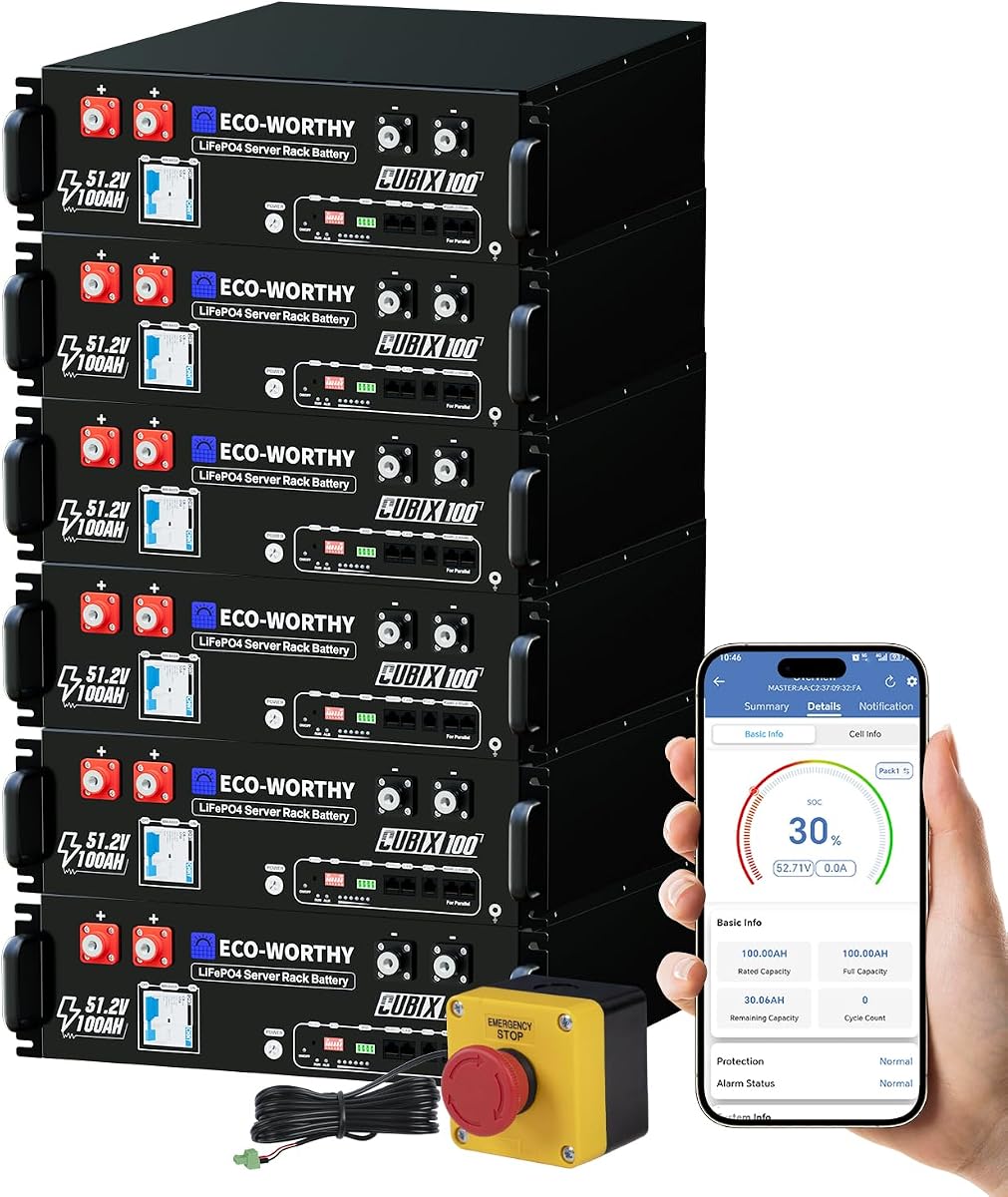


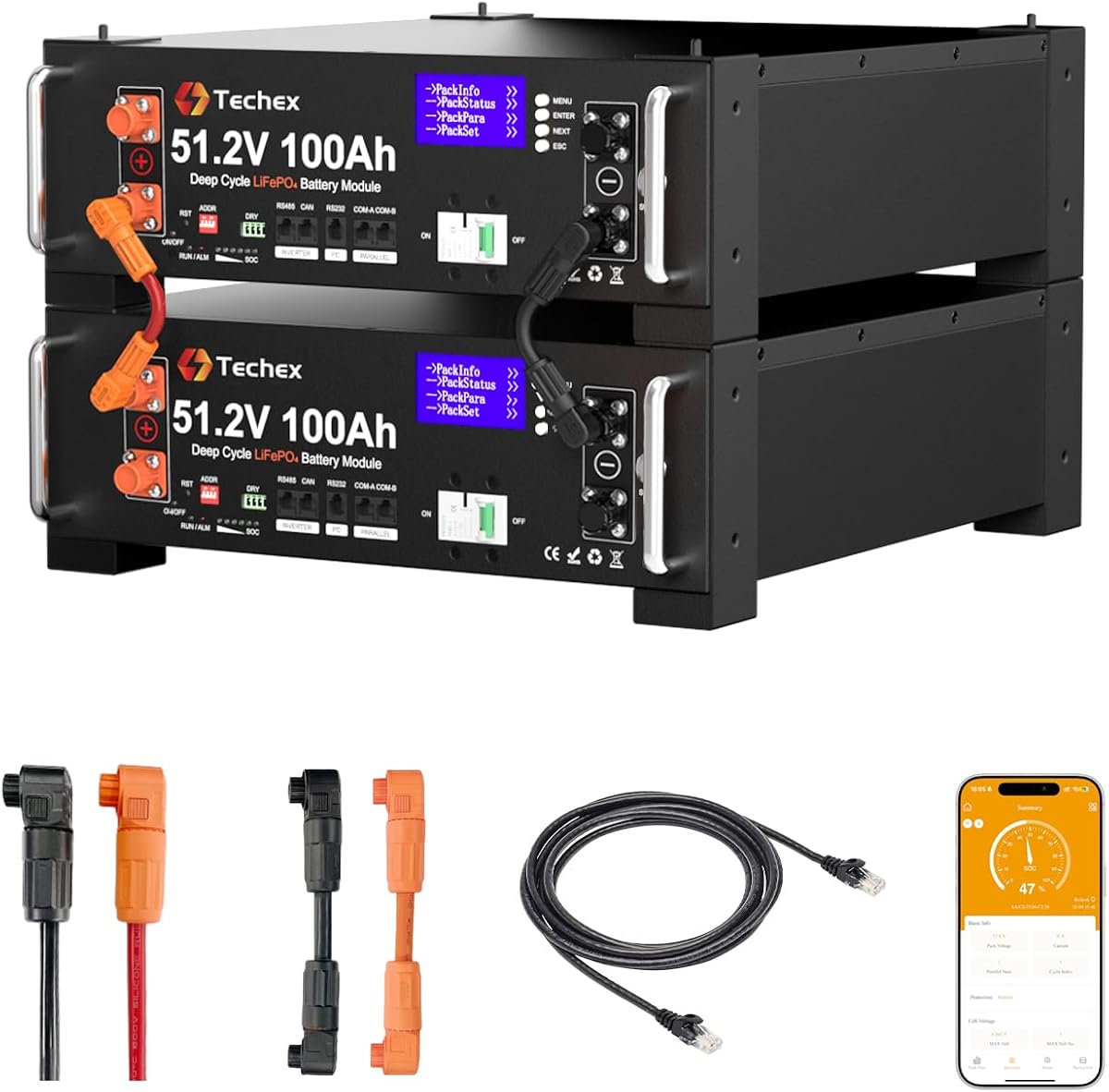
The ECO-WROETHY Cubix100 is a high-capacity 48V server rack battery offering with a 4.7 rating and an unusually large energy reserve. Its six-battery configuration is described as providing 30.72kWh, making it more appropriate for substantial whole-home or off-grid storage than for a small emergency-load circuit. UL9540, UL1973, and CEC-listed status are prominent features of the listing.
We may earn a commission when you buy through this link, at no additional cost to you.
The six 51.2V 100Ah batteries use Grade A LiFePO4 cells, vertical rack mounting, and a smart communication architecture. CAN and RS485 interfaces support integration with compatible integrated solar inverters, while Bluetooth and WiFi enable status monitoring through the ECO-WORTHY app. Expansion to as many as 32 units and 163.8kWh provides considerable long-term flexibility.
Its main trade-off is physical scale. A 30.72kWh installation requires substantial rack space, suitable wiring, and careful attention to load limits and ventilation. The seller also notes that safe transportation may require multiple packages arriving separately, so buyers should plan for more than one delivery and verify the complete contents before installation.
This is the strongest choice for a buyer seeking a large, certification-focused battery group without assembling a six-pack independently. It is less suitable for renters, small workspaces, or anyone unable to provide rack space and professional electrical work. For those requirements, the smaller solutions later in the guide offer more manageable starting points.
The stated 30.72kWh capacity provides a much larger reserve than a typical single-rack battery. It is better suited to running substantial loads for longer periods or supplementing a solar-charged system, although actual runtime depends on inverter efficiency, load size, temperature, battery age, and usable depth of discharge.
Vertical mounting and support for up to 32 parallel units make the Cubix100 viable for systems designed to grow over time. The included parallel and communication cables, grounding wires, terminal covers, hardware, and manual help organize installation, but protocol and polarity checks remain essential.
We may earn a commission when you buy through this link, at no additional cost to you.
The ECO-WORTHY Liber 10KP combines two 51.2V 100Ah LiFePO4 batteries with a 10,000W inverter, giving buyers a broad home-backup foundation rather than a battery-only component. Its 4.2 rating reflects a practical all-in-one package, with 10.24kWh of stated storage and a substantial inverter output rating.
We may earn a commission when you buy through this link, at no additional cost to you.
The inverter functions as a pure sine-wave unit, two-MPPT charge controller, and battery charger. It supports 120V single-phase or 120V/240V split-phase output, reaches 20kW peak power, and can work with larger solar arrays. The batteries add CAN and RS485 communication, Bluetooth, and WiFi monitoring through the manufacturer's app.
Expansion potential extends to six parallel inverters for up to 60kW of AC output and up to 32 batteries for 163.84kWh. That flexibility comes with meaningful configuration complexity: single-inverter output differs from multi-inverter phase support, and safety components such as the included RSD button must be installed correctly. Components are also shipped separately for safety.
Buyers who want a ready-made high-output system will find this more convenient than assembling an inverter and battery bank independently. It is best for installers comfortable with 48V high-voltage DC systems, phase configuration, and code-compliant wiring. Those needing a compact emergency solution may prefer the smaller 5kW ECO-WORTHY package.
Bundling the inverter, two batteries, an RSD button, and accessories simplifies initial procurement. The 10kW continuous rating provides ample headroom for essential household equipment, but surge-heavy loads still need to be checked against the inverter's maximum peak output and battery limits.
Two independent MPPT inputs can improve solar harvesting when the panels operate across different orientations or experience unequal shading. The ability to use split-phase output with multiple inverters makes the system relevant to larger homes, provided the installer designs the phase balance and protection correctly.
We may earn a commission when you buy through this link, at no additional cost to you.
The WT5100 48V 100Ah server rack battery combines a 5.0 rating with a straightforward 5.12kWh capacity. It is designed for solar storage, emergency backup, and residential energy systems, while its vertical server-rack format makes it especially convenient for installations with dedicated rack space.
We may earn a commission when you buy through this link, at no additional cost to you.
Safety is a major selling point. The listing identifies UL1973 certification, UL9540A testing, and CEC listing, alongside a built-in 100A smart BMS that protects against overcharge, over-discharge, overcurrent, overheating, and short circuits. Grade A LiFePO4 cells and a stated cycle life exceeding 6,000 cycles support the long-service positioning.
The LCD screen and controls provide local access to voltage, capacity, operating status, and system information. CAN and RS485 ports support many solar inverter systems, but buyers should confirm the exact protocol and communication settings for their inverter. Unlike some alternatives, the supplied information does not mention app-based or WiFi monitoring.
This battery is a strong general-purpose selection for installers who want a certified 5.12kWh rack unit and unusually broad parallel scaling. It fits well in a staged design where one battery can be installed first and additional modules added later. Remote-monitoring users may prefer the Techex or Wattcycle models with Bluetooth and WiFi.
UL1973 certification, UL9540A testing, and CEC listing provide useful documentation points for safety-conscious buyers. These designations should be confirmed against the current listing and the exact model, especially when local permitting, inspection, or utility requirements apply.
The stated support for as many as 63 parallel batteries is far beyond what most installations require, but it makes the WT5100 appropriate for installers designing modular systems. Expansion still requires correctly sized buswork, fusing, communications, and a compatible inverter configuration.
We may earn a commission when you buy through this link, at no additional cost to you.
The Techex 48V 100Ah V2 is a feature-rich 5.12kWh rack battery with a 4.7 rating. It stands out for combining WiFi and Bluetooth monitoring, a local smart display, a 100A BMS, and automatic fire suppression in a 3U form factor designed for vertical installation.
We may earn a commission when you buy through this link, at no additional cost to you.
Its upgraded communication section supports CAN and RS485 and names Victron, Pylontech, Luxpower, Sol-Ark, DEYE, and GoodWe among compatible inverter brands. Sixteen Grade-A EV LiFePO4 cells are used, with a stated capacity for more than 6,000 deep cycles. The dual terminals, 125A breaker, switch, and anti-reverse fast plugs support organized installation.
The 17.40 by 18.89 by 5.23-inch metal case weighs 100 pounds, so handling and rack reinforcement deserve consideration. Automatic aerosol fire suppression is designed to activate at temperatures above 170°C, while the BMS provides a second layer of electrical protection. Parallel communication and power cables are included, but correct phasing and BMS settings are critical.
This is an appealing option for buyers prioritizing connected monitoring and built-in fire protection without moving to a multi-battery system. It suits installers familiar with Techex communication protocols and compatible hybrid inverters. Those needing the longest stated expansion network may prefer the WT5100, while buyers prioritizing an all-in-one inverter kit can examine the ECO-WORTHY systems.
The LCD reports voltage, current, temperature, and protection status, while Bluetooth allows phone-based checks and WiFi adds remote visibility after configuration. This combination is useful in server rooms or installations where the rack is not continually accessible.
The BMS, integrated breaker, thermal controls, and fire-suppression canister create several layers of defense. Such protections reduce risk but do not replace correct fusing, ventilation, wiring discipline, code-compliant installation, and periodic system inspection.
We may earn a commission when you buy through this link, at no additional cost to you.
The VPauexii 48V 400Ah is positioned as a high-capacity 20.48kWh server-rack battery with a 5.0 rating. Its selling point is the combination of substantial energy storage, an included 3U stacking mount, preassembled cables, and built-in monitoring in a single rack-oriented package.
We may earn a commission when you buy through this link, at no additional cost to you.
The battery supports remote monitoring over WiFi or cellular data, local Bluetooth status checks, and an LCD for voltage, current, and power. CAN and RS485 communication is listed as compatible with EG4, Victron, Sol-Ark, GoodWe, DEYE, and other major inverter brands. Automatic aerosol fire suppression activates above 170°C, adding a notable safety-oriented feature.
There is an important ambiguity in the supplied product information: the title states 400Ah and 20.48kWh, while one bullet refers to a 48V 100Ah battery. The enclosure is listed at 99 pounds with dimensions of 17.4 by 18.8 by 5.22 inches, which also appears inconsistent with a conventional 48V 400Ah battery. Buyers should verify the exact model, cell configuration, capacity, and shipping contents before ordering.
For a buyer seeking a premium, high-density package with mounting accessories and remote monitoring, the product appears compelling on paper. The documentation conflict prevents an unqualified recommendation, making seller verification essential. If the listed 20.48kWh specification is confirmed, it offers an appealing middle ground between a standard 5.12kWh module and a very large multi-battery installation.
The included stacking mount, communication and power cable, grounding wires, terminal covers, and manual can reduce assembly friction. Mounting still requires checking rail depth, load rating, clearance, and the safety requirements of the installation space.
The difference between 100Ah and 400Ah descriptions materially changes expected capacity and runtime. Reviewing the seller documentation, battery label, cell arrangement, weight, and included components is essential before treating the headline capacity as a confirmed specification.
We may earn a commission when you buy through this link, at no additional cost to you.
The ECO-WORTHY 5KW backup package combines two 51.2V 100Ah LiFePO4 batteries with a 5,000W inverter. It delivers a stated 10.24kWh of battery capacity and 5,000W of continuous output, making it a balanced option for essential household circuits, offices, workshops, and smaller off-grid systems.
We may earn a commission when you buy through this link, at no additional cost to you.
Its inverter integrates a pure sine-wave output, a 100A MPPT controller, and a maximum 100A battery charger. The battery and inverter are described as having passed UL1973 and UL1741 testing by Intertek and meeting California Energy Commission standards. Bluetooth and WiFi monitoring add visibility into battery operation.
The architecture can expand to six parallel inverters for 30kW of AC output and up to 32 batteries for 163.84kWh. A single inverter uses 120V output, while parallel configurations can support 120V, 208V, or 240V. That phase flexibility is valuable, but it also makes professional configuration and protection planning more important.
This package is a sensible middle ground for buyers who need more storage than one 5.12kWh battery but do not require the output of a 10kW inverter. It is less convenient than a single shipped unit because safety requirements mean the components arrive separately. It also offers an approachable starting point for staged expansion.
Two 5.12kWh batteries paired with a 5kW inverter create a relatively balanced configuration for routine essential loads. The 10kW peak rating can assist with compatible surge loads, though appliance startup requirements should be checked in advance.
The listed inverter and battery expansion limits make it possible to begin with a smaller system and add modules later. Expansion planning should account for the inverter's communication protocol, phase configuration, conductor sizing, and available rack capacity.
We may earn a commission when you buy through this link, at no additional cost to you.
The Wattcycle 51.2V 100Ah battery is a 5.12kWh rack-mount module rated 4.0. Its standard 19-inch, three-rack-unit format and listed weight of 91.9 pounds make it relevant to mobile, compact, or space-conscious energy-storage installations where every pound and inch matters.
We may earn a commission when you buy through this link, at no additional cost to you.
The battery uses premium 102Ah EV-grade A+ LiFePO4 cells and carries an unusual stated cycle figure of more than 15,000 cycles at 60% depth of discharge. A 100A BMS protects against common electrical faults and temperature extremes, while a full-metal enclosure adds mechanical and thermal protection.
Monitoring is available through an integrated LCD touchscreen and Bluetooth 5.0 application. CAN, RS485, and RS232 communication gives it broader protocol options than many competitors, with specific integration support named for Victron and Schneider. As many as 16 batteries may be paralleled for 81.9kWh of stated total capacity.
This product is a good fit for RV systems, small cabins, industrial equipment, UPS applications, and installers who value protocol flexibility and a comparatively manageable weight. It lacks listed WiFi remote monitoring, and its lower rating gives less evidence of broad buyer satisfaction than the five-star products. Verify exact inverter settings and temperature limits before deployment.
The 19.09 by 17.72 by 5.24-inch chassis fits a standard three-rack-unit format and supports vertical installation. While it is still too heavy for casual handling, its listed 91.9-pound weight is easier to manage than many similarly sized lead-acid installations.
The stated 15,000-plus cycle capability under a 60% depth-of-discharge condition is a major differentiator, though actual service life depends on temperature, charge discipline, and operating depth. Multiple communication protocols also make this a useful candidate for mixed equipment environments.
We may earn a commission when you buy through this link, at no additional cost to you.
The Wattcycle two-pack combines two 51.2V 100Ah server-rack batteries into a 10.24kWh system with a stated 10.24kW continuous output. It is aimed at home backup, off-grid installations, industrial equipment, and commercial UPS use, offering more storage than a single comparable module.
We may earn a commission when you buy through this link, at no additional cost to you.
Each battery uses genuine BYD prismatic LiFePO4 cells and a 100A BMS with more than 20 listed protections. Each unit also supports 1C charging and discharging and a 200A two-second peak current. Two independent BMS systems provide redundancy, while 3A multi-channel active balancing is intended to improve charging consistency and usable capacity.
Both units have LCD touchscreens and Bluetooth app monitoring, with CAN, RS232, and RS485 support for major inverter brands. The package includes a 50A PPS expansion adapter cable. Parallel operation requires matching settings, properly sized interconnects, and compatible inverter communications, so the two-pack should not be treated as automatically interchangeable with any battery.
This set is appealing to buyers who prefer a matched two-battery package over assembling separate units. Its lack of a displayed customer rating means the product's real-world feedback is less visible than for the rated alternatives, so attention should shift to seller support, warranty terms, documentation, and verified cell specifications. It is best for installers comfortable configuring a parallel battery bank.
Buying two units together can simplify procurement and provide a 10.24kWh starting point. Parallel operation allows the inverter to draw from the bank as designed, but the installer must verify that the inverter's communication address, wiring, and current settings properly recognize both BMS systems.
Active balancing helps cells within each battery reach a similar state of charge, which supports efficient charging and long-term consistency. Two independent BMS systems add a layer of operational redundancy, although they do not make the installation maintenance-free or immune to common environmental stressors.
We may earn a commission when you buy through this link, at no additional cost to you.
The WattCycle dual-battery and 12kW inverter package is designed for larger residential or light-commercial energy systems. It combines 10.24kWh of battery storage with 120V/240V split-phase output, allowing it to address loads that ordinary single-phase equipment may not support effectively.
We may earn a commission when you buy through this link, at no additional cost to you.
Dual MPPT controllers accept up to 24,000W of PV input with stated efficiency above 98% and charging current up to 250A. The inverter provides pure sine-wave output and a UPS transfer time below 10 milliseconds, a useful specification for networking, communications, and other equipment sensitive to brief interruptions.
The battery side uses BYD LiFePO4 cells, a 100A BMS, Bluetooth monitoring, an LCD touchscreen, and 3A active balancing. The system supports as many as six parallel inverters for 72kW and twenty parallel batteries for 102.4kWh. Such expansion assumes correctly engineered buswork, protection, phase balancing, and a compatible installation environment.
This is a strong fit for a homeowner seeking split-phase backup, substantial solar charging, and future expansion. It requires more installation planning than a single battery or simple emergency inverter. Because no customer rating is displayed, buyers should place greater emphasis on current documentation, local code compliance, warranty coverage, and installer support.
A 240V split-phase inverter can serve equipment that requires 240V circuits while still supporting 120V loads. Phase balance and transfer behavior should be tested with the actual intended circuit list rather than estimated only from total inverter capacity.
The 24kW stated PV input ceiling gives the system considerable room for a large residential array. Actual harvest depends on panel layout, solar resource, MPPT configuration, shading, temperature, and the inverter's real operating limits.
We may earn a commission when you buy through this link, at no additional cost to you.
The Techex 48V 200Ah battery is a high-capacity 3U rack-mount option with a 5.0 rating. It offers 10.24kWh of stated storage and up to 10.24kW of output, giving buyers more room than a standard 5.12kWh module without moving to a multi-battery bank.
We may earn a commission when you buy through this link, at no additional cost to you.
The feature set parallels the smaller Techex V2. It includes WiFi and Bluetooth monitoring, a smart display, a 100A BMS, CAN and RS485 communication, optimized positive and negative terminal positions, dual terminals, a 125A breaker, and automatic fire suppression. Named inverter compatibility includes Victron, Pylontech, Luxpower, Sol-Ark, DEYE, and GoodWe.
The supplied description contains an internal inconsistency: it refers to 16 Grade-A EV cells even though the model is titled 200Ah, while listing the same 100-pound weight and physical dimensions as the 100Ah version. Those details warrant direct confirmation from the seller. The listing also notes that the item may arrive in multiple packages at different times.
This battery is a compelling choice for buyers wanting 10.24kWh in a single listed enclosure and valuing the Techex monitoring and safety ecosystem. It is best for installers who can confirm the actual cell configuration and output current. Compared with a two-pack of 5.12kWh modules, it may reduce rack count, but only if the verified capacity and thermal performance support that design.
The stated 10.24kWh capacity and 10.24kW output make this model relevant to homes, telecom installations, and workshops where load demand is higher. A single enclosure can simplify mechanical planning, although electrical and thermal requirements remain substantial.
Because the listing's cell count and weight do not clearly match a conventional 200Ah model, buyers should request photographs of the label, internal cell layout, technical datasheet, and test information. Accurate documentation is essential for calculating runtime and sizing protective equipment.
We may earn a commission when you buy through this link, at no additional cost to you.
The right choice depends on more than nominal watt-hours. Capacity, output, rack geometry, inverter communications, safety features, environmental limits, and the availability of qualified installation support should all be evaluated before purchasing a 48V lithium backup system.
A single 51.2V 100Ah battery commonly provides 5.12kWh of stated energy, while the two-battery and higher-capacity options in this guide offer 10.24kWh or more. Runtime is only one part of the calculation: usable energy, inverter losses, temperature, battery age, discharge rate, and the connected load all affect how long power will remain available. Divide the load's average wattage into the system's realistic usable energy, then apply a margin for aging and conversion losses rather than relying on the headline number alone.
Battery energy and inverter power are different limits. A 10.24kWh battery may still be paired with a 5kW inverter, while a larger inverter can exhaust usable battery capacity quickly. Continuous ratings should cover the sum of steady loads, and peak ratings should accommodate motors, compressors, pumps, and other startup-heavy devices. The included ECO-WORTHY systems provide 5kW or 10kW continuous options, while the WattCycle split-phase package provides a 12kW output.
Many models use a three-rack-unit enclosure with vertical installation, but dimensions and depth vary around 19 inches wide, 18 inches deep, and slightly more than 5 inches high. Measure the available rack, account for front and rear clearance, check rail and shelf load limits, and plan how the heavy modules will be moved into position. Standard 3U descriptions do not guarantee that a unit will fit every rack, particularly when power cables and rear-mounted components need space.
Closed-loop communication lets an inverter read battery voltage, current, state of charge, temperature, and fault information. CAN and RS485 appear throughout the list, with the Wattcycle models also supporting RS232, while the two-pack and 100Ah Wattcycle products name particular compatible brands. Protocol support alone is not enough: the battery may require a specific communication address, baud rate, CAN profile, or BMS menu setting. Obtain the manufacturer's protocol document and confirm that the intended inverter model supports the exact battery configuration.
Look for independent safety evidence, a capable BMS, overcurrent protection, temperature controls, and clear instructions for installation. Relevant listing claims include UL1973 certification, UL9540 certification, UL9540A testing, UL1741 testing, and CEC listing, but the exact status varies by product. Fire-suppression systems add another layer in the Techex and VPauexii batteries, while the Eco-Worothy products emphasize thermal-runaway management. These features should complement—not replace—correct fusing, grounding, ventilation, and code-compliant wiring.
Local LCD displays are useful for installation checks, while Bluetooth apps and WiFi can reveal state of charge, voltage, current, temperature, and protection status remotely. Remote monitoring is especially valuable in unattended telecom rooms, workshops, and off-grid installations, but it should not replace routine inspections. Look for a display that is readable in the intended environment, an app with clear alerts, and a straightforward way to select the correct communication protocol. Consider whether the product can be monitored without a cloud account or cellular connection.
Parallel capability allows a system to grow without replacing every battery, but the advertised maximum is only the beginning of the design process. The list includes stated limits ranging from 15 batteries to as many as 63, with complete systems offering much larger inverter and storage combinations. As modules are added, the installer must revisit bus cables, fusing, breaker ratings, communication addressing, phase balance, and the inverter's maximum battery current. More capacity also does not guarantee that every load can be served simultaneously.
Charging and discharging performance changes with temperature, and self-heating or extreme cold can affect usable output. The Techex listing states a charging range of 32 to 131°F and a discharge range from -4 to 140°F, while the Wattcycle 100Ah model lists operation from -4 to 149°F. Product support also varies, with stated warranties ranging from two to ten years depending on the item. Read the warranty document, confirm what is covered, and ensure the battery will remain within its specified temperature and humidity limits.
Begin with a site plan and compatible equipment list. Confirm the battery's nominal voltage, capacity, communication protocol, terminal layout, physical dimensions, and required inverter settings. Prepare a properly engineered rack or mounting solution with adequate load capacity, ventilation, cable strain relief, grounding, branch protection, and an orderly disconnect method. A qualified electrician should handle high-current 48V DC wiring, inverter interconnections, and any AC panel work.
Before energizing the system, inspect each battery for shipping damage, confirm that all units are the same model and have compatible firmware, and follow the manufacturer's parallel-installation order. Configure the BMS protocol and communication address before connecting the inverter. Charge the battery using the approved charger and inverter settings, then verify state of charge, cell balance, temperature, breaker status, and communication through both the local display and remote app. Test the system with the intended critical loads before relying on it during an outage.
For ongoing care, review state of charge, temperature, fault messages, and app alerts regularly. Keep vents free of dust and avoid exposing the enclosure to water, excessive heat, or conductive debris. Test the backup transfer and essential circuits on a regular schedule, confirm that the inverter's firmware remains compatible, and document the routine for future maintenance. If a BMS fault, unusual temperature, damaged cable, or communication failure appears, follow the manual's diagnostic procedure and stop using the affected circuit until it is safely inspected.
A nominal 51.2V 100Ah battery stores 5.12kWh, while a nominal 51.2V 200Ah battery stores 10.24kWh. The higher-capacity model can provide roughly twice the energy, but it may also place greater thermal and current demands on the enclosure and inverter. Buyers should compare verified cell configurations, weight, maximum discharge current, and warranty terms rather than relying on the nominal label alone.
Most 48V server rack batteries are DC energy-storage components and need a compatible inverter to provide usable AC power for ordinary appliances and building circuits. Some systems may support direct DC loads, but the voltage, current, connection method, and control behavior must match the equipment. The complete ECO-WORTHY and WattCycle packages include inverters for this reason.
The stated limits in this guide range from 15 batteries for the Techex and VPauexii products to as many as 63 for the WT5100, while the Wattcycle models list different limits. These are maximum architecture figures, not universal operating instructions. Use identical batteries, approved cables, correct fusing, proper communication addressing, and an inverter designed for the intended bank size.
CAN and RS485 allow the battery BMS to exchange operating data with a compatible inverter or monitoring system. This can include voltage, current, state of charge, temperature, and fault status, enabling more accurate control than a simple voltage-based setup. Communication will not work automatically unless the inverter supports the battery's protocol, wiring arrangement, address, and communication settings.
LiFePO4 chemistry is generally considered stable, but a battery installation still presents electrical and fire-safety risks that require careful mitigation. Relevant products include UL1973, UL9540, UL9540A, UL1741, or CEC-related claims, while some add automatic fire suppression. Buyers should verify the certification for the exact model and use qualified installation practices, appropriate protection, ventilation, grounding, and manufacturer instructions.
Most products in the list are designed for vertical installation in a three-rack-unit space, and some explicitly mention horizontal or stacking configurations. A standard rack is helpful, but buyers must check exact dimensions, depth clearance, weight limits, airflow, and the manufacturer's orientation guidance. A nominal 3U height does not guarantee compatibility with every rack or shelf.
A 10.24kWh system can support a continuous 1kW load for roughly ten hours only under ideal conditions, and actual runtime will be shorter after inverter losses, state-of-charge limits, temperature effects, and aging. A 500W load might run around twice as long, while a 5kW load could exhaust the reserve much faster. Use the inverter's expected efficiency and a safe usable-energy estimate when planning essential-load runtimes.
LiFePO4 batteries generally require less routine servicing than flooded lead-acid batteries, but they are not maintenance-free. Installers should periodically inspect terminals, connections, ventilation, state of charge, temperature, and BMS alerts, then test the inverter's transfer function and connected loads. Manufacturer instructions may also call for periodic capacity checks depending on the application and warranty requirements.
The WT5100 48V 100Ah stands out as a flexible single-battery choice with certification-focused safety claims, local monitoring, and unusually broad stated parallel expansion. The Techex 48V 100Ah is a compelling alternative when remote monitoring and built-in fire suppression matter, while the VPauexii 48V 400Ah offers the most ambitious high-density package in the list after its conflicting specifications are resolved.
For buyers who want a ready-made backup system, the ECO-WORTHY Liber 10KP, ECO-WORTHY 5KW Backup, and WattCycle 12kW Split-Phase package reduce the number of components that must be sourced separately. Prioritize the required usable energy, inverter output, verified communication protocol, physical fit, safety documentation, temperature range, and realistic expansion plan rather than choosing on watt-hours alone.
Current pricing, availability, ratings, included accessories, and seller documentation can change, so buyers should review the live listing before purchasing. Confirm the exact battery model, capacity, certification status, dimensions, delivery method, warranty, inverter compatibility, and all required cables and protection equipment. Those checks will produce a safer and more reliable LiFePO4 server rack backup installation.
