
Xiegu XPA125B
3.9Editor score
Integrated automatic tuner
100W-class HF output
Detailed status display
Our expert guide compares the 10 best linear amplifiers for ham radio, evaluating output power, compatibility, protection, tuning, thermal design, and ease of
A linear amplifier can give a low-power ham radio transceiver the reach and signal strength needed for serious local, DX, and contest operation. The best unit matches your radio, antenna, bands, operating modes, and cooling arrangements while preserving clean transmission across long sessions.
We compared the listed products by examining advertised output power, supported modes, drive requirements, frequency coverage, protection features, thermal design, display information, and transceiver compatibility. The list includes complete amplifiers, tuner-amplifier combinations, and lower-power modules that serve different station needs.
Each review reveals the intended use, practical advantages, and important limitations of its product. Ratings reflect the supplied marketplace feedback, while technical comparisons rely on the published product information. Availability and retailer terms can change, so confirm current specifications before ordering.
3.9Editor score

4.2Editor score
5.0Editor score
The comparison below separates true transmit amplifiers, tuner-amplifier combinations, and receive-oriented RF modules. Compare output claims, operating modes, drive requirements, and integration features before deciding which product fits your station.


The Xiegu GPA100 is a solid-state 100-watt-class linear amplifier designed to turn compatible low-power transceivers into considerably more capable HF stations. It carries a 4.2 rating, and its standout combination of output power, broad radio compatibility, intelligent protection, and wireless band control makes it the most complete option in this guide. The listed specification provides up to 100 watts on HF and 80 watts on 6 meters.
We may earn a commission when you buy through this link, at no additional cost to you.
Its strongest feature is flexible band operation. Operators can manually select one of seven bands using front-panel buttons and indicator lights, or activate automatic mode for tracking changes made on the radio. Built-in Bluetooth control provides a direct connection to the IC-705 without an additional cable, while unsupported bands can be bypassed. That makes the GPA100 particularly appealing to users who regularly change bands or modes.
The amplifier also emphasizes dependable operation during long transmissions. Intelligent controls detect high SWR, overcurrent, overheating, low efficiency, and excessive drive, taking appropriate protective action rather than allowing the amplifier to remain in a harmful condition. A linear, solid-state architecture is listed as supporting low distortion and high signal purity across SSB, AM, FM, CW, and digital modes.
This is the strongest general recommendation for operators who already own a compatible QRP-class radio. It offers meaningful power without the antenna-tuner feature of the XPA125B, but its automatic band control and protection system may appeal more to someone focused on effortless operation. Confirm drive levels, ALC behavior, band support, and connector details for your exact transceiver before making a final choice.
Seven selectable bands, automatic tracking, and Bluetooth communication with the IC-705 simplify the relationship between radio and amplifier. The device is also listed as compatible with the Xiegu G90, G1m, G106, X108G, X5105, X6100, and X6200.
The protection system addresses several common causes of amplifier stress, including high SWR, excessive current, heat, poor efficiency, and overpower. These safeguards are particularly valuable when tuning a new antenna system or changing bands frequently.
We may earn a commission when you buy through this link, at no additional cost to you.
The BJ-300 Plus is a broadband radio amplifier aimed at operators seeking substantial advertised output across AM, FM, SSB, and CW. Its supplied rating is 3.1, so buyers should place more weight on the stated controls, protection, and drive requirements than on broad customer sentiment. The amplifier lists maximum outputs of 100 watts FM, 120 watts AM, and 150 watts SSB.
We may earn a commission when you buy through this link, at no additional cost to you.
One of its practical advantages is the combination of output and accessible controls. A front-panel power switch, mode selector, and high/low adjustment let the operator tune the amplifier to different radios and operating situations. The published drive windows are 3–5 watts for AM or FM and 2–10 watts for SSB, giving SSB operators a reasonably broad starting range.
Thermal management and electrical protection are more substantial than on a simple board-only design. A radiator fan and large red aluminum heat sink are intended to support extended use, while electronic reverse-polarity protection and dual 15-amp fuses help guard against incorrect supply wiring and electrical surges. Standard PL-259 connectors are used for the radio and antenna connections.
The BJ-300 Plus could suit a station that values raw output and straightforward mode changes more than integrated tuning or wireless control. Its lower rating is the main reason it does not lead this list. Carefully set drive for the selected mode, use an appropriate 13.8-volt supply, and verify the antenna system can handle the advertised output before operation.
AM, FM, SSB, and CW support gives the amplifier broader utility than a mode-specific unit. The high/low control also provides a basic way to reduce output when the transceiver or antenna system calls for a lower operating level.
A dedicated fan complements the substantial heat sink during longer transmissions. Reverse-polarity protection and dual fuses add useful safeguards around the amplifier's 13.8-volt DC supply connection.
We may earn a commission when you buy through this link, at no additional cost to you.
This BJ-300 Plus listing provides the same fundamental high-power concept as the preceding model, with published output of 100 watts FM, 120 watts AM, and 150 watts SSB. Its 3.1 rating warrants careful shopping and comparison. It is aimed at HF, CB, and compatible two-way-radio stations that need a straightforward broadband amplifier with selectable operating modes.
We may earn a commission when you buy through this link, at no additional cost to you.
The amplifier accepts 3–5 watts of AM or FM drive and 2–10 watts for SSB. This gives operators a clear basis for matching it to a radio. A mode selector and high/low power control are positioned for quick adjustment, while an LED and power switch make the basic operating state easy to identify.
Its physical design places emphasis on sustained operation. The large red aluminum heat sink is paired with a cooling fan, helping move heat away from sensitive components. Electronic polarity-reversal protection and two 15-amp fuses address common DC installation mistakes. PL-259 connections for the transceiver and antenna keep the RF installation familiar to radio operators.
For buyers seeking a high-output amplifier without a tuner or sophisticated display, this model offers a practical feature set. The lack of integrated tuning means the antenna system must already be reasonably well matched, or an external tuner will be needed. Its 3.1 rating should be considered along with the product's documented protections and straightforward controls.
Published input ranges make it easier to identify whether the amplifier suits a particular radio. The mode selector and high/low control provide basic operating adjustments without navigating a complex menu.
The combination of a large heat sink and powered fan is more suitable for sustained operation than a bare module without active cooling. This design also simplifies installation around a permanent base station.
We may earn a commission when you buy through this link, at no additional cost to you.
The BJ-300 Broadband is a simple, high-output amplifier for ham radio and other HF transceiver applications. No marketplace rating is supplied, so this recommendation is based on the published specifications rather than customer feedback. It is listed at up to 100 watts FM, 120 watts AM, and 150 watts SSB, with support for AM, FM, SSB, and CW.
We may earn a commission when you buy through this link, at no additional cost to you.
The listed input requirement of 3–5 watts makes it particularly relevant to modest-output radios, although SSB operation can use a drive level stated elsewhere in the product information as high as 10 watts. A high/low selector allows the operator to choose an appropriate output range, and the separate on/off switch and LED keep daily operation uncomplicated.
Protection is centered on preventing installation errors. The product includes an electronic switch, polarity-inversion protection, and overvoltage protection according to its description. Those features are useful because a linear amplifier is connected to both a substantial DC supply and a sensitive transceiver, and inexpensive cabling mistakes can be costly.
This is a practical option for an operator who values output and uncomplicated controls more than an integrated tuner, remote band control, or detailed internal display. Its aluminum alloy heat sink supports heat dissipation, while ANT and RTX ports simplify connection planning. Confirm the exact drive requirements for your chosen mode and ensure your antenna and power supply are suitable for the intended output.
The high/low selector, on/off switch, and LED indicator reduce the learning curve. This simplicity is useful for a dedicated single-radio station or for an operator who does not want a complex menu-driven amplifier.
Overvoltage and polarity-inversion protection help reduce the consequences of supply mistakes. Users should still verify wiring, voltage, and grounding before connecting the amplifier to valuable station equipment.
We may earn a commission when you buy through this link, at no additional cost to you.
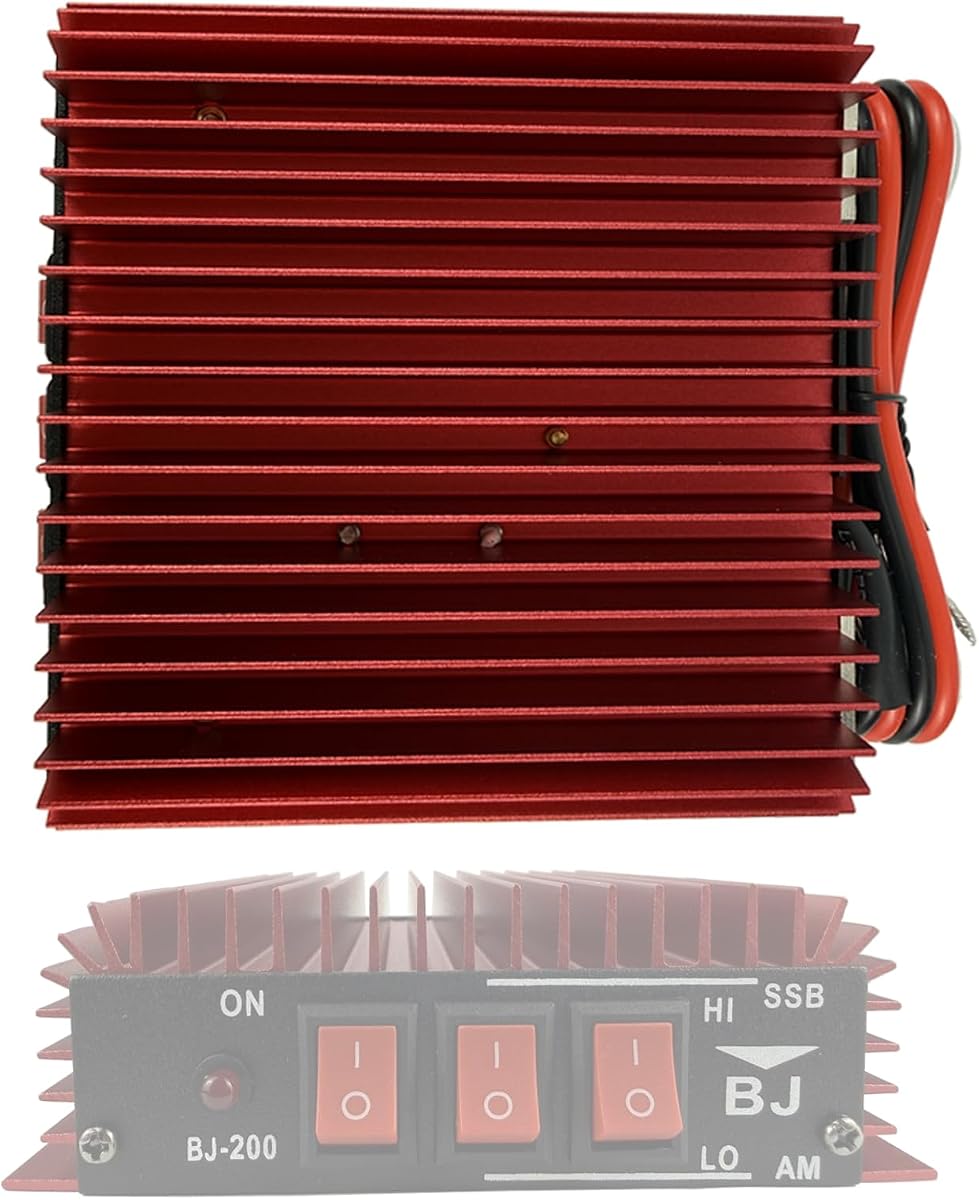
The BJ-200 stands out as the budget-focused choice in this guide, combining a 5.0 supplied rating with substantial advertised output. It is a broadband linear amplifier for 3–30MHz radio use and supports AM, FM, and SSB. Maximum output is listed as 50 watts FM, 100 watts AM, and 150 watts SSB from a 3–5-watt input.
We may earn a commission when you buy through this link, at no additional cost to you.
Its controls remain deliberately simple. An on/off switch, high/low power adjustment, AM/SSB mode selectors, and an LED indicator cover the functions most operators need. The amplifier runs from 13.8 volts DC and is listed at 8–11 amps of current draw, so a suitably capable supply is necessary for reliable operation.
Thermal design is handled by a red aluminum alloy heat sink, while built-in polarity reversal protection helps prevent damage from reversed DC connections. A compact form factor makes the unit suitable for a vehicle or base station, and standard radio connectors simplify integration with common CB and amateur-radio equipment.
This amplifier makes the most sense for a station that needs more output across the broad 3–30MHz range but does not require an automatic tuner, remote control, or sophisticated monitoring display. Its excellent supplied rating is encouraging, although product listings can change. Confirm the mode-specific drive level, supply capacity, cooling arrangement, and antenna rating before putting the amplifier into service.
The 3–30MHz range covers a large portion of the amateur-radio HF spectrum and makes the amplifier adaptable across multiple bands. It is a practical fit for operators seeking output and flexibility without a more complex tuner-equipped unit.
The compact enclosure suits a vehicle or temporary field setup, but sustained high-output operation still requires an appropriate 13.8-volt supply and adequate ventilation. Do not confuse a small footprint with a reduced need for heat management.
We may earn a commission when you buy through this link, at no additional cost to you.
The Xiegu XPA125B is the premium pick because it combines a 100-watt-class HF amplifier with an integrated automatic antenna tuner. Its supplied 3.9 rating reflects a generally positive but not flawless customer history. The product is particularly appealing to operators who want more than raw output: it can function as an amplifier, an automatic tuner, or the two functions used together.
We may earn a commission when you buy through this link, at no additional cost to you.
The tuner supports 14–500 ohm loads across HF and the 6-meter band. That flexibility is valuable for a station using different antennas, bands, or changing propagation conditions. The amplifier section can deliver up to 100 watts in normal operation, while the listed maximum output reaches 125 watts, making it suitable for QRP radios and low-power SDR transceivers that need greater transmitted power.
The 2.7-inch backlit LCD is one of the most useful features for station operation. It presents input and output power, SWR, voltage, current, temperature, amplifier status, and warning messages. Intelligent protection circuits place the amplifier into bypass mode if excessive SWR, excessive drive, or high temperature is detected, helping protect both the amplifier and connected radio.
Choose the XPA125B when automatic tuning, status visibility, and a flexible two-device architecture justify a more advanced station component. It is less attractive for a simple fixed installation with a well-matched antenna and a hardwired radio. Confirm the amplifier, tuner, and radio-control requirements in the current manual, and use the display data to establish a safe operating baseline.
The ability to use the tuner and amplifier independently adds unusual flexibility. An operator can use the automatic tuner alone for a low-power setup or combine both functions for a more capable HF station.
The large display consolidates the measurements an operator needs to judge a station safely. Temperature, voltage, current, SWR, and power readings make changes in operating conditions easier to identify.
We may earn a commission when you buy through this link, at no additional cost to you.
The LICAEVEY 30W board is a compact linear power-amplifier module intended for CW, SSB, and shortwave operation from 3 to 30MHz. No marketplace rating is supplied, so its appeal comes from the listed design rather than customer feedback. With 30 watts of output, it targets a different role from the 100-watt-class amplifiers in this guide.
We may earn a commission when you buy through this link, at no additional cost to you.
The product is presented as a finished board with clearly marked input, output, and power connections. That format can appeal to operators building a compact portable station, experimenting with an HF system, or adding a modest signal boost to a QRP transceiver. Broadband circuitry is described as reducing the need for manual tuning across the shortwave range.
Thermal management and electrical stability are emphasized. An integrated heat sink and low-loss PCB material are intended to support extended transmit cycles, while the described circuitry includes protection against overcurrent and voltage fluctuations. Those attributes are especially relevant for a module that may be installed without the room and heavy enclosure of a full-size base-station amplifier.
This board is best for operators whose priorities are compactness, moderate output, and integration with a DIY or portable radio project. It is not the strongest option for a high-power contest station, and its lack of published rating makes independent verification even more important. Review the board's connector type, supply voltage, drive level, grounding, and required impedance matching before installation.
The board format makes it easier to include meaningful linear amplification in a portable or custom enclosure. It can fill a gap between a bare transceiver and a full-size 100-watt station amplifier.
Broadband operation across 3–30MHz is valuable when changing bands. Actual performance still depends on correct drive, supply stability, heat removal, and the impedance presented by the connected antenna system.
We may earn a commission when you buy through this link, at no additional cost to you.
The BJ-200 CB Radio Power Amplifier is a compact listing for operators looking to add an amplifier to a CB installation. No marketplace rating is provided, and the supplied description is much shorter than those for the other products. It does, however, clearly identify a 12–14-volt DC input and a conventional three-wire connection arrangement.
We may earn a commission when you buy through this link, at no additional cost to you.
The RF connection uses an SO-239 connector, which is familiar in CB and amateur-radio installations. The three-wire arrangement covers RF input, RF output, and DC power. This makes the unit potentially approachable for someone assembling a vehicle or base-station system around existing CB equipment rather than building around a modern QRP transceiver ecosystem.
The wide supply range is described as compatible with standard automotive or stationary CB power supplies, including operation during engine start. That claim still calls for careful installation: a proper fuse, secure ground, correct connector orientation, and an antenna system suitable for the amplifier's operating level are essential regardless of the stated voltage range.
Because the listing does not state output power, supported modes, protection circuitry, or detailed drive requirements, it should be considered only after those specifications are verified. It may be useful for a specific CB-oriented installation, but ham radio buyers with SSB or CW requirements need more documentation before choosing it.
SO-239 connectors and a three-wire layout align with many existing CB installations. Operators can often reuse familiar coax and power arrangements instead of redesigning the entire station.
The limited description leaves several essential operating questions unanswered. Obtain the product's output, mode, drive, thermal, and protection specifications before using it with amateur-radio equipment.
We may earn a commission when you buy through this link, at no additional cost to you.
The Low Noise RF Amplifier is not a conventional transmit linear amplifier. It is a wideband low-noise amplifier for improving weak-signal reception, and it earns a 4.2 supplied rating. Its range extends from 0.1MHz to 2000MHz, with typical gain of 32dB and a maximum output listed at 13dBm, or 20mW, in a 50-ohm system.
We may earn a commission when you buy through this link, at no additional cost to you.
The product can support several receive-oriented uses involving ham radio, shortwave listening, FM broadcast, SDR, CB, and other RF systems. Its low-noise design is intended to strengthen weak signals entering the receiver front end, while the very broad frequency coverage makes it adaptable to multiple receiving tasks.
Power requirements are modest. The unit operates from 9–12 volts DC and draws only 27 milliamps, allowing use with a suitable lithium battery or a conventional 12-volt adapter. Its low consumption and small amplifier format make it useful for field reception or for integrating into a custom receive system.
This product is included because it is frequently encountered in searches for radio amplifiers, but it serves a fundamentally different purpose. It should not be connected in the transmit path of a ham radio to increase output power. Choose it when the goal is better weak-signal reception, and choose a genuine linear power amplifier when the goal is a stronger transmitted signal.
The 0.1–2000MHz range covers shortwave through much of the VHF and UHF spectrum. That breadth makes the module useful for a receive-oriented multi-band setup rather than a single-frequency application.
The 9–12-volt input and 27mA consumption simplify field use. Its maximum output is modest, however, so the unit should be treated as a receive preamplifier rather than a general-purpose power device.
We may earn a commission when you buy through this link, at no additional cost to you.
The Xiegu XPA125B PA and ATU listing is an alternative presentation of the XPA125B tuner-amplifier platform, with a supplied rating of 4.1. It is described as delivering up to 100 watts across HF and combining that capability with automatic tuning. The focus is on a streamlined upgrade for compatible Xiegu radios.
We may earn a commission when you buy through this link, at no additional cost to you.
The listed compatibility includes the Xiegu G90, G106, X5105, X6100, and X6200, as well as future Xiegu models. Automatic tuning reduces the need for repeated manual adjustments, while the product description states that maximum output is maintained automatically. This is particularly relevant to users who want simple band-changing without managing a separate tuner.
The listing emphasizes high-quality construction, durability, and support through Xiegu-oriented after-sales service. It also presents the unit as a suitable long-term addition to a radio equipment setup. The information is less technically detailed than the separate XPA125B listing, which specifically discusses protection circuits, display measurements, and 14–500-ohm load handling.
For an owner of one of the named Xiegu radios, this may be a convenient path to integrated 100-watt output and automatic tuning. For someone choosing from scratch, the other XPA125B listing provides a clearer account of display data, protection behavior, and tuner specifications. Compare the current manuals, host compatibility, control requirements, and antenna coverage before ordering either version.
Explicit support for several popular Xiegu transceivers makes this listing attractive to operators who prefer a coordinated radio-amplifier setup. Automatic tuning can make band changes less demanding.
The stated ability to maintain output automatically reduces repeated manual intervention. It is particularly useful in stations where the operator wants a clean transition between transmitting on different bands.
We may earn a commission when you buy through this link, at no additional cost to you.
Choosing a ham radio linear amplifier starts with the radio, antenna, operating modes, and available space. The most important checks are drive compatibility, output needs, thermal capacity, and whether an integrated tuner would simplify your station.
A linear amplifier must receive the correct input power and the proper control signals from the transceiver. Published drive windows are more useful than a headline output figure: for example, the BJ-200 and BJ-300 products are described around 3–5 watts of drive for AM or FM, while the BJ-300 Plus supports a wider 2–10-watt SSB range. The Xiegu GPA100 is designed for low-power transceivers and supports ALC when the connected radio provides it. Confirm the radio's output, mode behavior, ALC implementation, connector type, and whether the amplifier expects a particular data or control connection.
Output claims often differ by mode. The BJ-300 family is listed at 100 watts FM, 120 watts AM, and 150 watts SSB, while the GPA100 offers up to 100 watts on HF and 80 watts on 6 meters. These are not directly interchangeable numbers. SSB is normally the central concern for voice operators, while FM is relevant for repeater or data applications and CW for efficient weak-signal work. Compare the rating that applies to your primary mode, and account for the reduced power commonly required to maintain a clean signal.
Coverage should include every band and mode you plan to use. The LICAEVEY board and BJ-200 are described as broadband units covering 3–30MHz, while the GPA100 offers seven-band selection and the XPA125B tuner covers HF and 6 meters. A device that is broadband on transmit may still behave differently with an antenna presenting a challenging impedance. For narrow-band operations, check whether the selected amplifier and any tuner are intended to cover that exact band, particularly if your station uses separate antennas or unusual matching arrangements.
An automatic tuner can make a station more convenient by reducing the need for manual matching, but it is not a substitute for a sound antenna system. The Xiegu XPA125B stands apart because its amplifier and tuner can operate independently or together, and its tuner is listed for 14–500-ohm loads across HF and 6 meters. Simpler amplifiers are better matched to an already well-tuned antenna installation. Decide whether frequent band changing and changing antenna impedance justify adding a tuner, and consider the additional control complexity and station space it introduces.
Heat management determines whether an amplifier can remain stable during long transmissions. The BJ-300 Plus listings add an active radiator fan and large aluminum heat sink, while the GPA100 lists advanced cooling and protection against overheating. The BJ-200 uses a substantial red aluminum alloy heat sink, and the LICAEVEY board integrates heat-management hardware directly into its compact design. Allow unobstructed airflow, provide suitable ventilation, and avoid enclosing a high-output amplifier in a tightly packed cabinet. Continuous contests and long DX sessions demand more thermal margin than occasional short transmissions.
Protection is especially valuable when the amplifier is connected to an expensive transceiver. The GPA100 detects high SWR, overcurrent, overheating, low efficiency, and overpower. The BJ-300 family includes polarity protection, while one BJ-300 listing also identifies overvoltage protection and dual fuses. The XPA125B can enter bypass mode after excessive SWR, excessive drive, or high temperature and displays an alarm. Protection does not make poor setup acceptable, but it provides a second line of defense when an antenna, feed line, or drive setting is wrong.
A large output amplifier is not just another box in the radio room. Its depth, weight, connector placement, display visibility, and airflow requirements affect the installation. The XPA125B is smaller than the earlier XPA125 according to its description, while the BJ-200 is specifically positioned as a compact option for vehicle or base-station use. Plan a dedicated 13.8-volt supply where appropriate, include correctly rated fusing, use quality RF cable, and leave enough space around heat sinks and fans. The low-noise RF board is far smaller but belongs near the receive system rather than the transmitter output.
Not every RF amplifier increases transmitted signal. The 0.1–2000MHz low-noise module provides typical 32dB gain at only 13dBm maximum output, making it a receive preamplifier. It can improve the handling of weak signals in suitable receiving systems, but it does not replace a 100-watt linear power amplifier. A proper linear amplifier raises a low-power radio's output while preserving the modulation envelope. Choosing by the word amplifier alone can lead to disappointment, so define the task as reception, preamplification, impedance matching, or increased transmit power before buying.
Begin with the antenna and DC system rather than the amplifier. Confirm that the antenna, feed line, connectors, and grounding arrangement can support the intended mode and output. Use a supply with the correct voltage and adequate current capacity, verify polarity, install appropriate fuses, and provide the unobstructed airflow required by the amplifier's cooling design. Connect the transceiver according to the amplifier manual, confirm the required drive level, and begin with conservative output settings.
Tune the antenna system before relying on automatic band or drive features. Check the forward and reflected readings, listen to the transmitted signal, and listen for changes in the station's background noise. If using an integrated tuner, let it establish a match and confirm that the amplifier or tuner reports a normal operating condition. Watch the display for SWR, voltage, current, temperature, and drive readings where available, and never continue a transmission if a protection message or abnormal reading appears.
For long sessions, monitor the amplifier's temperature and the surrounding ventilation. Keep cables away from hot surfaces and moving fans, tighten connectors without damaging them, and avoid placing the unit where a closed cabinet can trap heat. Periodically inspect the heat sink, fan, DC connections, and RF cabling. When changing radios, antennas, modes, or output levels, return to a known-low setting before the next transmission and confirm that the amplifier is still matched to the new configuration.
A linear amplifier increases the output of a low-power transceiver while preserving the shape of SSB, CW, FM, AM, or digital modulation. This allows a modest QRP radio to produce a stronger signal for DX, contest, and local operation. It must be supplied with the correct drive level and connected to an antenna system that can handle the increased power.
It depends on your antenna system and operating habits. A tuner is helpful when the antenna presents a challenging impedance or when you change antennas and bands frequently. The Xiegu XPA125B integrates an automatic tuner, while simpler units such as the GPA100 are better suited to a stable, properly matched station.
A low-power radio can often drive a 100-watt-class linear amplifier if the amplifier accepts its output level and the radio provides suitable ALC or control behavior. The XPA125B is specifically described for QRP radios and SDR transceivers with low power consumption, while the GPA100 supports a range of listed low-power transceivers. Always verify the manual and start with conservative settings.
A linear power amplifier increases transmitted signal power while maintaining modulation fidelity. A low-noise amplifier boosts weak received signals and is placed on the receive side of a radio system. The 0.1–2000MHz module in this guide is a receive amplifier with only 13dBm maximum output, so it should not be used to increase radio transmission power.
RF amplifiers produce heat during transmission, and inadequate cooling can reduce stability or shorten component life. Products such as the BJ-300 Plus use a fan and large heat sink, while other models rely heavily on their heat sinks. Leave the advertised airflow space around the unit and avoid enclosing it in a sealed cabinet during high-output operation.
The correct drive depends on the amplifier, radio, mode, and desired output. The listed BJ models generally accept around 3–5 watts for AM or FM, with some SSB operation supported from 2–10 watts. Use the amplifier's instructions, begin below the recommended maximum, and watch output, SWR, current, and any protection indication while increasing drive.
The supplied information lists AM, FM, SSB, and CW support for the BJ-300 family, while the BJ-200 is listed for AM, FM, and SSB. The products also include mode selectors or operating controls suited to those functions. Confirm the exact mode configuration and drive requirements in the current documentation before using either amplifier.
Check antenna compatibility, feed-line condition, DC voltage, fuse rating, polarity, cooling, drive level, and connector security before transmitting. Start with a low output setting and monitor SWR, power, current, and temperature. If the amplifier enters protection or shows an abnormal reading, stop transmitting and correct the underlying setup rather than repeatedly attempting to transmit.
The Xiegu GPA100 is the best all-around recommendation because it combines substantial HF output, automatic band selection, wireless IC-705 control, broad QRP-radio compatibility, and a strong protection package. The Xiegu XPA125B is the premium choice for operators who want an integrated automatic tuner and a detailed monitoring display, while the BJ-200 provides a budget-friendly path to high advertised output across a broad frequency range.
Before buying, prioritize compatibility rather than the largest advertised wattage. Confirm drive requirements, supported modes, antenna limitations, cooling, and protection for your particular station. The BJ-300 variants may suit operators who want multiple modes and simple physical controls, the compact boards may fit portable or custom projects, and the low-noise module is only appropriate for receive-side signal improvement.
Finally, check the current manufacturer guidance, product listing, and retailer details before ordering. Specifications, host-radio support, protection behavior, and package contents can change between listings or revisions. A careful match among radio, amplifier, tuner, antenna, and power supply will produce a more dependable station than choosing on output alone.

