
GE Outdoor HD Digital TV Antenna
4.4Editor score
Up to 70+ mile range
VHF and UHF reception
Attic or outdoor mounting
ATSC 3.0 compatible
Compare the best long range UHF TV antennas for outdoor reception, signal range, amplification, filtering, installation, and reliable over-the-air TV.
A long range UHF TV antenna can bring local broadcast stations into homes where cable, satellite, or streaming access is limited or unwanted. The best models combine useful gain, broad frequency coverage, durable outdoor construction, and features such as amplification, filtering, motorized aiming, or multi-TV distribution.
This guide compares ten outdoor and indoor-outdoor antennas based on the supplied specifications, including stated reception range, supported broadcast bands, signal controls, mounting provisions, weather resistance, compatibility, and included installation components. It also weighs practical details that affect setup and long-term use rather than treating range claims as guarantees.
Each review explains the product's strongest features, limitations, and most suitable audience, from budget-oriented options to directional and amplified models for difficult reception. Ratings reflect the supplied customer feedback, while availability and pricing change over time, so readers should confirm current product details before purchasing.
4.4Editor score

4.4Editor score

4.6Editor score
This side-by-side comparison highlights each antenna's reception approach, frequency support, installation requirements, and distinguishing features, helping readers match an antenna to their local towers, available space, and desired level of signal control.




The Antennas Direct ClearStream 4V Outdoor TV Antenna combines four patented loop elements with dedicated Hi-VHF components and reflectors, giving it a more deliberate design than a basic one-direction outdoor antenna. Its supplied rating is 4.4 out of 5, and the product stands out for balanced VHF, UHF, and Hi-VHF coverage with a 43-degree horizontal reception pattern.
We may earn a commission when you buy through this link, at no additional cost to you.
The reflectors add forward gain and focus the antenna toward broadcast towers, which can help protect incoming signals from interference and reduce pixelation or complete picture loss. Its combination of four loops, Hi-VHF elements, and reflectors is intended to capture local over-the-air channels while rejecting unwanted signals from other directions. The antenna supports NEXTGEN TV, 4K, 8K UHD, and Full HD 1080p viewing without an internet connection.
The trade-offs are size and the need to position the antenna intelligently. At 17.4 inches high by 27.8 inches wide and 6 inches deep, it is more substantial than a compact indoor model. Because towers sit in different directions in each market, and trees, terrain, and building materials can block signals, directional alignment and a clear path toward transmitters remain essential regardless of the stated long-range capability.
This is the strongest all-around recommendation for readers who want serious outdoor reception without relying on a powered amplifier or remote-controlled motor. The supplied package includes reflectors, a Hi-VHF kit, a 20-inch mast with pivoting base, all-weather hardware, an adjustable mast clamp, instructions, and a manufacturer lifetime warranty. Choose it when balanced outdoor reception, strong physical construction, and a complete installation kit matter most.
Dedicated Hi-VHF and UHF elements let the antenna address low and high broadcast bands separately, while the four-loop array provides broad capture without requiring the motor found on several rotating alternatives.
The included reflectors increase forward gain and focus reception toward broadcast towers, helping the antenna preserve usable signals in locations where interference or multipath distortion can otherwise disrupt digital pictures.
We may earn a commission when you buy through this link, at no additional cost to you.
The GE Outdoor HD Digital TV Antenna is an uncomplicated option for households seeking local broadcast reception without a large feature list. It has a supplied rating of 4.4 out of 5, supports VHF and UHF signals, and is stated to capture stations from up to 70+ miles away under suitable conditions.
We may earn a commission when you buy through this link, at no additional cost to you.
Its major advantage is flexibility. The antenna can be installed in an attic, where it may remain out of sight, or mounted outdoors on a roof or mast. Standard coax connectivity makes it compatible with television brands and converter boxes that use a conventional antenna connection. It also supports ATSC 3.0 where that broadcast technology is available.
The product does not provide motorized direction adjustment, so users may need to reposition the antenna manually after channel scanning. Its actual results will depend on tower distance, terrain, trees, and the materials used in the home. The claimed range should therefore be treated as a maximum capability rather than a guaranteed distance in every location.
This is the best budget-oriented option in the roundup for readers who want an uncomplicated outdoor or attic antenna, universal television compatibility, and support for modern broadcast standards. It is particularly attractive to first-time antenna users who would rather avoid remote controls, powered amplification, and complex assembly. GE also backs the antenna with a limited lifetime replacement pledge and free U.S.-based technical support.
The same antenna can be hidden in an attic for a neat installation or placed outside where it has a clearer route to transmitters, allowing homeowners to choose based on available space and local reception conditions.
Standard coax support means the antenna can connect to most televisions and converter boxes without requiring specialized adapters, making it a practical entry point for new over-the-air viewers.
We may earn a commission when you buy through this link, at no additional cost to you.
The Televes DAT BOSS Mix LR is the most technically advanced antenna in this guide, combining a directional stacked triple-boom design, a built-in TForce preamplifier, and filtering for FM, LTE, 4G, and 5G interference. Its supplied rating of 4.6 out of 5 is the highest among the ten products.
We may earn a commission when you buy through this link, at no additional cost to you.
Its BOSS-Tech amplification system adjusts gain independently by band, supplying 38 dBi for High VHF and 46 dBi for UHF. That band-specific approach is designed to maintain stable output as signal conditions change and to avoid both weak reception and overload. The reflectors and directors focus reception toward towers, with stated front-to-back ratios of 12 dB for High VHF and 25 dB for UHF.
This sophistication comes with a more involved installation than a simple loop or bowtie. The antenna is directional, so accurate positioning matters, and the mounting system must be secure. The supplied hardware includes a UL-listed 12V dual-output power inserter, mast clamps, wrench, weather boot, and compatibility for mast diameters from 0.78 to 2.4 inches. Its dual operating mode is an important safeguard because the antenna continues passing signals passively if power is unavailable.
The Televes DAT BOSS Mix LR is best suited to rural, fringe, or technically challenging locations where weak signals, cellular interference, and fluctuating conditions justify a more advanced system. It supports current HDTV and Ultra HD 4K broadcasts and is compatible with ATSC 3.0 signals where available, provided the television uses an ATSC 3.0 tuner. For users willing to perform careful directional setup, it offers the most refined filtering and gain control in the roundup.
Independent High VHF and UHF amplification adapts to different signal conditions rather than applying one fixed gain level, which can be especially useful when stations arrive at substantially different strengths.
Integrated FM and cellular filtering reduces interference that may otherwise disrupt over-the-air television, making the antenna suitable for properties near towers, transmitters, or dense wireless activity.
We may earn a commission when you buy through this link, at no additional cost to you.
The Five Star Outdoor Yagi is built around a long, directional element array designed to strengthen VHF and UHF reception. Its supplied rating is 4.3 out of 5, and the product data states a potential range of up to 200 miles when the viewer has suitable distance and a clear path to a broadcast tower.
We may earn a commission when you buy through this link, at no additional cost to you.
The elongated receiving elements are intended to create a stable, strong signal, while the Yagi format concentrates reception in a particular direction. It supports 4K, 1080p, 1080i, and 720p local broadcast channels and can also operate as a radio or FM antenna. Weather-resistant materials, lightning protection, and a design intended to withstand wind and heavy rain make it appropriate for outdoor use.
Assembly is less convenient than for a mostly preassembled or integrated antenna. Some components must be joined, and the directional design makes careful placement important. As with every large outdoor system, foliage, terrain, roofing material, and other obstructions can sharply reduce performance. The stated range therefore reflects ideal conditions rather than an unconditional outcome.
This model appeals to rural users and dedicated over-the-air viewers who want a traditional, high-gain Yagi arrangement and do not need remote rotation. The package includes the antenna, 40 feet of coax, and a 20-inch mounting pole, and it can be installed on a roof, attic, chimney, eave, mast, or exterior wall. It is a strong choice when concentrated gain and a large installation footprint are acceptable.
The extended Yagi elements focus reception toward a known transmitter, which can produce stronger results than a compact multi-directional antenna when alignment and an unobstructed path are favorable.
The supplied pole and coax support common elevated mounting methods, allowing users to move the antenna above nearby obstructions and position it as close as practical to the direction of local broadcast towers.
We may earn a commission when you buy through this link, at no additional cost to you.
The Five Star Outdoor Digital Amplified HDTV Antenna combines remote-controlled rotation, automatic gain control, and a four-way splitter for as many as five televisions. Its supplied rating is 4.0 out of 5, and its stated reception range reaches up to 200 miles when local conditions permit.
We may earn a commission when you buy through this link, at no additional cost to you.
The motor lets users turn the antenna from indoors while searching for signals in different directions, avoiding repeated trips outdoors. An automatic gain-control chip provides adjustable gain from 15 to 35 dB, while six reflector elements are intended to improve UHF image quality and stabilize reception. A V-band component is also included to improve VHF reception. The antenna receives VHF and UHF television signals and supports FM broadcasts.
Its complexity introduces more opportunities for setup errors. The power supply and motor must operate correctly, and users must understand how the included four-way splitter distributes the signal to connected televisions. The 200-mile claim is also highly conditional because distance alone does not overcome trees, terrain, or buildings. As with any amplified antenna, poorly matched signals can be affected by overload, making careful adjustment important.
The product makes sense for large households that need several televisions and viewers who want the convenience of changing antenna direction remotely. Its package includes the antenna, 40 feet of coax, a four-way splitter, 15 cable clips, an installation kit, and a mounting pole. It is less attractive for a single television or a simple rooftop installation where a smaller, nonmotorized antenna would be easier to maintain.
The 360-degree motor allows users to rotate the directional array remotely, making it easier to find and retain stations when transmitters are located in different directions.
The included four-way splitter provides a straightforward path to multiple televisions, reducing the need to purchase separate distribution equipment for a household with several viewing locations.
We may earn a commission when you buy through this link, at no additional cost to you.
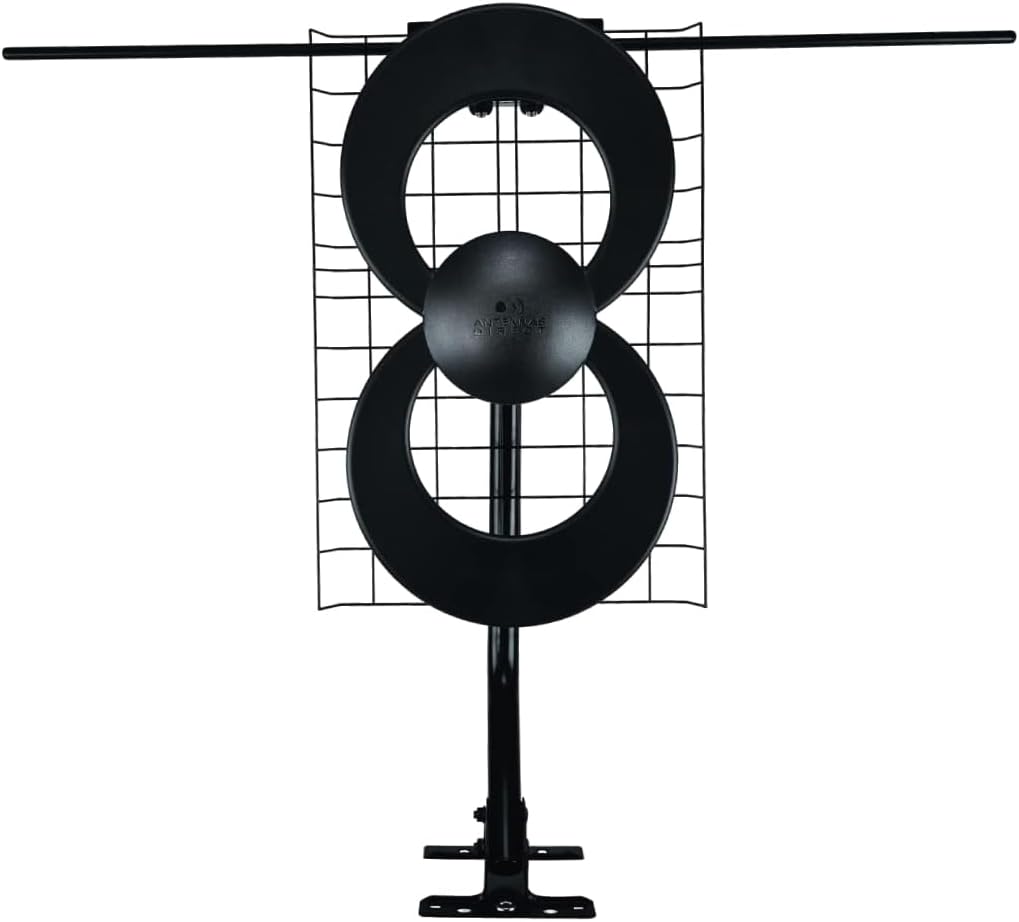
The Antennas Direct ClearStream 2V is a proven multi-directional antenna with a supplied rating of 4.4 out of 5. Its double-loop configuration, dedicated UHF and Hi-VHF elements, and included reflector are designed for reliable reception of free HD broadcasts, with a stated range of 60+ miles.
We may earn a commission when you buy through this link, at no additional cost to you.
Multi-directional reception makes this antenna useful when stations are not concentrated in one compass direction. The reflector adds forward gain and helps focus the antenna's power, potentially reducing interference that causes pixelation or complete picture loss. The product supports NEXTGEN TV, 4K, 8K UHD, and Full HD 1080p without requiring an internet connection.
Compared with the ClearStream 4V, this model offers a simpler and somewhat smaller installation, but it also has a lower stated range and fewer loop elements. Performance still depends on tower distance and obstructions such as trees and home building materials. It cannot receive cable channels, and its 20-inch mast with pivoting base must be installed securely when used outdoors.
This is a compelling choice for suburban and rural households seeking a proven multi-directional design without a motor or separate amplifier. The package includes the antenna, reflector, 20-inch mast with pivoting base, all-weather mounting hardware, adjustable mast clamp, and instructions. Antennas Direct supplies a lifetime manufacturer antenna warranty and a 90-day accessory warranty, adding useful support for long-term owners.
The multi-directional arrangement is particularly helpful where local transmitters are spread across a broad area, reducing the need to rotate the antenna whenever desired stations arrive from different bearings.
Users can place the antenna indoors, in an attic, or outdoors using the included pivoting mast and weather-resistant hardware, allowing installation to adapt to available space and line-of-sight conditions.
We may earn a commission when you buy through this link, at no additional cost to you.
The PIBIDI Outdoor TV Antenna focuses on a practical combination of extended reception elements, simple assembly, and outdoor durability. It has a supplied rating of 4.4 out of 5 and is designed to receive both VHF and UHF digital broadcast signals for 1080p and 4K television.
We may earn a commission when you buy through this link, at no additional cost to you.
Its stated operating frequencies are 170 to 230 MHz for VHF and 470 to 790 MHz for UHF. Longer and larger receiving elements are intended to produce a more stable signal across those bands. The antenna is mostly preassembled, and only a few elements need to be combined, with the product data stating that no tools are required and a clear installation guide is included.
Because it lacks a powered amplifier, users should not expect it to overcome every obstruction or overloaded environment. Trees, buildings, terrain, and the actual direction of towers can still limit reception. The supplied information also gives fewer package details than some competing products, so buyers should check the final contents and mounting requirements before ordering.
The PIBIDI is well suited to first-time antenna installers and anyone who values straightforward setup over motorized aiming or advanced filtering. Weather-resistant construction, lightning protection, grounding, and preassembled elements make it a practical outdoor option. It is also a sensible choice for viewers within ordinary broadcast distance who want local channels without complicated electronic controls.
Mostly preassembled components reduce the number of construction steps, making the antenna approachable for viewers who have never installed an outdoor television antenna before.
Separate VHF and UHF frequency coverage ensures the antenna can receive the broad mix of local digital stations commonly used by over-the-air viewers across different broadcast markets.
We may earn a commission when you buy through this link, at no additional cost to you.
The Five Star Outdoor HD TV Antenna with motorized rotation combines a 360-degree motor, infrared remote control, automatic gain control, and a super low-noise amplifier. Its supplied rating is 4.0 out of 5, while its stated capability includes reception from as far as 200 miles under favorable conditions.
We may earn a commission when you buy through this link, at no additional cost to you.
The motor allows the directional antenna to be repositioned from indoors, which is useful when desired stations occupy different directions. Its gain control spans 15 to 35 dB, and the low-noise amplifier operates across 45 to 860 MHz. A built-in LTE filter is intended to reduce interference from cellular signals, while two additional UHF elements and larger VHF elements support reception and picture quality.
One notable omission is the mounting pole. The package includes the antenna, control box, remote control, power supply, 40 feet of RG6 coax, a splitter, and instructions, but buyers must provide a suitable pole or other mounting system. Remote-control motors also introduce electronics and weather exposure that require careful installation and regular inspection.
This model is a good fit for viewers who want remote aiming and automatic gain control without purchasing a separate motorized antenna package. It supports 4K, 1080p, 1080i, and 720p broadcasts, plus radio reception. Users should regard the maximum range as highly dependent on unobstructed paths and local tower conditions, and they should account for the cost and effort of supplying an appropriate elevated mount.
The remote-controlled motor lets users explore different bearings from inside the home, a practical advantage over antennas that require manual repositioning whenever local stations arrive from separate directions.
Automatic gain adjustment and the super low-noise amplifier help maintain reception across changing conditions, while the LTE filter targets one common source of interference affecting over-the-air television.
We may earn a commission when you buy through this link, at no additional cost to you.
The Antennas Direct 8-Element Bowtie is a large, multi-directional outdoor antenna created primarily for UHF broadcast reception. Its supplied rating is 4.3 out of 5, and the product data lists a 70+ mile range, 17.4 dB gain, and a 470 to 608 MHz frequency range.
We may earn a commission when you buy through this link, at no additional cost to you.
Eight patented bowtie elements provide broad signal capture, while specially designed brackets let users turn the array in different directions toward local transmitters. Reflectors add forward gain and focus the antenna's power, which helps protect incoming television signals from interference. The multi-directional approach makes the model practical when stations are spread across more than one direction.
Its large dimensions—36.8 inches high, 50 inches wide, and 10 inches deep—create a sizable installation footprint. It is also focused on UHF rather than offering dedicated High VHF hardware comparable to the ClearStream models. Trees, terrain, and roofing materials can affect results, and the antenna cannot provide cable channels. Any mounting work must account for wind exposure and secure attachment.
This bowtie is best for rural or suburban viewers seeking broad UHF coverage and a substantial gain figure without an amplifier or motor. It supports NEXTGEN TV, 4K, 8K UHD, and Full HD 1080p without an internet connection. The package includes all-weather mounting hardware and an adjustable mast clamp, and the manufacturer includes a lifetime antenna warranty.
The eight-element bowtie configuration captures UHF signals from a wider set of directions than a single-array directional design, reducing the need for constant manual aiming in some markets.
Integrated reflectors provide additional forward gain and signal focus, helping preserve a clean picture when interference or multipath effects threaten reception.
We may earn a commission when you buy through this link, at no additional cost to you.
The PBD Amplified Outdoor TV Antenna offers a practical middle ground between simple directional antennas and more elaborate motorized systems. It has a supplied rating of 4.3 out of 5, a built-in high-gain low-noise amplifier, wireless remote-controlled 360-degree rotation, and a claimed reception range of up to 150 miles.
We may earn a commission when you buy through this link, at no additional cost to you.
The motor makes it possible to align the antenna with broadcast towers without going outside. Its dual TV outputs let two televisions receive a connection without requiring the user to add a splitter, while the included installation kit contains 40 feet of RG6 coax, mounting hardware, and a detailed guide. The weather-resistant design is intended for year-round outdoor use in urban and rural settings.
The maximum range remains dependent on tower distance, obstructions, and other reception factors. Amplification is most useful when it compensates for cable loss or weak incoming signals, while excessive gain can introduce overload in areas with strong transmitters. Motorized positioning also means the installation needs a secure mount and dependable power connection.
This is a strong option for households with two televisions that want convenient remote alignment and a complete cable-and-hardware package. It supports 1080p and 4K over-the-air channels and is NEXTGEN TV ready where available. Professional technical support is also listed among the product benefits, adding reassurance for buyers who may need help with installation or channel scanning.
Wireless remote rotation lets users change the antenna's direction from indoors, which is especially convenient after storm damage or whenever channel reception changes unexpectedly.
The two integrated television outputs simplify a common household configuration by allowing two sets to connect without the buyer adding another splitter before installation.
We may earn a commission when you buy through this link, at no additional cost to you.
The right outdoor television antenna depends on transmitter direction, signal strength, available mounting space, interference, and the number of televisions you intend to connect. Use the specifications as a guide, then compare those requirements with your local broadcast environment.
Antenna range is only one part of reception. A viewer near several broadcast towers may perform well with a modest multi-directional antenna, while a rural household far from transmitters may need a directional array with substantial gain and an unobstructed path. Towers, terrain, tree cover, hills, and the construction of the home can block or weaken signals even when a product advertises a long stated range. Before selecting an antenna, identify the direction of local transmitters and consider whether the proposed mounting location can see them.
Many local stations are broadcast in the UHF band, but some markets also include VHF or Hi-VHF stations. A product that supports only UHF may miss channels available on a lower-frequency broadcaster, while dual-band or tri-band designs offer broader compatibility. The ClearStream 4V and 2V include dedicated Hi-VHF elements, and the Televes DAT BOSS Mix LR is optimized specifically for High VHF and UHF. Match the antenna's frequency coverage to the stations you actually want.
Multi-directional antennas capture signals from a broad area and are convenient when transmitters are scattered in different directions. Directional Yagi, bowtie, and triple-boom designs concentrate reception toward a target and can outperform broad-pattern models when the tower location is known and alignment is accurate. Motorized models add convenience because their direction can be changed by remote control. The best pattern is the one that matches your tower geography and installation access.
Amplification can compensate for signal loss in long coax runs, weak incoming signals, and splitters, but it cannot create a usable signal that never reaches the antenna. Strong transmitters combined with excessive gain can cause overload and make reception worse. Automatic or band-specific gain controls offer more precise adjustment than a fixed amplifier. Always use quality shielded coax, minimize unnecessary splitters, and position the antenna before applying maximum amplification.
Over-the-air signals can be affected by FM radio, cellular transmitters, and other electronic sources. The Five Star Motorized 360 includes an LTE filter, while the Televes DAT BOSS Mix LR provides integrated filtering for FM, LTE, 4G, and 5G interference. These features are especially useful in developed areas with nearby wireless infrastructure. Filtering should not be selected without considering the actual interference environment, since local conditions differ substantially.
Outdoor antennas must withstand wind, rain, humidity, and ultraviolet exposure. Models with aluminum elements, stainless steel hardware, sealed cables, and all-weather mounting components are better suited to exposed roofs and walls. Attic installation can reduce weather exposure but may sacrifice some signal if roofing and insulation obstruct reception. Elevated placement is usually beneficial, yet installers must secure the mast properly, account for cable routing, and avoid creating water-entry points.
A single-television household may need nothing more than the antenna and a direct coax connection. The PBD includes two outputs, the Five Star amplified rotating model supports five televisions through a supplied four-way splitter, and the GE model is designed for straightforward standard-coax connections. Every split reduces the signal available to each television, so adequate gain and correct amplifier adjustment become increasingly important as the number of outputs grows.
Some antennas arrive mostly assembled, while Yagi and multi-element arrays require joining components and orienting them carefully. Motorized antennas add control boxes, power supplies, remotes, and motorized positioning that must be protected from the weather. The included equipment also varies substantially: some packages provide masts and long coax cables, while others require a separate pole. Review the package contents and your available tools before choosing a model.
Begin by identifying the direction of local broadcast towers and choosing an installation site with the clearest possible view. Mount the antenna as high as practical, secure the mast and hardware, and connect quality shielded coax before powering any amplifier. If the antenna has a motor or adjustable elements, align it toward the relevant transmitters and perform a fresh channel scan on each connected television.
Operate the antenna conservatively. Start with moderate or automatic gain, increase it only when weak signals require help, and reduce it if channels become unstable. On multi-directional models, reposition the antenna if some stations appear while others remain unavailable. For motorized versions, use the remote to make incremental changes and allow the antenna to settle after each movement. Avoid unnecessary splitters, since each one reduces signal strength.
Inspect the installation periodically, particularly after severe weather. Check the mast, brackets, grounding, cable connections, and any visible element damage. Keep water from entering coax connections and avoid creating tight cable bends. Clean removable debris from the antenna as appropriate, but do not climb onto roofs unless you can do so safely. If reception changes unexpectedly, check connections and rescan the television before altering the entire setup.
The distance an antenna can receive depends on transmitter power, terrain, foliage, building materials, antenna direction, amplifier quality, and coax loss. Products in this guide state ranges from approximately 60+ miles to as much as 200 miles, but those figures represent favorable maximum conditions rather than guaranteed results. A clear line of sight and correctly aimed directional antenna usually matter more than the headline range.
No. An antenna can recover weak signals and reject some interference, but it cannot create a reliable signal blocked by terrain, dense trees, or severe building obstructions. It also cannot receive cable or subscription channels. Residents should identify which broadcast stations are available locally and test whether an antenna improves those specific channels before assuming a higher-priced model will solve every reception problem.
An amplifier is useful when signals are weak, the coax run is long, or multiple splitters reduce signal strength. It can also make reception worse by overloading the television's tuner when signals are already strong. Non-amplified antennas are often sufficient for nearby transmitters and tend to be simpler. Start with modest amplification and reduce it if channels become unstable.
Outdoor installation usually provides better reception because the antenna can see more of the broadcast landscape and sit above nearby obstructions. Attic mounting can look neater and may reduce weather exposure, but roofing material, insulation, and walls can weaken signals. If the attic location produces inconsistent channels, moving the antenna outside to a clear line of sight is generally the most effective improvement.
A motor is convenient when local stations arrive from different directions or when the antenna is difficult to access. It does not automatically improve the antenna's inherent gain. A properly aimed fixed directional antenna can perform just as well, while a multi-directional antenna may require less adjustment. Choose a motor when convenience and flexible aiming outweigh the additional installation complexity.
Quality shielded RG6 coax is the standard choice for outdoor television antennas because it minimizes interference and signal loss over long runs. Keep connectors tight and protected from moisture, and avoid sharp bends or unnecessary extensions. Very long or poorly shielded cable runs can reduce performance, so the antenna should be mounted with the shortest practical cable route to the television system.
Local television station listings and official broadcast maps can identify the transmitters serving your area and their directions. Record the desired stations before installing an antenna, then use your television's channel scan after each major positioning or gain adjustment. Because reception changes with obstacles and weather, rescanning periodically can reveal whether the installation still needs attention.
Yes, provided the antenna has adequate signal gain for the number of connected devices and the distribution system is installed correctly. Some models include multiple outputs or a splitter, while others require separate equipment. Each split reduces the signal reaching individual televisions, so long coax runs and multiple connections may justify a model with stronger gain or intelligent amplification.
The Antennas Direct ClearStream 4V is the best overall option for balanced Hi-VHF and UHF reception, purposeful reflectors, outdoor versatility, and a complete mounting package. The GE Outdoor HD Digital Antenna is the best budget choice because it provides a straightforward, universally compatible design with attic or outdoor placement, while the Televes DAT BOSS Mix LR stands out as the best premium model with band-specific amplification, advanced filtering, and passive fallback operation.
The most important buying priority is the broadcast environment rather than the largest stated mileage. Identify tower directions, determine whether you need VHF, Hi-VHF, UHF, or FM reception, and account for trees, terrain, and building obstructions. Then select a pattern, amplifier level, mounting system, and number of outputs that match those conditions instead of paying for features that cannot solve the actual signal problem.
Product availability, customer ratings, included accessories, and pricing can change, so readers should confirm the current listing and technical details before making a final purchase. Comparing the antenna's mounting requirements and cable package against the intended installation site is just as important as comparing gain and range claims.