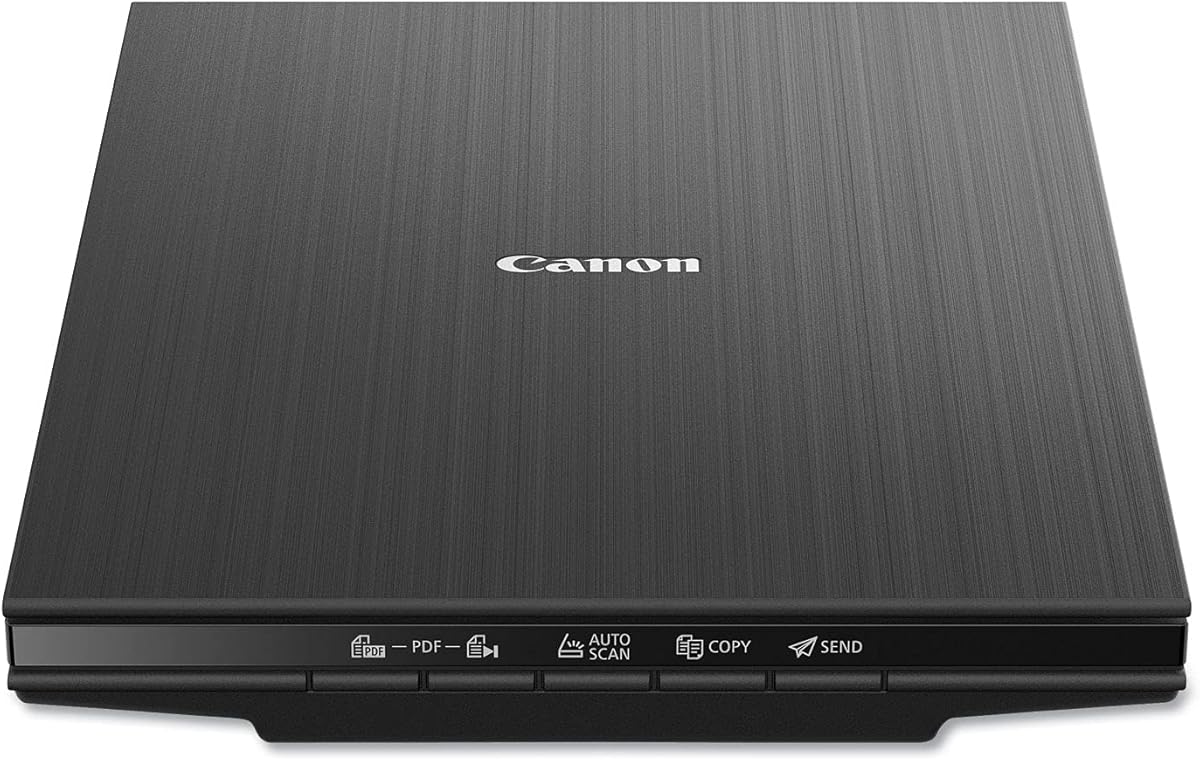
Canon CanoScan LiDE 400
4.1Editor score
4800 x 4800 dpi resolution
Single-cable USB Type-C
Photo and document scanning
A MacBook Neo workflow benefits from a scanner that moves paper into dependable digital files without making setup feel complicated. The right model should handle documents, receipts, cards, or family photos while fitting the way you work, whether that means a compact desk setup or portable scanning on the move.
We compared ten scanners on Mac compatibility, supported media, scanning speed, resolution, OCR, automatic document handling, connectivity, photo-oriented features, and practical workflow software. The list covers mobile feeders, flatbed units, wireless scanners, and specialized photo devices suitable for different budgets and document volumes.
Each recommendation highlights the product's most useful qualities and honest limitations, helping you identify the scanner that matches your MacBook Neo setup. Product details and availability can change, so confirm the latest specifications, software requirements, and current price before purchasing.
4.1Editor score

4.3Editor score

4.3Editor score
As an Amazon Associate we earn from qualifying purchases.
This side-by-side comparison shows how each scanner approaches MacBook Neo use, covering document handling, photo support, OCR, connectivity, resolution, portability, and workflow convenience.


The Epson Workforce ES-50 combines a genuinely portable single-sheet feeder with the document tools Mac users commonly need, earning it a 4.3 rating in the supplied data. It can scan a page in as little as 5.5 seconds, supports Windows and Mac, and uses USB power without requiring batteries. Its standout advantage is the balance between portability, automatic document handling, and practical file conversion.
We may earn a commission when you buy through this link, at no additional cost to you.
The ES-50 accepts documents up to 8.5 by 72 inches, which makes it useful for long receipts, records, and narrow paper formats. Epson ScanSmart helps users review and save files, while Nuance OCR can turn scans into searchable PDFs and editable Word or Excel documents. Automatic feeding mode can combine multiple inserted pages into one file, reducing the amount of manual organization required after a session.
Its limitations reflect its portable design. Because the feeder scans one sheet at a time, it is not the most efficient option for a large backlog of loose pages. The listed features emphasize documents rather than dedicated photographic reproduction, so users whose main goal is preserving prints and albums should consider a photo-oriented flatbed or feeder instead. A MacBook Neo user who values compactness and editable document output will find those trade-offs reasonable.
Choose the ES-50 for travel, home-office flexibility, receipt capture, and searchable records. It is a particularly strong fit for someone who wants a scanner that can live in a bag and connect to a laptop without a separate power supply. For sustained office throughput, a larger automatic feeder is more efficient, but for a portable MacBook Neo workflow, the ES-50 offers the most convincing combination of size, speed, and useful software.
The ES-50 is designed around a single-sheet mobile workflow, yet it automates more than the physical scan. Automatic file combining reduces repetitive file management, while OCR turns photographed or printed material into text that can be searched and edited.
Compatible Mac and Windows support, cloud destinations, and a TWAIN driver broaden the software options available on a MacBook Neo. The result is a flexible path from receipts and records to editable office documents rather than a simple collection of images.
We may earn a commission when you buy through this link, at no additional cost to you.
The Canon CanoScan LiDE 400 is a straightforward flatbed option with a 4.1 rating and an attractive balance of photo resolution, document handling, and a slim enclosure. It can scan in as little as eight seconds and uses a single USB Type-C cable for both data and power, simplifying connections to a MacBook Neo.
We may earn a commission when you buy through this link, at no additional cost to you.
Its 4800 by 4800 dpi optical resolution is particularly useful for photographs, illustrations, and other detailed material. Built-in enhancements include color restoration and dust removal, while automatic scan mode detects the type of material on the glass. Dedicated PDF controls can create editable, searchable multi-page PDFs, giving the scanner value beyond occasional image capture.
The main limitation is obvious but important: there is no automatic document feeder. Every page must be placed and scanned manually, which is acceptable for short documents, photos, and occasional records but less suitable for a large archive. The supplied specifications also call out only basic paper sizes, so users with unusual formats should verify dimensions before purchase.
For a MacBook Neo owner seeking an affordable, compact scanner that can handle both documents and photos, the LiDE 400 is a sensible starting point. Its high resolution, photo enhancements, and searchable PDF function offer versatility without the bulk of a full office feeder. It is best suited to users with modest scanning volume who value image quality and straightforward operation.
The 4800 dpi sensor gives the LiDE 400 an advantage when fine detail matters, from printed photographs to artwork. Color restoration and dust removal can also help revive or clean older source material before it is stored digitally.
A single USB Type-C cable handles power and data, reducing cable clutter. Automatic detection and straightforward PDF buttons make the scanner approachable for occasional users who do not want to configure complex profiles.
We may earn a commission when you buy through this link, at no additional cost to you.
The Brother DS-640 is built for users who need to carry a scanner between locations. Its 4.3 rating, sub-one-foot length, and approximate 1.5-pound weight distinguish it as one of the most compact feeder-style options in this guide. It also supports Windows, Mac, and Linux, providing unusually broad platform flexibility.
We may earn a commission when you buy through this link, at no additional cost to you.
Document throughput reaches up to 16 pages per minute, and color scanning is listed at the same speed as black-and-white scanning. The included iPrint&Scan desktop app supports destinations such as a computer, network location, email, cloud services, and OCR. Automatic color adjustment, rotation, bleed-through prevention, background removal, and text enhancement help improve output without requiring manual correction for every page.
The DS-640 uses a compact mobile design, so buyers with unusually long documents or a need for high-resolution photo reproduction should investigate its limits before ordering. It is fundamentally a document scanner, not a dedicated photo imaging system. Its smaller feed mechanism also may feel less convenient for sustained batch work than a full-size desktop automatic document feeder.
For a MacBook Neo user who travels frequently, works across multiple locations, or wants a lightweight feeder with broad operating-system support, the DS-640 is a strong fit. It offers more routing flexibility than many similarly compact scanners and enough speed for routine receipts, forms, and office records. Users focused primarily on photographs should look instead to the flatbed or photo-specific choices later in the list.
Despite its compact body, the DS-640 includes automatic color detection, image rotation, text enhancement, background removal, and OCR-related workflows. It is therefore more than a basic image-capture device for mobile document work.
The ability to send scans to a computer, network, email, cloud service, or OCR destination is valuable on a MacBook Neo. That flexibility helps connect paper intake with the applications and storage services already used for daily work.
We may earn a commission when you buy through this link, at no additional cost to you.
The Canon imageFORMULA R10 is a compact automatic document scanner with a 4.0 rating. It differentiates itself through duplex scanning, a 20-sheet feeder, and a stated speed of up to 12 pages per minute. It supports both Windows and Mac, making it a practical choice for a MacBook Neo office that regularly handles multipage paper.
We may earn a commission when you buy through this link, at no additional cost to you.
The R10 converts documents into searchable PDFs, JPEGs, and other digital formats. Its media handling covers receipts, business cards, plastic or embossed cards, reports, and legal documents. Built-in software is designed to update automatically, while preview controls let users straighten, trim, and organize files or create custom scanning buttons and destinations.
This is primarily a document scanner, and Canon explicitly states that it is not intended to scan photographs on photo paper or other photographic media. Its 12-page-per-minute maximum is also below several competing automatic feeders. For a large stack of routine paperwork, though, duplex capture means fewer passes and less manual intervention.
Choose the R10 when duplex documents, cards, and a moderate paper volume matter more than photographic quality. It gives a MacBook Neo user a straightforward automatic workflow with no complicated installation, making it well suited to home offices, classrooms, and remote workspaces. Photo owners should choose one of the dedicated photo scanners instead.
Scanning both sides in one pass is the R10's most meaningful productivity feature. Combined with its 20-sheet feeder, it reduces the amount of interaction needed for typical contracts, reports, forms, and records.
Preview, straighten, trim, and custom-destination tools help users correct and route scans before saving. Automatic software updates also simplify long-term maintenance compared with a setup that depends on a separate installation.
We may earn a commission when you buy through this link, at no additional cost to you.
The Plustek Photo Scanner ePhoto Z300 is purpose-built for digitizing printed photographs and receives a 4.5 rating, the highest among the listed products. It uses a CCD sensor, supports up to 600 dpi, and can scan a 4-by-6-inch photo in about two seconds. It also handles documents, making it a focused choice for photo archives and mixed paper projects.
We may earn a commission when you buy through this link, at no additional cost to you.
The scanner accepts 3-by-5, 4-by-6, 5-by-7, and 8-by-10-inch photos, along with letter and A4 paper. Automatic crop and deskew reduce the need to frame each image manually. Image enhancement tools can restore faded photographs, while the feed-style design can be more efficient than placing many items one by one on a flatbed.
Its 600 dpi maximum trails modern flatbed scanners that offer 4800 dpi, although the appropriate resolution depends on the intended use. The workflow also remains largely one-photo-at-a-time, which may feel slower for a very large family collection than a model designed for broad automatic batches. Users should also note the listed operating system range for older Mac OS X versions.
For someone building a digital copy of a photo collection on a MacBook Neo, the ePhoto Z300 offers speed and specialization that general-purpose scanners may not match. It is well suited to family photographs, small prints, and documents when photo handling is the priority. Users needing extremely fine detail or high-volume batch photo capture should examine the Epson FastFoto FF-680W.
A dedicated feed path and automatic crop and deskew reduce the steps required for each print. The two-second 4-by-6-inch scan claim also makes the Z300 efficient for converting a sizable assortment of small photos.
Built-in enhancement functions are designed to improve faded images. This focus gives the scanner an advantage when preserving older prints that may need more than a basic scan of the visible page.
We may earn a commission when you buy through this link, at no additional cost to you.
The Epson Perfection V19 II is a lightweight flatbed scanner with a 3.9 rating and 4800 dpi optical resolution. It supports photos, artwork, illustrations, books, and documents, with OCR capabilities for searchable PDFs and editable Microsoft Office files. Its high resolution makes it particularly relevant to a MacBook Neo workflow that includes photos or artwork.
We may earn a commission when you buy through this link, at no additional cost to you.
One-touch controls reduce the number of steps, while Easy Photo Fix can restore color to faded images. The removable, high-rise lid allows books and photo albums to be scanned, addressing a common limitation of low-profile flatbeds. USB power eliminates the need for a separate power adapter, and a built-in kickstand permits vertical storage when the scanner is not in use.
The main disadvantage is the absence of an automatic document feeder. Each sheet, book spread, or artwork must be placed manually, so this model is better for considered, high-quality capture than continuous intake of loose receipts. Its 3.9 rating is also the lowest listed, though that does not eliminate its usefulness for the tasks it is designed to perform well.
The V19 II is a strong option for a MacBook Neo owner who wants one flatbed to cover photographs, books, artwork, and text documents without sacrificing resolution. The removable lid and high resolution especially appeal to creative users. For a high-volume office that needs duplex or multipage automatic scanning, select one of the feeder-based alternatives instead.
The 4800 dpi optical resolution is useful when scanning prints, illustrations, and artwork. Combined with Easy Photo Fix, it supports both accurate reproduction and restoration of older color images.
A removable high-rise lid makes it possible to scan bound material and albums that will not fit beneath a shallow lid. OCR also extends the scanner beyond artwork into searchable, editable document output.
We may earn a commission when you buy through this link, at no additional cost to you.
The ScanSnap iX1300 offers a versatile combination of wireless flexibility, duplex capture, and a compact footprint, earning it a 4.2 rating. It reaches up to 30 pages per minute and can work with USB or Wi-Fi. Importantly, it can be used without a computer, making it more independent than scanners that require a connected Mac or PC to operate.
We may earn a commission when you buy through this link, at no additional cost to you.
The device can send files to a Mac, PC, mobile device, or cloud service, and a mobile app supports Chromebook scanning. It handles documents, photos, cards, and thicker items. The Quick Menu allows users to route scans directly into preferred computer applications, while ScanSnap Home organizes and edits documents, receipts, business cards, and photos.
Its key trade-off is the need to configure wireless connections and destinations before the full benefit is available. Some users may also prefer the newer wired design of the iX2400 for consistent operation. As with any compact duplex scanner, document capacity and handling requirements should be checked against the kinds of paper you regularly scan.
The iX1300 is a good middle ground for a MacBook Neo user who wants occasional wireless freedom without giving up high-speed duplex scanning. It works especially well for mixed paper intake and users who sometimes need to scan without opening a laptop. For a permanently connected, faster desktop workflow, the iX2400 is the more current alternative.
Wi-Fi operation and computer-free scanning give the iX1300 flexibility that a wired-only unit cannot offer. Sending output to cloud services, mobile devices, or a Chromebook can shorten the route from paper to its destination.
Automatic de-skew, color optimization, and blank-page removal reduce manual work across documents, receipts, cards, and photos. The Quick Menu then provides a direct path into commonly used applications.
We may earn a commission when you buy through this link, at no additional cost to you.
The Epson FastFoto FF-680W is a specialized high-speed photo and document scanner with a 4.5 rating. It can digitize a photograph in as little as one second at 300 dpi and batch up to 36 photos at once, making it the clear choice here for large print collections. It remains fully relevant to a MacBook Neo because the goal is efficient, high-quality preservation of physical photographs.
We may earn a commission when you buy through this link, at no additional cost to you.
The scanner accepts Polaroids, panoramas, postcards, and prints up to 8 by 10 inches. Automatic enhancement, color restoration, red-eye reduction, de-skew, crop, and rotation help prepare images for sharing. Single-step technology can capture an image and handwritten notes on its back together, while the included carrier sheet and SafeTouch technology help protect delicate material.
Resolution options include 300 dpi for sharing, 600 dpi TIFF for archiving, and 1200 dpi for enlargement. It also functions as a document scanner, offering OCR, documents up to 240 inches, and speeds up to 45 pages per minute or 90 images per minute. Wireless and USB connections add placement flexibility, while Dropbox and Google Drive support assists with backup and sharing.
The FF-680W is best for households, clubs, or small archives that have many photos to digitize and value a streamlined, wireless-capable workflow. It offers more specialized batch handling and photo protection than general-purpose scanners. Those capabilities come with a larger and more premium-oriented footprint, so buyers should consider whether photo volume justifies the investment.
The ability to scan as many as 36 photos in one batch removes much of the repetitive work associated with digitizing albums. One-photo-per-second performance at 300 dpi makes the process practical for extensive collections.
Color restoration, red-eye reduction, automatic correction, and red-eye reduction work together with a carrier sheet designed for delicate photos. Duplex capture also preserves handwritten notes found on the reverse side of an image.
We may earn a commission when you buy through this link, at no additional cost to you.
The Canon imageFORMULA RS40 combines photo and document digitization in an automatic feeder, earning it a 4.0 rating. It can scan both sides of photos and documents at up to 40 items per minute, giving it strong throughput for mixed media. Windows and Mac support, along with an included TWAIN driver, make it suitable for a MacBook Neo.
We may earn a commission when you buy through this link, at no additional cost to you.
Its software enhances photographs through red-eye correction, face smoothing, and other restoration options, while also supporting document scanning, conversion, and editing. The feeder accepts Polaroids, receipts, cards, driver licenses, and tax documents in varying sizes. Output formats include JPG, TIF, BMP, PNG, PDF, and PPTX.
The USB interface means it cannot offer the wireless placement found in the ScanSnap iX1300 or Epson FastFoto FF-680W. It also carries a one-year limited warranty according to the supplied information, which may matter more to buyers seeking longer-term coverage. The RS40 is therefore less flexible in placement, though its automatic feeder compensates with speed.
Choose the RS40 when a MacBook Neo user has both documents and photographs to digitize and prefers one wired automatic machine. It is especially suitable for creating digital montages, scrapbook material, searchable records, and mixed-format archives. Users wanting wireless freedom can select a ScanSnap alternative, while high-resolution fine-art work favors a flatbed.
The RS40 removes the need to separate photos from documents before scanning. Its media range includes everyday paper, cards, licenses, receipts, and multiple photo formats, all through an automatic feed process.
Red-eye correction and face smoothing make the included tools useful for old photographs, while the document side supports conversion and editing. Multiple image and presentation formats provide flexibility for storage and later editing.
We may earn a commission when you buy through this link, at no additional cost to you.
The ScanSnap iX2400 is a high-speed, one-touch scanner with a 4.3 rating and the largest stated feeder capacity in this guide. It processes up to 45 pages per minute, accommodates 100 sheets, and automatically detects document size and color depth. For a MacBook Neo user handling routine business documents, it presents a focused and highly efficient workflow.
We may earn a commission when you buy through this link, at no additional cost to you.
A single button starts a sequence that scans, cleans, and organizes pages. The scanner removes streaks and blank pages, deskews documents, and rotates images, reducing manual preparation. ScanSnap Home consolidates scanning and editing functions for documents, receipts, business cards, photos, and envelopes, while Quick Menu routes files to preferred computer applications.
Its stable wired USB connection prioritizes consistency rather than wireless placement. It is also not a dedicated photograph-preservation system, so users requiring very high optical resolution or extensive photo restoration may receive better results from a flatbed or photo scanner. Its premium positioning is most defensible when the larger feeder and speed are used regularly.
Choose the iX2400 for a MacBook Neo office that digitizes substantial volumes of receipts, forms, business cards, and multipage documents. Its combination of 45-page-per-minute throughput, a 100-sheet feeder, and automatic cleanup makes it a strong all-around productivity choice. Mobile users should instead favor a compact wireless or USB-powered model.
The 100-sheet feeder and 45-page-per-minute speed reduce interruptions during large scanning sessions. This makes the iX2400 particularly suitable for offices that regularly process stacks rather than a page at a time.
Automatic document-size and color-depth detection, streak removal, blank-page removal, deskewing, and rotation address common page-quality issues. ScanSnap Home and Quick Menu then simplify naming, editing, and routing the resulting files.
We may earn a commission when you buy through this link, at no additional cost to you.
The right scanner for a MacBook Neo depends on what you will scan, how quickly you need to process it, and how much space you can devote to the device. These factors cover the practical differences that matter most after installation.
Begin by confirming that the scanner supports macOS and the version running on your MacBook Neo. Several products in this guide explicitly support Windows and Mac, while the Brother DS-640 adds Linux compatibility. Software support can be just as important as the hardware connection: look for included OCR tools, searchable PDF creation, TWAIN or ICA drivers, and an app that can route scans to your preferred storage or editing applications.
The Epson ES-50 uses Epson ScanSmart and a TWAIN driver, the Canon models provide included scanning software or built-in tools, and the ScanSnap products use ScanSnap Home with a Quick Menu. Check that the software supports the file formats and destinations you need, especially if your workflow depends on editable Word, Excel, cloud, or OCR output.
Decide whether occasional manual scanning is acceptable or whether you need automatic document feeding. Flatbeds such as the Canon LiDE 400 and Epson Perfection V19 II provide excellent close-up access but require each item to be placed on the glass. Portable feeders, such as the Epson ES-50 and Brother DS-640, accept sheets individually, while larger models like the Canon R10, ScanSnap iX1300, Canon RS40, and ScanSnap iX2400 automate multipage intake.
For recurring office work, consider both speed and capacity. A 100-sheet feeder and 45-pages-per-minute rate suit heavy document flow, while a 20-sheet feeder is adequate for a smaller active workload. If you travel with your MacBook Neo, a single-sheet or compact design may matter more than maximum batch capacity.
Document scanners and photo scanners emphasize different qualities. The Epson Perfection V19 II and Canon LiDE 400 offer 4800 dpi optical resolution, which suits detailed prints and artwork. The Plustek ePhoto Z300 is optimized for feeding individual photographs with automatic crop and deskew, while the Epson FastFoto FF-680W is built for rapid batch photo archiving and restoration.
For faithful photo preservation, compare maximum resolution, automatic de-skew and crop, dust removal, color restoration, red-eye correction, and support for fragile prints. A high pixel figure does not replace correct handling, so also consider whether the feeder includes a carrier sheet and whether photographs can be captured with notes on their backs.
Optical character recognition converts a picture of text into searchable and editable content. This is essential for receipts, invoices, forms, and archived records because it allows you to locate information later and reuse it in a word processor or spreadsheet. The Epson ES-50, Epson Perfection V19 II, Epson FastFoto FF-680W, Brother DS-640, and Canon LiDE 400 all have OCR-related capabilities in the supplied information.
Consider the final output format as well. Searchable PDFs are useful for filing, editable Word and Excel files support direct office work, and OCR destinations in Brother's app can streamline routed scans. Test the workflow with a representative page before moving a large archive, since menu terminology and feature access can vary by operating system.
A MacBook Neo is portable, but not every scanner is designed to travel with it. The ES-50, Brother DS-640, and Epson Perfection V19 II are USB-powered and notably compact. The Canon LiDE 400 uses a single USB Type-C cable for data and power. Wireless alternatives include the ScanSnap iX1300 and Epson FastFoto FF-680W, which can reduce cable dependence and support cloud or mobile destinations.
A wired connection can be more consistent for sustained work. The ScanSnap iX2400 specifically emphasizes stable USB operation, while the Canon RS40 also uses USB. If wireless freedom is not important, prioritize automatic cleanup, feeder capacity, and OCR. If you need to scan away from a desk, prioritize weight, dimensions, power requirements, and whether the scanner can operate without a computer.
Speed matters most when processing more than a few pages at once. The ScanSnap iX2400 leads the listed document options at up to 45 pages per minute, followed by the Canon RS40 at up to 40 items per minute and the ScanSnap iX1300 at up to 30 pages per minute. The Brother DS-640 reaches up to 16 pages per minute, while the Epson ES-50 can scan a single page in approximately 5.5 seconds.
Photo workflows use different measures. The Epson FastFoto FF-680W can process one photograph per second at 300 dpi and batch up to 36 photos. The Plustek ePhoto Z300 can scan a 4-by-6-inch photo in two seconds. Match the speed rating to your typical batch size rather than focusing on the largest headline number.
Manual correction takes time when every page needs to be rotated, cropped, or cleaned. Automatic color detection, deskew, rotation, background removal, blank-page removal, and streak removal are particularly useful for mixed piles of receipts and office documents. The ScanSnap iX2400 and iX1300 emphasize one-touch automated cleanup, while the Brother DS-640 includes several automatic optimization functions.
For photographs, look for enhancement rather than document cleanup. Color restoration, red-eye reduction, automatic crop, dust removal, and face smoothing can make a meaningful difference to faded or imperfect prints. The best workflow combines the right correction tools with a preview step, allowing you to inspect critical pages before committing them to storage.
A scanner should send files somewhere useful rather than leaving them stranded in a temporary folder. Look for direct cloud support, email destinations, network folders, mobile-device delivery, and applications for documents, receipts, business cards, or photos. The ES-50 supports cloud scanning, the Brother DS-640 includes several scan-to destinations, and the ScanSnap iX1300 can reach computers, mobile devices, cloud services, and Chromebooks.
For important photo archives, establish a backup plan as soon as the files are created. The Epson FastFoto FF-680W includes support for Dropbox and Google Drive, while other products can route files to cloud services through their software. Always retain the original scan until you have verified the backup and opened the resulting file on your MacBook Neo.
Install the scanner's current Mac software before connecting it to the MacBook Neo, then follow the manufacturer's setup sequence for drivers, OCR, and scan destinations. Clean the glass or feed path with a lint-free cloth, check that the paper guide matches the media size, and make a test scan before beginning a large job. Choose an output folder and file format that match how you plan to use the document or photograph.
For feeders, arrange pages neatly and avoid forcing fragile, folded, or exceptionally thick material into the mechanism. Place originals face down or in the marked orientation, feed one sheet at a time when the scanner requires it, and allow automatic corrections to finish before removing the last page. For photographs, use the supplied carrier sheet when appropriate and handle prints by their edges to avoid scratches, smudges, and fading.
After scanning, preview every file and confirm that text is readable, pages are oriented correctly, photographs are sharp, and nothing important has been cropped. Save the originals in a clearly named folder and create a second backup for irreplaceable files. Periodically clean the rollers or glass as recommended, keep the scanner covered when idle, and avoid placing the device in a location where dust, moisture, direct heat, or unstable surfaces can affect the mechanism.
The best match depends on your workload. The Epson ES-50 is a strong portable option for documents and OCR, the Canon LiDE 400 offers affordable photo and document scanning, and the ScanSnap iX2400 suits high-volume document intake. Confirm that the current software version supports your specific macOS release.
A flatbed is often preferable for individual photographs, books, artwork, and delicate prints because you control placement and scan quality. The Epson Perfection V19 II provides 4800 dpi and a removable high-rise lid, while the Canon LiDE 400 combines high resolution with a slimmer design. Photo feeders such as the Epson FastFoto FF-680W are better when speed and batch volume matter.
Yes, when it includes optical character recognition or a compatible OCR workflow. The Epson ES-50 can create searchable PDFs and editable Word and Excel files, and the Epson Perfection V19 II can also generate editable Office documents. OCR accuracy varies with scan quality, so review each file before relying on it for critical records.
Not necessarily. Wireless connectivity is convenient for flexible placement, mobile destinations, and computer-free operation, especially with the ScanSnap iX1300 and Epson FastFoto FF-680W. A stable wired connection can be preferable for consistent high-speed workflows, while compact USB-powered models are often more convenient when traveling.
The ScanSnap iX2400 has the largest stated feeder capacity in this guide at 100 sheets, with a maximum speed of 45 pages per minute. The ScanSnap iX1300 offers up to 30 pages per minute, the Canon RS40 handles up to 40 items per minute, and the Canon R10 includes a 20-sheet feeder with duplex scanning.
Most can handle receipts, cards, and standard documents, but their strengths differ. The Epson ES-50 is compact and OCR-focused, the Brother DS-640 emphasizes portable routing, and the ScanSnap models focus on automatic cleanup and organization. Plastic or embossed cards should be checked against the individual product's media specifications before scanning.
Sort photographs by size and condition, remove loose debris carefully, and handle prints by their edges. Use automatic crop, deskew, color restoration, and dust removal where available, and employ a carrier sheet for fragile photographs. Start with a representative sample before processing the full collection so you can confirm color, sharpness, and orientation settings.
No. After your preferred scanning application saves and organizes a file, you can move it to any compatible folder or storage service. For valuable documents and photographs, maintain a backup outside the computer, verify that the copy opens correctly, and keep the original until the backup has been confirmed.
The Canon CanoScan LiDE 400 is the value-focused choice for light document use and detailed photo capture, while the Epson Workforce ES-50 is the most versatile portable recommendation for OCR, cloud workflows, and automatic multi-page organization. The ScanSnap iX2400 represents the premium productivity option, combining 45-page-per-minute throughput, a 100-sheet feeder, and automatic cleanup.
Prioritize the feature your daily work depends on: high resolution and a removable lid for photographs, OCR for searchable records, wireless access for flexible placement, or a large automatic feeder for continuous document intake. Also check the media sizes, software support, and output formats against the materials you expect to scan before deciding.
Specifications, software compatibility, and prices can change, so verify the current product listing and Mac support before ordering. Compare the selected scanner with the current price, included accessories, and warranty terms, and make sure the most important workflow is supported rather than choosing on speed or resolution alone.