
Wittner 836 Taktell Piccolo
4.6Editor score
Recognizable piccolo metronome format
Compact traditional styling
Simple mechanical operation
Portable piano practice companion
Explore the best mechanical metronome for piano with an expert comparison of tempo ranges, beat modes, sound, accuracy, durability, and ease of use in practice.
A mechanical metronome gives pianists a steady visual and audible reference without requiring batteries or an electronic display. The right model can improve timing, clarify complex rhythms, and make gradual tempo changes easier. Important considerations include beat clarity, tempo range, bell options, winding duration, build quality, and how comfortably the controls fit a home practice routine.
The products in this guide were compared using the supplied specifications and customer ratings. The list covers classic pyramid designs, wood-grain and transparent housings, compact models, and options with different movement materials or bell arrangements. It also distinguishes the practical details that matter for piano practice, including 40-208 BPM tempo coverage, selectable beat groupings, and ease of operation.
Each review explains the strongest reasons to consider a particular mechanical metronome, along with its limitations and ideal user. The top selections are highlighted separately for quick discovery, while the comparison table provides a side-by-side view. Product availability, ratings, features, and prices can change, so readers should confirm current details before making a purchase.
4.6Editor score

4.6Editor score

4.4Editor score
This side-by-side comparison highlights the supplied tempo ranges, beat selections, movement approaches, and physical designs so piano players can quickly identify a metronome that matches their practice space and rhythmic needs.


The Ueteto Mechanical Metronome Black is a straightforward practice tool with a 4.4 customer rating. Its main strengths are a 40-208 BPM tempo range, selectable 0, 2, 3, 4, and 6 beat patterns, and both audible click and bell sounds. Those features give a piano student enough rhythmic flexibility for scales, études, waltzes, and basic ensemble work without adding electronic controls to the setup.
We may earn a commission when you buy through this link, at no additional cost to you.
Its wind-up design is particularly convenient for musicians who want an uncomplicated tool that works without batteries. The operating sequence is easy to understand: remove the brake, take off the cover, select the beat and tempo, and then wind the mechanism. A full wind is listed as producing approximately 2,160 clicks and lasting at least 18 minutes, depending on tempo. That duration suits focused drills, though it may require winding during a longer rehearsal.
The main compromise is that the supplied information describes a primarily functional model rather than one with elaborately documented sound characteristics. The click and bell should be evaluated in the context of the room where it will be used, especially if a piano is already producing substantial sound. Its generic multi-instrument positioning also means it may be less specialized than some dedicated piano options.
This is a strong choice for beginners, students working in a shared practice space, and anyone who values simple operation over advanced features. It offers nearly the same tempo and beat coverage as many costlier models, making it a sensible first mechanical metronome. For longer sessions, a model with a longer stated running time may be more convenient.
The five beat selections make this model practical for more than simple quarter-note counting. A pianist can use different groupings to check accents, practice subdivisions, and work with compound or changing meters. The visible pendulum adds a second timing cue without introducing a digital display.
The absence of batteries removes both charging and battery-replacement concerns. The trade-off is that the spring must be wound regularly, but the process is uncomplicated enough for children and beginners to manage with little supervision.
We may earn a commission when you buy through this link, at no additional cost to you.
This wood-grain mechanical metronome carries a 4.4 rating and emphasizes a metal movement within its classic pyramid form. It supports 40-208 BPM and 0, 2, 3, 4, or 6 beat choices, giving piano players the core tempo controls needed for standard repertoire and rhythmic study. The traditional appearance also makes it easy to incorporate into a music room without looking out of place.
We may earn a commission when you buy through this link, at no additional cost to you.
The all-metal movement is the feature most likely to appeal to buyers concerned about long-term durability. According to the supplied description, the movement is intended to provide stable performance and support sustained use. The practical advantage is less about a flashy feature and more about a movement that feels appropriately robust for a frequently handled practice accessory.
Its controls follow a familiar mechanical pattern. Removing the bottom stopper, winding the unit, removing the cover, and selecting the desired beat and tempo should be intuitive for most beginners. The supplied information does not give a precise winding duration or detail the exact tone of the click and bell, so pianists who care intensely about those qualities may want to assess them before committing.
This model is best for students and teachers who want a traditional metronome with a decorative exterior and a metal movement. It is also relevant to guitar, violin, bass, and drum players, although the shared specification does not make it less suitable for piano. Overall, it is a balanced, no-frills option for daily timing practice.
Metal movement components can appeal to buyers who expect a practice tool to withstand repeated winding and adjustment. That durability-oriented design is especially helpful in a teaching studio or household where several musicians may use the same metronome.
The wood-grain housing gives the model the familiar appearance of a classic mechanical metronome. Beneath that styling are the tempo and beat controls expected from a practical piano timing tool, without electronic menus or complicated programming.
We may earn a commission when you buy through this link, at no additional cost to you.
The Tempi Metronome combines a 4.5 rating with an emphasis on classic design, steel gears, and musical usefulness. Its 40-208 BPM range and selectable 0, 2, 3, 4, and 6 beat patterns align closely with the requirements of developing pianists. The brown grain veneer also gives it a decorative finish suited to a visible music-room shelf or piano bench area.
We may earn a commission when you buy through this link, at no additional cost to you.
Its visual pendulum provides a continuous indicator of timing while the click anchors the pulse audibly. The optional bell offers another layer of rhythmic information, which can be valuable when practicing phrasing, accented meter patterns, or ensemble-like parts. Because the bell is optional, the same device can also serve quieter technical practice where an additional tone might be distracting.
The stated average winding time is about 20 minutes, which is reasonable for many individual practice sessions. Steel gears are presented as a durability feature, and the product includes a two-year warranty plus a microfiber cleaning cloth. As with any full-size mechanical metronome, however, its traditional construction and housing may take up more room than a compact model.
This metronome is a convincing option for adults, children, teachers, and pianists who appreciate a classic appearance as much as accurate timing. The stronger rating compared with several generic alternatives is encouraging, although ratings remain subjective. Its combination of steel gears, aesthetic finish, bell options, and warranty makes it particularly suitable as a gift or permanent home-practice accessory.
The brown grain veneer and classic silhouette are intentional selling points for buyers who want a musical accessory rather than a purely utilitarian tool. Its visual presence can make regular timing practice feel more inviting in a home or teaching environment.
The selectable bell can clarify accented beats and help a player perceive larger rhythmic groups. Turning it off through the 0 setting leaves a simpler click for technical work, making the metronome flexible across different practice objectives.
We may earn a commission when you buy through this link, at no additional cost to you.
The AUPHY M350 has a 4.4 rating and one of the most clearly specified mechanical movements in this roundup. It uses metal clockwork with POM gears, a lowered center of gravity, and a stated tempo error controlled within 1%. Those details make it a credible option for pianists who want a stable reference rather than merely a general-purpose practice accessory.
We may earn a commission when you buy through this link, at no additional cost to you.
The M350 supports 40-208 BPM and five beat selections: 0, 2, 3, 4, and 6. Choosing 2, 3, 4, or 6 enables the accent bell, while 0 turns the bell off without interrupting the practice click. That makes the model useful for everything from basic pulse exercises to more nuanced meter work, and the transparent dust cover lets the user observe the mechanism.
The stated run time is approximately 2,160 clicks, or 10-40 minutes depending on tempo. This is a clear trade-off: a larger tempo consumes the spring more quickly, so slow practice can last longer than the same unit used for fast passagework. The high-strength PC body is also less luxurious than a solid wooden case, though it combines with the metal movement to create a practical structure.
The AUPHY is well suited to students who need dependable timing and multiple rhythm options, as well as teachers who want one instrument for several lesson types. Its documented accuracy and stability are more persuasive than vague claims of precision. For a buyer who values specifications and a stable platform, it deserves close consideration.
The lowered center of gravity is intended to keep the metronome steady while it is working. A stable body reduces distracting wobbling, allowing the pianist to concentrate more fully on the sound and visual movement of the pendulum.
A stated tempo error within 1% gives buyers a more concrete standard than a general promise of high precision. That information is valuable when comparing the model with other mechanical options whose supplied descriptions do not provide an error tolerance.
We may earn a commission when you buy through this link, at no additional cost to you.
The walnut-colored mechanical metronome is built around beginner-friendly operation and visual timing. Its 4.2 rating is lower than that of several competitors, but the supplied features are substantial: a 40-208 BPM range, five beat choices, an accent bell, a metal movement, and a stated tempo error within 1%. It is a credible rhythm aid for a student learning how to structure practice.
We may earn a commission when you buy through this link, at no additional cost to you.
The operating instructions are notably detailed. After removing the brake and transparent cover, the user winds the key, selects 0, 2, 3, 4, or 6 beats, moves the pendulum weight to the desired tempo, and starts the pendulum. A visible pendulum and an easily recognizable beat make it possible to connect the sound with a physical sense of pulse.
The listed operating duration ranges from 15 to 45 minutes depending on tempo. That is an advantage over many mechanical models in a typical lesson or focused practice block, although fast tempi will still use the spring more quickly. The classic walnut color gives it a more decorative appearance than a utilitarian practice box, which may encourage regular use.
This option makes sense for a beginning pianist who prioritizes intuitive operation, accurate timing, and a traditional appearance over the highest customer rating in the list. It also works for guitar, drums, violin, bass, saxophone, and other instruments. Buyers should be comfortable with a wind-up spring and understand that running time changes with tempo.
The moving pendulum lets a beginner watch the relationship between the beat and larger tempo groupings. Pairing that visual movement with the audible click supports a stronger internal sense of rhythm than silent counting alone.
A stated 15-45 minute operating range suits individual lessons and many daily practice routines. Pianists working on especially slow exercises may receive the longer end of that estimate, while fast etudes will require more frequent winding.
We may earn a commission when you buy through this link, at no additional cost to you.
The Universal Black Mechanical Metronome stands out with a 4.6 rating, one of the highest figures in this list, and a well-rounded set of controls. It covers 40-208 BPM and supports 0, 2, 3, 4, and 6 beat choices, which is the core feature set most piano teachers look for in a general-purpose mechanical metronome.
We may earn a commission when you buy through this link, at no additional cost to you.
Its movement combines high-hardness plastic and metal, with the supplied information emphasizing precise rhythm, stable performance, and durability. The model is also described as accessible to beginners and children, making it practical for a first metronome. The clear, heavy-bell modes add audible accents that can help players recognize the start of a beat group.
The 30-day unconditional return policy and one-year manufacturer warranty provide some reassurance for a mechanical product whose long-term feel may not be fully predictable from online descriptions. On the other hand, the description does not provide the exact click tone, bell volume, dimensions, or detailed winding duration. Buyers who require those specific qualities should verify them before purchase.
Overall, this is the strongest all-around recommendation for most pianists because it combines a favorable rating, complete core tempo and beat controls, straightforward operation, and durable movement construction. It is equally sensible for guitar, violin, drums, and other instruments, but those broad compatibility claims also make it a dependable teaching-room choice.
The shared instrument compatibility makes this model practical for a household with more than one player or for a teacher moving between piano and string lessons. A common 40-208 BPM scale and standard beat groupings prevent a change in operating method.
The combination of a 4.6 rating, durable movement, one-year warranty, and thirty-day return policy creates a convincing package. It offers the controls expected from a serious practice tool while remaining accessible to beginners.
We may earn a commission when you buy through this link, at no additional cost to you.
The Ueteto Wood Grain metronome earns a 4.3 rating and distinguishes itself with a clearly stated operating duration of about 54 minutes at 40 BPM and 10 minutes at 208 BPM. That explicit tempo relationship is useful because it shows how much the winding reserve changes with the speed of the practice. For a pianist working on slow études, the longer cycle is particularly attractive.
We may earn a commission when you buy through this link, at no additional cost to you.
Its 40-208 BPM range and selectable bell for 2, 3, 4, or 6 beats cover the common needs of piano, violin, guitar, drums, saxophone, and banjo. Selecting 0 disables the bell while retaining the click. The description specifically calls the tick loud and crisp, a positive quality for anchoring practice over a piano, although actual projection will vary with the room and instrument.
Operation is simple: remove the black stopper, wind the key gently clockwise, and move the weight to set the tempo. The instructions caution against forcing the mainspring when resistance is felt. That guidance is sensible and helps protect the mechanism, though the 10-minute high-tempo runtime remains the main limitation for fast passagework.
This is a good recommendation for pianists who spend substantial time at slow tempi or want a low-maintenance mechanical tool with a generous wind. It is less ideal for someone who expects the longest runtime at every speed. Its value lies in combining a crisp signal, flexible beat settings, and a well-explained operating range.
The stated 54-minute run at 40 BPM is one of the most useful runtime figures in the roundup. It suits the patient repetition required by technical exercises, passage learning, and difficult chord changes.
The described loud, crisp tick offers a strong rhythmic anchor when a piano may otherwise mask softer sounds. The optional bell preserves that clarity while allowing the player to hear a more pronounced group accent.
We may earn a commission when you buy through this link, at no additional cost to you.
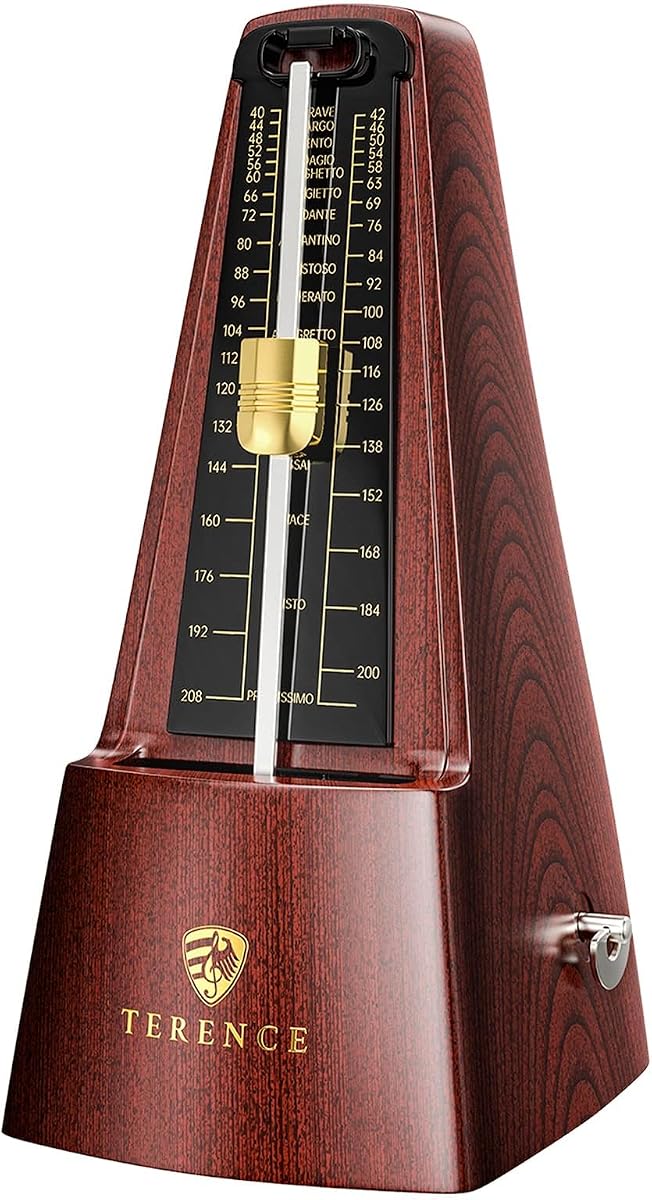
The TERENCE Transparent mechanical metronome has a 4.0 rating and distinguishes itself through appearance and upgraded components. Its transparent ABS housing reveals more of the movement than a traditional opaque case, while the description highlights an all-metal movement, metal accent bell, and copper pendulum rod. It is designed for piano, violin, guitar, saxophone, and other instruments.
We may earn a commission when you buy through this link, at no additional cost to you.
A 40-208 BPM range and a clear engraved scale support practical tempo selection. The metal movement is intended to deliver a clear, loud sound and permit longer use between windings than less robust mechanisms, but the supplied data does not provide a precise runtime. The copper-finished pendulum is described as resistant to rust, which is useful for a device expected to remain in a practice environment.
The transparent housing is also claimed to resist yellowing over time, potentially preserving the model’s distinctive appearance better than conventional plastic. That is a presentation benefit rather than a timing benefit, and buyers should focus on the metronome's sound and accuracy if those matter more than décor. The 4.0 rating is the lowest among the full-size pyramid-style models listed here.
The model is best for a pianist who wants a modern-looking teaching tool, transparent construction, and a loud mechanical accent. It may also appeal as a gift because of its visual presentation. It is less compelling for a buyer who prioritizes the highest customer rating or a clearly documented operating duration, but its upgraded material description makes it worth considering.
The transparent shell gives the internal mechanism a visible role in the design. For a teaching space or a modern music room, it offers a more contemporary look than a conventional wood-grain or opaque housing.
All-metal movement components, a metal accent bell, and a copper-finished pendulum emphasize durability and resistance to corrosion. These details are particularly relevant to buyers who want a traditional mechanical tool with upgraded internal materials.
We may earn a commission when you buy through this link, at no additional cost to you.
The Wittner 836 Taktell Piccolo combines a 4.6 customer rating with a compact traditional design. Unlike the larger pyramid models in this guide, it is a piccolo-format mechanical metronome, which can be attractive to pianists who want a dedicated timing tool without taking up much room. Its black plastic casing gives it a straightforward, familiar appearance.
We may earn a commission when you buy through this link, at no additional cost to you.
The supplied product information is notably concise, listing only the plastic casing, black color, and absence of a bell. The lack of an accent bell is not necessarily a disadvantage: a clear, consistent click can be preferable for scales, quiet technical work, and practice in an apartment where additional sounds may be undesirable.
Because the provided data does not list a tempo range, beat modes, winding duration, dimensions, or movement materials, this review cannot claim that the piccolo model offers the same feature coverage as the larger alternatives. Buyers who prioritize those specifications should verify the current product details. Its strongest documented advantages are its rating, recognizable format, and simple mechanical nature.
The Wittner 836 is a good premium choice for a pianist who values a traditional instrument, a compact profile, and a clear click without bells. It is also suited to quick daily exercises that can be completed at a stand or on a shelf. For advanced meter studies requiring multiple accent patterns, one of the fully specified 40-208 BPM models may be a safer choice.
The piccolo format offers a smaller alternative to the full-size metronomes that dominate this list. That makes it easier to move between a piano bench, music stand, and practice room without treating the device as permanent furniture.
Without a bell, the model keeps the timing signal focused on the regular click. For pianists practicing scales or quiet études, the absence of accent tones can create a cleaner practice environment and reduce unwanted sonic complexity.
We may earn a commission when you buy through this link, at no additional cost to you.
The Loud Sound Mechanical Metronome has a 3.8 rating, the lowest in this roundup, but it provides a familiar set of core features. Its 40-208 BPM range, five beat selections, loud clear sound, and engraved markings make it functionally relevant to piano practice despite the more modest rating.
We may earn a commission when you buy through this link, at no additional cost to you.
The operating process is conventional and approachable. Removing the dust cover, pulling out the bottom slot, moving the tempo slider, selecting the rhythm, winding the mainspring clockwise, and releasing the pendulum hook are all understandable steps. The model is aimed at beginners, exam candidates, professional performers, and educators, which makes its use cases broad.
Its clearest strength is the described volume and clarity of the beat. A stronger signal can help a pianist separate the metronome pulse from the resonance of an acoustic instrument, particularly during soft dynamics. Engraved markings are another practical feature because they should remain readable without relying on a backlit electronic display.
The rating is the primary reason to consider alternatives carefully, and the supplied information does not state a measured accuracy figure or running duration. Nonetheless, this is a viable option for someone who prioritizes a loud signal, simple controls, and broad tempo coverage over a premium finish. It may also work well for other instruments that benefit from a prominent click.
The advertised loud, clear beat is valuable when a pianist practices quietly and the instrument's sound may otherwise dominate. A strong external pulse can make it easier to remain aligned with the intended tempo.
The straightforward controls suit a first metronome, while the broad tempo range and multiple beat modes remain useful for examinations and advanced repertoire. Engraved markings provide a consistent reference across those different stages.
We may earn a commission when you buy through this link, at no additional cost to you.
Choose a mechanical metronome by balancing timing control, sound clarity, build quality, and the length of your practice sessions. Piano-specific usefulness comes from stable tempo settings, visible pendulum movement, and beat options that support common rhythmic patterns.
A useful piano metronome should cover slow exercises, moderate tempi, and fast performance speeds without forcing a separate device for each range. Most models in this guide provide 40-208 BPM, which is broad enough for technical studies, sonatas, etudes, and advanced repertoire. The pendulum weight or speed control should also move smoothly and provide enough precision to select a believable performance tempo.
Choose a model whose markings are clear and whose adjustment mechanism feels controllable. Engraved scales can be easier to interpret than small printed numbers, while a visible scale also helps a teacher quickly explain how a tempo relates to the music. Confirm that the model covers the slowest and fastest passages in your current study material.
Beat selection determines whether the metronome can represent the structure of a measure rather than merely count each pulse. The common 0, 2, 3, 4, and 6 options accommodate duple, triple, quadruple, compound, and grouped rhythms. Selecting 0 removes the accent bell while preserving the basic click, allowing a player to move between simple pulse work and more detailed meter study.
For piano practice, look for a clearly audible accent that helps define the beginning of a beat group. Bell tone should be noticeable without becoming harsh or distracting. Students working mostly in common time may need only 2, 3, and 4, but a broader range is useful for jazz, compound meters, and more advanced rhythmic concepts.
A metronome must remain audible beneath the piano without overwhelming the player. The most helpful sound is a consistent click that can be recognized immediately, followed by evenly repeated ticks. Models described as loud or crisp may be especially useful in rooms with reflective surfaces, louder instruments, or a piano lid raised for resonance.
Online descriptions often lack precise volume measurements, so consider how the click is likely to interact with your practice environment. An accent bell adds useful definition, but a bell-free model can be preferable for quiet apartment practice. The regular click should be the deciding factor because it carries the tempo throughout the exercise.
The movement and gears determine whether the metronome maintains a steady beat over repeated practice. Metal components are often highlighted because they resist wear and corrosion, while POM gears and high-strength plastic can provide durable performance when properly assembled. A lowered center of gravity may also improve stability and reduce unwanted movement on the piano bench.
Housing material is a combination of durability and appearance. Wood grain or veneer gives a classic look, transparent ABS provides a modern presentation, and molded plastic keeps the tool lightweight. Inspect the fit of the cover, winding key, sliders, and pendulum weight, and avoid forcing controls if they resist movement.
A mechanical metronome stores energy in a spring, so its running time depends on tempo. Most descriptions offer a range rather than one fixed duration, with slower tempi generally lasting longer because the mechanism moves less frequently. A 15-45 minute estimate can cover a typical lesson, while a stated range reaching about 54 minutes at 40 BPM is especially useful for slow technical work.
Match the expected runtime to your longest uninterrupted session. Fast etudes consume the spring more quickly, so a pianist working at the top of the range may need to wind more often. Winding gently until resistance appears protects the mainspring and reduces the chance of damaging the mechanism through force.
The moving pendulum provides a visual representation of the beat, which can help learners connect pulse, tempo, and subdivision. It also allows a teacher to point to a slower weight position and discuss how a note value affects performance speed. A transparent cover can make this motion more visible, while the traditional pyramid shape remains easy to recognize.
Look for a scale that is visible during use and a weight that moves without excessive wobble. The pendulum should return consistently after being released, and the housing should remain stable on a flat surface. For advanced practice, the visual cue is less important than precise sound, but it remains useful for musical phrasing and ensemble-style awareness.
A mechanical metronome should be straightforward to prepare. The best sequence is easy to remember: remove the brake or stopper, remove the cover, wind gently, choose the beat, set the tempo, and start the pendulum. Models that explain these steps clearly are especially suitable for children, beginning pianists, and teachers working with less experienced students.
Maintenance is limited but important. Keep the mechanism free of dust, avoid pulling on the pendulum weight, and do not force the winding key. If the tempo changes unexpectedly, check that the weight is seated properly and that the metronome is resting on a level surface. Simple care can preserve the timing and extend useful life.
Mechanical construction can involve a spring, gears, a bell, and several mechanical interfaces, so warranty coverage is worth considering. The universal black model in this guide includes a one-year manufacturer warranty and a 30-day unconditional return policy, while the Tempi model lists a two-year warranty. These periods provide different levels of reassurance for a durable household or teaching accessory.
Check the current terms before purchase because policies and product details can change. A return period is useful if the click is too loud, too soft, or incompatible with the intended room. Longer warranty coverage is more relevant when the metronome will be used by students, shared with family members, or kept in a teaching studio.
Place the metronome on a level surface near the piano, ideally where you can see the pendulum without turning away from the music. Remove the bottom brake or stopper and take off the dust cover. Choose the beat pattern that matches the meter, then move the pendulum weight to the tempo printed beside the music. Set the tempo before winding so the mechanism starts at the intended speed.
Wind the key gently clockwise until you feel clear resistance, then stop without forcing it. Release the pendulum from its resting position and allow it to swing evenly. Listen for the regular click and use the visible motion to check pulse and subdivisions. When the bell begins to mark accented groups, verify that its pattern matches the measure rather than assuming the first loud sound always represents a downbeat.
After practice, stop the pendulum and return the metronome to its resting position according to its instructions. Wipe the housing and cover with a soft, dry cloth, and keep dust away from the winding mechanism and scale. Never oil the movement unless the manufacturer specifically recommends a product for that model. If the tempo becomes inconsistent, check for an unsecured weight, a non-level surface, or a mechanism that needs professional service.
A mechanical metronome provides the visual movement and physical sound of a classic timing device without batteries or charging. An electronic model can offer more controls, presets, volume adjustment, and sometimes greater precision. The better choice depends on whether you value simplicity, a traditional appearance, and direct pendulum feedback or prefer programmable features and compact electronic convenience.
A 40-208 BPM range covers a very broad portion of piano study, including slow technical exercises, moderate movement tempos, and fast etudes. Check the marked tempo of the music you are studying, then choose a metronome that can represent both that tempo and the slightly faster practice speeds you may use as accuracy improves.
Set the metronome on a stable surface, select the correct beat pattern, adjust the pendulum to the desired tempo, and wind it gently. Start the pendulum and synchronize with the regular click. Use the bell to clarify accented groups when appropriate, and rely on the visible pendulum for an additional cue during long or difficult passages.
The winding spring supplies energy to the moving mechanism, so faster tempi consume that energy more quickly than slower tempi. Models may run for several minutes at high speed and considerably longer at low speed. This is normal, and winding again during a session is part of normal mechanical-metronome use.
The bell marks selected accented beats within the chosen grouping. For example, a 4-beat setting commonly makes the first beat of each group more noticeable. A setting of 0 disables the bell and leaves the ordinary click, which can be useful for simple pulse practice or quieter practice sessions.
Most models in this guide are designed for simple operation by beginners and children. The main steps are removing the cover, winding, choosing the beat, moving the tempo weight, and starting the pendulum. Adult supervision is still useful when teaching the child not to force the winding key and to place the metronome on a level surface.
Keep it in a dry place away from direct heat, moisture, and heavy impact, and do not leave it exposed to unnecessary dust. The pendulum and cover should rest without forcing the mechanism. Storing it near the piano is convenient for regular use, provided that the instrument is not exposed to extreme temperature changes or moisture.
The pendulum turns an abstract tempo into a visible repeating motion. Beginners can connect the click with the movement of the arm or weight, making it easier to perceive a steady beat and larger subdivisions. Experienced pianists can also use the visual pattern to check phrasing, grouped accents, and the relationship between notes of different durations.
The Universal Black Mechanical Metronome is the most balanced overall choice because of its 4.6 rating, complete 40-208 BPM range, multiple beat modes, durable mixed-material movement, warranty, and broad instrument compatibility. The Wittner 836 Taktell Piccolo is the premium pick for buyers who prefer a compact, traditional, bell-free format, while the Ueteto Black is a budget-friendly option with the core tempo and rhythm controls a beginner needs.
Prioritize a stable and clearly audible click, a tempo scale you can read, and enough winding time for your usual practice sessions. If you work on unusual meters, confirm that the model offers the necessary beat groupings. If you practice quietly, pay equal attention to the bell and overall volume, and consider a click-only design when extra tones would be distracting.
Ratings, product specifications, warranty terms, availability, and prices can change over time, so check the current listing before ordering. Comparing the latest customer feedback and product details with the needs of your piano, room, and practice schedule will help you choose a mechanical metronome that remains useful and dependable.