
Dorhea Five-Piece SG90 Micro Servo Kit
4.2Editor score
Five micro servos included
Broad three-to-six-volt range
Suitable for common RC projects
Compare the best Micro Servo Motor Kit options by torque, speed, gears, pack size, voltage, wiring, and Arduino compatibility for RC and robotics builds.
Micro servo motor kits combine compact positioning motors with the cables, horns, fasteners, or controllers needed to add controlled movement to robots, aircraft, boats, vehicles, and mechanical models. A worthwhile kit should match your project’s scale, weight, operating voltage, mounting space, and control system rather than simply including the largest number of servos.
This guide compares ten SG90-family and closely related micro servo kits across torque, operating speed, gear construction, rotation range, pack quantity, power requirements, interface details, and intended applications. It also highlights one unusually convenient tester-and-battery-holder bundle that serves a different need from a simple collection of replacement motors.
Each review explains who benefits most from the particular pack size or design, while also noting relevant limitations. The three leading choices cover strong all-around performance, a compact group of five motors, and a larger sixteen-unit project supply. Product availability and pricing can change, so confirm the current listing details before purchasing.
4.2Editor score

4.4Editor score

4.5Editor score
The table below compares all ten kits by motor type, pack quantity, key construction feature, and control or power details, making it easier to identify the option that fits a particular robotics, RC, or model-building project.




The Smraza SG90 9G Micro Servo Motor Kit Metal Gear for Arduino RC Plane 10 Pcs combines ten compact 9G servos with a stronger internal gear design. Its 4.4 rating reflects a favorable balance of practical specifications and customer feedback. The 10-piece quantity is substantial enough for multi-jointed builds while remaining easier to manage than a much larger inventory.
We may earn a commission when you buy through this link, at no additional cost to you.
Metal pinion gears and upgraded shafts are the kit’s most useful construction features. They are intended to resist the tooth breakage and heat deformation associated with plastic-gear units, making the servos more appropriate for robot arms, micro robots, compact aircraft, helicopters, boats, and other mechanisms that place repeated mechanical stress on the output train. Each servo also supports a full 180-degree operating range at 4.8–6.0 volts.
Performance figures include a running speed of 0.08 seconds for 60 degrees, 1.9 kg-cm stall torque, and a 5-microsecond dead band. The 24.5 mm leads simplify connection to a three-wire PWM system, while included servo arms make it easier to attach control horns. Buyers must still account for the stated startup requirement of more than 1A and provide a continuous PWM signal.
This is the strongest general recommendation for a builder who wants more than one motor without settling for a tiny two- or three-piece set. It suits classroom robot arms, small pan-tilt mechanisms, multi-axis robots, and RC projects requiring a dependable spare or two. For a single compact mechanism, a smaller kit may be less cumbersome, but for serious multi-servo construction, this ten-piece option is balanced and versatile.
The upgraded metal pinion and shaft improve durability in projects where the servo horn repeatedly moves a load. That makes the kit more relevant to robot arms and compact RC mechanisms than a basic replacement-only purchase.
Ten motors provide enough units for a pan-tilt rig, several small robotic joints, or a fleet of identical demonstration models. Including a few extras also gives the builder a practical replacement if one mechanism is damaged.
We may earn a commission when you buy through this link, at no additional cost to you.
The WWZMDiB SG90 Micro Servo Motor for Arduino Raspberry Pi DIY (3 Pcs) offers a focused set of three servos for compact experiments. It carries a 4.2 rating and is positioned for makers working with Arduino, Raspberry Pi, and other digital control environments. The modest quantity prevents unnecessary bulk when a project needs only a few axes of movement.
We may earn a commission when you buy through this link, at no additional cost to you.
Each motor operates from 4.8 to 6.0 volts and rotates through 180 degrees plus or minus one degree. The specified signal range runs from 500 to 2500 microseconds, with counterclockwise movement as the signal advances. Wiring is conventional: red connects to 5V, brown connects to ground, and yellow connects to digital pin 9 when following the stated setup.
The principal benefit is simplicity. Three motors are enough for a compact pan-and-tilt mechanism, a small gripper, a three-jointed arm, or a classroom demonstration with repeated units. However, the product data does not advertise metal gearing, so it should not be chosen on the assumption that it offers the same resistance to gear damage as the Smraza kits.
This is a good pick for a maker who needs several standard SG90 units but not a large project inventory. It is particularly convenient when consistent color coding and simple digital-pin control are priorities. Builders needing heavier loads, numerous joints, or integrated metal gears should consider one of the metal-geared alternatives instead.
The clearly identified red, brown, and yellow leads make the kit approachable for beginners. A maker can use the specified digital-pin arrangement as a starting point, then adapt the pin assignment to suit the controller and code.
Three units are enough to build compact pan-tilt, steering, gripper, or articulated mechanisms. The compact assortment is also easier to organize and power than a much larger group of motors.
We may earn a commission when you buy through this link, at no additional cost to you.
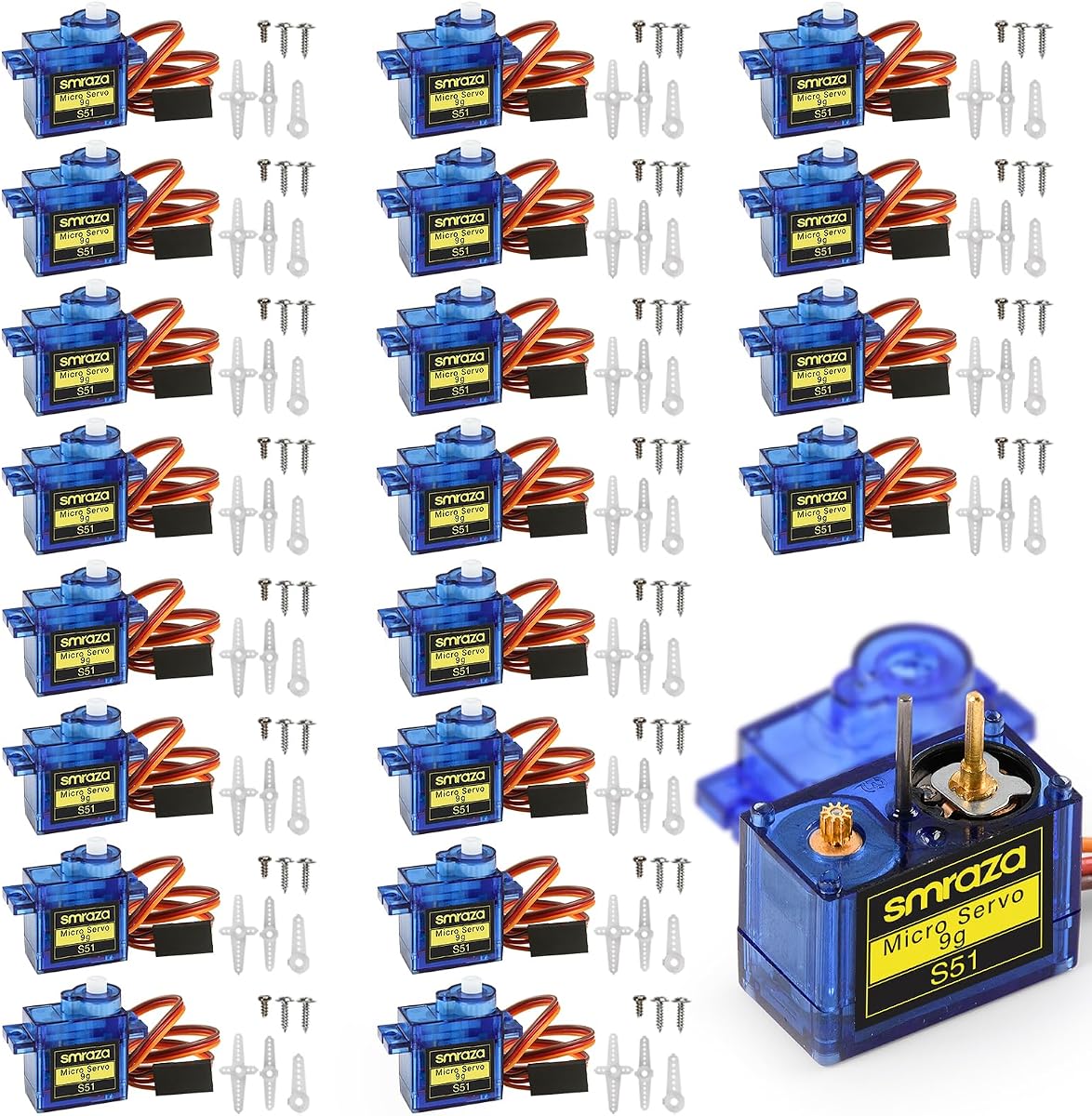
The Smraza SG90 9G Micro Servo Motor Kit Metal Gear for Arduino RC Plane 20 Pcs is the largest coordinated group in this comparison. It carries a 4.4 rating and is aimed at users building robots, aircraft, or model mechanisms that need numerous matching servos. A 20-piece inventory supports complex multi-axis projects without requiring several separate purchases.
We may earn a commission when you buy through this link, at no additional cost to you.
The motors use upgraded metal pinion gears and shafts, along with the same stated 1.9 kg-cm stall torque, 0.08-second speed, 5-microsecond dead band, and 180-degree range as the smaller Smraza packs. Compatibility with Arduino and Raspberry Pi PWM control is convenient for mixed maker projects, and 24.5 mm leads help maintain tidy connections in compact assemblies.
The trade-off is electrical rather than mechanical. Twenty motors can create a substantial simultaneous load, and the listed startup-current requirement means a controller board alone may be unsuitable. A stable external supply and careful distribution of power are essential. The quantity also needs storage and inventory management if only a few joints are under construction.
Choose this kit for a robot with many independently controlled surfaces, a classroom production run, or a project where standardized spare units matter. It is less rational for a single pan-tilt unit or a small hobby arm. Within those larger use cases, however, the coordinated 20-motor supply and metal-gear construction make it a practical project-scale option.
A large robot may require many matched actuators. Buying twenty units at once helps maintain a consistent control and mounting system across numerous joints or repeated demonstration models.
Because the listed startup current exceeds 1A, a large collection should use an appropriately rated external supply. Separate motor power and controller grounding should be planned before connecting all twenty servos.
We may earn a commission when you buy through this link, at no additional cost to you.
The Smraza SG90 9G Micro Servo Motor Kit Metal Gear for Arduino RC Plane 6 Pcs sits between the smaller replacement packs and the larger project inventories. Its 4.4 rating and six-motor count make it a balanced choice for a robot arm, several steering mechanisms, or a small collection of model-control points.
We may earn a commission when you buy through this link, at no additional cost to you.
Metal pinion gears and upgraded shafts improve the mechanical case over a basic plastic-gear servo. The listed 1.9 kg-cm stall torque and 0.08-second operating speed are useful for light, fast mechanisms, while the 180-degree range allows broad positioning choices. Three-wire PWM control works with Arduino, Raspberry Pi, and compatible JR or FUTABA receivers.
As with the other Smraza kits, the supply must be capable of more than 1A starting current. Six motors may be manageable, but several moving simultaneously can still overload a weak source. The included servo arms and 24.5 mm leads reduce assembly friction, while the absence of a larger quantity keeps the package reasonably focused.
This is a good middle ground for makers who need more than one or two motors but do not require a 10- or 20-piece inventory. It is particularly attractive for educational robot builds, compact aircraft, small boats, and several micro-robot mechanisms. For a single-axis demonstration, a smaller pack is sufficient; for a large robot, the 20-piece version offers more flexibility.
Six units can support a six-axis demonstration, paired steering controls, or a compact collection of independent mechanisms. The quantity is easier to manage than a large project pack while remaining more versatile than a trio.
The upgraded pinion and shaft target durability concerns in frequently moving mechanisms. This makes the set a better fit for articulated arms and small RC applications than a basic plastic-gear alternative.
We may earn a commission when you buy through this link, at no additional cost to you.
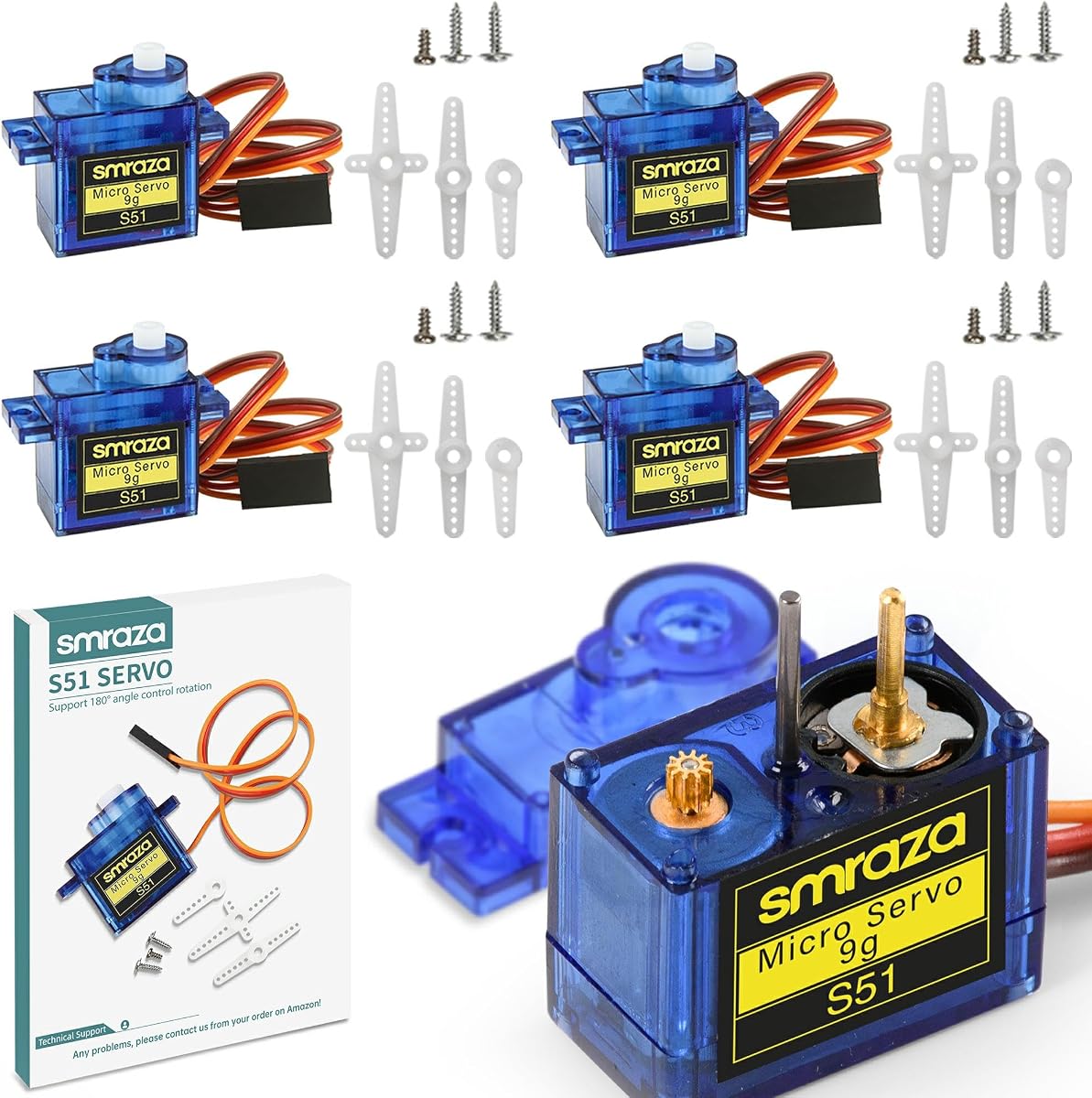
The Smraza SG90 9G Micro Servo Motor Kit Metal Gear for Arduino RC Plane 4 Pcs offers a flexible middle quantity for compact projects. With a 4.4 rating, it combines the mechanical advantages of metal gearing with enough motors to complete a small robot, a four-point control system, or a few model mechanisms.
We may earn a commission when you buy through this link, at no additional cost to you.
Its stated 1.9 kg-cm stall torque and 0.08-second speed for 60 degrees position it well for lightweight, responsive tasks. The 5-microsecond dead band supports precise control, while the 180-degree range provides broad movement. The motors support common Arduino and Raspberry Pi PWM arrangements and include servo arms with 24.5 mm leads.
The main limitation is that four motors may be one unit short of some common designs, such as a six-axis robot. That shortage is less significant when the project can share actuators or use a simpler mechanism. The power requirement remains important, because a four-servo arrangement can still exceed what an inadequately rated source can handle during startup.
Buyers should choose this kit when they want a small batch of identical, metal-geared servos and appreciate having an extra unit available. It works well for teaching platforms, compact pan-tilt mechanisms, small articulated models, and individual course projects. It is not the most economical choice for one motor, but it offers better project flexibility than a two- or three-piece pack.
Even when three motors complete a mechanism, the fourth gives the builder a replacement or an additional control point. That flexibility makes the set practical for experiments and classroom use.
The listed speed, torque, dead band, and 180-degree range support responsive positioning in small mechanisms. The metal pinion is particularly relevant when movement occurs repeatedly.
We may earn a commission when you buy through this link, at no additional cost to you.
The Miuzei MG90S 9G Micro Servo Motor Metal Gear for RC Plane Robot Arduino (2) is a two-motor option for compact mechanisms that need more torque than a standard SG90. It has the highest numerical rating in this group at 4.5 and lists a 2.0 kg-cm stall torque at 6.0 volts.
We may earn a commission when you buy through this link, at no additional cost to you.
Its aluminum metal teeth and coreless motor are designed to combine strength, reduced noise, and precise 180-degree movement. The 0.08-second speed at 6.0 volts is quick enough for aircraft, drones, crawler vehicles, robot arms, quadcopters, and RC boats. It is also described as compatible with Arduino and suitable for Raspberry Pi-based projects.
The two-piece format is the clearest limitation. It is ideal for a paired steering, pan-tilt, or gripper arrangement, but it is insufficient for a robot with many joints. A stable 5V source is recommended, and an external supply is suggested for multi-servo installations even though only two units are included.
This is the pick for a builder who values torque and metal-gear construction more than having a large collection. The stronger output makes it a natural consideration for small model control surfaces or lightly loaded robotic joints. If the project needs multiple servos, the Smraza packs provide more coordinated inventory and comparable control versatility.
The listed 2.0 kg-cm stall torque gives the MG90S an advantage for small mechanisms that encounter moderate resistance. It can suit robot arms, small aircraft, and vehicle steering more effectively than a basic SG90.
Aluminum gear teeth add strength, while the coreless motor design is associated with lower noise. These features make the pair useful where smooth, repeatable movement matters.
We may earn a commission when you buy through this link, at no additional cost to you.
The Dorhea 5 Pcs SG90 Micro Servo Motor Mini SG90 9g Servo Kit is a practical five-unit assortment for lightweight projects. Its 4.2 rating reflects a straightforward, versatile product aimed at remote-control helicopters, micro robots, robot arms, boats, and other small mechanisms.
We may earn a commission when you buy through this link, at no additional cost to you.
Each 9G servo has a stated stall torque of 1 kg-cm at 4.8 volts and a 7-microsecond dead band. The operating range of 3.0 to 6.0 volts is unusually broad among the listed kits, offering flexibility for different power arrangements. The compact, lightweight design supports installation in small aircraft, walking mechanisms, robot hands, and even door-lock demonstrations.
The straightforward three-wire interface uses red for 5V, brown for ground, and yellow for digital pin 9 in the described setup. Compared with the metal-geared options, the 1 kg-cm torque is lower and the product data does not claim upgraded metal gearing. It is therefore best suited to light loads rather than heavy articulated mechanisms.
This is the strongest budget-oriented choice for a maker who needs a useful group of five and values voltage flexibility. It works well for a small robotic arm, several model control surfaces, or a classroom kit. Its limitations are acceptable when the project is compact and lightly loaded; for repeated high-load movement or larger robots, a metal-geared set is the better investment.
The stated 3.0–6.0 volt operating range gives this kit broader compatibility with small power systems than options limited to 4.8–6.0 volts. The control electronics and load should still be checked before use.
Five servos are enough to build a small robotic hand, walking mechanism, set of steering controls, or multiple aircraft control surfaces. Their low weight suits compact model installations.
We may earn a commission when you buy through this link, at no additional cost to you.
The 5pcs SG90 Micro Servo Motor Kit 9G Mini Servos with Cable provides five compact units for RC vehicles, aircraft, boats, robots, and articulated demonstrations. It differs from the higher-rated options in that the supplied data shows no customer rating, so there is no numerical evidence here to compare against the other products.
We may earn a commission when you buy through this link, at no additional cost to you.
The listed operating speed is 0.09 plus or minus 0.01 second per 60 degrees at 4.8 volts and 0.08 plus or minus 0.01 second at 6.0 volts. Stall torque is 1 kg-cm at 4.8 volts, with a 5-microsecond dead band and analog controller type. Three-wire leads use red for 5V, brown for ground, and yellow for the signal connection.
The kit is compatible with JR and FUTABA interfaces, supporting use with remote-control systems as well as digital controllers. Five motors offer enough quantity for a robot hand, walking project, or several compact model functions. However, the data does not advertise metal gearing, so buyers should not assume the same tooth strength or heat resistance as the upgraded Smraza units.
This set is best for a standard 9G project with moderate requirements and a need for several identical motors. It may also appeal to users who prefer a straightforward analog-compatible design. Because no rating is available, the decision should rely on the stated dimensions, speed, torque, and intended use, with close attention to the seller’s current product details.
The listed movement rates support responsive control in small aircraft, boats, and robotic mechanisms. Increasing the supply toward 6.0 volts corresponds with the faster stated speed.
JR and FUTABA interface compatibility makes the motors useful with compatible RC equipment as well as programmable controllers. The conventional wire arrangement remains easy to follow.
We may earn a commission when you buy through this link, at no additional cost to you.
The Servo Motor Tester Kit SG90 9g Micro Servo 180 Degree + RC Micro Servo Tester Controller with Power Supply Case 4AA Battery Holder Case with JR Connector is a specialized bundle for testing. It carries a 4.2 rating and includes one 180-degree SG90 servo, a tester controller, a four-AA battery holder, and a JR connector.
We may earn a commission when you buy through this link, at no additional cost to you.
The tester supports manual, automatic, and neutral modes. Manual control is useful for checking a servo’s response and locating its endpoints, while automatic and neutral operation can make repeated or centered testing more convenient. The battery holder eliminates the need to connect the tester to a desktop power supply during initial setup.
This product is not designed to compete with multi-motor project kits. It includes only one servo, so a robot arm, pan-tilt system, or multi-axis model would require additional motors and suitable control hardware. Its value lies in the controller and portable power arrangement, which make troubleshooting individual servos much easier.
Choose this bundle when you need a dependable way to test an SG90 before installation or diagnose a servo that is not responding normally. It is also useful for a classroom demonstration of PWM behavior or for a maker who wants to experiment without writing controller code first. For production work, a larger motor kit paired with a proper controller is more appropriate.
The dedicated controller provides a straightforward way to send control signals and observe the included servo. This removes much of the setup complexity from a first electrical test.
The four-AA holder lets the tester operate away from a bench supply. The JR connector provides a simple physical link to compatible micro servo leads.
We may earn a commission when you buy through this link, at no additional cost to you.
The Hanaive 16 Pcs Sg90 9g Mini Micro Servo Motors Rc Servo Kit is the most extensive general-purpose motor assortment in the guide. It has a 4.5 rating and includes sixteen matching servos, multiple horn options, and fixing screws. The complete set is practical for builders working on several robots, a larger articulated mechanism, or a long series of model projects.
We may earn a commission when you buy through this link, at no additional cost to you.
Each servo measures approximately 3.2 by 3.09 by 1.24 centimeters, making it suitable for compact installations. Stated stall torque is 1.6 kg-cm at 4.8 volts, operating speed is 0.1 second per 60 degrees at 4.8 volts and 0.08 second at 6.0 volts, and the maximum running angle is 180 degrees. A 5-microsecond dead band supports precise positioning.
The three-wire interface includes red power, brown ground, and yellow signal connections. Compatibility with JR and FUTABA interfaces makes the motors useful in common RC configurations. The manufacturer explicitly notes that reduced pulling force limits suitability to ordinary small electric aircraft and excludes large fixed-wing models and electric helicopters.
This kit is a premium choice for quantity and included hardware rather than extreme torque. Sixteen units and the supplied horns and screws make it excellent for educational fleets, multiple robot builds, or keeping standardized replacements on hand. It should not be selected for large aircraft or demanding high-load mechanisms, where a higher-torque servo would be a better fit.
The sixteen matched servos support repeated models, multiple robot arms, or a classroom set. Including several arms and fixing screws makes it easier to vary horn orientation and secure each unit.
The listed dimensions, 1.6 kg-cm torque, and 180-degree range suit small aircraft, boats, micro robots, and robotic arms. The manufacturer’s warning against large fixed-wing and electric helicopter use should be respected.
We may earn a commission when you buy through this link, at no additional cost to you.
Selecting a micro servo motor kit requires balancing motor count, torque, speed, voltage, gear construction, and controller compatibility against the physical demands of the project. The following factors help narrow the options without overlooking power requirements or installation constraints.
Torque is the twisting force a servo can generate at its output shaft, and it is one of the clearest indicators of whether a motor can move a particular load. The kits in this guide range from 1 kg-cm for the standard Dorhea and generic SG90 options to 1.9 kg-cm for the Smraza metal-gear packs and 2.0 kg-cm for the Miuzei MG90S duo. The Hanaive set provides 1.6 kg-cm, placing it between those groups. Stall torque is a maximum capability rather than a recommended continuous operating level, so a mechanism should not be designed to sit constantly at the limit.
Choose enough torque for the load with a sensible margin. Long horns, offset linkages, large control surfaces, and articulated arms can increase the effective force required at the shaft.
Gear material affects durability under repeated movement. The Smraza kits explicitly use upgraded metal pinion gears and shafts intended to resist tooth breakage and heat deformation, while the Miuzei pair uses aluminum metal teeth. The Dorhea, WWZMDiB, generic, tester, and Hanaive descriptions do not make equivalent metal-gear claims. A metal pinion is especially useful in compact robot arms, aircraft controls, and other mechanisms that repeatedly move against a load or stop abruptly.
For occasional light-duty movement, standard gearing may be sufficient. For frequent or loaded cycles, favor a documented metal-gear design.
Pack quantity should reflect both immediate needs and a sensible spare margin. The guide includes two-, three-, four-, five-, six-, ten-, sixteen-, and twenty-servo options, as well as a single-servo tester bundle. Three or four motors suit compact mechanisms, five or six support more elaborate robots, and ten through twenty make sense for multi-axis systems, classroom fleets, or multiple identical builds. A few spare units are useful, but an oversized collection adds cost, storage needs, and a greater collective power burden.
Count the required control axes, then add only the number of spares that will genuinely be used.
Voltage compatibility begins with the motor, but the power source must also meet the stall and startup demands. Most of the featured SG90 options specify 4.8–6.0 volts, while the Dorhea set lists 3.0–6.0 volts. The Smraza kits specifically call for a source capable of more than 1A at startup, and the Miuzei listing recommends a stable 5V supply and an external source for multi-servo setups. Using several motors from a controller’s small regulator can cause resets, irregular movement, or browned-out electronics.
Match the supply to both voltage and current requirements, and connect controller ground and motor ground carefully.
Operating speed indicates how quickly the output moves through a 60-degree interval. The Smraza motors and Miuzei MG90S are listed at 0.08 second per 60 degrees under suitable conditions, while the generic five-piece set ranges from 0.08 to 0.09 second. The Dorhea and Hanaive sets list 1 kg-cm and 1.6 kg-cm torque respectively, with speed values dependent on voltage. Dead band is another useful comparison point: 5 microseconds appears on several kits, while the Dorhea set lists 7 microseconds. A narrower dead band generally corresponds to a finer control range around the center position.
Prioritize speed only when the mechanism benefits from rapid movement; smooth or heavily loaded systems may need a more deliberate response.
Most listed motors support approximately 180 degrees of movement. That range is useful for a broad mechanical sweep, but a specific project may need a narrower mechanical limit to prevent cable binding, collision, or excessive stress. The controller must also be able to generate the expected PWM signal. The featured products use conventional three-wire connections with red for power, brown for ground, and yellow for signal. Some are also described as compatible with JR or FUTABA interfaces, allowing use with compatible RC receivers as well as programmable boards.
Confirm signal voltage, pin assignments, and the mechanical limits before attaching a horn or linkage.
The most important application question is whether the motor’s output and physical size suit the mechanism. A micro servo can fit a tiny aircraft, robot hand, boat, pan-tilt mount, or demonstration rig, but it may not drive a large fixed-wing surface or a heavy robot joint. The Hanaive listing explicitly limits its reduced-pulling-force motors to ordinary small electric aircraft. The Smraza products emphasize micro robots, robotic arms, helicopters, planes, gliders, and small boats. The Miuzei pair also targets drones, quadcopters, crawler vehicles, and RC boats.
Match the manufacturer’s stated applications to your own build rather than assuming every RC model has equivalent load requirements.
A complete kit can save assembly time when it includes servo horns, cable leads, and fixing hardware. The Smraza sets include servo arms and 24.5 mm leads, while the Hanaive package includes multiple arms and screws. The dedicated tester bundle goes further by adding a controller, a four-AA battery holder, and a JR connector. That bundle is valuable for checking one servo before committing it to a project, but it is not a substitute for a multi-motor kit. Always verify the package contents against the listing and compare them with the hardware your build actually requires.
Include a tester or spare motor when reliability matters, but do not choose a tester bundle when the main requirement is enough actuators for a robot.
Before installation, identify the power, ground, and signal wires and confirm that the controller can safely drive the selected servo. In the conventional arrangement used by these products, red is the power line, brown is ground, and yellow is the signal line. Connect the motor ground to the controller ground, use a supply within the motor’s stated voltage range, and ensure the source can handle startup current. For multiple servos, use a suitable external supply and avoid routing all motor current through a small board regulator.
Mount the servo securely, attach the appropriate horn, and keep the output within the mechanism’s safe range. Start with a limited movement angle, then calibrate the endpoints after the load is connected. A servo should not be forced against a hard stop, and linkages should avoid binding. Continuous PWM is needed for dependable positioning, so do not expect the motor to hold a commanded position after the control signal stops.
Care for the motors by keeping dust, moisture, and conductive debris away from the gears and output shaft. Avoid forcing the horn by hand, especially on the standard plastic-geared options. Inspect wires for pinching and ensure that the horns do not collide with nearby structures. When a servo becomes noisy, moves irregularly, or heats heavily, reduce the load, improve the power supply, and check for mechanical obstruction before continuing to operate it.
Most of the SG90 kits in this guide specify an operating range of 4.8–6.0 volts. The Dorhea set is listed more broadly at 3.0–6.0 volts, so its exact behavior should be considered alongside the controller and connected load. Always follow the specifications for the specific listing and avoid exceeding the stated maximum.
The number depends on the design: one servo may control a gripper, two may operate a simple pan-tilt unit, and a jointed arm may need one motor per moving joint. More elaborate robots can require six or more actuators. Measure the mechanism, check available mounting space, and ensure the power supply can support all motors moving at once.
They are generally more appropriate for frequently loaded or repeatedly moving mechanisms because the metal pinion is intended to resist wear, breakage, and heat deformation. A standard SG90 can still work well in a light-duty arm. The real deciding factor is the combined load, movement frequency, mounting stress, and control quality of the entire mechanism.
The controller may control several servos, but it is often better to power the motors from a separate supply with enough current capacity. The Smraza listings specify a startup capability greater than 1A, and a multi-servo system can demand much more. Connect the external supply ground to the controller ground and avoid causing resets through voltage drops.
A micro servo kit primarily supplies several motors for building mechanisms. A tester bundle supplies fewer motors but adds a controller and portable battery holder for checking operation. It is ideal for troubleshooting, learning how PWM positions a servo, and confirming that a motor works before installation.
Stall torque is the maximum turning force available when the output shaft stops moving under load. It should not be treated as a continuous working specification. A good design keeps normal operation well below the stall point and accounts for leverage created by horns, linkages, and the distance of the load from the shaft.
Not necessarily. The Hanaive listing specifically recommends its reduced-pulling-force servos only for ordinary small electric aircraft, not large fixed-wing models or electric helicopters. Larger surfaces and models often need higher-torque servos with stronger bearings, gears, and mounting support.
First check for an obstructed linkage, excessive load, or a horn rubbing against the chassis. Then verify the voltage, improve supply capacity, and make sure the servo is not held against an end stop. A noisy servo under heavy load should be disconnected and tested independently to determine whether the problem is mechanical or electrical.
The Smraza 10-piece kit is the strongest overall recommendation because it combines a practical motor count with metal pinion and shaft upgrades, 1.9 kg-cm torque, fast movement, and broad compatibility. The Dorhea five-piece kit stands out as the budget pick for light RC and robotics work, particularly when its broader voltage range is useful. The Hanaive sixteen-piece set offers the largest general-purpose inventory with horns and screws, making it convenient for repeated or multi-model builds.
Prioritize the requirements that directly affect the mechanism: adequate torque, a documented gear design, room for the motor body, safe travel, and a supply that can handle startup and simultaneous movement. A large kit is not automatically better if the project needs only one axis, and a higher-torque servo is not the right answer to every request. Match the stated applications to the actual scale and load of your model.
Product listings, availability, ratings, and pricing can change, so verify the current details before ordering. Check the package quantity, operating voltage, connector arrangement, included horns, and any manufacturer limitations. Most importantly, plan the power supply and mechanical mounting at the same time as the motor selection to avoid a kit that cannot perform as intended.