
Waveform QuadPro Complete Kit
4.4Editor score
Full 4×4 MIMO support
Up to 9.1 dBi gain
Complete window-entry installation kit
Our Mimo Antenna Kit guide compares 10 options for 4G, 5G, routers, hotspots, gateways, and home internet, with clear installation and gain advice.
A Mimo Antenna Kit can improve cellular reception for routers, hotspots, modems, and fixed wireless internet systems, but the best configuration depends on signal direction, device ports, carrier bands, and installation conditions. The strongest choice balances multi-antenna support, low-loss cables, suitable gain, mounting hardware, and straightforward setup.
We compared all ten products by antenna architecture, supported frequency ranges, stated gain, MIMO configuration, included cables and adapters, mounting options, weather resistance, and compatibility with major cellular networks. The list includes complete kits, antenna-only packages, omnidirectional models, directional panels, and log-periodic antennas for different installation needs.
Each review explains where that antenna fits best and which compromises buyers should consider. We also cover port matching, tower aiming, cable placement, and outdoor installation. Product listings and availability can change, so confirm current specifications and gateway compatibility before ordering.
4.4Editor score

4.2Editor score

4.2Editor score
The table highlights the major differences among these ten kits, including MIMO configuration, antenna style, stated gain, frequency coverage, and the most important installation consideration.




The Waveform QuadMini Complete Kit is a flexible 4×4 MIMO solution for cellular routers with four antenna ports. Its 4.2 rating reflects a generally positive buyer history, while its low-profile omnidirectional format makes it especially practical for home, office, and temporary installations. The stated performance reaches up to 5.2 dBi of gain, but actual results still depend on signal conditions, carrier bands, device compatibility, and placement.
We may earn a commission when you buy through this link, at no additional cost to you.
A major advantage is that users do not have to identify or aim toward a specific cell tower. The antenna can be placed on the side of a building with better reception and then moved if conditions change. That makes the QuadMini more forgiving than a directional panel. The complete package includes a Window Entry Cable, UltraFlex-Quad cables, weatherproofing boots, and mounting accessories, reducing the need to source a separate installation system.
Its four-antenna configuration is important for routers designed around 4×4 MIMO rather than simple 2×2 connectivity. The product information also notes that MIMO isolation and polarization can affect data performance, not merely the strength shown by a signal-reading application. However, buyers should not assume that adding antennas automatically improves every network. The router must expose the appropriate ports, and the cellular service must provide a useful signal in the selected direction.
The QuadMini is a strong recommendation for people who want a complete, movable system without the precision required by a directional antenna. It is particularly useful when tower location is uncertain, when a window installation is preferred, or when the router has four cellular antenna connectors. Choose it over a high-gain directional product when placement flexibility is more important than concentrating reception toward one known tower.
Because the QuadMini receives signals from multiple directions, it can be placed on the strongest side of a building without precise alignment. This makes it a practical starting point when the nearest tower is unknown or reception changes with weather, obstructions, or network conditions.
The bundled Window Entry Cable, four UltraFlex cables, weatherproofing boots, and mounting hardware simplify assembly. Buyers can choose suction cups, a pole adapter, a desktop stand, or direct wall mounting depending on the location and available signal.
We may earn a commission when you buy through this link, at no additional cost to you.
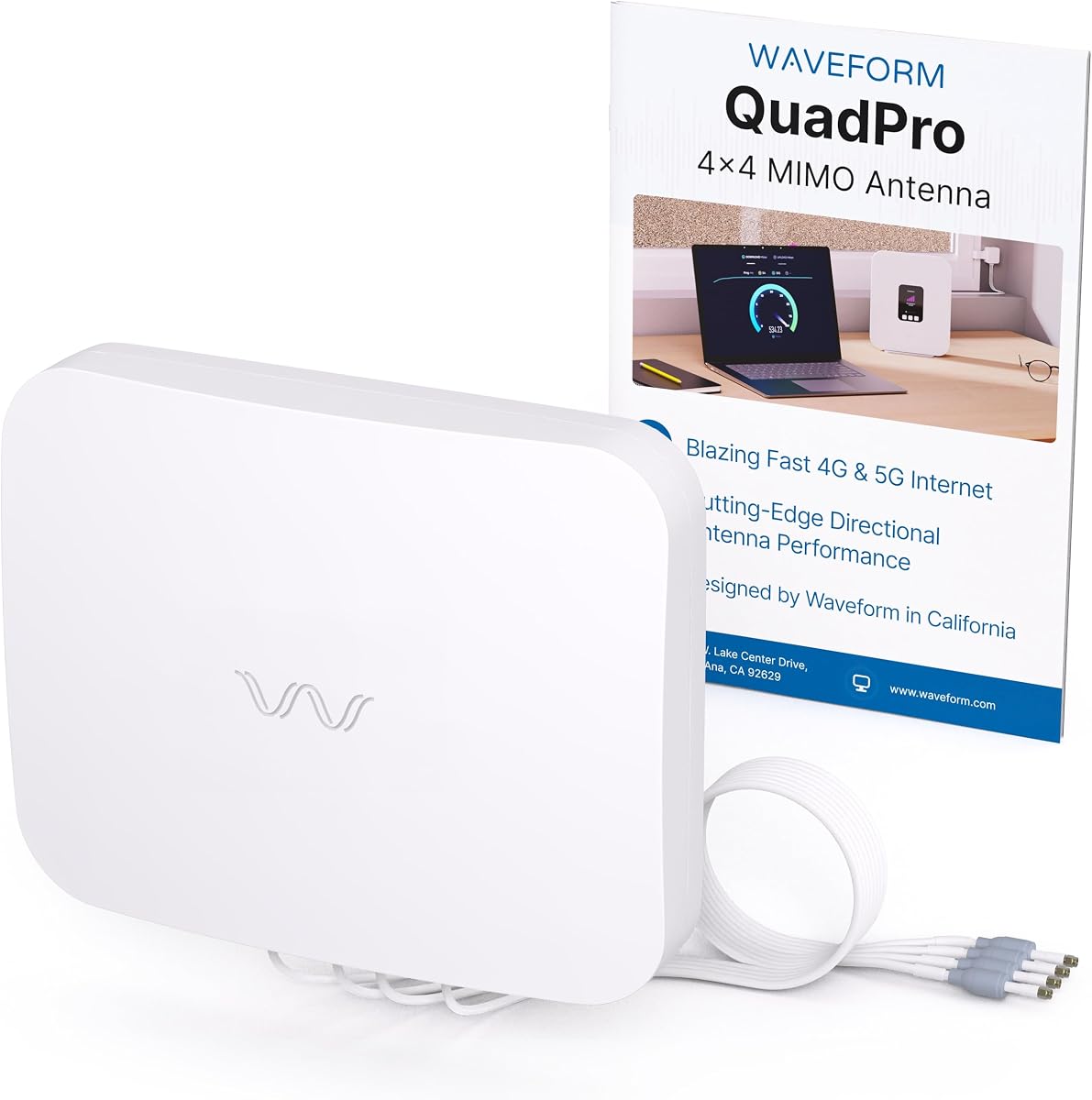
The Waveform QuadPro Complete Kit is the strongest premium-style option in this list for users with a compatible four-port 5G router or gateway. It has a 4.4 rating and combines full 4×4 MIMO support with stated gain of up to 9.1 dBi from 600 to 6000 MHz. The product information identifies support for AT&T, Verizon, T-Mobile, and US Cellular bands, making it a broad option for modern cellular networks.
We may earn a commission when you buy through this link, at no additional cost to you.
This directional panel concentrates reception toward a selected tower, so proper aiming matters. That concentration can be valuable when the router sits indoors behind walls, on a lower floor, or in a location with mediocre baseline reception. The complete kit includes a Window Entry Cable, FlexMount, UltraFlex-Quad cable, weatherproofing boots, and appropriate connection hardware, allowing a tidy installation without drilling a cable opening through a wall.
Waveform also provides detailed guides for T-Mobile Home Internet gateways, including the G4AR and G4SE, Nokia 5G21, Arcadyan KVD21, and Sercomm Fast 56WW. It also supports Verizon 5G Home Internet and AT&T Internet Air. These details matter because connector layouts and antenna ports can vary among gateway models, and a broad-spectrum antenna does not guarantee plug-and-play compatibility without checking.
The QuadPro is best for a permanent fixed installation where the user can locate and aim toward the nearest tower. It is less suitable for a mobile setup or a location where the antenna must be repositioned frequently. For buyers seeking the highest level of included equipment and installation support, this is the most complete directional package in the group.
Directional gain of up to 9.1 dBi can make a major difference when a tower is identifiable and the panel is aligned correctly. Installation should begin with basic signal information and then be refined by checking the connected network's performance.
The included documentation addresses several T-Mobile Home Internet gateways and also covers Verizon and AT&T fixed-wireless services. This focus is useful for buyers who want installation help beyond generic antenna assembly instructions.
We may earn a commission when you buy through this link, at no additional cost to you.
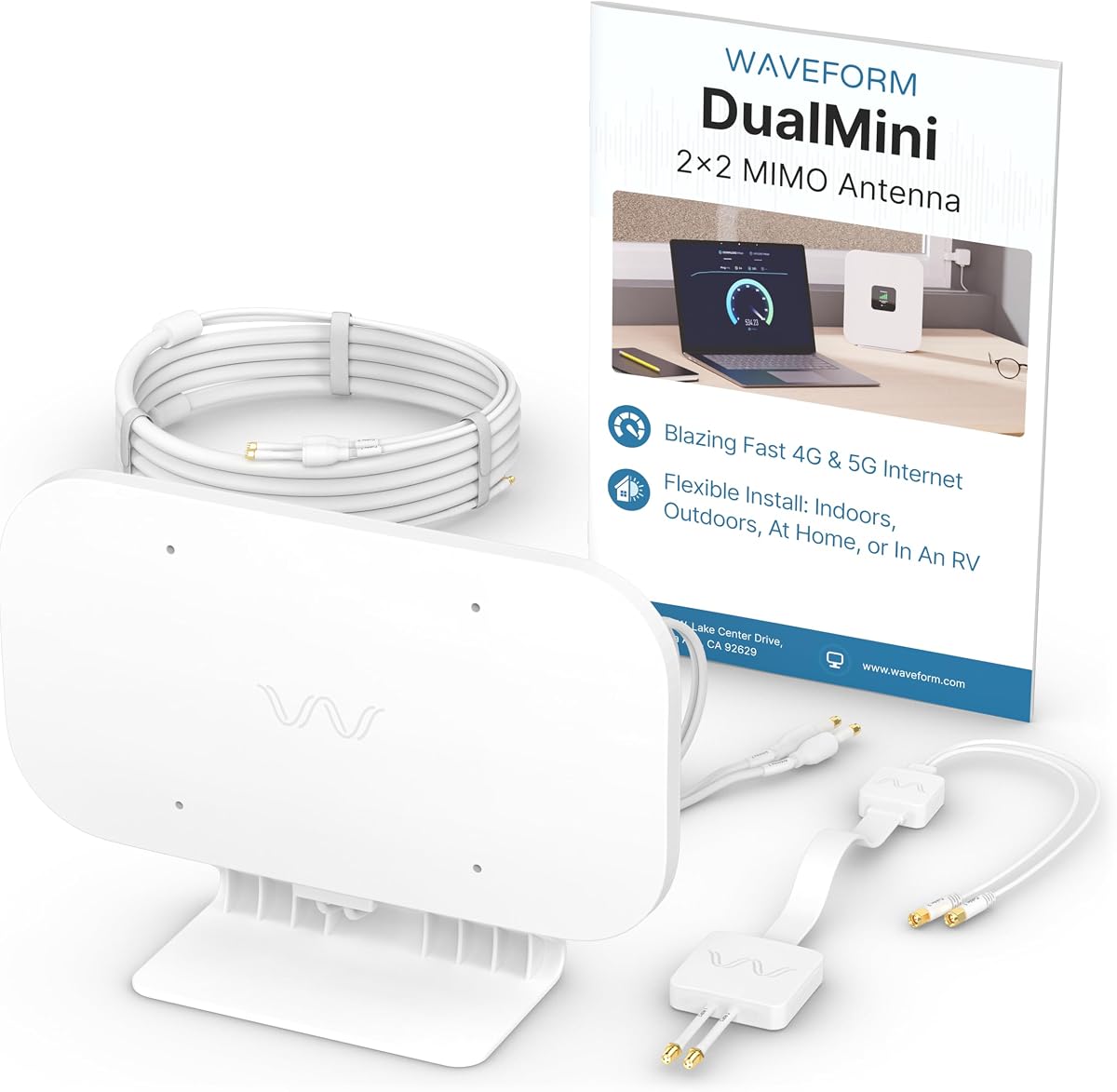
The Waveform DualMini Complete Kit is designed for cellular routers with two antenna ports. Its 4.2 rating, low-profile construction, and omnidirectional pattern make it a natural fit for apartments, offices, and other locations where finding a precise line to a tower would be inconvenient. Stated gain reaches up to 5.2 dBi, while the included Window Entry Cable and UltraFlex-Twin cables support a more organized installation.
We may earn a commission when you buy through this link, at no additional cost to you.
The DualMini shares many practical qualities with the QuadMini, including suction cups, a pole adapter, a desktop stand, and direct wall mounting. These options let users test reception on a window, move the antenna between rooms, or use a permanent exterior or interior position. Because the antenna works in multiple directions, installation does not require the same calibration involved with a directional panel.
The central limitation is MIMO configuration. A 2×2 kit is appropriate for many cellular hotspots, modems, and routers, but it cannot deliver the four-feed configuration expected by a 4×4 MIMO device. Buyers should inspect the gateway or router before ordering and confirm the required connector type and adapter arrangement. The product information does not list every individual device supported by the kit.
This is a sensible recommendation for a two-port router that needs a low-profile, no-aim solution. Choose the DualMini when flexibility and a tidy installation matter more than four-antenna support. It is also a more natural match for common 2×2 equipment than the QuadMini or other 4×4-focused products.
The kit is structured around two MIMO signal paths, making it suitable for routers and hotspots that expose two cellular antenna connections. Checking the router's ports before ordering prevents an unnecessary mismatch.
Its low-profile design can sit on a desktop, attach to a wall, use a pole adapter, or connect to a window with suction cups. Omnidirectional reception eliminates the need to point the unit at a single tower.
We may earn a commission when you buy through this link, at no additional cost to you.
This 2×2 MIMO Log Periodic Antenna Kit combines a 4.2 rating with a high stated gain of 15 dBi and broad operation from 698 to 3800 MHz. It is a strong budget-oriented choice for users with two cellular antenna ports who can mount directional antennas outdoors and aim them toward a cell tower. The package includes two antennas, two 32-foot cables, TS9 adapters, an L-mount, anchors, cable ties, and installation guides.
We may earn a commission when you buy through this link, at no additional cost to you.
Dual low-loss coaxial cables are included to reduce avoidable signal loss across the run from the antennas to the device. The stated 15 dBi gain is intended to support a strong, stable connection in challenging locations, while the log-periodic design focuses energy toward the selected direction. This makes it useful for fixed homes, rural installations, offices, and other locations where a tower can be identified.
The mount uses a thick stainless steel base plate with full continuous welding, according to the product information. That construction is a meaningful inclusion for an external installation because it provides a stable foundation for the paired antennas. Nevertheless, the 32-foot cables, TS9 adapters, and outdoor placement make this a less convenient choice for mobile use or renters unable to mount hardware outside.
This kit is recommended for buyers seeking a complete high-gain directional system without paying for a premium brand bundle. Verify that the router uses compatible SMA or TS9 connections and that both antenna cables can reach the device. If those requirements are met and a directional tower is available, it offers a straightforward 2×2 MIMO solution with substantial installation hardware.
The 15 dBi specification makes this kit appealing where outdoor placement and tower alignment are possible. Directional operation concentrates its performance toward the selected tower rather than spreading it evenly across every direction.
The welded stainless steel base plate, L-mount, anchors, and cable ties create a more permanent installation. This package is better suited to fixed structures than frequently assembled mobile configurations.
We may earn a commission when you buy through this link, at no additional cost to you.
The 5G 4G LTE 4×4 MIMO Outdoor Panel Antenna Kit stands out with a 5.0 rating, the highest listed rating among the products reviewed. It supports full four-feed MIMO, offers up to 10 dBi of stated gain, and covers 600 to 6000 MHz. The stated compatibility includes major United States and Canadian carriers, making it a broad option for 4G and 5G routers, modems, hotspots, and gateways.
We may earn a commission when you buy through this link, at no additional cost to you.
The package contains one panel antenna, a mounting pole, four 32-foot low-loss cables with N male to SMA male connectors, and four TS9 adapters. That cable and adapter selection gives installers several connection paths, but they should first confirm which interface their device uses. Four separate 32-foot cables also need to be routed together to avoid unnecessary strain or poor cable management.
As a directional antenna, the panel is intended to be aimed at the nearest cell tower for the strongest result. Its weatherproof construction makes it suitable for outdoor use, and the included pole supports elevated placement away from obstructions. As with all directional systems, improper aiming can reduce performance, so the installer should compare placement and alignment choices rather than installing only by appearance.
This kit is an attractive option for a compatible four-port gateway that needs broad-band external reception and strong directional performance. It is especially suitable for fixed home internet or remote-network installations where a pole mount is available. Buyers with only two antenna ports should choose a 2×2 kit instead, while those needing no aiming should consider an omnidirectional model.
The 4×4 MIMO arrangement is built for devices with four cellular antenna connections. It is a closer match to many high-end fixed-wireless routers than a basic two-antenna panel, while still relying on the user's network and tower conditions for real-world gains.
Coverage from 600 to 6000 MHz supports major 4G and 5G bands, and the listing identifies AT&T, Verizon, T-Mobile, US Cellular, Bell Canada, Rogers, Telus, Digicel, and Telcel. That broad list is useful for travel, mobile installations, or non-U.S. networks.
We may earn a commission when you buy through this link, at no additional cost to you.
This external 2×2 log-periodic kit is a practical choice for cellular hotspots, routers, and gateways that need two directional antenna connections. Its 4.0 rating is solid, while the listed 10 dBi gain and 698–3800 MHz operating range target 4G and 5G reception. The product uses two long coaxial runs to preserve the separation and performance required for two MIMO signal paths.
We may earn a commission when you buy through this link, at no additional cost to you.
The complete package includes two log-periodic antennas, two 32.8-foot low-loss cables, two TS9-male-to-SMA-female adapters, an L-mount, anchors, and a user manual. These components allow a fixed external installation with the antennas positioned in a suitable direction and the cables routed toward the connected device. Connector compatibility should be verified before setup.
A directional log-periodic design can improve reception when aimed correctly, but it is less forgiving than an omnidirectional antenna. Obstacles, nearby structures, and an incorrect tower estimate can all reduce the benefit. The long cables also mean that poor connector handling or sharply bending the coax can undermine an otherwise sound installation.
The kit is recommended for users who know where their nearest tower is or can determine the correct direction and who need a complete, gain-oriented 2×2 setup. It is less appropriate for renters, frequent travelers, or users who cannot keep the antennas aimed in a fixed position. For those cases, a low-profile omnidirectional kit would offer a simpler installation.
The 10 dBi directional design can focus reception toward a selected tower, making it useful for improving a weak fixed installation. Correct alignment remains essential, so a nearby strong signal is not automatically the best guide.
Two antennas, matching 32.8-foot cables, adapters, an L-mount, anchors, and a manual cover the major installation components. This reduces assembly friction compared with assembling a multi-antenna system independently.
We may earn a commission when you buy through this link, at no additional cost to you.
The Waveform QuadPro Antenna Only package delivers the same core 4×4 MIMO directional antenna platform as the complete kit, but it is intended for buyers who already have suitable cables, mounts, window-entry hardware, and adapters. Its 4.4 rating and stated gain of up to 9.1 dBi across 600–6000 MHz place it among the stronger technical options in this comparison.
We may earn a commission when you buy through this link, at no additional cost to you.
The product information emphasizes support for 4G and 5G bands used by AT&T, Verizon, T-Mobile, and US Cellular. It also discusses connections to 5G routers, modems, and gateways, along with detailed guidance for T-Mobile Home Internet hardware. Because it is the antenna-focused option, existing installation components can reduce duplication or allow a custom cable run.
The most important distinction from the complete QuadPro kit is what is not included. Users should account for the required coax, Window Entry Cable or equivalent entry solution, FlexMount or another mount, weatherproofing boots, and any needed SMA or U.FL adapters. This package is better for experienced installers or buyers with compatible equipment than for a straightforward first-time setup.
It is a strong recommendation for users who want the QuadPro antenna and already understand their gateway's connector requirements. A complete-kit alternative may be easier for beginners, but this option can be the more efficient choice for an existing installation. Confirm cable lengths, connector types, and mounting requirements before ordering.
The antenna can integrate with cables and mounting hardware already chosen for the site. This is helpful for technicians, mobile installers, and users who need a longer or more specialized run than a standard bundled configuration provides.
The stated 600–6000 MHz range and support for major U.S. carrier bands make the antenna relevant to both 4G and 5G networks. Device interfaces still need to be checked because compatible radio bands do not guarantee identical connector arrangements.
We may earn a commission when you buy through this link, at no additional cost to you.
The 5G 4G LTE MIMO 2×2 Panel External Antenna Kit is a wideband directional set for compatible cellular routers, modems, hotspots, and gateways. Its stated performance includes 2×2 MIMO, 12 dBi gain, and coverage from 600 to 6000 MHz. The listing does not provide a numeric buyer rating, so the decision should rely on the detailed specifications, included hardware, and fit with the user's equipment.
We may earn a commission when you buy through this link, at no additional cost to you.
Two permanently attached 32-foot low-loss cables use SMA male connectors, and two TS9 adapters are included for compatible equipment. The mounting system supports pole or wall installation, while the directional panel is intended to be aimed toward the nearest tower. Together, these features make the kit suitable for homes, offices, RVs, farms, and remote fixed locations where an elevated outdoor position is possible.
The broad frequency range allows the same antenna to cover 4G LTE and 5G networks. Compatibility information includes T-Mobile Home Internet, Verizon, AT&T, T-Mobile, Telus, Bell Canada, and Rogers, though the listing also contains less clearly formatted carrier names. Buyers should focus on actual connector standards and their local network rather than relying only on the carrier list.
This panel is a solid option for a two-port device that benefits from a focused, outdoor installation. It is less suitable for users who need immediate placement without aiming or for those unable to mount hardware outdoors. Because no rating is listed, the included hardware and clear 2×2 configuration are especially important points to verify before purchase.
The 600–6000 MHz range supports 4G LTE and 5G use within one directional antenna platform. That makes the kit adaptable to different cellular systems while retaining a focused installation for a selected tower.
The adjustable bracket supports both pole and wall mounting, and the long attached cables allow the panel to be positioned away from the gateway. External placement can reduce the effect of walls and other obstructions on received cellular signals.
We may earn a commission when you buy through this link, at no additional cost to you.
This 2×2 omnidirectional antenna kit provides an alternative for gateway and router users who want broad directional coverage without aiming a panel at a tower. It has a 3.6 rating, the lowest listed score in the group, but its stated specifications include 13 dBi gain, 600–6000 MHz coverage, and support for 5G, 4G, LTE, and Wi-Fi applications.
We may earn a commission when you buy through this link, at no additional cost to you.
The installation kit includes a 32-foot RF240 cable, TS9 connectors, and a sturdy pole mount bracket. The listing describes compatibility with major carriers and common gateways, routers, modems, mobile hotspots, and 5G home internet devices. The included 32-foot run allows the antenna to be placed away from the indoor equipment, while the pole bracket supports an exterior position.
Its construction is described as weather-resistant, with a stated length of 2.07 feet and diameter of 0.26 feet for outdoor-oriented use. Omnidirectional operation is especially useful for RVs, mobile setups, and locations where the nearest tower changes or cannot be identified. The trade-off is that the antenna does not concentrate reception toward a selected direction in the way a panel or log-periodic model can.
This kit is most appropriate for users who prioritize placement flexibility and a straightforward pole-mounted setup. Its lower buyer rating warrants checking connector details and recent customer feedback before ordering. It is less compelling than the strongest directional products when a fixed tower location is known and maximum concentration in one direction is the priority.
Receiving from multiple directions makes the kit suitable for RVs, remote locations, and changing cellular conditions. It removes the repeated adjustment associated with directional antennas, although tower position still determines which location provides the best result.
The 32-foot RF240 cable allows the antenna to sit outside while the gateway remains indoors. A pole bracket provides the basic mounting platform, while weather-resistant construction is intended for outdoor deployment.
We may earn a commission when you buy through this link, at no additional cost to you.
The Peplink Mobility 42G is a rugged cellular and Wi-Fi antenna system with a 4.6 rating, making it the highest-rated product with a numeric buyer score in this roundup. Its cellular side uses an omnidirectional 4×4 MIMO design across 600–6000 MHz, while the integrated Wi-Fi section provides 2×2 MIMO operation on the 2.4 GHz and 5 GHz bands.
We may earn a commission when you buy through this link, at no additional cost to you.
Its IP68-rated, low-profile housing is designed for durability, and the system includes a wall or pole mount plus double-sided 3M adhesive pads. The 16-foot cable and SMA connection are relevant for a permanent installation, while the included GPS receiver adds a function not offered by most generic cellular antenna kits. It is especially relevant to users who need both wide-area cellular and local Wi-Fi coverage from one external unit.
Unlike the complete kits that bundle several leads and adapters, this is a particular antenna system with a defined connector arrangement. Buyers should confirm the receiving Peplink device or compatible setup, connector requirements, and supported network functions before installation. Its broad frequency range and 4×4 cellular configuration are impressive, but they do not remove the need for device compatibility.
The Mobility 42G is best for a durable mobile or fixed installation where a Peplink-centered networking setup is in use and local Wi-Fi coverage is needed alongside cellular service. It is less convenient as a universal plug-and-play kit for unrelated routers. Its strong rating, rugged enclosure, dual radio coverage, and integrated GPS justify consideration for buyers who value a specialized, integrated antenna platform.
The antenna combines 4×4 MIMO cellular coverage with a 2×2 dual-band Wi-Fi element. This makes it useful for mobile networking installations that need both wide-area service and local wireless coverage from a single durable housing.
The IP68-rated low-profile housing is built for demanding mobile use. Wall and pole mounting options plus adhesive pads provide several ways to secure the unit on a vehicle, enclosure, or fixed structure.
We may earn a commission when you buy through this link, at no additional cost to you.
The right Mimo Antenna Kit depends on your router's ports, the available cellular signal, nearby tower direction, and installation environment. Use the following factors to narrow the field before comparing complete and specialized antenna systems.
MIMO antennas use multiple independent signal paths, so the kit's configuration must match the equipment it will connect to. A 2×2 kit fits routers with two cellular antenna ports, while a 4×4 kit is intended for devices with four ports. Using fewer antennas than the router supports may limit its designed MIMO capability, while using more does not automatically create additional paths in the equipment.
Choose the exact MIMO layout your router or gateway requires.
Antenna gain is only useful if the signal can reach the router without an unsuitable connection. Check whether the device uses SMA, TS9, U.FL, or another interface, and confirm whether an adapter is needed. Cable length, connector quality, and low-loss construction also influence the result, particularly over the long runs included with many outdoor kits.
Verify every connector before buying, then plan the cable route.
A directional antenna concentrates reception toward a particular tower and can be effective when the correct bearing is known. It usually requires careful placement and can lose performance if pointed incorrectly. An omnidirectional antenna receives from multiple directions, making setup easier and placement more flexible, but it does not concentrate energy in the same way. The best choice depends on whether precision or convenience matters more.
Use directional models for known towers and omnidirectional models for flexible placement.
Gain indicates how strongly an antenna concentrates or accepts signals, but it does not create cellular coverage where none exists. A directional product may list higher gain because it focuses on a narrow area. Compare gain with frequency range: broad 4G and 5G support, such as 600–6000 MHz or 698–3800 MHz, is useful when the device or network may use different bands.
Prioritize usable band coverage, then consider directional gain.
Outdoor and elevated placement can reduce the impact of walls, floors, and other obstructions, but it requires weather resistance and secure mounting. Window suction cups and interior stands are easier to reposition and useful for testing. Pole mounts suit permanent installations, while wall mounting is convenient where drilling is acceptable. Consider the full cable run, access to the device, and the strength of the available mounting point.
Match the mount to the site rather than forcing the site to the mount.
A complete kit can include the antenna, multiple cables, adapters, weatherproofing boots, a mount, and documentation. That arrangement reduces assembly uncertainty and is usually better for first-time installers. An antenna-only package can be more efficient for people with compatible cables or specialized mounting hardware, but it demands more planning and may leave essential items to source separately.
Choose a complete kit for convenience or components for customization.
Cellular antennas may cover broad carrier bands, yet gateways can still have unique port layouts, firmware expectations, or recommended installation methods. Some products include guides for specific T-Mobile Home Internet devices, while others provide general guidance. Confirm that your carrier operates in the area, that the gateway has the necessary external antenna connectors, and that any documented setup applies to the exact model.
Match the antenna to the carrier, gateway model, and available ports.
Cellular readings can change with time, tower load, nearby construction, foliage, and weather. Treat a single reading as one part of installation rather than a complete prediction of final speed. Directional systems benefit from testing multiple positions, and outdoor equipment needs weatherproof connections. Long cables should be supported and routed without sharp bends, strain, or pinched sections that could degrade the signal.
Test placement carefully and protect every outdoor connection.
Begin by identifying every cellular antenna port on the router, gateway, hotspot, or modem. Compare those ports with the kit's MIMO count and connector types, power down the equipment before attaching cables, and install the specified adapters where needed. Read the included guide because the order of cables and adapters can matter for a multi-antenna system.
For an omnidirectional kit, move the antenna to the side of the building or room with the best baseline cellular signal and allow enough spacing from metal objects and electronics. For a directional panel or log-periodic antenna, determine the direction of the serving tower, aim the antenna, secure the mount, and then test performance from the connected device. Recheck alignment if results are inconsistent.
After installation, compare the router's signal information and connection stability before and after the upgrade. Route cables away from sharp bends, power adapters, and unnecessary splitters. Outdoor components should be firmly mounted, and every connector should be protected according to the kit instructions. Periodically inspect seals, brackets, cable ties, and cable condition, particularly after severe weather or physical movement of the installation.
Not always. A 5G router may use a 2×2 MIMO configuration, so its antenna requirements should be determined by the number and type of external cellular ports rather than the 5G label alone. A 4×4 kit is appropriate only when the device supports four antenna paths. Installing a 2×2 kit on compatible two-port equipment can provide a cleaner match and a simpler installation.
No. Gain describes antenna concentration, not guaranteed internet performance. Directional antennas can be highly effective when aimed toward a serving tower, while omnidirectional antennas are easier to place but spread their reception pattern. Actual results depend on network coverage, carrier bands, distance, obstructions, device capability, and installation quality. A well-aligned moderate-gain antenna can outperform a poorly positioned higher-gain unit.
It depends on the site. Indoor or window mounting is convenient for testing and avoids permanent exterior work, although walls and glass can weaken reception. Outdoor installation generally provides a clearer path to towers and is often better for directional antennas. Choose a location with the best signal, secure mounting, safe cable routing, and weather protection for every exposed connection.
These adapters allow an antenna cable to connect to a router or gateway with a different antenna interface. A TS9-to-SMA adapter, for example, can connect a TS9 cable assembly to a device with an SMA port. Adapters should match the required gender and impedance. Buyers should confirm the device connector rather than assuming all cellular antennas use the same fitting.
An external antenna is often the first step because it can improve the signal that reaches the modem and preserve the modem's internal MIMO capabilities. A booster may be considered for other scenarios, but it is not automatically needed. The correct approach depends on the device, carrier, signal type, and regulatory requirements, so users should check compatibility before adding powered equipment.
Use enough cable to place the antenna in a strong-signal location while minimizing avoidable loss and unnecessary slack. Kits in this roundup include runs ranging from 16 to more than 32 feet. Short runs can be useful for a nearby wall or window position, while longer runs support pole-mounted outdoor antennas. Keep the cable supported, away from sharp bends, and separate from power wiring where practical.
It can when weak reception is limiting the cellular connection, because stronger and cleaner signal may allow the modem to use a more efficient network mode. If the tower, plan, or backhaul is already the bottleneck, an antenna may have little effect. Compare several network measurements before and after installation rather than judging the upgrade from a single reading or a momentary speed test.
Identify the general direction of the serving tower, secure the antenna, and point its face toward that direction with a clear line of sight. Fine alignment can then be based on the router's signal readings and network performance. Because cellular readings can fluctuate, test from more than one position and avoid changing the router, cable, or adapter while comparing results.
The Waveform QuadPro Complete Kit is the strongest all-around premium recommendation for a compatible four-port gateway, combining broad band coverage, 4×4 MIMO support, up to 9.1 dBi of stated gain, and a complete window-entry installation package. The Waveform QuadMini is the more flexible editor's choice because its low-profile omnidirectional design does not require tower aiming. The 2×2 Log Periodic Kit is a compelling budget choice when a permanent outdoor installation and known tower direction are available.
Prioritize port and connector compatibility before gain. Match the kit's 2×2 or 4×4 architecture to the router, verify the frequency range and carrier support, and choose directional or omnidirectional coverage based on the installation site. Cable quality, mounting stability, weather protection, and careful alignment can matter as much as the headline gain specification once the hardware is installed.
Finally, recheck the current listing, included components, and device documentation before ordering. Kits can change their bundled cables, adapters, mounts, or included documentation, while gateway port arrangements can also vary by revision. Confirming those details at the point of purchase helps ensure that the chosen Mimo Antenna Kit is ready for the intended router and installation.