
Solar Ultrasonic Animal Repellent, Deer & Raccoon Deterrent Outdoor, 2 Pack
5.0Editor score
Variable ultrasonic output
Thirty-foot motion detection
Two high-activity coverage zones
Discover the best possum repellent deterrent options for yards, gardens, porches, and campsites, with features, placement tips, and comparisons.
Possums can quickly turn an ordinary yard into a noisy problem, especially when they investigate garbage cans, pet food, bird feeders, gardens, or sheltered crawl spaces. An effective possum repellent deterrent combines scent, sound, light, and physical exclusion without relying on poison or cruel traps.
The products compared here use two broad approaches: botanical scent pouches that create persistent odors and solar-powered electronic deterrents that react to nearby movement. This guide evaluates each option using its stated coverage, weather resistance, installation requirements, animal compatibility, ease of use, and suitability for yards, gardens, farms, and nighttime nuisance control.
Each review explains the product's strongest features, practical limitations, and best placement. The selections also show how odor-based and electronic deterrents differ, while the buying guide explains how to match a device to the animal, location, and coverage pattern around your property. Product availability and pricing can change, so check the current listing before buying.
5.0Editor score

5.0Editor score

4.4Editor score
The table below compares scent-based pouches with motion-activated ultrasonic devices, solar predator lights, and larger multi-pest solar stakes. Key differences include activation method, intended animals, weather protection, and the most practical placement for properties with nighttime possum activity.




This eight-pack of 25-gram pouches offers a straightforward botanical approach to possum control. It has a 3.4 rating, but its appeal lies in simplicity: each sealed pouch is ready to place around garbage cans, garden edges, entry points, sheds, or other areas where unwanted animals have appeared. The listed ingredients include garlic and peppermint oils inside breathable non-woven fabric bags.
We may earn a commission when you buy through this link, at no additional cost to you.
The strongest feature is the claimed scent protection of up to six weeks per pouch, which can offer a longer maintenance interval than many odor-based alternatives. Because the product releases its aroma gradually, it does not require spraying, batteries, charging, or a direct power connection. It can be moved as the possum's habits change, allowing you to concentrate several bags around a favorite route or distribute them across a larger perimeter.
Its limitations are inherent to passive scent repellents. Rain, wind, direct sunlight, and poor placement can alter how strongly and how long the odor reaches an animal. A pouch cannot prevent an animal from entering if attractive food remains accessible. The manufacturer also recommends blocking entry gaps, cleaning food scraps, sealing garbage, removing pet food, and collecting fallen fruit, making sanitation and exclusion essential companions to the repellent.
This option suits homeowners who prefer a chemical-free-looking, low-maintenance method and need protection around trash cans, attics, bird feeders, gardens, or sheds. For a possum that moves along a predictable ground-level route, place pouches close to that route while keeping them inaccessible to children and pets. It is a sensible passive option, provided you are willing to monitor scent strength and combine it with sound-based deterrence where nighttime visits persist.
Each pouch is described as providing up to six weeks of scent protection, making regular visual checks useful rather than constant replacement. Place multiple pouches at intervals around the most active route so an approaching possum encounters the scent before reaching food or shelter.
The pouches are particularly relevant to possums attracted to garbage, pet food, fallen fruit, and bird feeders. Securing those attractants is still necessary because odor alone cannot make an exposed food source inaccessible.
We may earn a commission when you buy through this link, at no additional cost to you.
This four-pack uses solar-powered stakes, ultrasonic pulses, and intermittent vibration to discourage a broad range of outdoor pests. Its 3.8 rating reflects a middling customer history, while the feature set is particularly relevant to properties where possums share space with moles, gophers, rabbits, skunks, raccoons, groundhogs, and other animals.
We may earn a commission when you buy through this link, at no additional cost to you.
Each stake is advertised with up to 50 feet of coverage and a combination of 400–1,000 Hz ultrasonic pulses with vibrations every 20 seconds. The product is also described as silent, although that claim should be understood within the context of the stated sonic operation rather than treated as a guarantee of total inaudibility. Solar power and an IP65 waterproof housing are the main practical strengths for continuous outdoor use.
The product's broad range and aggressive marketing claims require careful placement. The listing describes coverage of up to one acre for a larger deployment, but a four-pack does not guarantee blanket protection across an entire property. Terrain, vegetation, stake spacing, animal movement patterns, and interference between units can all affect real-world results. The device also does not remove food sources or physically close entry points.
This four-pack is best for buyers who want a few solar stakes to protect a garden, lawn, orchard, or farm zone and who also have a broader nuisance-animal problem. It is less suitable for a small patio where one focused motion deterrent would be easier to position. For possums, place stakes along confirmed paths and near feeding or sheltering points rather than expecting one central unit to cover every side of a property.
The combination of ultrasonic pulses and periodic vibration gives nocturnal animals both sound and tactile environmental cues. That can be useful in yards where possums repeatedly cross open ground or approach a garden edge.
Four independently placed stakes can cover separate garden, lawn, and orchard zones. Each panel needs direct sunlight, while the stakes should face activity paths and remain spaced according to the stated coverage.
We may earn a commission when you buy through this link, at no additional cost to you.
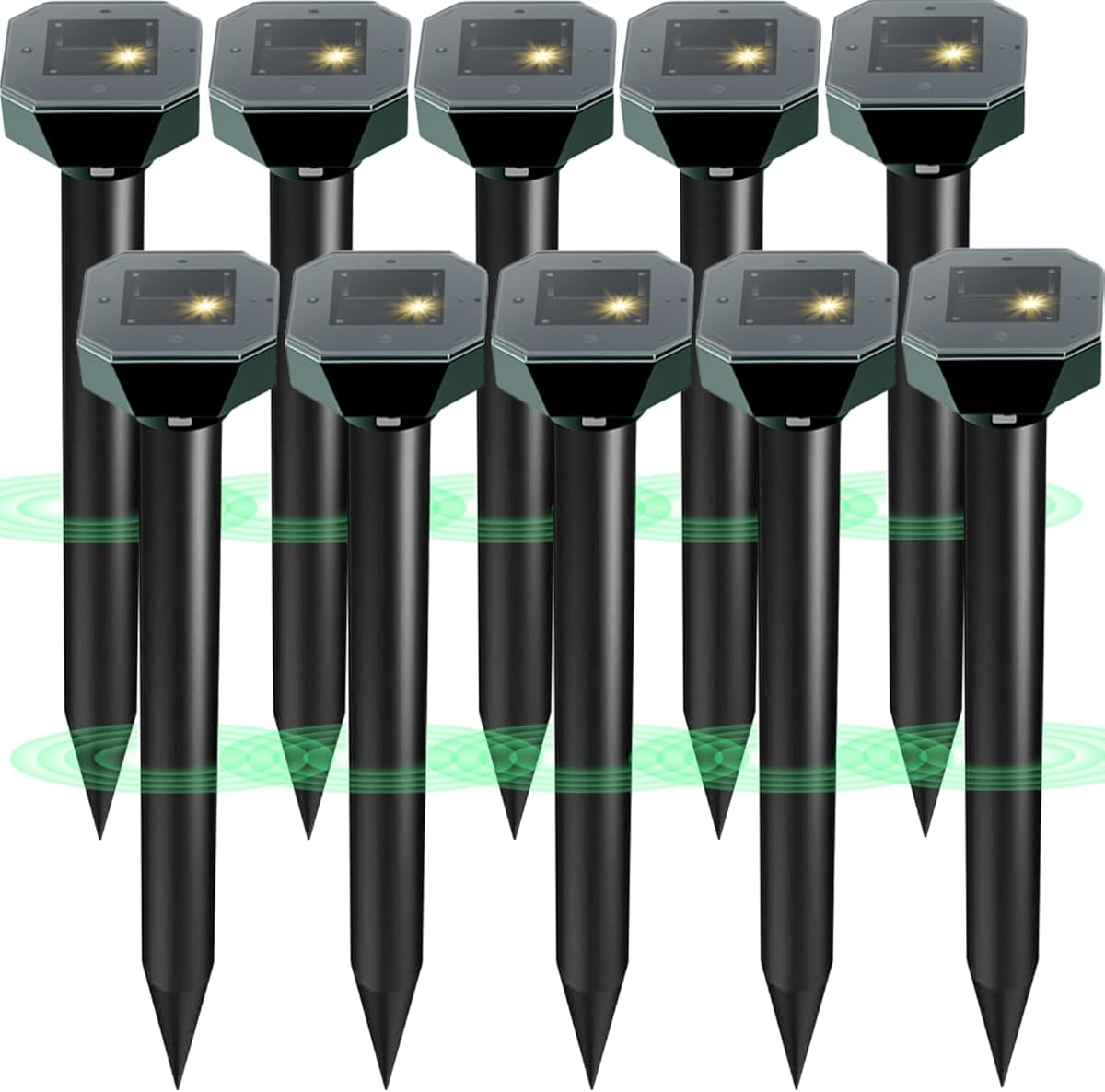
This ten-pack is the most extensive electronic deployment in the roundup and carries a 4.4 rating, the highest among the listed products. It combines solar power, IP65 weather-resistant construction, dynamic ultrasonic frequencies, and intermittent vibration. Its target list explicitly includes possums alongside raccoons, skunks, rabbits, moles, gophers, voles, groundhogs, and numerous other garden pests.
We may earn a commission when you buy through this link, at no additional cost to you.
The product's most attractive feature is its scalable coverage. Ten stakes can be positioned around vegetable beds, lawns, orchards, fences, and animal approaches rather than relying on a single central unit. The stated 50-foot radius makes spacing across larger properties more practical, while the dynamic frequency design is intended to reduce the chance that pests become accustomed to one fixed output.
That scale also creates trade-offs. A ten-unit installation takes more time, and every unit must receive adequate sunlight. The marketing language is expansive, so buyers should evaluate the device as a motion or sonic deterrent rather than a guaranteed solution for every species. As with other electronic repellents, the units cannot stop an animal that is strongly motivated by accessible garbage, pet food, or an open shelter.
This is the premium pick for a large property with multiple animal routes, extensive gardens, or a need to deter several nuisance species at once. It is less attractive for someone dealing with a single possum around one porch or trash can, where a focused device or scent pouch may be easier to manage. Its higher rating, ten-unit flexibility, and broad intended coverage justify the top-premium position among the options reviewed.
Ten stakes let you establish separate deterrent points rather than concentrating protection in one location. This is especially useful when possums enter through different fence openings, garden edges, or animal paths.
Variable ultrasonic output paired with periodic vibration creates a changing deterrent pattern. The approach is designed for properties where a single fixed sound might quickly become less effective.
We may earn a commission when you buy through this link, at no additional cost to you.
The Broox device is a single solar unit with motion detection, ultrasonic output, an alarm, and a flashing LED. It has a 3.8 rating and distinguishes itself through five frequency modes plus the ability to stake it in the ground or mount it on a wall. That flexibility makes it useful for yards, farms, gardens, and close-to-structure installations.
We may earn a commission when you buy through this link, at no additional cost to you.
The infrared sensor has a stated 110-degree angle and a 20–25-foot detection range. A solar panel charges the unit, while an included USB cord offers a backup charging method. Weatherproof, UV-protected construction is designed to handle rain, snow, and sun exposure, and the device avoids chemical repellent ingredients.
An important limitation is that ultrasonic output only affects animals capable of hearing the relevant frequencies. The listing specifically notes that it will not work for snakes because they cannot detect ultrasonic sound. Possums can hear ultrasonic frequencies, but actual results still depend on sensitivity, habituation, positioning, and whether the animal has a powerful food incentive nearby.
This is a good choice for a homeowner who needs one adaptable unit rather than a large multi-unit deployment. Mount it near a porch, fence, or garden route, angle the sensor toward the expected approach, and keep the detection field clear. It works best as one layer in a broader plan that also removes food and blocks shelter. For extensive acreage or several independent animal paths, a multi-pack offers more practical coverage.
The ability to mount the device on a wall or insert it into the ground allows you to adapt the same unit to different entry routes. A wall position may be useful near a deck, while a stake can cover lawn or garden edges.
Multiple modes allow the operator to vary the deterrent response rather than relying on one setting. Starting with an appropriate mode and observing the animal's behavior can help identify which configuration is most effective.
We may earn a commission when you buy through this link, at no additional cost to you.
This four-pack specializes in nighttime deterrence through simulated predator-eye LED lights and flickering flame effects. It has a 3.1 rating, the lowest in the selection, but it directly addresses the nocturnal nature of many possum visits. The listing explicitly identifies opossums alongside raccoons, skunks, deer, foxes, coyotes, and other nighttime intruders.
We may earn a commission when you buy through this link, at no additional cost to you.
The automatic light sensor turns the devices on at dusk and off at dawn, avoiding unnecessary daytime operation. Solar charging is supplemented by Type-C USB charging, and the units carry an IP44 waterproof rating. Recommended mounting heights range from 12 inches for skunks, raccoons, and opossums to 24 inches for foxes and coyotes, with higher positions suggested for larger animals.
The primary weakness is specialization. Because the light is designed to work only at night, it offers little value during daylight nuisance activity unless another method handles daytime foraging. Its IP44 rating also differs from the stronger IP65 or IP66 constructions found elsewhere in the roundup, so sheltered positioning may be sensible during prolonged wet weather.
This product is best for properties where possums emerge after dark around chicken coops, gardens, garages, or farm structures. Install it at the listed opossum height and point the predator effect toward the route the animal uses. A homeowner with daytime and nighttime problems may benefit from pairing it with an ultrasonic motion device or botanical pouches.
A built-in light sensor activates the predator-light effect at dusk and deactivates it at dawn. This makes the units efficient for owners whose main concern is after-dark possum noise and movement.
The guidance to install opossum devices at 12 inches is valuable because visual deterrents are more convincing when positioned at an animal's eye level. Higher placements can be used for larger targets that share the same routes.
We may earn a commission when you buy through this link, at no additional cost to you.
This ten-pack of solar stakes is designed as a broad pest-control network, with possums included among more than 20 targeted animal types. It has a 3.8 rating and closely resembles another multi-pest system in this roundup, using ultrasonic frequencies between 400 and 1,000 Hz combined with periodic vibration.
We may earn a commission when you buy through this link, at no additional cost to you.
Its main advantage is the ability to place ten units throughout a property. One-acre coverage is stated, which is relevant to farms, orchards, large lawns, and gardens where possums may approach from several directions. IP65 waterproofing and round-the-clock solar operation support extended outdoor deployment without batteries or wiring.
The breadth of the claims also demands realistic expectations. A device advertised for many species is not a substitute for species-specific research or physical exclusion. Dynamic frequency modulation may reduce habituation, but it cannot guarantee that every animal will leave. The solar panels must receive strong sunlight, and dense landscaping, structures, and uneven terrain can interrupt the stated coverage pattern.
This ten-pack is a sensible choice when the homeowner has a large outdoor area and wants a single system to discourage possums along with skunks, raccoons, gophers, moles, rabbits, and other animals. It is overkill for a single localized problem, but valuable when a smaller detector cannot cover the property's full perimeter. Position the stakes where paths intersect and distribute them evenly rather than clustering them.
Ten solar stakes can define a broad deterrent network around fields, orchards, lawns, and gardens. The stated one-acre capacity makes the pack more relevant to large properties than compact yards.
The device uses sound and vibration rather than poison, making it suitable for owners seeking a non-chemical deterrent approach. Wildlife remains responsible for avoiding the treated area rather than being killed by the system.
We may earn a commission when you buy through this link, at no additional cost to you.
This 24-pack of botanical scent pouches is a practical choice for users who want to place many small deterrents around a property. It has a 3.5 rating and uses plant-based ingredients, including mint and citrus oils, to discourage skunks, raccoons, and other nuisance animals. Possums are included in the broader use case for wildlife activity around living spaces.
We may earn a commission when you buy through this link, at no additional cost to you.
The generous pouch count provides flexibility. You can line a porch, patio, garage, shed, RV, deck, or walkway with multiple scent points without moving one pouch repeatedly. Each pouch is described as releasing scent for up to 30 days, depending on environmental conditions, and requires no spraying, mixing, or cleanup.
Its limitations are shared by passive odor products. Direct sunlight, wind, rain, and fluctuating temperatures can shorten useful scent life, and an animal may investigate from a direction that carries the odor away. The non-toxic, no-fume design is appealing around family spaces, but placement still needs to keep pouches out of reach of children and pets. The listing's broad indoor and outdoor positioning should not be interpreted as permission to place them where they could be chewed.
This pack suits homeowners who want extensive scent coverage around multiple garage doors, patio corners, garden paths, or refuse areas. It is also useful for renters or property managers who prefer something that can be deployed quickly without charging a device. For a persistent possum problem, pair the pouches with sealed garbage, removed pet food, and a motion-activated deterrent near the main approach.
Twenty-four pouches make it easier to establish a distributed scent perimeter. Concentrating units around corners, openings, and known travel paths is generally more useful than leaving them in a straight, obvious line.
Because the pouches require no power or liquid, they can be used in covered patios, garages, sheds, and other spaces where an electronic unit would be less convenient. Keep them positioned according to the manufacturer's directions.
We may earn a commission when you buy through this link, at no additional cost to you.
This two-pack combines a 110-degree PIR sensor, 13.5–45.5 kHz ultrasonic output, and a bright flashing light. Its 5.0 rating makes it one of the highest-rated products in the roundup, while the two-unit format offers a balanced option for homeowners who need more than one targeted coverage zone.
We may earn a commission when you buy through this link, at no additional cost to you.
The devices detect approaching movement from up to 30 feet under suitable conditions and activate only when an animal enters the sensing zone. Solar charging reduces battery and wiring requirements, while an IP65 weather-resistant ABS housing supports year-round outdoor use. The product description recommends positioning one unit near a garden or orchard and the other near a lawn edge, patio, driveway, fence line, or common entry route.
The crucial requirement is proper aiming. A 110-degree sensor is useful across a broad approach area, but vegetation, walls, and other obstructions can interfere with detection. The panel also needs direct sunlight for consistent charging, and persistent visits may require moving or angling the device. Like other ultrasonic systems, it depends on the target animal detecting and avoiding the sound.
This is a strong general-purpose pick for a yard with two clearly identified problem areas, especially when daytime activity and nighttime movement both need to be covered. It is more focused and easier to deploy than a ten-stake system. Start with the primary travel path, monitor the device for two or three weeks, and relocate it if the possum begins approaching from another direction. Clean food sources and deny shelter to improve the result.
The PIR sensor conserves stored energy by waking the deterrent only when movement is detected. This makes the units practical for zones that do not need continuous daytime sound or light.
A two-pack can protect separate areas at the same time. One unit can cover a vegetable bed while the second watches a driveway, patio, or fence opening used by nocturnal possums.
We may earn a commission when you buy through this link, at no additional cost to you.
This single solar device offers five operating modes, three frequency ranges, adjustable volume, motion detection, ultrasonic output, alarm sounds, and a flashing light. Its 4.0 rating places it among the stronger-reviewed products, and its target list includes skunks, raccoons, foxes, rabbits, owls, rodents, and other stray animals.
We may earn a commission when you buy through this link, at no additional cost to you.
The 110-degree PIR sensor has a stated detection range of up to 33 feet. A rechargeable lithium battery can receive solar power or a USB connection, and the IP66 housing offers a strong weather-protection rating. Adjustable volume lets users moderate the output for their surroundings, while the five modes provide several operating patterns.
The key detail is that volume adjustment does not change the emitted frequency. If an animal becomes accustomed to a particular sound pattern, simply lowering the volume may not solve the problem. The listing also suggests allowing 10–15 days to observe a decrease in visits, which is a more realistic expectation than expecting an immediate response. Solar placement and an unobstructed sensing field remain important.
This device is best for a homeowner who wants one compact unit with more controls than a basic motion deterrent. It can be inserted into soil or mounted on a wall, making it suitable for gardens, terraces, farms, and areas near a structure. For possums, test it along the animal's habitual path and adjust modes before deciding whether a second unit or a scent deterrent would improve coverage.
Several modes and three ultrasonic frequency ranges create more varied responses than a single fixed setting. Testing each mode against observed animal behavior is more useful than assuming every option will work equally well.
Solar charging supports cordless placement, while USB charging helps maintain operation during extended cloudy periods. The IP66 housing and rechargeable battery make the unit well suited to exposed outdoor locations.
We may earn a commission when you buy through this link, at no additional cost to you.
This two-pack of solar ultrasonic repellents has a 5.0 rating and focuses on motion-triggered protection for gardens, orchards, patios, and fence lines. It uses a 110-degree PIR sensor, variable 13.5–45.5 kHz ultrasonic output, and a white flashing light to discourage deer, rabbits, raccoons, skunks, squirrels, and cats.
We may earn a commission when you buy through this link, at no additional cost to you.
The devices detect movement from up to 30 feet and activate only when an animal enters the sensing zone. Solar power eliminates outdoor wiring and frequent battery changes, while the IP65 housing is designed for changing outdoor conditions. The two-unit pack is particularly useful for properties with two separate high-activity areas, such as a vegetable garden and a fruit-tree line.
Its main limitation is the number of placement points. Two units cannot comprehensively cover a large property with numerous routes, so strategic placement matters more than simply placing them far apart. The solar panels need unobstructed direct sunlight, and leaves or dense shade can reduce charging. As with other motion repellents, results depend on the animal detecting the ultrasonic output and associating the protected zone with an unpleasant experience.
This is a good value-oriented choice for a small or medium yard with two identifiable routes. It combines a strong customer rating, simple installation, and dual-zone flexibility without the complexity of a ten-stake deployment. Place one unit near the principal food attractant and the other along the most visible travel path, then remove garbage and fallen produce. If visits persist, change the angle or location rather than assuming the device must cover an entire property by itself.
The two-pack allows simultaneous protection of separate garden or yard zones. It is especially useful when one possum route is near vegetables and another passes a patio, fence, or fruit tree.
The built-in solar panel and rechargeable design simplify installation around gardens and landscaping. Positioning each panel where it receives direct sunlight is the most important maintenance consideration.
We may earn a commission when you buy through this link, at no additional cost to you.
The right possum deterrent depends on the animal's behavior, the location you need to protect, and how much maintenance you are willing to perform. Compare scent, sonic, visual, and exclusion methods while considering nighttime activity, weather exposure, property size, and the importance of keeping food and shelter inaccessible.
Scent pouches and electronic repellents solve different problems. Botanical pouches create a passive odor barrier and require no charging, making them useful around garbage cans, patios, sheds, and covered entry points. Their effectiveness depends on the animal encountering the scent before it reaches food or shelter, and wind or rain can reduce dispersal. Electronic devices respond to movement with ultrasonic sound, flashing lights, vibrations, or predator imagery, making them more responsive when an animal approaches a protected zone. Electronic systems are usually better for known nighttime paths, while scent products can cover a broader area without a precise facing direction.
Match the product to the number of routes a possum uses rather than relying on a single maximum distance. A two-pack works well when there are two distinct approach paths, while a four- or ten-pack allows wider distribution across gardens, lawns, orchards, and fence openings. Pay attention to whether the stated radius is a maximum under favorable conditions. Walls, shrubs, terrain, and the direction of an approaching animal can all change the usable range. Position devices where paths overlap or near the point of interest, such as a trash enclosure, bird feeder, garden bed, or porch edge.
Possums are often most noticeable at night, so automatic night operation can be valuable. Predator-light devices activate from dusk to dawn, while motion-activated models remain dormant until their sensors detect movement. Ultrasonic devices may be less noticeable to people because their output is outside normal human hearing, although some users may hear portions of the alarm or vibration. For a yard where possums race across an open path, a motion sensor can conserve power and deliver the response precisely when needed. For an animal that lingers near a den or feeding station, a continuously present scent barrier may complement the motion device.
Outdoor deterrents must tolerate rain, sun, wind, and temperature changes. Products with IP65 or IP66 housings offer stronger weather-protection specifications than the IP44 rating listed for the nocturnal predator-light pack. Solar devices also need direct sunlight, and a panel placed under deep shade, beneath a tree, or beside a wall may charge inconsistently. USB charging is a useful backup for extended cloudy periods, but it is not a substitute for selecting a suitable sunny location. Scent products require different care: inspect them after heavy rain or prolonged direct sun and replace them if the scent has weakened.
Not every deterrent affects every species in the same way. Possums can detect ultrasonic frequencies, but a device's stated target list and operating range still matter. Some products emphasize rodents and burrowing pests, while others explicitly include opossums. Predator lights rely on visual response and are most relevant at night. Botanical scents such as peppermint, garlic, mint, and citrus are intended to make familiar areas less attractive. Because possums are adaptable, avoid relying on one method indefinitely and rotate placement or combine an electronic device with physical exclusion and sanitation.
The best deterrent is one you can position correctly and maintain. Scent pouches are the simplest option because they require no electrical setup, while solar stakes need adequate spacing, sunlight, and a stable insertion point. Motion sensors should be aimed toward the route and kept free of obstructing vegetation. Predator lights need animal-appropriate mounting heights, with the nocturnal pack recommending 12 inches for opossums. Plan to inspect battery or charge performance, wipe or expose solar panels as needed, and reposition devices if behavior changes.
No repellent is a substitute for removing the reasons an animal visits. Possums investigate garbage, pet food, fallen fruit, bird feeders, crawl spaces, and sheltered decks. Use lidded or secured trash cans, remove uneaten pet food, collect fallen produce, clean food residue, and close gaps under fences or structures. Block entry points before the animal establishes a routine, and keep the deterrent positioned near the route. This combination is especially important when a product's effect is gradual or when an animal is highly motivated by food.
Review every product's safety claims and follow the supplied directions. Several listings describe their devices or botanical pouches as suitable for pets, children, gardens, or organic planting scenarios, but placement still matters. Keep scent pouches out of reach, do not spray oils where they can be ingested, and position electronic devices where household members will not repeatedly encounter them. Consider whether flashing lights or alarm sounds could disturb nearby residents. Devices are deterrents rather than lethal controls, but responsible placement and humane practices should remain central to the selection.
Begin by observing where possums enter, travel, feed, and shelter. Look for tipped trash cans, tracks, disturbed compost, missing pet food, or repeated noise near decks and crawl spaces. Remove those attractants, secure waste containers, clean fallen fruit and food residue, and close obvious access gaps. The most effective setup combines physical housekeeping with a deterrent placed along the confirmed route.
For electronic devices, follow the supplied installation instructions, switch the unit on, and place the solar panel where it receives direct sunlight. Insert a stake securely or mount the device at the recommended height, then aim the motion sensor or predator light toward the approach path. For scent pouches, position them near entry points, garbage areas, garden edges, or other high-activity locations without placing them where children or pets can chew them.
Allow enough time to evaluate the response and monitor the area. Observe whether visits decline, whether the animal changes its route, and whether the unit remains powered. Clean the sensor and solar panel, remove obstructing leaves, and adjust the angle or location if the possum approaches from a new direction. Replace scent pouches when their odor weakens, and keep all waste and food sources protected so the animal does not have another reason to return.
The most effective approach combines a correctly positioned deterrent with secure garbage, removed pet food, cleaned fallen fruit, and blocked entry points. Motion-activated electronic devices work well along confirmed travel paths, while scent pouches are useful around garbage cans, porches, and covered entries. A single method may work well for a limited problem, but repeated visits often indicate that an attractant remains accessible.
Possums can hear ultrasonic frequencies, so a device designed to deter them may be useful when an animal enters its detection zone. Results still depend on sensitivity, placement, and the strength of the animal's attraction to food or shelter. Aim the sensor toward the route, keep the area clear, and combine the device with sanitation and exclusion.
The products in this roundup are described as avoiding chemical poisons, and several list pet-friendly or garden-use positioning. Nevertheless, you should follow the manufacturer's directions, keep scent pouches inaccessible, and mount electronics outside frequently touched areas. Consider how flashing lights, alarm sounds, and placement may affect people as well as animals.
Place it along the route the possum repeatedly uses, especially near trash cans, pet food, bird feeders, garden beds, deck edges, or shelter openings. For motion devices, face the sensor toward the approach and keep vegetation from blocking it. For predator lights, use the recommended height for opossums, and distribute scent pouches around corners and access points.
The correct number depends on the number of routes, the device's usable coverage, and obstacles in the yard. A two-pack may be enough for two distinct priority zones, while four or ten stakes are more appropriate for large lawns, orchards, farms, or multiple fence openings. Spacing should follow the stated coverage, but strategic placement along travel paths is more important than evenly covering every square foot.
Performance can decline when the panel receives too little sunlight, the sensor is obstructed, the animal approaches from an unexpected direction, or it becomes accustomed to a consistent pattern. Clean the panel, clear the sensing field, reposition the device, and use available modes or variable output. Also check whether garbage, food, or shelter is encouraging the possum to return.
A deterrent can make an area less attractive, but lasting results usually require making the property unsuitable rather than continually repelling the animal. Secure trash, remove food, close entry points, and eliminate shelter. If nighttime activity continues, combine methods and monitor the most active route instead of expecting a single device to solve every part of the problem.
Scent pouches are convenient for passive coverage and locations where a solar unit is difficult to position, such as narrow covered walkways or storage areas. Electronic devices are better for targeted approach routes because they react when movement is detected. A combined setup can be effective when a property has both an enclosed entry point and an open nighttime travel path.
The two solar ultrasonic motion-sensor packs stand out for their 5.0 ratings, straightforward installation, and ability to protect two separate zones. The ten-pack upgraded multi-pest system earns the premium recommendation for large properties needing broad, distributed coverage, while the natural and 24-pack scent products offer simpler passive alternatives for entry points and garbage areas.
Prioritize the method that matches the animal's route rather than choosing solely by maximum coverage. Confirm that the product targets possums, position it where the animal must pass, and ensure solar panels receive direct sunlight or scent pouches remain exposed long enough to work. Most importantly, secure waste, remove food, and block shelter so the possum has no reason to test the deterrent repeatedly.
Before making a final selection, check the current product listing, included components, placement instructions, and availability. Ratings, configurations, and product details can change over time, and the best deterrent is the one that fits the size of your property, the specific area under attack, and the amount of ongoing maintenance you can realistically provide.