
EP 6 Ft Heavy Duty Appliance Extension Cord
4.8Editor score
Six-foot space-saving length
ETL-listed 14-gauge construction
Flat three-prong wall plug
Flexible weather-resistant jacket
Compare the best refrigerator extension cord options by length, wire gauge, safety certification, power capacity, plug design, and appliance fit needs.
A refrigerator extension cord can make a poorly positioned outlet usable, but choosing the wrong model can introduce unnecessary heat, awkward routing, or incompatibility with a high-draw appliance. A worthwhile cord should pair appropriate wire gauge and electrical ratings with a three-prong connection, durable insulation, and a plug that fits the available space.
This guide compares ten heavy-duty appliance extension cords across cord length, conductor gauge, power capacity, safety certification, connector design, insulation, and intended uses. The list includes compact options for close wall connections and longer cords for larger kitchens, laundry rooms, workshops, and other areas where an outlet is several feet from the appliance.
Each review identifies the product's most useful qualities and practical limitations based on the supplied specifications. The top selections stand out for their combination of capacity, space-saving construction, and appliance suitability. Product availability and pricing can change, so readers should confirm the current specifications and listing details before purchasing.
4.8Editor score

4.8Editor score

4.8Editor score
The comparison below highlights the cord length, conductor size, power rating, grounding arrangement, safety certification, and space-saving features of all ten options. These details help narrow the field before considering the placement of the refrigerator and the load connected to the cord.




This six-foot appliance extension cord combines a relatively compact length with heavy-duty electrical specifications suited to refrigerators and other major household appliances. It carries a 4.8 rating, and its UL listing provides a clear safety-certification point. The grounded, three-prong configuration also makes it more appropriate for modern appliances than a two-conductor cord.
We may earn a commission when you buy through this link, at no additional cost to you.
The most useful feature is the angle plug, which helps the connector remain closer to the wall in tight locations. Its 14-gauge conductors are specified for 15 amps at 125 volts and a maximum of 1875 watts. Heavy-duty vinyl insulation adds mechanical protection, while the product is explicitly described as suitable for refrigerators, washers, dryers, power tools, and other large appliances.
Its main limitation is that six feet may not be enough when the outlet is around a corner or behind a wide appliance. A longer cord can also be less convenient to route and store. Still, for an outlet only a short distance away, the compact size is a meaningful benefit that reduces excess cable around the appliance and limits trip-hazards.
This is the strongest all-around recommendation for most refrigerator installations because it balances full appliance-level capacity, grounding, recognized safety certification, and a useful low-profile plug. Choose it when the available outlet is close enough for six feet and your refrigerator uses a three-prong connection.
The angled plug is particularly useful where the refrigerator sits close to the wall. It reduces the amount of clearance required around the outlet while retaining a grounded three-prong connection.
The 14-gauge, 1875-watt specification is the key reason to treat this as an appliance cord rather than a lightweight household extension. It provides ample capacity for compatible refrigerators within the stated limits.
We may earn a commission when you buy through this link, at no additional cost to you.
The EP six-foot model is a practical, compact appliance cord with a 4.8 rating. It is ETL-listed and uses 14 AWG wire rated for 15 amps, 125 volts, and 1875 watts. Those specifications align it with refrigerators, washers, dryers, air conditioners, and other equipment that benefits from heavier construction than a standard household extension cord.
We may earn a commission when you buy through this link, at no additional cost to you.
Its flat three-prong plug is designed to sit close to the wall, making the cord less disruptive behind a refrigerator or other large appliance. The flexible vinyl jacket is described as resistant to moisture, abrasion, and sunlight. Reinforced insulation and a robust construction are additional features intended to support dependable long-term use.
Six feet is the central compromise. It is long enough to bridge a modest gap but may be inadequate for an outlet positioned diagonally or beyond the edge of the room. The three-prong design also means it will not fit a two-slot receptacle, although that is normally the correct and safer configuration for a grounded appliance.
This cord is well suited to buyers who want a short, space-conscious extension without giving up 14-gauge capacity. It is a strong pick for refrigerators positioned near a wall outlet, particularly when a compact routing profile matters more than extended reach.
The low-profile plug is useful behind refrigerators where a bulky connector could prevent the appliance from sitting squarely against the wall or interfere with nearby objects.
A flexible, protective vinyl jacket makes the cord easier to position around furniture and household obstacles. The listed resistance to moisture, abrasion, and sunlight supports use in a variety of environments.
We may earn a commission when you buy through this link, at no additional cost to you.
The Vockjour ten-foot cord combines a useful amount of reach with low-profile construction and a 4.8 rating. Its 14 AWG, three-conductor cable is rated for 15 amps, 125 volts, and 1875 watts, while the ETL certification provides another useful measure of safety standards.
We may earn a commission when you buy through this link, at no additional cost to you.
Pure copper wire cores and a durable PVC jacket are notable product-specific features. The copper construction is intended to support efficient power delivery with minimal voltage drop, while the jacket provides protection against ordinary wear. The female connector accepts both three-prong and two-prong plugs, giving it broader application potential than cords with a fixed three-slot receptacle.
The trade-off is that ten feet can be more than needed for a close wall connection, leaving additional cable to route or store. Its white color may also show dirt more readily than darker models. The stated 1875-watt limit must be observed, and the connector should never be pushed beyond that rating.
This is a strong premium-oriented pick for users who want more length than the compact options, combined with copper conductors, broad plug compatibility, recognized certification, and a space-saving profile. It works particularly well when the outlet is several feet from the refrigerator but the cord can be routed neatly.
The pure copper cores are intended to support efficient power delivery and minimize voltage drop. That makes the construction relevant for users seeking more than a basic light-duty extension.
The female end accepts both two-prong and three-prong plugs, allowing the cord to serve a broader mix of household equipment while remaining within its stated electrical limits.
We may earn a commission when you buy through this link, at no additional cost to you.
This 15-foot appliance extension cord is intended for situations where the wall outlet sits well away from the refrigerator or another major appliance. It has a 4.8 rating, 14 AWG wiring, and a stated maximum capacity of 1875 watts at 15 amps and 125 volts.
We may earn a commission when you buy through this link, at no additional cost to you.
The 90-degree plug is one of its most useful design elements because it allows the cord to remain closer to the wall than a conventional protruding connector. Grip grooves at the female end make it easier to connect and disconnect an appliance, and the heavy-duty vinyl is described as durable, resilient, soft, and easy to fold.
The obvious disadvantage is length. Fifteen feet can create excess cable that must be secured carefully, particularly in walkways or around doors. The listing also states that the cord may be linked with other extension cords, power strips, or surge protectors, but the combined load must remain within the maximum rating.
This model is best for a refrigerator in a large kitchen, basement, garage, or laundry room where a short cord would not reach. Buyers should route it out of traffic areas and avoid creating loops that could be caught or tripped over.
Fifteen feet provides meaningful flexibility for relocating an appliance within a room while retaining heavy-duty construction. It is a practical middle ground between short and extra-long appliance cords.
The molded grooves at the female end are a small but meaningful convenience when connecting a heavy refrigerator cord. They make the connector easier to grip without requiring extra leverage.
We may earn a commission when you buy through this link, at no additional cost to you.
This 15-foot EP model offers a long reach with heavy-duty appliance specifications and a 4.8 rating. It is ETL-listed, uses 14-gauge wire, and is rated for 15 amps, 125 volts, and 1875 watts, matching the electrical class expected for refrigerators and other major household equipment.
We may earn a commission when you buy through this link, at no additional cost to you.
A flat three-prong plug helps the cord sit neatly against a wall, which is especially valuable when the refrigerator is close to the receptacle or nearby cabinetry. The flexible vinyl covering is listed as resistant to moisture, abrasion, and sunlight. Reinforced insulation and a robust design are intended to protect the cable and preserve its condition over time.
As with other long cords, excess length is the main practical drawback. If the cord is significantly longer than the required route, it should be coiled, secured, or hidden behind the appliance so it does not become a trip hazard. The white housing also needs more routine cleaning than a darker model.
This is a strong recommendation for buyers who prioritize reach, certification, and flexible weather-resistant construction. It is especially useful for refrigerators in broad kitchens, workshops, laundry rooms, or other locations where fifteen feet of reach is genuinely needed.
The ETL listing, 14-gauge conductor, and 1875-watt capacity distinguish this from lighter household cords. Together, they support its positioning as an appliance-oriented extension for higher-demand equipment.
The flexible jacket is built to tolerate moisture, abrasion, and sunlight while remaining easier to route. This makes the cord adaptable to both household and work-area installations.
We may earn a commission when you buy through this link, at no additional cost to you.
The Elecan four-foot cord is designed for a refrigerator or major appliance positioned very close to its outlet. It has a 4.8 rating, an ETL-listed construction, and heavy-duty 14 AWG conductors rated for 15 amps, 125 volts, and 1875 watts.
We may earn a commission when you buy through this link, at no additional cost to you.
Its flat cable and low-profile plug allow the appliance to sit closer to the wall, reducing the amount of space consumed behind the unit. A safety grounding plug and high-temperature-resistant design support dependable use with major appliances and tools. The heavy-duty vinyl insulation is described as resistant to moisture, ultraviolet exposure, and wear while remaining flexible.
Four feet is the clear compromise and may eliminate this model for many installations. It is most appropriate where the outlet is immediately behind or beside the appliance and the cord must bridge only a small gap. The product also includes a two-year warranty against quality issues.
Choose this cord when minimal reach and maximum compactness matter more than flexibility of placement. Its heavy-duty ratings and grounded design make it more refrigerator-appropriate than a lightweight two-wire extension, provided the appliance plug and wall outlet are compatible.
At four feet, the cord is optimized for appliances that sit beside a receptacle. Its short length avoids excess cable and makes tidy routing straightforward.
The three-prong grounding plug and 14 AWG construction provide the core features expected from a major-appliance extension. High-temperature resistance adds confidence for use with demanding equipment.
We may earn a commission when you buy through this link, at no additional cost to you.
This six-foot cord stands apart through its 12 AWG conductor specification, making it the thickest wire listed in the comparison. It carries a 4.8 rating and is ETL-listed for 15 amps, 125 volts, and 1875 watts. The three-conductor copper construction is designed for large household appliances and tools.
We may earn a commission when you buy through this link, at no additional cost to you.
Its right-angle flat plug is specified at approximately 0.94 inches at the thickest point, helping it sit flush against a wall or floor. The SPT-3 flat cable can route behind refrigerators, desks, and kitchen furniture without creating a large protrusion. The blue molded plug and included caution tape make the cord easier to identify, especially in low-light or high-traffic spaces.
The thicker cable may feel less flexible or flexible in a different way than 14 AWG alternatives, and a right-angle connector can be inconvenient where the outlet is recessed or obstructed. The plug and receptacle geometry should be checked before purchase. The stated 1875-watt maximum remains the governing limit even with the heavier conductor.
This cord is a compelling option for buyers who prioritize the thickest listed gauge, easy identification, and careful routing. It is particularly useful behind refrigerators and in kitchens, garages, or workshops where a marked cord can improve awareness of its path.
The 12 AWG conductor is thicker than the 14 AWG used by most options in the list. It is a strong construction choice for high-demand appliances and equipment within the rated amperage and wattage.
The blue plug makes this extension easier to recognize than a conventional gray or black cord. Included caution tape can further mark its route and reduce the chance of accidental contact.
We may earn a commission when you buy through this link, at no additional cost to you.
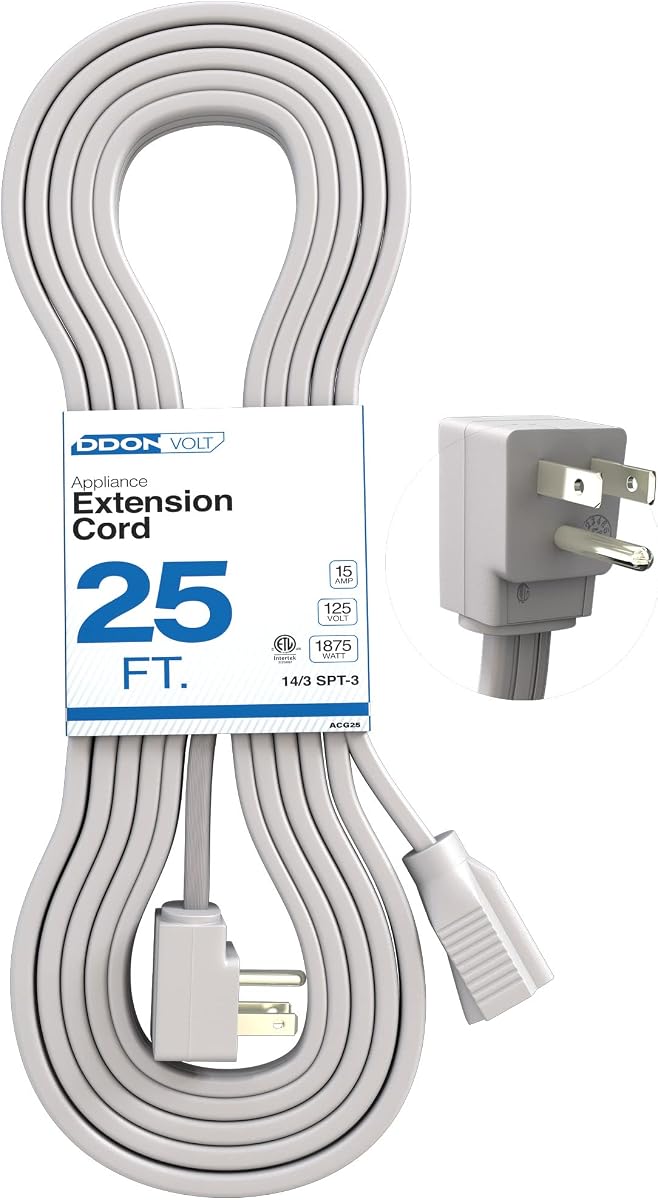
The 25-foot appliance cord is the longest option in this guide and is aimed at installations where the wall outlet is far from the refrigerator or another major appliance. It has a 4.8 rating, heavy-duty 14 AWG wiring, and a maximum load of 1875 watts at 15 amps and 125 volts.
We may earn a commission when you buy through this link, at no additional cost to you.
A 90-degree flat plug allows the wall connection to remain close to the outlet, while grip grooves on the female end help with connecting and disconnecting the appliance. The soft, flexible, heavy-duty vinyl is designed to resist damage while remaining foldable. The product can support refrigerators, air conditioners, microwaves, power tools, washers, dryers, and dishwashers when used within its limits.
Twenty-five feet is convenient only when genuine reach is required. Otherwise, it creates a large amount of excess cable that must be hidden, secured, or coiled. A long cord lying in a work area also increases trip risk. Users should avoid daisy-chaining beyond the stated 1875-watt total.
This model is best for unusually distant outlets, large rooms, basements, garages, or workshop layouts. For most standard kitchen installations, a shorter 10- or 15-foot model will be easier to manage and safer to route.
Twenty-five feet is the most reach available in the comparison. It gives users considerable freedom to position a refrigerator or tool away from a distant receptacle.
When the full length is not required, coil and secure the unused portion behind the appliance or along a wall. Keeping the active route out of walking areas helps prevent snagging and tripping.
We may earn a commission when you buy through this link, at no additional cost to you.
The HUANCHAIN model is a six-foot, 14/3 flat-plug cord with a 4.8 rating. It is ETL-listed and rated for 15 amps, 125 volts, and 1875 watts. Although its title identifies it as intended for indoor use, the supplied description also states that the SJTW construction is suitable for indoor and outdoor home or office use.
We may earn a commission when you buy through this link, at no additional cost to you.
The flexible vinyl jacket is described as resistant to high temperature, aging, flame, water, and corrosion. A long strain-relief section at the plug end is tested for repeated bending, while every cord receives a high-voltage test before shipment. The flat plug allows furniture and appliances to remain closer to the wall.
Its compact length limits the distance the refrigerator can sit from the outlet, and the primary indoor positioning may be less attractive for exposed outdoor installations. Users should interpret any outdoor suitability according to the manufacturer's instructions and local electrical guidance rather than assuming it is designed for every weather exposure.
This is a useful selection for nearby appliances, home offices, and indoor workspaces where durability and a dark finish are priorities. The 14-gauge capacity, flat plug, and ETL listing make it more appropriate for refrigerators than a standard lightweight extension.
The extended strain-relief design is intended to survive repeated flexing at the plug. That is especially useful when a refrigerator cord is connected, disconnected, or adjusted frequently.
The black cord and flat plug have a low-visibility appearance that can blend into dark appliances or utility areas. Six feet keeps the installation compact when the outlet is nearby.
We may earn a commission when you buy through this link, at no additional cost to you.
The EP three-foot extension cord is the most compact option here, providing a short bridge from a nearby outlet to a refrigerator or other compatible appliance. It carries a 4.8 rating, ETL certification, and a heavy-duty 14 AWG, three-prong design rated for 15 amps, 125 volts, and 1875 watts.
We may earn a commission when you buy through this link, at no additional cost to you.
Its flat plug sits close against a wall, reducing the clearance needed behind the appliance. The flexible vinyl jacket is described as resistant to moisture, abrasion, and sunlight, while reinforced insulation is intended to improve durability. The product is listed for refrigerators, washers, dryers, air conditioners, and other large household appliances.
Three feet is extremely limited and will suit only an installation where the connection point is immediately adjacent to the receptacle. It offers almost no freedom to shift the refrigerator within the room. The fixed three-prong format also requires a grounded wall outlet.
This cord makes sense as a minimal adapter when the appliance is already beside the correct outlet but its fixed power lead cannot reach. For even a modest gap, one of the six- or ten-foot options will usually be more practical.
The three-foot length avoids excess cable when an appliance sits immediately beside a receptacle. It is a useful minimal extension rather than a general-purpose room-to-room solution.
Despite its short length, the cord retains 14-gauge construction, three-prong grounding, ETL certification, and reinforced insulation. Those features preserve its appliance-oriented character.
We may earn a commission when you buy through this link, at no additional cost to you.
The right refrigerator extension cord depends on electrical capacity, outlet distance, grounding, connector clearance, and the path the cable must follow. Reviewing these factors before buying helps avoid an undersized cord, an inconvenient length, or a setup that creates a trip hazard.
Measure from the wall outlet to the refrigerator's connection point, including the route around the appliance and any required slack. A cord that is too short may pull the appliance connector sideways or leave the refrigerator unable to sit properly. A cord that is much longer than necessary creates excess cable that can bunch behind the unit or enter a walking area. The products in this guide cover three, four, six, ten, fifteen, and twenty-five feet, allowing buyers to match a more precise distance to their layout.
Most of the listed cords are rated for 15 amps at 125 volts and a maximum of 1875 watts. Confirm that the refrigerator, combined with any other equipment on the same circuit or extension, remains within that limit. Do not treat a cord's gauge as permission to exceed its rating. The 12 AWG model has the thickest conductor specification, but it also carries the same stated maximum wattage. Always follow the appliance manufacturer's instructions and the extension cord's own specifications.
A lower AWG number indicates a thicker conductor. Most options use 14 AWG wire, while the blue flat cord uses 12 AWG. Heavy-duty gauge is especially relevant for refrigerators because compressors can draw significant current, particularly during startup. Thicker wire is also valuable over longer routes because it is better equipped to limit voltage drop. Wire gauge alone does not replace checking the complete amperage, voltage, and wattage rating printed or listed for the product.
A grounded three-prong connection is the preferred choice for a refrigerator extension cord because it maintains an equipment-grounding path. Most products in the guide use a three-prong male plug and a three-slot female connector. The Vockjour model is unusual in accepting both two-prong and three-prong plugs at the appliance end, but that broader compatibility does not change the need to observe its 1875-watt limit. The extension cord, wall receptacle, and refrigerator plug must all be compatible.
UL and ETL listing are the two safety certifications represented in this comparison. A listed cord has been evaluated against applicable safety standards, giving buyers more information than an unspecified household extension. Certification should be considered alongside proper construction, correct amperage, sound wall outlets, and appropriate use. A certified product is not a substitute for inspecting the cord or keeping the load within its rating.
A conventional plug can prevent an appliance from sitting close to the wall. Flat and right-angle plugs use less depth and are especially useful behind refrigerators, bookshelves, desks, and cabinets. Before buying, check the outlet orientation and the space available between the wall and appliance. A low-profile design only helps if the connector can be inserted fully and the cord can leave the plug without being sharply bent.
The cords in this guide use flexible vinyl or PVC-style protective jackets. The specifications variously mention resistance to moisture, abrasion, sunlight, ultraviolet exposure, aging, and high temperature. These qualities help the cable tolerate ordinary household movement and environmental exposure, but the cord should still be protected from standing water, physical damage, and extreme conditions unless the manufacturer explicitly permits them. Route the cable behind the appliance or along a wall whenever possible.
Color and included warning tape can matter when a cord passes through a workshop, garage, basement, or other high-traffic area. The blue 12 AWG model is visually distinctive and includes caution tape intended to mark its location. Dark gray or black cords may blend into shadows and furniture, while white cords are easier to see in bright rooms but may show dirt sooner. Visibility is a useful safety consideration, but it should not replace sound routing or electrical compliance.
Begin by confirming that the wall outlet is grounded, intact, and compatible with the cord. Plug the extension cord fully into the receptacle without any prongs exposed, then connect the refrigerator using the cord's female end. Keep the cable dry and undamaged, and never exceed the listed 15-amp or 1875-watt limit. Do not use adapters that bypass grounding or overload the connection.
Route the cable so it cannot be pinched, crushed, stapled, or walked on. Behind the refrigerator is usually preferable, provided the cord does not contact hot surfaces or moving compressor components. Keep unused length coiled rather than leaving loose loops in front of the appliance. If the cord crosses a walkway, secure it with an appropriate cable cover and make its location visible.
Inspect the plug, connector, cable jacket, and strain relief periodically. Look for cracks, discoloration, exposed conductors, flattened sections, heat damage, or a connection that fits loosely. Replace a damaged cord rather than repairing its insulation with tape. When moving the refrigerator, disconnect the extension cord rather than pulling it by the wire, and store the cord loosely folded after use.
A refrigerator can be connected through a properly rated extension cord when the installation is necessary and the cord remains within its electrical limits. It is still preferable to use a nearby dedicated outlet if one is available. A permanently installed appliance may be better served by a properly located receptacle, and the refrigerator manufacturer should be consulted for any specific guidance. Never leave a damaged cord or improvised connection in service.
The products in this guide use 14 AWG or 12 AWG conductors, both of which are appropriate heavy-duty choices for compatible refrigerators. A 12 AWG cord has a thicker conductor than a 14 AWG cord and may be beneficial for long routes or demanding loads. Gauge is only one consideration, so the complete amperage, voltage, and wattage rating must also be respected.
Yes, grounding is important for a refrigerator because the metal appliance and its compressor hardware can carry an electrical fault. A three-prong extension cord preserves the grounding path when used with a grounded wall outlet and compatible appliance plug. Do not use a two-to-three-prong adapter that removes or bypasses the grounding connection. All parts of the connection should be properly rated and fully seated.
Choose a length that reaches the outlet with modest slack and allows the refrigerator to sit properly. Three- and four-foot cords suit close connections, while six and ten feet provide more flexibility for common layouts. Fifteen and twenty-five feet are useful when the outlet is distant. Excess length should be secured so it does not become tangled or create a trip hazard.
Some listed products state that they can be linked with other extension cords, power strips, or surge protectors, but the combined load must never exceed 1875 watts. More connections can also create additional resistance, heat, and points where plugs may loosen. A single properly rated cord is generally easier to manage and route safely for a refrigerator installation.
A flat or right-angle plug reduces the depth required at the wall outlet, allowing a refrigerator or another appliance to sit closer to the wall. This is helpful in tight spaces where a bulky connector would interfere with placement. The plug should still be inserted fully, and the cable should leave the connector without a sharp fold.
A refrigerator extension cord is primarily intended to provide a safe power connection when the outlet is not conveniently located. A surge protector is a separate device designed to manage power spikes and may include additional outlets, but it must be compatible with the appliance and all connected loads. Users should not exceed the ampacity of the cord, receptacle, or any linking component.
Disconnect it immediately and stop using it. Warmth can indicate an overloaded connection, incompatible components, a damaged conductor, or a plug that is not fully inserted. Do not continue powering the refrigerator until the cause is identified. Have the circuit and outlet checked by a qualified electrician if faults or overheating are suspected.
The Heavy Duty 6 FT Major Appliance Cord is the most balanced overall selection because it combines 14-gauge capacity, 1875-watt capability, a grounded three-prong connection, UL listing, and a space-saving angle plug. The EP six-foot model is a practical budget-oriented alternative, while the Vockjour ten-foot cord adds copper conductors, broad connector compatibility, and ETL certification for a more feature-rich setup.
Prioritize the electrical rating, grounding, and certification before color or convenience features. Match the cord length to the measured route, and choose a flat or right-angle plug if the refrigerator sits close to the wall. For long extensions, route the cable out of walkways and avoid leaving excess cord spread across the floor. Inspect the cord regularly and never exceed its stated limits.
Product details, certifications, ratings, and prices can change, so confirm the current listing and manufacturer specifications before purchasing. Comparing the exact connector, length, and power rating against the refrigerator's requirements will help ensure a safer and more convenient installation.