Shineboc Wet Dry Sandpaper
4.6Editor score
Seven-grit multipack assortment
Cuts into custom sheet sizes
Supports wet and dry sanding
Our expert guide compares the best sandpaper for 3D prints, covering grit ranges, sheet formats, detail tools, durability, wet and dry use, and overall needs.
Sandpaper helps 3D-printed parts look and feel more refined by removing layer lines, refining edges, and smoothing rough surfaces. The right product depends on print material, layer height, desired finish, and the level of detail your project requires.
We compared these ten products by examining their grit coverage, sheet dimensions, abrasive materials, handling formats, wet-and-dry capabilities, and usefulness for small printed features. The list includes multipack sheets, flexible sanding sticks, detail blocks, and ergonomic sanding sponges.
Each pick highlights a different practical advantage, from a broad all-purpose grit assortment to precision tools for tight spaces. Ratings reflect the supplied customer feedback, while product details and availability can change, so confirm the current listing before buying.
4.6Editor score

4.7Editor score
4.8Editor score
This side-by-side comparison shows each product's format, grit coverage, material, and most useful finishing role. The table highlights why ordinary sheets, detail sticks, blocks, and sponges suit different 3D-printing tasks.


This 48-piece sandpaper assortment combines silicon carbide abrasive, a flexible waterproof backing, and grits ranging from 120 to 5000. Its 4.7 rating reflects a broadly favorable customer response, while the extensive grit progression makes it especially versatile for 3D-print finishing.
We may earn a commission when you buy through this link, at no additional cost to you.
The main advantage is coverage. Three sheets in each of 16 grits support a complete workflow that begins with visible-layer reduction and ends with fine polishing. The sheets measure 9 by 3.6 inches, can be trimmed to fit smaller holders or printed features, and have clearly marked grit numbers for quick selection. They also work wet or dry, offering flexibility for different finishing habits.
Because these are loose sheets rather than a fitted sanding block, users will need a sufficiently firm, comfortable surface for consistent results. Very fine grit may also be unnecessary when the printed surface is already smooth. Even so, the assortment reduces the need to buy separate products for rough shaping, intermediate blending, and final polishing.
This is the strongest general-purpose choice in the list for makers who print parts of different sizes and want one comprehensive stock of abrasive. It is particularly useful for PLA and other relatively easy-to-sand prints, as well as resin parts that need careful surface refinement. Choose it when grit variety and material flexibility matter more than a built-in handle.
The 16-grit range allows controlled refinement instead of jumping directly to an aggressive abrasive. Start with a moderate grit for prominent layer lines, then move upward until the surface feels progressively smoother.
Each 9-by-3.6-inch sheet can be cut down for miniature parts, narrow features, or custom sanding blocks. The flexible backing also conforms better than a rigid sheet on curved and irregular surfaces.
We may earn a commission when you buy through this link, at no additional cost to you.
Honoson's set consists of 20 double-sided sanding sticks with grits from 80 through 12000. The sticks use sandpaper and EVA materials, feature tapered water-drop shapes, and carry a 4.6 rating. Their main advantage is controlled access to narrow details on a printed model.
We may earn a commission when you buy through this link, at no additional cost to you.
A sanding stick fits where a broad sheet cannot. It can work along seams, around raised features, inside recessed areas, and across the edges of small components without removing too much material. Each stick is labeled, which helps prevent confusing coarse and fine surfaces, while the double-sided design provides two usable grits per tool.
The range is unusually broad, but not every printed part requires all 20 levels. Using the most aggressive grit can soften details or alter small features, so progression matters. The very fine 12000-grit option may be useful for polishing selected areas, yet it will not correct visible layer lines by itself.
This set is best for miniatures, figurines, articulated prints, and other intricate parts where the main challenge is reaching edges and recesses. It is less efficient for flattening a large panel or smoothing a broad curved surface. For those projects, conventional sheets or blocks provide faster coverage.
The tapered profile reaches corners and grooves that a rectangular sheet may bridge over. This makes the sticks useful for seams between parts, recessed panel lines, and narrow edges on small models.
With twenty labeled levels, users can select a moderate step for corrections and a finer level for polishing. Changing grits gradually helps preserve the shape of delicate printed features.
We may earn a commission when you buy through this link, at no additional cost to you.
This detail sanding kit includes 180 aluminum oxide sheets, a compact PU foam block, and nine grits from 80 to 1000. Its 4.7 rating and large assortment make it a practical budget pick for makers who sand frequently and value simple, rapid tool changes.
We may earn a commission when you buy through this link, at no additional cost to you.
The mini block measures 3.5 by 1.1 inches, allowing it to glide into corners, grooves, edges, and trim. A tool-free hook-and-loop attachment lets users replace sheets quickly, while a three-color grit system separates coarse, medium, and fine choices. That organization is particularly useful when moving through several finishing stages on one print.
The 1000-grit ceiling means the kit is better for correcting layer lines and refining texture than for producing a highly polished surface. Users wanting a mirror-like finish may need finer sheets or a separate polishing step. The small block also offers less surface area and leverage than a full-size sanding block.
For beginners, hobbyists, and anyone working on small printed objects, this kit offers an unusually complete setup. It combines a dedicated holder with enough replacement abrasive to cover many projects. It is a particularly sensible choice for miniatures, props, printed models, and small mechanical parts.
The hook-and-loop backing holds sheets securely while allowing fast replacement. This makes it easier to move from coarse correction to fine refinement without repeatedly searching for adhesive-backed paper.
The small PU foam sander follows curves and enters tight spaces while remaining comfortable in the hand. Its narrow profile gives direct control around printed seams and recessed details.
We may earn a commission when you buy through this link, at no additional cost to you.
Shineboc's 21-sheet set contains three sheets in each of seven grits from 120 to 2000. It uses silicon carbide with an electrostatically coated abrasive layer and reinforced backing. The 4.6 rating indicates a solid customer reception, and the package offers a balanced range for most surface refinement work.
We may earn a commission when you buy through this link, at no additional cost to you.
The precut 9-by-3.6-inch format can be used with blocks, palm sanders, or sheet sanders, but it can also be cut into smaller pieces for model-scale parts. Clear grit markings support quick selection, while the reinforced backing helps the paper resist tearing under hand pressure or on irregular printed surfaces.
This set begins at 120 grit, making it more appropriate for visible layer lines and moderate surface correction than for aggressive removal of major defects. Its upper limit of 2000 grit is useful for a smooth finish but does not cover the highest polishing levels offered by some competing assortments.
It is a good straightforward choice for makers who need a modest range rather than an enormous collection. The anti-clogging and wet-or-dry construction are useful for resin prints and general surface prep, while the ability to trim the sheets makes the package adaptable to different 3D-print geometries.
The included levels move from 120 through 2000 grit, which is sufficient for common layer-line cleanup and final smoothing. Each grit has multiple sheets, supporting repeated use without immediately running out.
The sheets fit common manual and powered holders, yet can be cut down for small parts. That versatility lets the same stock serve both broad surfaces and detailed features.
We may earn a commission when you buy through this link, at no additional cost to you.
The 24-piece sanding sponge set provides a 3.93-by-2.75-inch foam block in each of several grit divisions, covering 80 through 3000 grit. With a 4.6 rating, it offers a comfortable alternative to loose abrasive sheets, especially for curved or irregular 3D-printed parts.
We may earn a commission when you buy through this link, at no additional cost to you.
The sponge layer absorbs vibration and improves the grip, which can reduce hand fatigue during repetitive finishing. Its flexible body conforms to curves and fits into corners, allowing the abrasive face to maintain contact where a stiff block might bridge over the surface.
The larger blocks are less nimble than sanding sticks for tiny recesses, and the set includes no dedicated pointed tool. Users working on figurines may prefer to trim or combine pieces, while those smoothing large printed shells will find the broader face more efficient.
This product is best for users who spend considerable time manually smoothing curved prints or who find rigid paper blocks uncomfortable. It also supports wet and dry use, helping limit dust and extend abrasive life during wet finishing. The broad grit progression handles both correction and polishing.
The flexible foam maintains contact across rounded housings, organic shapes, and irregular supports. It can make broad finishing passes more consistent without forcing a rigid edge into the print.
The cushioning layer helps absorb vibration and provides a secure, comfortable hold. This is valuable during the many light passes often required to remove layer lines.
We may earn a commission when you buy through this link, at no additional cost to you.
This 45-sheet collection spans 15 grits from 80 to 5000 and uses electro-coated silicon carbide over a waterproof, tear-resistant backing. Its 4.6 rating and substantial sheet count make it a strong option for users who want broad finishing options without moving to a detailed handheld tool.
We may earn a commission when you buy through this link, at no additional cost to you.
The grit range supports a complete progression from correcting prominent layer lines to polishing selected surfaces. Sheets can be trimmed into different sizes, and each carries a printed grit number for fast identification. The package is well suited to workshops where multiple parts or materials may be finished in sequence.
Waterproof construction adds flexibility for wet sanding, which can reduce dust and help limit scratching when the abrasive is prepared properly. The 80-grit sheets are aggressive enough for substantial correction, so users should test them on a concealed area before approaching delicate features.
This is a good general inventory option for a serious 3D-printing hobbyist. It handles medium and large parts well and provides enough choices for multi-stage finishing. For narrow cavities, however, a sanding stick or compact detail block will offer more precise access.
The broad range lets a user correct, smooth, and polish with one organized stock. Gradual grit changes reduce the risk of leaving deep scratches that would require removing more material later.
The waterproof backing supports wet use in addition to fast dry abrasion. This gives makers options for dust control, surface preparation, and finishing different print materials.
We may earn a commission when you buy through this link, at no additional cost to you.
This pack contains 50 matchstick-shaped sanding sticks measuring 5.4 by 0.2 inches, with one end at 120 grit and the other at 280. Its 4.4 rating is the lowest in the group, but the format targets a specific need: controlled access to tight spaces on small printed models.
We may earn a commission when you buy through this link, at no additional cost to you.
The tapered ends make it easy to work along seams, grooves, edges, and other narrow areas that ordinary sheets may not reach. Black 120-grit abrasive handles rougher correction, while gray 280 grit supports finer polishing. Flipping the stick changes the grade immediately.
Unlike a broad assortment, this package provides only two abrasive levels. That means it cannot handle a full progression from visible layers to a mirror finish on its own. The supplied claim of saving time should also be considered in context: the real efficiency advantage comes from direct access and a secure hand grip.
It is a useful companion for miniatures, figurines, jewelry-scale prints, and other delicate parts. The 50-piece count reduces downtime when abrasive wears down, and the smooth wood handles support steady control. Buyers with more demanding finishing needs should pair it with a broader sheet assortment.
The pointed ends can enter narrow seams and shallow recesses that larger blocks cannot reach. This makes the sticks useful for cleaning up edges without disturbing adjacent detail.
A 120-grit end handles initial correction, and the 280-grit end refines the surface. Flipping the stick gives makers a simple way to move between the two without changing tools.
We may earn a commission when you buy through this link, at no additional cost to you.
Fandeli's 36-sheet set covers grits from 120 to 2500 and measures 22.86 by 9.14 centimeters. It uses silicon carbide over a flexible, water-resistant paper backing. The 4.7 rating and long-standing brand history make it a dependable choice for general surface finishing.
We may earn a commission when you buy through this link, at no additional cost to you.
A closed abrasive structure supports fast cutting and a long working life, while the flexible backing conforms to curved and irregular surfaces. The water-resistant, non-slip paper supports dry and wet work, and grit markings on the back make selection straightforward. Sheets can also be cut down to suit smaller tools.
Because the backing is water-resistant rather than a completely waterproof synthetic material, users should still avoid prolonged saturation. The set also lacks the extremely fine polishing grits found in the largest 5000-grit assortments. Neither limitation prevents it from producing a smooth, well-finished print.
Fandeli is a sensible pick for makers who work across models, wood, metal, crafts, and printed parts. Its balanced range covers common surface correction and polishing, while the flexible sheets are useful on curved components. A small detail tool is still worthwhile for deep recesses.
The adaptable paper backing follows rounded and irregular shapes better than a rigid sheet. This improves contact and helps users maintain an even finish on curved printed housings.
The closed abrasive structure is designed for efficient material removal and useful wet performance. Combined with a non-slip backing, it supports controlled handling during hand sanding.
We may earn a commission when you buy through this link, at no additional cost to you.
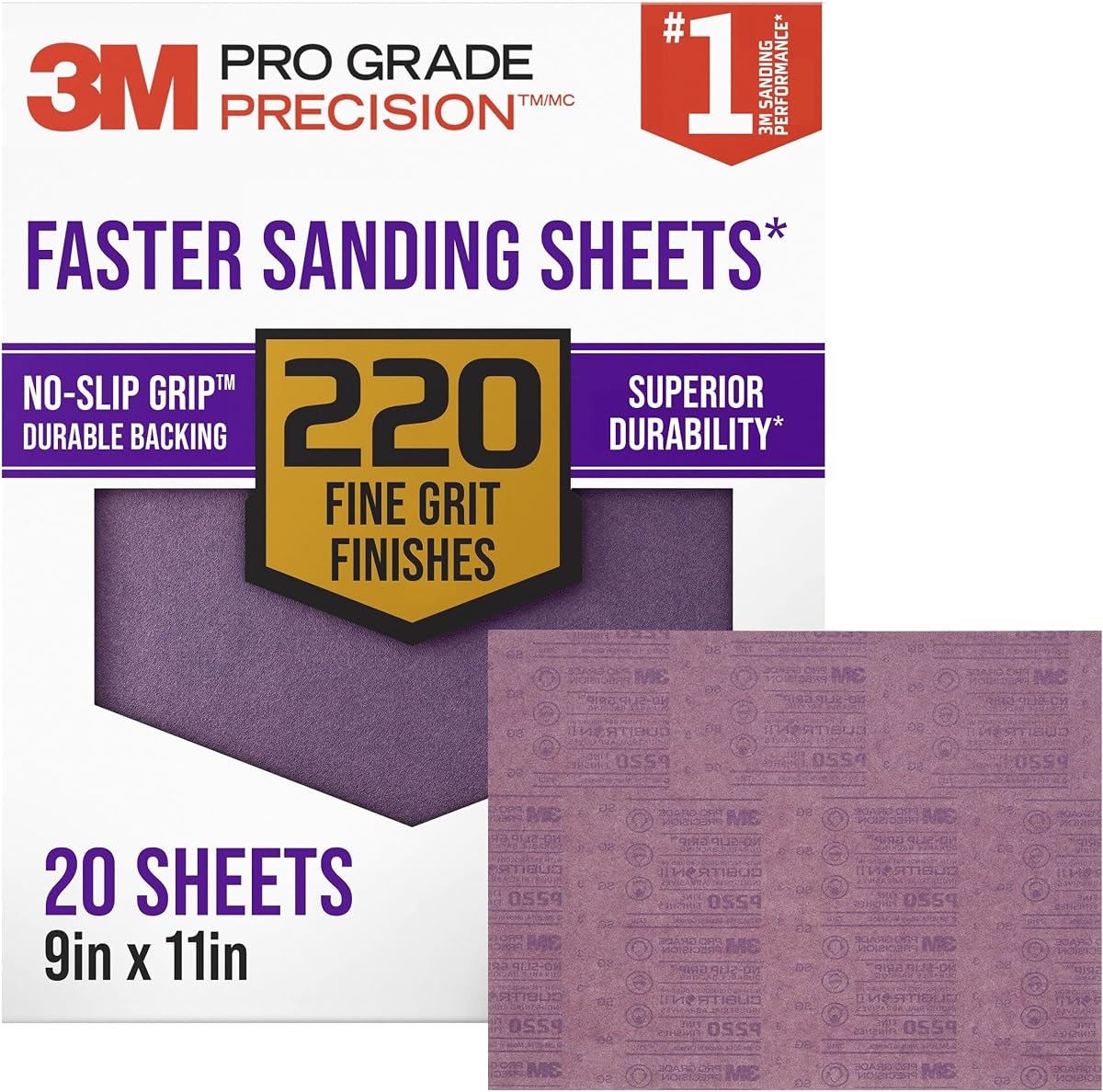
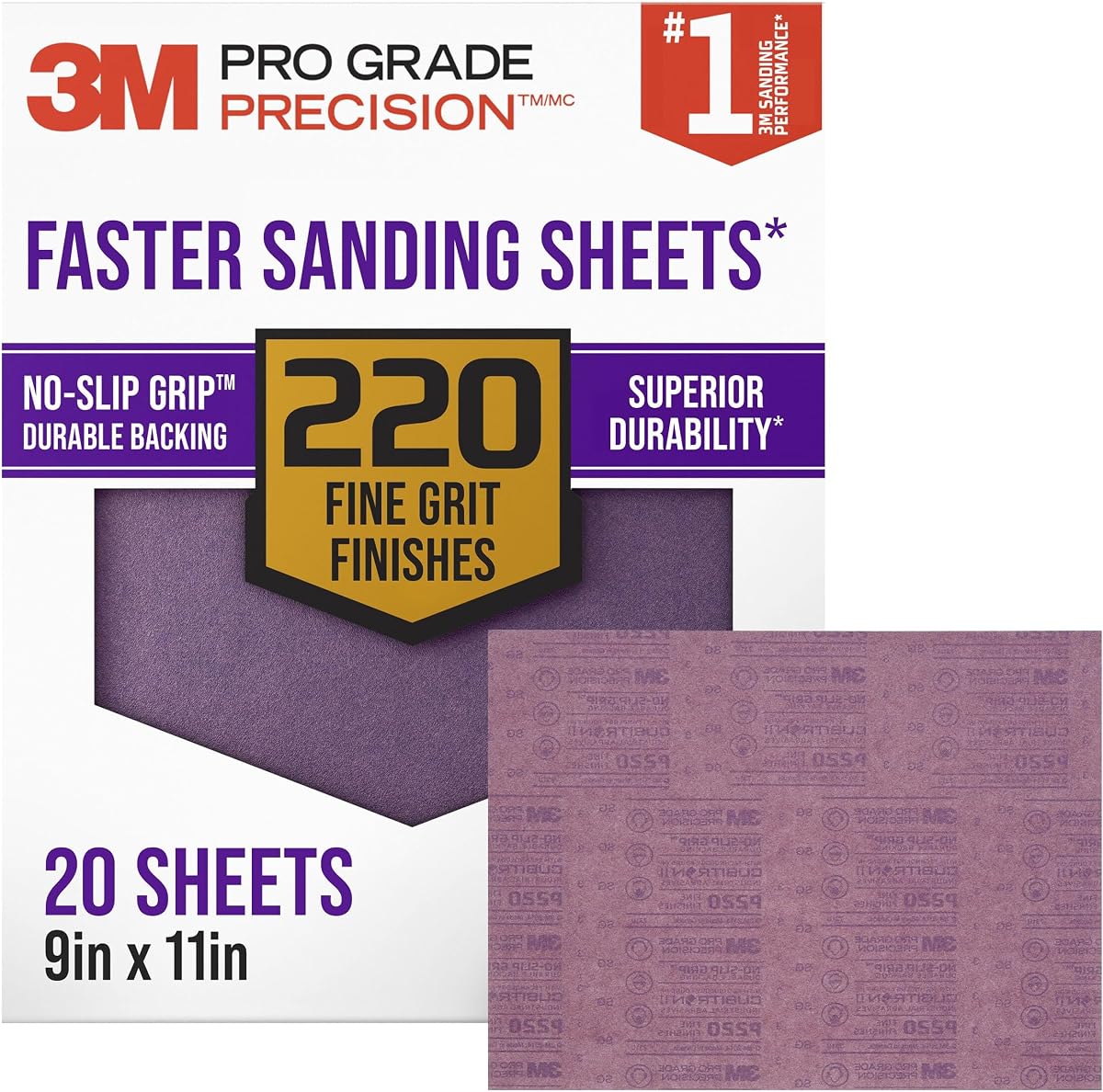
These 3M Pro Grade sheets provide 20 sheets of 220-grit abrasive in an 11-by-9-inch format. The 4.8 rating is the highest among the products compared, and the construction uses premium mineral grits associated with Cubitron II industrial abrasive technology.
We may earn a commission when you buy through this link, at no additional cost to you.
A no-slip backing helps reduce hand fatigue and tearing, while the sheets conform to the surface for easier sanding. The abrasive is designed not to discolor the workpiece, an important advantage when light-colored prints are being smoothed. Wet and dry use are both supported.
The main limitation is that the package contains only 220 grit. It is well suited to blending visible layer lines and preparing a surface for later finishing, but it is not a complete progression. Full-size sheets also need trimming for a small model or handheld detail block.
This is the premium choice for users who value consistent abrasive performance, a durable backing, and careful surface control. It is especially attractive for larger printed parts, prototypes, and objects that will subsequently be painted or coated. Makers needing several finishing stages should use it alongside finer grits.
The 220 grade is a practical middle step for reducing obvious layer texture before finer polishing. It removes material efficiently while maintaining more control than a very coarse abrasive.
The no-slip backing supports a steady grip and helps the sheets resist damage under tension. It is especially useful when the printed surface curves or the user is applying moderate pressure.
We may earn a commission when you buy through this link, at no additional cost to you.
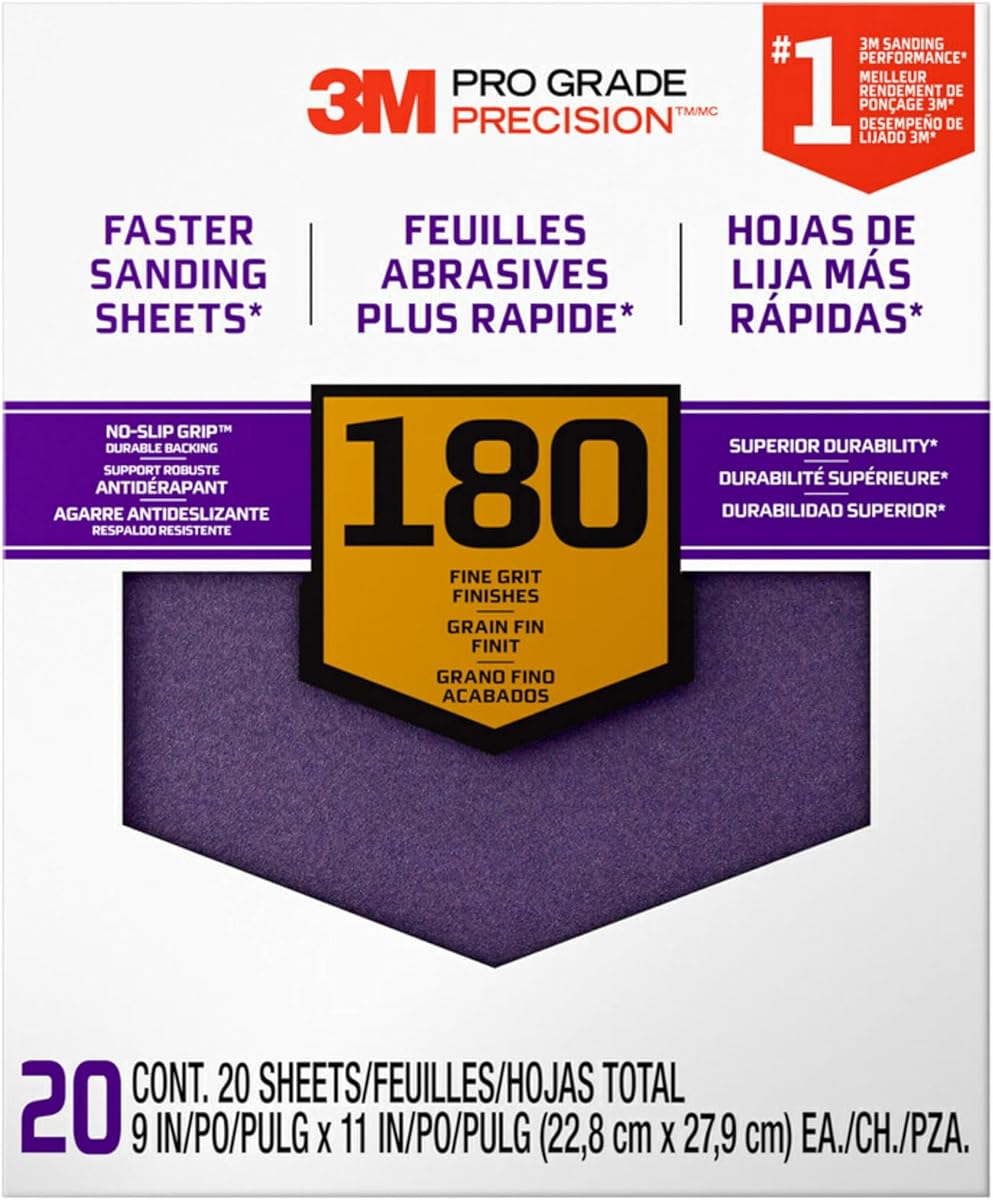
The 20-sheet 3M Pro Grade package uses 180-grit mineral abrasive on full-size 11-by-9-inch sheets. Its 4.7 rating indicates strong customer feedback, while the coarser grade targets visible layer lines and rougher printed surfaces.
We may earn a commission when you buy through this link, at no additional cost to you.
The premium mineral grit is intended for efficient cutting, and the no-slip backing helps reduce fatigue and tearing. These sheets conform to the workpiece, allowing them to follow curved parts. They also support wet or dry use and are designed not to discolor the sanded surface.
At 180 grit, the paper is more aggressive than the 220-grit version in this guide. That makes it useful for rapid correction, but it can leave visible scratches if used too long or taken through an overly large grit jump. It should be followed by progressively finer abrasives.
This package is best for a 3D-printing workflow that begins with a substantial smoothing stage. It suits large printed parts, prototypes, and surfaces that need visible layers reduced before cosmetic finishing. Keep the sheets supported in a firm block and test the grade on a hidden section first.
The 180-grit grade is a practical choice when layer texture is pronounced. It removes material more decisively than finer paper, helping establish a smooth base for subsequent stages.
The 11-by-9-inch size fits common sanding blocks and powered holders. Its durable no-slip backing is designed to withstand repeated use and reduce tearing during controlled passes.
We may earn a commission when you buy through this link, at no additional cost to you.
The most useful sandpaper is determined by print material, visible layer height, part geometry, and the intended finish. Consider abrasive grit, sheet size, backing, handling format, and whether wet sanding is appropriate before choosing a product.
Choose several grits, but change them gradually. A common principle is not to skip more than one grit between steps.
Test every abrasive on a hidden area and adjust the grit to the material.
Choose large sheets for broad panels and small sheets for detailed models.
Keep a pointed or narrow detail tool for recesses, seams, and undercuts.
Use flexible sheets for curves and reinforced backings for demanding work.
Wet sanding controls dust, while dry sanding is usually faster for initial correction.
Replace torn or clogged sheets instead of forcing them to work.
Buy the range you will use, not simply the largest assortment.
Begin by removing supports, cleaning away loose plastic or resin dust, and identifying the most noticeable layer lines. Mark the printed part so you can check its alignment and shape, then test the selected grit in a hidden area. Start with a moderate abrasive, use light pressure, and sand with a consistent motion. On large surfaces, work with the general direction of the print; around curved details, use short controlled strokes and avoid concentrating force in one spot.
Use progressively finer grits rather than jumping directly to a very fine sheet. Between stages, wipe the part with a clean, dry cloth so loose abrasive does not scratch the next surface. A sanding block can make pressure more uniform, but sanding sticks and detail blocks are better for narrow recesses. For wet sanding, keep the area consistently damp, use a compatible waterproof sheet, and allow the part to dry fully before painting, coating, or reassembly.
After use, brush away dust and store sheets flat or in a clean holder. Do not fold abrasive paper at a sharp crease, and keep dirty wet sheets separate from unused stock. Replace a sheet when it tears, loses its shape, becomes heavily clogged, or no longer cuts smoothly. Separate grit types in labeled containers or compartments so a coarse particle does not accidentally scratch a nearly finished surface.
A gradual range beginning around 120 to 220 grit is useful for visible PLA layer lines, followed by progressively finer grits for smoothing. The correct starting grit depends on layer height and how aggressively you prefer to work. A typical progression might move from 180 to 220, 320, 400, and then 600 or finer. Test each stage on a hidden area and avoid skipping too many levels.
Yes, provided the sheet is explicitly suitable for wet use and the print material can tolerate water. Wet sanding is especially common for resin prints because it can help control fine dust and produce an even surface. Use the abrasive wet, keep the workpiece consistently damp, and dry it thoroughly before painting or coating. Ordinary dry-only paper may weaken, tear, or perform poorly when saturated.
No. Sanding works best when the surface needs cosmetic refinement and the part can tolerate controlled abrasion. It may be inappropriate for very thin features, fragile overhangs, flexible prints, or surfaces where scratches would be unacceptable. Deep seams and support marks may be better corrected with tools, cutters, fillers, or a redesign before final sanding.
Usually, sanding comes first. Smooth the print, remove scratches, and complete any filler work before applying primer, paint, or a clear coating. Painting over unsanded layer lines can make them more visible, while sanding after painting risks cutting through the finish. For resin prints that will be painted, inspect for a smooth and clean surface before choosing a primer.
Sanding sticks and compact detail blocks are generally more useful than full-size sheets for small features. Their narrow or tapered shapes can enter grooves, seams, sockets, and recessed panel lines. For broad bases or curved surfaces, use a small flexible sheet or a compact block. A combination of both formats gives the best balance of coverage and control.
Use a clean, sharp sheet and change grits gradually rather than moving from coarse to ultra-fine in one step. Keep the abrasive flat on the surface, apply light pressure, and clean away residue between grit stages. Wet sanding may reduce the appearance of fine scratches, but the technique still requires a compatible sheet and careful surface preparation.
Change it when it tears, becomes heavily clogged, loses its shape, or starts producing uneven results. Even a usable sheet can become ineffective after resin or plastic residue fills the abrasive surface. Inspect it under good light between stages and discard it rather than creating additional scratches with a worn or contaminated grit.
Several sizes make controlled finishing easier because each grit can correct the scratches left by the previous one. A small kit with medium and fine grades may handle ordinary prints, while detailed models benefit from a broader progression. The most important principle is to move gradually and use the finest appropriate grit for the intended cosmetic result.
The 48-piece 120-5000 grit assortment is the most versatile all-around option, offering a broad progression and flexible wet-or-dry sheets. The Honoson sanding sticks excel in tight spaces, the 180-piece detail kit is a capable budget package with a convenient block, and the 3M 220-grit sheets lead the group in customer rating and premium abrasive construction.
Prioritize the shape of the printed part, the severity of its layer lines, and the finish you want before choosing an abrasive. Use ordinary sheets for broad surfaces, sanding sticks for recesses, and a cushioned sponge for comfortable work on curved parts. A staged grit progression will usually produce better results than using the same abrasive from beginning to end.
Check the current listing details and customer feedback before purchasing, because product specifications and availability can change. Select the format and grit coverage that match your usual prints, then protect your parts by working gradually, cleaning between stages, and replacing damaged or clogged sheets.