
Magnasonic All-in-One 24MP Film Scanner
4.3Editor score
Twenty-four megapixel scans
Five-inch tilting display
No computer required
A scanner for Kodachrome slides should do more than take a quick photograph of a mounted transparency. It should produce consistently sharp images, reproduce color convincingly, and turn fragile family photographs into files that are easy to store, organize, and share. The most useful models combine suitable film support, a bright preview screen, and a straightforward path from scanning to saving.
This guide compares ten scanners using the information supplied for each product, including supported formats, display size, resolution claims, editing functions, and connectivity. It covers affordable all-in-one units, larger standalone scanners, smartphone-assisted options, and professional desktop models. It also distinguishes between native sensor resolution and interpolated resolution, since both figures appear in the product descriptions.
Each review explains who the scanner is most likely to suit, along with its principal advantages and limitations. The top picks highlight the strongest combinations of features rather than simply equating a higher specification with a better result. Product specifications and availability can change, and prices fluctuate, so readers should confirm the current listing and accessory details before buying.
4.3Editor score
4.3Editor score

5.0Editor score
As an Amazon Associate we earn from qualifying purchases.
The table below places all ten options side by side, emphasizing supported film formats, scan resolution, display features, and workflow requirements. It is designed to help readers narrow the field before considering the more detailed reviews.



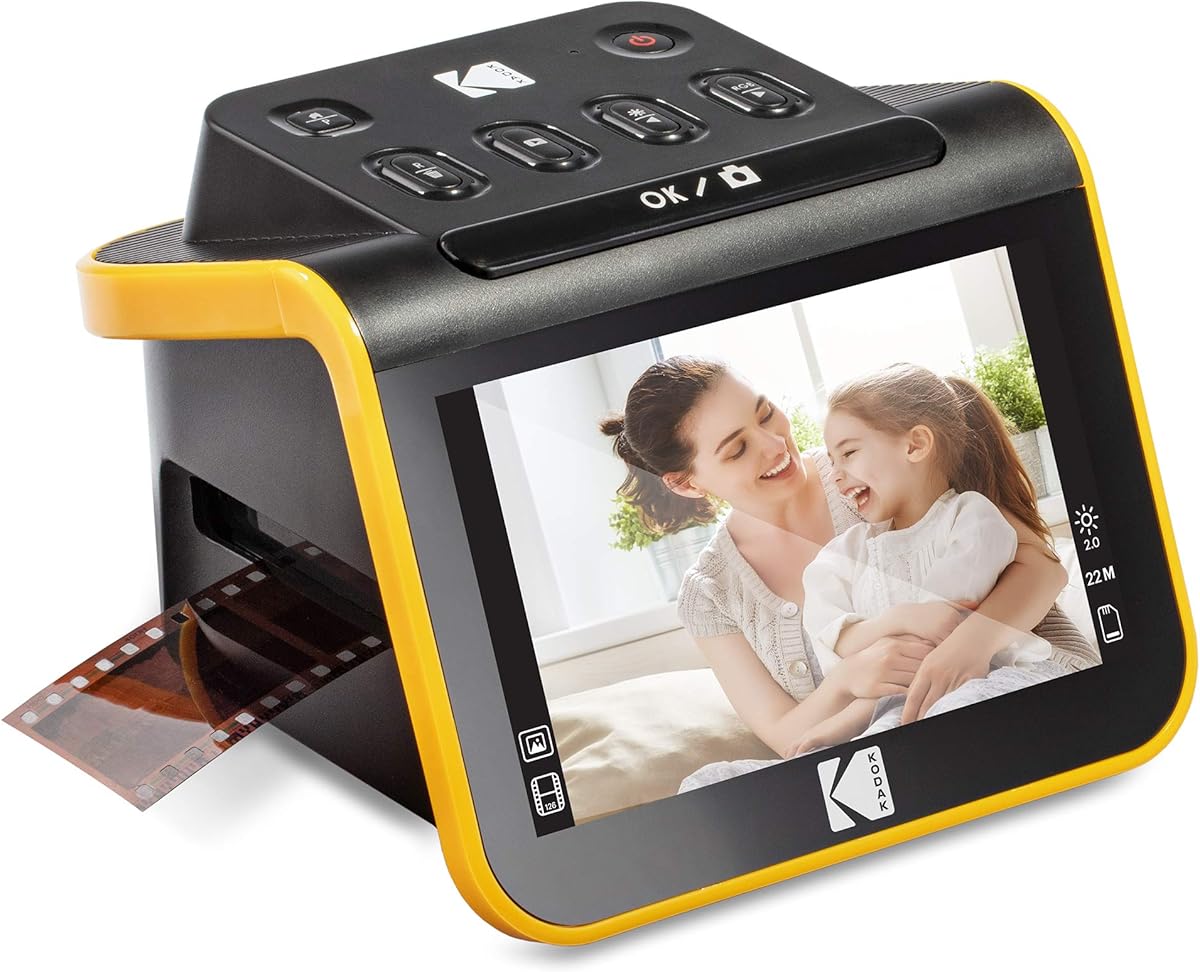
The KODAK Slide N Scan combines a 5-inch LCD, a quick-feeding film tray, straightforward editing controls, and support for several common film formats. Its 4.3 rating reflects a generally favorable balance of functionality and ease of use. The supplied information does not identify the scanner as a dedicated Kodachrome model, but its 50mm slide holder and advertised slide support make it a practical choice for scanning 35mm mounted transparencies, subject to confirming the dimensions of the mounts and frames.
We may earn a commission when you buy through this link, at no additional cost to you.
Its standout quality is the combination of a moderately large display and a largely computer-independent workflow. Images can be previewed, adjusted, and saved directly to an SD or SDHC card, while the 5-inch gallery can also display stored photographs. A quick-load tray reduces the need to reposition each frame, and the included 50mm holder, 135, 110, and 126 adapters, cleaning brush, USB cable, and HDMI cable cover many common archive needs.
The headline 22MP figure is described as interpolated rather than a native sensor resolution, so it should not be treated as equivalent to a true 22MP capture. The scanner also requires a suitable SD or SDHC card, which is explicitly excluded from the package. Some buyers may find the software controls less flexible than those available in a full desktop editing environment, but the single-button Scan workflow places useful correction tools within reach of nontechnical users.
This is the most balanced recommendation for readers who want dedicated slide and negative scanning without the complexity of a professional desktop workflow. It is particularly appropriate for families converting mixed collections into digital files, previewing results on the built-in screen, and organizing scans without making the computer the only destination. Buyers should check holder compatibility and obtain a supported memory card before starting a large archive session.
Direct saving to an SD card, a simple Scan button, and built-in color and brightness adjustments reduce the steps between loading a frame and storing a digital copy. The gallery and HDMI connection also make it convenient to review a collection before transferring it to a computer.
The included 50mm slide holder and adapters for 135, 110, and 126 film make this scanner more versatile than a single-format device. Users with framed or unusually mounted slides should nevertheless compare the holder dimensions with their own collection.
We may earn a commission when you buy through this link, at no additional cost to you.
The KODAK Slide N Scan Max is built around a 7-inch tiltable LCD, making it one of the most approachable scanners here for previewing slides and negatives. It carries a 4.1 rating and emphasizes an efficient, computer-free process. Although no specific Kodachrome designation appears in the supplied details, its general slide-scanning function makes it a plausible option for standard 35mm transparencies after checking the physical carrier and format compatibility.
We may earn a commission when you buy through this link, at no additional cost to you.
The large display is the defining feature. It gives users a generous view for checking focus, orientation, cropping, and color before saving. A quick-feeding tray supports continuous scanning, while direct saving to SD or SDHC cards up to 32GB makes the unit useful for home archive projects. One-touch editing handles resizing, conversion, and adjustments without sending users into a complicated menu structure.
The product information leaves the exact native scan resolution unspecified, which makes a direct quality comparison with the 13MP and 24MP models difficult. It also needs a memory card, and its advertised card capacity is lower than some competing products. A large screen is excellent for reviewing slides, but it cannot compensate for a weak source, poor focus, or a holder that does not match the mounted film.
Choose this model when a large, approachable display and quick, standalone operation matter more than knowing the exact native sensor specification. It is well suited to families, educators, and casual archivists who want to inspect each frame without working in a crowded computer interface. For demanding collections where optical resolution and maximum archival detail are the priority, one of the more explicitly specified scanners may offer a clearer path.
A 7-inch tiltable screen makes it easier to spot dust, misalignment, weak color, and other problems before a scan is saved. That visibility can be particularly helpful for mixed slide boxes where frame orientation and condition vary.
Continuous feeding, direct card storage, and one-touch controls suit users who want to make steady progress through a collection. The gallery function adds value by allowing completed photographs to remain on display.
We may earn a commission when you buy through this link, at no additional cost to you.
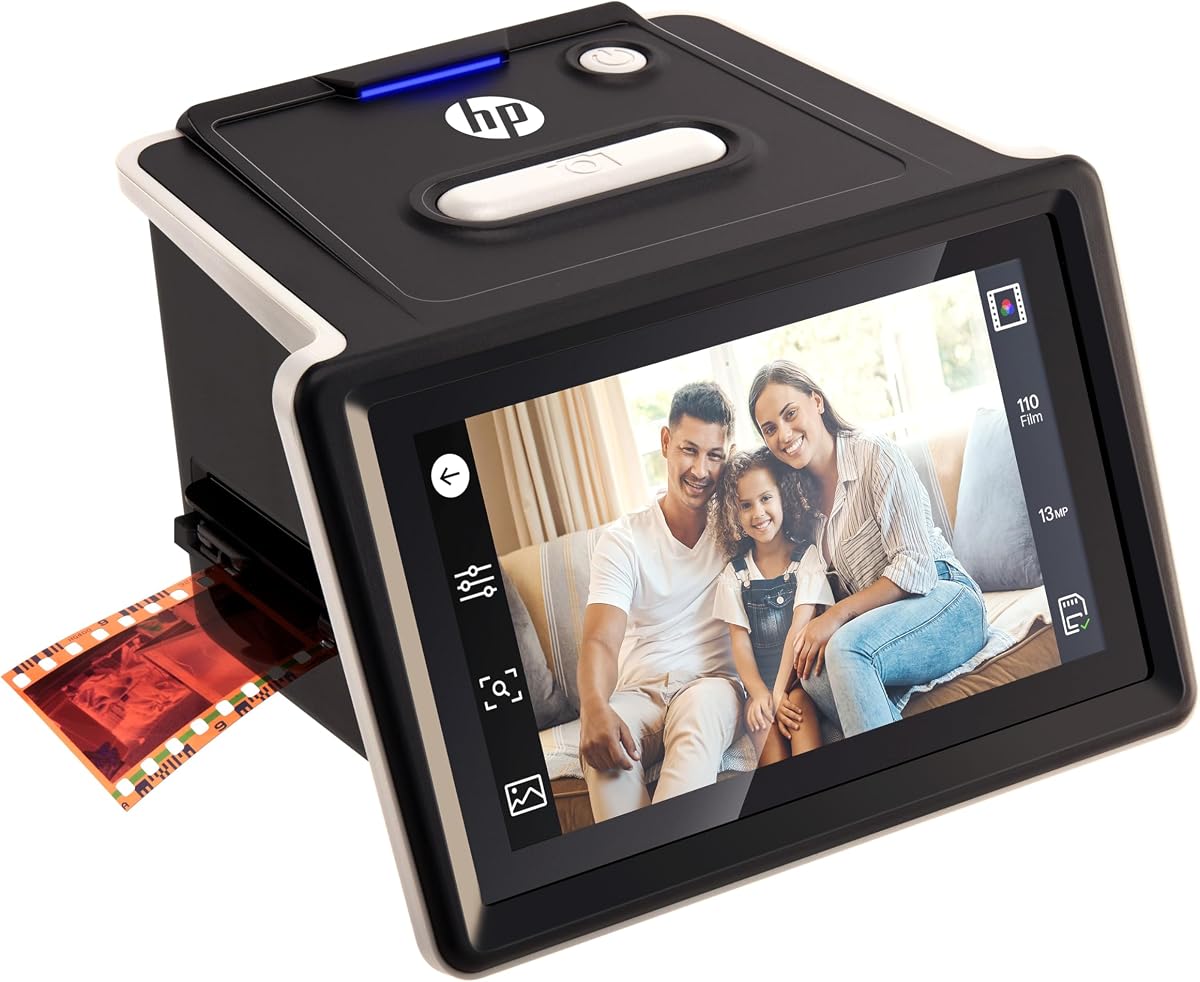
The HP FilmScan HPFS500 offers a 5-inch all-angle touchscreen, a 13MP CMOS sensor, and a quick-load tray for handling mixed archives. Its 4.3 rating makes it one of the strongest all-around choices in the group. The scanner supports positive slides and 135, 126, and 110 negatives, although the listing does not make a specific Kodachrome compatibility promise.
We may earn a commission when you buy through this link, at no additional cost to you.
The touchscreen provides direct access to preview and editing functions without a separate computer. That makes the device particularly approachable for users who want to adjust a scan as they work. The 13MP native sensor figure offers a clearer basis for comparison than an interpolated headline number, while the stated 22MP interpolation may still produce larger files at the cost of additional computational processing rather than equivalent native detail.
As with other compact scanners, the physical carrier matters. Mounted Kodachrome slides are generally handled as positive transparencies, but users should confirm frame dimensions and the supplied holder arrangement. The all-angle screen is useful but smaller than the 7-inch displays offered by two competing models. A USB-C connection is listed, while the primary workflow is described as fully standalone.
This HP model is a strong fit for users who prefer touchscreen operation and want a clearly stated native resolution. It also handles more than slides, making it convenient for collections that include several negative formats. Choose it for intuitive, computer-free editing and efficient batch work; choose a larger-screen model instead if reviewing every frame on a big display is the priority.
The scanner uses a 13MP CMOS sensor and offers 22MP interpolated output. The native figure is the more meaningful basis for evaluating optical detail, while interpolated output primarily increases file dimensions.
The all-angle touchscreen keeps preview and editing controls together on the unit. This reduces setup complexity and lets users correct an image immediately after capture.
We may earn a commission when you buy through this link, at no additional cost to you.
The KODAK SCANZA is a general-purpose film and slide scanner with support for 35mm, 126, 110, Super 8, and 8mm material. It has a 4.2 rating, a 3.5-inch adjustable LCD, and both native 14MP and interpolated 22MP resolution claims. Its general slide support makes it relevant to Kodachrome owners, but the listing specifically emphasizes common negative formats rather than naming Kodachrome as a dedicated target.
We may earn a commission when you buy through this link, at no additional cost to you.
Multiple adapters and one-touch scan-and-save controls are useful for family collections that contain more than mounted slides. The SD card slot supports cards up to 128GB, which is more capacity than several other models in this comparison. RGB, resolution, gallery, and other editing controls are available through an intuitive interface, while the supplied cleaning brush can help reduce dust and speckles.
The 3.5-inch display is the main compromise. It can show enough for basic framing and review, but users comparing a large slide on-screen will find the 5-inch and 7-inch models more comfortable. The scanner also depends on a separate memory card, and the included accessories do not include one. Its strongest attraction is format breadth, especially for households with old motion-picture material alongside standard transparencies.
The SCANZA is best for budget-conscious archivists who want one device to handle several generations of analog material. It offers a simple path from film to JPEG, but professionals seeking more extensive color calibration or editing control may prefer a desktop workflow. Confirm that the supplied carrier fits the slides in the collection, particularly if they have unusual cardboard or plastic mounts.
Support for still-film formats and Super 8 or 8mm material makes the SCANZA useful for mixed family collections. Buyers should still verify whether a particular camera format or unusual film holder is included before planning an extensive session.
Large one-touch buttons, an insert directory, and an included tray make operation approachable. The ability to browse a gallery and save directly to SD storage reduces the amount of computer work required.
We may earn a commission when you buy through this link, at no additional cost to you.
The HP FilmScan with its 7-inch touch LCD is designed for users who want a generous, interactive workspace for reviewing and editing photographs. It has a 4.0 rating, a 13MP color CMOS sensor, and direct USB and HDMI connectivity. It supports slides and 135, 126, and 110 negatives, making it relevant for standard Kodachrome transparencies, although no Kodachrome-specific feature is stated.
We may earn a commission when you buy through this link, at no additional cost to you.
The 7-inch touchscreen is the main attraction. Users can preview, crop, and adjust scans directly on the scanner without installing additional software. A quick-feed tray and included 50mm adapter support an efficient batch workflow, while the color CMOS sensor handles both color and black-and-white negatives. The gallery mode can also display digitized photographs as a slideshow.
Its rating is the lowest among the standalone scanners in the group, so prospective buyers should pay close attention to recent customer feedback. The 13MP figure is clearly associated with the CMOS sensor, but the listing does not separately explain whether any advertised modes add interpolation. Display size cannot replace optical resolution, so this model should be evaluated primarily as a convenient editing and viewing device rather than automatically as the highest-detail scanner.
This HP FilmScan is well suited to beginners and professionals who want to work directly on the hardware display. It is especially useful for mixed collections and for showing scanned pictures on a television. It may be less compelling than a smaller, less complex model for occasional users, but the large interface and low-friction editing make it a strong candidate for long digitization sessions.
Cropping and image adjustments are performed on the 7-inch touch display, which reduces dependence on external software. This is particularly convenient when the goal is to correct orientation, framing, and basic appearance before archiving.
The display can serve as a slide viewer and a digital frame, while HDMI makes slideshow use straightforward. It is a useful option for families that want to review converted memories on a larger television.
We may earn a commission when you buy through this link, at no additional cost to you.
The Magnasonic FS71 stands out as a straightforward all-in-one scanner with a 5-inch display, 24MP digital output, and no requirement for a computer. It carries a 4.3 rating and supports 35mm, 126, 110, and Super 8 negatives along with 135, 126, and 110 slides. That general slide capability makes it a sensible budget-oriented option for scanning Kodachrome transparencies when the carrier dimensions are compatible.
We may earn a commission when you buy through this link, at no additional cost to you.
The supplied highlights emphasize convenience. Users can adjust brightness, RGB color correction, flip, and mirror directly on the scanner, then save images to an SD card supporting up to 128GB. A 5-inch LCD provides enough room for basic review, and an HDMI connection can display film, slides, and saved images on a television or monitor. Fast-loading trays are included to keep the workflow moving.
The stated 24MP figure is described as the digital output resolution, but the product data does not separately identify a native sensor value. That distinction matters when comparing image quality because interpolation does not create additional optical detail. The HDMI cable and SD card are not included, so the advertised viewing and storage functions require a few additional accessories. Some users may also want more extensive editing than the on-device tools provide.
The FS71 is a strong value pick for readers who prioritize capacity, useful controls, and a computer-free process. It is suitable for converting large slide collections while keeping the learning curve modest. Buyers seeking professional-level color calibration or maximum archival resolution should look beyond its headline output figure, but for everyday family archiving it provides a persuasive feature set.
Brightness, RGB color correction, rotation, and mirroring are available without a computer. These controls cover many common issues encountered when converting transparent film and mounted slides.
SD-card support up to 128GB provides ample room for substantial archives. A suitable card must be purchased separately, and files should be backed up to a computer or cloud service after capture.
We may earn a commission when you buy through this link, at no additional cost to you.
The BEONEGLOBAL ClearScan P7 combines a 7-inch LCD, a 24MP maximum output, and a 1/2.3-inch CMOS sensor in a standalone design. Its 4.1 rating reflects a capable feature set, and the included SD card makes it more immediately ready to use than most competitors. It supports 35mm, 135, 126, 110, Super 8, and 8mm material, including slides, though it does not specifically identify Kodachrome compatibility.
We may earn a commission when you buy through this link, at no additional cost to you.
The upgraded control layout places buttons below the screen, reducing awkward hand movement during operation. An image-size adjustment feature allows users to customize framing, while one-touch controls handle scanning, editing, and color enhancement. The large screen is well suited to inspecting slides before saving, and the supplied card removes one common purchasing obstacle.
Although the product data states that the sensor delivers scans up to 24MP, it does not distinguish that figure from a native sensor resolution. A 1/2.3-inch CMOS sensor is also not directly comparable to a larger sensor without additional information. Consequently, the specification should be treated as a maximum output claim rather than proof of 24MP optical detail. The 4.1 rating is solid but not as strong as the leading models' ratings.
The ClearScan P7 is a good choice for users who want a large screen, broad format support, and a package that can be used without first purchasing a memory card. It is particularly convenient for family archiving and occasional slide viewing. Readers whose priority is maximum optical detail should investigate dedicated desktop scanners with explicitly stated native resolutions.
An SD card is included, so buyers do not need to source storage before the first session. This convenience is valuable for casual users and anyone beginning an archive without an established backup routine.
The seven-inch screen provides a clear preview area, and placing the physical buttons below it supports more natural handling. Adjustable image sizing adds flexibility when working with different framing requirements.
We may earn a commission when you buy through this link, at no additional cost to you.
The KODAK Mobile Film Scanner is a lightweight, app-based kit for viewing and photographing 35mm slides and negatives with a smartphone. It has a 3.7 rating, which is lower than the standalone scanners, and the supplied information clearly describes it as an inexpensive tool for experimentation rather than a dedicated high-resolution scanner. Its general slide compatibility makes it a minimal option for an occasional Kodachrome frame.
We may earn a commission when you buy through this link, at no additional cost to you.
The platform folds into a small box, while the separate film tray and battery-powered LED backlight provide basic illumination. Users load a frame, position the phone camera over the opening, and use an app to focus, capture, edit, and share. There is no built-in sensor or preview LCD, which greatly reduces complexity and makes the kit easy to store or carry.
Image quality depends on the smartphone camera, its lens, focusing behavior, and the quality of the original slide. The product information explicitly warns that resolution varies and that users may need to tap the screen to refocus. A cloudy or damaged transparency may also look different from how it appears on a lightbox. This is therefore not a strong choice for large, high-fidelity archives.
The mobile scanner makes sense for a small number of slides, a demonstration, or a low-cost way to introduce a family to digitization. It can produce good results when the phone camera is capable and the user carefully focuses each frame. For a substantial Kodachrome collection, a scanner with a dedicated sensor, fixed optics, and consistent batch controls will deliver more uniform results.
The collapsible cardboard platform and separate tray avoid the need for a powered desktop unit. The kit is easy to store, carry, and share, which can make digitization feel less intimidating to beginners.
The smartphone serves as both camera and display, so its autofocus and lens quality influence the final image. Users should tap to focus, keep the camera square to the frame, and repeat captures when sharpness is uncertain.
We may earn a commission when you buy through this link, at no additional cost to you.
The Nikon Coolscan IV ED is a desktop-oriented film scanner with 2,900-dpi optical resolution, USB connectivity, a 3.6 dynamic range, and a 42-second scan time. Its 5.0 rating is the highest listed score in the comparison. Although the supplied data does not explicitly state slide support, its slide-scanning capability and high optical specification make it a strong consideration for a quality-focused Kodachrome collection.
We may earn a commission when you buy through this link, at no additional cost to you.
The LED light source is designed to provide consistent color, while the color management system is intended to produce vivid and accurate matching. A dynamic range of 3.6 supports the capture of detail across a broad span of tones, which is useful when slides contain both deep shadows and bright areas. The USB interface provides a direct connection to a computer for controlled capture and post-processing.
This is not an all-in-one standalone appliance. There is no built-in screen, and it depends on a compatible computer and suitable scanning software or driver support. The 42-second cycle is considerably slower than quick standalone workflows, though the trade-off is a dedicated, repeatable desktop process. Buyers should also verify current software compatibility and the availability of suitable carriers for their mounted slides.
The Coolscan IV ED is best for archivists who already have a computer and want more deliberate control over capture. Its optical resolution, LED consistency, and color-management features make it more appropriate for valued slides than casual smartphone photography. Readers seeking a simple screen-based appliance should choose one of the standalone models instead.
The stated 2,900-dpi figure is an optical resolution rather than an interpolated file size. That distinction makes the specification more meaningful when preserving fine detail in a mounted transparency.
A dedicated LED source supports consistency between sessions, while color management and a 3.6 dynamic range help preserve a broad range of tones. Proper software setup remains important for a consistent final result.
We may earn a commission when you buy through this link, at no additional cost to you.
The Nikon Super Coolscan 4000 ED offers 4,000-dpi optical resolution, 48-bit color, and a 38-second scan time. Its 5.0 rating matches the Nikon Coolscan IV ED for the highest score shown. The product explicitly supports film strips, slides, and APS formats, making it a compelling premium option for a serious Kodachrome archive when a suitable computer connection and compatible software are available.
We may earn a commission when you buy through this link, at no additional cost to you.
This scanner's central advantage is its high optical specification. A 4,000-dpi sensor can preserve fine detail, while 48-bit color provides a wide tonal and chromatic working range for accurate editing. The LED light source is intended to maintain color consistency, an important consideration when a large collection is scanned across multiple sessions.
The interface is the major barrier for modern buyers. An IEEE 1394 FireWire card is included, but the scanner must be connected to a compatible PC or Mac system. It has no built-in display, and the workflow depends on appropriate software and hardware. The 38-second scan time is relatively quick for a dedicated desktop unit, but it remains less convenient for casual users than a standalone model with direct card saving.
The Super Coolscan 4000 ED is the premium recommendation for collectors, institutions, and experienced users who prioritize optical detail and a controlled desktop workflow. It is particularly suitable for valuable Kodachrome slides that merit careful handling and the highest stated resolution in the group. Buyers should confirm current computer compatibility before purchasing and be prepared to organize files carefully after capture.
The 4,000-dpi optical resolution is the highest figure in this comparison and is not described as interpolation. It offers a strong technical basis for preserving texture and fine detail in high-quality transparencies.
The 48-bit color pipeline, LED illumination, and computer-based operation favor careful control over archival files. The trade-off is the need for compatible hardware, suitable software, and more involved file management than a card-based standalone scanner.
We may earn a commission when you buy through this link, at no additional cost to you.
The right scanner depends on how many slides you own, how much control you want, and whether a computer is part of your workflow. Resolution, color handling, carrier compatibility, and storage should be considered together.
A scanner's stated output resolution can describe native sensor capture, interpolation, or both. Native resolution generally provides a more accurate indicator of optical detail, so it deserves priority when preserving fine features in a Kodachrome image. Several consumer scanners advertise 22MP or 24MP output, but some derive that figure through interpolation rather than capturing that many independent sensor pixels. Desktop Nikon models explicitly state their optical resolutions, making direct quality comparisons easier. For most home archives, the difference may be difficult to appreciate at ordinary viewing sizes, but a high native figure matters for large prints, close inspection, and future-proof files.
Kodachrome is valued for its distinctive color response, so the scanner should offer credible color management and enough tonal information to preserve highlights, shadows, and saturated hues. Dedicated LED illumination can improve consistency, while a stated dynamic range is useful for slides with broad tonal differences. Standalone scanners commonly provide brightness, RGB correction, and color enhancement controls. These are convenient starting points, but a professional workflow may also allow software-based correction against a reference. A good choice should make both automatic setup and later refinement reasonably straightforward.
Even a scanner that handles standard 35mm slides may not accommodate unusual cardboard mounts, oversized frames, or damaged carriers. Kodachrome transparencies come in several physical arrangements, so compare frame dimensions, glass thickness, and holder design before purchasing. Some models include a 50mm adapter or multiple film inserts, while others provide a smaller set of carriers. The product data also does not specifically name Kodachrome for every model, so it is safest to verify standard 35mm positive-slide support rather than assume every colorful transparency is treated identically.
Standalone scanners save directly to SD cards, include a preview screen, and often require no software installation. This is convenient for families, quick projects, and users who want to share images immediately. Desktop scanners generally provide greater control over capture and file handling, but require a compatible computer, appropriate drivers, and more steps for each session. A smartphone-assisted kit offers the least hardware, yet image consistency depends heavily on the phone camera and manual focus. Choose the workflow that matches your technical comfort and the size of the collection.
A preview display helps confirm focus, orientation, cropping, and color before an image is saved. Five-inch screens are practical for most routine work, while seven-inch models make detailed comparison and slide review more comfortable. Touchscreens can make adjustments intuitive, while physical buttons may be easier for users who dislike dense touchscreen menus. The best interface is not necessarily the most complex; it is the one that lets you find brightness, color, orientation, and save controls without guesswork.
Standalone scanners commonly save JPEG files to SD or SDHC cards, and several support capacities up to 128GB. Larger files require more storage, so a card with ample free space is important. Remember that most cards must be purchased separately unless explicitly included. A computer-based scanner avoids a mandatory memory card but requires a structured folder and backup system. For any sizable archive, use the three-copy principle: keep the original slides, maintain a working digital copy, and store at least one verified backup away from the scanning location.
A few favorite slides can be handled with almost any listed device, but hundreds or thousands of frames reward a quick-feed tray, automatic orientation, and efficient saving. Standalone units can scan continuously into a card, while the professional Nikon models capture one frame at a time through a computer. The advertised 38- and 42-second desktop scan times are still practical for serious archival work. Consider how often you expect to scan, how much supervision each frame needs, and whether you will continue the project after the initial session.
Film holders, adapters, cleaning brushes, cables, and memory cards can materially affect the total cost and convenience of a scanner. Some models include a 50mm holder and several film adapters, while the ClearScan P7 includes an SD card. Conversely, some standalone products require separate cards, and the Magnasonic FS71 does not include an HDMI cable. A cleaning brush is useful because dust on a film surface or scanner light source can appear in every captured image. Review the full contents list rather than assuming every needed accessory is present.
Begin by organizing the collection in a clean, dry workspace. Handle mounted slides by their edges, avoid touching the emulsion or polished surfaces, and inspect each frame for dust, scratches, mold, or cracked mounts. Read the scanner's manual, install the correct holder, and clean both the film and the scanner's light source using the recommended method. Do not apply liquid directly to a slide unless the manufacturer explicitly permits it.
Select the appropriate positive-slide or film setting, insert the frame in the proper orientation, and close the tray carefully. Preview the image on the built-in display or computer, check focus and color, and make small corrections before saving. When using a desktop model, allow the software to settle and keep all settings consistent for the session. If a scan looks unexpectedly dull or blurred, inspect the original on a light source and check for dust, a reversed carrier, or focus problems before changing multiple software settings.
After capture, confirm that each file opened successfully and is associated with the correct slide. Name files systematically, copy them to at least two separate storage locations, and keep the physical slides in archival sleeves or suitable boxes. Keep the scanner dry, unplug it when it will not be used for long periods, and follow the manufacturer's cleaning guidance. Periodic backups and careful labeling are more valuable to a long-term archive than leaving files only on the memory card used during scanning.
Most of the listed models advertise support for 35mm slides or positive transparencies, which covers the usual format of Kodachrome film. However, the supplied product data does not identify every scanner as specifically Kodachrome-compatible. Check the holder dimensions, film thickness, and manufacturer guidance before scanning a valuable collection.
A native resolution around 13MP or higher provides a strong starting point for ordinary prints and screen viewing. Higher optical resolution offers additional detail for large prints and close inspection, while interpolated resolution mainly enlarges file dimensions. The Nikon desktop scanners state higher native optical resolutions, whereas some consumer models advertise larger interpolated outputs.
Most standalone models can save directly to an SD card and include a built-in display, so a computer is not required for basic scanning. The Nikon Coolscan IV ED and Super Coolscan 4000 ED are desktop devices that require a compatible computer, while the mobile Kodak kit uses a smartphone as the camera and display.
A larger screen can make focus, dust, framing, and orientation easier to inspect. The 7-inch HP, Kodak, and BEONEGLOBAL models provide more visual workspace than 3.5-inch or 5-inch alternatives. However, display size does not determine optical quality, and the original slide, cleanliness, lighting, and focus still have a greater effect on the final file.
First inspect the slide on a neutral light source to determine whether the issue originates in the original. Then check the scanner's film type, brightness, and color settings. Dust on the light source or slide can also flatten an image, so clean the system gently and rescan before applying stronger software corrections.
Keep the original mounted slides in clean archival storage and organize them in the same order used for the digital files. Save the scans in clearly named folders, maintain at least one additional backup in another location, and verify periodically that the backup files still open correctly. A second storage device and cloud backup are useful safeguards.
Most of the standalone models include supports for 135, 126, and 110 negatives as well as slides. Some also handle Super 8 or 8mm motion film. The exact carrier and format list should be checked before purchase, especially when a collection contains unusual formats, damaged mounts, or thick glass.
It can work well for a small number of slides when the phone camera is capable and the user carefully focuses and aligns each frame. Results vary with the phone, original slide, lighting, and user technique. A dedicated scanner is more consistent for a large collection because it uses fixed optics, controlled illumination, and repeatable film positioning.
The KODAK Slide N Scan is the strongest overall choice for a balanced standalone workflow, combining a 5-inch display, direct card saving, one-touch editing, and several film adapters. The Magnasonic FS71 is a compelling budget option with 24MP output and roomy storage support, while the Nikon Super Coolscan 4000 ED represents the premium path to explicitly stated 4,000-dpi optical resolution and professional desktop control.
Prioritize the factors that affect your actual collection: native resolution for fine detail, native and interpolated resolution for more accurate file size, dependable color and lighting, the correct slide holder, and enough storage for the expected number of files. A simple standalone unit is usually better for regular family use, while a desktop scanner makes sense when maximum optical detail and a controlled software workflow justify the added setup.
Specifications can change, compatibility can depend on the physical carrier, and prices vary over time. Before ordering, confirm the current listing, included adapters, memory-card requirements, and computer compatibility. For any valued Kodachrome collection, begin with a few representative slides and confirm that the results meet your quality and preservation expectations before scanning the entire archive.