Garmin Striker 4
4.6Editor score
ClearVu scanning sonar
Built-in waypoint mapping
Freshwater and saltwater coverage
A small boat depth finder helps anglers locate fish, understand bottom structure, identify hazards, and navigate unfamiliar water without occupying valuable console space. The most useful unit balances readable sonar, dependable mounting, intuitive controls, and enough depth range for the lakes, rivers, or coastal areas where you fish.
We compared ten depth-finding and fish-finder options using the supplied specifications, focusing on screen size, sonar technology, transducer installation, portability, GPS functions, mapping tools, and overall suitability for compact boats. The list includes permanently mounted units, portable wired and wireless systems, and in-dash models.
Each pick below highlights a distinct way to find fish, from simple CHIRP scanning to portable casting and advanced navigation. Ratings reflect the listed customer feedback, while features and limitations are based on the available product information. Prices and availability can change, so confirm current details before buying.
4.6Editor score

4.6Editor score

4.5Editor score
As an Amazon Associate we earn from qualifying purchases.
The comparison covers permanent and portable depth finders across display size, sonar capabilities, mounting approach, navigation functions, and maximum depth, making it easier to identify the right model for a compact boat.



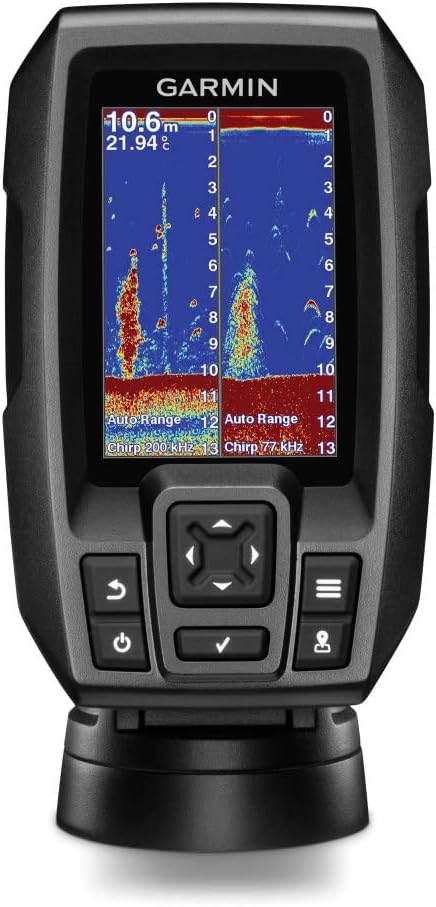
The Garmin Striker 4 combines a compact 3.5-inch display with ClearVu scanning sonar, CHIRP technology, GPS waypoint navigation, and a stated maximum depth of 1,600 feet in freshwater. Its 4.6 rating reflects strong customer satisfaction, while its small footprint makes it especially practical for anglers with limited console space.
We may earn a commission when you buy through this link, at no additional cost to you.
The clear strength is its combination of scanning sonar and a relatively small unit. ClearVu is designed to produce detailed images of fish, submerged structure, and bottom features, while CHIRP sends a continuous sweep of frequencies for improved target separation. The keyed interface also avoids the learning curve associated with touchscreen controls, making basic operation approachable.
Waypoint mapping adds practical navigation beyond fish finding. Anglers can mark brush piles, stumps, docks, and other productive or potentially hazardous locations, then return to them later. A maximum saltwater depth of 750 feet and freshwater range of 1,600 feet cover many fishing environments, although the screen remains modest compared with larger chartplotter-style units.
This is our best budget recommendation for a small boat because it supplies more capability than a basic depth-only instrument without requiring a large display. It is ideal for anglers who want fish arches, structure detail, and simple GPS waypoints in a compact package. Choose it when ease of use, useful sonar, and limited mounting space matter most.
ClearVu scanning sonar supplies broad, detailed views of fish and underwater structure. That makes the 3.5-inch display more consequential than its modest size suggests, particularly when identifying drop-offs, vegetation, and tight groups of fish.
The built-in waypoint map is useful for storing productive locations without requiring a full navigation package. It also makes the Striker 4 a practical bridge between a simple depth sounder and a larger chartplotter.
We may earn a commission when you buy through this link, at no additional cost to you.
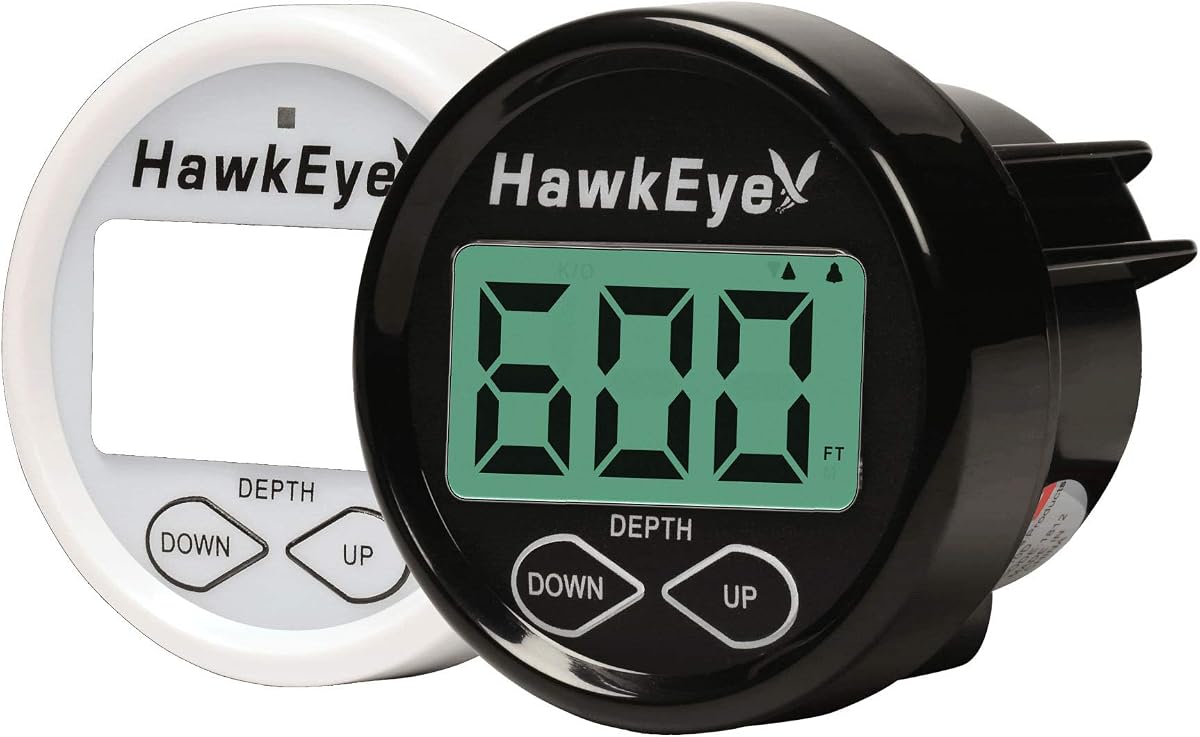
The DepthTrax 2B is designed as an in-dash digital depth finder rather than a conventional fish-finder display with a large color screen. It provides uninterrupted readings from 2.5 to 600 feet, a 200 kHz transducer, and an advanced three-stage warning system with audible alarm, red LED indication, and LCD alerts.
We may earn a commission when you buy through this link, at no additional cost to you.
Its standout benefit is the clean, integrated dashboard installation. Instead of adding a separate screen to the console, the display occupies an existing or prepared in-dash opening. This can preserve valuable sightlines and storage space on a compact boat where a conventional bracket-mounted unit would be inconvenient.
The included transducer options support transom or glue-in installation and can shoot through solid fiberglass hulls or aluminum hulls up to 1/8 inch thick. Algorithmic programming is intended to reduce false readings, while the polarized LCD and storage sun cover support glare-free viewing. Installation limitations make careful hull-material verification important.
The DepthTrax 2B is best for boaters who primarily want dependable depth, shallow-water alerts, and an integrated dashboard rather than fish identification or mapping. Its 4.2 rating is lower than many display-based competitors, but the specialized in-dash design serves a distinct purpose. Confirm opening size, wiring, and hull compatibility before ordering.
An in-dash depth sounder can be especially valuable on a small center-console or open fishing boat. It reduces visual clutter and keeps the instrument protected from spray, accidental knocks, and shifting gear.
The three-stage warning system provides depth information through sound, light, and on-screen indicators. This layered feedback helps an angler notice a changing bottom before reaching very shallow water.
We may earn a commission when you buy through this link, at no additional cost to you.
The Humminbird PiranhaMAX 4 is a straightforward 4-inch fish finder that pairs a readable display with dual-beam sonar. Its 4.6 rating places it among the strongest customer-rated options in this guide, and the included transom-mount transducer makes it a logical first permanent unit for many small boats.
We may earn a commission when you buy through this link, at no additional cost to you.
The dual-beam design gives users a choice between a narrow beam for detail and a wide beam for broader coverage. Narrow scanning can help separate individual targets and inspect specific areas, while the wider beam makes it easier to locate fish and structure over a larger area. A tilt-and-swivel mount lets the display be adjusted for the helm position and viewing angle.
The main limitation is its navigation capability. Unlike several Garmin models in the list, the PiranhaMAX 4 is presented primarily as a fish finder rather than a GPS chartplotter. It therefore appeals to anglers who want straightforward sonar information and a familiar physical interface without paying for extensive mapping and route tools.
Choose the PiranhaMAX 4 if you want a simple, dependable 4-inch unit with selectable beam coverage. It is especially suitable for boaters who value dual-beam flexibility, an included transom transducer, and easy angle adjustment. For advanced navigation, look to one of the GPS-equipped alternatives instead.
Wide coverage is useful for quickly scanning open water, while a narrower beam offers more detail around specific targets and structure. Having both options makes the unit adaptable to different fishing conditions.
The included XNT 9 28 T transom-mount transducer reduces the need for a more involved hull installation. It is a practical first choice for rental boats, seasonal use, and owners who want an easier mounting process.
We may earn a commission when you buy through this link, at no additional cost to you.
This portable fish finder uses a wireless, castable sonar sensor and a handheld color display, offering a radically different approach to finding fish on a small boat. It can detect depth, temperature, approximate fish size, fish depth, and bottom contour while supporting lake, river, sea, kayak, shore, and ice-fishing use.
We may earn a commission when you buy through this link, at no additional cost to you.
The biggest advantage is freedom from a permanent installation. Two small holes in the sensor allow it to be tethered with fishing line and cast into the water, while the handheld unit maintains a wireless connection up to 262 feet or 80 meters. That makes it convenient for anglers who move between boats, launch from shore, or do not want to drill into a hull.
Its 105-degree beam provides generous coverage, while the stated depth range of 2.6 to 164 feet suits many freshwater and moderate fishing environments. Two display backgrounds—black and white—improve readability in bright sunlight or at night. The sensor battery display has a special behavior: the sensor must be placed in water before its battery status is shown correctly.
This is a strong pick for portable use and trial of several fishing spots without committing to a fixed mount. The 4.3 rating suggests generally favorable reception, although it trails the highest-rated units. It is best for anglers who value casting and flexibility more than detailed chart navigation or high-resolution target separation.
Because the sensor can be tethered and cast, anglers can examine deeper water, ledges, or areas away from the hull. The handheld display preserves a clear view while the probe communicates wirelessly.
Switching between black and white backgrounds helps preserve contrast under sunlight or darkness. This small feature makes the portable unit more versatile across changing fishing conditions.
We may earn a commission when you buy through this link, at no additional cost to you.
The Garmin Striker Vivid 4cv delivers a 4-inch color display, vivid sonar palettes, CHIRP traditional and ClearVu scanning sonar, GPS navigation, and Quickdraw Contours. Its 4.6 rating and broad feature set make it our editor's choice for a small boat that wants a capable fish finder without moving to a full-size chartplotter.
We may earn a commission when you buy through this link, at no additional cost to you.
Sonar quality is the defining attraction. The included GT20 transducer supports both CHIRP traditional sonar and CHIRP ClearVu scanning, giving users both conventional fish arches and detailed structural imagery. Vivid color palettes make those returns easier to interpret by distinguishing fish, vegetation, rock, and other bottom features.
Integrated high-sensitivity GPS lets anglers mark waypoints, create routes, and view boat speed. Built-in Quickdraw Contours expands the unit beyond fish finding by allowing users to create and store maps of frequently visited water. A tilt-and-swivel bail mount is included, and the straightforward control interface suits anglers who do not want a complicated marine electronics setup.
Compared with a larger Garmin display, the 4-inch format preserves valuable console space while remaining large enough to interpret sonar colors and contours. It is our top general recommendation for small-boat anglers seeking modern visuals, mapping, navigation, and straightforward operation. The main trade-off is that it is a fixed system and lacks the Wi-Fi features of the larger Striker Vivid 7cv.
Vivid scanning sonar palettes improve visual separation between fish and the surrounding bottom. Anglers can interpret color differences more quickly, which is helpful when scanning structure or following a school across changing depth.
Quickdraw Contours adds practical map creation to an otherwise straightforward fish finder. Combined with GPS waypoints and routes, it provides useful navigation while remaining manageable for a smaller boat.
We may earn a commission when you buy through this link, at no additional cost to you.
The Portable Wired Fish Finder is a compact handheld system that connects to a wired sensor and is intended for kayaks, docks, ice fishing, and small boats. It reports depth, approximate fish location and size, weeds, sand, and rocks, with a stated detection range from 3 to 328 feet.
We may earn a commission when you buy through this link, at no additional cost to you.
Its simplicity is a major advantage. Tossing the sensor into the water and turning on the display is less complicated than permanently installing a transducer. Five sensitivity levels allow users to adjust the response, while a battery-saver mode, backlight, fish alarm, and selectable units make the handheld unit adaptable to different sessions.
The included neck strap is useful on a kayak because it keeps the display accessible without occupying a lap or storage pocket. It can also fit inside a tackle box when not in use. Powered by four AAA batteries, the product is rated for approximately four to five hours of continuous use with new batteries.
This unit is a practical option for anglers who want more information than a basic handheld depth meter but do not want a permanent installation. Its 4.3 rating indicates positive overall reception. The main compromise is the cable connecting the display and sensor, which is less convenient to cast than the wireless alternative in this guide.
Fish-size estimates, approximate fish depth, and bottom descriptions give kayak anglers more context than depth alone. The compact display and neck strap keep the information accessible without taking over a limited cockpit.
Five sensitivity settings let the display respond differently as conditions change. A fish alarm can help draw attention to detected targets, while the backlight improves use in low light.
We may earn a commission when you buy through this link, at no additional cost to you.
The Humminbird Helix 5 Chirp GPS G3 is the most navigation-focused recommendation in this guide, combining a 5-inch display, Dual Spectrum CHIRP sonar, a broad basemap, and real-time mapping. Its 4.5 rating indicates strong customer satisfaction, while the feature set is well suited to anglers who use a small boat for both fishing and navigation.
We may earn a commission when you buy through this link, at no additional cost to you.
Dual Spectrum CHIRP provides Wide Mode for broad coverage and Narrow Mode for detailed scanning and precise two-dimensional target separation. The low-Q transducer supports cleaner separation of fish from structure. This combination gives the Helix 5 more interpretive depth than a basic depth sounder while retaining a display size that remains manageable on a compact console.
Humminbird Basemap includes coverage of more than 10,000 lakes and the continental United States coastline, with compatibility for premium LakeMaster, CoastMaster, and Navionics charts. AutoChart Live can build maps of depth contours, bottom hardness, and vegetation while boating, using eight hours of built-in recording time and supporting AutoChart Zero Line SD cards.
This is the premium pick for boaters who want detailed sonar and serious navigation in a relatively compact unit. The keypad interface remains usable in wet conditions, and its softkey menu system organizes settings and views effectively. The trade-offs are permanent mounting, wiring, and a larger footprint than the simplest small-boat models.
A built-in basemap, waypoint navigation, optional premium charts, and recorded mapping create a much more complete marine electronics experience. It is especially useful for anglers who cover unfamiliar lakes or coastal water.
AutoChart Live records depth contours, bottom hardness, and vegetation during a trip. Those details can help build a personal understanding of an area and improve future navigation and fishing decisions.
We may earn a commission when you buy through this link, at no additional cost to you.
The Garmin Striker Plus 4 combines a bright 4.3-inch color display, dual-beam CHIRP sonar, built-in GPS, and Quickdraw Contours. Its 4.6 rating places it alongside the most well-regarded products here, and its relatively compact screen offers more room for charts than the entry-level Striker 4.
We may earn a commission when you buy through this link, at no additional cost to you.
The dual-beam transducer provides both detailed and broad sonar views, while traditional frequencies of 50, 77, 83, and 200 kHz offer flexibility across different depths and structures. Garmin describes the image quality as crystal clear and emphasizes strong target separation. A 200-watt RMS transmit power provides a capable foundation for regular fishing use.
Quickdraw Contours can store maps using one-foot contours across as many as two million acres, giving users more flexibility than the basic waypoint map on the Striker 4. GPS also supports waypoints, routes, and boat speed. The sunlight-readable screen and intuitive interface should remain practical during bright daytime conditions.
This model is an excellent choice for a small-boat angler who wants mapping but not a large chartplotter or wireless ecosystem. Its 4.3-inch footprint is still manageable on many compact consoles. Choose it over the smaller Striker 4 when contour storage and dual-beam coverage are priorities; choose the Striker Vivid 4cv when richer color sonar is more important.
One-foot contour storage and support for up to two million acres create a useful mapping system without requiring the largest display in the category. It is a strong compromise for small-boat anglers who fish familiar waters repeatedly.
Multiple traditional frequencies and two beam options let users balance target detail against coverage. That flexibility is useful when moving between shallow structure, deep ledges, and open water.
We may earn a commission when you buy through this link, at no additional cost to you.
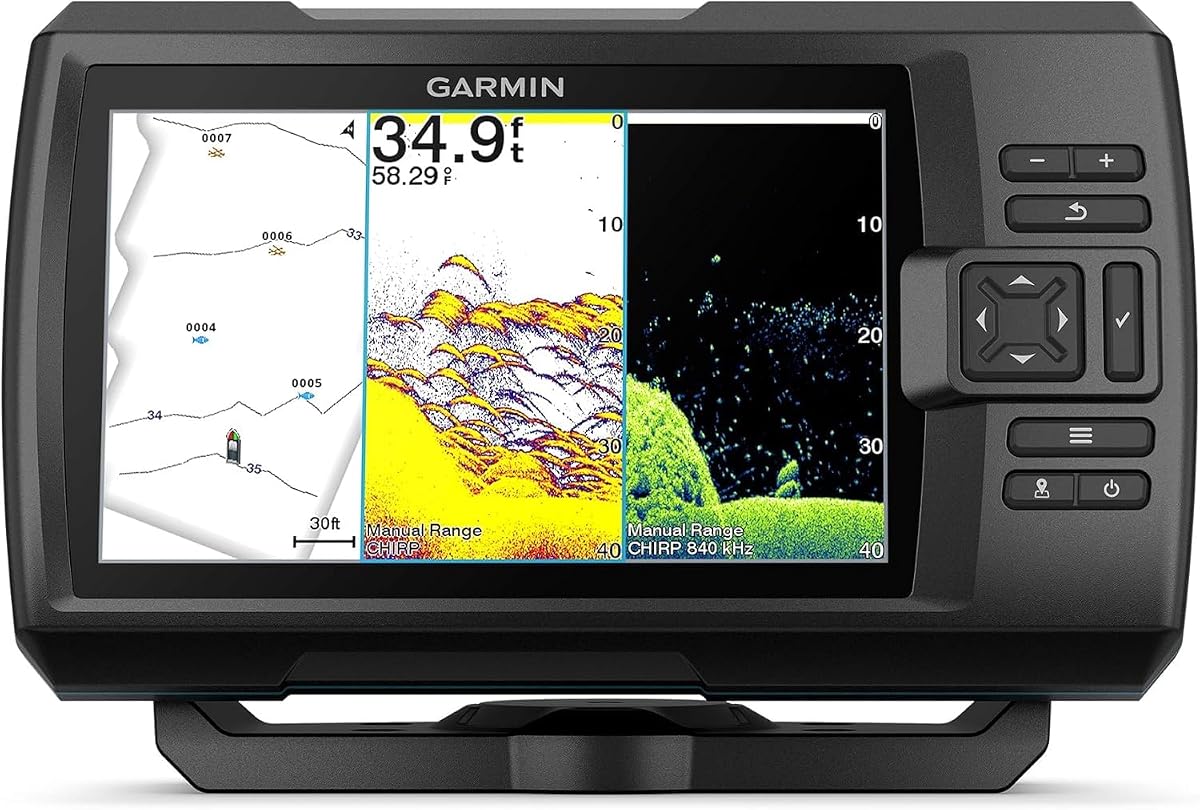
The Garmin Striker Vivid 7cv raises the visual and connected-feature ceiling with a 7-inch color display, CHIRP ClearVu scanning, vivid sonar palettes, GPS, Quickdraw Contours, and Wi-Fi connectivity. Its 4.5 rating reflects solid customer feedback, but boaters should weigh the substantial screen against their available console space.
We may earn a commission when you buy through this link, at no additional cost to you.
The large display makes detailed sonar returns, bottom structure, and map information easier to interpret. A GT20 transducer supports Garmin CHIRP traditional sonar and ClearVu scanning, while vivid palettes help distinguish fish from vegetation, rock, and other features. High-sensitivity GPS supports waypoints, routes, and boat-speed display.
Wi-Fi adds a modern convenience layer absent from most competing units in this guide. Compatible phones can use the ActiveCaptain app to transfer waypoints, receive smart and software-update notifications, and access the Garmin Quickdraw Community. That connectivity can streamline workflows without replacing the physical controls at the helm.
This is the best choice for a small boat with a broad dash, a center console, or enough mounting flexibility to accommodate a seven-inch unit. It is less suitable for a very compact skiff where every inch matters. Its value lies in combining excellent visibility, advanced sonar, mapping, and phone connectivity in one marine display.
The seven-inch screen provides ample room to distinguish sonar colors and inspect contours. It is particularly beneficial for anglers who share a display with family, compare maps, or spend long periods studying bottom structure.
Wi-Fi connection to ActiveCaptain supports waypoint transfer, notifications, and community access. It creates a useful bridge between the onboard unit and a compatible smartphone without requiring a separate dedicated network device.
We may earn a commission when you buy through this link, at no additional cost to you.
The Garmin Striker 4cv provides a balanced set of features in a compact package: a 4.3-inch sunlight-readable display, CHIRP traditional and ClearVu scanning sonar, built-in GPS, and Quickdraw Contours. Its 4.6 rating and 300-watt RMS transmit power make it a strong all-around choice for small-boat anglers.
We may earn a commission when you buy through this link, at no additional cost to you.
CHIRP and ClearVu give users a choice between continuous-frequency traditional sonar and more detailed scanning imagery. This helps with fish identification and bottom interpretation while remaining understandable enough for newer anglers. The color display provides more visual definition than a monochrome depth-only unit without expanding to the seven-inch footprint of the Striker Vivid 7cv.
Quickdraw Contours enables maps with one-foot intervals and stores data for up to two million acres. GPS waypoints, routes, and speed information add practical navigation, while the rugged design is intended for regular fishing environments. The unit occupies a middle ground between the basic Striker 4 and the connected Vivid 7cv.
Choose the Striker 4cv when you want detailed sonar, contour creation, and basic navigation but not smartphone connectivity. It is particularly suitable for a compact center-console, jon boat, or fishing kayak with a protected mounting location. Its fixed installation is the primary compromise for anglers who require true portability.
This model occupies the most useful position between the simplest Garmin fish finder and the largest display. It adds color, detailed scanning, and contour mapping without introducing a much larger physical footprint.
The combination of 300-watt RMS transmit power, CHIRP traditional sonar, and ClearVu scanning supports detailed interpretation of fish and structure. One-foot contour mapping then helps anglers turn each outing into a more useful local reference.
We may earn a commission when you buy through this link, at no additional cost to you.
The right small-boat depth finder depends on available space, installation tolerance, fishing water, and the detail you need from sonar. Review these factors before comparing screen sizes or advanced features.
Display size determines how much sonar, contour, and navigation information can be viewed comfortably. A 3.5-inch screen saves considerable room and works well for basic fish finding, while 4-inch and 4.3-inch models provide a better balance between detail and compact footprint. The 5-inch and 7-inch options are easier to interpret but require more console space and may be excessive for a very small skiff or kayak.
Choose the smallest display that comfortably shows the information you actually use. Brightness and sunlight readability matter nearly as much as diagonal size.
Traditional sonar returns fish arches and bottom contours, while scanning sonar creates more detailed imagery of structure. CHIRP uses a continuous sweep of frequencies and can improve target separation. Dual-beam systems offer narrow detail and wide coverage, making them adaptable when scanning different water depths and habitats.
For basic depth and fish location, traditional sonar may be sufficient. Choose CHIRP, ClearVu, or Dual Spectrum when structure separation and clearer bottom interpretation are central to your fishing.
A transom-mount transducer is generally the simplest permanent option and works well on many fiberglass and aluminum boats. Glue-in mounts create a cleaner appearance but require hull preparation and careful compatibility checks. In-dash depth finders need a suitable opening and wiring, while portable sensors avoid permanent modifications altogether.
Match the mounting method to your hull, console, and willingness to modify the boat. Verify every stated thickness and construction limitation before installation.
Portable systems are ideal for anglers who share a boat, fish from shore or ice, move between kayaks, or do not want a fixed transducer. Wired handheld units are straightforward but limited by cable length, while wireless castable sensors offer greater deployment distance. Permanent installations provide consistent power and a cleaner onboard arrangement.
Choose portability for flexibility and minimal installation. Choose a permanent unit when you want a dedicated display, reliable wiring, and a permanently available sonar view.
A depth finder should comfortably exceed the maximum depth of your target water. Listed limits range from 164 feet on the portable wireless unit to 1,600 feet in freshwater on the Garmin Striker 4, while in-dash and standard transducers cover lower but still useful ranges. Saltwater and freshwater limits may differ.
Compare the rated maximum with the deepest water you expect to fish. Extra range provides margin for deeper reservoirs, channels, and changing conditions.
GPS transforms a depth finder into a broader navigation tool by supporting waypoints, routes, and speed information. Waypoint-only mapping is sufficient for storing productive spots, while Quickdraw Contours and AutoChart Live create detailed maps of depth and bottom characteristics. The Humminbird Helix 5 also supports premium chart options.
Choose basic GPS for saved locations and speed. Select contour mapping or expanded charts when you repeatedly navigate unfamiliar water and want a reusable record of structure.
Wi-Fi connectivity can enable waypoint transfer, smart notifications, update notices, and access to online communities when a compatible smartphone is available. It is a meaningful convenience, but it should not replace judgment of display size, transducer performance, and mounting needs. Most alternatives in this guide are fully functional without a phone.
Prioritize connectivity when it fits your workflow. Otherwise, focus on sonar quality, local mapping, and a display you can comfortably operate.
Permanent units draw power through the boat's electrical system, while portable models use replaceable batteries or rechargeable sensors. The portable wired unit uses four AAA batteries and is stated to last approximately four to five hours with new batteries in continuous use. A wireless sensor requires charging before each outing.
Choose a power arrangement that matches session length and charging habits. Confirm battery guidance before leaving for a full day of fishing.
Begin by reading the included instructions and confirming that the transducer, display, cables, mounting hardware, and power connection are compatible with your boat. Before permanent installation, inspect the hull, identify the mounting location, and verify the transducer's stated compatibility requirements. Test the display with power before routing cables or securing the unit.
For portable systems, pair the handheld unit with the sensor, confirm that the battery is charged, and begin with a clear, level area of water. Practice casting or lowering the sensor, reading depth and bottom information, and adjusting sensitivity or beam settings. Learn the fish alarm and shallow-water warnings before relying on them in unfamiliar water.
After each trip, rinse a saltwater-exposed transducer and connector with fresh water, remove salt and debris, and let the parts dry before storage. Protect displays from prolonged direct sun when possible, inspect seals and wiring, and keep the unit secured against impact. Update software when applicable and preserve the transducer installation settings between outings.
A 3.5-inch to 4.3-inch screen is usually the best balance for a compact console. The smaller Striker 4 prioritizes space efficiency, while 4-inch and 4.3-inch models make contours, sonar colors, and navigation information easier to see. Choose a 5-inch or 7-inch unit only when the dashboard has adequate space and the larger display offers a meaningful benefit.
A portable finder is better for shared boats, shore fishing, ice fishing, and anglers who dislike drilling or wiring their hull. A permanent unit is better for consistent onboard use, cleaner integration, and uninterrupted power. The portable wireless model offers the greatest casting flexibility, while the wired handheld model is simpler to carry and deploy.
Some transducers are designed to shoot through compatible hulls, but the support varies by model. The DepthTrax 2B specifies that its included transducer can shoot through solid fiberglass and aluminum up to 1/8 inch thick, while also noting that glue-in mounting is not suitable for every vessel. Check the exact installation requirements before drilling or gluing.
CHIRP is not essential for every use, but it can improve target separation and produce clearer sonar information than conventional single-frequency returns. The Garmin Striker 4, Striker Plus 4, Striker Vivid 4cv, and Striker Vivid 7cv use CHIRP technologies, while the Humminbird Helix 5 offers Dual Spectrum CHIRP. It is worth prioritizing for anglers who frequently distinguish fish from structure.
Choose a maximum rated depth comfortably above the deepest water you expect to fish. The products here cover ranges from 164 feet to 1,600 feet in freshwater, depending on the model and transducer. A greater range offers safety margin, but display resolution, signal performance, and intended fishing environment also matter.
GPS is useful when you want to mark productive areas, return to specific structure, create routes, or view boat speed. It is less essential when the main goal is continuous depth and fish-arch information. The Striker Plus 4, Striker 4cv, and both Striker Vivid models provide GPS, while the Helix 5 offers a much more extensive navigation and charting package.
Rinse the transducer and connector with fresh water after use in saltwater, especially if the boat will sit in the water. Check for damage, corrosion, loose fasteners, and cable wear before reinstalling it. Avoid abrasive cleaners, and make sure the transducer face remains unobstructed for accurate readings.
It can be on a narrow skiff or tightly packed console, but it is practical on many center-consoles and larger fishing boats. The 7-inch Garmin Striker Vivid 7cv offers excellent readability, advanced sonar, mapping, and Wi-Fi, yet requires the most dashboard space. Measure the mounting area and viewing angle before choosing it.
The Garmin Striker 4 is the strongest budget-oriented all-rounder, combining ClearVu sonar, CHIRP, waypoint mapping, and a compact display. The Striker Vivid 4cv is our editor's choice for modern color sonar, GPS, and contour mapping, while the Humminbird Helix 5 Chirp GPS G3 leads the premium navigation category.
Prioritize the fit of the unit to your boat rather than simply selecting the largest screen. Verify transducer compatibility, power, mounting requirements, depth range, and local water conditions. Portable options make sense when flexibility matters, while permanent models are stronger for dedicated and neatly integrated use.
Customer ratings and product availability can change, and current prices may vary by seller and configuration. Review the latest listing, package contents, warranty details, and installation instructions before making a final purchase.