
Tapo Smart Water Leak Detector
4.6Editor score
One-second rapid leak response
Six-sided dual-side sensing
Long replaceable battery life
This guide compares the best Smart Water Leak Detector Sensor options for detection accuracy, alerts, connectivity, placement, and whole-home protection in
A smart water leak detector sensor adds an early-warning layer between hidden plumbing failures and serious water damage. The best units combine responsive probes, loud local alarms, dependable wireless connections, useful phone notifications, and housings suited to damp locations, making them valuable around appliances, sinks, pipes, basements, and utility areas.
This guide compares ten leak detection systems based on the supplied product specifications, including sensing methods, alarm output, wireless range, app features, hub requirements, battery life, water resistance, and installation flexibility. It includes direct Wi-Fi models, hub-based systems, and a cable-style detector for homeowners with different monitoring needs.
Each recommendation highlights the product's strongest use case, practical limitations, and ideal placement. The top picks illustrate the best balance of value, feature depth, and specialized monitoring, while the complete list covers compact sensors, multi-sensor kits, Apple HomeKit options, and systems designed to support broader smart-home protection.
4.6Editor score

5.0Editor score

4.6Editor score
The table below compares all ten detectors by sensing approach, alert method, connectivity, and practical placement features, helping readers identify the right system for apartments, large homes, Apple ecosystems, or smart-home installations.
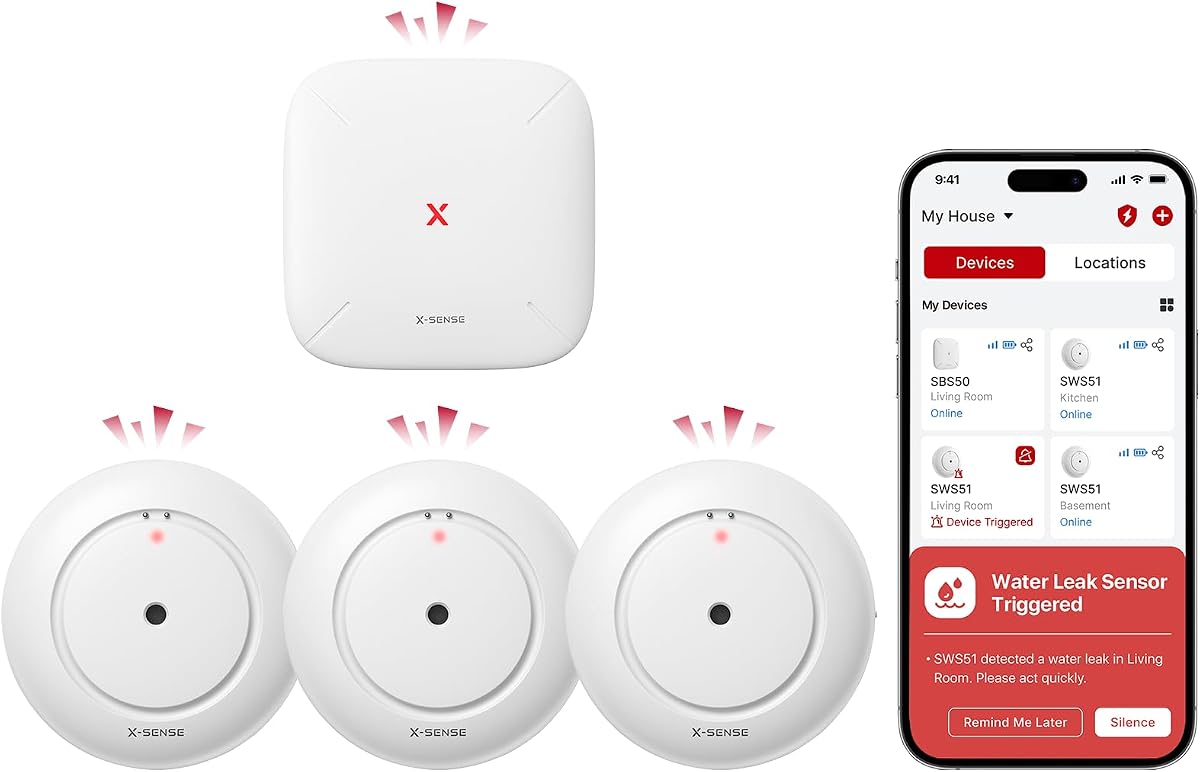


The X-Sense SWS54 combines three compact sensors, a dedicated base station, loud local warnings, and direct Wi-Fi notifications in one of the most balanced kits in this guide. Its 4.5 rating reflects a strong overall package, particularly for homeowners who want to cover several risk points without assembling separate gateways and devices.
We may earn a commission when you buy through this link, at no additional cost to you.
Six-probe detection gives the sensors two upper probes for dripping water and four lower probes for pooling water as shallow as 0.4 millimeters. When moisture is detected, both the sensor and base station can sound a 120 dB alarm. The base reaches up to 1,804 feet in open areas, making it practical for a large house, detached garage, basement, or laundry area.
The app adds more than a basic notification. It supports sharing with up to 12 users, configurable reminders, and alert postponement intervals of 10 or 30 minutes, two, six, or 12 hours. That flexibility is helpful after a leak is found but repair and cleanup are still underway, although homeowners must remember that a postponed alert should never substitute for prompt action.
The principal compromise is the need for a 2.4 GHz Wi-Fi network; 5 GHz is unsupported. The base also needs a suitable outlet and placement where its alarm can be heard. Even so, the SWS54 offers an excellent mix of range, sensitivity, alarm volume, and remote monitoring for anyone protecting multiple areas of a medium or large home.
The combination of upper and lower probes makes the system useful around both horizontal and vertical leak risks. It can catch a dripping supply line as well as water accumulating beneath a washing machine, dishwasher, water heater, or sink.
The base's 120 dB alarm helps turn individual sensor warnings into a broader household alert. Its long open-area range also makes the kit more adaptable to properties where several monitored areas are spread across different floors or outbuildings.
We may earn a commission when you buy through this link, at no additional cost to you.
The Tapo T300 offers fast, straightforward leak monitoring at a restrained price point, earning a 4.6 rating and a place as the best budget-oriented recommendation. It is particularly attractive to Tapo users because the sensor can trigger a hub alarm in addition to its own 90 dB buzzer, giving users both local and network-wide warning options.
We may earn a commission when you buy through this link, at no additional cost to you.
Its six probes detect water from above and below, and the system can trigger its siren in as little as one second. Replaceable AAA batteries are rated for up to three years under laboratory conditions, though actual life depends on operating conditions. Low-battery notifications through the app help owners schedule replacements before the monitoring cycle is interrupted.
The main trade-off is the requirement for a Tapo hub. Buyers who already use the Tapo ecosystem can integrate more effectively, but standalone users should account for the cost and setup of that additional component. The supplied information also does not specify a maximum communication distance, so placement should be based on actual hub signal quality rather than an assumed range.
For people seeking a compact and dependable sensor inside an existing Tapo smart home, the T300 is an excellent pick. Its rapid response, IP67 housing, long battery life, and ability to extend a hub alarm make it more capable than a simple local water alarm.
The stated one-second trigger response gives the T300 an advantage when a leak begins as a slow drip. Fast notification can shorten the interval between the first sign of water and an owner's ability to shut off supply or move stored belongings.
Its replaceable batteries and IP67 enclosure support placement near sinks, appliances, pipes, and other humid locations. Routine testing and battery reminders help preserve confidence that the sensor will remain ready between inspections.
We may earn a commission when you buy through this link, at no additional cost to you.
The Moen Flo Detector is a three-pack built for homeowners who want leak monitoring that can grow into a broader water-protection system. Its 3.6 rating is lower than those of the other products, but the available specifications distinguish it through remote sensing, multi-unit support, and compatibility with the Flo Smart Water Monitor and Shutoff.
We may earn a commission when you buy through this link, at no additional cost to you.
Each detector can provide real-time moisture notifications through the Moen Smart Water Network app. The included extension cable and remote sensing disc extend detection as far as 48 inches, making the sensor useful in tight spaces where a conventional probe body cannot sit directly beside the suspected source of water.
The three-pack provides a practical starting point for protecting several high-risk areas, and additional single or multi-packs can be used for broader coverage. Connecting the detector to a separately sold Flo monitor and shutoff expands the role from alerting to actively stopping water flow. That makes this a better fit for a planned whole-home system than for a quick standalone installation.
The main limitation is that the shutoff hardware is not included, and the lower 3.6 rating suggests the product may not satisfy buyers who place greater weight on customer feedback than on ecosystem integration. Even so, the remote sensing disc and compatibility with automatic shutoff are unusually valuable for plumbing-focused protection.
The 48-inch remote sensing disc is the defining feature of this system. It can reach into cabinet interiors, behind equipment, or other locations where placing the full sensor beside a pipe or appliance would be difficult.
When paired with the separately sold Flo Smart Water Monitor and Shutoff, these detectors can become part of a more automated response. The detector alerts the network, while the compatible shutoff equipment can limit ongoing water flow.
We may earn a commission when you buy through this link, at no additional cost to you.
The X-Sense SWS0A41 is the slim-profile answer for areas where a conventional sensor would be awkward or impossible to position. It measures only 0.7 inches thick and three inches in diameter, yet includes four sensors, a base station, app alerts, and a long stated wireless range.
We may earn a commission when you buy through this link, at no additional cost to you.
Two upper probes detect dripping water, while four lower sensors can identify pooling water as shallow as 0.4 millimeters. The base station produces an alarm of up to 100 dB and flashes a red light on the detector when water is found. The app provides alarm history, low-battery notices, testing, adjustable volume, and reminder postponement.
Its 1,700-foot open-area range remains suitable for many homes and outbuildings, though walls and floors will reduce effective distance. The 100 dB base alarm is strong for general rooms but not as forceful as the 120 dB system in the first-ranked X-Sense kit. As with direct Wi-Fi products, the network must be 2.4 GHz.
The SWS0A41 is best for renters, apartment residents, or homeowners who need sensors beside appliances, inside cabinets, beneath fixtures, or in other narrow gaps. It combines an unobtrusive body with a capable four-sensor package and extensive app-based controls.
The 0.7-inch profile allows the sensor to slide into spaces that would reject a bulkier detector. This is especially useful behind washers, along cabinet walls, beside pipe penetrations, and under fixtures where preserving access matters.
Alarm history, low-battery notices, volume adjustment, testing, and shared access turn the unit into more than a standalone siren. Delayed reminders can also prevent repetitive notifications while a discovered leak is being addressed.
We may earn a commission when you buy through this link, at no additional cost to you.
The RUIKORING WD71 three-pack is designed for households that want to start with several monitored locations and expand over time. Its gateway can support as many as 24 WD71 sensors, making it one of the more scalable systems in the comparison while retaining a straightforward sensor-and-gateway layout.
We may earn a commission when you buy through this link, at no additional cost to you.
The sensors have two upper probes for dripping water and four lower probes for pooling moisture. At least two bottom probes must be activated to reduce false alarms, an important design detail for a detector intended to sit on floors. A 120 dB local alarm is joined by a gateway alarm of up to 90 dB and app push notifications.
The app supports alarm history, volume controls, muting, device sharing, and automatic arming or disarming schedules. Scheduling may be useful when a monitored area is expected to get wet, although the system should not be disabled simply to avoid notifications. The stated gateway range is up to 328 feet outdoors and typically around 150 feet indoors.
The WD71's principal trade-off is that its meaningful wireless distance is less generous than the X-Sense systems' open-area figures. It also uses the Tuya Smart app, and optional SMS or phone-call notifications are handled through a third-party publisher with separate charges. It remains a capable expandable kit for typical homes where the gateway and sensors share a strong network connection.
A 24-sensor gateway capacity gives the system room to grow as new appliances, bathrooms, or utility areas are assessed. That makes the three-pack a practical starting point for a staged whole-home installation rather than a disposable single-zone solution.
Automatic arming and disarming can accommodate predictable sources of water, such as weather or seasonal conditions. Care is still essential because a detector provides the most protection when it remains armed whenever the monitored area could experience a leak.
We may earn a commission when you buy through this link, at no additional cost to you.
The Aeotec SmartThings Water Leak Sensor is primarily an automation component rather than a stand-alone phone-connected detector. It works with an Aeotec Smart Home Hub, a Samsung SmartThings Hub Gen 3, or another compatible ZigBee hub, and it gains much of its value from the routines users create around moisture and temperature events.
We may earn a commission when you buy through this link, at no additional cost to you.
The sensor can detect excess water or moisture and provide phone alerts through the SmartThings app. It also monitors temperature within a 32- to 104-degree operating range. When unusual conditions are detected, users can choose a light or siren response and program other connected devices to shut off water flow or electronics.
ZigBee range is listed at 50 to 130 feet depending on construction, so the hub needs a strong and appropriately located signal path. The device is intended for indoor use and does not offer the long open-area reach of Wi-Fi kits. A hub is also required, adding installation complexity for buyers who have not already adopted SmartThings.
The sensor is an excellent choice for an established SmartThings household that wants leak detection to trigger broader safety routines. Its limitations are less important when the hub, compatible devices, and automations are already in place, but they make it less convenient as a simple standalone monitor.
A leak can initiate a chain of actions rather than simply sounding an alarm. Programmable shutoffs and electronic shutdowns can reduce exposure, although compatibility with the intended appliances and hub should be confirmed before relying on automated controls.
Monitoring temperature alongside moisture is useful in spaces where heat, cold, or water-related equipment failure may create risk. Users can choose between visual and audible alerts according to the location and household routine.
We may earn a commission when you buy through this link, at no additional cost to you.
The TECKNET Leak Detector is a direct-Wi-Fi option that avoids the need for a separate hub. It includes two sensors and four AAA batteries, offering a simple way to monitor two high-risk areas while retaining app notifications, a 120 dB adjustable alarm, and six-probe detection.
We may earn a commission when you buy through this link, at no additional cost to you.
Two upper probes and four lower probes allow the sensors to register both drips and pooled water. The IP67 housing is intended for humid environments such as basements, laundry rooms, kitchens, and spaces near water heaters. Low-battery reminders help owners replace the two AAA batteries before monitoring is lost.
The sensor connects to a 2.4 GHz Wi-Fi network and does not support 5 GHz networks. It uses the Tuya Smart app for instant leak alerts. While basic push notifications are available, optional SMS and phone-call alerts require a third-party subscription service, so buyers should distinguish those premium features from the standard app notification.
With a 4.2 rating, the TECKNET is not the strongest all-around option in the list, but it is practical for users who want immediate phone alerts without building a hub-centered system. The included pair, batteries, loud siren, and sealed construction make it a convenient entry point for targeted leak monitoring.
Connecting directly to 2.4 GHz Wi-Fi removes one of the main setup hurdles associated with hub-based systems. It is an attractive option for a household that wants notifications without investing in another central device.
The 120 dB alarm can be adjusted to suit the room, while low-battery reminders help maintain readiness. Two included sensors make it possible to cover a pair of important locations immediately.
We may earn a commission when you buy through this link, at no additional cost to you.
The WaterWatcher is a specialized premium sensor for people who want a leak alarm to control a connected appliance rather than merely issue a notification. Its 4.6 rating reflects a mature package backed by a five-year warranty, with automatic shutoff and manual reset as its defining features.
We may earn a commission when you buy through this link, at no additional cost to you.
When the sensor detects water, it can turn off the connected appliance and keep it off until manually reset. This is a strong safety model because an automatic restart could reintroduce water flow before the source has been inspected. The enhanced sensor is designed to pinpoint even very small traces, which also makes it useful with dehumidifiers and other sensitive equipment.
Compatibility extends to dehumidifiers, aquariums, hydroponics setups, washing machines, well pumps, and other appliances. That broad range of use is a meaningful advantage over app-focused sensors, particularly in a basement or utility area where a phone may not be nearby and immediate equipment isolation is valuable.
The key limitation is that this is not a conventional phone-connected smart sensor in the same sense as the Wi-Fi products. It requires compatible equipment and manual intervention after activation. Buyers who value automatic appliance shutoff, durable support, and a conservative reset process will find it more specialized and reassuring than a basic alarm.
The ability to switch off a connected appliance can prevent a minor leak from becoming a larger incident. It is especially relevant to equipment that could continue drawing water or operating with water present.
Keeping the appliance off until a manual reset ensures that no one simply clears the alarm and forgets the underlying issue. The process is less convenient than a remote reset, but it is deliberately conservative.
We may earn a commission when you buy through this link, at no additional cost to you.
The 110 dB WiFi Detector earns the highest listed rating in this guide at 5.0, with a feature set that balances sensitive probes, remote alerts, compact placement, and a strong audible alarm. Although the product title refers to three water sensors, the supplied package information specifies two detectors, one gateway, and two AAA batteries.
We may earn a commission when you buy through this link, at no additional cost to you.
Two stainless-steel strips detect drips from pipes and drains, while four lower probes identify dampness or standing water. Both arrays work together and trigger a 110 dB alarm. The IP66 housing is designed for humid locations such as basements, under kitchen sinks, near pipes, bathtubs, washing machines, and water heaters, and the sensors can be reused after drying.
The gateway connects to 2.4 GHz Wi-Fi and binds to the Tuya Smart app, where users can receive leak notifications and adjust or mute alarms. Its compact form is helpful in concealed locations, and no separate smart-home hub is needed. As with many direct Wi-Fi products, however, 5 GHz Wi-Fi is unsupported.
The mismatch between the title and the listed package contents is worth noting before purchase, so buyers should verify the quantity they will receive. Beyond that ambiguity, the unit offers an excellent combination of loud warning, flexible volume, phone alerts, and durable construction. It is a particularly strong choice for a couple of priority leak locations without a larger multi-sensor kit.
Front strips catch drips from vertical plumbing while lower probes identify water collecting on a floor. Using both sensing methods reduces the chance that a leak will be missed because it approaches the sensor from an unexpected direction.
The maximum 110 dB alarm is powerful enough to attract attention in a busy home, while multiple volume levels let users reduce noise in bedrooms or other quiet spaces. App-based muting adds another layer of control after a leak is located.
We may earn a commission when you buy through this link, at no additional cost to you.
The Eve Water Guard is the most cable-focused option in the guide and a strong match for Apple HomeKit users. Its 4.6 rating reflects a polished combination of a 6.5-foot sensing cable, 100 dB siren, red flashing light, phone notifications, and support for both Bluetooth and Thread.
We may earn a commission when you buy through this link, at no additional cost to you.
The cable can monitor a broad floor area or sit beneath a sink, water heater, appliance, pipe, or utility fixture. It can also be extended up to 490 feet, allowing a single unit to follow a larger run of pipe or cover an area where several small probes would otherwise be needed. The sensor is particularly appropriate for bathrooms, basements, and utility rooms.
The device joins a Thread network automatically and can act as a router node that improves the reach and stability of a compatible smart home. It works with HomeKit and does not require an Eve bridge or gateway. Privacy is another major strength: there is no Eve cloud, registration, or tracking, and communication is local and direct.
Its main limitation is dependence on a current iPhone or iPad with the latest iOS or iPadOS, making it less suitable for Android-only or mixed-ecosystem homes. For Apple users who value cable coverage, Thread support, and local operation, though, it is a distinctive and capable premium detector.
A long cable can trace a pipe run, spread across a floor, or sit beneath a broad appliance. This is useful where water might travel before reaching a compact point sensor and where several point sensors would otherwise be required.
The absence of cloud registration and tracking supports users who prefer direct device communication. Thread can also act as a network extender, improving the stability of a compatible HomeKit setup.
We may earn a commission when you buy through this link, at no additional cost to you.
The right smart water leak detector sensor depends on where water is most likely, how quickly you want to be notified, and whether your household already has a compatible smart-home platform. These factors determine the balance of probes, alarms, wireless technology, and installation flexibility you need.
Point sensors with upper and lower probes are effective around pipes, appliances, sinks, and floors where drips or pooled water are likely. Cable sensors cover a broader path and can follow pipes or stretch across an area, making them useful beneath equipment and along utility runs. Consider whether the monitored water would arrive as a drip, a spread, a flood, or moisture absorbed into a surface.
Direct Wi-Fi products connect to a 2.4 GHz network and do not require a separate smart-home hub. Hub-based sensors, such as the Tapo T300 and Aeotec SmartThings model, need compatible central hardware but may integrate more smoothly with an existing ecosystem. Before buying, verify the required app, network band, hub compatibility, and whether the alert service needs a paid subscription.
A loud local siren is important because a phone notification may not be seen or heard immediately. Available outputs range from 90 dB to 120 dB, with the X-Sense SWS54 offering the highest stated level. Adjustable volume is useful in bedrooms, while fixed high output can be preferable in basements, garages, and utility areas where the sensor is farther from occupied rooms.
Maximum range is usually measured in open areas and can be reduced by walls, floors, metal appliances, and building materials. A stated 1,700 or 1,804-foot figure is useful across large properties, but indoor placement still depends on signal quality. ZigBee systems may have shorter effective reach but can perform well when the hub is centrally located and the smart-home mesh is already established.
IP66 and IP67 ratings indicate protection against dust and water to differing degrees, making either suitable for many humid indoor locations. Resistance is not the same as permission to submerge a sensor continuously, and outdoor exposure may require additional consideration. Match the product's stated operating environment to basements, laundry rooms, kitchens, bathrooms, garages, and other likely leak zones.
Battery-operated sensors reduce installation complexity, but owners should consider testing intervals, low-battery alerts, and battery access. Stated battery lives range from about two years to as much as three years, with actual life depending on conditions and use. Detectors near exterior walls, garages, or humid spaces may need closer attention even when the manufacturer offers a longer estimate.
A single sensor can protect a critical point, but leaks often originate in several high-risk areas. Multi-packs and gateways make it easier to monitor washing machines, dishwashers, water heaters, bathrooms, basements, and utility rooms together. Pay attention to gateway capacity, sharing options, and whether the system supports additional sensors so the installation can grow over time.
Alerts are more useful when they lead to a clear response. Some systems can trigger hub alarms, smart-home shutdown routines, or automatic appliance shutoff, while others offer timers, shared access, and alarm history. The Moen and Aeotec models can connect with broader water-control or automation systems, while the WaterWatcher focuses on keeping connected equipment off until a manual reset.
Begin by mapping likely leak sources, including appliance supply lines, drain hoses, water heaters, sinks, toilets, pipe penetrations, sump pumps, and areas where a hose or joint could fail. Clean and dry each selected surface, then position the sensor so its probes can make direct contact with water. For a point sensor, keep the body level and avoid leaving it where condensation, spilled cleaning water, or unrelated dampness could create a false alarm.
Set up the specified app, connect the sensor or gateway to a 2.4 GHz Wi-Fi network when required, and complete every installation step rather than assuming the default notification settings are sufficient. If the model supports shared access, add household members or anyone responsible for responding to alarms. Confirm that phone notifications arrive, test the sensor using the manufacturer's method, and position the base station where its alarm can be heard.
On a regular schedule, test the unit, inspect the probe area for dirt, and replace the batteries when prompted or according to the specified battery interval. After any leak, dry and inspect the sensor before returning it to service, and do not ignore a recurring alarm until the sensor itself has been ruled out. Review app history and verify that the system still appears connected, especially after changes to the Wi-Fi network, router, hub, or phone.
Place them near the greatest leak risks, including beneath washing machines and dishwashers, beside water heaters, under sinks, near toilets, along exposed pipes, and near sump pumps. The sensor should sit on a level surface with its probes able to touch pooling water, and the base station or hub should be positioned where its alarm can be heard. Avoid locations where condensation or routine cleaning will regularly wet the probes.
Many models in this guide connect directly to a 2.4 GHz Wi-Fi network, while others require a compatible hub. Products such as the Tapo T300 and Aeotec SmartThings sensor need central hardware, whereas the X-Sense, TECKNET, RUIKORING, and 110 dB WiFi Detector kits use direct Wi-Fi connections. Check network-band support before installation because several models do not support 5 GHz Wi-Fi.
Test the alarm and app notification regularly according to the manufacturer's instructions, with monthly checks being a sensible routine for many households. Confirm that the sensor sounds, the notification arrives, the batteries are healthy, and the probes remain clean. Increase testing frequency if the sensor is in a difficult-to-access location, a frequently wet area, or a home occupied by people who may not recognize the alarm.
A leak sensor can identify moisture early, but it cannot guarantee that a flood will never occur. Its value comes from giving you time to shut off water, move belongings, contact a plumber, or activate an automatic shutoff system. Devices such as the Moen Flo Detector and WaterWatcher can integrate with equipment that stops water flow, adding a preventive layer beyond simple alarms.
A point sensor detects water when liquid reaches its probes, making it ideal for localized risks such as a sink, appliance, or pipe connection. A cable sensor provides a long detection line that can follow a pipe or cover a broad floor area. The Eve Water Guard is a notable example, with a six-and-a-half-foot cable that can also be extended for larger installations.
Condensation can activate a moisture sensor, especially when the housing is cold or the probes are exposed to humid air. Install the unit according to its instructions, keep the probe area clean and dry, and place it where normal condensation will not collect. Repeated alarms in a humid location may require repositioning the sensor rather than simply muting the notifications.
No. One compatible hub can often support multiple sensors, and some direct Wi-Fi systems use a gateway that supports several units. The RUIKORING gateway can handle up to 24 compatible sensors, while the Tapo and SmartThings options require a hub that may already support other devices. Check the stated capacity and signal range before placing sensors throughout a large property.
No. App push notifications are generally the standard remote alert, but some Tuya-based products offer optional SMS or voice-call notifications through a third-party service. Those premium channels may require a separate subscription and may involve third-party charges. Review the app's notification settings before assuming every available alert method is included without additional cost.
The X-Sense SWS54 is the strongest overall choice for broad household coverage, combining three sensors, a 120 dB base alarm, app reminders, and a long open-area range. The Tapo T300 is the best budget-oriented pick for Tapo users, while the Eve Water Guard is the premium option for Apple households that value cable coverage, Thread, and local privacy.
Prioritize the failure mode you want to prevent, the spaces where leaks are most likely, and the alerts you will genuinely respond to. Point sensors suit isolated appliance and plumbing risks, cable sensors cover broad paths, and hub-based options integrate best with established smart homes. Direct Wi-Fi models offer simpler installation, but they commonly require a 2.4 GHz network and may offer fewer automation features.
Before finalizing a purchase, verify current product details, package contents, compatibility, and network requirements. Prices and promotions can change over time, so compare the complete kit rather than judging a sensor by the headline price alone. A monitored point of failure is still more valuable than an advanced system placed where it cannot be installed or maintained correctly.