
Fitbit Ace 2
4.6Editor score
Swim-proof activity tracking
Up to five-day battery
Goal badges and celebrations
Kid-friendly child account
Choosing a smartwatch for kids means balancing activity tracking, communication, safety, durability, and fun without overwhelming a child with unnecessary features. A useful kids watch should feel comfortable, survive busy days, and give parents clear information without turning everyday wear into another source of conflict.
We compared ten products using the specifications and feature details supplied for each listing. The guide covers the Fitbit Ace 2, two Garmin Bounce models, 4G GPS watches, standalone fitness trackers, and a replacement Fitbit Ace LTE charger, emphasizing the distinct purpose of each option.
Each pick reveals what it is best suited for, from basic step counting to two-way calling and geofenced location alerts. Ratings, availability, plans, and prices can change, so readers should confirm current details and compatibility before making a final purchasing decision.
4.6Editor score

4.1Editor score

3.4Editor score
As an Amazon Associate we earn from qualifying purchases.
This side-by-side overview highlights the major differences in location tracking, communication, fitness functions, water resistance, battery life, and compatibility. It also separates full child smartwatches from simpler fitness trackers and an accessory rather than presenting every listing as a direct Fitbit Ace 2 equivalent.


The Fitbit Ace 2 is the most directly relevant choice for someone searching by the Fitbit name while keeping a child's experience simple. It carries a 4.6 rating, the highest among the ten products, and concentrates on movement goals rather than adding a full phone to a child's wrist. Steps, active minutes, sleep, and bedtime reminders create a health-focused routine that a young child can understand.
We may earn a commission when you buy through this link, at no additional cost to you.
Its strongest advantages are the limited kid view, virtual badges, on-screen celebrations, and friend challenges within the associated child account. The watch tracks steps and active minutes, can run for up to five days depending on use, and resists water to 50 meters. A syncing range of up to six meters means the device must be reasonably close to the paired phone for synchronization, an important limitation that parents should consider before buying.
This is not a standalone GPS smartwatch, and it does not provide cellular messaging or emergency calling. That is not necessarily a drawback for a younger child whose parents want a simple first wearable rather than independent communication. The shorter sync distance and animation-related charging demands may also be inconvenient, but the core activity-tracking experience is focused, encouraging, and less complicated than many alternatives in this list.
The Ace 2 is best for families seeking a dedicated Fitbit activity tracker that helps a child become more active without exposing them to a full smartphone interface. It is particularly attractive for young children, swim days, and parents who value a child-specific account and long battery life. For communication-heavy needs, look to the Garmin models instead; for uncomplicated steps and sleep data, the Ace 2 remains the strongest fit.
Virtual badges, animated celebrations, and step challenges turn daily movement into something that feels like progress. The limited kid view also gives children useful independence without exposing the full range of tools found in an adult account.
Water resistance to 50 meters suits swimming and everyday spills, while the stated battery life of up to five days reduces charging interruptions. Actual duration varies with use, particularly when animated clock faces are displayed.
We may earn a commission when you buy through this link, at no additional cost to you.
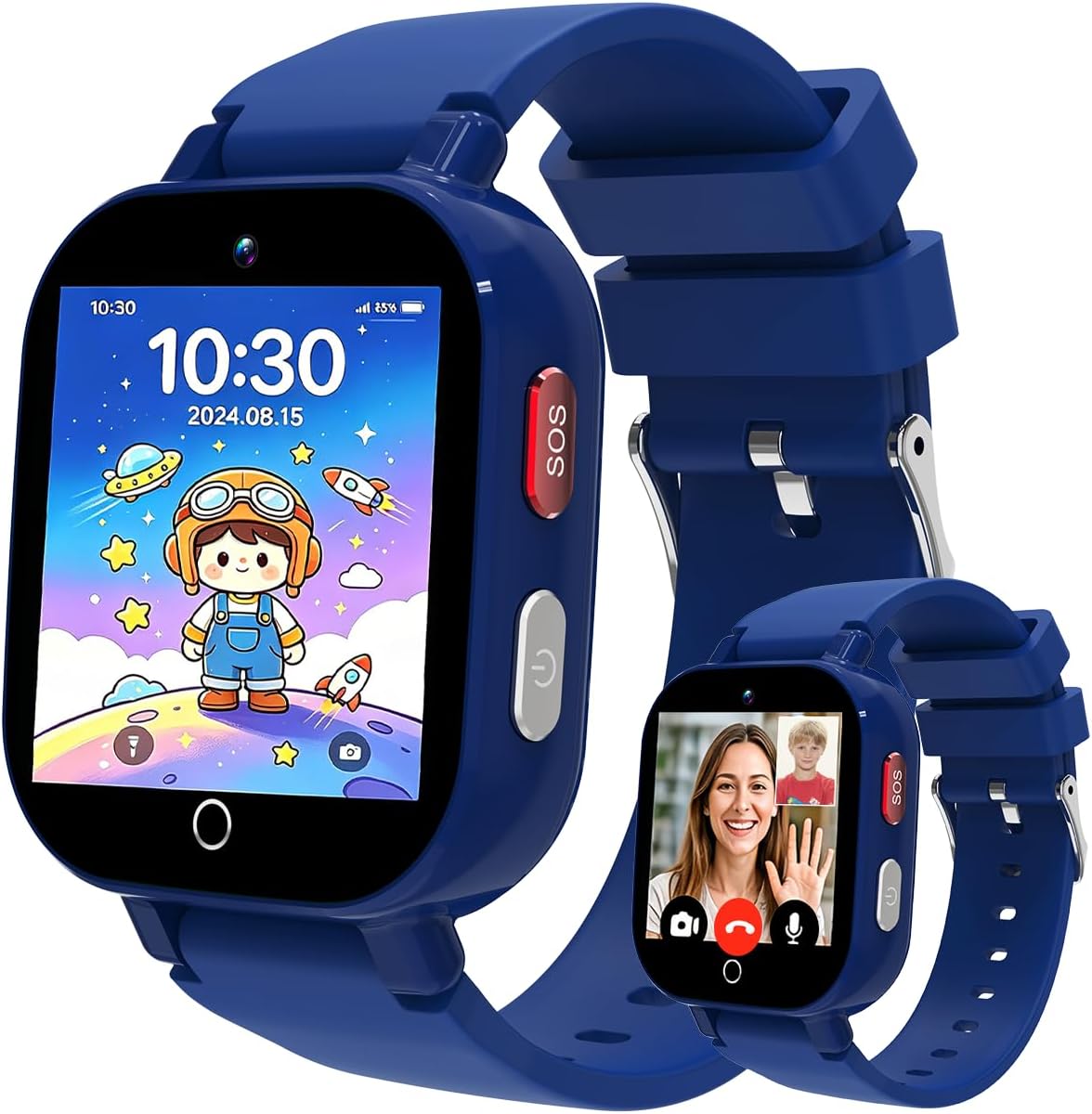
This 4G kids smartwatch is the most feature-heavy conventional phone-watch in the group, combining location, communication, entertainment, and parental controls in one device. Its 4.1 rating reflects a broad feature set, and the included SIM card makes it more immediately suited to independent calling than the Bluetooth-only fitness trackers later in the ranking.
We may earn a commission when you buy through this link, at no additional cost to you.
The location system supports GPS, GLONASS, Galileo, BeiDou, QZSS, and NavIC, with Google Maps viewing, route history, multiple safe zones, and geofence notifications. Parents can remotely ring the watch or use the surrounding-environment listening feature. Children can make video calls, voice calls, send messages, use emojis, and participate in a family group chat through 4G or Wi-Fi.
The app provides meaningful controls for a school-age child, including class mode, approved contacts, unknown-call blocking, dial-pad restrictions, scheduled power settings, and remote shutdown. A press-and-hold SOS button contacts preset family members, while the camera, AI voice assistant, translation, image recognition, games, calculator, alarms, and sports modes add entertainment value. These extras also make the watch busier and more likely to need parental supervision.
The stated battery figure is five days during daily use and seven days on standby, although real results will depend on calling, video, GPS, and network conditions. Most importantly, the listing states that this watch supports the United States only. It is best for families in the US who want a dedicated first phone with comprehensive controls and are comfortable managing cellular service and app permissions.
Parents can inspect location history, refresh a current position, review daily routes, and create multiple safe zones. Alerts when a child enters or leaves a parent-defined area add useful awareness without requiring constant manual check-ins.
Class mode can suppress distractions during lessons, while approved-contact and dial-pad settings limit who may call. Scheduled power controls, remote restart options, and call restrictions make the device more manageable once it is set up correctly.
We may earn a commission when you buy through this link, at no additional cost to you.
The Garmin Bounce sits between a basic fitness tracker and a full-featured cellular kids watch. Its 4.1 rating and two-way text and voice messaging make it especially relevant for parents who want direct contact without the broad entertainment suite found on many generic 4G watches. The Garmin Jr. app serves as the central control point for communication and location.
We may earn a commission when you buy through this link, at no additional cost to you.
Parents can view a child's live location, review defined boundaries, and receive notifications when the child enters or leaves them. Children can send and receive text and voice messages through the app, while the Assistance feature lets a child trigger a message containing live location to family contacts. The feature requires setup and cellular data coverage, so it should be discussed with a child before it becomes part of their emergency routine.
Physical design strengths include a bright color touchscreen and a durable, swim-friendly construction. These qualities suit playgrounds, school days, and family activities. The trade-off is battery life of up to two days, and connected feature usage or poor LTE conditions can shorten that duration considerably. An active subscription and LTE connectivity are also necessary for the core messaging and location functions.
The Bounce is a strong recommendation for families seeking a restrained, recognizable Garmin experience with dependable two-way communication and location tools. It offers fewer distractions than the 4G models and a more focused communication setup than standalone fitness trackers. Choose it when the Garmin ecosystem, compact feature set, and parent-managed messaging matter more than maximum battery duration or built-in entertainment.
Two-way text and voice messaging gives children a practical way to reach family while keeping the device away from the game-heavy feature sets of conventional kids phones. Communication runs through the Garmin Jr. app.
Live position checks and notifications for entry into or exit from parent-defined boundaries provide useful context around school, parks, and home. These tools require an active subscription and LTE service.
We may earn a commission when you buy through this link, at no additional cost to you.
The Garmin Bounce 2 develops the Bounce concept into a more capable premium smartwatch. At 43mm, it offers two-way calls, voice messages, and text messaging through the Garmin Jr. app, along with location tracking and parent-defined boundary alerts. Its 3.4 rating is the lowest listed, but the supplied specifications also reveal the broadest feature set among the Garmin options.
We may earn a commission when you buy through this link, at no additional cost to you.
Parents can manage tasks, schedule alerts and alarms, track steps, monitor sleep, reward desired behavior, and enable school mode to lock distracting features. Voice commands can activate the watch and place calls. The Assistance feature sends a call and live-location message to family contacts, while Garmin-managed LTE connectivity removes the need to switch phone providers, although a subscription is still required.
Fitness and entertainment functions distinguish the Bounce 2 from the original model. Built-in sports applications use GPS for running, biking, pool swimming, and other activities, while compatible headphones or the watch itself can play favorite music when an Amazon Music Unlimited or Amazon Prime subscription is available. Up to two days of battery life is limited by comparison with the longer claims of basic trackers, especially when connected features are used heavily.
This watch suits a child who is ready for more independence and whose parents value structured tasks, rewards, school controls, and communication. It is less appropriate for a very young child or for families seeking a simple, subscription-free activity tracker. The feature breadth and premium positioning justify consideration despite the lower rating, but current connectivity cost and coverage should be checked before purchase.
The Garmin Jr. app can assign tasks that a child completes on the watch. Parents can pair those tasks with behavior rewards, scheduled alerts, alarms, sleep monitoring, and school mode to create a structured routine.
GPS-based sports apps cover running, biking, pool swimming, and more, while music services add another form of entertainment. Relevant media subscriptions are required for the listed music options.
We may earn a commission when you buy through this link, at no additional cost to you.
This second 4G kids smartwatch listing shares the core communication and safety platform of the earlier model while offering another configuration to compare. It earns a 4.1 rating and pairs real-time GPS, safe-zone alerts, 4G video calling, voice calls, instant messaging, and family group chats with an IP68 water-resistance rating.
We may earn a commission when you buy through this link, at no additional cost to you.
Its app allows parents to inspect location history, review routes, create multiple geofences, receive alerts, and remotely ring the device. A hold of the SOS button initiates calls to preset contacts, while remote listening provides a way to hear the watch's surroundings when needed. Class mode and scheduled power settings help separate school time from free time, and the SIM card is included.
Entertainment and learning tools are more developed than those of the Fitbit Ace 2 or Garmin Bounce. The watch offers an AI voice assistant, translation, image recognition, a camera, album, games, stopwatch, calculator, alarms, and sports modes. A stated five-day daily-use battery supports these functions, though real longevity depends on use, connectivity, and the amount of media activity.
This model is a reasonable choice for a US family that values a multifunction first phone and wants generous entertainment options without moving to the more structured Garmin ecosystem. It is less compelling for children too young to manage calls and menus independently. Parents should also consider whether the abundance of AI, camera, and game functions could undermine the calmer goal-setting experience sought from a child-oriented Fitbit.
One-tap calls, voice messages, text, emojis, a dial pad, and family group chat support regular contact. Wi-Fi can reduce data use, while multi-band LTE and a signal booster are designed to improve connection stability.
Games, camera functions, translation, image recognition, and an AI assistant make this watch engaging, while class mode and remote monitoring provide parental oversight. More frequent engagement may increase charging and supervision demands.
We may earn a commission when you buy through this link, at no additional cost to you.
This third listing uses the same general 4G kids-watch platform and 4.1 rating, but its appeal lies in the depth of app-based control available to adults. It combines multi-satellite location services, 4G and Wi-Fi communication, video calls, voice calls, messages, and family group chats in a child-focused device marked IP68 waterproof.
We may earn a commission when you buy through this link, at no additional cost to you.
The parent app can manage approved contacts, block unknown calls, disable the dial pad, activate class mode, schedule power-on and power-off times, and perform remote shutdown or restart. It also provides call restrictions and customizable settings. For safety, families can set multiple geofences, view location history, examine daily routes, remotely ring the watch, and use the remote listening function when appropriate.
Children can use an AI voice assistant, translation, image recognition, camera, games, calculator, stopwatch, alarms, and sports modes. The combination is useful for keeping a child occupied during travel or waiting, but it also creates a much more complex device than a basic Fitbit Ace 2. The parent must configure contacts and permissions carefully to ensure the child cannot reach unintended numbers or functions.
Battery life is stated at five days for daily use and seven days on standby, with Wi-Fi available to reduce data consumption. Compatibility is listed for iOS and Android, but the watch supports only the United States. This model is best for families that want a highly configurable first phone and can commit to a structured setup process, rather than simply adding a low-distraction activity tracker.
Approved-contact lists, unknown-call blocking, and dial-pad disabling help limit communication to trusted people. These settings are particularly useful for a child who is not yet ready to manage a full smartphone.
Class mode can lock distracting features during designated periods. Scheduled power settings, alarms, call restrictions, and remote device management make it easier to align the watch with school, bedtime, and family routines.
We may earn a commission when you buy through this link, at no additional cost to you.
The Nyonio Kids Watch combines fitness tracking with a child-friendly pink design and a 1.5-inch color touchscreen. Its 4.1 rating reflects a broad collection of useful activity and routine tools, while the title emphasizes operation without a phone or app for core functions. It is aimed at children roughly ages six through 14.
We may earn a commission when you buy through this link, at no additional cost to you.
The watch records steps, distance, and calories, offers 19 indoor and outdoor sport modes, and monitors deep sleep, light sleep, and awakenings. A vibrating alarm provides a discreet wake-up option, while sitting and water reminders encourage healthier routines. Battery life is stated at five to seven days depending on use, and the adjustable TPU strap is designed for comfort during sports, hiking, and games.
Customization includes more than 60 interface options, downloadable or uploaded wallpapers, and a DIY dial. Bluetooth can forward calls, SMS, and supported social notifications from a paired phone. However, the watch cannot accept or make calls or messages through a SIM card and does not offer a separate Wi-Fi connection. Some detailed activity information is viewed through an app, which slightly complicates the otherwise phone-free premise.
This is a good fit for a child who wants a colorful, watch-like activity tracker with games-free fitness features and alarms but does not need independent communication. It is especially suitable for parents who prefer the child's watch to remain simple and less distracting. Families needing live location, emergency calling, or two-way cellular conversations should choose a 4G or Garmin model instead.
Automatic sleep monitoring distinguishes deep and light sleep and records awakenings. Combined with the vibrating alarm and hydration or sitting reminders, these features help establish a daily routine without requiring a full phone.
A large color display, DIY faces, wallpaper options, and an adjustable strap let the watch feel personal. Bluetooth notifications are useful, but actual calling and messaging require a separate phone connection.
We may earn a commission when you buy through this link, at no additional cost to you.
The Kids Fitness Smartwatch is built more around entertainment and personalization than independent communication. It has a 3.9 rating, a 1.83-inch display, a front camera, 18 games, and an IP68 water-resistance rating. Its title stresses that the core experience does not require a paired phone or app, making it simple to introduce as a standalone wearable.
We may earn a commission when you buy through this link, at no additional cost to you.
Activity tools include step, distance, calorie, active-minute, and sleep tracking. The watch also offers multiple alarms, themes, a pedometer, flashlight, timer, stopwatch, calculator, calendar, and DIY watch face. A palm-activated display wake-up and one-touch acceleration control make navigation more convenient for small hands. Multilingual support broadens its usability across different households.
The camera can take selfies, store images in a gallery, and let children set favorite photos as watch faces. Dynamic wallpapers and 18 games add significant entertainment value, with the games intended to encourage logical thinking, hand-eye coordination, reflexes, and discrimination. That focus makes the device fun, but it may be less attractive to parents who want a Fitbit-style tool centered primarily on movement goals.
This watch is best for children who will treat a wearable as a fun personal accessory and whose parents are comfortable with games and camera functions on the wrist. It is not designed to replace a child's phone or provide emergency calls. Choose the Nyonio model or another dedicated fitness tracker for more structured sport and sleep routines, or choose a 4G model for safety and communication.
The 18 included games are designed to support logical thinking, hand-eye coordination, reflexes, and discrimination. They give the watch more entertainment value than a conventional activity tracker without requiring a cellular plan.
Children can upload photos, create DIY dials, choose dynamic wallpapers, and browse captured images. The larger color screen and lift-to-wake behavior make these personalization options easier to use day to day.
We may earn a commission when you buy through this link, at no additional cost to you.
The black Kids Fitness Smartwatch offers a practical balance of exercise tracking, sleep monitoring, heart-rate data, and personalization. It carries a 4.1 rating and a 1.5-inch color touchscreen, making it a more traditional fitness-watch alternative to the larger entertainment-focused model in the previous position.
We may earn a commission when you buy through this link, at no additional cost to you.
Its 19 sport modes cover indoor and outdoor activities such as running, jump rope, and basketball. The watch also tracks steps, distance, calories, deep and light sleep, and the number of awakenings. Parents can use the vibrating alarm, along with sitting and drinking-water reminders, to support a routine that does not disturb others with a loud alarm.
The TPU strap is adjustable and intended to withstand active use, while IP68 protection handles water exposure. Stated working time reaches five to seven days depending on usage. Customization includes more than 60 interface styles, downloadable or uploaded wallpapers, and a DIY dial. Bluetooth notifications can forward incoming calls, SMS, and supported social messages from a connected phone.
The important limitation is that this is not an independent communication watch. It cannot use a SIM card to answer or send calls and messages, and it has no separate Wi-Fi connection. Some detailed activity data is viewed through an app. It is best for an active child who needs a straightforward tracker, sleep insights, and reminders without the distractions of calls or games.
The sports selection covers common indoor and outdoor movements, allowing a child to switch profiles for running, jump rope, basketball, and other activities. That variety is more useful than a single generic exercise setting.
Vibration offers a more discreet wake-up method than a full-volume alarm. Sitting and hydration reminders add simple behavioral prompts, while sleep and heart-rate readings give parents a broader picture of daily routines.
We may earn a commission when you buy through this link, at no additional cost to you.
The tenth listing is not a kids smartwatch or fitness tracker. It is a replacement charging dock made for the Google Fitbit Ace LTE kids smartwatch and holds a 4.1 rating. Its narrow purpose should be recognized before adding it to a roundup: it may complete an existing setup, but it cannot serve as a wearable purchase.
We may earn a commission when you buy through this link, at no additional cost to you.
The supplied compatibility information is straightforward. The sylacor charger dock is designed for the Fitbit Google Ace LTE, and the package contains only the replacement charger. It does not include the watch, straps, or any subscription. A buyer should confirm that the device needing charging is an Ace LTE rather than another Fitbit model.
This accessory is useful when the original dock is lost, damaged, or unreliable and the family already owns a compatible Ace LTE. It may also serve as a convenient second charging location. However, it adds no steps, sleep tracking, location updates, messaging, safety functions, or games, so it should never be evaluated as an alternative to the Fitbit Ace 2 or the full kids smartwatches in this guide.
The recommendation is therefore conditional: purchase it only if you need a replacement or spare dock for an existing Ace LTE. For someone seeking the best smartwatch for kids Fitbit-style activity tracking, the Ace 2 is the relevant wearable, while the 4G and Garmin models are stronger choices for communication and location tracking.
A dedicated replacement charger can restore normal charging to a compatible Ace LTE without requiring a complete new wearable setup. It is especially helpful when the original cable is lost or physically damaged.
Compatibility is limited to the Fitbit Google Ace LTE. Confirm the model before ordering because this package contains only the charger and does not include a watch or other device components.
We may earn a commission when you buy through this link, at no additional cost to you.
The right choice depends on whether the priority is simple movement encouragement, independent communication, location monitoring, or entertainment. Comparing those goals alongside age, network support, subscriptions, battery expectations, and water resistance prevents a purchase based on features the child will rarely use.
Start by deciding whether the child needs a fitness tracker or a phone-watch. The Fitbit Ace 2 focuses on steps, active minutes, sleep, bedtime reminders, and motivational goals. The Nyonio and black fitness smartwatch options add sports modes, heart-rate tracking, alarms, and customization but remain Bluetooth accessories. By contrast, the 4G models and Garmin Bounce devices support cellular calling, messaging, live location, and safety tools. Choosing the simpler category reduces cost, distractions, and setup complexity when independent communication is unnecessary.
Choose an activity tracker for younger children or families focused on healthy routines. Choose a cellular smartwatch when a child needs to reach a parent independently and can understand contact, location, and class-mode settings.
Location features are most useful when parents can define meaningful places and receive timely boundary alerts. The Garmin Bounce and Bounce 2 support live location and parent-defined boundaries. The 4G watches add route history, remote ringing, multiple safe zones, and multi-satellite positioning through systems including GPS, GLONASS, Galileo, BeiDou, QZSS, and NavIC. GPS can be affected by buildings, terrain, network conditions, and the child's movement, so no device should be treated as infallible.
Look for route history, safe-zone alerts, and clear app controls. Confirm that location services work in the child's regular schools, parks, and travel areas before relying on them.
Independent calls and messaging commonly depend on an active cellular plan, an included SIM, or a manufacturer-managed subscription. Garmin explicitly states that an active subscription and LTE connectivity are required for the Bounce models, and the Bounce 2 manages its LTE subscription through Garmin. The 4G listings include a SIM card, but account activation, carrier compatibility, and service costs should be confirmed. These ongoing requirements can materially affect the total ownership experience even when the watch appears affordable initially.
Check network coverage for the child's locations and review the subscription terms before buying. If avoiding recurring service costs is essential, favor a standalone activity tracker with no cellular connection.
Battery estimates differ sharply across this list. The Fitbit Ace 2 states up to five days, and the Nyonio and black fitness watches state five to seven days depending on use. The 4G watches list five days of daily use and seven days on standby, while both Garmin Bounce models provide only up to two days. Real results vary with GPS, LTE signal, calls, video, animated displays, and charging habits. A child who forgets to charge may need a longer-lasting tracker, while a reliable routine can make a shorter-lived cellular watch manageable.
Compare real-world expectations rather than headline maximums. The Garmin listing specifically notes that connected feature use and network conditions significantly affect battery life.
Children encounter water through sinks, puddles, pools, and rain, making water resistance relevant beyond occasional splashes. The Fitbit Ace 2 is swim-proof and resistant to 50 meters. The Nyonio and black fitness watches list IP68 protection, as do the 4G models. Garmin describes the original Bounce as durable and swim-friendly, while the Bounce 2 emphasizes a 43mm design but does not provide a more detailed protection rating in the supplied information. Ratings describe resistance under specific conditions, not permission to expose every electronic component to every water activity.
Prefer a clearly stated water-resistance level for swimming and outdoor use. Also consider strap durability, screen protection, and whether the watch can survive being dropped, bumped, or forgotten in a bag.
A child-focused device should limit whom the child can contact and which distracting features remain accessible. The Garmin Jr. app supports school mode, task assignment, boundary alerts, and behavior rewards. The 4G models add approved-contact controls, unknown-call blocking, dial-pad disabling, class mode, scheduled power settings, and remote management. The Fitbit Ace 2 instead offers a limited kid view paired with a child account, which may be preferable when minimizing screen access is the main concern. Parents should review permissions, disable unnecessary functions, and explain location sharing in age-appropriate terms.
Choose controls that fit the child's maturity rather than simply enabling every feature. Review contacts and school schedules regularly, especially after changes in routines or friendships.
The best activity display is one a child will actually check and understand. The Ace 2 emphasizes badges and celebrations, the Nyonio and black fitness trackers emphasize sports modes and customizable faces, and the 4G watches add games, a camera, translation, image recognition, and an AI voice assistant. The Garmin Bounce 2 combines built-in GPS sports apps with music access. Entertainment can make a watch more motivating, but it can also lead to distraction, additional charging, and less focus on healthy habits. Larger screens improve interaction but may make a watch bulkier on a smaller wrist.
Match features to the child's age and attention span. Favor activity encouragement for younger users and balanced communication, exercise, and entertainment for school-age children who are ready to manage more tools.
A watch is only useful if the child is willing to wear it. Adjustable TPU straps, a 1.5-inch screen, a 1.83-inch screen, or a 43mm case produce different fits, and parents should consider wrist size, weight, and ease of fastening. App support also matters. Some activity details are available through an app even when core watch functions operate independently, while Garmin and 4G models depend heavily on app setup for location, contacts, and remote controls. Confirm that the accompanying app is available for the parent's phone and that its menus and permissions are understandable.
Read current app requirements and device compatibility before ordering. A simple interface that the child can use without help is often more valuable than a feature list filled with options they cannot manage.
Begin by charging the watch fully and installing the appropriate app on the parent's compatible smartphone. Create or sign into the child's account, then review permissions before sharing location or enabling contacts. Add only trusted family members, agree on which app features the child can access, and establish a consistent charging time. For cellular models, activate the included or required service and test calls, messages, and location updates in both the home area and regular school route.
Introduce the watch according to the child's age. Explain what the SOS or assistance button does, which contacts are approved, and when the device should be used. Agree on class mode, bedtime limits, sports use, and charging responsibilities. Encourage movement through goals or family challenges rather than presenting the watch as a punishment. For location-dependent devices, make it clear that GPS is a supplemental safety aid and not a substitute for responsible behavior, direct supervision, or emergency services.
Care for the device by keeping the charging contacts clean and dry, using the supplied or compatible magnetic charging cable, and avoiding damage to the strap. Check water-resistance guidance before swimming, and do not expose a watch to heat, harsh chemicals, or impacts beyond its stated design. Review contact lists, geofences, class schedules, and app permissions regularly. If the watch is lost, damaged, or no longer needed, remove it from the family account and follow the manufacturer's support process.
No. The Fitbit Ace 2 is a child-focused activity tracker designed for steps, active minutes, sleep, reminders, and motivational goals. It offers a limited kid view within a child account rather than cellular calling or two-way messaging. Families who need independent communication should consider a Garmin Bounce or 4G kids smartwatch instead.
The Garmin Bounce models and the 4G kids watches offer location-related functions. Garmin supports live tracking and parent-defined boundary notifications, while the 4G models add route history, remote ringing, safe zones, and additional positioning systems. All cellular location features require compatible service and should be checked for coverage around the child's school and usual activities.
The supplied product information states that an active subscription and LTE connectivity are required for the Bounce models' messaging, live location, and boundary-alert functions. The Bounce 2 also manages its LTE subscription through Garmin. Families should review current service requirements before purchasing either model.
No. These watches use Bluetooth to forward notifications from a paired phone and do not support SIM cards for making or answering calls or sending messages. They also do not have a separate Wi-Fi connection. Their strengths are fitness, sleep, alarm, customization, and entertainment features rather than independent communication.
The supplied listings explicitly state that these watches support the United States and do not support other countries. This limitation matters because cellular bands, carrier networks, SIM arrangements, and local regulations vary by region. Prospective buyers outside the US should confirm compatibility rather than assume this version will work.
The listed battery expectations range from up to two days on the Garmin Bounce models to five to seven days on several fitness trackers. Cellular calls, video, GPS use, weak network reception, and animated displays can shorten battery life. Choose based on your family's charging routine and the features the child will genuinely use every day.
That depends on the model. The Fitbit Ace 2 is described as swim-proof and water-resistant to 50 meters, while the Nyonio, black fitness smartwatch, and 4G watches list IP68 protection. Garmin describes the original Bounce as swim-friendly. Even with a stated rating, check the manufacturer's current care instructions and avoid exposing charging contacts or openings to water.
No. It is a replacement charging dock for an existing Google Fitbit Ace LTE and includes only the charger. It can be useful when the original dock is lost or damaged, but it provides no fitness tracking, communication, location, or safety functions. It is an accessory rather than an alternative to any smartwatch in the roundup.
The Fitbit Ace 2 is the clearest choice for simple, motivating activity tracking, offering a 4.6 rating, virtual badges, sleep features, swim resistance, and up to five days of stated battery life. The Garmin Bounce stands out for focused two-way communication and location tracking, while the Bounce 2 serves families that want a broader premium set of calling, tasks, sports, music, and parental-management features.
Prioritize the device that matches your child's actual routine rather than the longest feature list. Younger children may benefit from the Ace 2's limited kid view or a straightforward fitness tracker. Older children who travel independently may need a 4G or Garmin model with calling, approved contacts, geofences, and an SOS or assistance feature. Always account for cellular subscriptions, network coverage, app setup, charging frequency, and water-resistance limits.
Ratings, product details, plans, availability, and prices can change over time, so verify the current listing before ordering. Read the compatibility notes for the exact model, confirm that required services work in your area, and check the latest battery and care guidance. Doing that final verification helps ensure the selected watch supports your child's needs without adding avoidable costs or complexity.