
100×100mm Digital PCB Preheater
4.8Editor score
Compact 100×100mm heating area
Digital 30–400°C temperature control
Even multi-point aluminum heating
Our Soldering Hot Plate guide compares 10 models by heating area, power, temperature control, safety features, repair versatility, and value for electronics
A soldering hot plate provides broad, controlled heat for PCB rework, SMD component removal, phone screen work, LED repair, and other precision electronics tasks. The best model combines a useful heating area, responsive temperature regulation, even heat distribution, and safeguards that make prolonged bench work more practical.
This guide compares 10 soldering hot plates using the specifications and feature details supplied for each model. We considered heating size, wattage, control systems, plate construction, cooling, voltage compatibility, repair applications, and whether each design is better suited to compact electronics work or larger production-style jobs.
Each review identifies the strongest reasons to choose a particular plate, along with its practical limitations. The leading options include a budget-focused 100×100mm model, a versatile 200×200mm plate with calibration controls, and a feature-rich infrared preheater. Product listings, ratings, and availability can change over time.
4.8Editor score

4.8Editor score

4.4Editor score
The comparison below highlights each plate's heating area, electrical rating, control system, and most important physical feature, making it easier to match a hot plate to a specific electronics repair workflow.


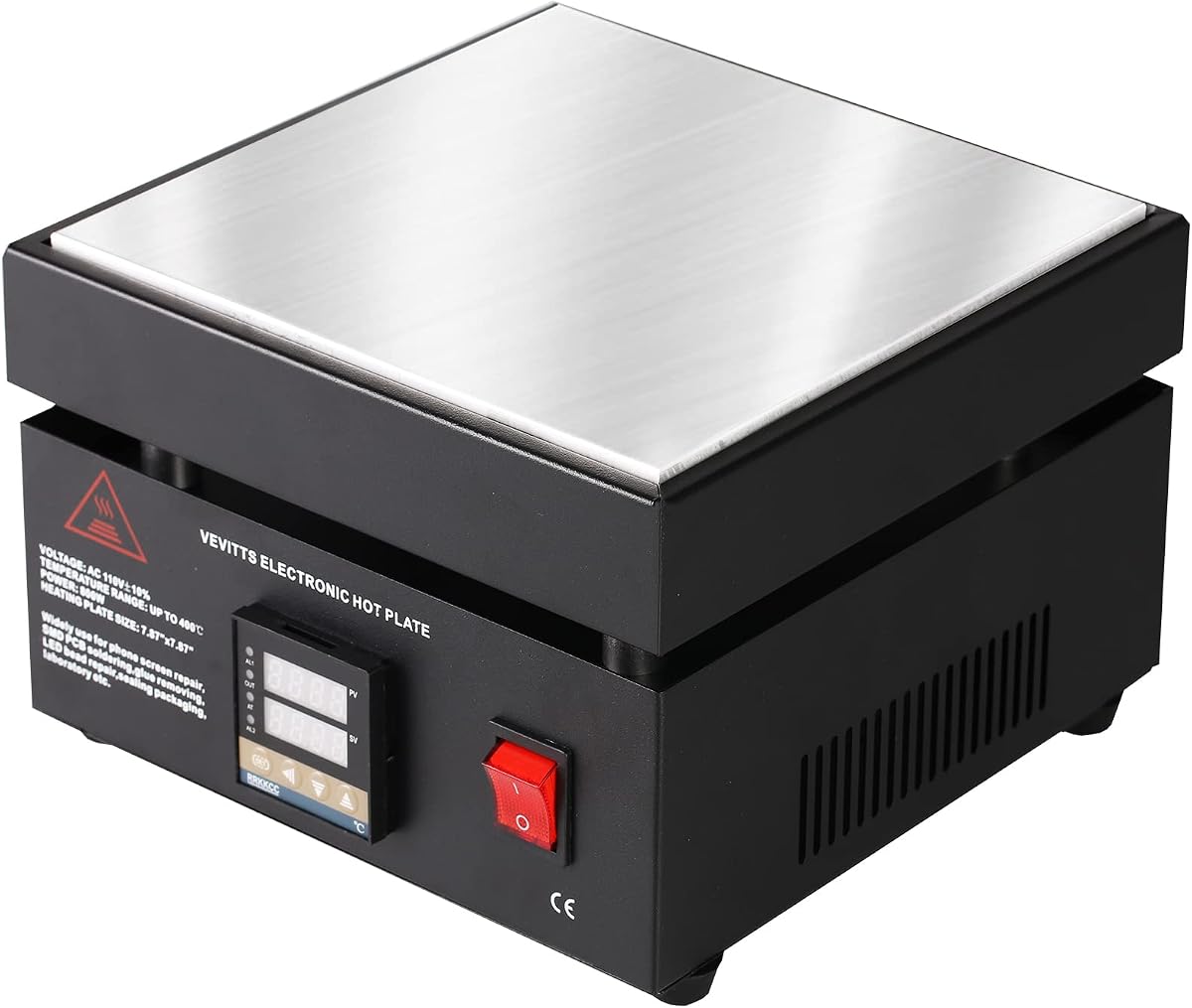

This 850W soldering hot plate combines a 200×200mm aluminum heating surface with a broad 30–400°C adjustment range. Its 4.4 rating reflects a practical design aimed at users who need to preheat or rework several small items at once. The large surface is especially useful for phone screens, LED components, SMD assemblies, and PCBs that benefit from distributed heat.
We may earn a commission when you buy through this link, at no additional cost to you.
Multi-tube heating technology is intended to transfer heat efficiently through the aluminum plate, while the CPU-based controller supports consistent temperature regulation. Three-dimensional cooling holes help dissipate heat from multiple angles. That combination makes the unit more versatile than a simple laboratory hot plate, particularly for electronics repair, component processing, and controlled heating tasks.
The tradeoff is a less sophisticated control panel than the newer digital models in this guide. No independent calibration control is specified, so technicians who require a way to fine-tune the relationship between the displayed temperature and the actual plate temperature may prefer a model with explicit calibration. The general-purpose construction may also be less specialized than an infrared BGA station.
Despite those limitations, this plate is a strong choice for repairers who want more heating space than a compact 100×100mm unit without moving to a dedicated infrared preheater. It is particularly well suited to electronics repair benches, LED work, screen separation, and general preheating. Consider it the broad-heating workhorse of this lineup.
The 200×200mm surface allows multiple joints or small components to be heated together, reducing repeated repositioning during PCB and SMD rework. This is more useful than a tiny plate when the work does not fit comfortably over a single heating point.
Beyond soldering, the listed temperature range supports applications such as LED substrate maintenance, mold-core preheating, sealing and dispensing, baking, drying, and laboratory sample heating. That versatility helps justify its place on a mixed repair and prototyping bench.
We may earn a commission when you buy through this link, at no additional cost to you.
This compact 350W hot plate is built around a 100×100mm aluminum heating plate and earns a 4.6 rating. It offers a 30–400°C range under microcomputer control, making it a practical middle ground between a minimal laboratory heater and a high-power 200×200mm rework platform.
We may earn a commission when you buy through this link, at no additional cost to you.
Multi-tube technology is used to promote efficient heat transfer, while two-dimensional cooling holes provide multi-angle heat dissipation. The controlled temperature and relatively compact platform suit phone screen separation, LED display repair, component work, SMD rework, PCB removal, and routine soldering tasks where the workpiece can fit within the square heating area.
Its main limitation is capacity. A 350W element and 100×100mm platform cannot heat as many points simultaneously as an 850W model with a 200×200mm surface. Multiple larger boards may also require repositioning. It is therefore more appropriate for focused component work than for batch preheating or unusually large assemblies.
This is a good selection for an electronics hobbyist, repair technician, lab, or classroom that wants digital temperature control in a manageable footprint. Choose it when access to electronics, precise adjustment, and repeatable heating matter more than maximum area and power. Its combination of control, compactness, and a 4.6 rating makes it one of the stronger balanced options here.
The 100×100mm platform is large enough for common small PCBs and components but avoids the footprint of a full 200×200mm station. That balance makes it easier to position beside an iron, hot-air tool, magnifier, and hand tools.
Microcomputer temperature regulation is valuable for work involving SMD components and screen assemblies, where changing the temperature of one localized area repeatedly can create uneven results. The broad range accommodates different heating demands without moving to another appliance.
We may earn a commission when you buy through this link, at no additional cost to you.
This 100×100mm digital preheater is the top budget-oriented choice in the guide, combining a 4.8 rating with an extensive feature list. It uses an aluminum alloy plate, a digital display, a temperature sensor, and a microcomputer control system to heat multiple solder joints and components rather than addressing one point at a time.
We may earn a commission when you buy through this link, at no additional cost to you.
The stated 30–400°C adjustment range makes it adaptable to PCB rework, mobile phone motherboard repair, SMD removal, LED display work, and other soldering jobs. Heat-resistant edging helps keep hands away from the active surface, while ventilation holes on both sides and a multi-angle cooling structure help manage heat buildup during extended sessions.
As a 350W, 110V unit, it lacks the rapid output and expansive working area of the 850W models. Users operating on a 220V supply will need to verify compatibility rather than assume compatibility. The supplied information also does not identify a separate calibration control, although the sensor-driven regulation remains a meaningful advantage over a basic on-off heater.
For a DIY enthusiast, student, phone repair technician, or electronics hobbyist building a first bench, this model offers one of the most complete packages in the lineup. It provides digital control, even multi-point heating, useful safety features, and a manageable footprint. That combination makes it the best budget pick for everyday PCB rework.
The temperature sensor provides real-time feedback, allowing the controller to adjust heating power as the plate temperature changes. That approach is more informative than relying only on a simple switch and can make repeated jobs easier to manage.
The combination of a 100×100mm aluminum alloy surface, 350W output, and targeted ventilation fits small PCBs, SMD parts, phone screens, and LED assemblies. It is a sensible first soldering hot plate when the job does not require a large work surface.
We may earn a commission when you buy through this link, at no additional cost to you.
This 200×200mm digital soldering hot plate is the editor's choice because it combines a generous work area, high heating output, real-time temperature feedback, and independent calibration. Its 4.8 rating reflects one of the strongest feature packages in the guide, while the 850W element is well suited to rapid multi-point heating.
We may earn a commission when you buy through this link, at no additional cost to you.
The aluminum alloy plate spreads heat across a square area large enough to accommodate multiple joints, components, or larger sections of a board. A temperature sensor and microcomputer controller help maintain a stable setting across the 30–400°C range. A dedicated front-panel button allows users to calibrate the readout against actual plate temperature over time.
The main constraint is electrical: this model is configured for 220V. It should not be connected to an incompatible supply, and buyers in 110V regions need to confirm their local electrical requirements. Its larger footprint also takes up more bench space than a compact 100×100mm plate, although the additional area reduces the need to reposition work.
This is the most versatile all-around recommendation for a repairer who works on PCBs, SMD components, phone screens, LED displays, and mixed electronics. It is particularly attractive when temperature accuracy and the ability to calibrate matter, but the workspace must be suitable for a 200×200mm platform and the correct voltage.
The dedicated calibration button allows the digital reading to be adjusted to remain consistent with the actual heating pad over time. This is especially useful for technicians who repeat similar jobs and need repeatable working conditions.
Pairing 850W output with a 200×200mm surface makes the unit useful for boards that need several points heated together. It reduces the repeated heating cycle associated with moving a small plate from one joint to another.
We may earn a commission when you buy through this link, at no additional cost to you.
This 850W hot plate offers a familiar general-purpose format: a 200×200mm aluminum heating surface, 30–400°C control, and three-dimensional cooling holes. Its 4.4 rating makes it a credible option for users who want a large, capable plate without the more specialized fixture found on a dedicated BGA station.
We may earn a commission when you buy through this link, at no additional cost to you.
Multi-tube heating technology is intended to transfer heat efficiently through the plate, while the multi-angle cooling arrangement is designed to improve heat dissipation during extended operation. The CPU-controlled platform supports accurate temperature regulation, making it applicable to screen separation, LED display work, component handling, SMD rework, PCB removal, and soldering.
It does not list the digital sensor feedback, independent calibration, or prominent digital readout emphasized by newer models. Those omissions may matter to a professional who wants to verify actual plate conditions frequently. It also offers fewer holding and mounting features than the 853A infrared model.
The plate remains well suited to mixed repair work, including aluminum substrate maintenance in the LED industry, mold-core preheating, sealing and dispensing, sample heating, and laboratory or teaching tasks. Users who want substantial area and power in a straightforward soldering platform will find its core design convincing.
Three-dimensional, multi-angle ventilation helps move heat away from the platform. That design is valuable when the station is used for repeated preheating cycles rather than a single short task.
The stated uses extend into industrial heating, sample testing, and research environments. Buyers in those settings benefit from the same stable temperature platform and large aluminum surface offered for electronics repair.
We may earn a commission when you buy through this link, at no additional cost to you.
The WEP 946D IV is the smallest dedicated soldering hot plate in this group, with a 100×50mm aluminum heating area and a 4.6 rating. It is designed for localized work involving SMD components, LED diodes, BGA chips, smartphone assemblies, screen preheating, and glue removal rather than broad board preheating.
We may earn a commission when you buy through this link, at no additional cost to you.
Its microcomputer controller supports PID programming and cycle timing, a 122–752°F adjustment range, and switching between Celsius and Fahrenheit. The digital readout provides an immediate reference during operation. Metallic guards protect the plate edges, and the compact format can pair with a hot-air rework station or soldering station to approach BGA chips from above and below.
The small platform is also the central compromise. A larger PCB or component group may not fit comfortably, and 210W is less forceful than the 450W and 850W alternatives. The product is rated for 110–127V in the United States and must not be connected to a 220V socket.
For a technician who primarily repairs small smartphones, SMD assemblies, or individual BGA packages, this focused format can be more useful than an oversized plate. It is also backed by one year of US technical support. Choose it when compact access and programmable control outweigh the need to preheat an entire large board.
The 100×50mm surface gives access to small packages while keeping the workpiece centered over the heating zone. This makes the unit relevant to phone, BGA, LED diode, and localized rework procedures.
PID programs, cycle timing, and Celsius-Fahrenheit conversion support a repeatable process. These controls are useful when a technician wants a defined heating cycle rather than simply switching the plate on and monitoring it manually.
We may earn a commission when you buy through this link, at no additional cost to you.
This model pairs an 850W heating element with a 7.9×7.9-inch aluminum plate, offering a large area for soldering and rework. Its 4.8 rating is among the strongest in the guide. The platform is aimed at users who want fast preheating for phone screens, LED displays, component work, SMD redesign, and PCB removal.
We may earn a commission when you buy through this link, at no additional cost to you.
An LED microcomputer controller allows the desired temperature to be set and maintained within the stated 30–400°C range. The broad surface allows a workpiece to sit flat without moving it between isolated heating points. That makes the station more convenient for PCB work than a narrowly focused mini plate.
Compared with the editor's choice, its supplied feature summary does not mention a temperature sensor, independent calibration, or advanced multi-angle cooling. It also has no adjustable holding assembly. These are meaningful omissions for users who want to verify actual plate temperature or secure a board during long rework operations.
The 110V configuration suits many US workbenches and avoids the 220V limitation of the larger digital rework model. This is a strong choice for repairers who prioritize large area, high power, and simple temperature setting over advanced calibration and dedicated workpiece positioning.
The 850W element is designed for quick, efficient component preheating. Combined with the broad aluminum surface, it supports boards and assemblies that would need repeated repositioning on a smaller platform.
The LED microcomputer controller gives the operator a dedicated temperature-setting interface and a 30–400°C range. It is a practical level of control for common electronics rework without requiring the more specialized infrared design.
We may earn a commission when you buy through this link, at no additional cost to you.
The 853A is the most specialized premium option in the guide, designed around infrared ceramic elements, closed-loop PID control, and an adjustable workpiece fixture. Its 4.4 rating reflects a feature-rich station aimed at serious BGA, SMD PCB, and double-sided board rework rather than general laboratory heating.
We may earn a commission when you buy through this link, at no additional cost to you.
Infrared ceramic heating is intended to deliver rapid, efficient warming, while the digital display provides real-time monitoring across a 50–400°C range. The 4.72×4.72-inch stainless steel plate resists corrosion and incorporates an anti-static design for sensitive electronic components. Its surface construction also differs from the aluminum and cast-iron plates elsewhere in the lineup.
The four-thumbcrew holding assembly is the standout physical feature. It can slide and then secure a workpiece at a suitable size, reducing movement during preheating and rework. That makes the station especially appealing for large flat integrated circuits and double-sided boards. The added fixture does take time to adjust and may feel unnecessary for very small components.
This is the recommendation for a technician who values repeatable PID temperature control, infrared heating, board retention, and an anti-static work surface. Its 450W output is lower than that of the 850W plates, but the heating method and fixture make it a more purposeful BGA rework platform. It earns the best premium designation.
Four independent thumbscrews allow the holding assembly to move and lock around different workpiece sizes. Stable positioning is valuable when an assembly must remain aligned throughout heating.
Closed-loop PID control adjusts the heating level while the infrared elements provide rapid warm-up. The clean digital display lets the operator track real-time temperature during desoldering and PCB rework.
We may earn a commission when you buy through this link, at no additional cost to you.
The Vevitts 110V 850W model is designed for repairers who want a large heating area without the noise of a fan. Its aluminum alloy plate measures 200×200mm, and the fanless three-sided ventilation design supports quiet operation during long bench sessions.
We may earn a commission when you buy through this link, at no additional cost to you.
Multi-tube heating technology works with the aluminum surface to promote fast, even heat transfer. A microcomputer CPU controls the 30–400°C range and is intended to support rapid temperature rise, uniform distribution, and consistent constant-temperature operation. A full heat-insulation wrap also helps protect the user from accidental contact with hot exterior areas.
The supplied information does not mention a real-time external temperature sensor, independent calibration, or a board fixture. Users who rely on those features should consider the editor's choice or the 853A. This model also shares the bench-space demands of other 200×200mm plates, although it occupies less lateral space than a square 7.9-inch plate.
It is a compelling option for phone screen separation, LED component processing, SMD rework, PCB desoldering, soldering, laboratories, and teaching institutions. Quiet operation is especially helpful in shared workspaces or during long sessions, making it a refined alternative to louder forced-air systems.
The fanless design avoids the constant background noise associated with many actively cooled electronics stations. That can make long repair sessions more comfortable, particularly in a shared lab or teaching space.
The heat-insulation wrap surrounds the heating system to reduce accidental burn risk. It complements the platform's usefulness for soldering and component work without changing the core heating approach.
We may earn a commission when you buy through this link, at no additional cost to you.
The SHP-1 is a 110V digital laboratory hot plate with a 120×120mm cast-iron surface, a 1KW heating capacity, and a 3.9 rating. It reaches temperatures from room temperature to 500°C and uses CPU control with a digital display to maintain stability within a stated ±1°C.
We may earn a commission when you buy through this link, at no additional cost to you.
Multi-tube heating technology is designed for rapid, uniform heat transfer, while three-sided ventilation and a fanless configuration provide quiet cooling. Heat-resistant insulation borders help reduce burn risk. Its broad temperature range and cast-iron construction make it suitable for glue curing, mold preheating, material testing, factory workshops, and research laboratories.
There is one critical limitation for shoppers searching specifically for a soldering hot plate: the supplied information explicitly says the textured cast-iron surface is unsuitable for PCB reflow soldering. That restriction makes it less suitable than the aluminum and stainless-steel models for conventional electronics rework, even though it is a capable general heater.
This product is best reserved for laboratories, industrial workflows, or users whose primary need is dependable high-temperature heating rather than PCB repair. Its lower rating also warrants more attention to recent customer feedback. For electronics assembly, choose one of the purpose-designed soldering plates instead.
The stated ±1°C control accuracy and digital CPU system suit applications that require consistent sample temperatures. That makes the unit more relevant to laboratory and industrial testing than to casual heat placement.
The textured cast-iron work surface is explicitly unsuitable for PCB reflow. It should not be treated as a drop-in substitute for an aluminum soldering platform, even when the temperature display and heating range appear similar.
We may earn a commission when you buy through this link, at no additional cost to you.
The right soldering hot plate depends on the size and type of components you handle, the precision your work requires, and the electrical environment at your bench. These factors help narrow the field before comparing individual models.
Heating area determines how much of a PCB or component assembly can be warmed at once. A 100×50mm plate is well suited to individual packages, while 100×100mm plates can accommodate small boards and several SMD components. A 200×200mm surface offers room for phone screens, larger boards, and multi-point heating. Larger areas do not automatically guarantee better results, however, because heat must still reach the relevant spots evenly.
Wattage influences how quickly a plate can reach and recover its selected temperature. The 850W models are positioned for rapid preheating and larger surfaces, while the 210W WEP and 350W compact plates target smaller jobs. The 450W infrared model uses a different heating method and includes PID control and a holding fixture. Compare power together with plate area rather than treating wattage as a standalone quality score.
Reliable temperature control helps reduce hot spots, overheating, and cold solder joints. Basic microcomputer control is adequate for many repair tasks, while PID control offers more precise regulation. A real-time sensor provides useful feedback, and independent calibration can keep the digital display aligned with the actual plate temperature. Look for an easy-to-read display and a temperature range that comfortably covers your normal jobs.
Aluminum is common in soldering hot plates because it transfers heat rapidly and distributes thermal load across the surface. Stainless steel offers corrosion resistance and appears in the infrared 853A station, while cast iron provides durable general-purpose heating but is explicitly unsuitable for PCB reflow in the SHP-1. The material also affects heat retention and the type of work the plate can safely handle.
Electrical requirements are a non-negotiable buying factor. Several models are listed for 110V or 110–127V in the United States, while the editor's choice 200×200mm digital preheater is specified for 220V. Plugging a unit into the wrong supply can damage it and create a safety hazard. Confirm the voltage and plug configuration of the exact model before purchasing, especially if your location differs from the listing's default market.
Sustained high output creates heat around the station, so cooling and insulation deserve attention. Multi-angle or three-sided ventilation helps dissipate heat, while a fanless design can reduce noise. Heat-resistant borders, edge guards, and insulation wraps reduce accidental contact. The products also warn against touching the active surface during operation or immediately after shutdown, so safe handling remains essential even with protective design features.
A fixture can be valuable when a board must remain centered and stable during a long heating cycle. The 853A includes an adjustable holding assembly with four thumbscrews that can accommodate different workpiece sizes. Most flat plates rely on the user to position the board by hand. Decide whether your work benefits from adjustable retention or whether the extra setup and bulk of a fixture are unnecessary.
A good soldering hot plate should do more than heat one joint. Look for compatibility with PCB rework, SMD removal, phone screen separation, LED display repair, component processing, and desoldering. Some models also support mold preheating, sealing and dispensing, sample testing, glue curing, and laboratory work. Checking intended applications prevents you from purchasing a general-purpose heater when you actually need a controlled electronics platform.
Before heating a workpiece, confirm that the plate is stable, the surrounding bench is clear, ventilation openings are unobstructed, and the power supply matches the unit's voltage requirement. Place the board or component flat over the center of the heating area without forcing it against an edge. Set an initial temperature appropriate for the material and process rather than starting with the maximum available setting.
Allow the plate to stabilize and verify the indicated temperature before beginning a repair. Work with the top surface accessible, use suitable tools, and keep hands and loose clothing away from the hot area. For BGA removal, the WEP model can be paired with a hot-air station or soldering station so heat can be applied from above and below. Keep a solder wick or other relevant materials close, but never place them on the plate unnecessarily.
After the task is complete, switch off the unit and let the plate cool naturally. Do not touch the surface immediately after shutdown, and do not move it by the heated platform. Clear debris from around the plate, preserve unobstructed airflow, and wipe the surface only after it has cooled using an appropriate non-damaging method. Review the display and calibration behavior periodically so the unit continues to deliver consistent results.
A 100×100mm plate is a practical choice for many small PCBs, SMD assemblies, phone components, and LED repair tasks. A 200×200mm model is preferable when you regularly work on larger boards, screens, or multiple joints that should be heated together. Always compare the plate dimensions with the physical footprint of your usual work.
Not necessarily. A laboratory hot plate may use cast iron and support general heating tasks, while a soldering hot plate is designed with a surface, temperature range, and controls suited to electronics rework. The SHP-1 in this guide is a capable laboratory heater, but its supplied information explicitly says it is not suitable for PCB reflow soldering.
Yes, when the plate size, temperature control, and workpiece handling match the chip and board. The 853A adds an adjustable holding fixture and infrared heating, while the compact WEP 946D IV is designed to pair with a hot-air or soldering station. Combining top and bottom heating can improve control during removal and rework.
The lineup includes models specified for 110V or 110–127V and one clearly listed for 220V. Connecting the wrong plate to an incompatible supply can damage the electronics and create a safety hazard. Check the voltage, plug style, and local electrical requirements for the exact listing before ordering.
Many included models offer a 30–400°C or 50–400°C range, giving room for different electronics processes. The correct setting depends on the solder, board, component, and procedure, so no single temperature is universally correct. Begin conservatively and follow the requirements of the specific repair.
No. A larger surface must combine adequate wattage, quality construction, and an appropriate heating design to distribute heat effectively. Models using an aluminum alloy surface, multi-tube technology, sensors, and microcomputer control are designed for more uniform results, but actual performance also depends on the workpiece and operating conditions.
Fanless designs can reduce noise while ventilation holes dissipate heat, which is useful in quiet labs and shared workspaces. They still generate heat and must have unobstructed airflow. Forced cooling is not automatically superior, but either approach requires sensible ventilation around the station.
Calibration is useful for repeatability because the displayed temperature can differ from the actual plate temperature as equipment ages. It is especially valuable for technicians performing consistent production-like work. For occasional repair, a stable sensor-controlled or microcomputer-regulated plate may be sufficient, but checking the displayed reading remains sensible.
The 100×100mm digital PCB preheater is the strongest budget choice, combining a 4.8 rating, real-time sensor feedback, 30–400°C control, and a compact footprint. The 200×200mm digital model is the editor's choice because its 850W output, broad surface, and independent calibration make it especially versatile for PCB and SMD work.
For a specialized premium station, the 853A offers infrared heating, closed-loop PID control, an anti-static stainless surface, and an adjustable board fixture. Beyond those leaders, the WEP 946D IV suits very small component work, while the remaining aluminum-plate models provide larger areas for phone, LED, and general electronics tasks. Prioritize compatibility with your workpieces, precise control, and safe electrical operation.
Ratings and product information can change as manufacturers update listings, so review the current product page and recent customer feedback before purchasing. Also confirm the exact voltage, plate dimensions, included accessories, and intended application. Taking those final checks seriously helps ensure that the selected soldering hot plate fits both the repair task and the available bench.