
PreSonus StudioLive Classic 16.0.2
4.0Editor score
Multichannel USB recording
Detailed Fat Channel processing
Scene recall and MIDI control
Our Sound Board for Church guide compares 10 mixers for input count, phantom power, effects, recording, monitoring, connectivity, and church-friendly control.
A sound board for church must handle more than microphones: instruments, backing tracks, playback devices, and monitoring often need to work together without complicated routing. The right mixer offers enough inputs, dependable controls, useful effects, and an operating layout that a volunteer or worship leader can understand.
We compared ten sound boards using the supplied specifications, with particular attention to input flexibility, phantom power, equalization, Bluetooth and USB support, recording options, headphone monitoring, and suitability for live church use. The list covers compact personal mixers, multipurpose live consoles, and a more advanced digital recording desk.
Each review explains where the mixer is strongest, where compromises appear, and which teams may find it useful. Ratings and specifications reflect the supplied product information, while features should always be checked against the microphones, instruments, speakers, and computer system used by the church. Availability and pricing can change.
4.0Editor score

4.5Editor score

4.4Editor score
The comparison below highlights the differences in channel capacity, signal processing, media connectivity, and recording capability. It is designed to help worship leaders, volunteer audio teams, and small churches identify a mixer that matches their service demands without paying for unnecessary features.




The W IN-MIX DX16 is a 16-channel mixer built for situations where a church needs to combine several microphones, instruments, stereo sources, and backing tracks in one live mix. Its supplied rating is 4.5, and the most important reason to notice it is the breadth of its channel and processing options. It is especially relevant to the supplied description of church sound teams, touring musicians, event technicians, and home studio operators.
We may earn a commission when you buy through this link, at no additional cost to you.
The console provides 14 XLR and 6.35 mm combo inputs plus two stereo channels, giving worship teams room to bring in lead and backup vocals, keys, guitars, and other line-level sources. Every channel has independent gain and three-band EQ, while a seven-band master EQ helps shape the overall response for the room. Individual 48V switches are useful when the service includes condenser microphones, and illuminated mute buttons reduce the chance of an accidental silence during a transition.
Its 99 DSP effects include reverb, delay, chorus, and dynamics, reducing the need for separate processors in many straightforward setups. Bluetooth supports backing tracks, and USB recording can capture performances to a computer. The trade-off is that this is a large console with many controls, so a volunteer team will benefit from labeling channels, storing a documented soundcheck, and assigning one person to manage the main mix during services.
This is a strong recommendation for small and midsize churches that want one mixer to cover live worship, rehearsals, recordings, and occasional streaming. It may feel excessive for a room that only uses two or three microphones, but for a band, guest speakers, and regular media playback, its input flexibility and per-channel control are difficult to overlook.
The 14 balanced combo inputs and two stereo channels let a team connect microphones, instruments, and stereo equipment without relying on a large collection of adapters. This makes the DX16 practical for services that regularly change between spoken messages, acoustic sets, and fuller band arrangements.
Independent gain, EQ, effects, phantom power, and illuminated mute controls keep common decisions close at hand. A consistent channel-labeling scheme and saved soundcheck settings can make the mixer easier for rotating volunteers to operate.
We may earn a commission when you buy through this link, at no additional cost to you.
The PreSonus StudioLive Classic 16.0.2 is a digital console mixer designed for worship teams that need to blend live sound control with serious recording capability. Its supplied rating is 4.0, but the feature set distinguishes it from the conventional live mixers in this guide. The 18-in, 16-out USB 2.0 interface can record all channels and the main stereo mix at 24-bit/44.1 kHz or 48 kHz.
We may earn a commission when you buy through this link, at no additional cost to you.
The console includes 16 channel inputs, with eight mono and four stereo channels, 60 mm faders, and 12 Class A XMAX solid-state microphone preamplifiers. Fat Channel processing applies three-band semi-parametric EQ, compression, downward expansion, and limiting to channels and buses. Four auxiliary buses, two internal effects buses, a main-bus 31-band graphic EQ, and a pair of 32-bit effects processors provide extensive routing and tone control.
Those capabilities are valuable for a church that records worship services, produces rehearsal tracks, or wants the option to preserve individual channels rather than relying only on a stereo mix. Scene recall can restore approved settings, while MIDI I/O and the included Studio One Artist, Capture, UC Surface, and QMix-UC options support both software control and live-recording workflows. The complexity is the main limitation: a new team should learn the signal flow, bus assignments, and scene structure rather than treating the surface like a basic analog mixer.
This console is best suited to churches with a dedicated audio volunteer, regular recording needs, or a long-term plan to capture services and create media. It offers more depth than simpler mixers while remaining focused enough for live worship. Teams that only need basic amplification and occasional playback will find its broad control set more than they can use.
The multichannel USB interface can capture individual channels and the main mix, giving editors more flexibility during post-production. This is particularly valuable when a service includes a sermon, music, acoustic parts, and playback that may need separate treatment.
Scene storage and recall allow approved configurations to be reproduced more consistently. A church can develop distinct scenes for preaching, worship, rehearsal, and special events while reducing the need to rebuild every setting during a pressured soundcheck.
We may earn a commission when you buy through this link, at no additional cost to you.
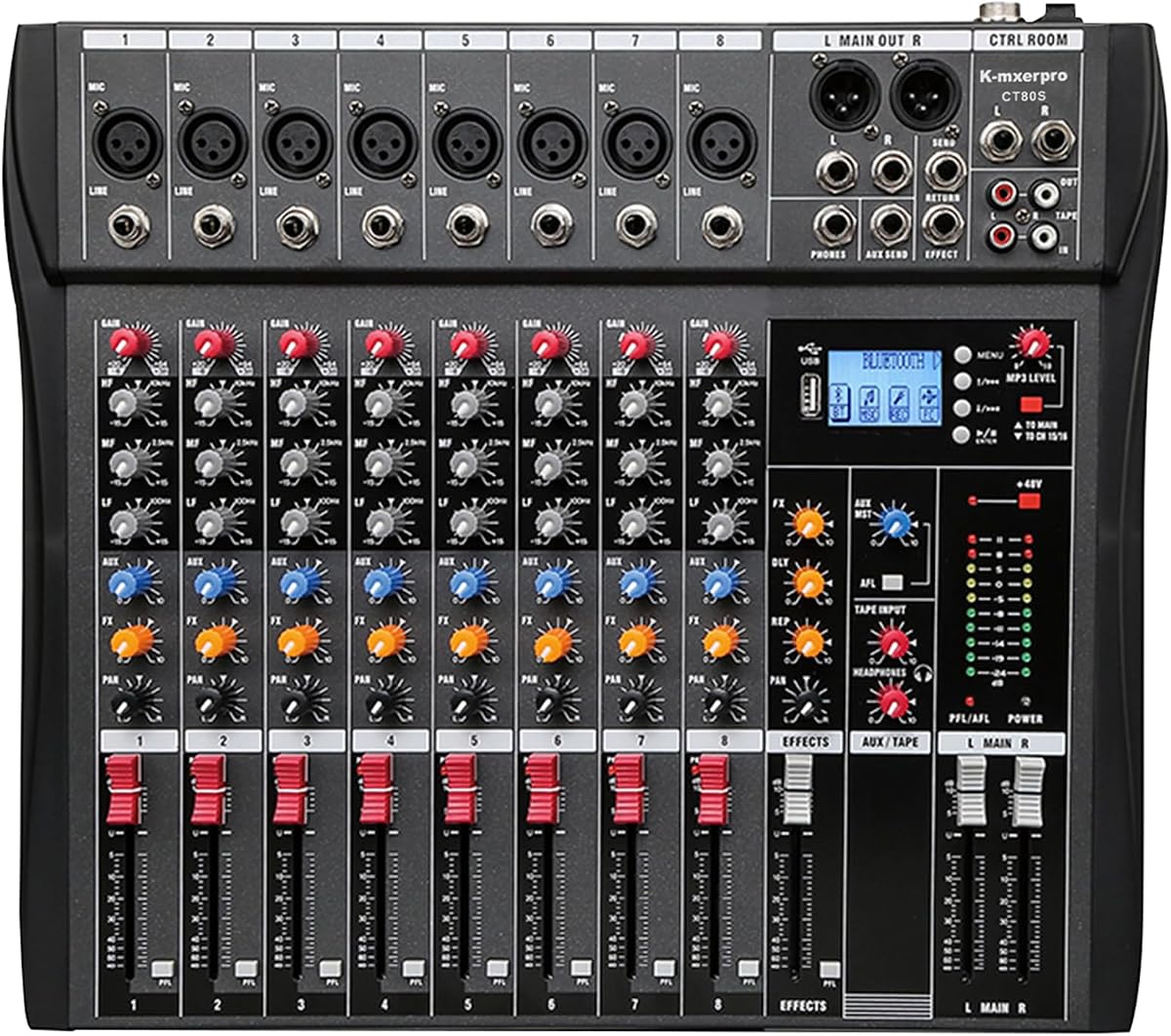
The FULUODE CT-80S is an eight-channel sound system mixer with a 4.4 supplied rating and a feature set aimed at practical live music, conferences, karaoke, and small worship environments. It combines balanced microphone connections, three-band channel controls, 48V phantom power, Bluetooth 5.0, and MP3 or USB media playback in a relatively thin 1.57-inch enclosure.
We may earn a commission when you buy through this link, at no additional cost to you.
Its eight channels can accept wired or wireless microphones and instruments, making the board a sensible center point for a service with several vocal positions and a few instrumental sources. A large LED display shows track information, and the built-in media section provides song selection without requiring a laptop for every playback task. The phantom power supply supports condenser microphones, while the three-band controls help operators balance voices and instruments.
The compromises are principally about scale and flexibility. A small church using only a pulpit microphone may find more channel capacity than required, while a full band with stereo keyboard returns, several wireless microphones, and direct playback may push the board toward its limits. The product information also specifies 110V power and an American plug, so the church should verify that this matches its local electrical setup and equipment expectations.
This mixer is a good fit for small rooms, mobile worship teams, rehearsal spaces, and churches seeking a straightforward live board with modern playback. It is less appropriate as a long-term multitrack recording solution, but for straightforward amplification, wireless microphone support, and service playback, the CT-80S offers a useful combination of features and simplicity.
Bluetooth 5.0, MP3 input, USB media support, and the visible track display make it straightforward to prepare standalone backing tracks. This can be useful for small teams that prefer not to depend on a computer for every service.
Eight channels, familiar three-band equalization, phantom power, and a compact profile provide a manageable starting point. Written channel labels and a consistent gain structure can further reduce confusion for less experienced operators.
We may earn a commission when you buy through this link, at no additional cost to you.
The XTUGA CT120 is a slim 12-channel sound board for live stages, streaming, karaoke, studio recording, and mobile performances. Its supplied rating is 4.3, and its strongest church application would be a small worship team that needs more inputs than an eight-channel console but values a portable, streamlined surface.
We may earn a commission when you buy through this link, at no additional cost to you.
Gold-plated XLR ports and 48V phantom power support balanced microphone connections, while the USB audio interface can record and export to a computer. The built-in media player and recorder handle MP3, WAV, and WMA files, and Bluetooth provides another way to stream from a phone, tablet, or computer. These options help cover spoken messages, music playback, and live recording without forcing every source through the same workflow.
The 1.4-inch chassis and sealed rotary knobs are intended to resist dust and maintain dependable operation, which is useful when the board travels between sanctuary, rehearsal room, and community events. The supplied description uses broad compatibility language for supported channel counts, so buyers should verify the exact input layout on the physical model rather than assuming every configuration is identical.
The CT120 is a strong candidate for a small church, worship band, or mobile ministry that wants a middle ground between compact and large consoles. It should appeal to teams using several microphones, an instrument or two, and occasional playback. Confirm the exact connections, media support, and local power requirements before purchase, because the board is designed to be flexible rather than specialized for a single workflow.
The XLR inputs offer a conventional path for microphones and other balanced sources. With phantom power available, the CT120 can accommodate dynamic and condenser microphones when the appropriate channel settings are used.
Bluetooth, direct media playback, and the USB interface support several common playback methods. Teams should standardize one primary method for services to reduce the chance of an unexpected connection or playback issue.
We may earn a commission when you buy through this link, at no additional cost to you.
This eight-channel professional audio mixer is designed for live shows, streaming, recording, rehearsal, weddings, and small events. It has a supplied rating of 4.0 and a practical set of tools for churches: XLR and unbalanced quarter-inch connections, 48V phantom power, a USB audio interface, Bluetooth playback, three-band equalization, and headphone monitoring.
We may earn a commission when you buy through this link, at no additional cost to you.
Every input channel includes gain, FX, PFL, a level control, and a peak indicator. PFL is particularly useful because it allows an operator to isolate a source in the headphones before bringing it into the main mix. The mixer also includes reverb and delay, which can provide useful space for vocals, although a trained operator should set effects deliberately rather than leaving them at a level that obscures intelligibility.
Media can come from a computer, flash drive, phone, tablet, or Bluetooth source, and the console can record the ongoing mix to a USB flash drive. That flexibility makes it useful for a compact worship setup where the goal is to capture a service mix without deploying a large multitrack recording system. The trade-off is the eight-channel limit, which may be restrictive when a full band, several wireless microphones, and stereo playback are all required.
This board is best for small churches, prayer rooms, rehearsal spaces, or secondary rooms where a limited number of sources need clean live control and a basic recording. Its per-channel PFL, gain, EQ, and peak monitoring create a solid workflow for catching problems early. It is less compelling for a busy sanctuary that expects to expand into more inputs or need isolated track editing.
PFL monitoring and individual peak indicators let the operator check a source before raising its level. This makes the board particularly helpful during quick soundchecks and for volunteers who need immediate visual and audible feedback.
The ability to record to a USB flash drive reduces dependence on a computer during the service. The recording is a combined mix, so editors should understand that individual sources cannot be separated afterward.
We may earn a commission when you buy through this link, at no additional cost to you.
The 12-channel professional sound console is aimed at live performance, recording, streaming, and conference work, with 320 selectable 24-bit DSP effects providing a particularly extensive onboard library. Its supplied rating is 4.1, and the processing depth makes it interesting for churches that want quick access to reverb, delay, and related treatments without adding a floor processor.
We may earn a commission when you buy through this link, at no additional cost to you.
Each channel includes gain, three-band EQ, pan, dual auxiliary sends, a PFL button, 48V phantom power, a -26 dB PAD switch, and an 80 Hz high-pass filter. The master output has a seven-band graphic EQ for overall tonal shaping. Combo connectors accept XLR microphones, quarter-inch instruments, and line-level equipment, giving a small worship team flexibility in how sources are connected.
Bluetooth playback, USB audio input, direct recording and playback from a USB drive, and phone connection through USB add several media routes. Headphone output supports real-time monitoring. The OTG adapter needed for some phone workflows is not included, and operators should verify the exact connection and recording behavior they need before relying on a particular option during a service.
This console is a good candidate for churches running varied events, including worship, conferences, youth gatherings, and community programs. The high-pass filters and PAD control can help manage rumble and unusually hot sources, but they also demand proper gain staging. The large effect library should be treated as a resource rather than a reason to process every channel heavily.
The 80 Hz high-pass filter can reduce low-frequency noise on unsuitable sources, while the PAD switch offers a way to accommodate hotter line-level inputs. These tools are most useful when the operator understands their purpose and avoids unnecessary processing.
Three hundred twenty effects create a broad library for worship, karaoke, and event audio. Teams should save a small set of proven presets for vocals, instruments, and spoken material to keep decisions consistent.
We may earn a commission when you buy through this link, at no additional cost to you.
The GP160 is a 16-channel sound board with a 5.0 supplied rating, the highest in this group. It is explicitly positioned for live stages, churches, studios, and karaoke, making its feature combination directly relevant to worship teams that need flexible live control and a route for recording or streaming.
We may earn a commission when you buy through this link, at no additional cost to you.
A 24-bit DSP chip and per-channel three-band EQ provide the main tone controls, while manual delay and reverb controls allow vocal and instrument effects to be adjusted directly. XLR microphone connections, guitar and keyboard inputs, 48V phantom power, Bluetooth, and USB playback make source setup flexible. The PFL function allows channels to be checked privately, and independent auxiliary sends plus separate headphone and monitor volume controls support a more deliberate monitoring workflow.
The dedicated REC OUT is intended for clean streaming, while the full-size MP3 fader provides visible control over backing tracks. USB audio can be routed through physical channels so equalization can be applied to the music source. A heavy-duty metal chassis and anti-oxidant copper jacks support frequent use, although the 16-channel layout is broad enough that channel organization becomes important. A newer model may also have a shorter public operating history than the established PreSonus console.
The GP160 is a compelling recommendation for a growing church or worship band that wants many inputs, solid live features, and recording flexibility in one surface. It may be more than a small congregation needs, but for a band with worship leaders, backup singers, instruments, and media playback, its channel count and monitoring features create a practical foundation.
Sixteen channels give a team room for microphones, instruments, and stereo sources without moving to a much larger console. The physical layout should be labeled by source, and unused channels should be kept at a consistent neutral level.
PFL, independent auxiliary sends, and separate monitor controls support deliberate sound checks. The recording output can also provide a focused destination for streaming while the main mix continues to serve the room.
We may earn a commission when you buy through this link, at no additional cost to you.
The 6-channel audio interface mixer is a compact option for karaoke, studio work, streaming, recording, and worship settings with a limited number of sources. It has a 4.3 supplied rating and combines four XLR microphone inputs, two quarter-inch stereo channels, three-band EQ, 16 DSP effects, Bluetooth, and a USB interface in a small live mixing surface.
We may earn a commission when you buy through this link, at no additional cost to you.
Each XLR channel supports dynamic or condenser microphones, with 48V phantom power available for condenser models. The two stereo channels can accept instruments, wireless microphone receivers, direct boxes, and other quarter-inch sources. Independent faders and effects controls make it possible to balance vocals and accompaniment, although a church using more than four microphones may need to move to a larger board.
Bluetooth playback and USB media support cover common source formats, and built-in controls allow play, pause, track selection, and mode changes. The 16 effects programs provide basic reverb and delay options. The mixer is described as an analog product, which means a lack of sound can result from incorrect setup rather than a digital software issue. Teams should follow the manual carefully, confirm input selection and gain settings, and test each connection before the service.
This is a sensible choice for a small prayer room, youth space, rehearsal studio, or church that mainly needs a pulpit microphone, a worship leader, a keyboard or guitar, and playback. It is less suitable for a full band, several guest speakers, and a separate monitor mix. Its simplicity and low input count make it approachable, provided the church does not expect to outgrow those limits soon.
Six channels are easy to understand once the church's basic source list is defined. A compact board can be less intimidating for a volunteer than a large surface filled with controls that the team will never use.
Four XLR inputs with 48V phantom power provide useful flexibility for vocal microphones. Phantom power should only be enabled for compatible condenser microphones, while dynamic microphones normally operate without it.
We may earn a commission when you buy through this link, at no additional cost to you.
The 5-channel Bluetooth audio mixer is built around three balanced combo inputs, stereo quarter-inch connections, and left and right RCA inputs. Its 3.7 supplied rating is the lowest among these products, but its feature set is relevant to a small church, rehearsal space, podcast setup, karaoke room, or personal streaming project that needs more processing than a basic passive mixer.
We may earn a commission when you buy through this link, at no additional cost to you.
The first three channels include three-band EQ, built-in compression, independent 48V phantom power, and a high-pass filter. Compression can help control unpredictable vocal levels, while the high-pass filter reduces unwanted low-frequency noise. The 99 effects include reverb, delay, chorus, and flanger, and a headphone jack supports direct hardware monitoring without computer delay.
Bluetooth, flash-drive playback, and USB connection to a computer or mobile device provide several source paths. USB recording captures a stereo mix at 16-bit/48 kHz, not separate tracks, so a separate audio interface is required for multitrack work. The product description specifically positions the mixer for home use and personal projects, which means a church should evaluate it as a supplementary tool rather than automatically assuming it meets professional live-event expectations.
The board is most appropriate for a small worship team handling one or two microphones, a keyboard, and playback, or for church media volunteers who need a convenient streaming mixer. Its small channel count and home-oriented design limit its usefulness for a full sanctuary. Nevertheless, compression, monitoring, flexible stereo inputs, and 99 effects make it a capable option within its intended scale.
Per-channel compression and three-band EQ give an operator useful tools for balancing unpredictable voices. The controls are most valuable when the source is monitored consistently and the settings are adjusted deliberately.
USB capture produces a two-track stereo mix, which is convenient but does not preserve isolated sources for later editing. Churches that need individual tracks should use a dedicated multichannel audio interface.
We may earn a commission when you buy through this link, at no additional cost to you.
The 8-Channel Audio Mixer with Bluetooth is a slim live and recording console with a 4.3 supplied rating. It provides eight XLR and quarter-inch inputs, making it suitable for a small worship team that needs to combine several microphones, instruments, and line-level devices without moving to a large multipurpose mixer.
We may earn a commission when you buy through this link, at no additional cost to you.
Each channel has independent gain, FX, volume, and three-band high, mid, and low EQ controls. Built-in 48V phantom power supports condenser microphones, while delay and reverb can add depth to vocals and instruments. PFL selection and a headphone output allow the operator to monitor a channel in real time, helping identify noise, distortion, or an unexpectedly hot signal before it affects the room.
Bluetooth 5.0 supports streaming from a phone, tablet, or computer, and USB devices can be used for playback and recording. Importantly, the product information states that Bluetooth does not connect to a speaker. It is therefore a source connection rather than a complete wireless link to the church's sound system. The 1.57-inch profile and sealed knobs are designed for portability and resistance to dust during regular use.
This mixer is a good fit for rehearsals, small services, youth rooms, and churches that need a focused number of inputs. Its controls are understandable, and the combination of PFL, EQ, phantom power, and effects is valuable for improving a basic live mix. It is less appropriate for a full band, a growing number of wireless microphones, or teams requiring isolated multitrack editing.
Eight inputs are enough for a basic worship configuration when the team prioritizes microphones and a few instruments. Clear labels and a fixed input order will help volunteers maintain consistent gain and mute settings.
PFL and headphone monitoring help an operator investigate a single source without changing the main mix. This is especially useful when a wireless microphone behaves differently from a wired microphone.
We may earn a commission when you buy through this link, at no additional cost to you.
Choosing a church sound board starts with a realistic inventory of every source that will be connected. The most capable mixer is not necessarily the most useful one; input needs, operator experience, room acoustics, recording goals, and reliability matter more than a long feature list.
Choose enough input positions for the present and foreseeable worship configuration.
Match phantom power availability to the exact microphone assigned to each channel.
Verify that the mixer can connect to the speakers, monitors, recorder, and stream already in use.
Favor straightforward tone controls and a few proven effects over a large but confusing feature set.
Choose a recording format based on whether the church needs a final mix or editable individual tracks.
Prioritize a clear, teachable surface because the volunteer operator will use the mixer more often than its owner.
Choose a durable, portable design that matches where the mixer will actually live and travel.
Begin with a complete input plan rather than connecting sources in the order they are found. List each channel, label it on the mixer, identify whether it carries a microphone, instrument, or stereo source, and note the required gain, EQ, effect, and phantom-power setting. Check all cables, adapters, power requirements, and speaker connections before the service. A brief written chart prevents accidental changes and makes it easier for another volunteer to take over the board.
Perform a soundcheck with realistic levels. Set gain conservatively, leave enough headroom for peaks, engage phantom power only for compatible condenser microphones, and bring each source into the mix one at a time. Use PFL or headphone monitoring to locate hum, distortion, weak signals, and unintended effects. After the main mix is established, set monitor and auxiliary levels separately, confirm the recording or streaming path, and listen to the final output from a position where the operator can hear it clearly.
After the service, save or document the working settings, power down the system in the proper order, disconnect cables without pulling on the connectors, and remove any flash drive or storage device. Keep the board covered and away from moisture, dust, liquids, and excessive heat. Clean the surface with a dry or lightly damp cloth as appropriate, avoid spraying cleaner directly into controls, and periodically inspect sockets, cables, and knobs for wear.
The right count depends on the number of simultaneous sources rather than the number of people in the congregation. List typical microphones, instruments, direct boxes, media players, and guest-speaker inputs, then add a few spare positions. An eight-channel board can work for a small setup, while a 16-channel mixer is more practical for a full worship band and multiple vocal positions.
Phantom power normally supplies the voltage required by condenser microphones. It should only be enabled for microphones designed for it, and a well-behaved dynamic microphone does not normally require the feature. Because incorrect routing can cause silence or interference, check each microphone type and verify the switch on the intended channel before the service.
Many sound boards can capture a stereo mix to a computer or flash drive, which is useful for an immediately usable service recording. Some advanced models can also record individual channels through a multichannel USB interface. Confirm whether the output is a combined mix or isolated tracks, since a stereo mix cannot be separated into individual instruments during editing.
Bluetooth is useful for sending backing tracks or other playback from a phone, tablet, or computer to the mixer. It is not a complete replacement for balanced audio connections in a professional church system, and one product in this guide specifically notes that Bluetooth does not connect to a speaker. For predictable operation, use a wired or approved digital playback path whenever possible.
Main monitoring lets the operator hear the complete mix, while PFL, or pre-fader listen, is used to isolate a selected channel through the headphones. PFL helps diagnose a noisy, distorted, or incorrectly configured source before changing the live mix. It is especially useful in churches where the same board serves different services with different microphones and instruments.
An analog mixer can provide a direct, hands-on control surface and is often sufficient for conventional live amplification. A digital mixer may add multitrack recording, scene recall, software control, and more extensive routing. The better choice depends on the church's recording ambitions, volunteer training, existing software, and budget rather than the digital versus analog label alone.
Start by positioning microphones as close as practical to their sources and aim them away from main speakers. Keep gain under control, apply high-pass filtering when appropriate, and reduce monitor or effect levels that allow the microphone to pick up amplified sound. EQ alone cannot replace correct placement, and changes should be made carefully during the soundcheck.
Keep the mixer covered when it is not in use, protect it from moisture and dust, and inspect cables and connectors regularly. Clean the surface without spraying liquid directly into the controls, and confirm that every channel still has the expected source after a service. Periodic testing also helps reveal a failing cable or connector before it disrupts a rehearsal or worship service.
The strongest all-around choice in this guide is the W IN-MIX DX16 because its 16-channel layout, 14 balanced combo inputs, per-channel EQ and phantom power, 99 effects, and USB and Bluetooth options cover many live church requirements in one surface. The PreSonus StudioLive Classic 16.0.2 stands out for churches that need multichannel recording, sophisticated channel processing, and scene recall, while the FULUODE CT-80S offers a more approachable eight-channel option for smaller services and rooms.
Before buying, write down every source the church expects to connect and prioritize sufficient inputs, compatible outputs, dependable monitoring, and controls the volunteer team can learn. Extra features matter only when they support a real workflow. Confirm phantom-power requirements, recording format, speaker connections, power compatibility, and the exact physical input layout, then test the complete setup during a rehearsal rather than relying on feature descriptions alone.
Product availability and pricing can change, so check the current listing and specifications at the time of purchase. Also confirm details such as included cables, software access, adapters, and media requirements. With those checks completed, the right sound board can become a stable, understandable hub for worship, speech, instruments, playback, recording, and streaming.