
BIGTREETECH TMC2209 V1.3 UART Stepper Driver Module
4.7Editor score
Quiet StealthChop2 operation
UART and STEP/DIR support
Up to 256 microsteps
Sensorless homing capability
This guide compares the best stepper motor driver for 3D printer options by noise, current, microstepping, protection, compatibility, and ease of setup.
A stepper motor driver for a 3D printer acts as the bridge between the controller board and each stepper motor, translating command pulses into controlled current and movement. A capable driver affects print noise, motion smoothness, heat, reliability, and the ease of diagnosing motor-related problems, so choosing the right circuit board deserves careful attention.
The ten products in this guide were compared using their stated current ratings, voltage ranges, microstepping support, control interfaces, protection features, motor compatibility, and intended applications. The list includes basic A4988 modules, higher-current DRV8825 boards, and quiet TMC2208 and TMC2209 options for both traditional and sensorless-homing printer designs.
Each review explains the module's strongest traits, practical trade-offs, and best-fit user, while the comparison table summarizes the key technical distinctions. Ratings reflect the supplied customer feedback, and ratings and product details can change over time. Prices and availability also fluctuate, so check the current listing before purchasing.
4.7Editor score
4.7Editor score

4.6Editor score
This side-by-side comparison highlights the major differences in current capacity, voltage support, microstepping, control modes, protection, and printer compatibility. It is designed to help builders identify the driver that matches their controller, motors, noise tolerance, and homing system.

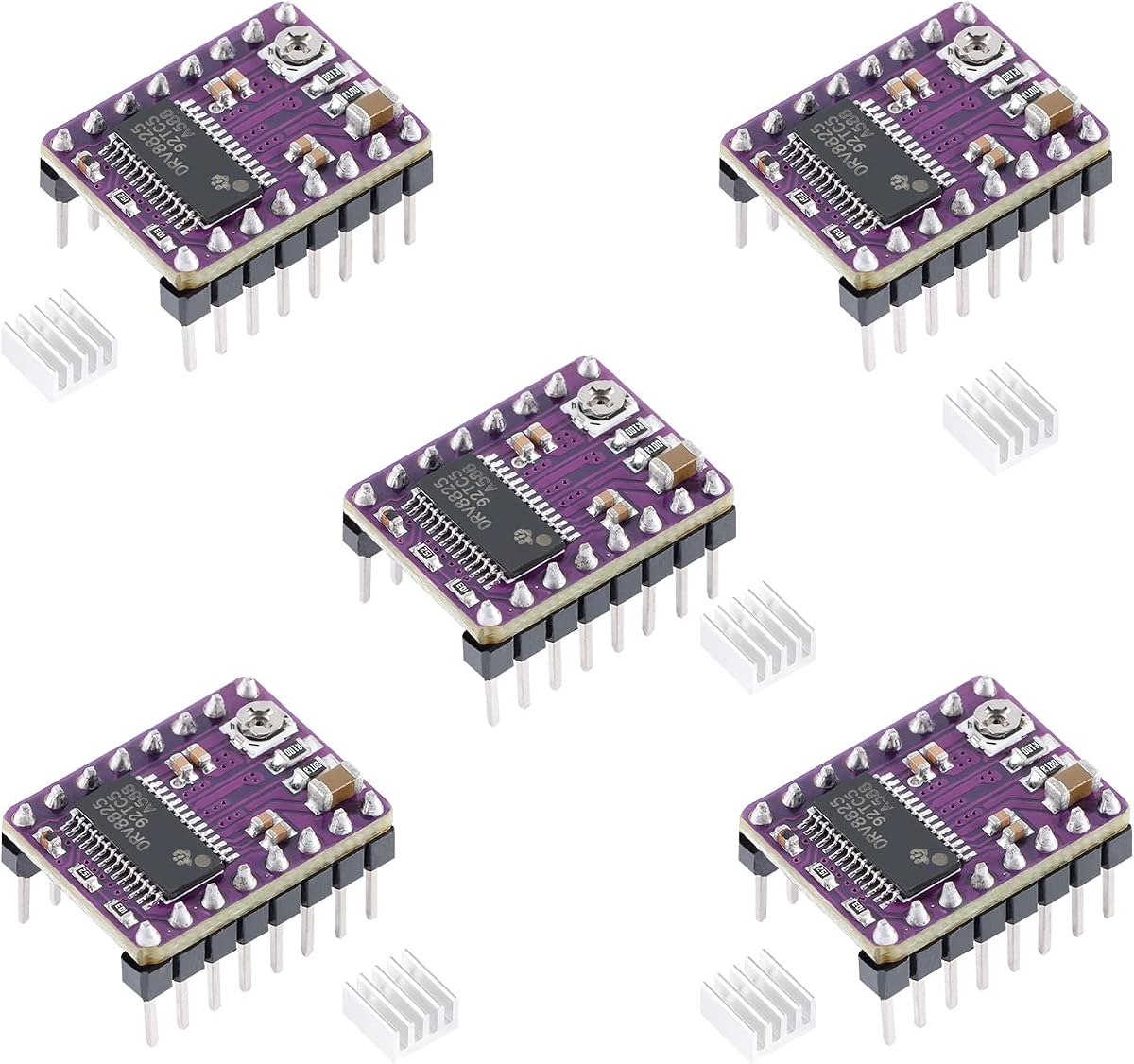


The HiLetgo five-pack A4988 is a straightforward driver option for common two-phase bipolar stepper motors, and it holds a 4.4 customer rating. Its appeal comes from a familiar STEP and direction interface, five selectable step resolutions, and a form factor that works with many entry-level 3D printer controller boards. The included heat sinks and adjustable current control make it a sensible starting point for standard builds.
We may earn a commission when you buy through this link, at no additional cost to you.
Output drive capacity reaches up to 35V and ±1.2A, which fits a common range of printer motors. The board supports full-step through sixteenth-step operation, while intelligent chopping automatically chooses fast or slow current decay. Thermal shutdown, under-voltage lockout, and crossover-current protection add practical safeguards, although the user must still configure the onboard potentiometer correctly and install the heat sink for sustained high-current operation.
The main compromise is that this generation of A4988 hardware has no UART communication or StallGuard sensorless homing. It therefore offers less tuning flexibility than a TMC2209 and cannot directly replace a sensorless-homing function. Its sixteenth-microstep ceiling is also lower than the 32 microsteps of the DRV8825 and the 256-step interpolation available from TMC modules.
This is a good match for a first printer, an educational build, or a RAMPS-style system that uses limit switches. It also works for a simple repair when exact board compatibility matters more than advanced motion features. Choose it when reliability, straightforward wiring, and low complexity outweigh quiet operation and configurable homing.
The STEP and direction interface makes this module familiar to a wide range of printer electronics. A builder only needs a compatible socket and correctly configured microstep jumpers, which simplifies installation on controllers designed around A4988 modules.
The onboard potentiometer allows the output current to be matched to the connected motor. Combined with thermal shutdown, under-voltage lockout, crossover-current protection, and supplied heat sinks, it provides sensible safeguards for sustained printing.
We may earn a commission when you buy through this link, at no additional cost to you.
This BIGTREETECH TMC2209 four-pack combines a 4.7 rating with features normally sought from more advanced printer electronics. It supports a simple STEP/DIR interface as well as UART configuration, giving new builders an easy path into quiet operation and giving experienced users a route to detailed tuning. Four modules cover most core axes, while the quiet StealthChop2 technology is its defining advantage.
We may earn a commission when you buy through this link, at no additional cost to you.
The electrical specifications include a 4.75V to 28V range, continuous current up to 2.0A, and peaks of 2.8A. Up to 256 microsteps and sinusoidal control can improve motion refinement, while CoolStep dynamically manages current and is stated to save 75% energy under supported operating conditions. StallGuard4 can detect changes in motor current, creating a basis for sensorless homing on compatible firmware and hardware.
UART operation requires modifying firmware and the module does not offer the same plug-and-play simplicity as a basic A4988. The higher current ceiling also makes correct motor-to-driver matching important. Users who do not want to configure communication settings can use STEP/DIR mode, although they will not access every UART-only tuning parameter.
This is our best budget recommendation because it combines quiet operation, broad board compatibility, useful sensorless-homing hardware, and a four-module bundle. It suits builders of Ender-style or other modern 3D printers who want cleaner movement without replacing the entire controller board. It is less suitable for a completely new beginner who wants no configuration beyond attaching headers.
StealthChop2 is designed to reduce the familiar high-frequency whining produced by bipolar stepper motors. The result is a more comfortable machine and potentially better print presentation, especially when the printer is running long jobs in a shared workspace.
StallGuard4 can support homing without physical endstop switches when the board, firmware, mechanical setup, and tuning are compatible. UART adds further control, while STEP/DIR remains available for a simpler installation path.
We may earn a commission when you buy through this link, at no additional cost to you.
The DRV8825 five-pack is a higher-current alternative to common A4988 modules, with a stated maximum output of 45V and ±2.5A. Its 4.2 rating reflects a practical option for builders who need more current headroom and finer microstepping without adopting UART-based communication. The five-board bundle and included heat sinks make it useful for multi-axis upgrades.
We may earn a commission when you buy through this link, at no additional cost to you.
The module supports full-step, half-step, quarter-step, eighth-step, sixteenth-step, and thirty-second-step modes. Its four-layer PCB is described as improving heat dissipation, while the internal chip resistance and power consumption are stated to be lower than those of an A4988. A compact 1.5 by 2 centimeter size preserves compatibility with the familiar A4988-style module footprint.
The trade-off is that this remains a conventional STEP/DIR driver without sensorless homing. It is not described as using the ultra-quiet chopping methods of the TMC2208 or TMC2209, so users prioritizing the lowest motor noise will find a TMC module more appropriate. Current settings also need to be established correctly for the connected motor and cooling arrangement.
The DRV8825 fits DIY printers, CNC projects, engraving machines, robotics, and office automation systems where higher current or 1/32 microstepping matters. It is especially attractive for a RAMPS or similar legacy platform upgrade. Choose it when power handling and simple control matter more than silent movement or UART configuration.
The 2.5A maximum output and 45V voltage capability provide more headroom than the A4988 alternatives in this list. That margin can be useful for larger NEMA-style motors, although the actual operating current should remain within both the motor and driver thermal limits.
Thirty-second-step operation can produce smoother movement than a standard A4988. The four-layer board and supplied heat sinks are intended to help manage heat while maintaining the compact module format used by many printer controller boards.
We may earn a commission when you buy through this link, at no additional cost to you.
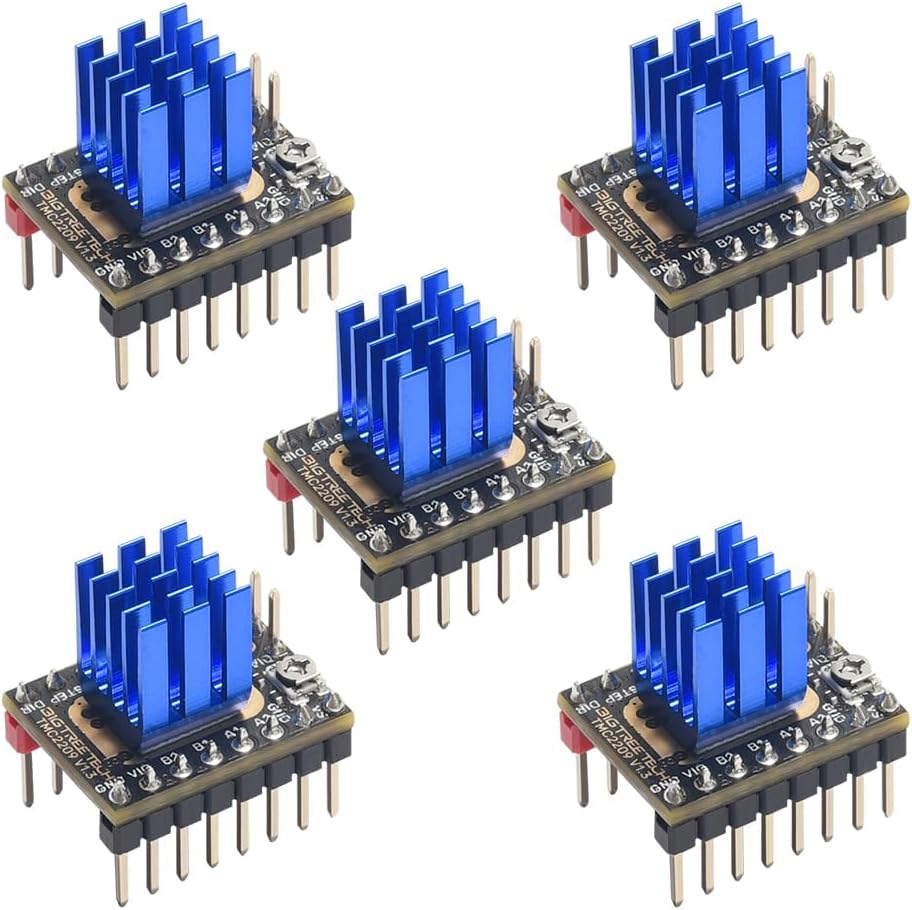
The BIGTREETECH TMC2209 V1.3 earns our Editor's Choice designation because it balances quiet operation, useful configurability, and broad printer compatibility. Its 4.7 rating reflects strong customer reception, and the module's combination of StealthChop2, StallGuard4, 256 microsteps, and dual operating modes makes it a versatile choice for both new builds and upgrades.
We may earn a commission when you buy through this link, at no additional cost to you.
It supports bipolar stepper motors from 1 to 1/256 step modes, operates from 4.75V to 28V, and provides continuous current up to 2.0A with 2.8A peaks. UART and STEP/DIR modes give users options depending on controller support. The listed compatible platforms include BIGTREETECH Octopus, SKR, Manta, and MKS boards, and it can replace several common legacy drivers when pinout and firmware requirements are met.
UART configuration requires firmware modification and the manufacturer's instructions, so this is not the simplest possible option for an absolute beginner. The 28V ceiling also makes it less suitable than the DRV8825 for unusually high motor supply voltages. Sensorless homing depends on correct StallGuard tuning and a mechanically sound axis; the feature should not be treated as a substitute for proper endstop setup in every printer.
This is the strongest all-around choice for a modern enthusiast printer because it reduces noise, can eliminate endstop hardware when properly configured, and supports fine motion control without changing the motor architecture. It is also suitable for replacing TMC2100, A4988, DRV8825, or LV8729 modules in a compatible system, provided board layout and firmware are verified first.
StealthChop2 targets motor noise while retaining torque through the TMC2209's current-regulation architecture. It is particularly attractive for printers in bedrooms, offices, or workshops where continuous stepper noise would otherwise be distracting.
StallGuard4 monitors motor-current changes to identify abnormal rotation, allowing compatible firmware to use that signal for homing. Correct current, acceleration, travel distance, and mechanical reliability remain essential for dependable results.
We may earn a commission when you buy through this link, at no additional cost to you.
The DORHEA TMC2208 five-pack targets a broad audience of 3D printer builders, particularly those using RAMPS 1.4, MKS, Prusa i3, or Ender-3 Pro-style electronics. Its 4.5 rating, quiet operation, 256-step subdivision, and ability to replace several common driver types make it a versatile bridge between legacy and modern printer setups.
We may earn a commission when you buy through this link, at no additional cost to you.
The module supports a 4.75V to 36V voltage range, continuous current of 1.4A, and peak current of 2A. StealthChop2 and microPlyer interpolation are intended to provide smooth, low-noise movement, including when the controller supplies a limited pulse frequency. The adapter includes stackable headers for direct board installation, plus a screwdriver and heatsinks for practical setup.
Its adapter can also test a SilentStepStick or flash a TMC2208 module using a USB-to-serial converter. This is a useful feature for bench testing, though the adapter is preconfigured for standalone operation when the VIO-VM jumper is closed. Users must still distinguish the board's test-oriented features from the behavior of a fully installed printer driver.
Compared with the TMC2209, the TMC2208 has a lower current ceiling but a higher stated maximum voltage. It is a good fit for quieter legacy machines whose motors and controller fall within its electrical limits. Buyers should check the driver footprint, jumper settings, firmware support, and current requirements before replacing an installed module.
The module is positioned as a replacement for TMC2100, A4988, DRV8825, and LV8729 drivers. That flexibility helps builders modernize an existing printer while preserving familiar controller architecture, provided the physical and electrical requirements align.
Stackable headers support direct use on compatible printer boards, while the USB-to-serial configuration allows module testing or firmware flashing. This combination gives experienced builders more ways to validate a driver before installing it permanently.
We may earn a commission when you buy through this link, at no additional cost to you.
This five-pack A4988 provides a familiar, uncomplicated option for DIY 3D printers, CNC machines, and automation projects. Its 4.5 rating and straightforward specification set make it appealing to builders who value easy integration over advanced communication. The modules support full-step through sixteenth-step modes, adjust current through an onboard potentiometer, and include aluminum heat sinks.
We may earn a commission when you buy through this link, at no additional cost to you.
The board supports motor supplies up to 35V and continuous current up to ±1.2A per phase. Intelligent chopping selects fast or slow current decay automatically, while over-temperature shutdown, under-voltage lockout, and crossover-current protection guard against common electrical faults. Documentation and support for installation, programming, and troubleshooting are also identified as included after-sales resources.
This remains an A4988-class design, so it does not offer UART configuration, StallGuard sensorless homing, or the high microstep interpolation of the TMC alternatives. The motor may be audible during movement, and heat management remains important when operating near the stated current ceiling. The claimed broad printer compatibility still depends on the socket, jumper configuration, and firmware settings.
Choose this option for a new standard A4988 build, a collection of replacement modules, or an automation project that needs a dependable STEP/DIR interface. It is especially suitable for users who would rather avoid UART and sensorless-homing setup. Users seeking whisper-quiet operation should look toward the TMC2208 or TMC2209 instead.
The familiar step and direction interface avoids communication setup, which makes this a practical starting point. Five selectable resolutions give enough flexibility for positioning tasks in printing, engraving, and small automation mechanisms.
Matching aluminum heat sinks help move heat away from the driver during sustained operation. Thermal shutdown, under-voltage lockout, and crossover-current protection provide additional layers against common electrical faults.
We may earn a commission when you buy through this link, at no additional cost to you.
The High-Current A4988 five-pack carries a 5.0 rating and offers a complete five-module kit for standard two-phase stepper control. It is designed for 3D printing and other positioning applications where an uncomplicated STEP/DIR interface, adjustable current, and supplied cooling hardware are more important than advanced serial configuration.
We may earn a commission when you buy through this link, at no additional cost to you.
Its stated output capacity is up to 35V and ±1.2A, with a maximum current of 2A when used with the included heat sink. The board supports full-step, half-step, quarter-step, eighth-step, and sixteenth-step operation. An onboard potentiometer adjusts the maximum output current, while automatic fast or slow decay selection helps optimize current behavior across different speeds and loads.
The module includes over-temperature shutdown, under-voltage lockout, and crossover-current protection. Digital documentation and technical support are available for setup, programming, and troubleshooting. As with other A4988 boards, however, the higher heat-sink-assisted figure should not be treated as permission to exceed the motor's rated current or operate without adequate cooling.
This is a good selection for a standard printer build or a group of straightforward automation projects. Its high listed rating and complete bundle may be attractive, but ratings should not replace compatibility checks. Verify the controller's module type, voltage, current limits, and microstep settings before ordering.
The package includes five A4988 modules with pins and five matching heat sinks. That arrangement is convenient for X, Y, Z, and extruder axes, as well as a spare for a printer using more than four motors.
Automatic selection between fast and slow decay can improve motor performance without continuous manual adjustment. The onboard potentiometer still provides an important way to set the maximum current for the connected motor.
We may earn a commission when you buy through this link, at no additional cost to you.
The BIGTREETECH TMC2209 six-pack is the most complete premium bundle in this guide, with six driver modules and heat sinks for a multi-motor printer. Its 4.6 rating reflects strong performance, and the combination of StealthChop2, flexible microPlyer interpolation, SpreadCycle, and compatibility with many modern controller boards makes it well suited to high-quality, quiet machines.
We may earn a commission when you buy through this link, at no additional cost to you.
Each module operates from 4.75V to 28V and supports continuous current up to 2.0A with peaks of 2.8A. Up to 256 interpolation steps can create smoother movement even where the controller supplies a limited pulse frequency. The stated 0.2A RDSon value and lower-resistance output drivers are intended to reduce dissipation and support higher current delivery.
The six-module format leaves room for a printer with more axes or useful spare modules, but it does not reduce the need for correct current configuration. UART and detailed settings may be required for the broadest feature set, and sensorless homing needs careful tuning. Users should also ensure that their controller board and firmware support the intended operating method.
Choose this package when replacing all the main drivers in a modern printer, building a six-motor machine, or keeping matching spares available. It is a premium option for builders who value low noise and a complete set of matching hardware more than a minimal module count. Verify board compatibility and motor current ratings before installation.
Six matching modules simplify a comprehensive printer rebuild and cover common X, Y, Z, extruder, and additional-axis arrangements. Including heat sinks also keeps the cooling hardware consistent across the installation.
The low-resistance output design is intended to limit power dissipation while delivering current efficiently. SpreadCycle provides precise cycle-by-cycle regulation, while StealthChop2 focuses on reducing audible motor noise during normal movement.
We may earn a commission when you buy through this link, at no additional cost to you.
This BIGTREETECH TMC2209 combines quiet operation, UART and STEP/DIR control, sensorless-homing hardware, and 256-step interpolation. Its 4.2 rating is lower than those of several other TMC2209 listings in the guide, but the supplied specifications remain strong for users who value the full TMC feature set and a flexible installation path.
We may earn a commission when you buy through this link, at no additional cost to you.
The driver handles continuous current up to 2.0A and peaks of 2.8A within a 4.75V to 28V range. StealthChop2 is designed for low-noise movement, while CoolStep dynamically controls current and is stated to save 75% energy. StallGuard4 can provide a basis for sensorless homing by detecting abnormal motor-current changes during axis travel.
The product is described as compatible with boards including BIGTREETECH Octopus, SKR, Manta, SKR Pro, and MKS Gen L, but users should still verify their exact model and firmware. Sensorless homing depends on correct mechanical setup and tuning. UART adds configuration work, while STEP/DIR simplifies installation at the cost of access to some advanced settings.
This is a solid choice for a modern enthusiast build that benefits from quiet operation and wants the option of sensorless homing. It suits users who are comfortable consulting configuration instructions and troubleshooting motion behavior. For the simplest installation, choose a basic STEP/DIR A4988 instead.
CoolStep adjusts current dynamically according to operating demands, which can reduce energy use and heat. That behavior is useful for printers that run long jobs and need to balance noise, temperature, and power consumption.
StallGuard4 can detect changes in motor current that indicate the motor is no longer rotating normally. Compatible firmware can use that information to establish an axis end position, although successful homing depends on calibration and reliable mechanics.
We may earn a commission when you buy through this link, at no additional cost to you.
The two-pack TMC2208 V1.2 is a focused option for builders who need to upgrade selected axes rather than replace an entire set of drivers. Its 4.5 rating and support for common Reprap, MKS, Prusa i3, and Ender-3 Pro-style electronics make it relevant to both repairs and incremental printer upgrades.
We may earn a commission when you buy through this link, at no additional cost to you.
Each module supports a 4.75V to 36V supply, 1.4A continuous current, 2A peak current, and 256-step subdivision. StealthChop2 and microPlyer interpolation support low-noise, smooth motor behavior, including where pulse frequency is limited. The adapters include stackable headers for direct board installation, and the configuration can support testing or flashing a SilentStepStick through a USB-to-serial converter.
The two-piece quantity is less convenient for a complete five-axis build, and the current ceiling is below that of the TMC2209. Users who want all the advanced TMC2209 functions or greater current headroom should evaluate that alternative. The board's ability to replace A4988, DRV8825, TMC2100, and LV8729 modules is useful, but footprint and firmware compatibility must still be checked.
This two-pack is best for a targeted upgrade, such as replacing the two drivers responsible for the most objectionable printer noise. It also works for testing whether a TMC module suits a legacy system before purchasing a full set. Choose it when two well-equipped modules and convenient testing support matter more than maximum bundle size.
Replacing only the two loudest motor drivers can provide a noticeable improvement without rebuilding every axis. The quiet chopping and fine subdivision are particularly useful for smooth movement in X, Y, Z, or extruder positions.
The stackable adapter supports direct installation, while USB-to-serial access allows bench testing and firmware flashing. These features help users validate operation before committing the modules to a permanent installation.
We may earn a commission when you buy through this link, at no additional cost to you.
Choosing a stepper motor driver for a 3D printer requires matching electrical limits, control methods, motion features, and physical board compatibility. The most important starting point is the printer's controller and motor configuration, followed by the desired balance of quietness, current headroom, microstepping, and installation complexity.
Begin by identifying the exact controller board, socket type, jumper layout, and firmware in the printer. A4988-compatible, DRV8825, and TMC2209 modules may share a broadly similar footprint, but small differences in pin functions, onboard communication, or required configuration can prevent a board from working as intended. Check the manufacturer's documentation and do not assume that physical insertion alone guarantees compatibility.
The driver's voltage rating must exceed the motor supply voltage used by the printer, while its current capability must match the motor's rated phase current without exceeding the driver's thermal limits. Peak-current figures are not equivalent to a continuous operating target. Use the motor manufacturer's specifications, set the current control conservatively, and improve cooling if the driver operates near its limits.
Quiet chopping technologies such as StealthChop2 are major reasons to choose a TMC2208 or TMC2209. Fine microstepping and interpolation can improve the smoothness of movement, while higher microstep resolution alone does not guarantee a quieter or more accurate print. Consider the printer's use environment, the type of motion, and whether low motor noise will noticeably improve the user's experience.
The listed options range from sixteen microsteps on the A4988 modules to thirty-two on the DRV8825 and as many as 256 on the TMC2208 and TMC2209. More microsteps can make movement look and sound smoother, but the controller must issue enough pulses to use them. Firmware configuration and the printer's mechanics remain important, so a higher resolution setting is not an automatic upgrade in every case.
STEP/DIR operation is familiar and relatively simple, while UART allows more detailed configuration when the controller and firmware support it. StallGuard-based sensorless homing can reduce the need for physical endstops, but it requires careful current, acceleration, and travel tuning. Existing printers with reliable limit switches may gain little from sensorless homing, whereas a new board design may benefit from fewer mechanical switch failures.
Stepper drivers dissipate heat as current increases, so heat sinks, airflow, and correctly set current are critical to dependable operation. The listed modules include thermal shutdown, under-voltage lockout, and crossover-current protection on the A4988 options, while the four-layer DRV8825 board is specifically described as improving heat dissipation. Protection circuits are safeguards, not substitutes for sensible current configuration.
Bundles range from two TMC2208 modules to six TMC2209 modules, while most A4988 and DRV8825 choices include five. A typical printer may need four modules for the main axes, so a five-pack covers the core machine and a spare. A six-pack can suit an extended-axis build or provide matching replacements. If only one noisy axis needs improvement, a smaller set may be enough.
Advanced drivers offer more capability but also more ways for setup to go wrong. Look for clear instructions, board-specific examples, UART configuration guidance, and support resources. Several listings mention BIGTREETECH's GitHub instructions or digital documentation, which can be valuable when changing communication modes, setting current, or tuning sensorless homing.
Before installation, disconnect the printer's power and confirm the motor voltage, rated phase current, controller model, and module compatibility. Consult the controller documentation for the proper socket orientation, jumper settings, and any UART requirements. Install the specified heat sink, attach the correct cables, and avoid forcing a module into a socket whose pin layout differs from the board.
Set the driver's current to an appropriate value for the connected motor, starting conservatively and increasing only while monitoring temperature and motion. In UART mode, configure the communication address and driver settings in firmware before testing. Confirm the selected microstep resolution, acceleration, and travel limits, then use a small manual move to verify direction and smooth operation before beginning a full print.
During operation, keep airflow around the driver and watch for unusually hot modules, repeated motor stalls, unexpected noise, or lost steps. Clean dust from the heatsink and surrounding air paths, and check connectors for looseness. If a problem appears, stop the motion, disconnect power, and recheck current, wiring, firmware settings, and motor compatibility before changing components. Do not operate a driver without adequate cooling or beyond its electrical ratings.
For most modern printer upgrades, a TMC2209 offers quieter movement, finer interpolation, and optional sensorless homing through StallGuard4. An A4988 remains useful when simplicity, broad legacy compatibility, and minimal configuration are the priorities. The best choice depends on the controller board, firmware, motor ratings, and whether the user wants to tune the driver.
Yes, the listed TMC2209 modules support both STEP/DIR and UART modes. STEP/DIR is the simpler option and is useful for basic operation, while UART provides access to more configuration and is required for some advanced functions. Firmware support and the controller's communication wiring must both be confirmed before installation.
Use the rated phase current from the motor specifications and set the driver to a suitable level while allowing for the board's cooling conditions. The onboard potentiometer on A4988-style modules and the TMC's configuration process both require care. If the module becomes excessively hot, the motor stalls, or the current rises unexpectedly, reduce the setting and check the wiring.
A heat sink is strongly recommended whenever the driver handles substantial current for an extended period, because the chip can become hot even when the motor is stationary during a print. The TMC modules in these listings are sold with heat sinks, and the A4988 and DRV8825 bundles also include them. Attach the correct sink and maintain airflow around the board.
No. Sensorless homing uses motor-current monitoring to detect a stall, which can reduce mechanical switch usage on compatible systems, but it depends on firmware support, correct current settings, suitable acceleration, and dependable mechanics. A printer with properly functioning endstops does not automatically need sensorless homing, and a failed stall detection can also cause an axis to move farther than intended.
Replacement may be possible when the physical footprint, voltage, current, jumper configuration, and firmware are compatible. DRV8825 and TMC2209 boards are often designed around the familiar A4988-style footprint, but onboard communication and microstep settings can differ. Verify the exact board documentation and change the firmware or jumper configuration as required.
The listed DRV8825 module has a stated maximum output of 2.5A and a 45V maximum voltage, while the TMC2209 options support 2.0A continuous current with 2.8A peaks and a 28V maximum. A higher headline rating does not automatically make a driver better, because sustained operation, heat dissipation, motor requirements, and the printer's supply voltage determine the practical result.
Loud movement can result from an incorrect microstep setting, inadequate current, a loose belt, mechanical binding, low supply voltage, or a driver operating in a mode that emphasizes torque over quiet movement. Check the motor specification, driver configuration, heat-sink installation, and printer mechanics. If the board supports UART, review its current and chopping settings in the firmware.
The BIGTREETECH TMC2209 four-pack stands out as the best budget-oriented choice because it combines quiet StealthChop2 operation, UART and STEP/DIR modes, sensorless-homing hardware, and four matching modules. The Editor's Choice TMC2209 is the most versatile standalone recommendation, while the six-pack TMC2209 is the strongest complete premium bundle for a multi-axis machine.
Prioritize exact controller and firmware compatibility first, then match voltage, continuous current, microstepping, and homing needs to the printer. A4988 modules remain sensible for simple legacy builds, the DRV8825 offers greater current and 1/32 stepping, and the TMC2208 is a useful quiet option for selected axes. Correct current settings and heat management are more important than any headline specification.
Ratings, availability, and prices can change, and firmware support can evolve across printer platforms. Before ordering, check the current product listing, compare the exact board requirements, read the installation instructions, and confirm that the kit quantity matches the number of axes you intend to equip.