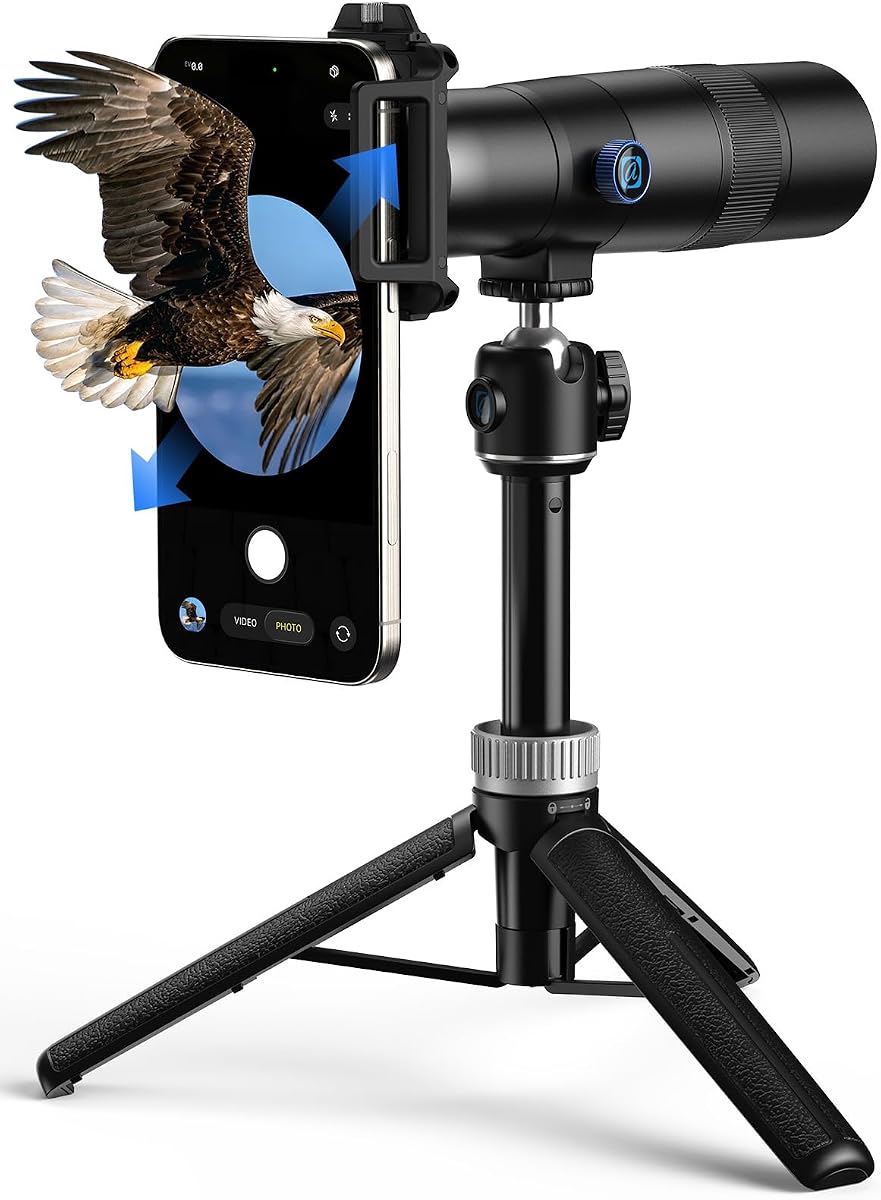
MIAO LAB 30X Telephoto Lens
4.6Editor score
Adjustable manual focus
Dual viewing modes
Aluminum tripod included
Our guide compares the best telephoto iPhone camera lenses for magnification, stability, compatibility, optics, and everyday outdoor use.
A telephoto iPhone camera lens can transform distant scenery, wildlife, performers, and architectural details into more useful photographs than the phone’s built-in cameras provide. The most important factors are magnification, optical clarity, field of view, manual focus, mounting stability, and precise alignment with the main camera.
We compared ten clip-on telephoto lenses using their stated magnification, optical construction, focusing method, included accessories, phone compatibility, and intended shooting distances. The list includes models ranging from 10X to 50X, adjustable 20–60X optics, and a dual telephoto-and-macro option for close subjects.
Each review identifies the strongest use case and practical compromises of its featured lens, from easier subject framing to the reach required for very distant targets. Product ratings and availability can change over time, and current prices should be checked before making a purchase.
4.6Editor score

4.8Editor score

4.3Editor score
This side-by-side comparison highlights magnification, optical design, focusing approach, stability support, and smartphone compatibility. It helps distinguish lenses designed for easy framing from extreme-distance tools and versatile all-purpose models.


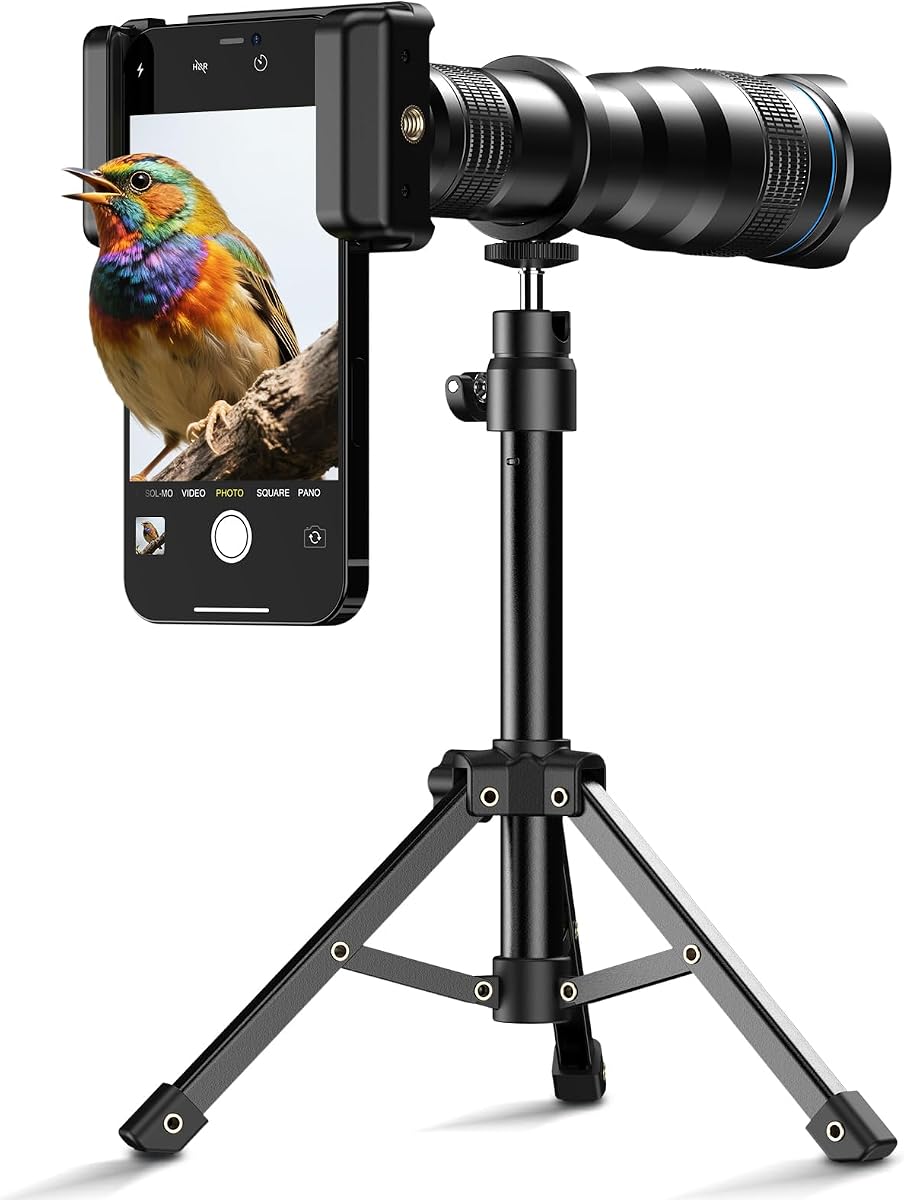


The APEXEL 10X Tele-Macro Pro stands apart because one clip-on accessory combines a 10X telephoto lens with a 10X macro optic. Its 4.3 rating reflects a practical approach for users who want more than simple digital zoom without committing to a narrow, extreme-magnification system. The stated eight-inch macro focusing distance also makes it unusually versatile for flowers, leaves, and insects.
We may earn a commission when you buy through this link, at no additional cost to you.
Its optical design uses 12 elements and full-surface multi-layer coatings intended to reduce glare and distortion while supporting clarity, color, and light transmission. The body weighs only 5.12 ounces, so it is easier to carry than many larger telephoto kits. Its minimalist universal clip is designed to attach in seconds without tools, making it convenient for travel, hiking, concerts, and spontaneous outdoor shooting.
The central trade-off is magnification. A 10X optic cannot match the reach of the 28X, 30X, 36X, 50X, or 20–60X lenses in this guide. It is therefore less suitable for tiny wildlife subjects or details at extreme distance. The macro capability also does not make this a general-purpose close-up lens for every subject, since the stated focusing distance is specific rather than a broad near-field range.
This is the best choice for buyers who value one small accessory capable of covering both distant scenes and small natural details. It is especially useful for casual travel photography, concerts where the performer is moderately distant, and close observations of insects or foliage. Those wanting maximum reach should consider a 30X or 36X model instead.
The combined telephoto-and-macro design reduces the need to carry separate optics. It is particularly useful when a trip includes both distant stage action and nearby natural details.
The coated 12-element structure and low 5.12-ounce weight make this model appealing for mobile creators who want more reach without the bulk of a larger spotting scope.
We may earn a commission when you buy through this link, at no additional cost to you.
The APEXEL 36X Telephoto Lens earns the highest rating in this comparison at 4.8 and provides a strong balance of reach, clear compatibility guidance, and outdoor practicality. It is designed for subjects approximately 100–500 feet away, covering useful territory for birds, architectural details, performers on a well-lit outdoor stage, and other stationary or slow-moving targets.
We may earn a commission when you buy through this link, at no additional cost to you.
Multi-coated optical glass is intended to reduce reflections and flare, while the aluminum-alloy body offers a durable option for travel and outdoor use. The included tripod is especially important at this magnification because even minor hand movement can become visible in the final photograph. The product guidance recommends aligning the optic with the phone’s main camera, turning the focus ring, and using a three-second camera timer.
This is not the easiest model for rapidly moving athletes or performers. At 36X, both framing and focus become demanding, and the stated guidance specifically says the lens is not suitable for fast-moving subjects. Low-light venues can also be challenging because a telephoto attachment gathers less light than a phone’s standard camera.
Despite those limitations, it is the strongest general recommendation for a buyer who wants substantial magnification and a relatively controlled field of view. The adjustable clip fits phones 66–95 millimeters wide, but camera alignment remains essential. It is best suited to photographers willing to plan their position, stabilize the setup, and focus before the decisive moment.
Compared with a 50X optic, the fixed 36X design offers more practical framing while still resolving subjects that a phone camera cannot approach. That balance makes it versatile for birds, buildings, and outdoor events.
The included tripod and timer guidance address the most common problem with high-power phone lenses. A stable platform and deliberate focusing routine produce more dependable results.
We may earn a commission when you buy through this link, at no additional cost to you.
The MIAO LAB 28X HD Telephoto Lens is built around easier subject location and a wider field of view than is common among similarly powerful phone telescopes. Its 3.9 rating is the lowest in this lineup, but the design priorities remain clear: concerts, sports, bird watching, wildlife, and travel are the intended applications.
We may earn a commission when you buy through this link, at no additional cost to you.
The lens uses a redesigned light path to improve light intake and a field-of-view ring intended to limit dark corners. The listing appropriately notes that results can vary by phone model because sensor positions and camera systems differ. Manual focusing is used to bring distant subjects into clarity, and the aluminum body can function as a monocular for extended viewing.
Its limitations include the same issues inherent to any clip-on telephoto system, especially alignment, shake, and changing phone camera behavior. The 3.9 rating also suggests the buyer should pay particularly close attention to recent customer feedback before ordering. A tripod is not listed among the included accessories, which may make steadier support an additional purchase.
This model is most attractive to users who find ultra-narrow 36X, 50X, or 60X views difficult to manage. The 28X magnification still provides meaningful distance reach, while the wider view makes locating wildlife or a concert performer more manageable. It is a sensible choice for beginners who prioritize framing over maximum magnification.
A wider field of view gives the photographer more room to locate a subject before locking focus. It is a practical advantage in landscapes, outdoor sports, and wildlife observation.
The monocular function gives the optic value before or between photographs. It is useful for scanning the horizon, identifying birds, and studying distant scenery without relying on a phone screen.
We may earn a commission when you buy through this link, at no additional cost to you.
The MIAO LAB 28X Telephoto Lens carries a 5.0 rating and focuses on a practical middle ground between ordinary phone zoom and extreme telephoto magnification. It is designed for stable outdoor subjects roughly 15–80 meters away, including birds, boats, landmarks, and sporting events that appear too small in a standard camera view.
We may earn a commission when you buy through this link, at no additional cost to you.
The 28X design is described as wider and more natural than many higher-power phone telescopes, which makes it approachable for beginners. Manual focus is adjusted by slowly rotating the focus ring. Because magnification reveals even slight hand movement, the recommendation is to brace the arms or use a tripod, although that tripod is sold separately. The aluminum body also supports direct viewing through a monocular-style setup.
Edge darkening is reduced rather than eliminated, and performance can differ because multi-camera phone layouts vary. The instructions advise centering the lens over the 1X main camera and applying a small amount of digital zoom when needed. Users should also disable automatic macro or lens switching when the phone offers those controls, as automatic changes can interrupt the optical connection.
This lens suits buyers who want a broad 28X reach without the extremely narrow composition of a 50X or 60X optic. It is also a strong choice for travel because it can function as a camera attachment or handheld monocular. The separate tripod requirement is a drawback, but it gives the buyer flexibility to choose a support suited to different outings.
Twenty-eight times magnification provides substantial reach while preserving a view wide enough for locating subjects. The stated 15–80-meter range is especially relevant to landscape and wildlife outings.
A correct 1X camera position and controlled focus can influence results more than a small difference in advertised magnification. The clear setup guidance helps buyers avoid common camera-switching problems.
We may earn a commission when you buy through this link, at no additional cost to you.
The 36X Evil Eye Telephoto is a broad outdoor kit with a 4.2 rating, adjustable focus, a storage bag, and an included aluminum tripod. Its stated uses include camping, sporting events, moon watching, bird watching, fishing, hiking, golf, concerts, travel, and general landscape observation, giving it appeal beyond conventional phone photography.
We may earn a commission when you buy through this link, at no additional cost to you.
The body is described as aircraft-grade aluminum with quality optical glass, while the focus ring changes the lens’s focal setting. A fixing ring allows the optic to be assembled onto the tripod, freeing the user’s hands and reducing the shake that becomes conspicuous at 36X. The phone clip is advertised as compatible with the vast majority of smartphones.
Some marketing language is broader than the product details support, such as suggesting the lens can clearly capture things miles away. Environmental haze, atmospheric conditions, subject movement, and available light can make such extreme claims difficult to realize. A narrow field of view also makes finding and tracking smaller subjects more demanding than with 28X or 30X alternatives.
This kit makes the most sense for an all-purpose outdoor buyer who values included accessories and versatility. The tripod, bag, and monocular function create a complete package for travel and observation. It is less compelling for users who want especially easy framing, so the prospective buyer should understand that 36X is a specialist reach rather than a casual zoom.
The tripod and storage bag make the system easier to deploy and carry than a bare lens. It is a good fit for hikes, campsites, and events where observation and photography may happen together.
No phone telephoto can create detail that the original image did not contain. Haze, low light, motion, and focus accuracy all influence the final result at extreme distances.
We may earn a commission when you buy through this link, at no additional cost to you.
The APEXEL 50x Telephoto Lens is the premium long-reach option in this guide, combining 50X magnification with a detailed 10-element, seven-group optical system. Its 4.3 rating and specified performance characteristics position it for serious wildlife, moon, landscape, and target-viewing applications where greater reach justifies a larger, more specialized setup.
We may earn a commission when you buy through this link, at no additional cost to you.
The lens has a 55.5-millimeter objective, 50X magnification, and a 1200-millimeter equivalent focal length. Stated figures include at least 99% light transmission, approximately 95% reflectivity, and 2.8% distortion, while the multi-layer coating is intended to reduce ghosting and flare. The included tripod and phone holder are specifically designed to control the shake that hand-holding would reveal at this magnification.
This is a highly specialized tool rather than an everyday telephoto. Its narrow field of view can make small wildlife or moving subjects difficult to locate, and a phone’s digital zoom may be needed to reduce dark edges or improve framing. The instruction to mount the lens on the tripod first and never hand-hold it is sensible because the weight and reach increase the risk of dropping the phone or optic.
The buyer who selects this model is prioritizing maximum fixed magnification, optical specification, and a complete stabilizing system. It is well suited to stationary wildlife, lunar observation, and distant landscape details. Those who struggle with narrow framing should instead choose a 28X or 36X lens, while the 20–60X alternative offers more flexibility.
Fifty times magnification reaches beyond the fixed 28X, 30X, and 36X options. The tripod, holder, and universal clip create a system designed to turn that reach into repeatable results.
The removable eyecup converts the optic into a monocular for wildlife and moon observation. This is valuable for long sessions because the viewer can concentrate on finding a subject before attaching the phone.
We may earn a commission when you buy through this link, at no additional cost to you.
The APEXEL 36x Telephoto Zoom combines a 4.4 rating with a wider field of view than the 50X option. It is designed for graduation ceremonies, campus sports, birds, wildlife, fishing, camping, zoo visits, outdoor events, and distant scenery, with a recommended shooting range of approximately 30 to more than 200 feet.
We may earn a commission when you buy through this link, at no additional cost to you.
Multi-coated glass elements are intended to reduce glare and distortion while producing natural color. The clip supports phones measuring 66–95 millimeters wide, and the instructions explain that a thick case may need to be removed. Correct alignment over the 1X main camera is essential, and the guide recommends a small amount of phone zoom to minimize the circular dark edges sometimes visible at 1X.
The product’s key benefit is easier subject tracking than a 50X system provides. However, this is still a high-power telephoto, so movement and hand shake can affect results. A tripod is not specified as included, making external stabilization advisable. The product is also explicitly not intended for close-up family photography, and automatic macro behavior should be disabled on supported iPhones when it interferes.
This is a compelling alternative for buyers who want high magnification but dislike the extreme narrowness of 50X optics. It works especially well for predictable outdoor events where the subject can be located before the shot and focus can be set in advance. For more detailed optical specifications, the companion 36X model in this guide offers additional transmission and body information.
Thirty-six times magnification gives the photographer room to locate and follow a subject better than a 50X optic. That makes it a more practical event and sports choice.
The suggested 1.2–1.5X digital zoom can restore a fuller screen when the optical circle produces dark corners. Correct lens alignment remains necessary.
We may earn a commission when you buy through this link, at no additional cost to you.
The MIAO LAB 30X Telephoto Lens is the best budget-oriented complete kit in this comparison, combining a 4.6 rating, 30X magnification, an aluminum tripod, and a universal phone clip. The lens uses an aluminum-alloy body and high-quality glass, with a silicone eyecup that allows it to function as a monocular when it is not attached to a phone.
We may earn a commission when you buy through this link, at no additional cost to you.
The focus ring can be rotated at any time, allowing the user to correct focus while observing. The included tripod uses a fixing ring to support the optic and reduce the blur associated with hand movement. Its phone clip is listed for devices 70–100 millimeters wide, which includes many mainstream iPhone, Samsung Galaxy, and other Android models but excludes smaller iPhone Mini and SE-series devices.
Thirty-times magnification creates a narrow enough view that a tripod is valuable for almost every serious long-distance shot. The stated best shooting distance is 300 millimeters and beyond. Results also depend on light, atmospheric haze, and whether the subject remains still, so the lens should not be expected to preserve fine detail in every environment.
This model is ideal for a buyer who wants a full outdoor setup without moving to the premium 50X class. It supports camping, sporting events, moon watching, bird watching, fishing, hiking, golf, concerts, and travel. Its combination of 30X reach, an included tripod, and direct observation is particularly useful for people planning more than occasional phone photography.
The bundled tripod is a major advantage at 30X. It reduces movement and makes it easier to focus steadily on a distant subject before taking the photograph.
The monocular mode lets users scan a landscape or locate wildlife before switching to photography. This makes the kit more engaging for long outdoor sessions.
We may earn a commission when you buy through this link, at no additional cost to you.
The APEXEL 30X Telephoto Lens offers a useful balance of reach, accessories, and fit. Its 4.3 rating aligns it with the other well-regarded APEXEL options, while the adjustable clip accommodates phones approximately 71–105 millimeters wide. This broad range covers many iPhone, Samsung Galaxy, Google Pixel, and Android models, although small iPhone Mini and SE devices are excluded.
We may earn a commission when you buy through this link, at no additional cost to you.
Manual focus is adjusted through a focus ring, allowing deliberate refinement of distant subjects. The aluminum-alloy body and multi-layer coated optical glass are designed to support durability, clarity, vivid color, and reduced distortion. An aluminum-alloy tripod and fixing ring are included, giving users the stability needed at 30X without purchasing a separate support immediately.
The monocular configuration adds direct viewing through a silicone eyecup, which can be useful for bird watching, moon observation, and scenic viewing. As with other 30X systems, the field of view is narrow enough that subjects can be challenging to locate, and the listed best shooting distance of 300 millimeters and beyond means the optic is intended primarily for distant subjects.
This is a strong choice for a buyer with a larger mainstream smartphone who wants 30X reach and a full accessory kit. It is particularly suitable for travel, camping, concerts, and wildlife observation where both a camera attachment and handheld spotting tool are valuable. Buyers should confirm phone width and camera alignment before ordering.
The 71–105 millimeter adjustment gives users room to fit many modern phones and cases. Device width and camera position should still both be checked.
Multi-layer coatings are intended to improve clarity while reducing distortion. The result is most useful in good light with a stable, correctly aligned setup.
We may earn a commission when you buy through this link, at no additional cost to you.
The MIAO LAB 20–60X Zoom is the most flexible model in the lineup because it can operate from a 20X wide telephoto view to a 60X extreme setting. Its 4.0 rating does not lead the group, but the adjustable range, filter support, and sophisticated tripod distinguish it from models limited to one fixed magnification.
We may earn a commission when you buy through this link, at no additional cost to you.
The optical system uses 13 elements in 10 groups, with multilayer coatings intended to reduce ghosting, reflections, flare, and chromatic aberration. Stated specifications include at least 99% light transmittance, approximately 95% reflectance, and about 3% distortion. At the top of its range, it corresponds to a 1440-millimeter equivalent focal length, while the lower end provides a 480-millimeter equivalent.
The included tripod is unusually substantial, with four-section legs, anti-slip locks, a 360-degree pan-tilt head, and a standard 1/4-20 mount. The optic also has a 58-millimeter filter thread compatible with common UV, variable neutral-density, circular polarizer, star, and specialty filters. These are useful creative and exposure-control options, but they add complexity and cost to a mobile kit.
This model is best for a buyer who wants one lens to handle moderate and extreme reach rather than committing to a fixed 30X or 50X magnification. It can be detached for monocular observation and is suitable for wildlife, concerts, landscapes, moon viewing, and travel. Buyers should be comfortable with careful mounting, filter handling, and tripod use to gain the most from the system.
The 20X lower end helps with framing and subject discovery, while the 60X end adds detail. That range makes the optic adaptable to changing outdoor conditions.
The 58-millimeter filter thread opens the system to useful accessories. Polarizers, neutral-density filters, and protective filters can support different shooting conditions.
We may earn a commission when you buy through this link, at no additional cost to you.
The right clip-on telephoto lens depends on subject distance, acceptable field of view, support equipment, and phone fit. Review magnification alongside focusing, optics, compatibility, and practical outdoor needs rather than treating the largest advertised number as the only measure of quality.
Choose a moderate magnification for moving subjects and wider compositions. Choose greater reach for distant wildlife, the moon, and fine architectural details.
Prioritize a wider field when subjects move or are hard to find. Use adjustable zoom when one lens must handle varied distances.
Look for coated optics and a rigid metal body. Detailed transmission and distortion figures help distinguish thoughtfully engineered models.
Manual focus is normal for these optics. Pair high magnification with a tripod and timer for consistently sharp results.
Check width, case clearance, and camera position before buying. Correct alignment is essential to image quality.
Expect the best results in bright, clear conditions. Avoid relying on digital zoom to recover unrecorded detail.
Choose a monocular-capable lens for observation-heavy trips. It helps identify subjects before photographing them.
Include a tripod and protective storage in the buying decision. Match the kit’s bulk to the trips and subjects you expect to photograph.
Start by measuring the phone with its case and identifying the main 1X camera. Remove a thick case if the clip cannot seat securely, then attach the lens so the optical opening is centered over that camera. Open the camera app before final adjustment to confirm that the selected camera remains the main lens. On supported iPhones, disable Auto Macro or other automatic lens switching when it causes the view to jump.
Set up the tripod or stabilize the phone on a solid surface, then zoom the phone app only slightly if the external lens creates dark edges. Turn the manual focus ring slowly while watching the subject, and use the camera timer or remote function to avoid shaking the lens during exposure. For fast movement, begin with a wider magnification or lower-power model, focus before the action reaches its peak, and avoid repeatedly repositioning a 50X or 60X optic.
After use, detach the phone and lens gently, wipe the glass with a soft microfiber cloth, and keep the objective capped or covered in its storage bag. Do not leave the optic pointed at intense sunlight, expose it to moisture or dust, or use harsh cleaners on coated glass. Store the tripod collapsed, check the clip and locking parts for looseness, and revisit alignment if phone placement changes.
Yes. A clip-on telephoto optic provides genuine magnification that is usually more useful than digital cropping, which enlarges a smaller portion of the original image. The benefit is greatest with stationary subjects, good light, accurate focus, and correct alignment over the main camera. Results will still be limited by motion, haze, and the phone camera itself.
No. Higher magnification does not create new information, and it makes shake, focus errors, and framing difficulties more obvious. A 30X or 36X lens may produce a more useful image of a moving subject because it offers a wider view and is easier to align. Choose the lowest magnification that fills the frame adequately for the subject and distance.
First, center the lens directly over the phone’s main 1X camera and make sure the clip is seated firmly. Then use a small amount of phone zoom if necessary; some models specifically recommend approximately 1.2X to 1.5X. Thick cases and misaligned optics can also cause dark corners, so removing the case may improve the fit and consistency.
A tripod is highly recommended at 30X and above, and it can also improve results with lower-power models. Even small movements become magnified at long distances. If a tripod is not included, use a stable surface, a timer, braced arms, or a phone support. The included tripods are usually designed for the matching lens and phone holder.
Not necessarily. Check both the stated phone-width range and the position of the camera. Some models exclude compact iPhone Mini and SE-series devices, and a thick case may increase the total width or interfere with the clip. The lens must also sit directly over the main camera for the image to be properly illuminated.
Several models in this guide include a removable silicone eyecup for direct viewing. This is useful for bird watching, moon observation, wildlife scanning, and landscape viewing. The phone attachment and monocular modes have different requirements, so follow the manufacturer’s instructions when detaching or converting the lens.
A 28X to 36X model is generally easier to frame than a 50X or 60X optic. For performers, the best result also depends on where the photographer is seated, whether the stage is brightly illuminated, and whether the subject moves. A tripod and timer can prevent blur, while a wider magnification is helpful for initially locating the action.
Use a soft, lint-free microfiber cloth and avoid household cleaners, abrasive materials, and spraying liquid directly onto the glass. Remove dust carefully from the outer lens and keep the objective protected in its case when it is not being used. Store the system away from moisture, excessive heat, and prolonged direct sunlight.
The APEXEL 36X Telephoto Lens is the strongest all-around choice because it combines 36X reach, multi-coated optics, an included tripod, and clear guidance for outdoor subjects. The MIAO LAB 30X is the best budget complete kit, while the APEXEL 50x serves buyers who want the most fixed reach and a complete long-range spotting setup.
Prioritize the actual shooting situation rather than magnification alone. Wider 28X and 30X views are easier to frame, 36X options balance reach and visibility, and 50X or 20–60X systems suit planned observations of very distant subjects. Correct alignment, manual focus, a stable support, and good lighting are just as important as the advertised zoom number.
Before ordering, confirm the phone-width range, case clearance, main-camera position, and included equipment. Reviews and product availability can change, so check current customer feedback and current prices at the time of purchase, then choose the lens whose magnification and field of view best match your most common subjects.
